Standard Laboratory Methods for Flax Yarn Linear Density Determination
Standard flax yarn linear density determination mandates motorized skein reeling under 0.5 cN/tex tension combined with ISO 6741 oven-dry commercial mass correction.


Reel
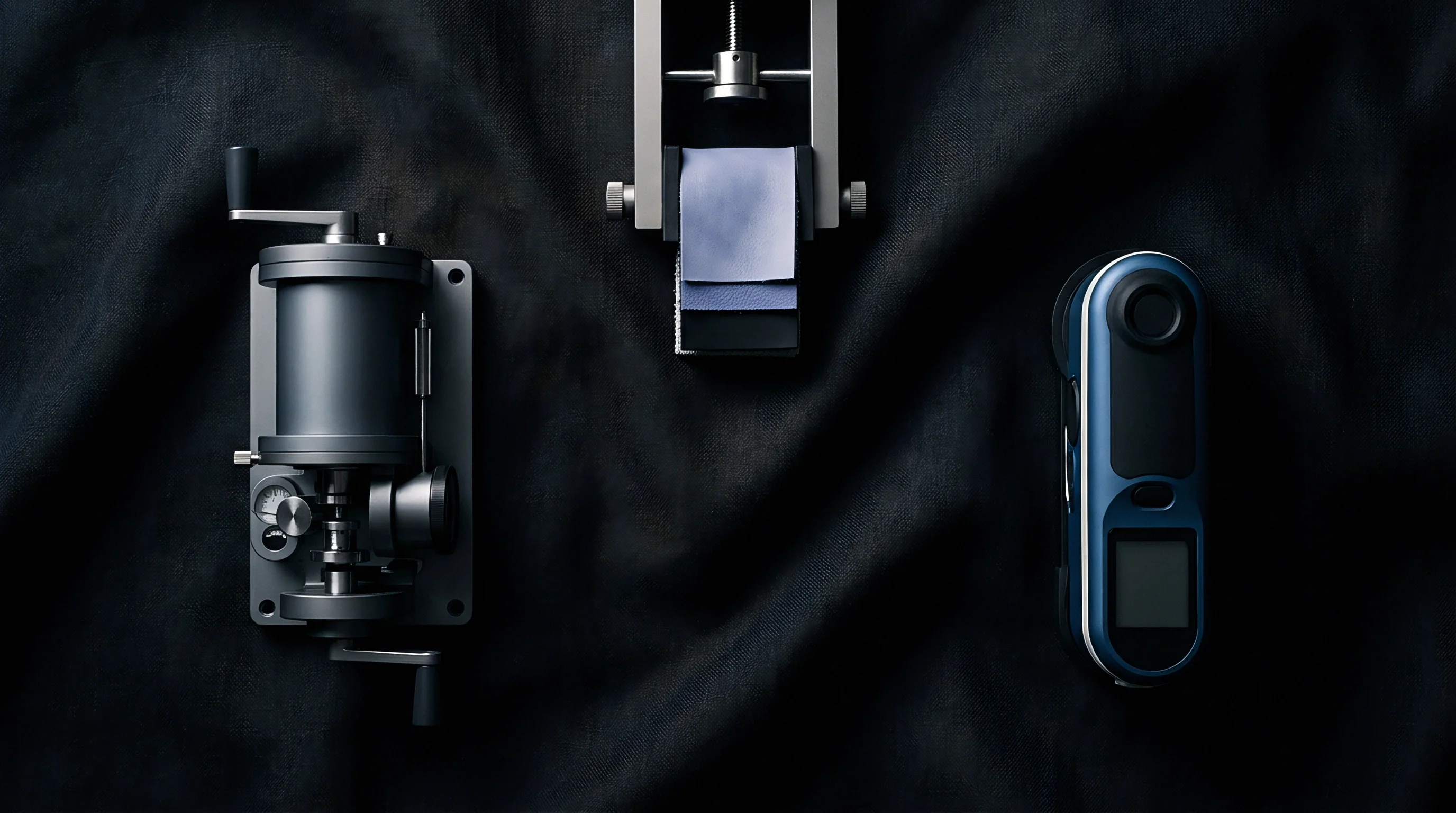
Finding the yarn count of bast fibers requires extracting an exact length under controlled tension. Unlike continuous filaments or combed cotton, flax has an irregular cellular structure, variable bundle lengths, and high flexural stiffness. Under ISO 2060 and ASTM D1907, testing relies on a motorized reeler with a fixed perimeter that winds a set number of turns into a skein or lea.
For long-staple flax, the wheel’s perimeter tolerance must stay within plus or minus 0.2 percent of nominal circumference ~ usually set to 1.000 metre or 1.500 yards. Calibration errors compound fast: a perimeter deviation of just 1 millimetre on a 1 metre wheel introduces a 0.1 percent mass error before weighing even begins.
Wrapping tension directly affects the measured length of a flax specimen. Too little tension leaves residual micro-kinks and crimp in the bundle, undercounting the length drawn per turn. Too much pulls the yarn past its yield point, stretching it permanently and artificially lowering mass per unit length.
Standard procedure sets the pretensioning force for flax yarn at 0.5 cN per tex, within plus or minus 0.1 cN per tex. On fine wet-spun linen, this keeps the wrap taut without slipping ultimate fibers within the strand structure.
Because linear density directly affects loom performance, wrapping speeds must stay steady while preparing specimens. Motorized reelers running between 100 and 300 revolutions per minute avoid the acceleration surges that distort tension halfway through a skein. Direct-drive motors equipped with electronic revolution counters ensure precise cutoffs, preventing fractional turns from altering test length.
Manual reeling cannot maintain uniform speed or tension, making hand-wound skeins useless for laboratory testing or commercial arbitration.
Package preparation requires stripping off outer layers before taking samples. Surface yarn on bobbins, cones, or cops is routinely compromised by air exposure, handling, and uneven winding tension from the spinning frame builder. Discarding the outer 100 metres from each package exposes stable material.
Capturing lot variation ~ the commercial CV percentage of yarn count ~ requires individual skeins from at least ten randomly chosen packages per spinning lot.
Flax yarn structural anomalies create distinct wrapping challenges during laboratory sampling. Mechanical failure modes that alter skein length precision during wrapping include:
- Yarn Snagging happens when slubs catch in package guide eyes, spiking tension and stretching yarn as the skein forms.
- Skein Overlapping occurs when traversing guides fail to spread yarn across the reel face, creating a build-up that alters effective wheel circumference.
- Tension Fluctuation shows up when off-winding drag changes from package nose to base, shifting the length yielded per revolution.
- Sliver Sloughing affects low-twist dry-spun tow yarns, where weak cohesion allows fibers to slip under normal tension settings.
Sample lengths depend on the yarn system and fiber grade. Standard skeins for fine wet-spun linen are usually 100 metres or 120 yards, giving enough mass for accurate weighing while keeping winding time reasonable. For heavy dry-spun tow yarns over 200 tex, shorter skeins of 10 or 50 metres prevent overloading micro-balances.
Whatever length is chosen must yield at least 1.000 gram of yarn so that a balance precise to 0.001 gram gives four significant figures.
Packages arriving at the lab contain varying amounts of moisture picked up in transit or storage. Reeling unconditioned yarn causes mass errors as the fiber gains or loses moisture during testing. Standard procedure requires letting packages acclimate in the laboratory atmosphere before unwinding so outer layers reach thermal and hygrometric balance.
Short of equilibrium, dimensions shift as yarn swells or dries during test runs.
Ambient humidity fluctuations alter the physical length of unconditioned flax yarn as it moves across the mechanical reel.
Regain
Flax is a highly hygroscopic fiber, consisting of crystalline cellulose held within a matrix of hemicellulose, pectin, and lignin. Water enters the amorphous regions of the cell wall and binds to available hydroxyl groups, driving radial and longitudinal swelling. Because specimen mass shifts directly with ambient temperature and humidity, measuring linear density without strict environmental controls produces arbitrary figures unfit for commercial contracts or fabric calculations.
ISO 139 defines standard conditioning requirements for flax yarn. The baseline atmosphere requires a temperature of 20.0°C plus or minus 2.0°C and relative humidity of 65.0 percent plus or minus 4.0 percent, though tropical standards allow 27.0°C plus or minus 2.0°C at 65.0 percent relative humidity. Equilibrium is reached when consecutive weighings at least 2 hours apart show less than a 0.1 percent change in mass.
Because sorption hysteresis causes flax to equalize faster when approaching equilibrium from a dry state rather than a wet one, high-precision referee testing requires pre-conditioning samples in dry air below 10 percent relative humidity.
Drying samples to an absolute dry state isolates pure fiber mass from moisture content. ISO 6741-1 and ISO 2060 Method C specify ventilated oven drying at 105.0°C plus or minus 3.0°C until all bound and free water evaporates. To avoid instant moisture regain during weighing, hot specimens are held inside an integrated oven balance or transferred to airtight weighing bottles.
Because convective air currents inside the oven exert buoyant forces on balance pans, forced airflow must be shut off during reading, or samples must cool for 30 minutes in a glass desiccator over active silica gel before taking their mass.
Official commercial moisture regain allowances reconcile oven-dry fiber weight with commercial billing weights. Since conditioning to true moisture equilibrium can take 24 hours, trade agreements apply fixed regain percentages directly to dry mass calculations. Standard values exist for specific flax product classes:
- Pre-condition samples in a low-humidity chamber at 50°C for 4 hours to erase sorption hysteresis memory.
- Move pre-conditioned specimens into the standard atmosphere of 20°C and 65% relative humidity for at least 24 hours.
- Weigh conditioned skeins on a calibrated analytical balance with 0.0001 grams resolution to record conditioned mass.
- Place weigh boats containing skeins into a ventilated drying oven set to 105°C for 3 hours until constant mass is attained.
- Calculate oven-dry mass and apply official commercial regain factors to determine true commercial yarn linear density.
Conditioned mass measured at 20°C and 65% relative humidity yields a standard commercial regain baseline of 12.0% for wet-spun flax yarns.
Commercial mass is calculated by applying the designated regain percentage to the dry sample mass, accounting for any finishes, sizes, or waxes removed during solvent extraction. Wet-spun linen yarns use an official commercial regain allowance of 12.0 percent. Dry-spun flax and tow yarns use 13.0 percent because they retain more pectin and non-cellulosic impurities.
Bleached or dyed yarns are assigned a lower rate of 12.5 percent, as chemical processing removes much of the hydrophilic material.
Differentiating dry mass, conditioned mass, and commercial mass prevents costly pricing mistakes in yarn purchasing. Dry mass is zero-moisture weight after oven desiccation. Conditioned mass is physical weight at equilibrium under standard lab conditions.
Commercial mass is the contractual figure calculated by multiplying dry mass by one plus the official regain rate divided by one hundred. Landed costs rely on commercial mass, allowing suppliers to bill based on agreed regain standards rather than dockside ambient weights.
Due to sorption hysteresis, yarn brought to equilibrium from a wet state retains about 1.5 percent more moisture than yarn conditioned from a dry state under identical room conditions. Pre-conditioning removes this history by bringing moisture content below 5 percent prior to final lab exposure. Skipping pre-conditioning on freshly boiled or wet-processed samples can cause count errors exceeding two full Metric Count units.
Moisture uptake in linen follows a distinct sorption curve controlled by the polymer chemistry of the cell wall.

Conversion
Yarn linear density expresses mass per unit length or length per unit mass. Evaluating flax yarn requires working across both direct systems, like Tex and Decitex, and indirect systems, like Metric Count (Nm) and English Lea (NeL). Direct systems give mass for a fixed length, meaning higher numbers mark thicker yarns.
Indirect systems give length for a fixed mass, so higher numbers indicate finer yarns. Confusing the two distorts loom setup, cover factor targets, and finished fabric weight calculations.
Tex measures linear density in grams per 1,000 metres, while decitex (dtex) represents grams per 10,000 metres; Tex is the standard SI metric unit in modern testing. Metric Count (Nm) indicates how many metres of yarn weigh one gram. English Lea (NeL), traditional in British and North American linen trading, counts the number of 300-yard hanks in one pound.
Converting between these systems relies on exact mathematical formulas derived from mass and length equivalencies.
| From System | To Tex (g/km) | To Metric Count (Nm) | To English Lea (NeL) |
|---|---|---|---|
| Tex (g/km) | 1.000 | 1000 / Tex | 1653.5 / Tex |
| Decitex (dtex) | dtex / 10 | 10000 / dtex | 16535 / dtex |
| Metric Count (Nm) | 1000 / Nm | 1.000 | 1.6535 Nm |
| English Lea (NeL) | 1653.5 / NeL | NeL / 1.6535 | 1.000 |
Calculations across systems require careful handling of rounding precision. Converting Nm 26 wet-spun linen to Tex gives 1000 divided by 26, or 38.46 Tex (384.6 dtex). Converting that same Nm 26 yarn to English Lea requires multiplying 26 by 1.6535, giving 42.99 NeL (typically called 43 Lea).
Indirect systems are non-linear: shifting from 10 Lea to 15 Lea changes linear density by 55.1 Tex, whereas shifting from 50 Lea to 55 Lea alters linear density by only 3.0 Tex.
ISO 2060 specifies Method C for commercial mass calculation, establishing complete desiccation as the mandatory baseline prior to applying official regain factors.
Twisting shortens the yarn strand, altering measured linear density compared to unspun fiber bundles. Helical twisting pulls fibers around the yarn axis, creating twist contraction that grows with higher twist multipliers (turns per metre divided by the square root of Metric Count). Coarse flax yarns with high twist can shrink up to 4.0 percent in length during spinning.
Reports must state whether linear density reflects as-spun yarn ~ with twist contraction included ~ or untwisted fiber bundles.
Extracting short yarn samples from greige or finished fabric to measure linear density requires correcting for crimp under ISO 7211-5. Woven yarns interlace over and under orthogonal threads, gaining a wavy shape that makes extracted strands measure shorter than their actual length. Technologists apply a standard straightening force ~ 0.5 cN per tex plus or minus 0.1 cN per tex for flax ~ to un-crimp the strand without pulling the fibers.
Failing to remove weave crimp artificially inflates linear density, leading to errors during fabric reverse-engineering.
Twist contraction can alter the delivered metric count during automated reel wrapping if tension is uncalibrated.
Verifying linear density requires clear testing protocols to validate incoming shipments against sales specifications:
- Sampling Frequency Determination requires selecting ten distinct yarn packages per pallet to achieve a statistically valid representation of batch variance.
- Environmental Stabilization Verification checks that ambient laboratory conditions hold 20°C and 65% relative humidity for 24 hours prior to unwinding.
- Tension Calibration Check validates that reeler tension meters record precisely 0.5 cN per tex across all winding positions.
- Oven Desiccation Control confirms that drying oven temperatures remain clamped at 105°C until consecutive weighings show mass stability.
Consider a lab test of a nominal 39 Tex (Nm 26 / 43 Lea) wet-spun 100% flax yarn batch. Ten 100-metre skeins reeled under a standard pretension of 19.5 cN (0.5 cN/tex 39 tex) yield a total conditioned mass of 39.420 grams at 20°C and 65 percent relative humidity. This gives a conditioned linear density of 39.42 Tex (Nm 25.37).
Drying the ten skeins in a ventilated oven at 105°C to constant mass leaves 34.885 grams, giving an oven-dry linear density of 34.885 Tex.
Applying the standard commercial moisture regain allowance of 12.0 percent for wet-spun flax yields the official commercial mass and commercial linear density:
Commercial Linear Density = Oven Dry Tex (1 + (Commercial Regain / 100))
Commercial Linear Density = 34.885 (1 + (12.0 / 100)) = 34.885 1.120 = 39.071 Tex
Dividing 1000 by 39.071 yields a commercial Metric Count of Nm 25.59. Multiplying 25.59 by 1.6535 gives an English Lea value of 42.31 NeL. Although the raw conditioned yarn initially appeared heavy at 39.42 Tex, applying the commercial regain adjustment confirms the shipment was actually within 0.18 percent of the nominal 39.00 Tex target.
| Test Parameter | As-Received (Unconditioned) | Lab Conditioned (ISO 139) | Oven-Dry State (105°C) | Commercial Mass Basis (12.0% Regain) |
|---|---|---|---|---|
| Total Mass (10 skeins) | 40.150 g | 39.420 g | 34.885 g | 39.071 g |
| Moisture Content (%) | 13.11 % | 11.50 % | 0.00 % | N/A (Standard Allowance) |
| Linear Density (Tex) | 40.15 Tex | 39.42 Tex | 34.89 Tex | 39.07 Tex |
| Metric Count (Nm) | Nm 24.91 | Nm 25.37 | Nm 28.66 | Nm 25.59 |
| English Lea (NeL) | 41.19 Lea | 41.95 Lea | 47.39 Lea | 42.31 Lea |
| Methods Note: Skein length = 1,000 m total (10 x 100 m). Standard commercial regain applied according to ISO 6741-1. | ||||
Linear density errors compound across downstream warp preparation, causing beam length miscalculations that truncate weaving runs, waste loom setup time, and leave partial warp cuts unsold on cloth beams.

Shed
Fluctuations in linear density dictate high-speed loom efficiency, reed selection, warp tension stability, and fabric weight (GSM). In plain and twill linen weaves, varying yarn thickness shifts how ends and picks pack together. Under Pierce’s cover factor equations adapted for flax, cover factor equals ends per centimetre divided by ten times the square root of Tex.
A 5 percent rise in Tex increases cover factor, closing up the weave and lowering air permeability while pushing cloth weight beyond contract specifications.
Maintaining uniform shed geometry on rapier and air-jet looms requires consistent yarn diameter. Thick places and slubs increase friction in heddle eyes and reed dents, triggering local tension spikes that break warp ends and ruin efficiency. Thin places drop local tensile strength, causing strands to snap under high shed opening stress.
Setting a baseline tension of 0.5 cN per tex reflects standard weaving floors.
Even small variations in linear density disturb shed mechanics, while twist contraction and moisture loss complicate length measurements across production lots.
Variable yarn count creates specific problems on air-jet looms. Weft insertion depends on aerodynamic drag from main and relay nozzles acting on the yarn surface, which scales directly with diameter. Thin pick segments catch less air, delaying arrival and buckling the tip inside the shed.
Thick segments generate excessive drag, causing early arrival and tip rebound that result in short picks or loose filling. Keeping yarn mass CV below 8.0 percent is vital for running air-jet looms reliably above 500 picks per minute.
| Yarn Count CV (%) | Warp Stops per 10^5 Picks | Maximum Achievable Loom Speed (RPM) | Loom Shed Efficiency (%) | GSM Drift Range (%) |
|---|---|---|---|---|
| Below 5.0 % | < 1.2 stops | 650 RPM (Rapier) / 800 RPM (Air-Jet) | 92.5 % | ± 1.5 % |
| 5.0 % to 8.0 % | 1.2 to 2.8 stops | 550 RPM (Rapier) / 650 RPM (Air-Jet) | 87.0 % | ± 3.5 % |
| 8.1 % to 12.0 % | 2.9 to 5.5 stops | 450 RPM (Rapier) / 500 RPM (Air-Jet) | 78.5 % | ± 6.0 % |
| Above 12.0 % | > 5.5 stops | 350 RPM (Rapier) / Unusable (Air-Jet) | 65.0 % | > ± 10.0 % |
Changing yarn lots during active production often requires adjusting reed calculations. Reed count (dents per centimetre) and the denting plan depend on yarn diameter, which for wet-spun flax can be estimated as d = 0.037 sqrt(Tex) in millimetres. Replacing a nominal 42 Tex yarn with a 46 Tex shipment increases diameter from 0.240 mm to 0.251 mm.
That 4.6 percent expansion raises friction inside the dents, requiring a coarser reed or fewer ends per dent to prevent chafing and filamentation as the shed opens.
Coarse yarn count variance expands warp tension fluctuations and accelerates yarn break rates on high-speed rapier looms.
Audit compliance and quality control tracking mandate maintaining standardized laboratory documentation across mill operations. The essential records include:
- Atmospheric Calibration Logs Logged Daily show continuous temperature and humidity charts within laboratory testing spaces.
- Skein Reeler Perimeter Certificates confirm annual metrological verification of reel circumference accuracy to within 0.2 percent.
- Oven Temperature Verification Records document multi-point thermal sensor readings across internal drying chamber zones.
- Analytical Balance Calibration Records trace daily weight check checks against accredited standard reference masses.
Unrecorded linear density variations and raw fiber inconsistency drive yarn count beyond contract limits, causing loom stoppages and fabric weight drift.

Contract
Yarn purchasing contracts set linear density tolerances, sampling procedures, and price adjustments for non-conforming lots. Most commercial agreements allow a tolerance of plus or minus 3.5 percent from nominal count, settling at full price based on calculated commercial mass. Deviations beyond 3.5 percent trigger financial adjustments, while variations past plus or minus 5.0 percent give buyers full rejection rights under ISO 2859-1 single sampling plans.
Commercial invoice settlement depends strictly on commercial mass rather than raw weight recorded at the mill gate.
Landed costs combine commercial mass calculations with shipping weights and customs valuations. The billed net mass equals gross weight minus packaging tare, multiplied by the ratio of (100 + official regain) to (100 + measured moisture percentage). If a shipment arrives at 14.5 percent moisture when official regain is fixed at 12.0 percent, the billable weight drops below scale weight, ensuring buyers do not pay yarn prices for absorbed water.
Accurate linear density testing is essential for beam winding and loom scheduling. Unverified yarn count leads to early beam run-outs, leaving hundreds of metres of weft yarn idling on bobbins and wasting scheduled loom capacity. Calculating beam capacity involves multiplying total warp ends by cut length and commercial Tex, then dividing by one million to get net warp weight per beam.
Precise testing ensures calculated beam weight aligns with physical creel limits within tight tolerances.
Standard contracts include arbitration clauses stating that count disputes are settled strictly by commercial mass determined through ISO 2060 oven-drying tests at an independent certified lab, overriding mill-floor scale readings or shipping manifests.