Determination of Wet Spun Flax Yarn Linear Density and Mechanical Properties
Wet spun flax linear density and mechanical properties depend on strict moisture regain control, hot water pectin drafting, and CRE tensile evaluation.

Skein
Laboratory measurements of linear density in wet spun flax yarns underpin structural fabric design and loom productivity calculations, establishing beam capacity limits. Flax fibers originate from bast bundles bound by natural plant polymers, leaving their cross-sections without the radial symmetry of combed cotton or synthetic filaments. Wet spinning alters this bundle structure by drawing roving through a hot water bath ahead of drafting, producing denser yarn with smoother fiber alignment and higher tenacity than dry-spun yarns.
Getting an accurate mass per unit length requires strict control over unwinding tension, measured lengths, and sample conditioning to prevent commercial disputes and loom stops.
Linear density testing generally follows ISO 2060 or ASTM D1907. Both standards specify reeling a set length of yarn under controlled tension into a skein, conditioning or oven-drying the mass, and expressing the count in Tex, Metric Count (Nm), or English Lea (NeL). For wet spun flax, reel tension must stay at 0.5 cN/tex ± 0.1 cN/tex.
Too much tension stretches the strand before weighing, artificially inflating the Metric Count, while slack winding leaves sagging loops that produce falsely high Tex values. Standard evaluations use a 1.000-meter circumference reel turned 100 times to make a 100-meter test skein, though heavy counts over 100 Tex drop to 50 turns.
Moisture content is the main source of error in count calculations. Official commercial regain allowance for flax is 12.0%, but packages straight from spinning frames or drying ovens range anywhere from 6% to 16% equilibrium. Weighing yarn directly off an unconditioned plant floor distorts the figures.
ISO 2060 offers two paths: bring the yarn to equilibrium in a standard atmosphere of 20°C ± 2°C and 65% ± 4% relative humidity, or dry the samples to an absolute oven-dry mass at 105°C ± 2°C and add the standard commercial regain allowance. Weighing skeins inside conditioned balance enclosures keeps room humidity shifts from skewing the final count.
Standard Unit System Relationships and Mathematical Conversions
Conversions across yarn numbering systems rely on fixed relationships. Tex gives mass in grams per 1,000 meters, Metric Count (Nm) measures length in meters per gram, and English Lea (NeL) counts 300-yard hanks per pound. Standard conversions are:
Tex = 1000 / Nm
Tex = 1653.5 / NeL
Nm = 1.6935 × NeL
A wet spun yarn ordered at Nm 26 translates to 38.46 Tex or 43.00 Lea. In commercial practice, fine wet spun yarns span from Nm 39 (25.6 Tex, 64.5 Lea) up to Nm 80 (12.5 Tex, 135.5 Lea) for lightweight shirting, sheer curtain fabrics, and intricate Jacquard damasks. Coarser yarns run between Nm 10 (100 Tex, 16.9 Lea) and Nm 18 (55.5 Tex, 30.5 Lea), destined mainly for heavy upholstery, duck canvas, and structured garments.
| Metric Count (Nm) | Linear Density (Tex) | English Lea (NeL) | Nominal Mass per 100m Skein (g) | Permissible Tolerance Range (Tex) |
|---|---|---|---|---|
| Nm 10.0 | 100.0 | 16.5 | 10.00 | 97.0 – 103.0 |
| Nm 14.0 | 71.4 | 23.7 | 7.14 | 69.3 – 73.5 |
| Nm 26.0 | 38.5 | 43.0 | 3.85 | 37.3 – 39.7 |
| Nm 39.0 | 25.6 | 64.5 | 2.56 | 24.8 – 26.4 |
| Nm 50.0 | 20.0 | 82.7 | 2.00 | 19.4 – 20.6 |
| Nm 60.0 | 16.7 | 99.2 | 1.67 | 16.2 – 17.2 |
| Nm 80.0 | 12.5 | 132.3 | 1.25 | 12.1 – 12.9 |
| Mass values calculated at standard commercial regain allowance of 12.0%. Tolerances reflect commercial grade A weaving limits of ±3.0% nominal Tex variance. | ||||
Reeling errors in the lab corrupt count figures and carry through into loom setup. Uncontrolled winding tension, package drag, and fluctuating lab humidity produce misreadings that throw off cover factor calculations during warp preparation.
- Unwinding Friction Variation changes tension as yarn strips off the package, pulling elastic zones and creating variable skein lengths.
- Inadequate Conditioning Time leaves package cores dry while outer layers take on room moisture, causing uneven moisture distribution through the sample.
- Reel Perimeter Calibration Drift shifts true reel circumference away from the nominal 1,000 millimeter specification, passing length errors straight into the Tex calculation.
- Balance Calibration Deficits lose precision on light skeins of fine counts like Nm 60 or Nm 80, where a 0.01-gram error alters the calculated count by more than 0.6 Tex.
ISO 2060 mandates standard conditioning at 20°C and 65% relative humidity for 24 hours to stabilize flax moisture regain prior to skein weighing.
Uncorrected moisture variations in count figures trigger immediate disputes when shipments arrive. Supply contracts need clear terms covering test conditions, regain correction formulas, and official moisture allowances. Contracts specifying linear density without citing ISO 2060 atmospheric conditioning or oven-dry adjustments leave buyers paying for water ~ delivering full weight on the balance but losing usable yardage off the bobbin.

Pectin
Wet spinning relies on thermally softening the gums that hold flax stem fibers together. In raw bast fiber, individual elementary filaments ~ 15 to 30 millimeters long and 10 to 30 micrometers across ~ are bound into technical bundles by pectin, hemicellulose, and lignin. Dry spinning leaves these bundles intact, limiting fineness and creating a rough, hairy surface.
Wet spinning bypasses this limitation by passing roving through a 60°C ~ 70°C water bath right before entering the drafting zone of the spinning frame.
Hot water weakens hydrogen bonding in the middle lamella and softens calcium pectate gels inside the bundle structure. As draft is applied between the back and front rollers, elementary fibers and small sub-bundles slide past each other. This reduced friction lets the rollers draw the strand down far thinner than dry processing allows.
Fine wet-spun yarns can reach cross-sections of just 15 to 25 elementary fibers at Nm 80, while dry-spun counts seldom go finer than Nm 18 without severe strength drops.
Once drafted, traveler rotation imparts twist to lock aligned fibers into a helix. But twist is only half the strength equation. As wet yarn builds on bobbins and moves into drying ovens at 70°C to 80°C, surface moisture containing dissolved pectin and hemicellulose migrates toward contact points between fibers.
As this water evaporates, the natural polymers re-solidify into an internal binder, fusing adjacent fibers into a tight, consolidated matrix.
Twist Factor Dynamics and Structural Cohesion
Mechanical performance in wet spun flax comes from both polymer re-solidification and physical twist. Twist levels are set using a twist multiplier ~ either alpha metric (αm) or alpha tex (αtex) ~ to scale turns per meter against count:
Turns per Meter (TPM) = αm × sqrt(Nm)
Turns per Meter (TPM) = αtex × 1000 / sqrt(Tex)
Warp yarns take higher twist to survive repeated abrasion through the shed and reed, operating at multipliers from αm 110 to αm 130 (αtex 34.8 to 41.1). Weft yarns, where flexibility and handle matter more, use lower multipliers from αm 85 to αm 105 (αtex 26.9 to 33.2). Over-twisting forces fibers into steep helical angles relative to the strand axis, inviting shear failure and dropping tensile strength under straight pull.
Low twist leaves fiber ends loose, leading to strand slippage and fuzzing behind the reed.
Drying profiles on the bobbin control yarn stiffness and modulus. Flash-drying at elevated temperatures traps migrating pectin near the outside of the package, forming a rigid skin while leaving inner layers soft and inconsistent in tenacity. Multi-stage drying at moderate heat distributes redeposited pectin evenly through the package, maintaining uniform tensile performance from outer to inner layers.
Proper hot water bath temperatures during drafting allow fiber bundle sliding without stripping essential natural binder adhesive from elementary fiber walls.
Drafting roving through a lukewarm bath leaves bundles too stiff to draw smoothly, causing cross-sectional variations and drafting waves. Constant bath temperature monitoring prevents cold-water drag, which snaps roving ends and creates heavy slubs. Maintaining stable bath conditions and water quality during drafting is mandatory when spinning fine counts.
Strand
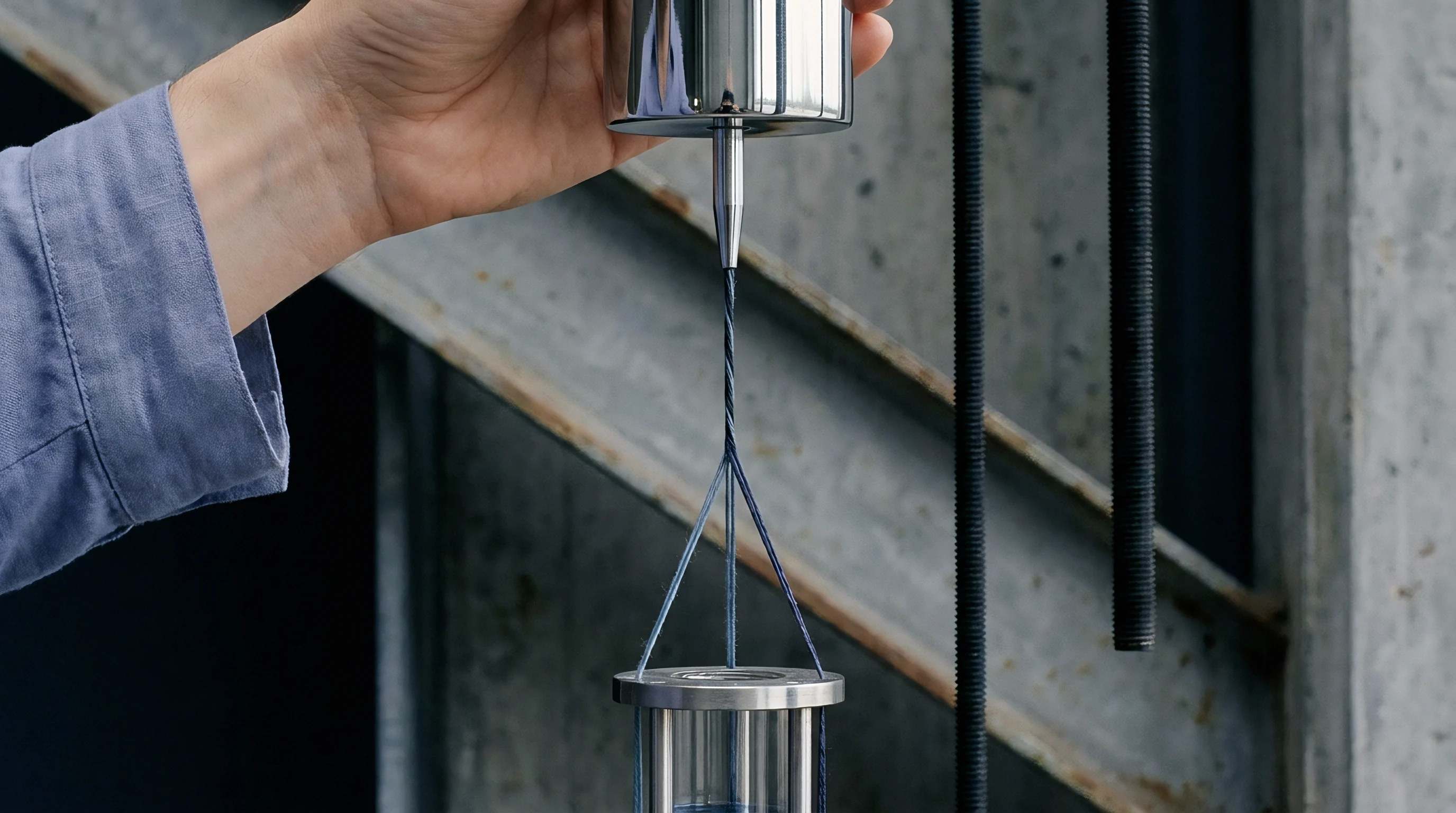
Single-end tensile testing evaluates breaking load under straight axial tension. Constant Rate of Extension (CRE) procedures under ISO 2062 and ASTM D2256 measure breaking force, elongation, and work-to-rupture. Wet spun flax shows a distinct load-elongation curve: a steep initial modulus, almost no plastic deformation, and a sharp brittle break.
This failure curve helps engineers predict weaving behavior, warp stop rates, and finished fabric tear strength.
Standard single-end tests use a 500 millimeter gauge length pulled at 500 millimeters per minute. Because wet spun flax is rigid and low-stretch, gripping parameters are sensitive. Flat-face pneumatic clamps reduce jaw breaks.
Serrated jaws crush the unyielding fibers and cause line breaks at the clamp edge, whereas smooth rubber or polyurethane inserts hold the strand evenly without damaging outer fibers. Any test series with over 10% jaw breaks fails validity under ISO 2062.
Tenacity normalizes breaking force against linear density, expressed in centinewtons per Tex (cN/tex). Wet spun flax achieves single-strand tenacity from 18.0 cN/tex to 35.0 cN/tex depending on fiber origin, retting quality, drafting control, and twist. This equals or beats combed long-staple cotton (22.0 to 28.0 cN/tex) and rivals some industrial synthetics.
Elongation at break stays low, between 1.5% and 3.2%. High tenacity combined with low elongation yields an unyielding yarn that carries high static loads but has little give to absorb shock loading.
| Yarn Count (Nm) | Linear Density (Tex) | Mean Breaking Force (N) | Tenacity (cN/tex) | Elongation at Break (%) | Initial Modulus (cN/tex) |
|---|---|---|---|---|---|
| Nm 10.0 | 100.0 | 22.50 | 22.5 | 2.80 | 620 |
| Nm 14.0 | 71.4 | 16.80 | 23.5 | 2.60 | 680 |
| Nm 26.0 | 38.5 | 9.80 | 25.5 | 2.30 | 750 |
| Nm 39.0 | 25.6 | 7.00 | 27.3 | 2.10 | 820 |
| Nm 50.0 | 20.0 | 5.70 | 28.5 | 1.95 | 890 |
| Nm 60.0 | 16.7 | 4.90 | 29.3 | 1.85 | 940 |
| Nm 80.0 | 12.5 | 3.80 | 30.4 | 1.70 | 1020 |
Getting repeatable ISO 2062 tensile readings requires careful sample handling, tight lab climate control, and calibrated equipment.
- Mount the package on a creel inline with the tester thread guide to eliminate unwinding drag.
- Thread the strand through the top pneumatic jaw, centering it on the rubber insert faces.
- Apply 0.5 cN/tex ± 0.1 cN/tex pre-tension to pull out slack before clamping the bottom jaw at a 500 millimeter gauge distance.
- Run the crosshead at 500 millimeters per minute until the strand snaps.
- Record breaking force in centinewtons and elongation percentage, checking that failure occurred in the gauge length away from the jaws.
- Test 50 individual strands per package to determine mean strength and tenacity coefficient of variation.
Tenacity testing of wet spun flax at a 500 millimeter gauge length yields single-strand breaking forces between 18.5 cN/tex and 24.0 cN/tex under 12% moisture regain.
Dry conditions reduce flax elongation. Testing yarn without a 24-hour conditioning cycle can drop elongation below 1.2%, causing premature brittle failure. Tenacity falls by roughly 1.8 cN/tex when sample moisture drops under 9%.
Moisture plasticizes the cellulose matrix, enabling chain movement so individual elementary fibers distribute load before breaking. Skipping lab climate control often leads to false rejections of compliant yarn.
Fault
Mass variation along the strand affects fabric appearance and creates thin points susceptible to breakage. These irregularities come from varied bast bundle lengths, partial retting, drafting waves, and uneven pectin migration during bobbin drying. Unlike cotton or synthetics, which show narrow Gaussian mass profiles, wet spun flax displays a wide distribution.
Evaluating mass CV (CVm%) and counting discrete defects requires capacitive or optical testers set up specifically for bast fibers.
Capacitive sensors track capacitance changes as yarn runs through a slot, converting capacitance values to linear mass. Because flax absorbs moisture readily, local moisture spikes can skew capacitive data. Optical sensors supplement capacitive measurements by measuring external diameter, distinguishing physical cross-sectional shifts from moisture fluctuations.
Standard testing runs at 400 meters per minute over a 1,000-meter sample per bobbin.
What Drives Mechanical Breakage in Fine Bast Yarns?
Tensile breakdown in wet spun flax follows weak-link Weibull statistics. Strands break at their thin points, not at average linear density. A thin place down -50% in mass holds about half the load-bearing elementary fibers of a nominal section.
Under shedding tension, stress concentrates at these thin spots, exceeding local strength long before average strand tenacity is reached.
Mass CV (CVm%) in wet spun flax ranges from 14.0% on fine combed counts (Nm 60 to Nm 80) up to 22.0% on tow-heavy coarse yarns (Nm 10 to Nm 14). Faults are categorized by their deviation from nominal cross-sectional mass:
- Thin Places (-50%) are localized drops in mass exceeding 50% of nominal cross-section, serving as prime failure sites under tension peaks during weaving.
- Thick Places (+50%) consist of un-drafted bundle fragments that increase diameter and catch in reed dents.
- Neps (+200%) are small, tight knots of tangled fibers or residual bark that cause surface specks and reed friction.
- Slub Defect Structures are long thick sections over +100% mass extending beyond 10 millimeters, which obstruct the shed opening during high-speed insertion.
High defect counts quickly reduce loom efficiency. When thick places or slubs try to clear narrow reed dents or heddle eyes, friction strips surface fibers into small bunches. These fuzz-balls build up and block the eye, snapping the warp end.
Meanwhile, thin places break under shedding stress. High-speed looms require strict tolerances on thin place counts per 100,000 meters.
Capacitive mass readings do not always correlate directly with loom breaks. Standard capacitive units calculate mass based on uniform material density, but raw flax bundles contain mixed ratios of crystalline cellulose, amorphous material, and hollow lumen spaces. A 40% drop in optical diameter might not mean a 40% drop in tensile strength if the remaining core contains well-aligned, strong fibers.
Capacitive CVm numbers cannot predict warp performance without single-end tensile data mapping the lower Weibull tail, which is why mills evaluate both defect counts and tensile minimums when testing incoming lots.

Loom
Shedding tension places heavy stress on wet spun flax warps. In dense setts, loom efficiency drops because low elasticity prevents the warp from cushioning tension surges. Peak warp tension on rapier looms running 450 to 600 picks per minute climbs to 35 ~ 50 cN per end during shed opening and beat-up, compared with 15 ~ 25 cN per end for cotton.
Uneven warp preparation amplifies these tension spikes. Creels need consistent tension across all ends so slack yarns do not hang in the shed and tight ends do not snap at beat-up. Sizing is essential for high-speed weaving because it binds surface fibers.
Unsized flax exhibits surface hairiness from protruding fiber ends, which interlock between adjacent warp ends during shedding. Interlocked ends distort the shed opening, causing insertion errors or missed picks.
Sizing mixes for wet spun flax typically combine modified starches, polyvinyl alcohol (PVA), and wax lubricants. The size film should coat the outer surface without soaking deep into the core, keeping the yarn flexible. Over-sizing turns the strand rigid, causing flexural fatigue breaks inside heddle eyes, while under-sizing lets surface fibrils work loose into fuzz-balls behind the reed.
Target size add-on ranges from 8.0% to 12.0% dry pick-up, depending on count and sett.
| Yarn Count (Nm) | Weave Structure | Warp Sett (ends/cm) | Weft Sett (picks/cm) | Cover Factor (K) | Loom Speed (PPM) | Warp Stops / 100k Picks | Shed Efficiency (%) |
|---|---|---|---|---|---|---|---|
| Nm 14.0 | Plain 1/1 | 18.0 | 16.0 | 4.81 | 550 | 1.2 | 91.5 |
| Nm 26.0 | Plain 1/1 | 24.0 | 22.0 | 4.71 | 500 | 1.8 | 88.0 |
| Nm 26.0 | Twill 2/2 | 30.0 | 26.0 | 5.88 | 480 | 2.1 | 86.5 |
| Nm 39.0 | Plain 1/1 | 28.0 | 26.0 | 4.48 | 450 | 2.6 | 84.0 |
| Nm 50.0 | Damask Jacquard | 36.0 | 32.0 | 5.09 | 400 | 3.4 | 80.5 |
| Nm 80.0 | Plain 1/1 | 42.0 | 38.0 | 4.70 | 350 | 4.8 | 74.0 |
Fabric cover factor (K) defines practical density limits for warp and weft constructions. Using metric units, cover factor is calculated from thread sett and Metric Count:
K = Sett (threads/cm) / sqrt(Nm)
When combined warp and weft cover factors exceed 9.5 to 10.0 in plain weave linen, beat-up resistance increases rapidly. Inelastic flax yarns refuse to flatten over one another at crossover points. Forcing high pick densities into dense warps leads to warp grouping, reed lines, beat-up bars, and heavy strain on loom drives.
Optimizing loom performance on wet spun flax requires tuning drop-wire settings, shedding timing, and sizing parameters.
- Asymmetric Shed Geometry drops the back-rest roller to equalize tension between top and bottom shed lines, reducing friction as the shed opens.
- Late Shedding Timing delays harness frame crossover relative to beat-up, locking the pick before peak tension hits the warp.
- Viscosity-Controlled Size Baths limit size penetration to roughly one-third of the yarn radius, preserving flexibility while anchoring surface fibrils.
- Air-Jet Insertion Nozzle Pressure Optimization prevents strand untwisting or fibril stripping during high-velocity pneumatic transport.
Warp yarn sizing coat weight must coat the outer fiber envelope without penetrating the inner core to maintain beam flexural compliance.
High warp break rates on fine linen qualities can stem from sizing inconsistencies and inadequate weave-room humidity, or from improper drop-wire settings and aggressive beat-up angles. Resolving these quality disputes requires testing incoming yarn before sizing to establish objective mechanical baselines and separate yarn faults from weaving parameters.

Tariff
Commercial contracts for wet spun flax set physical tolerances and financial terms, where count variations directly affect operating costs. Buyers contract on nominal linear density but pay against delivered net mass, yardage yield, and lab test data. Vague purchase terms allow marginal yarn lots to pass initial checks while causing frequent stops during weaving.
A thorough wet spun flax contract sets clear numerical limits across six parameters: nominal linear density tolerance, minimum tenacity, tenacity CV%, mass CVm%, maximum discrete faults per 100,000 meters, and certified moisture regain at weighing. Grade A weaving yarns require linear density to fall within ±3.0% of nominal Tex. A shipment of Nm 26 (38.46 Tex) must measure between 37.31 Tex and 39.61 Tex under standard ISO 2060 conditions.
Strength specifications need statistical limits alongside average values. A contract requiring a mean tenacity of 24.0 cN/tex remains vulnerable if tenacity CV exceeds 15.0%, because high variability leaves weak ends that fail during warping and weaving. Technical procurement rules should set a absolute strength floor (such as no break below 16.0 cN/tex in 100 tests) along with a maximum tenacity CV of 10.5%.
Loom-hour cost analysis shows that paying a 12% premium for higher-regularity, low-fault yarn lowers net manufacturing costs per meter of finished fabric. When weaving fine Nm 50 flax on rapier looms operating at $28.00 per loom hour, yarn averaging 4.5 warp stops per 100,000 picks reduces efficiency to 78%, producing 9.3 meters per hour. Switching to low-fault yarn averaging 1.8 stops per 100,000 picks lifts efficiency to 88% and output to 10.5 meters per hour.
This speed gain reduces weaving overhead and direct labor from $3.01 to $2.66 per meter, absorbing the initial yarn premium while cutting cloth mending costs.
Incoming quality audits sample bobbins from 5% of delivered cartons per lot. Samples undergo 24-hour conditioning before testing skein count, CRE tenacity, mass CVm%, and moisture regain. If lab results miss contracted tolerances, terms enforce price adjustments or full rejection.
Standardized laboratory testing makes raw flax procurement predictable and verifiable.