Predicting Dynamic Hydrothermal Pectin Dissolution Rates to Prevent High Draft Triangle Rupture
Hydrothermal pectin dissolution rates must match drafting speed and bath temperature to prevent core rigidity or slippage in the wet spinning draft triangle.
Triangle
In wet line flax spinning, the draft triangle forms between the front drafting roller nip and the twist insertion point, converting untwisted sliver into yarn. Ultimate flax fibres are held together in the stem by a middle lamella of complex pectins, hemicelluloses, and structural proteins. Unlike dry spinning for cotton or wool, wet spinning uses hydrothermal softening in a hot water bath ahead of the drafting zone.
Water between 60°C and 85°C penetrates the twisted roving, hydrolyzing the insoluble calcium pectate gel that binds adjacent fibres into bundles. Softening this pectin matrix lowers inter-fibre friction and shear strength so individual ultimate fibres ~ typically 10 to 40 millimetres long and 15 to 35 micrometres in diameter ~ slide past each other under the draft ratio.
If hydrothermal softening falls short, drafting force spikes quickly. When roving reaches the front roller nip with a partially ungelled pectin core, inter-fibre cohesion stays higher than the bundle’s tensile strength. The front rollers pull lead fibres forward while trailing segments remain locked behind the nip line by unsoftened pectin.
The bundle snaps directly inside the draft triangle ~ a failure known on the floor as draft triangle rupture. This breaks yarn continuity immediately, stopping the frame or introducing heavy thick-and-thin defects that ruin yarn evenness (Uster CV%).
Trough temperature determines whether the fibre bundle slides cleanly or snaps under mechanical tension.
Dynamic testing on long-staple European flax (Nm 40 to Nm 100) shows that draft triangle stability depends on balancing pectin shear degradation against roving transit velocity through the bath. Roving twist holds the strand together during transport from the creel, but excessive twist blocks water from reaching the core. If the twist multiplier exceeds an alpha-metric factor of 45, hot water cannot reach the innermost pectin lamellae during brief immersion windows (typically 1.2 to 3.5 seconds, depending on delivery speed and flume length).
The outer fibres slide while the inner core stays stiff, generating internal shear that tears the draft triangle apart at high draft ratios (drafts between 12 and 22).
Dissolving too much pectin causes a different failure mode. Above 85°C, or when slow delivery prolongs bath residence time, middle lamella pectin solubilizes completely. Fibre bundles lose structural integrity before reaching the drafting rollers.
Friction drops below cohesion, collapsing the slip limit. Without residual pectin viscosity to regulate fibre movement, drafting waves take over: loose fibre clusters float uncontrolled through the nip, creating severe count variation and weak points that break during winding.
- Core pectin ungelled rupture occurs when insufficient immersion leaves the center of high-twist roving dry, driving drafting force above bundle tenacity.
- Thermal over-dissolution slippage develops when bath temperatures dissolve over 75 percent of native pectins, stripping inter-fibre friction and causing drafting waves.
- Crosslink calcification resistance happens when high calcium ion concentration in hard trough water hinders calcium pectate chelation, keeping pectin gels rigid at standard temperatures.
- Roller nip squeeze out occurs when excess bath fluid squeezes backward at the back-roller entry, washing out dissolved pectins unevenly and creating friction spikes.
Roving twisted beyond optimal levels creates severe density gradients across its cross-section during thermal wetting. Controlling the draft triangle requires keeping track of water temperature, flume residence duration, water hardness, and roving uniformity. If bath temperature drifts unmanaged, the frame suffers immediate end-breakage spikes, raising waste and dragging down yield per machine hour.

Hydrolysis
Pectin solubilization during wet spinning is a hydrothermal hydrolysis process governed by temperature, pH, ionic strength, and middle lamella composition. Flax pectin consists mainly of homogalacturonan (HG) regions interspersed with rhamnogalacturonan-I (RG-I) domains. HG regions are made of alpha-1,4-linked D-galacturonic acid units that are partially methyl-esterified, and this degree of esterification (DE) sets the thermal stability of the network.
High-ester pectins (DE above 50 percent) gel under acidic conditions via hydrogen bonding and hydrophobic interactions, while low-ester pectins (DE below 50 percent) crosslink with divalent calcium ions (Ca²⁺) to build insoluble egg-box networks in the cell wall.
Hydrothermal dissolution in the trough follows two main kinetic pathways: beta-eliminative cleavage of the galacturonan backbone, and de-esterification paired with calcium ion leaching. Above 70°C, heat weakens non-covalent hydrophobic bonds while natural organic acids in the flax lower local bath pH to 5.2 ~ 6.2, starting glycosidic bond cleavage. The pectin solubilization rate constant (kd, in s⁻¹) fits Arrhenius kinetics up to 85°C. Activation energy (Ea) for middle lamella pectin dissolution in unretted or dew-retted line flax spans 45 to 62 kJ/mol, depending on retting severity and initial calcium content.
At a bath temperature of 75°C and pH 6.0, middle lamella pectin retains a dynamic shear modulus of 120 Pa after 2.0 seconds of immersion.
Predicting dynamic pectin dissolution during frame operation requires modeling bath transit time (tres), calculated as effective trough immersion length (L, in metres) divided by roving feed speed (vfeed, in metres per minute). Water diffuses radially into the roving as it moves through the flume, following Fickian diffusion rules. At 75°C, the effective diffusion coefficient (Deff) of water into twisted flax roving sits between 1.2 × 10⁻⁹ m2/s and 3.5 × 10⁻⁹ m2/s.
If the diffusion time constant (τ = r2 / Deff, where r is roving radius) exceeds tres, the strand core remains unsoftened, driving draft triangle forces up.
| Bath Temp (°C) | Water Hardness (ppm Ca²⁺) | Bath pH | Rate Constant kd (s-1) | Pectin Cohesion Half-Life (s) | Draft Triangle Status |
|---|---|---|---|---|---|
| 60 | 150 | 6.8 | 0.08 | 8.66 | High Rupture Risk (Stiff Core) |
| 70 | 100 | 6.2 | 0.22 | 3.15 | Marginal Softening (Low Draft Only) |
| 75 | 50 | 5.8 | 0.45 | 1.54 | Optimal Wet Spinning Window |
| 80 | 25 | 5.5 | 0.85 | 0.82 | Optimal High-Speed Window |
| 85 | 10 | 5.2 | 1.65 | 0.42 | Excessive Dissolution (Sliver Slip) |
| 90 | 5 | 4.8 | 2.90 | 0.24 | Severe Drafting Waves & Lapping |
Water hardness directly suppresses dissolution rates. Dissolved calcium ions shift chemical equilibrium toward calcium-pectate salts, reinforcing ionic bridges between cells. In trough water with elevated calcium (above 100 ppm Ca²⁺), the effective rate constant drops by up to 60 percent compared to softened water (below 20 ppm Ca²⁺).
Mills running unsoftened well water face frequent draft triangle breaks unless they raise bath temperatures to levels that risk damaging the cellulosic cell walls.
Inline thermocouples track thermal drop along the trough. Heat loss across an uninsulated 3-metre flume can drop water temperature by 5°C to 8°C between entry and exit, creating uneven dissolution across multi-spindle frames. Spindles near reheating inlets get 78°C water, while end-of-line positions drop to 70°C. That temperature gap alters pectin viscosity enough to cause tension variations across identical spindles on one frame.
The transition point where calcium-chelated homogalacturonan chains uncoil under hydrodynamic flow and longitudinal shear in the drafting zone depends on this underlying chemical kinetics.


Assay
Predicting hydrothermal pectin dissolution rates requires lab assay protocols for incoming raw flax and dressed roving before batches reach the spinning floor. Standard physical grading ~ relying on hand feel, staple length, and hackling yield ~ misses how middle lamella pectin reacts to wet heat. Two lots of scutched flax with the same metric fineness (Nm 2000 by ISO 2370) and bundle tenacity (35 cN/tex) can behave completely differently in the trough if their degree of esterification or mineral content differs.
Measuring galacturonic acid (GalA) content gives the baseline for total pectin load in the bundle. The standard spectrophotometric assay uses enzymatic or acid hydrolysis followed by reaction with m-hydroxydiphenyl at 520 nm. Raw flax bast fibre usually carries 3.5 to 6.0 percent pectin by weight.
Over-retted flax can drop as low as 1.2 percent residual pectin, leaving it fragile and prone to sliver slip. Under-retted flax reaches up to 8.0 percent, needing higher thermal input before it will draft.
According to ISO 2062 test conditions adapted for wet bundles, fibre assemblies pre-treated in demineralized water at 75°C for 2.0 seconds must exhibit a wet tenacity between 18 and 24 cN/tex to prevent draft triangle failure.
Testing bundles under ISO 2370 combined with Fourier-transform infrared spectroscopy (FTIR) and comparing the ester carbonyl peak at 1740 cm-1 against the carboxylate peak at 1600 cm-1 gives the degree of esterification directly. A high DE value (above 60 percent) marks ester-rich pectin that softens quickly at lower bath temperatures. A low DE (below 40 percent) points to a calcium-heavy matrix requiring chelating agents like tetrasodium EDTA or citric acid in the trough water to bind calcium ions and speed up dissolution.

How Does Calcium Ion Chelating Alter Dissolution Rates?
Adding organic chelating agents to the bath selectively binds Ca²⁺ ions from the middle lamella, breaking down the egg-box gel structure without needing higher heat. Dosing 0.5 g/L of citric acid into a 70°C bath boosts the dynamic rate constant kd by 140 percent. That lets mills drop the trough temperature from 80°C to 72°C on low-DE flax, saving energy while preventing draft triangle rupture.
Dosing must be controlled carefully: over-chelating strips structural calcium entirely, turning the middle lamella into a slippery gel that causes drafting waves.
- Galacturonic acid spectrophotometry measures total middle lamella pectin mass to check if retting severity aligns with target count requirements.
- FTIR esterification ratio determination calculates the DE value to set baseline trough temperatures and chelation needs.
- Dynamic wet bundle tenacity testing measures force-displacement in roving soaked in heated bath fluid for fixed intervals.
- Atomic absorption spectrophotometry of ash content determines native calcium, magnesium, and potassium concentrations bound in the fibre wall.
Domestic Heilongjiang dew-retted roving often has lower esterification (DE 38 ~ 45 percent) than imported Western European stock (DE 52 ~ 62 percent). China-based mills running mixed lots need to segregate roving batches by chemical assay rather than physical appearance. Feeding low-DE domestic stock into a machine profile set for European high-DE fibre causes immediate draft triangle breaks from incomplete core softening.
High end breakage is sometimes attributed to natural batch variation in raw flax that machine adjustments cannot resolve, but chemical assays allow mills to adjust trough parameters and neutralize batch differences before spinning starts.
Flume
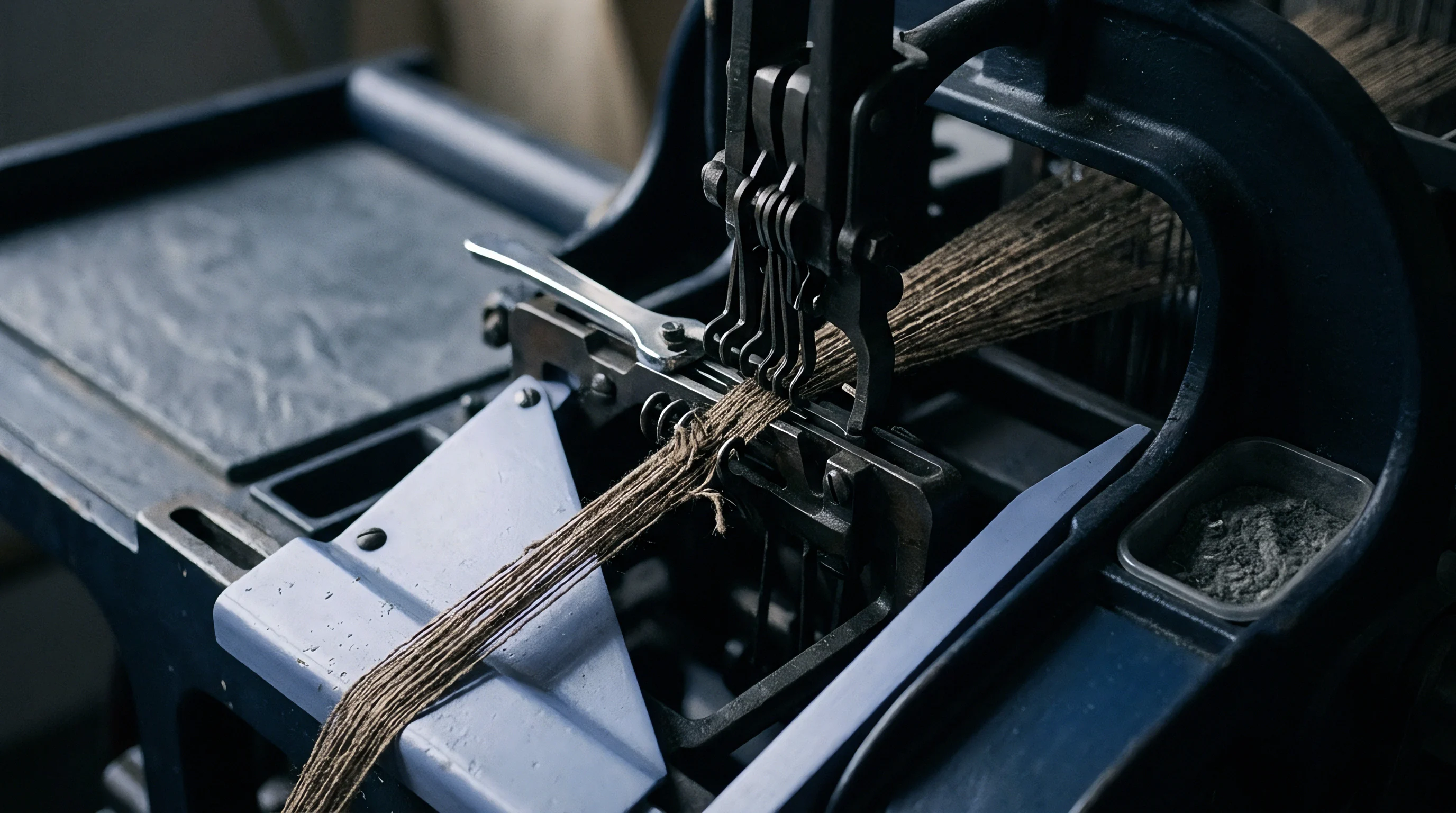
The flume configuration translates the pectin dissolution model directly to the spinning floor. High-speed wet frames run at delivery speeds between 15 and 35 metres per minute, giving roving less than two seconds inside the heated trough. The system has to maintain uniform heat transfer, fresh fluid contact around the strand, and consistent chemical dosing across every spindle position.
Fluid dynamics inside the flume govern how fast heat reaches the roving core. Laminar flow around the moving strand builds a stagnant boundary layer that slows heat and water penetration. Adding micro-turbulators or jet nozzles along the immersion path breaks up this layer, raising the convective mass transfer coefficient by up to 45 percent.
Forced agitation gets hot water into the core of fine roving (Nm 60 to Nm 100) within 1.0 second, preventing dry-core ruptures.
| Yarn Count Target | Roving Linear Density (tex) | Roving Twist (αm) | Trough Temp (°C) | Flume Residence Time (s) | Break Draft Ratio | Main Draft Ratio |
|---|---|---|---|---|---|---|
| Nm 26 (38.4 tex) | 1000 | 32 | 65 ~ 70 | 2.5 ~ 3.0 | 1.12 | 26.0 |
| Nm 40 (25.0 tex) | 650 | 36 | 70 ~ 75 | 2.0 ~ 2.5 | 1.15 | 26.0 |
| Nm 60 (16.6 tex) | 420 | 40 | 75 ~ 78 | 1.5 ~ 2.0 | 1.18 | 25.3 |
| Nm 80 (12.5 tex) | 300 | 42 | 78 ~ 82 | 1.2 ~ 1.5 | 1.20 | 24.0 |
| Nm 100 (10.0 tex) | 220 | 45 | 82 ~ 85 | 1.0 ~ 1.2 | 1.22 | 22.0 |
| Data compiled for long-staple dew-retted European flax (hackling yield > 62%), processed with demineralized water (hardness < 15 ppm Ca²⁺) and 0.2 g/L citric acid dosing. | ||||||
Roller nip pressure and roller gauge must match the state of pectin dissolution. The back roller gauge has to exceed the maximum ultimate fibre length (typically 45 to 55 millimetres) to keep fibres from snapping. When the pectin matrix is properly softened, break draft (1.05 to 1.25) splits the structural gel linkages cleanly before the main drafting zone.
The break draft acts as a mechanical activator, opening weakened pectin bridges so ultimate fibres enter the main draft triangle as a uniform, parallel array.
Flume calibration follows a set procedure to keep results consistent across shifts:
- Flush the bath with demineralized water until conductivity drops below 50 micro-Siemens per centimetre.
- Bring the bath to target temperature using closed-loop steam heat exchangers, checking that temperature stays within plus or minus 0.5°C across all feed points.
- Dose organic acid buffer to hold bath pH at 5.5 to 5.8, neutralizing alkaline residues from earlier washing.
- Set feed and delivery roller speeds to match calculated immersion times for the roving count.
- Inspect the draft triangle under stroboscopic lighting to confirm the apex angle stays sharp and stable without flutter or necking.
Pectin viscosity must match drafting speed, or the finest strand will snap at the nip line.
Outlay
Unpredicted pectin dissolution rates hit mill margins, yarn costs, and fabric profitability directly. On the floor, draft triangle rupture shows up as end breakage. Standard targets for high-quality long-staple line flax run between 8 and 15 breaks per 1,000 spindle-hours.
Miscalculate pectin dissolution ~ through uncalibrated bath temperatures or undetected fibre variation ~ and breakage rates surge to 40 ~ 90 per 1,000 spindle-hours.
Every break adds immediate cost. Delivery rollers keep feeding wet roving into suction units until an operator re-pieces the strand or an automatic stop takes over. That pneumatic waste represents material that has already consumed energy, labor, and chemical processing.
At 60 breaks per 1,000 spindle-hours on an Nm 60 line, pneumatic waste rises by 3.8 percent of total throughput. None of that material can return to line spinning; it gets downgraded to tow spinning or sold off for non-wovens at a 70 percent discount against raw flax cost.
In trials on Nm 50 line yarn, waste penalties reached 0.42 EUR per kilogram once end breakage passed 18 per 1,000 spindle-hours. Labor costs rise right along with break frequency. Operatives tied up re-piecing ends cannot load creels, service spindles, or monitor quality.
When operator limits force a reduction in frame speeds, overall output falls and overhead costs per kilogram go up.
| End Breakage Rate (per 1,000 sp-hr) | Pneumatic Waste (%) | Frame Speed Efficiency (%) | Yarn Cost Surcharge (€/kg) | Landed Yarn Price (Nm 60, €/kg) | Woven Fabric Cost Impact (€/m at 180 g/m²) |
|---|---|---|---|---|---|
| 10 (Baseline) | 1.2 | 96.5 | 0.00 | 18.50 | 3.33 |
| 20 | 2.1 | 94.0 | 0.38 | 18.88 | 3.40 |
| 40 | 3.9 | 88.5 | 1.15 | 19.65 | 3.54 |
| 60 | 5.8 | 81.0 | 2.10 | 20.60 | 3.71 |
| 80 | 8.2 | 72.5 | 3.45 | 21.95 | 3.95 |
Defects that survive the draft triangle without breaking cause ongoing downstream damage. Incomplete dissolution leaves thick slubs of unattenuated fibre clusters, while over-dissolution creates thin weak spots lacking inter-fibre cohesion. When that yarn reaches high-speed warping and weaving (running at 400 to 600 insertions per minute), weak points snap under warp tension.
A single loom stop costs roughly 1.50 to 2.80 EUR in downtime and fabric repair. Off-spec yarn simply moves spinning-room problems into the weave room, triggering customer claims and chargebacks.
Yarn sold under ISO 2060 count testing specifications carries a maximum allowable Uster mass variation (CV%) of 14.5 percent for Nm 60 wet-spun line; exceeding this threshold incurs mandatory commercial rebates of 5 percent to 15 percent of invoice value.
Procurement contracts should build hydrothermal pectin metrics into fibre specifications. Technical buyers need suppliers to provide galacturonic acid assay data, esterification ratings, and target trough temperatures alongside traditional numbers like hackling yield and staple length. Adding pectin kinetics to raw material specifications takes flax purchasing out of empirical trial-and-error and grounds it in measurable data.
Contracts for wet-spun flax roving should require pre-immersed bundle tenacity to stay within a 3.0 cN/tex tolerance band under standard bath conditions (75°C at pH 5.8), shifting financial liability for unretted or chemically resistant fibre back to the primary processor.