Quantifying Dynamic Thermal Elongation and Hysteresis in Synthetic Jacquard Harness Cords under Continuous Cyclic Load
Viscoelastic hysteresis and guide friction cause thermal cord elongation, degrading warp shed geometry during high-speed jacquard weaving.

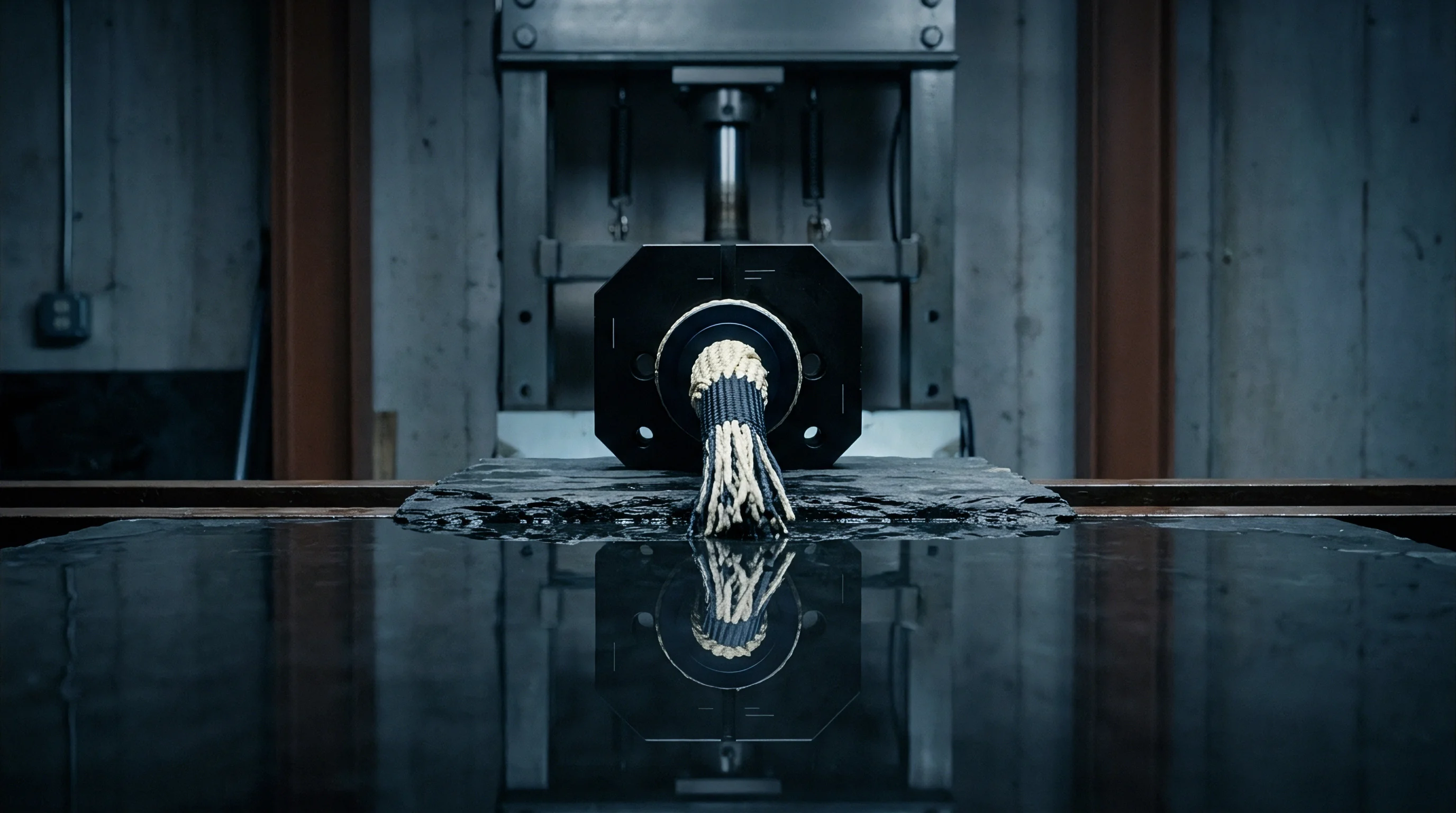
Viscoelasticity
High-density jacquard looms running at 850 picks per minute subject harness cords to periodic tensile loads between 2.5 N and 11.0 N per hook cord. Under these conditions, braided synthetic cords made from polyamphiphile or polyethylene terephthalate cores display viscoelastic behavior, with strain lagging behind applied stress to produce cyclic hysteresis. This mechanical phase shift ~ quantified as tan delta ~ measures the ratio of loss modulus to storage modulus within the polymer matrix.

Phase Lag and Energy Storage in Monofilament Assemblies
Under continuous oscillation, synthetic core fibers respond to sinusoidal forcing through a combination of elastic storage and viscous dissipation. Part of the mechanical work input during shedding strokes returns elastically at shed closure, while the remainder is dissipated internally as heat through inter-filament friction and polymer chain movement. As these chains realign under sustained dynamic motion, the loss tangent rises noticeably during initial operation.
The loss tangent of braided synthetic cords rises as internal filament friction converts sinusoidal mechanical movement into localized dissipation heat.

Loss Modulus Shift across Continuous Shedding Cycles
Continuous cyclic stress degrades the stiffness of the polymer matrix over time. Past 10,000 cycles, internal heat accumulation raises core temperatures enough to soften amorphous polymer regions, driving down storage modulus and increasing phase lag. This loss of stiffness alters tension transmission between the jacquard head and warp ends, introducing subtle micro-variations in shed height over long production shifts.
Neglecting internal energy dissipation under dynamic cyclic loads leads to unpredicted shed opening losses, premature cord fatigue, and higher rates of unrecoverable pattern defects in dense, high-speed weaving runs.


Dissipation
Friction heat in jacquard harness assemblies builds up primarily at mechanical contact interfaces. The main point of contact is the comber board, where thousands of individual cords pass through tightly packed vulcanite or ceramic bushings at angles from 0 to 25 degrees. Running at 900 picks per minute, the surface velocity across these bushings reaches 2.4 meters per second.
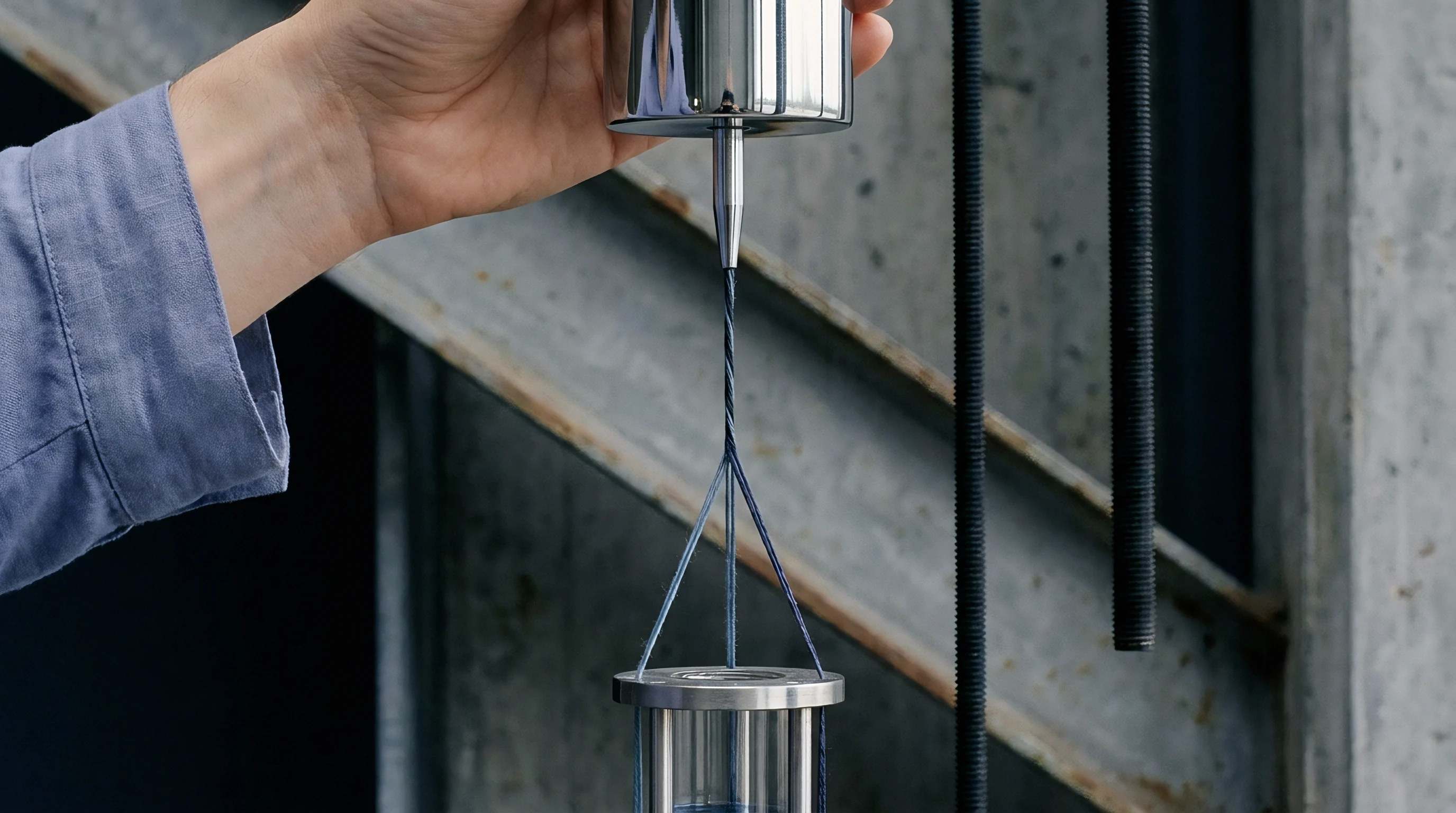
Thermal Accumulation at Comber Board Perforations
Guidance plates situated directly above the warp lines act as primary points of friction. In high-density gantry arrangements, stagnant air pockets between tightly bundled harness cords limit convective cooling. Thermal imaging shows that temperatures inside the core of the comber board can exceed ambient air by 28 degrees C to 42 degrees C, creating thermal gradients that degrade surface coatings over extended multi-day production runs.
At an operating frequency of 850 picks per minute and a ambient shed temperature of 21 degrees C, dense comber board core zones achieve steady-state thermal equilibrium at 62 degrees C.
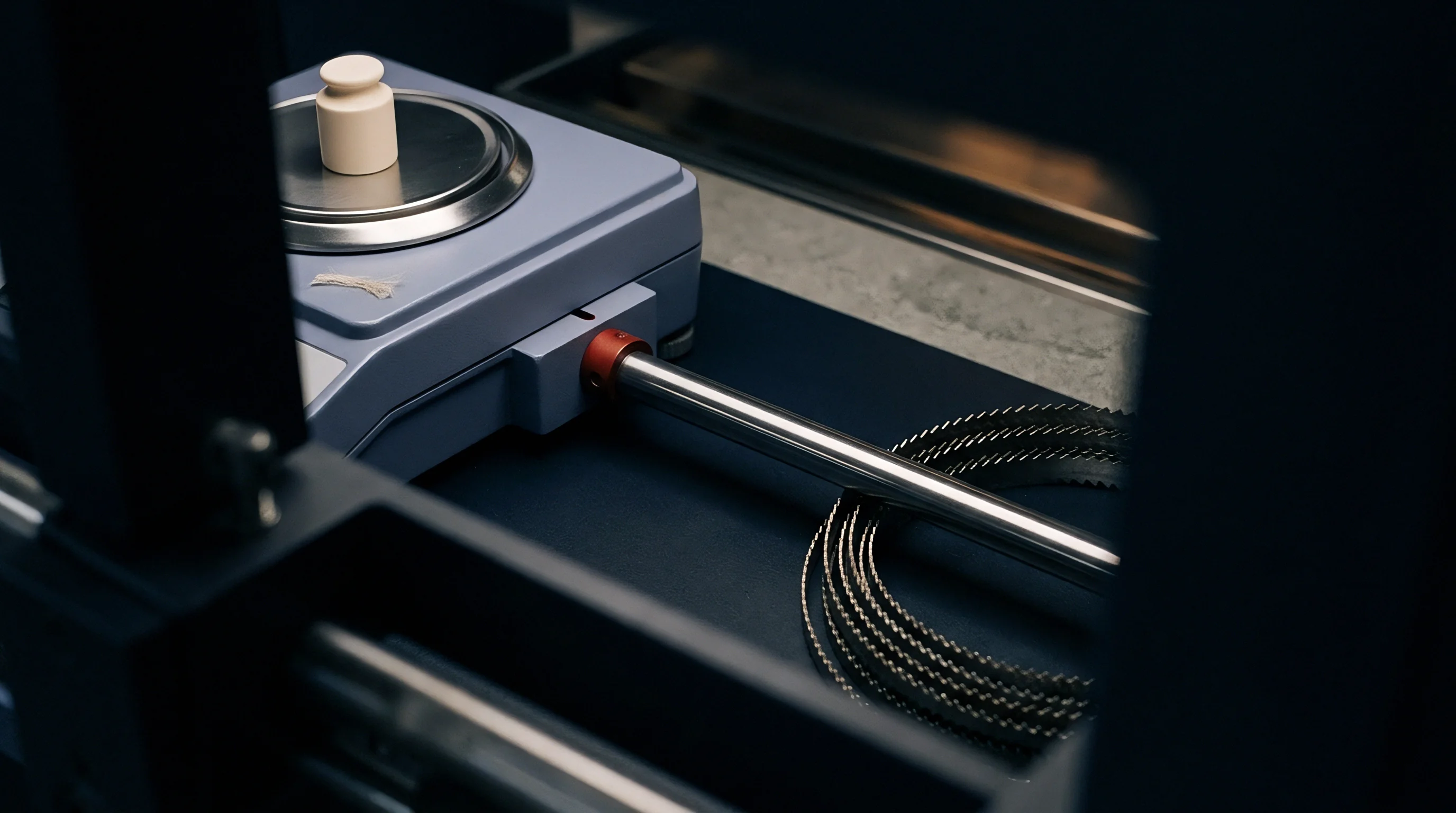
Interface Friction Profiles for Coated Synthetic Cords
Applying fluoropolymer jackets over high-tenacity aramid or liquid crystal polymer cords lowers the boundary coefficient of friction, though continuous cycling still generates high localized temperatures. Glass boards and neck wire connectors add to this thermal load, establishing a steep temperature gradient along the entire harness assembly.
| Cord Material Construction | Friction Coefficient (PTFE Board) | Thermal Conductivity (W/m·K) | Equilibrium Temperature at 850 PPM (°C) | Dynamic Stiffness Retained (%) |
|---|---|---|---|---|
| Braided PET core with polyurethane coating | 0.22 | 0.15 | 68.5 | 81.2 |
| Aramid core with PTFE fluoropolymer jacket | 0.12 | 0.28 | 44.0 | 94.6 |
| Liquid Crystal Polymer braided core | 0.14 | 0.32 | 41.2 | 96.1 |
| UHMWPE core with silicone lubricated sheath | 0.09 | 0.41 | 36.8 | 88.4 |
- Axial thermal expansion selection ~ Select fiber chemistries that exhibit near-zero or negative axial expansion under elevated shed operating temperatures.
- Glass transition threshold margin ~ Verify that polymer glass transition values exceed maximum localized comber board core temperatures by at least 40 degrees C.
- Static tension creep stability ~ Quantify permanent elongation percentages after 100 continuous hours under 5 N static bias load before committing warp beams.
- Fluoropolymer sheath resistance ~ Confirm that outer jacket matrix integrity does not soften or bind inside ceramic board guide holes below 80 degrees C.
Cord manufacturers frequently blame operational harness drop errors on mill climate control discrepancies rather than disclosing friction coefficients measured under static bench conditions.


Creep
Isolating temporary thermal movement from permanent strain accumulation is a core measurement challenge. Linear thermal expansion occurs almost instantly as cord temperature rises, governed by the fiber’s axial coefficient of thermal expansion. Synthetic materials vary significantly here: polyethylene terephthalate fibers expand with temperature increases, whereas high-modulus aramid fibers contract slightly when heated.

What Distinguishes Dynamic Thermal Expansion from Reversible Elasticity?
Linear thermal growth occurs independently of permanent polymer flow, but mechanical creep runs concurrently under the continuous static bias exerted by return springs or lingo weights between 2.0 N and 6.0 N per cord. Primary creep causes rapid initial molecular alignment, transitioning into steady-state secondary creep that accelerates under higher tension and multiplies when temperature rises.
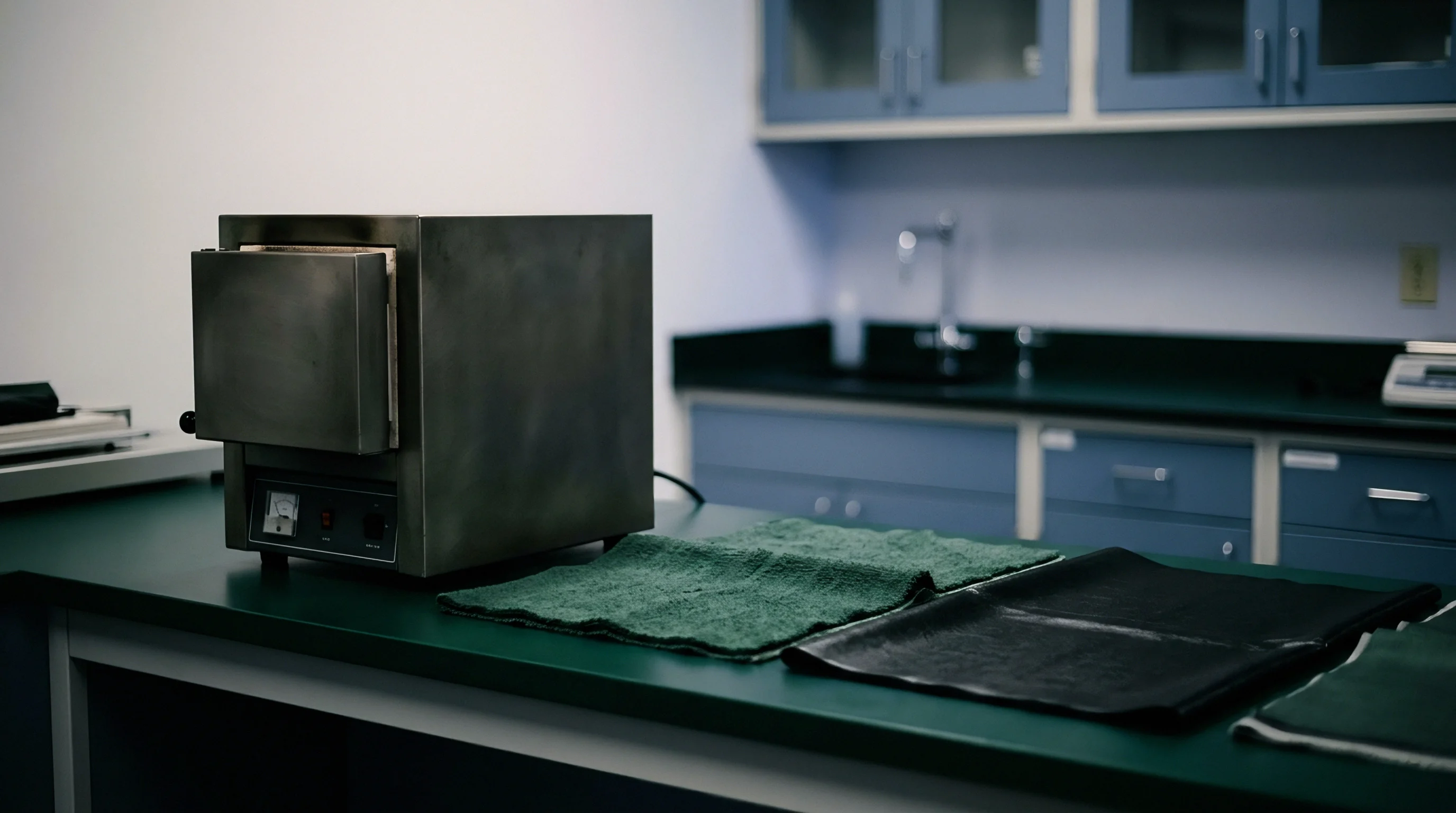
Separation of Thermal Linear Expansion and Tension-Induced Creep
Separating pure thermal expansion from load-induced deformation requires multi-stage mechanical testing. As temperature rises from a 20 degrees C ambient baseline to a 55 degrees C thermal equilibrium, increased polymer chain mobility accelerates secondary creep by a factor of 2.5 to 4.0. For example, a 1.800-meter PET harness cord operating under 4.5 N static spring tension at 850 picks per minute illustrates this interaction: warming from 20 degrees C to 58 degrees C produces 4.10 mm of axial thermal expansion (given a positive expansion coefficient of 60 x 10^-6 /K).
Over 24 hours of continuous shedding, secondary creep adds another 1.65 mm of permanent stretch. This total elongation of 5.75 mm drops the warp thread position at the shed line by 2.87 mm, exceeding clear-shed tolerances and causing warp ends to abrade against the rapier guides.
- Mount the cord sample into pneumatically clamped capstan grips set to 1000 mm gauge length.
- Calibrate non-contact laser optical sensors against reference target markers on the sample cord jacket.
- Initiate pre-conditioning tensile cycling between 2.0 N and 8.0 N at 2.0 Hz for 1,000 cycles to stabilize braid geometry.
- Elevate actuator cyclic frequency to 14.1 Hz matching 840 RPM loom velocity while engaging continuous laser tracking.
- Record load cell strain readings, surface thermograms, and optical gauge movement every 60 seconds.
- Stop actuator motion after 1,000,000 cycles, allow specimen to cool to 20 degrees C, and measure residual permanent extension.
Selecting harness cords with negative axial thermal expansion helps balance tension-induced mechanical creep against thermal growth over long production runs.
Bench
Static tensile testing fails to capture the dynamic loads present in high-speed shedding, yielding incomplete performance metrics. Accurate evaluation requires test rigs equipped with sinusoidal force actuators, non-contact optical extensometers, and calibrated infrared thermography. Procedures based on DIN 53835 apply alternating tension profiles between 2.0 N and 10.0 N at frequencies scaled to actual loom speeds.
Standardized Test Rigs and Thermographic Strain Isolation
Dynamic testing isolates thermal effects from applied mechanical loads by enclosing the cord sample within a climate-controlled chamber. Non-contact laser extensometers track target markers set 500 mm apart, recording instantaneous length changes down to a resolution of 0.001 mm. At the same time, calibrated infrared cameras log surface temperature profiles across the cord to establish true thermal equilibrium points.
Supply contracts specifying harness cord performance require dynamic hysteresis testing conducted under simulated loom frequency and temperature conditions according to ISO 6721 standards.
Dynamic Mechanical Analysis under Cyclic Stress Protocols
Evaluating material behavior during sinusoidal force cycles highlights how the cord absorbs and dissipates energy. By cross-referencing instantaneous load, strain, and surface temperature, test software separates total elongation into elastic deformation, dynamic thermal growth, and unrecoverable creep.
| Fiber Core Formulation | Cyclic Thermal Elongation (mm/m at ΔT=35°C) | Dynamic Tan Delta (10 Hz) | Permanent Creep Set after 1M Cycles (%) | Peak Surface Temp (°C) |
|---|---|---|---|---|
| Standard PET Multifilament Braided | +2.10 | 0.048 | 0.82 | 64.2 |
| Para-Aramid High-Modulus | -0.12 | 0.015 | 0.14 | 48.6 |
| Liquid Crystal Polymer (LCP) | +0.05 | 0.009 | 0.08 | 42.1 |
| UHMWPE Gel-Spun Fiber | -0.42 | 0.022 | 0.38 | 39.5 |
| Data captured on dynamic test rig under 2.0 N to 8.0 N sinusoidal force cycle at 14.1 Hz frequency in accordance with ISO 6721-4 standards. | ||||
- Mispicked shed openings ~ Dropped warp threads caused by harness cord thermal slack cut into rapier insertion lines.
- Reed mark patterning ~ Uneven harness cord heights shift individual end tension, creating longitudinal density faults across the woven sheet.
- Accelerated sheath abrading ~ Softened coating matrices frictionally bind inside comber board holes, stripping fluoropolymer jackets.
- Pattern repeat distortion ~ Differential thermal expansion across center and edge harness cords alters woven motif symmetry.
Including DIN 53835 cyclic fatigue clauses in raw material procurement contracts shifts qualification compliance burdens directly back to thread spinners.
Compensation
Correcting dimensional drift on active looms requires a mix of mechanical and environmental controls. Technicians rely on comber board height adjustment spindles to offset anticipated thermal growth, raising the frame by 1.5 mm to 3.0 mm before starting multi-day runs with PET harness cords. Switching to low-expansion LCP or aramid cords bypasses the need for these manual offsets altogether.
Shed Geometry Corrections and Comber Board Offset
Alongside guide plate adjustments, air distribution systems routed through the harness gantry help prevent internal thermal spikes. Directing forced ventilation across the comber board plates sweeps away boundary-layer friction heat, keeping operational cord temperatures below 35 degrees C.

Active Thermal Venting and Mechanical Leveling Protocols
High-efficiency jacquard systems also make use of active tensioning springs with non-linear rate characteristics. These non-linear springs counteract progressive cord elongation, maintaining uniform warp thread lift and steady tension across changing thermal conditions.
| Harness Elongation Range (mm) | Warp Shed Drop (mm) | Loom Efficiency Impact (%) | Dominant Cloth Defect Mode |
|---|---|---|---|
| 0.1 to 0.5 | 0.05 to 0.25 | < 0.2 | Negligible dimensional variance |
| 0.6 to 1.2 | 0.30 to 0.60 | 1.8 | Minor warp streakiness and fuzzing |
| 1.3 to 2.5 | 0.65 to 1.25 | 6.4 | Frequent rapier mispicks and edge loops |
| 2.6 to 5.0 | 1.30 to 2.50 | 18.5 | Major shed breakdown and warp end snap |
Whether closed-loop optical sensors can dynamically adjust individual comber board segment heights during ultra-high-speed weaving remains an area of ongoing development.