Optimizing Asymmetric Shed Motion Curves to Suppress Microfibrillar Shear Strain in Technical Flax Weaving
Asymmetric shed motion curves reduce peak warp acceleration and heddle contact angles, keeping shear stress below middle lamella limits to preserve flax modulus.


Kink
Technical flax yarn carries structural damage into the loom long before the warp beam meets the let-off drive, having already undergone decortication and hackling. Inside each bundle, the elementary bast fibres contain crystalline cellulose microfibrils aligned between eight and eleven degrees off the fibre axis. Mechanical decortication forces transverse slip planes and kink bands into those cell walls, disrupting local cohesion.
When the loom imposes reciprocating tensile loads, these sites serve as stress concentrators where longitudinal shear strips apart the hemicellulose and pectin matrix bonding adjacent microfibrils. The bundle yields internally long before reaching the take-up roller.
Standard symmetric shedding splits harness stroke evenly above and below the warp line, imposing identical peak elongation on both sheets. That geometric symmetry works against bast fibres. Unbleached technical flax breaks at only 1.5 to 2.2 percent elongation, leaving virtually no margin for transient tension spikes.
At full lift, warp ends endure simultaneous axial stretch and severe transverse bending over heddle eyes and drop wires. Microfibrillar shear strain develops as normal friction combines with bending moments, sliding the spiralling fibrils past one another inside the secondary cell wall and rapidly splitting the bundle.
Axially, flax bundles show considerable tensile resistance, with dry moduli between 50 and 70 gigapascals. Transverse shear strength is far lower, rarely clearing 15 megapascals across the middle lamella. Shedding loads readily exceed that threshold whenever yarn drag across drop wires, heddles, and reed dents concentrates at defect sites.
Protecting bundle cohesion requires moving away from harmonic shed symmetry toward kinematic profiles that lower peak warp tension and shallow the contact angles during high-tension phases.
A raw technical flax yarn showing five percent initial dislocation density loses up to eighteen percent of its composite-reinforcement tensile efficiency when shed tension peaks surpass thirty centinewtons per tex.
Under cyclic abrasive stress, degradation within the bundle develops along four recognizable paths:
- Inter-elementary splitting divides composite bundles along the middle lamella under excessive transverse yarn rubbing, which ruins yarn cohesion and accelerates fly generation in the drop wire region.
- Microfibrillar dislocation unravelling strips crystalline cellulose ribbons away from damaged kink bands, causing micro-voids that degrade dry resin wet-out during composite infusion.
- Secondary cell wall delamination separates the thick S2 layer from outer primary sheaths, producing localized fibre fraying that snags inside heddle mail eyes during reverse harness motion.
- Transverse fibril fracture breaks load-bearing fibrils across the diameter of elementary fibres, causing premature yarn snapping at pick insertion speeds above four hundred metres per minute.
Disputes over early tensile loss in technical fabrics routinely weigh crop-level retting conditions in wet harvest years against mechanical bundle slippage induced on the loom.
Curve
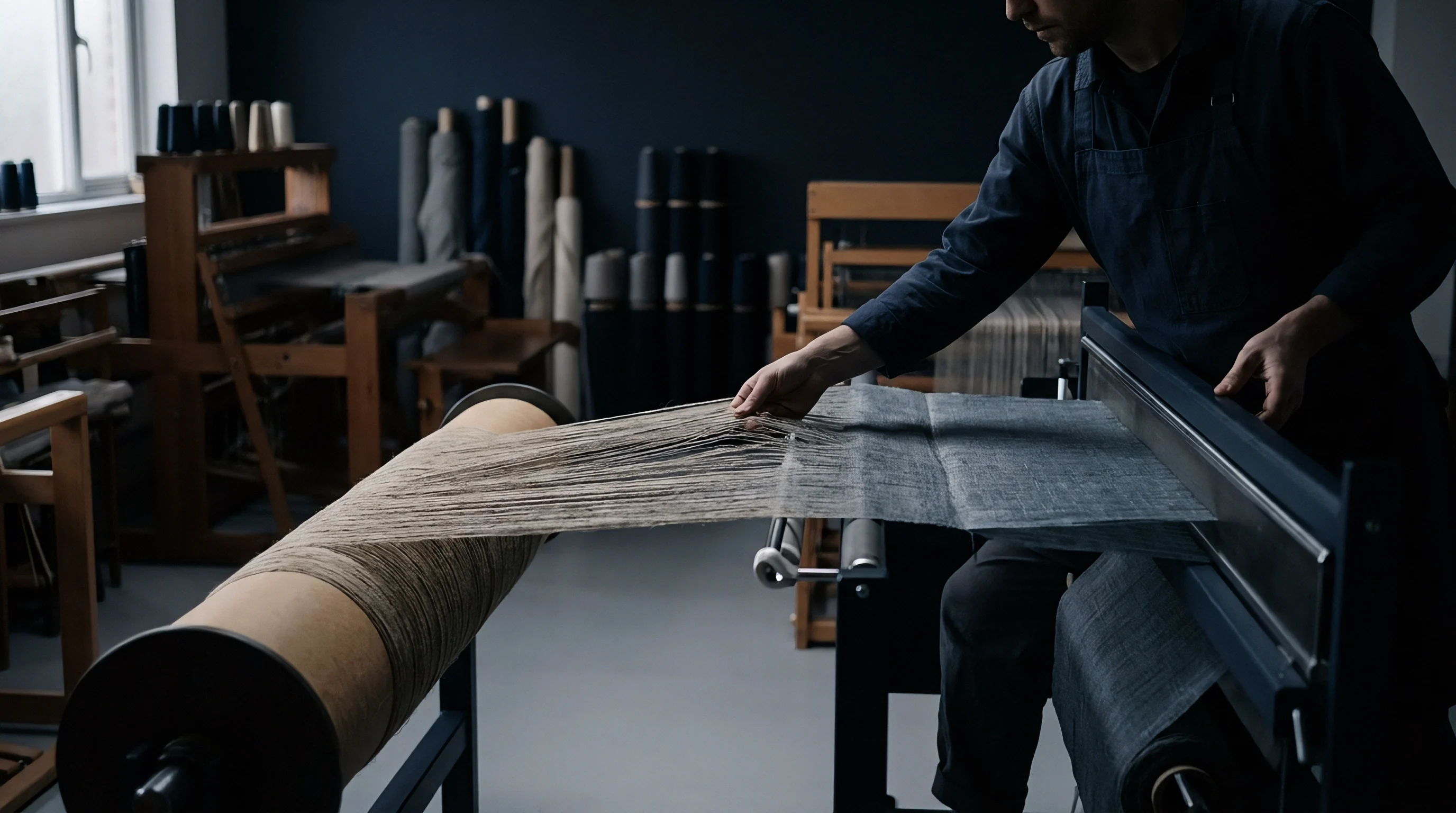
Loom builders originally mapped cam and dobby profiles for synthetics and carded cotton, materials that absorb dynamic acceleration without splitting. Bast fibres require motion laws matched to their crystalline rigidity. Electronic shedding systems and programmable cams allow shed timing to follow modified sine, cycloidal, or asymmetric polynomial curves, varying dwell and acceleration separately for the upper and lower sheets.
Altering the displacement curve manages the rate of strain application and keeps peak shear under the rupture limit of the middle lamella.
Symmetric harmonic shedding drives harness acceleration highest at the shed crossing, peaking yarn velocity right as tension climbs. An asymmetric profile postpones that opening acceleration, holding maximum aperture longer for pick insertion while easing harness speed through the closing cycle. Replacing harmonic motion with an asymmetric polynomial curve using a sixty-degree dwell and skewed deceleration cuts peak instantaneous warp tension by twelve to twenty-two percent, depending on loom width and yarn count.
An asymmetric kinematic profile alters the tension differential between upper and lower shed sheets. Dropping the neutral warp line creates an asymmetric shed where the upper sheet works through a smaller angular displacement than the lower. Because the top ends clear the race board freely while bottom ends ride the rapier guides, adjusting the lower harness profile suppresses friction-driven shear.
Delaying lower harness arrival at full shed by twenty to thirty degrees of main shaft rotation spreads the peak tensile load across a broader timing window.
| Profile Designation | Top Dwell Angle | Bottom Dwell Angle | Peak Warp Tension (cN/tex) | Microfibrillar Strain (%) | Tensile Retention (%) |
|---|---|---|---|---|---|
| Symmetric Harmonic Cam | 0° | 0° | 38.4 | 2.84 | 76.2 |
| Standard Cycloidal (Symmetric) | 30° | 30° | 34.1 | 2.15 | 83.7 |
| Asymmetric Modified Sine | 50° | 70° | 28.6 | 1.42 | 91.5 |
| Asymmetric 5th-Order Polynomial | 45° | 80° | 24.3 | 0.98 | 96.8 |
A fifth-order polynomial curve bounds jerk ~ the third derivative of displacement ~ which governs the impact shock delivered through the heddle eye. Softening jerk protects the fragile pectin interfaces binding elementary fibrils. In dynamic warp monitoring, sudden harness acceleration snaps individual flax fibres well before the yarn reaches its nominal tensile limit.
Eliminating these sharp acceleration spikes preserves bundle cohesion throughout production runs.
Matching harness acceleration curves to the exact relaxation spectrum of bast cellulose preserves yarn life across the entire warp beam.
The physical limit of this kinematic adjustment depends on shed opening height and insertion clearance. Extending dwell too far compresses harness movement into fewer degrees of rotation, driving up velocity and dent abrasion. Tuners must balance harness dwell against insertion clearance to protect the bast bundles without exciting chassis resonance.

Sley
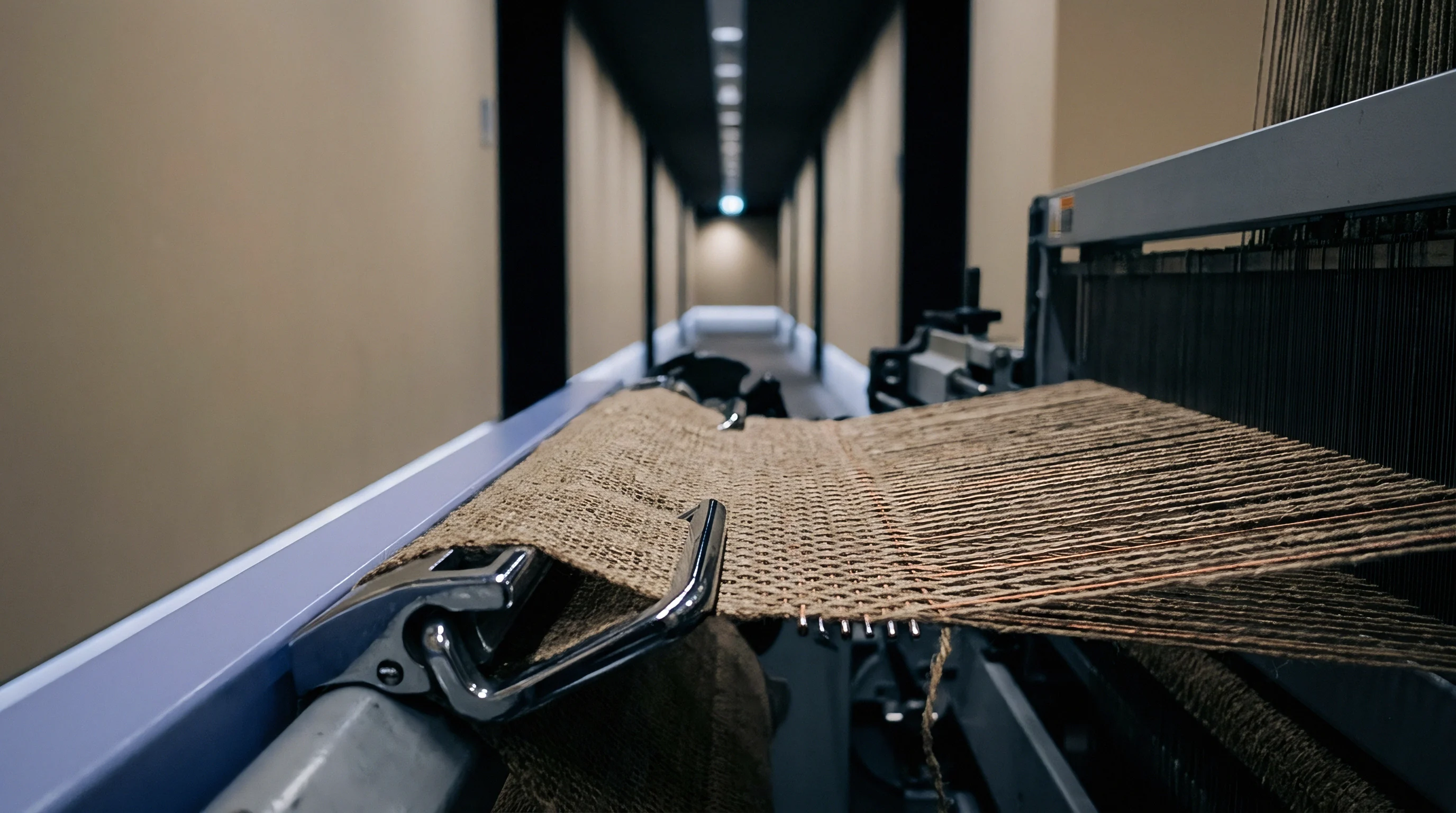
Loom geometry outside the harness frame governs yarn shear as directly as cam design. Warp ends travel from the back rest roller over drop wires, through heddle eyes and reed dents, and across the breast beam to the sand roller. Setting the back rest roller five to fifteen millimetres above the breast beam datum alters the mechanical balance across the shed, slacking the upper sheet while tightening the lower during shed opening.
Sley motion and beater kinematics have to be synchronized to this uneven tension distribution to avoid crushing the yarn during cloth formation.
Does Asymmetric Lift Mitigate Axial Shear?
Harness height offsets shift the entry angle of warp ends entering the heddle eyes. Limiting top shed rise to forty-eight millimetres while opening the bottom shed to sixty-two millimetres alters the wrap angle through the mail eyes continuously over each shaft cycle. Shallower wrap angles lower normal contact pressure.
Under the Capstan relation, even marginal decreases in deflection produce exponential reductions in frictional drag, preventing the lateral abrasion that strips microfibrils from elementary fibre walls.
The timing of reed strike relative to shed crossing determines whether beatup falls on a closed, crossing, or open shed. Heavy technical constructions often beat up on a closed shed to lock picks and limit fell bounce. On flax, however, closed-shed beatup imposes intense transverse shear, pinching warp ends over weft picks right as warp tension rebounds from zero.
Shifting shed crossing fifteen and twenty-five degrees ahead of front centre seats the pick in a slightly crossed shed under steady tension, keeping the reed from grinding bundles into high-friction compaction.
Setting up a rigid rapier loom for structural flax requires calibrating shedding and beatup in a strict sequence:
- Back rest positioning aligns the rear roller twelve millimetres above horizontal centre to establish an asymmetric baseline tension between upper and lower harness frames.
- Dropper box levelling matches the entry trajectory of warp sheets to prevent yarn chatter against stop-motion contact bars during sudden harness accelerations.
- Heddle frame stagger spaces adjacent harness shafts by two millimetres vertically to stop adjacent warp ends from entangling and shearing each other during shed interchange.
- Cam dwell indexing sets a seventy-degree lower shed dwell synchronized with rapier insertion entry at ninety-five degrees of crankshaft rotation.
- Sley drive phase adjustment delays reed contact until five degrees past front dead centre to minimize peak compaction impact on sensitive bast yarn kink bands.
Adjusting these physical components without coordinating harness kinematics causes rapid yarn degradation across the outer reed dents. When sley acceleration and harness curves run out of phase, warp ends abrade against stainless steel dents at surface temperatures surpassing eighty degrees Celsius, drying natural flax moisture and inducing matrix micro-cracking across the composite reinforcement plane.
Insertion
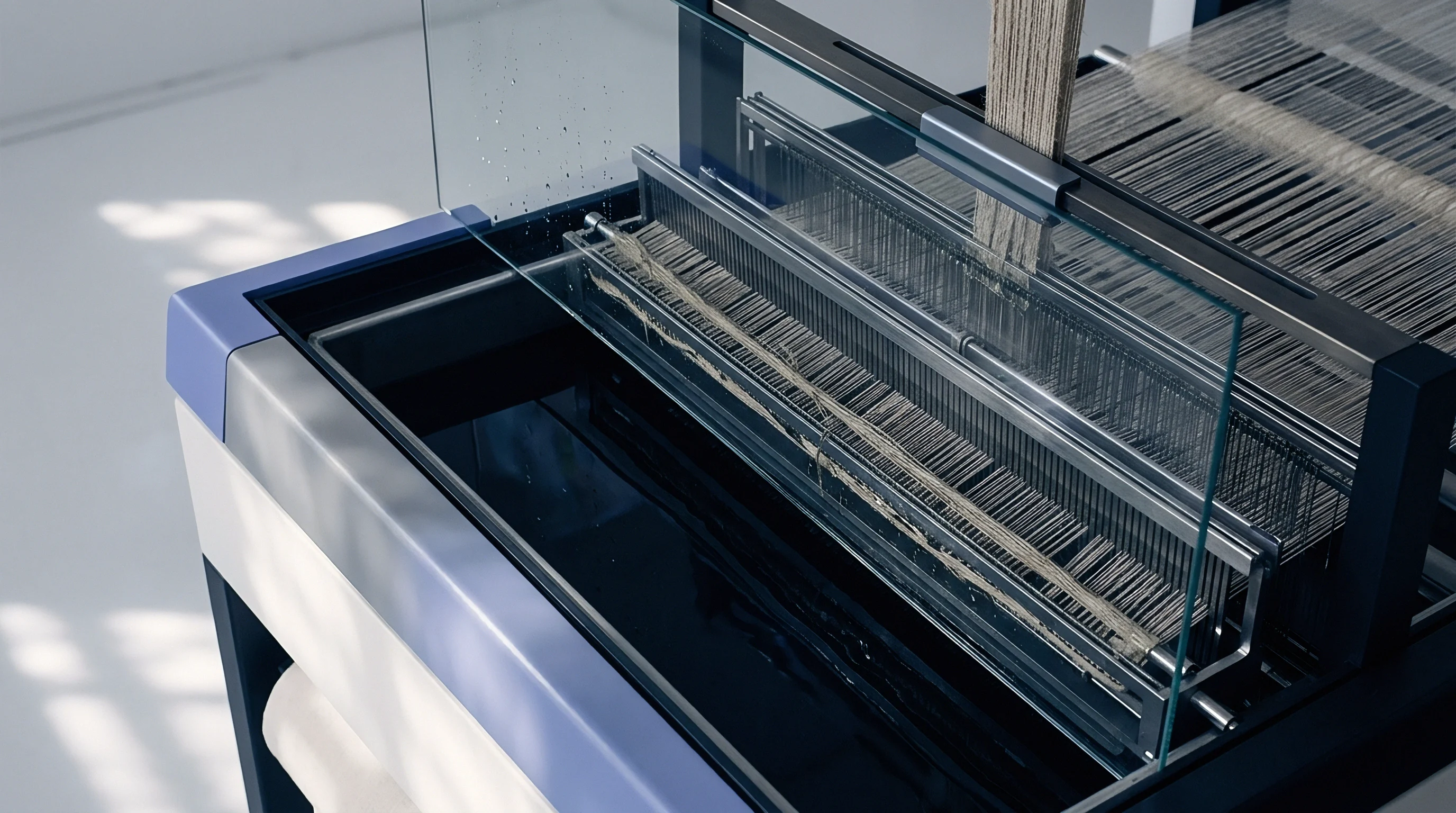
Rapier tape trajectory and gripper dimensions dictate the clearance needed to carry filling across the warp without interference. Standard technical looms run gripper heads through shed apertures between fifty and sixty-five millimetres at the reed. On flax, tuners often open the shed wider to clear yarn fuzz and prevent gripper hang-ups, but that extra lift escalates microfibrillar shear strain by driving warp ends deeper into peak elongation.
Should Dwell Timing Decouple Peak Extension?
Low-profile guided rapier heads operate within vertical clearances under forty-two millimetres. That reduced profile permits shallower shed angles, lowering cyclic warp extension from 1.8 percent down to 0.9 percent per pick. Decoupling harness dwell between the sheets protects the yarn further: holding the bottom shed open while closing the top leaves the rapier track clear over the race board as upper warp ends ease back toward neutral.
The duration of peak tension on any individual bundle drops by roughly half.
Dynamic tensioners positioned between the beam and the harness must smooth inertial ripple during insertion dwell. Spring-loaded oscillating back rests react too sluggishly to bast tension transients, typically resonating below eight hertz. Modern electronic let-offs employ servo-driven eccentric compensators operating above twenty hertz, feeding yarn forward during harness acceleration to suppress tension spikes before they reach the heddles.
| Operating Parameter | Symmetric Harmonic Setup | Optimized Asymmetric Profile | Variance Impact |
|---|---|---|---|
| Loom Speed (rpm) | 240 | 310 | +29.1% |
| Warp Break Frequency (per 10⁵ picks) | 8.4 | 1.2 | -85.7% |
| Fibre Shed / Fly Accumulation (g/m²) | 4.6 | 0.8 | -82.6% |
| Loom Operating Efficiency (%) | 71.5 | 88.2 | +16.7% |
| Yarn Modulus Loss in Greige (%) | 21.4 | 3.1 | -18.3% |
Climate control in the weave room serves as a mechanical variable during insertion. Flax cellulose requires sixty-five to seventy-five percent relative humidity at twenty-two degrees Celsius to maintain fibrillar plasticity; dry air embrittles hemicellulose, turning natural dislocations into cracks under rapier impact. Formulations combining modified potato starches with water-soluble lubricants coat the bundles, reducing inter-fibre friction from 0.42 down to 0.18 without interfering with composite resin wetting later on.
A contract clause mandating maximum allowable warp sizing pick-up of 3.5 percent enforces precise loom climate control to prevent dry yarn brittleness.
Under international composite specifications, failure to respect humidity limits and yarn sizing restrictions invalidates mechanical performance warranties. When buyers execute fabric supply contracts under ISO 13934-1 testing terms, suppliers must demonstrate that tensile strength retention through the greige state meets ninety percent of incoming raw yarn ratings before shipments clear customs.

Rupture
Isolating fibrillar damage in flax cloth from macro-scale yarn slippage requires structural testing beyond basic fabric grab tests, where inter-yarn friction masks internal bundle splitting. Quantifying shear suppression involves off-axis tensile characterization paired with scanning electron microscopy and acoustic emission monitoring under monotonic load. Sound bundles remain acoustically quiet at low strain, whereas yarn damaged during shedding emits early burst signals from matrix micro-cracking at strain levels below 0.3 percent.
When weaving shear damages outer elementary fibre walls, reinforcement fabrics consolidate poorly during vacuum resin infusion. Non-destructive permeability scans show uneven bundle compaction that forms low-resistance race-tracking channels. Epoxy channels through these paths around dry bundle cores, leaving dry zones that turn into macro-cracks under fatigue loading in finished laminates.
Quality qualification protocols must test both incoming roving and woven greige to differentiate loom damage from field variability. Preform screening relies on four clear criteria:
- Microfibrillar dislocation index quantifies the percentage of kink bands exhibiting transverse micro-cracks under polarized optical microscopy, which should remain below eight percent across warp samples.
- Tensile modulus retention compares raw un-woven warp yarn stiffness directly against warp threads unravelled from greige cloth using ISO 13934-1 tensile procedures, demanding values above ninety-two percent.
- Off-axis shear modulus measures +/-45-degree tensile behaviour inside infused laminates under ISO 14129 guidelines to confirm that matrix-fibre inter-laminar shear limits meet fifteen megapascals.
- Visual fuzz density tallies free elementary fibre ends protruding from warp threads across ten square centimetres of cloth surface, providing an immediate proxy for heddle eye abrasion damage.
The assumption that all bast yarn bundles sustain up to two percent cyclic dynamic elongation without microfibrillar splitting is contradicted by literature showing wide performance spreads tied to retting depth and hackling preparation. When datasheets are ambiguous, buyers specify single-fibre tensile testing under ASTM D3822 alongside cyclical hysteresis curves before placing orders for structural reinforcement grades.
Whether non-destructive high-frequency ultrasonic attenuation scanning can accurately map localized microfibrillar dislocation growth across ten-thousand-metre production rolls without requiring physical destructive sampling remains unresolved.

Outlay
Tuning loom kinematics directly controls production capacity. Fabrics woven from wet-spun flax compete against E-glass and basalt on price per kilogram and modulus per euro. Raw flax roving runs four and seven euros per kilogram depending on purity and tow grade, while high-tenacity glass trades below three euros per kilogram.
Every point of efficiency surrendered to warp breaks or fly accumulation increases overhead on the finished yardage.
A 2.2-metre rapier loom carries an hourly capital and operational charge of thirty-five to fifty euros covering power, climate control, and shop overhead. Weaving a 350-gram-per-square-metre plain fabric at 220 picks per minute on conventional symmetric cams delivers roughly seventy-two percent efficiency. Stoppages cause start marks that must be cut out during grading under ASTM D5430 four-point inspection.
Switching to an asymmetric fifth-order polynomial profile raises continuous operating speeds to 310 picks per minute while bringing efficiency to eighty-eight percent.
The financial return from kinematic shed tuning appears directly in the calculation of net manufacturing cost per linear metre of technical cloth:
| Cost Component | Symmetric Setup (€/m) | Asymmetric Profile (€/m) | Variance (€/m) |
|---|---|---|---|
| Net Landed Greige Cost | 10.38 | 8.06 | -2.32 |
| Raw Wet-Spun Flax Yarn (200 tex) | 4.25 | 4.10 | -0.15 |
| Yarn Waste and Sizing Materials | 0.68 | 0.28 | -0.40 |
| Loom Shed Hour Charge (Allocation) | 3.85 | 2.58 | -1.27 |
| Inspection, Mending, and Scrap Rate | 1.60 | 1.10 | -0.50 |
An operational saving of 2.32 euros per metre lowers landed greige cost by twenty-two percent. Cleaner shedding also protects dobby actuators and guide bearings, pushing routine service intervals from three hundred loom hours to over eight hundred hours. The capital cost of cutting CNC cam tracks or retrofitting programmable electronic dobbies amortizes across the initial twenty thousand metres of woven reinforcement.
Suppressing dynamic microfibrillar shear strain in the shed allows mills to dispense with synthetic sizing formulations that require hot water scouring and chemical desizing ahead of resin infusion. Greige reinforcement woven under an asymmetric profile moves straight from the loom into prepreg consolidation, bypassing wet-processing, avoiding effluent treatment costs, and preserving the chemical affinity between natural cellulose hydroxyl groups and bio-epoxy matrix systems.