Plain Weave Standing Where a Twill Drapes at Equal Weight
Equal weight plain weave stands rigid while twill drapes because maximum yarn crossover frequency locks crimp and restricts lattice shear mobility.

Beam
Warp preparation for high-density flax textiles requires rigorous mechanical control during thread distribution. A warp beam loaded with wet-spun linen yarn operates under narrow physical tolerances imposed by the low elasticity of bast fibers. Flax exhibits an ultimate elongation at break below three percent, leaving little margin for tension variations during beaming.
In plain weave, every warp end alternates lift cycles on every pick, maximizing yarn-to-yarn contact forces and stressing the warp during shed opening. Twill constructions spread lift cycles across multiple shafts, reducing how often individual warp threads move and altering the physical load on the beam.
Direct beaming of linen yarn depends on consistent tension control at the creel. Tension variations across the warp sheet generate localized crimp imbalances in finished cloth, producing wavy selvages, uneven thread spacing, and structural skewing when grey cloth comes off the loom under tension. Electronic tension meters on a 177-centimetre warping reed running 100 percent wet-spun flax yarn at Nm 26 (38.4 tex) show that tension spikes above 45 grams per end cause immediate micro-fractures inside the flax fiber bundles.
These fractures reduce tensile strength and accelerate fiber shedding within heald eyelets during weaving.
Flax yarn bundles show high resistance to radial compression under lateral load.
Sizing applied to linen warps for plain weave must lay down outer yarn hairiness while keeping the fiber core flexible. Over-applying native starch to boost abrasion resistance remains a frequent mill defect; excessive starch pickup raises flexural rigidity and hinders yarn deflection during beat-up. Because plain weave forces warp ends to bend sharply around weft picks at every intersection, an over-rigid size film resists displacement.
The beat-up mechanism then drives the weft against an unyielding warp grid, resulting in high beat-up resistance, reed marks, and persistent loom stops from end breakages behind the reed.
| Sizing Component | Plain Weave Target (Nm 26) | Twill Weave Target (Nm 26) | Viscosity Range (mPa·s at 85°C) | Film Elongation Limit (%) |
|---|---|---|---|---|
| Modified Potato Starch | 6.5% dry weight mass | 4.5% dry weight mass | 25 – 30 | 3.2 |
| Polyvinyl Alcohol (PVA) | 3.0% dry weight mass | 2.0% dry weight mass | 12 – 15 | 8.5 |
| Synthetic Softener / Wax | 0.8% dry weight mass | 0.6% dry weight mass | N/A | N/A |
| Total Size Pickup Rate | 10.3% dry yarn mass | 7.1% dry yarn mass | 18 – 22 | 5.8 |
Sizing requirements for twill differ because the weave structure incorporates floats where yarns pass over two or more intersecting threads. This architecture lowers crossover points per unit area by 33 to 50 percent relative to plain weave at identical thread counts, meaning warp yarns undergo fewer directional changes per centimetre of cloth. Sizing formulations for twill warps can lower total pickup to roughly 7 percent dry yarn mass.
This preserves natural yarn flexibility, letting long floats slide cleanly against adjacent ends during beat-up and shedding, while also simplifying desizing and scouring during wet finishing.
Sectional warping becomes necessary when producing dense linen fabrics with complex warp stripes or multi-shaft twill patterns. Tension across each section band on the warping drum must remain uniform throughout the winding cycle. A tension variation of just 2 grams per end between sections creates visible bands of uneven crimp across the fabric, leading to differential shrinkage and permanent warp banding in wet finishing.

Warp Beam Preparation and Yarn Tension Mechanics
Beam density directly governs how evenly the warp sheet unwinds inside the loom shed. Warping machines rely on hydraulic pressing rollers on the beam to maintain uniform packing density. For wet-spun linen warps, a density of 0.55 to 0.62 grams per cubic centimetre prevents inner yarn layers from shifting or cutting into underlying wraps under high winding tension.
When density falls below 0.50 grams per cubic centimetre, warp ends sink into the beam bed during heavy beat-up, creating slackness in the shed that triggers mis-picks and automatic loom stops.
Warping creels with active tension compensation adjust thread braking as bobbin diameters decrease. Flax bobbins from wet spinning frames vary in unwinding resistance due to uneven residual moisture. Active compensation keeps end tension within plus or minus 1.5 grams.
Holding this tolerance ensures every warp thread enters the sizing trough under identical stretch, securing uniform elastic recovery across the full width of the beam.
Creel alignment relative to the lease rods directly influences fiber migration. Misaligned guides force linen yarn across stationary metal edges at sharp angles, stripping micro-fibrils from the core and generating fuzz balls. These clusters gather behind heald wires during weaving, bridging adjacent warp threads and causing entanglement.
In plain weave, where every end moves on every pick, fuzz balls quickly cause warp breakdown. Twill structures tolerate slightly more hairiness because shed crossings occur less frequently, though clean yarn clearance remains critical for efficiency.
Direct warping bypasses intermediate section drums, running yarns from large creels straight onto the loom beam. This technique provides superior tension uniformity across weaving widths up to 340 centimetres and suits long runs of standard plain weave grey cloth with warp lengths over 3,000 metres. Sectional warping remains reserved for short-run specialty twills or yarn-dyed goods where pattern flexibility outweighs warping speed.
Float Topology and Interlocking Crimp Architecture
The difference in drape between plain weave and twill of identical mass per unit area is driven by float geometry and crimp distribution. In standard 1/1 plain weave, each warp yarn alternates over and under successive weft picks, producing the maximum number of intersections per unit area. At every crossover, warp and weft yarns undergo forced out-of-plane deflection, establishing structural crimp.
Total fabric crimp measures the difference between unraveled yarn length and its physical path length in the woven grid.
Redistributing structural crimp during deformation demands measurable mechanical energy.
In a 180 gram per square metre 1/1 plain weave using Nm 26 linen at 19 ends and 19 picks per centimetre, the yarn path follows a tight, continuous sinuous curve whose radius of curvature depends on yarn diameter and packing density. Because the flax bundle has a high flexural modulus, forcing yarns into tight, continuous bends stores elastic strain energy across the fabric matrix. That stored strain resists bending, causing plain weave linen to hold a stiff plane when supported along an edge.
Equal fabric weight does not yield equal mechanical flexibility when the interlacing frequency drops by half across alternate weave structures.
A 2/2 twill engineered to the same 180 gram per square metre target requires a higher thread density to offset its lower interlacing frequency. To match the weight of the plain weave with Nm 26 yarn, thread count must rise to roughly 23 ends and 23 picks per centimetre. Despite containing 21 percent more threads per centimetre, the 2/2 twill features floats passing over two warp and two weft threads before interlacing, increasing the un-interlaced length and allowing yarns to lie flatter in cross-section.
Fewer crossover points per centimetre fundamentally change the mechanical behavior of the twill grid. Warp crimp drops from roughly 8.5 percent in plain weave to 5.2 percent in 2/2 twill, meaning yarns undergo less severe bending during weaving. Under an applied bending moment, the floats act like short independent beams that flex and rotate with minimal restraint from adjacent crossovers.
This structural freedom lets the fabric deform under its own weight, producing fluid drape that plain weave cannot replicate at equal mass.
Interlocking crimp architecture also dictates shear resistance. When cloth drapes over compound surfaces, it deforms through shear as the perpendicular angles between warp and weft become oblique. In plain weave, every crossover serves as a friction pivot locked under high crimp force; shearing the fabric requires enough energy to overcome static friction at every node.
In twill, lower crossover density and longer floats let parallel yarns slide past one another under lower shear loads, allowing the textile to conform smoothly.

Thread Count Parity and Mechanical Stiffness Divergence
Comparing fabrics with identical thread counts and yarn sizes isolates weave geometry from yarn properties. A 100 percent linen fabric woven from Nm 39 (25.6 tex) yarn at 24 ends and 24 picks per centimetre reaches a mass of roughly 140 grams per square metre in 1/1 plain weave. Woven as a 3/1 twill with the same yarn and sett, fabric mass drops to about 131 grams per square metre because the yarns take up less crimp.
The plain weave variant of this Nm 39 construction displays more than twice the absolute flexural rigidity of the 3/1 twill. Measuring resistance to bending, the plain weave yields a warp flexural rigidity of approximately 32.5 micro-Newton metres, compared to roughly 14.1 micro-Newton metres for the 3/1 twill. This divergence stems directly from jammed crossover nodes: each intersection clamps adjacent fiber bundles and restricts independent flexure.
Inter-yarn friction dominates the initial deformation phase.
This difference in stiffness becomes pronounced during repeated handling. Plain weave linen retains high initial bending resistance because crimp keeps contact pressure elevated between yarns. When bent, flax micro-fibrils in the core undergo severe localized tension and compression.
Lacking synthetic elasticity, these strain cycles break down outer fiber bundles over time, causing the fabric to develop sharp, permanent creases rather than rounded folds.
Twill weaves distribute bending strain along the full length of each float segment. As a 3/1 twill bends, stress spreads across un-interlaced yarn lengths rather than concentrating on individual bundles. The floats slide laterally over adjacent ends, absorbing energy through light friction rather than buckling.
This mechanism prevents sharp creasing and helps the cloth return flat once bending loads lift, yielding rounded, fluid folds.
Cyclic pure bending tests measure flexural hysteresis ~ the energy lost when cloth bends to a set curvature and relaxes. Plain weave linen produces a broad hysteresis loop, reflecting high internal friction and energy loss at locked crossovers. Twill linen yields a narrow hysteresis loop, showing that float segments displace with minimal mechanical resistance.
This difference in energy dissipation directly tracks visual assessments of softness and drape.
Pushing thread density in plain weave past its geometric jamming limit creates severe distortion. In a jammed plain weave, warp ends cannot accommodate weft diameters without forcing extreme crimp transfer, locking the fabric into an unyielding sheet suitable for canvas but ill-suited for apparel. Twill accepts much higher thread densities before jamming, allowing mills to produce dense, wind-resistant textiles that retain fluid movement.
Float lengths cannot be extended indefinitely without compromising durability. While long floats in 4/4 or 5/1 twills reduce flexural stiffness and improve drape, they leave yarn segments vulnerable to snagging and surface abrasion. Excessively long floats also degrade tear strength by allowing individual threads to snag and bear concentrated loads alone.
A 2/2 or 3/1 twill provides a balanced compromise between fluid drape, shear mobility, and surface durability for medium-weight linen.
A yarn float length exceeding six millimetres invites structural instability in wet-spun flax fabrics.

Geometry
Structural differences between woven textiles trace directly to the frequency of yarn intersections per unit area. Geometry governs how mass, cover factor, and cross-sectional density interact within a construction. A planner engineering a plain weave linen to match the mass per unit area of a twill must modify thread or yarn counts to achieve parity.
Plain weave relies on an alternating 1/1 matrix, whereas twill incorporates floats across multiple ends or picks. This difference changes packing density and alters how the fabric flexes under gravity.
The planar cover factor measures the surface area obscured by yarns relative to total fabric area. Calculating cover factor requires determining yarn diameters from linear density. For wet-spun linen, yarn diameter can be estimated where diameter in millimetres equals 1.33 divided by the square root of metric yarn count (Nm), adjusted by a packing factor of 0.72.
A plain weave constructed with Nm 26 warp and weft yarns at 19 ends and 19 picks per centimetre yields fractional warp and weft cover factors of 0.49 each, resulting in a combined cover factor of 0.74 and leaving 26 percent open area in the grid.
| Weave Architecture | Warp Count (Nm) | Weft Count (Nm) | Warp Sett (ends/cm) | Weft Sett (picks/cm) | Combined Cover Factor | Bending Length (mm) | Shear Modulus (N/m·rad) |
|---|---|---|---|---|---|---|---|
| 1/1 Plain Weave | 26.0 | 26.0 | 19.0 | 19.0 | 0.740 | 34.2 | 4.85 |
| 2/1 Warp Twill | 26.0 | 26.0 | 21.5 | 21.5 | 0.785 | 26.8 | 2.90 |
| 2/2 Balanced Twill | 26.0 | 26.0 | 23.0 | 23.0 | 0.812 | 21.4 | 1.82 |
| 3/1 Broken Twill | 26.0 | 26.0 | 24.0 | 23.5 | 0.825 | 19.6 | 1.45 |
Matching the 180 gram per square metre target in a 2/2 balanced twill with Nm 26 yarn requires increasing thread count to 23 ends and 23 picks per centimetre. This raises fractional warp and weft cover factors to 0.59, pushing total cover factor to 0.83. Despite this denser coverage and lower porosity, the 2/2 twill exhibits a bending length of only 21.4 millimetres, compared to 34.2 millimetres for plain weave.
Standard cantilever bending length correlates directly with stiffness; shorter lengths indicate cloth that bends readily under its own weight.

Structural Cover Factor and Planar Mass Distribution
Mass distribution across a woven lattice depends on yarn spacing and flattening at crossover points. In dense plain weave, compression forces yarn bundles into elliptical cross-sections at intersections. For Nm 26 yarn, this flattening widens the major yarn axis by up to 18 percent, narrowing inter-thread gaps and reducing thickness.
Plain weave hits its jamming limit early because expanding yarn profiles make lateral contact well before reaching theoretical sett maximums.
Twill structures distribute mass across multiple planes through layered yarn floats. In a 2/2 twill, float segments sit slightly above the central fabric plane, producing distinct surface textures and three-dimensional relief. This distributes yarn mass across a greater effective thickness without locking threads into rigid contact.
A 180 gram per square metre 2/2 twill measures roughly 0.48 millimetres thick, compared to 0.36 millimetres for an equal-weight plain weave, leaving internal void volume for yarn shear displacement.
Cantilever stiffness testing confirms that a 180 gram per square metre plain weave linen requires double the applied bending energy to achieve the same angular deflection as an equal weight twill.
Thread packing geometry dictates how kinetic energy dissipates during flexure. Bending subjects outer yarn fibers to tension and inner fibers to compression. In plain weave, locked crossover nodes concentrate these forces into individual flax fibers that have minimal strain tolerance, generating high internal friction.
In twill, floating yarn segments displace into adjacent structural voids during bending, dissipating applied forces through low-friction movement.
Planar mass distribution also governs thermal and optical performance. The higher cover factor of 2/2 twill limits direct light transmission, yielding good opacity at lower fabric weights. Plain weave, while stiffer, retains larger microscopic pores between crossovers due to its lower thread count for an equivalent weight.
Air permeability tests confirm higher airflow through plain weave than through dense twill, making plain weave breathable yet mechanically stiff.
Conditioned under ISO 139 standards at 20°C and 65 percent relative humidity, 180 gram per square metre plain weave linen demonstrates a warp bending rigidity of 21.4 micro-Newton metres squared across cantilever tests. Shifting ambient humidity moves this value by up to 18 percent as moisture swells flax bundles, increasing contact pressure at intersections. Higher humidity tightens the plain weave lattice and elevates rigidity, whereas twill accommodates moisture uptake with little impact on drape.
High-speed warping trials show end-break frequency rising sharply whenever spool unwinding tension deviates from target thresholds.

Flexural Rigidity across Alternate Interlacing Schemes
The flexural rigidity of a woven textile equals the product of its elastic modulus and structural moment of inertia per unit width. Calculating rigidity across weave designs evaluates how float length alters resistance to bending moments. In 1/1 plain weave, every yarn segment acts as a short beam pinned between closely spaced pivots.
The unsupported yarn length equals the distance between adjacent threads ~ roughly 0.52 millimetres for Nm 26 yarn at 19 ends per centimetre. These short spans resist bending, producing high stiffness.
In a 2/1 warp twill, the warp float covers two weft threads before interlacing, extending the unsupported yarn length to about 1.05 millimetres. Doubling this span reduces segment stiffness by a factor proportional to the cube of its length under beam bending principles. While crossover nodes preserve lattice stability, the longer floats drop overall warp flexural rigidity from 21.4 micro-Newton metres squared to 11.2 micro-Newton metres squared.
The cloth drapes more freely while maintaining warp tensile strength.
A 3/1 twill extends unsupported float length to roughly 1.58 millimetres, dropping flexural rigidity further to approximately 7.5 micro-Newton metres squared at equivalent weight. The long warp floats slide across weft threads with minimal friction, deforming under light loads. However, because floats are distributed asymmetrically ~ producing a warp face and a weft reverse ~ the fabric can curl if warp and weft tensions are not balanced during weaving and wet finishing.
Broken twills, including satin and herringbone variations, alter crossover sequences to eliminate continuous diagonal lines. In a 4-shaft broken twill, float lengths match standard 2/2 twill, but staggered interlacing distributes flexibility evenly. Standard twills bend most easily along the diagonal axis parallel to the twill line, whereas broken twills exhibit isotropic bending, hanging cleanly without twisting in garment applications.
Bending Moment Analysis in Equal Mass Structures
Analyzing bending moments requires evaluating the energy stored at crossover nodes during flexure. Total bending moment (M) for a unit area under curvature (κ) represents the sum of yarn flexural resistance (My) and inter-yarn rotational friction (Mf). In plain weave, rotational friction Mf dominates because compressed yarn bundles operate under high contact pressure, requiring substantial force to initiate flexing.
| Weave Design | Curvature Range (cm⁻¹) | Bending Rigidity B (µN·m²) | Hysteresis Moment 2Mo (mN·m/m) | Resilience Ratio (%) |
|---|---|---|---|---|
| 1/1 Plain Weave | 0.0 to 2.5 | 21.4 | 1.85 | 42.5 |
| 2/1 Twill | 0.0 to 2.5 | 11.2 | 1.12 | 56.0 |
| 2/2 Balanced Twill | 0.0 to 2.5 | 6.8 | 0.68 | 68.5 |
| 3/1 Satin Weave | 0.0 to 2.5 | 4.5 | 0.42 | 74.2 |
Fabric flexural rigidity (B) measured under pure bending demonstrates a non-linear relationship between curvature and moment. At low curvature (0.0 to 0.5 cm⁻¹), the fabric behaves elastically as friction prevents yarns from slipping. Once the bending moment exceeds the static friction threshold (2Mo), nodes slip and effective stiffness drops.
Plain weave linen maintains a high friction threshold (1.85 milli-Newton metres per metre), holding a rigid plane until noticeable force is applied. Twill linen exhibits a lower threshold (0.68 milli-Newton metres per metre), yielding under gravity.
The resilience ratio from cyclic bending hysteresis measures mechanical energy recovered upon releasing the bending force. Plain weave linen yields a resilience ratio of 42.5 percent, with energy lost to internal fiber friction and plastic deformation. This low recovery explains why plain weave linen wrinkles readily.
Twill linen reaches a 68.5 percent resilience ratio, recovering cleanly from deformation and providing superior crease resistance.
Residual torque from ring spinning also influences bending. Wet-spun linen yarns retain torsional twist that applies continuous rotational force to crossover nodes. High node density in plain weave constrains this torque, maintaining planar flatness.
In asymmetrical twills, unconstrained torque along long floats can cause edges to skew once tension lifts. Mills manage residual torque through heat setting, steam relaxation, or scouring before cutting.
Uncontrolled tension spikes directly degrade weaving efficiency and fabric uniformity.
Wet finishing scours and softens the surface, but it cannot alter the mathematical intersection frequency of a 1/1 plain weave grid or relax crimp enough to match the fluid drape of an equivalent-weight twill. Plain weave will always retain a higher minimum bending length than an equivalent-weight twill.
Shear
Shedding parameters determine the static and dynamic forces applied to warp ends during shed formation. Shedding displaces warp yarns to clear the triangular shed for weft insertion. Plain weave requires two shedding frames operating in complete opposition on every pick, imposing severe cyclic tension as half the sheet rises while the other drops.
This requires precise warp line geometry to prevent yarn chafing and moderate peak tension spikes at maximum shed opening.
Twill weaving distributes shed lifting across three, four, or more shafts. In a 2/2 twill, only half the ends displace on any single pick, moving in a staggered sequence that lowers peak mechanical loads. The loom shed for twill can operate at a lower opening height than plain weave while providing ample clearance for rapier heads.
A lower opening reduces warp stretch per cycle, preserving yarn elasticity and reducing fatigue breaks over long runs.
- Align loom harness frames precisely with a depth gauge to ensure equal shed clearance across all shedding shafts.
- Adjust backrest roller height 15 millimetres above breast beam level to create asymmetrical warp tension between top and bottom shed lines.
- Set shedding timing to late timing, closing the shed 15 degrees after top dead centre to minimize peak beat-up tension on the insertion line.
- Select a high-grade stainless steel pitch-bound reed with a 55 percent air space ratio to reduce yarn-to-reed friction during beat-up.
- Calibrate the electronic let-off system to hold warp sheet tension within plus or minus 3 Newtons across the full beam unwinding cycle.
Reed selection directly impacts shear performance and surface quality in grey goods. Plain weave requires reeds with generous air space ratios to keep flax fibers from wedging between wires during beat-up. Beat-up force in plain weave runs up to 40 percent higher than in equivalent twill because each pick is driven into an opposing grid of locked crimp bends.
This force generates back-pressure against the insertion mechanism, demanding rigid loom frames and precise beat-up timing to avoid pick spacing defects.

Loom Shed Dynamics and Warp Tension Spikes
Tension profiles recorded during weaving show force peaks matching the shedding cycle. On high-speed rapier looms running plain weave linen at 450 picks per minute, warp tension peaks reach up to 120 grams per end at full shed opening before dropping to a 25-gram baseline during closure. These rapid cycles subject inelastic flax fibers to severe fatigue, requiring size films capable of absorbing dynamic loads without flaking.
Standard purchasing contracts must specify allowable angular skew limits under 2.5 percent to prevent severe distortion during automatic fabric spreading.
Twill weaving dampens dynamic tension spikes through phased frame movements. On a 4-shaft dobby loom running a 2/2 twill, heald frames displace in a staggered sequence. Peak warp tension spreads across different intervals within the 360-degree machine cycle, capping instantaneous loads near 75 grams per end.
This reduced peak tension eases mechanical strain on let-off and take-up mechanisms, stabilizes selvages, and allows higher loom speeds without increasing stop rates.
The effective shear modulus declines substantially under staggered shed configurations.
Backrest roller height adjusts path length between upper and lower shed sheets. Raising the backrest above horizontal establishes an asymmetrical shed where the top sheet carries less tension than the bottom. In plain weave, this allows weft picks to slide home during beat-up by creating temporary slack between adjacent warp ends.
In twill, asymmetrical shedding sharpens twill line definition on the face while maintaining clear passage for rapiers.
What Determines the Transition from Buckling to Fluid Drape?
The onset of out-of-plane deformation in hanging fabric depends directly on mechanical resistance at yarn crossovers. When a flat panel drapes under gravity, it experiences multi-axial deformation dominated by shear straining and bending. In 1/1 plain weave linen, high contact pressure locks threads into a rigid grid.
When forced to flex, the fabric cannot absorb shear through inter-yarn rotation and buckles into large, stiff folds with sharp crease lines.
Fluid drape requires low shear resistance (G) combined with low flexural rigidity (B). Shear deformation occurs as warp and weft yarns pivot at crossover points, shifting the orthogonal lattice into rhomboid shapes. Initial shear resistance depends on the static friction torque (Mo) at intersections.
For 180 gram per square metre plain weave linen, static shear torque measures roughly 3.4 milli-Newton metres per radian; for equal-weight 2/2 twill, it drops to 1.1 milli-Newton metres per radian because crossover density is lower.
Once gravitational loads exceed static friction torque, crossover nodes rotate. In plain weave, jammed adjacent yarns make lateral contact quickly, limiting shear rotation to roughly 15 to 20 degrees before geometric locking occurs. In twill, longer floats and greater void volume permit crossovers to rotate up to 40 degrees without jamming.
This additional shear capacity allows twill to conform to compound curves, generating rounded, cascading folds.
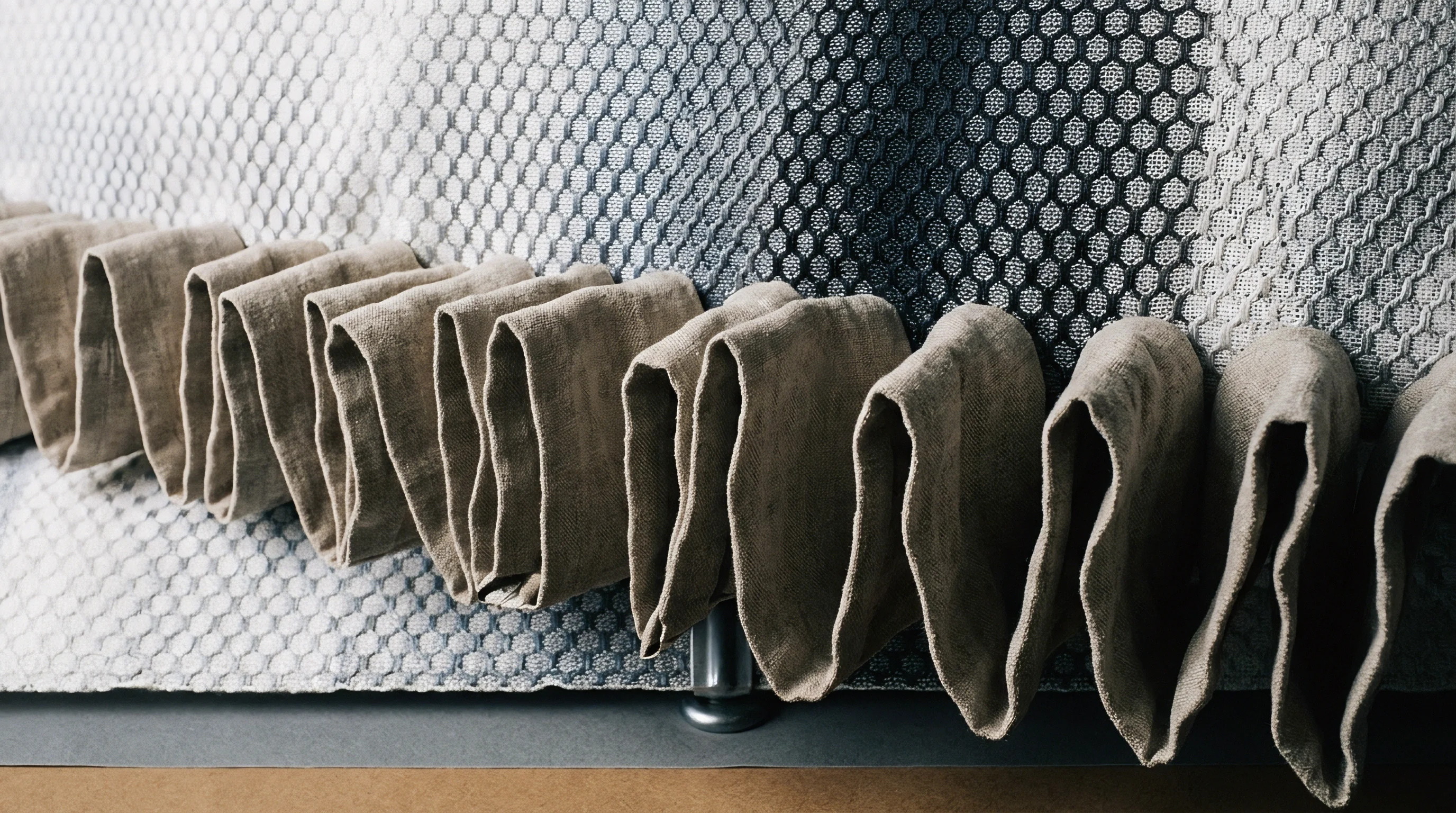
Fabric thickness also influences the transition from buckling to fluid drape. Plain weave consolidates mass into a thin, dense layer where intersections remain constrained in a single plane. Twill spreads mass across a thicker, three-dimensional profile that accommodates internal yarn shifting.
As twill bends, face floats slide relative to back floats, absorbing bending energy through low-friction displacement. This internal movement prevents buckling and preserves smooth drape geometry.
Fabric stiffness varies nonlinearly across increasing curvature thresholds.

Shear Deformation and Cross-Over Friction Thresholds
The crossover friction threshold marks the lateral force needed to initiate shear sliding between intersecting warp and weft threads. Node friction depends on surface roughness, sizing residue, fiber swelling, and crimp force. Wet-spun linen yarns exhibit high surface friction from the rigid structure of flax bundles and residual pectins.
In plain weave, high crimp forces clamp intersecting yarns together, creating a locked contact zone that requires high shear force to break.
Shear testing on a picture-frame rig maps force-displacement curves across weave architectures. Under increasing displacement, plain weave displays steep initial stiffness, resisting angular deformation until the friction threshold yields. The force drops abruptly, accompanied by surface buckling and diagonal wrinkling.
The resulting shear modulus (G) measures approximately 4.85 Newtons per metre-radian for 180 gram per square metre plain weave linen.
Tested under identical conditions, 2/2 twill produces a smooth, shallow force-displacement curve with shear resistance rising gradually. The calculated shear modulus for equal-weight 2/2 twill is approximately 1.82 Newtons per metre-radian. A lower shear modulus allows the fabric to stretch along the bias under light tension, providing tailored garments with the compliance needed to fit complex contours without extensive darting.
Wet processing and mechanical finishing modify crossover friction thresholds by changing fiber surface texture. Cellulase washing strips loose surface fibrils, lowering yarn-to-yarn friction. Liquid ammonia treatments swell the flax fibers, rounding yarn cross-sections and relaxing internal crimp strain.
While these finishes soften plain weave linen, they cannot override the geometric constraints of high crossover density; an enzymatically treated plain weave will always show higher shear resistance than an identically finished twill of matching weight.
Dynamic shear loads cause permanent skewing if the fabric lattice lacks elastic recovery. When shear forces push crossovers beyond their friction limits, plain weave tends to hold diagonal distortion, causing garments to twist after laundering. Twill structures accommodate shear through distributed float movement, settling back toward square when relaxed.
Quality procurement standards for linen require clear tolerances for allowable skew after laundering.


Inspection
Quality control protocols evaluate weaving defects using standardized point allocation systems. Inspecting greige linen off the loom requires illuminated inspection frames running at controlled speeds between 5 and 25 metres per minute. Inspectors score visual flaws against standardized criteria like the ASTM D5430 four-point system.
In plain weave linen, the tight structural symmetry highlights defects; small variations in pick spacing or warp tension disrupt the grid and become instantly visible.
Twill fabrics conceal certain greige defects more effectively because of their continuous diagonal texture. Minor pick-density variations blend into the diagonal ridges, reducing penalty scores during inspection. However, twills remain vulnerable to directional flaws including twill line distortion, float snags, and bias skewing.
Inspection of twill linen requires angled top lighting to reveal subtle float skips and mis-picks that direct lighting washes out.
| Defect Length / Nature | Penalty Points Assigned | Plain Weave Max Count (per 100 m²) | Twill Weave Max Count (per 100 m²) | Action Threshold |
|---|---|---|---|---|
| Defects up to 3 inches (75 mm) | 1 point | 12 points | 15 points | Minor repair / grading note |
| Defects 3 to 6 inches (75-150 mm) | 2 points | 8 points | 10 points | Process audit triggered |
| Defects 6 to 9 inches (150-230 mm) | 3 points | 4 points | 5 points | Loom stoppage / correction |
| Defects over 9 inches (230 mm) | 4 points | 2 points | 3 points | Full roll rejection / penalty |
| Continuous defects (e.g. reed marks) | 4 points per yard/metre | 0 points tolerated | 1 point tolerated | Immediate loom shutdown |
Defect point calculation follows the standard formula where total penalty points per 100 square metres equals total point count multiplied by 100, divided by inspected roll length in metres times usable fabric width in metres. High-grade apparel linen requires a total penalty score below 18 points per 100 square metres. Uncalibrated loom brake stop-motions cause pick density spikes on restarts; in Nm 26 plain weave linen, widespread micro-starting marks can drive defect rates to 26.4 points per 100 square metres, exceeding acceptable thresholds.

Four Point Grading Protocols for Greige Structural Defects
Applying four-point grading to grey linen requires distinct definitions for each fault type. A starting mark appears as a light or dark horizontal band across the width, caused by irregular pick packing when the loom restarts after a stop. In plain weave linen, a deviation of just 0.05 millimetres in pick spacing creates an obvious visual fault because tight crossovers leave no float space to absorb variations.
In twill, starting marks must be far more severe before breaking the diagonal texture enough to draw a 4-point penalty.
Reed marks represent another major defect in plain weave production. A reed mark is a continuous warp-way stripe caused by bent or misaligned reed wires that crowd adjacent ends while leaving gaps between neighboring dents. Because every end interlaces on every pick in plain weave, reed marks alter local cover factor and form permanent visual lines.
Backlit inspection tables reveal these defects as bright vertical streaks parallel to the selvage.
- Starting Marks show as dense pick clusters or wide gaps caused by improper loom brake tension during motor stops.
- Reed Stripes appear as continuous vertical gaps created by distorted reed wires crowding warp ends into localized bands.
- Broken Floats occur in twill structures when a warp end snaps, leaving un-interlaced weft segments hanging loose on the fabric face.
- Slub Entrapments form when thick nep clusters lodge inside tight plain weave crossover nodes, creating raised surface knots.
- Bias Skewing represents lattice twist where weft yarns sit at oblique angles relative to the selvage edge.
Slubs ~ thick fiber clusters inherent to flax spinning ~ behave differently in plain weave than in twill. In plain weave, large slubs are crushed during beat-up against opposing crossover nodes, expanding laterally, crowding adjacent ends, and creating raised knots that feel rough. In twill, longer float segments accommodate slubs with minimal distortion, allowing the thick fiber segment to sit flat within the float layer without generating localized stiffness or wear points.

Cantilever Stiffness and Cantilever Beam Displacement Methods
Objective measurement of fabric drape relies on cantilever stiffness testing under ISO 9073-7 or ASTM D1388. The fixed-angle cantilever test advances a 25 mm by 200 mm fabric strip at constant speed over a platform edge until the bending tip contacts an inclined plane set at 41.5 degrees below horizontal. Overhang length (L) is read directly in millimetres to calculate bending length (c) and flexural rigidity (B).
Bending length equals half the measured overhang length (c = L / 2). Flexural rigidity (B) in micro-Newton metres is calculated by multiplying fabric mass per unit area (W, in grams per square metre) by the cube of bending length (c3), scaled by a conversion constant (10-3). A 180 gram per square metre plain weave linen yields an overhang length of 68.4 millimetres, producing a bending length of 34.2 millimetres and flexural rigidity of 7.21 micro-Newton metres.
Equal-weight 2/2 twill yields an overhang length of 42.8 millimetres, a bending length of 21.4 millimetres, and a flexural rigidity of 1.76 micro-Newton metres.
Standard ISO 9073-7 cantilever testing proves that equal weight twill linen achieves less than one-fourth the absolute flexural rigidity of plain weave linen.
Cantilever testing reveals distinct directional anisotropy across warp, weft, and diagonal bias axes. Plain weave displays high stiffness along both warp and weft directions, with minor variations reflecting sizing pickup or crimp differentials. Twill linen shows moderate stiffness along warp and weft axes, but its diagonal bias stiffness drops substantially.
Tested at 45 degrees to the selvage, overhang length for twill falls by up to 35 percent relative to warp overhang length, demonstrating its capacity to deform along shear planes.
Drape coefficient (Cd) testing with circular drape meters (ISO 9073-9) provides three-dimensional analysis of fabric geometry. A circular specimen 300 millimetres in diameter is supported between horizontal discs 180 millimetres in diameter, letting the unsupported outer ring collapse under gravity onto an optical sensor floor. The drape coefficient represents the shadowed area of the draped fabric relative to the total area of the unsupported ring.
High values indicate stiff cloth; lower values indicate soft, fluid drape.
The drape coefficient for 180 gram per square metre plain weave linen falls between 65 and 75 percent, projecting a shadow formed by a few large, angular folds. Equal-weight 2/2 twill yields a drape coefficient between 35 and 45 percent, creating a symmetrical shadow with numerous small, rounded folds. This difference in drape coefficient directly correlates with visual assessments of drape fluidity in finished apparel and home furnishings.
Structural resistance to bending shifts as deformation moves beyond initial elastic limits.

Post Wash Dimensional Alterations and Residual Shrinkage
Dimensional stability testing after laundering (ISO 5077) highlights how weave mechanics control shrinkage and compaction. Linen undergoes significant dimensional change in wet finishing as weaving tensions relax and flax fibers swell. Weave geometry determines whether fiber swelling produces linear fabric shrinkage or structural thickening.
Dense plain weave exhibits substantial warp shrinkage during early wash cycles as crimp consolidates within its tightly packed matrix.
In plain weave, swollen weft yarns force warp ends along a longer path around each pick, increasing warp crimp and pulling the fabric together along its length. For 180 gram per square metre plain weave linen, unrestrained warp shrinkage after three standard 40°C wash cycles typically reaches 7.5 to 9.0 percent. Restricting this shrinkage through mechanical sanforization can over-stretch locked crossover nodes, storing residual tension that releases during subsequent laundering.
Twill linen shows less warp crimp consolidation during washing due to its floating yarn geometry. Swelling weft picks push against long floats that displace into open internal voids rather than forcing warp path elongation. Warp shrinkage for equal-weight 2/2 twill typically ranges between 4.0 and 5.5 percent under identical wash conditions.
Lower shrinkage stabilizes pattern cutting and reduces the risk of seam puckering from differential shrinkage against sewing thread.
Post-wash abrasion resistance also emphasizes structural differences between plain and twill constructions. Martindale testing (ISO 12945-2) rubs samples under constant pressure against standard wool abradant. In plain weave, raised crossover nodes take the brunt of initial abrasive contact as localized wear points.
High pressure on these individual nodes causes rapid fuzzing, micro-fibrillation, and early yarn breakdown between 18,000 and 22,000 rubbing cycles.
Twill linen spreads abrasive contact across the broader surface of its floating yarn segments. Long floats slide beneath the abradant pad, distributing friction across multiple fiber bundles rather than concentrating stress on raised nodes. Under identical Martindale conditions, 2/2 twill linen reaches thread breakdown between 32,000 and 38,000 rubbing cycles.
This higher durability makes twill well suited for upholstery and contract textiles requiring extended wear life alongside soft drape.
Un-scoured plain weave linen that shrinks past pattern tolerances can impose landed cost penalties around €1.40 per metre when finished panels require manual re-cutting.


Ledger
Loom capacity costing relies on converting warp and weft insertion rates into direct machine operating hours. Purchasing woven fabric effectively buys dedicated shed time on weaving machinery. Capacity models evaluate loom productivity using picks per minute (PPM), achievable shed efficiency, warp change downtime, and electrical draw per woven linear metre.
Plain weave geometry imposes physical speed limits and higher mechanical stress compared to twill, directly raising unit manufacturing costs.
High beat-up resistance in dense plain weave linen forces mills to lower loom speeds to protect drive motors and limit warp end breaks. A modern high-speed rapier loom operating across a 190-centimetre reed width can weave 2/2 twill linen at 480 picks per minute at 88 percent average shed efficiency. The same loom running equal-weight plain weave linen must drop to 390 picks per minute to keep tension spikes below yarn fatigue thresholds, while shed efficiency falls to 81 percent due to more frequent warp stops.
| Operational Parameter | 1/1 Plain Weave (180 g/m²) | 2/1 Twill (180 g/m²) | 2/2 Balanced Twill (180 g/m²) |
|---|---|---|---|
| Warp / Weft Sett (threads/cm) | 19.0 / 19.0 | 21.5 / 21.5 | 23.0 / 23.0 |
| Loom Speed (Picks Per Minute) | 390 PPM | 440 PPM | 480 PPM |
| Shed Operating Efficiency (%) | 81.5% | 85.0% | 88.2% |
| Weaving Rate (Metres Per Hour) | 7.36 m/hr | 7.38 m/hr | 7.52 m/hr |
| Total Loom Hours per 1,000 m | 135.8 hours | 135.5 hours | 133.0 hours |
| Direct Shed Operating Cost / Metre | €2.45 / metre | €2.44 / metre | €2.40 / metre |
| Sizing & Chemical Finishing Cost | €1.15 / metre | €0.95 / metre | €0.88 / metre |
| Total Landed Greige Cost / Metre | €6.82 / metre | €6.78 / metre | €6.71 / metre |
Hourly production rates determine baseline shed cost. The weaving rate in linear metres per hour equals loom speed in picks per minute multiplied by 60 minutes, multiplied by shed efficiency percentage, divided by picks per centimetre times 100. For 180 gram per square metre plain weave running at 390 PPM at 81.5 percent efficiency with 19 picks per centimetre, output reaches 7.36 linear metres per hour.
Equal-weight 2/2 twill running at 480 PPM at 88.2 percent efficiency with 23 picks per centimetre yields 7.52 linear metres per hour, despite carrying 21 percent more picks per centimetre.
Loom Speed Limitations and Power Allocation
Loom power draw correlates directly with shed opening height and beat-up force. Weaving high-density plain weave requires higher motor torque during beat-up to seat weft picks into locked crimp bends. Power monitoring on industrial rapier looms records average draws of 7.8 kilowatt-hours for plain weave linen, compared to 6.4 kilowatt-hours for 2/2 twill linen on identical frames.
Higher energy demand increases direct overhead allocations per linear metre.
Mechanical wear accelerates when running plain weave linen under high cyclic tension. Harness ribbons, heald wires, drop wires, and reed dents experience heavy friction and vibration. Mill maintenance records show heald wire replacement cycles shorten by 35 percent on frames assigned continuously to plain weave flax.
Weaving mills incorporate these wear rates into overhead models, adding maintenance surcharges to quotations for dense plain weave specifications.
Loom operating speed serves as the primary driver of shed allocation cost.
Warp changeovers consume critical loom capacity. Loading a new warp beam requires tying-in, drawing-in, harness alignment, and drop-wire setting. A full change demands 4 to 6 hours of technician time while the loom stands idle.
Plain weave warps use simpler 2-frame or 4-frame drawing-in sequences than complex twills, reducing setup time; however, higher end-breakage rates during startup on plain weave erode these initial savings.

Capacity Allocation and Setup Charge Arithmetic
Minimum order quantities and warp setup charges reflect fixed beam preparation costs and loom downtime. Producing a custom linen warp requires a minimum warp length ~ typically 1,500 to 3,000 metres ~ to amortize creel setup, sizing bath preparation, yarn waste, and tying-in labor. When an order falls below minimum warp length, the mill levies a setup surcharge to cover un-amortized machine time.
Warp setup calculations isolate fixed machine costs from variable yarn and finishing expenses. Calculating setup surcharge (Sw) follows the formula where setup cost equals total labor hours multiplied by hourly shop rate, plus sized yarn waste mass times raw yarn price per kilogram, plus lost loom margin during downtime. For an Nm 26 linen warp, yarn waste during setup averages 25 kilograms.
At an hourly shop rate of €65 and yarn cost of €14 per kilogram, fixed setup charges reach €825 per change, adding €1.65 per metre to greige fabric on a short 500-metre run.
Long production runs amortize setup charges to negligible levels, shifting unit costs back to yarn mass and loom speed. Committing to annual warp reservations ~ allocating 10,000 to 50,000 metres of standardized warp across repeating runs ~ eliminates setup surcharges. Standardizing warp specifications across product lines allows mills to vary weft densities and weave structures without changing the main beam, maximizing loom occupancy and throughput.

Landed Metre Cost Calculations for Equal Weight Options
Landed cost models combine raw fiber, sizing, direct loom operating costs, wet finishing, process waste allowances, and freight tariffs into a final price per finished linear metre. Raw materials represent the largest expense in linen manufacturing, accounting for 50 to 60 percent of total landed cost. Wet-spun flax yarn prices fluctuate with European crop yields, yarn count, and bleaching levels.
Consider the total landed cost breakdown for 1,000 metres of finished 180 gram per square metre linen fabric delivered to a European distribution warehouse. The 1/1 plain weave specification uses Nm 26 yarn (19 ends/cm by 19 picks/cm), requiring 198 kilograms of raw yarn per 1,000 finished metres to cover 8 percent total process waste (warping scrap, selvage trim, and finishing shrinkage). At a yarn price of €14.50 per kilogram, total yarn cost comes to €2,871 (€2.87 per metre).
Direct loom operating costs of €2.45 per metre, sizing and chemical finishing of €1.15 per metre, and freight/duty of €0.35 per metre produce a total landed cost of €6.82 per finished linear metre.
Subsequent production runs confirm these cost allocations under standard mill conditions.
The equal-weight 2/2 twill option uses the same Nm 26 yarn but requires higher thread density (23 ends/cm by 23 picks/cm) to reach 180 grams per square metre. Total raw yarn mass increases to 226 kilograms per 1,000 finished metres due to the higher thread count, partially offset by a lower 5 percent finishing shrinkage rate. Total yarn cost rises to €3,277 (€3.28 per metre).
However, faster loom speeds (€2.40 per metre weaving cost) and lower sizing and desizing demands (€0.88 per metre finishing cost) reduce non-material expenses, bringing total landed cost for the twill to €6.71 per finished linear metre.
Despite requiring 14 percent more yarn mass for equivalent weight, 2/2 twill linen finishes at a lower landed cost per metre than plain weave. Sourcing buyers often assume higher thread count twills carry a price premium over lower thread count plain weaves. Loom economics contradict this assumption: fewer warp break stops, faster weaving speeds, and reduced chemical finishing allow twill structures to achieve landed cost parity or savings while delivering superior drape fluidity and flexural performance.
Commercial sales contracts should specify flexural rigidity tolerances via ISO 9073-7 cantilever testing alongside thread count specifications, binding the mill to deliver verified drape performance rather than nominal fabric weight alone.