Reconciling Wet Processed Linen Weight Loss against Commercial Loom Hour Billing Allowances
Reconciling wet processed linen weight loss against loom hour billing requires adjusting greige pick counts for chemical extraction and structural shrinkage.
Mass
Raw flax fibers arriving at the spinning frame carry pectic substances, fats, waxes, hemicellulose, lignin, and residual cellular matter that separate from primary cell walls during aqueous processing. Removing pectin reduces yarn diameter noticeably. Non-cellulosic constituents account for nine to twelve percent of total dry fiber mass in wet-spun flax yarn, whereas dry-spun tow yarns retain fifteen to twenty percent.
Primary warp preparation adds another two to four percent in water-soluble starches or synthetic binders to withstand mechanical abrasion during shedding.
When greige linen cloth undergoes finishing, hot aqueous processing strips these non-cellulosic components along with applied warp sizes. Alkaline scouring with sodium hydroxide saponifies natural waxes and hydrolyzes pectins within the middle lamella. Hydrogen peroxide bleaching oxidizes residual lignin fragments to hit target Whiteness Index values, while caustification expands the crystalline cellulosic lattice, smoothing yarn contours and removing loose surface fibrils.
| Yarn Spinning System | Scouring Loss Range (%) | Bleaching Mass Loss (%) | Warp Crimp Increase (%) | Net Weight Variance (%) |
|---|---|---|---|---|
| Wet-Spun Long Flax (Nm 26) | 6.2 – 7.5 | 2.1 – 3.0 | 4.5 – 6.2 | -8.3 to -10.5 |
| Wet-Spun Long Flax (Nm 14) | 7.8 – 9.1 | 2.8 – 3.5 | 5.2 – 7.0 | -10.6 to -12.6 |
| Dry-Spun Tow Linen (Nm 9.5) | 11.5 – 13.8 | 3.8 – 4.9 | 6.8 – 8.5 | -15.3 to -18.7 |
| Half-Linen Cotton-Warp (Nm 26/2) | 4.1 – 5.2 | 1.5 – 2.2 | 3.1 – 4.8 | -5.6 to -7.4 |
| Data derived from ISO 3801 laboratory boil-off trials under standardized alkaline liquor conditions at 98°C. | ||||

Chemical Extraction Dynamics
Alkaline scouring at elevated temperatures strips natural lipids alongside middle-lamella pectins, with higher water temperatures accelerating breakdown rates. Industrial scouring baths deploy chelating agents to isolate calcium ions that stabilize pectin networks; as these binders dissolve, fine mineral dust and soluble polysaccharides wash into the liquor, directly diminishing total substrate mass before oven drying establishes exact clean yields.
Enzyme biopolishing removes 3.5 to 5.0 percent of greige fabric mass at a liquor ratio of 10:1 without altering reed denting.
Subsequent enzymatic biopolishing uses cellulase enzymes to cleave microfibril protrusions from yarn surfaces, enhancing hand feel and reducing pilling tendencies while removing an additional three to five percent of pure cellulosic material. Cumulative dry mass loss across combined scouring, bleaching, caustification, and enzymatic biopolishing frequently reaches twelve to eighteen percent relative to initial greige weight. A buyer calculating finished fabric yield directly from unadjusted greige warp weights will systematically miscalculate landed square-metre costs.
Failing to account for chemical mass depletion during initial yarn budgeting causes severe cost overruns when finished shipments fail to meet contracted total weight metrics.
Allowance
Commercial loom booking frameworks convert mill shed time into financial charges based on projected picks per minute and warp utilization. Because a weaver incurs fixed operating overheads per machine hour ~ including power consumption, labor, electronic jacquard or dobby maintenance, and floor space allocation ~ contract quotes reflect total loom hours consumed to insert the required pick volume rather than final cloth weight.
Discrepancies arise because looms insert yarn based on greige pick density, whereas buyers purchase finished yardage defined by target weight, width, and hand feel. Greige picking rates dictate machine time: running at four hundred picks per minute inserting twenty picks per centimetre, a loom produces 1.2 linear metres of greige cloth per operating hour at full shed efficiency, or 0.984 linear metres under a standard eighty-two percent allowance.

Shed Billing Structures
Weaving capacity agreements frequently bill clients per operational machine hour rather than per delivered yardage bolt, relying on an assumed ratio between yarn mass mounted on the warp beam and fabric mass arriving at the folding table. Standard commercial allowances grant the weaver a two to three percent waste factor for selvedge trim, warp tying ends, and beam remnants under the assumption that yarn enters and exits the loom at virtually equivalent mass.
- Greige Mass Standard establishes baseline loom hour allocations using raw un-washed yarn weights directly from the spinning package.
- Chemical Extraction Gap creates billing disputes when wet processing removes fifteen percent of yarn mass after loom hour charges finish accruing.
- Warp Contraction Offset compensates partial weight loss through longitudinal fabric shrinkage that concentrates picks into fewer finished linear metres.
- Unreconciled Loom Invoicing occurs when weavers bill supplementary machine hours to replace mass lost during aggressive vat scouring routines.
Loom hours represent mechanical work already performed that cannot be retroactively discounted simply because chemical processing stripped organic mass from the fiber.

Vat
Aqueous finishing vessels impose severe hydromechanical forces on woven flax substrates during boil-off routines. Processing cloth in jet dyeing machines or continuous open-width scouring lines alters yarn physical geometry while stripping non-cellulosic impurities. As pectins dissolve, individual flax fibers shift within the bundle; yarn linear density drops in tex value, yet overall fabric structure compacts both longitudinally and laterally, raising thread counts.
ISO 3801 testing establishes commercial mass tolerance limits that trigger automated loom-hour billing adjustments.
Tensionless aqueous relaxation increases warp crimp substantially, typically expanding a five percent greige crimp to eleven or twelve percent following hot scouring and drying. This physical contraction increases picks per centimetre in the relaxed fabric ~ a greige cloth woven at eighteen picks per centimetre expands to twenty-one picks per centimetre in its finished state. Structural compaction partially offsets chemical mass loss on a grams-per-square-metre basis, but reduces total linear yield harvested from the warp beam.
Does Loom Speed Adjust for Chemical Loss?
Mechanical insertion rates remain constant regardless of downstream weight changes caused by hot liquor baths. A rapier loom operates at its calibrated velocity whether weaving heavy greige tow or ultra-clean wet-spun yarns, accruing billing charges strictly according to machine revolutions recorded by the monitoring system. Loom hours measure mechanical insertion effort rather than net chemical yield after dyeing, while finishing shrinkage compresses the woven web to concentrate pick counts over a reduced overall bolt length.
Linear yardage shrinkage and chemical mass loss operate in opposite directions on fabric weight per unit area, making finished square-metre mass an unreliable indicator of actual loom hours expended.
Capacity
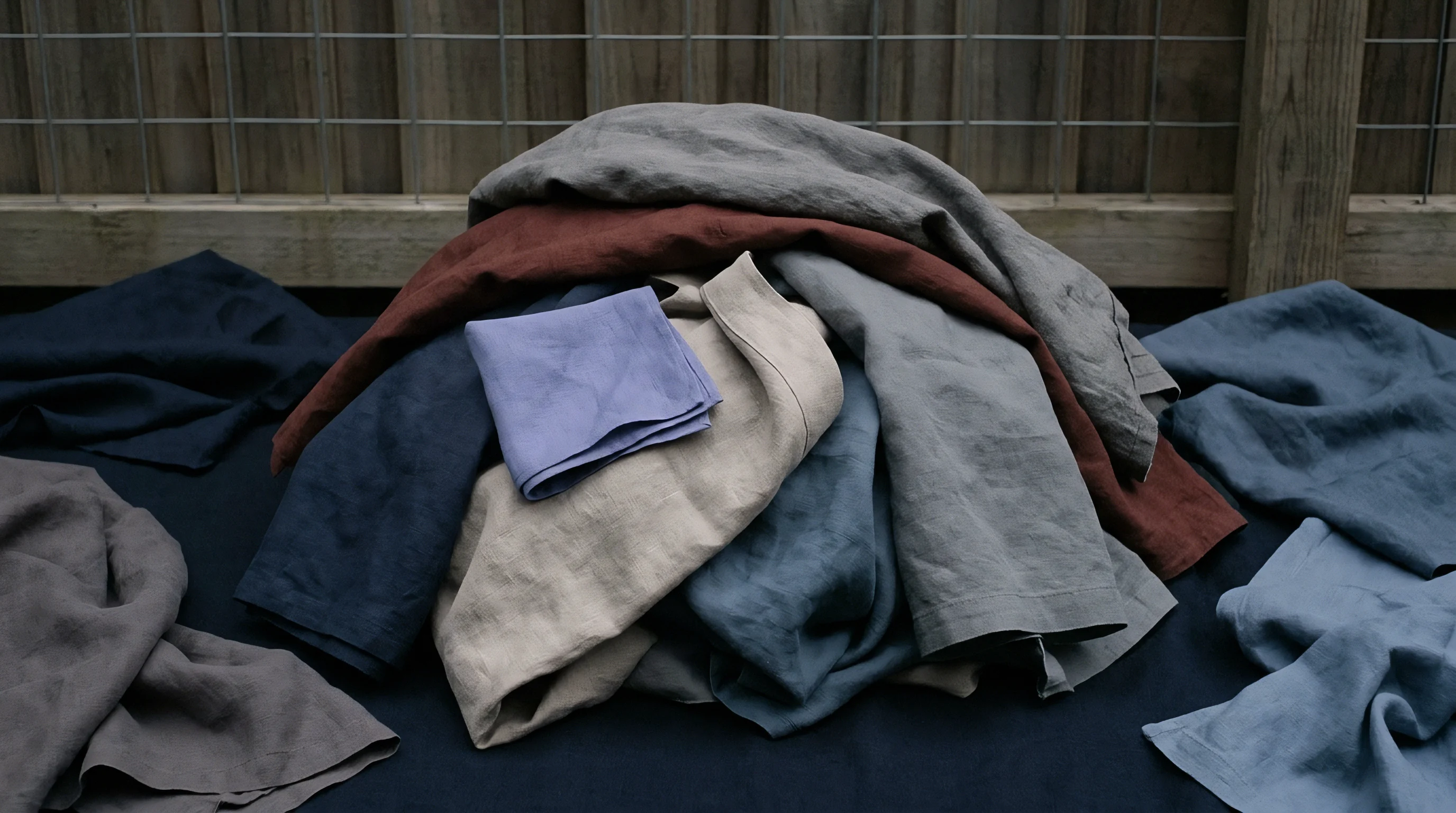
Production planning models calculate required machine allocations using warp length formulas and expected reed beat-up rates. To evaluate the financial gap between greige loom-hour billing and finished wet-processed cloth delivery, consider a standard commercial production run: a buyer specifies five thousand finished linear metres of pure wet-spun linen fabric at a target weight of two hundred grams per square metre and a finished width of one hundred forty centimetres.
Worked Loom Allocation Model
This baseline order of five thousand finished linear metres yields exactly 1,400 kilograms of finished linen fabric. Passing through hot alkaline scouring, peroxide bleaching, and cellulase biopolishing, testing under ISO 3801 establishes an aggregate wet-processing mass loss of 12.5 percent for this specific yarn batch. Simultaneously, aqueous relaxation causes a 6.8 percent longitudinal length shrinkage and an 8.0 percent lateral width contraction.
Delivering five thousand finished linear metres requires the weaving shed to produce 5,365 linear metres of greige fabric off the loom at a width of one hundred fifty-two centimetres. Greige pick density set at 17.5 picks per centimetre compacts to 18.8 picks per centimetre in the finished cloth, requiring 93,887,500 total loom insertions.
| Finishing Ensemble | Greige Target GSM | Wet Process Loss (%) | Finished Output GSM | Billing Adjustment Factor |
|---|---|---|---|---|
| Scoured & Semi-Bleached | 215 | 8.5 | 202 | 1.028 |
| Full Bleach & Caustified | 228 | 13.2 | 205 | 1.074 |
| Enzyme Washed & Dyed | 242 | 16.8 | 201 | 1.121 |
| Softened Greige (Control) | 204 | 2.1 | 200 | 1.005 |
Running a 220 cm rapier loom at 380 picks per minute with an audited shed efficiency of 83 percent yields an effective insertion speed of 315.4 picks per minute, or 1.08 linear metres of greige cloth per hour. Total machine time required to weave the order equals 4,961 loom hours. At a commercial rate of $16.50 per loom hour, total weaving charges reach $81,856.50 ~ equating to $16.37 per finished linear metre in raw weaving costs alone.
If the buyer contracted on a simple greige-weight basis assuming zero chemical mass loss, projected yarn weight would have been 1,600 kilograms. Actual greige yarn consumed was 1,782 kilograms to account for the 12.5 percent chemical extraction in the vat, leaving an unrecovered gap of 182 kilograms of material. The list below outlines decision parameters for auditing loom billing allowances.
- Target Finished Yield defines contract obligations in net linear metres post-finishing rather than gross greige bolt output.
- Mass Extraction Benchmark establishes pre-approved percentage deductions for pectin and size removal prior to loom charge calculations.
- Crimp Contraction Factor calculates true warp length consumption per finished metre based on boiled-off crimp state.
- Loom Efficiency Reconciliation aligns billed machine hours with verified pick counters on the weaving machine console.
Under ISO 6741 testing of Nm 26 wet-spun yarn, a three-percent shift in liquor temperature changes total pectin extraction by 2.4 percent. Auditing these batches requires distinguishing natural pectin variability from excessive chemical dwell time during scouring.
Verification
Laboratory testing isolates physical yarn structural changes from chemical removal of pectin and wax complexes by comparing greige retain samples directly against fully processed cloth rolls. Oven-dry mass determination under ISO 6741 provides the standard reference for establishing clean dry fiber mass, weighing desiccated test specimens before and after chemical extraction to calculate exact non-cellulosic mass fractions.
Heavier yarn counts retain a higher proportion of non-cellulosic impurities through initial scouring than fine wet-spun yarns.
Combining ISO 3801 mass testing with ISO 7211 pick density and yarn crimp measurements enables engineers to calculate structural compaction separately from chemical weight loss. Auditors use these combined metrics to reconcile disputed loom-hour invoices.
- Extract three representative greige swatches across the width of the woven roll prior to wet processing.
- Condition samples according to ISO 139 standard atmosphere (20°C, 65% relative humidity) for twenty-four hours.
- Determine dry mass of greige samples using ISO 6741 desiccated oven drying at 105°C.
- Perform standardized alkaline scour under ISO 105 boil-off conditions to remove all soluble sizes and pectins.
- Re-dry and weigh extracted samples to calculate exact percentage of chemical mass loss.
- Measure finished pick density and warp crimp percentage using ISO 7211-2 and ISO 7211-3 test methods.
- Apply mass loss and crimp contraction percentages to the master loom-hour allocation formula.
Standard commercial purchase agreements incorporating ISO 3801 mass reconciliation clauses adjust final invoice payments automatically when laboratory mass loss figures deviate by more than 1.5 percent from agreed greige benchmarks.

Contract
Sourcing agreements establish conversion schedules linking loom machine runtimes directly to finished cloth yield. Machine runtime charges must reflect both mechanical insertion performance and chemical mass conversion ratios; defining billing rates purely per machine hour exposes buyers to substantial cost inflation when wet processing losses run high. Defining dynamic weight-adjustment factors inside the contract protects both mill operator and buyer.

Commercial Reconciliation Formulas
Master supply agreements introduce sliding scale billing tables that automatically adjust final invoice totals based on yarn spinning type and targeted finishing intensity. When actual measured mass loss exceeds the baseline limit, the loom hour billing rate scales down proportionally to compensate for the reduced linear yardage yield harvested by the buyer.
Shed efficiency drops rapidly when un-bleached linen warps deposit heavy pectin dust into rapier guide channels.
Equally, contracts protect weavers against variable raw flax batch characteristics: if a raw flax lot carries unusually high pectin content, documented chemical mass losses can be passed through without incurring machine-efficiency penalties. Incorporating clear ISO test protocols, pre-calculated crimp expansion factors, and baseline boil-off allowances into the master purchase order creates a transparent accounting bridge between shed machine time and landed fabric weight.