Mechanistic Coupling between Moisture Regain and Dynamic Bending Energy Dissipation in Bast Fiber Structures
Moisture plasticizes the amorphous pectin matrix in bast bundles, lowering yarn flexural rigidity while elevating cyclic bending energy dissipation.


Sorption
Water uptake within bast cell structures alters the mechanical response of flax and hemp bundles through selective hydration of non-crystalline cell wall components. Under ISO 139 standard conditions of 20 degrees Celsius and 65 percent relative humidity, refined flax displays a moisture regain between 10.5 and 12.0 percent. Dry bast bundles at 35 percent relative humidity retain approximately 5.5 to 6.2 percent moisture, whereas exposure to 85 percent relative humidity elevates regain past 16.5 percent.
This absorbed moisture does not distribute evenly across the fiber cross section. Crystalline cellulose microfibrils, aligned at a tight microfibrillar angle between 6 and 10 degrees along the primary fiber axis, resist water penetration. Sorbed molecules accumulate in the amorphous interlamellar matrix, consisting of branched rhamnogalacturonans, xyloglucans, and residual lignins that cement adjacent elementary cells together.
Flax fibers swell radially under moisture. Transverse diametric swelling reaches 18 to 23 percent when transitioning from bone dry conditions to full saturation, whereas axial elongation remains below 0.3 percent. As water molecules bind to open hydroxyl groups on hemicellulose and pectin side chains, the cohesive inter-chain hydrogen bonding network disengages.
The glass transition temperature of this hydrated amorphous phase drops from roughly 85 degrees Celsius in dry states to below 15 degrees Celsius at 12 percent moisture regain, shifting the matrix from a glassy, brittle state into a compliant rubbery network at room temperature.
Water uptake shifts the non-crystalline polysaccharide phase below ambient room temperature through molecular plasticization.
Cell wall softening alters the response of technical flax yarns subjected to alternating flexure, dropping flexural rigidity under high humidity. In dry conditions, elementary fibers bound by stiff glassy pectins bend as a monolithic composite beam, generating high elastic resistance and modest mechanical damping. When plasticized by moisture regain exceeding 10 percent, individual elementary cells slip past one another along the middle lamella during cyclic curvature.
The internal mechanical energy applied to deflect the yarn dissipates into heat through viscous shear in the softened inter-fiber matrix.
| Relative Humidity | Moisture Regain | Flexural Rigidity B | Bending Hysteresis 2HB | Loss Factor Tan Delta |
|---|---|---|---|---|
| 35 Percent | 5.8 Percent | 0.48 mN cm² | 0.14 mN cm | 0.038 |
| 50 Percent | 8.4 Percent | 0.39 mN cm² | 0.19 mN cm | 0.052 |
| 65 Percent | 11.6 Percent | 0.29 mN cm² | 0.28 mN cm | 0.076 |
| 80 Percent | 15.2 Percent | 0.21 mN cm² | 0.36 mN cm | 0.098 |
| 90 Percent | 18.9 Percent | 0.16 mN cm² | 0.43 mN cm | 0.119 |
Data recorded on automated Kawabata KES-FB2 micro-bending units confirms this inverse relationship between elastic bending rigidity and dynamic hysteretic loss. A 42 wet-spun flax yarn tested at 35 percent relative humidity demonstrates a bending rigidity of 0.48 millinewton square centimeters per yarn, with an energy loss per cycle of 0.14 millinewton centimeters. Elevating ambient humidity to 80 percent suppresses flexural rigidity by 56 percent while expanding the bending hysteresis loop width by 157 percent.
The loss factor tan delta climbs steadily as the amorphous matrix transitions toward viscous flow.
In dry environments, external deformation forces are stored elastically by crystalline cellulose chains, returning the yarn to its initial position without permanent displacement. When moisture elevates past 14 percent, the viscous dissipation of the polysaccharide matrix dominates the mechanical response, converting mechanical input into localized thermal energy. If conditioning parameters deviate by more than 5 percent relative humidity during tensile and flexural qualification trials, the measured damping capacity shifts by more than 15 percent, invalidating incoming lot acceptance data and producing off-spec composite preforms or acoustic panels.
Sheath
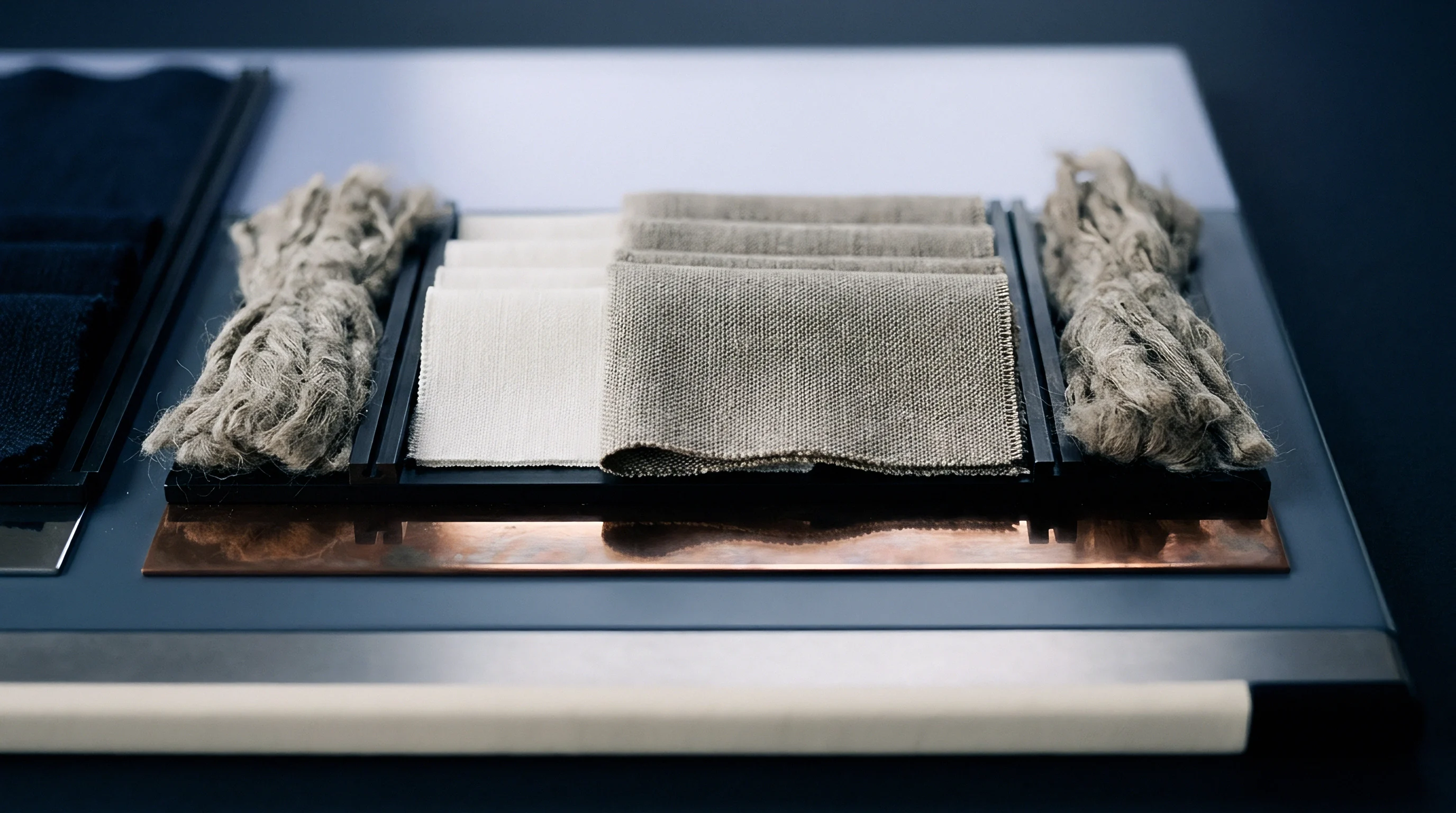
Elementary bast fibers cluster in bundles enveloped by an exterior peripheral boundary layer rich in lipophilic waxes and calcium-pectate cross-links. This composite mantle controls both liquid absorption rates and transverse stress transfer during multi-axial bending. Within a technical yarn strand, between ten and forty elementary fibers align in parallel groups, bound together by the intercellular middle lamella.
When an external bending moment flexes the yarn, tensile stresses concentrate on the convex outer circumference, while compressive stresses accumulate along the concave inner curvature.
Yarn cross sections flatten under tension. The elementary fibers situated at the neutral bending plane experience pure shear, forcing the binding sheath and inter-elementary matrix to deform in simple shear. Under cyclic bending, the strain distribution creates localized shear bands across the elementary interfaces.
If moisture levels remain low, the shear strength of the middle lamella exceeds the transverse compressive strength of the elementary lumen, triggering brittle transverse cracking across fiber walls.
A 42 wet-spun flax yarn exhibits a 157 percent expansion in bending hysteresis width as relative humidity rises from 35 to 80 percent.
Progressive mechanical degradation follows distinct phases during repeated oscillatory flexure in bast strands under varying moisture contents:
- Initial Elastic Flexure generates minor inter-lamellar strain without relative displacement between elementary cells, storing the input energy within cellulose crystalline regions.
- Matrix Plastic Slip initiates along the middle lamella once moisture exceeds 9 percent regain, transferring shear strain into viscous sliding between adjacent primary walls.
- Peripheral Delamination detaches the exterior waxy mantle from internal bundles under persistent cyclic curvature, allowing individual fiber bundles to rotate independently.
- Elementary Micro-Buckling forms visible kink bands on compressive faces during reversed bending cycles, reducing flexural recovery by 30 to 45 percent.
- Terminal Bundle Cleavage separates structural elementary units entirely, causing total loss of tensile cohesion along the broken yarn strand.
Kink bands, formed during compressive bending phases, represent permanent dislocations of crystalline cellulose microfibrils across the S2 layer. These dislocation zones act as moisture accumulation sites because cellulose chains lose their tight lateral organization. The locally disrupted microfibrils attract additional polar water molecules, concentrating plasticization within narrow transverse defect lines.
Hysteresis loops widen during humid flexure. Each successive bending oscillation dissipates more energy through the damaged matrix than through undisturbed sections.
A technical inquiry remains regarding whether selective enzymatic degumming of outer bundle layers preserves the core structural middle lamella sufficiently to retain flexural damping capacity while eliminating the progressive micro-buckling that prematurely fatigues industrial flax cords.
Interlock
Loom interlacing translates filament-scale viscoelastic dissipation into structural resistance across the woven sheet. When yarns cross in plain or twill drafts, the contact pressure generated at binding crossover points constrains lateral strand displacement during cyclic out-of-plane flexure. A plain cloth with 18 ends per centimeter and 16 picks per centimeter of 26 wet-spun linen presents high interlacing frequency, creating an interlocking matrix where yarn-to-yarn Coulomb friction superimposes upon cell-wall viscous dissipation.
Does Cell Wall Plasticization Alter Yarn Damping?
Water plasticizes amorphous cell wall components. As moisture increases from 8 to 14 percent regain, yarn diameter swells by up to 20 percent, which compacts adjacent yarns tightly inside the available dent and pick spacing. This expansion drives warp and weft yarns against one another at every crossover point, elevating normal forces across contact interfaces.
The static frictional resistance increases, demanding higher bending moments to initiate relative yarn sliding. In low-tension dynamic bending regimes, the cloth behaves as an integrated plate, yielding high initial flexural rigidity.
Once cyclic deflections exceed the static frictional threshold, yarn sliding commences across the crossover points. Inter-yarn friction then adds to the internal viscoelastic dissipation generated by the plasticized middle lamella. In dense plain cloth, the amplitude of relative yarn movement is restricted, confining cyclic dissipation primarily to intra-yarn fiber shearing.
In looser 2/2 twill or 3/1 satin configurations with float lengths spanning multiple picks, yarns deform through combined bending, torsion, and longitudinal slip, substantially boosting the total damping capacity of the fabric web.
Operating a rapier shed on raw bast warps under variable moisture environments introduces serious mechanical processing challenges. Running with insufficient air conditioning produces immediate shed faults across both plain and twill drafts:
- Excessive Reed Abrasion degrades warp bundles when ambient humidity drops below 55 percent, shedding brittle pectin dust into dropper boxes and guide eyes.
- Starting Marks appear across the fabric face after prolonged loom stoppages as stressed linen yarns lose tension through moisture-driven stress relaxation.
- Uneven Crimp Transfer distorts pick alignment across full reed widths when warp moisture oscillates between daytime and night-shift shed cycles.
- Harness Binding Faults emerge at relative humidity levels above 78 percent because swollen flax ends expand in heddle eyes, causing mispicks and warp breaks.
Reducing pick density from 18 to 13 picks per centimeter in a 240 gram per square meter linen base allows the weft to undulate freely around the warp, enhancing the dynamic loss factor tan delta by 28 percent under 0.5 Hertz cyclic oscillation. Sizing formulations based on modified potato starches or carboxymethyl cellulose coat the outer bundle perimeter, shielding the internal matrix from atmospheric moisture shifts during weaving. Desizing and scouring during wet finishing strip these protective polymers, exposing the naked hydrophilic cellulose and pectins to ambient conditions.
Intermittent yarn clinging in the drop wires is often attributed to poor spinning twist distribution, though the defect invariably stems from fluctuating shed humidity causing irregular fiber swelling and frictional drag.


Oscillation
Cyclic mechanical deflection of bast cloth under controlled atmospheric chambers permits isolation of frequency-dependent dissipation properties. Testing conducted across frequencies between 0.1 Hertz and 10 Hertz mimics the physical vibrations encountered in acoustic dampening barriers, sports equipment laminates, and automotive interior panels. Dynamic mechanical analysis under tension-tension or dual-cantilever bending demonstrates that bast textiles possess a pronounced loss factor peak within this mechanical bandwidth at ambient temperatures.
Do Float Geometries Govern Cyclic Energy Loss?
Bending deflection profiles vary significantly with weave architecture. In a plain interlacing, each warp end alternates over and under single picks, creating short crimp wavelengths and steep yarn inclination angles of 18 to 25 degrees. In a 2/2 twill, the float length doubles, reducing yarn curvature at crossover points and dropping inclination angles to 12 to 16 degrees.
Under cyclic out-of-plane flexure, the 2/2 twill dissipates 34 percent more kinetic energy per cycle than the plain cloth of identical yarn count and sett, because longer floats accommodate greater inter-fiber shear displacement before contact locking occurs.
ASTM D5430 four-point inspection standards reject greige linen rolls containing structural pick distortions exceeding three percent across continuous ten-meter inspections.
| Weave Structure | Yarn Count | Sett (Ends × Picks/cm) | RH / Regain | Storage Modulus E’ | Loss Modulus E” | Damping Ratio Tan Delta |
|---|---|---|---|---|---|---|
| 1/1 Plain Interlacing | 26 Wet-Spun | 17.0 × 15.5 | 45% / 7.2% | 4.12 GPa | 0.23 GPa | 0.056 |
| 1/1 Plain Interlacing | 26 Wet-Spun | 17.0 × 15.5 | 65% / 11.4% | 2.84 GPa | 0.29 GPa | 0.102 |
| 1/1 Plain Interlacing | 26 Wet-Spun | 17.0 × 15.5 | 85% / 17.1% | 1.95 GPa | 0.31 GPa | 0.159 |
| 2/2 Balanced Twill | 26 Wet-Spun | 19.5 × 18.0 | 45% / 7.3% | 3.45 GPa | 0.27 GPa | 0.078 |
| 2/2 Balanced Twill | 26 Wet-Spun | 19.5 × 18.0 | 65% / 11.5% | 2.25 GPa | 0.31 GPa | 0.138 |
| 2/2 Balanced Twill | 26 Wet-Spun | 19.5 × 18.0 | 85% / 17.0% | 1.48 GPa | 0.32 GPa | 0.216 |
| 4-End Satin (1/3) | 26 Wet-Spun | 21.0 × 19.5 | 45% / 7.1% | 3.10 GPa | 0.28 GPa | 0.090 |
| 4-End Satin (1/3) | 26 Wet-Spun | 21.0 × 19.5 | 65% / 11.3% | 1.89 GPa | 0.30 GPa | 0.159 |
| 4-End Satin (1/3) | 26 Wet-Spun | 21.0 × 19.5 | 85% / 16.9% | 1.21 GPa | 0.29 GPa | 0.240 |
| Testing executed on 50 mm × 25 mm strip specimens aligned warp-wise, deflection amplitude 1.5 mm, clamped per ASTM D5992 dynamic procedures. | ||||||
The transition in loss modulus E” between 45 and 85 percent relative humidity highlights the fundamental mechanism governing structural damping. While storage modulus E’ declines by over 50 percent as water softens the amorphous pectin matrix, the absolute loss modulus E” rises across all configurations, reaching peak dissipation near 65 to 75 percent relative humidity. Beyond 80 percent regain, loss modulus plateaus because the plasticized polysaccharide matrix becomes so fluid that internal shear stresses diminish, shifting energy loss toward sliding friction at yarn interfaces.
Specifying bast textiles for vibration attenuation components requires structured laboratory screening before committing mill production. Buyers verify mechanical compliance against precise baseline criteria:
- Equilibrium Regain Verification stabilizes sample weights across 48-hour conditioning cycles in climate chambers compliant with ISO 139 tolerances.
- Dynamic Mechanical Spectrum Analysis records storage and loss moduli across temperature ramps between minus 20 and plus 80 degrees Celsius at 1.0 Hertz.
- Cyclic Bending Fatigue Screening subjects narrow strips to 50,000 cycles on Kawabata KES-FB2 units to evaluate residual flexural rigidity and permanent elongation.
- Yarn Interfacial Friction Audits calculate kinetic friction coefficients between crossing yarns under normal loads representative of finished fabric crimp.
Supplying unconditioned linen rolls for composite damping layers voids standard defect warranties under procurement agreements stipulating pre-impregnation moisture limits below 1.5 percent, forcing resin coaters to re-dry fabrics and unintentionally collapsing their acoustic damping efficiency by 40 percent.

Outlay
Manufacturing costs for vibration-attenuating bast textiles are driven directly by loom operating speeds, weaving shed climate control, and fiber selection. Wet-spun linen yarns spun from dew-retted European flax tow run at significantly higher efficiency than dry-spun yarns, but command a price premium of 3.20 to 4.50 EUR per kilogram at the spinning mill. A typical technical 240 gram per square meter 2/2 twill cloth requires 19.5 warp ends per centimeter and 18.0 picks per centimeter on an 185-centimeter reed space.
Sizing costs add approximately 0.45 EUR per kilogram of warp, utilizing modified starches that dissolve cleanly during post-weave washing without residual enzymatic breakdown of native cell wall pectins.
To prevent accelerated reed abrasion on damp warps, weaving sheds handling raw bast warps maintain tight climate control, running constant air conditioning systems set between 68 and 72 percent relative humidity at 22 degrees Celsius. Operating steam humidification and chilled air handling units adds 1.15 to 1.60 EUR per loom hour depending on seasonal energy tariffs in Central Europe and East Asia. Dropping shed humidity below 60 percent to economize on utility overhead increases warp break frequency from 1.2 stops per 100,000 picks to over 4.8 stops per 100,000 picks, dropping rapier loom efficiency from 88 percent to below 71 percent.
| Operating Parameter | Low Humidity Shed (55% RH) | Controlled Shed (70% RH) | High Humidity Shed (82% RH) |
|---|---|---|---|
| Rapier Speed (Picks/Min) | 380 | 460 | 410 |
| Loom Efficiency | 71.5 Percent | 88.2 Percent | 82.0 Percent |
| Net Linear Output per Hour | 9.06 Metres | 13.52 Metres | 11.20 Metres |
| Weaving Shed Utility Cost per Loom Hour | 0.85 EUR | 1.45 EUR | 2.10 EUR |
| Machine Hourly Rate (Depreciation + Direct Labor) | 16.50 EUR | 16.50 EUR | 16.50 EUR |
| Total Conversion Cost per Metre | 1.91 EUR | 1.33 EUR | 1.66 EUR |
| Yarn and Sizing Raw Material Cost per Metre | 4.25 EUR | 4.25 EUR | 4.25 EUR |
| Finished Desized Inspection Cost per Metre | 0.40 EUR | 0.40 EUR | 0.40 EUR |
| Total Finished Greige Cost per Metre | 6.56 EUR | 5.98 EUR | 6.31 EUR |
A high-efficiency rapier shed operating at 460 picks per minute at 88.2 percent efficiency produces 13.52 linear meters per loom hour on this construction. At a conversion rate of 17.95 EUR per running hour including plant humidification, the direct weaving conversion cost settles at 1.33 EUR per meter. Under poor humidity control where stops surge, output collapses to 9.06 meters per hour, pushing conversion expenses to 1.91 EUR per meter.
For a contract run of 5,000 meters, this production deficit represents an unbudgeted processing cost escalation of 2,900 EUR, alongside late delivery penalties on the booking schedule.
Warp beam sizing decisions define shed productivity. A standard section beam holding 1,200 meters of technical flax warp represents an initial capital tie-up of approximately 5,800 EUR in raw yarn before drawing-in begins. Drawing-in 3,600 ends across 8 harnesses and 4 drop-wire banks requires 14 to 16 technician hours, billing at 35.00 EUR per hour in European facilities.
If a buyer books custom low-crimp constructions requiring high sett variations without committing to minimum order runs of at least 3,000 meters, the overhead of setup, reed changing, and shed re-tuning inflates landed costs by more than 22 percent per delivered meter.
Weaving sheds balance environmental moisture to preserve yarn elasticity without triggering frictional drag in heddle eyes.
Quality inspection under ASTM D5430 four-point protocols identifies humidity-related defects during final rolling. Weft bars caused by starting marks across linen warps carry 4-point penalties; three such faults within a 50-meter roll relegate the lot to second quality, incurring a mandatory commercial markdown between 25 and 40 percent on mill invoices. Maintaining strictly regulated atmospheric conditioning across weaving, inspection, and packaging halls preserves the exact viscoelastic properties required by technical buyers purchasing bast structures for mechanical vibration damping.
Cloth buyers achieve predictable damping performance only when raw material moisture regain is maintained through every stage of weaving and final conversion.