Bast Fiber Defect Quantification in Mechanical Scutching Operations
Mechanical scutching defect quantification relies on precise gravimetric or optical mass-balance analysis to measure residual shive and control long fiber yield.

Anatomy

Pectinate Adhesion at the Middle Lamella
In long-stemmed plants like Linum usitatissimum, bast fibers sit in the phloem parenchyma tissue, arranged in concentric bundles between the outer epidermis and the inner vascular cambium. The structural attachment connecting these long technical fiber bundles to the inner woody core ~ commonly designated the shive or xylem cylinder ~ depends on the chemical composition of the middle lamella. This intercellular layer consists mostly of highly esterified calcium-bound polygalacturonans, neutral pectins, complex hemicelluloses, and varying amounts of structural lignin.
How much energy it takes to break this biological interface determines how efficiently fiber can be extracted during decortication and scutching.
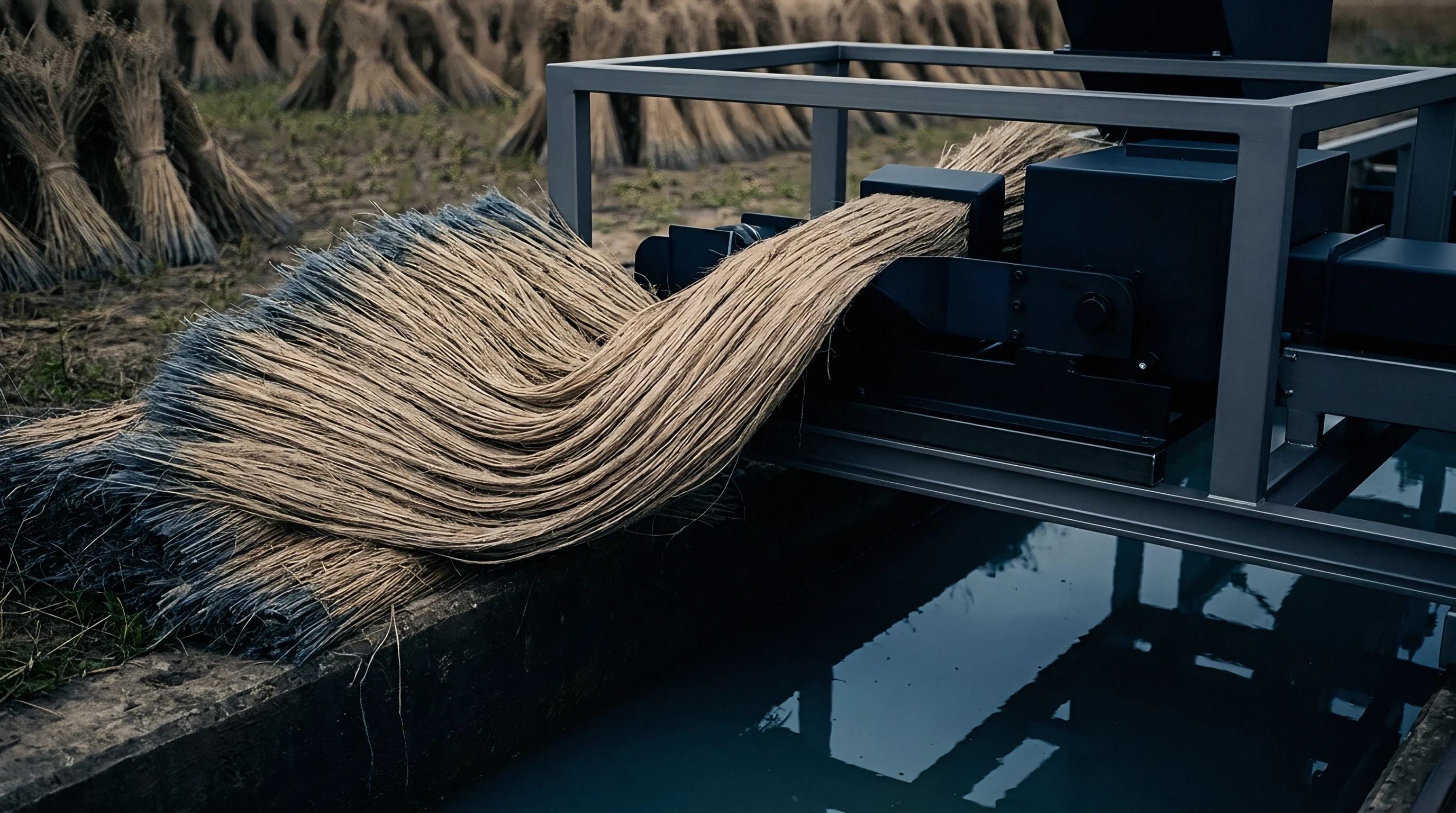
If retting is incomplete, calcium pectate complexes within the compound middle lamella hold onto their structural cohesion. Beating blades striking unretted or under-retted flax straw hit shear resistance over 18 Newtons per square millimeter across the pectin matrix. Because of this bond, mechanical breaker rolls and scutching turbines have to strike harder to crack the stem.
That extra impact fractures the primary cell walls of ultimate fiber cells transversely, producing high amounts of short tow fiber while leaving bark fragments and shives firmly bonded to what line fiber is left.
Over-retting degrades pectin bonds within the middle lamella while attacking the primary and secondary cell walls of individual fiber filaments. Micro-fungal species like Epicoccum nigrum and Cladosporium herbarum secrete localized endo-polygalacturonases and xylanases that break down the microfibrillar structural skeleton. Over-retted straw sheds shives easily under scutching, but the impact of turbine knives causes weakened fiber bundles to split longitudinally and snap across their length.
Yields of long fiber fall off rapidly, dust levels surge, and the remaining fiber shows reduced tensile strength during later hackling passes.
Varietal Cell Wall Architecture and Bark Anchorage
Fiber bundle cross sections vary by cultivar and field conditions. Stems between 1.5 and 2.5 millimeters in diameter hold about 20 to 30 fiber bundles in a ring, with each bundle containing 10 to 40 individual ultimate fibers bound together by an inter-fiber pectin matrix. Cortical thickness and core xylem density directly control how the stem bends inside breaker rolls; a rigid xylem core high in lignin resists bending until it snaps at sharp, localized points, shearing off the outer cortical layer cleanly.
Adhesion in the outer epidermal layer causes a secondary defect category: unretted bark strips, or skin attachments. When field retting fails to decompose outer cuticular wax and pectin-dense sub-epidermal tissue, the outer rind strips off in long, continuous ribbons alongside the technical fiber bundles. These bark ribbons possess high friction coefficients and resist mechanical beaters.
Downstream, they disrupt spinning operations because non-cellulosic impurities refuse to draw during drafting on wet-spinning frames.
Field moisture variations during mechanical scutching alter fiber bundle elasticity faster than adjustments to turbine clearance can compensate.
Stem dryness governs how bast bundles react to mechanical impact. Straw entering the scutching line above 12 percent moisture shows heavy viscoelastic dampening. Flexible stems absorb blade hits instead of snapping the inner xylem cleanly, leaving flattened straw ribbons with shive fragments trapped inside folded fiber sheaves.
Conversely, straw entering below 6 percent moisture becomes extremely brittle, breaking into fine shive dust and heavily fragmented fibers.
Clean mechanical separation requires maintaining stem moisture strictly between 8.5 and 10.5 percent at the breaker rolls. Within this narrow range, the woody xylem breaks into discrete, rigid particles 2 to 15 millimeters long, while technical fiber bundles take the flexural strain without cell walls collapsing transversely. That difference in bending modulus between the woody core and cellulosic bast fiber provides the operational basis for turbine-based scutching plants.
Under-retted fiber bundles hold together well, but they retain excessive woody fragments after mechanical processing.

Turbine
Kinematics of Mechanical Decortication and Scutching
Industrial scutching lines process retted flax straw through two continuous stages: a breaker unit and a scutching turbine unit. The breaker unit relies on pairs of fluted iron or steel rollers set in series with increasingly fine tooth profiles. As straw passes through these rollers, compressive and bending stresses crack the central xylem core transversely without severing continuous longitudinal bast fiber strands.
Flute pitch, tooth geometry, roller pressure, and speed ratios govern how closely spaced those cracks are along the stem.
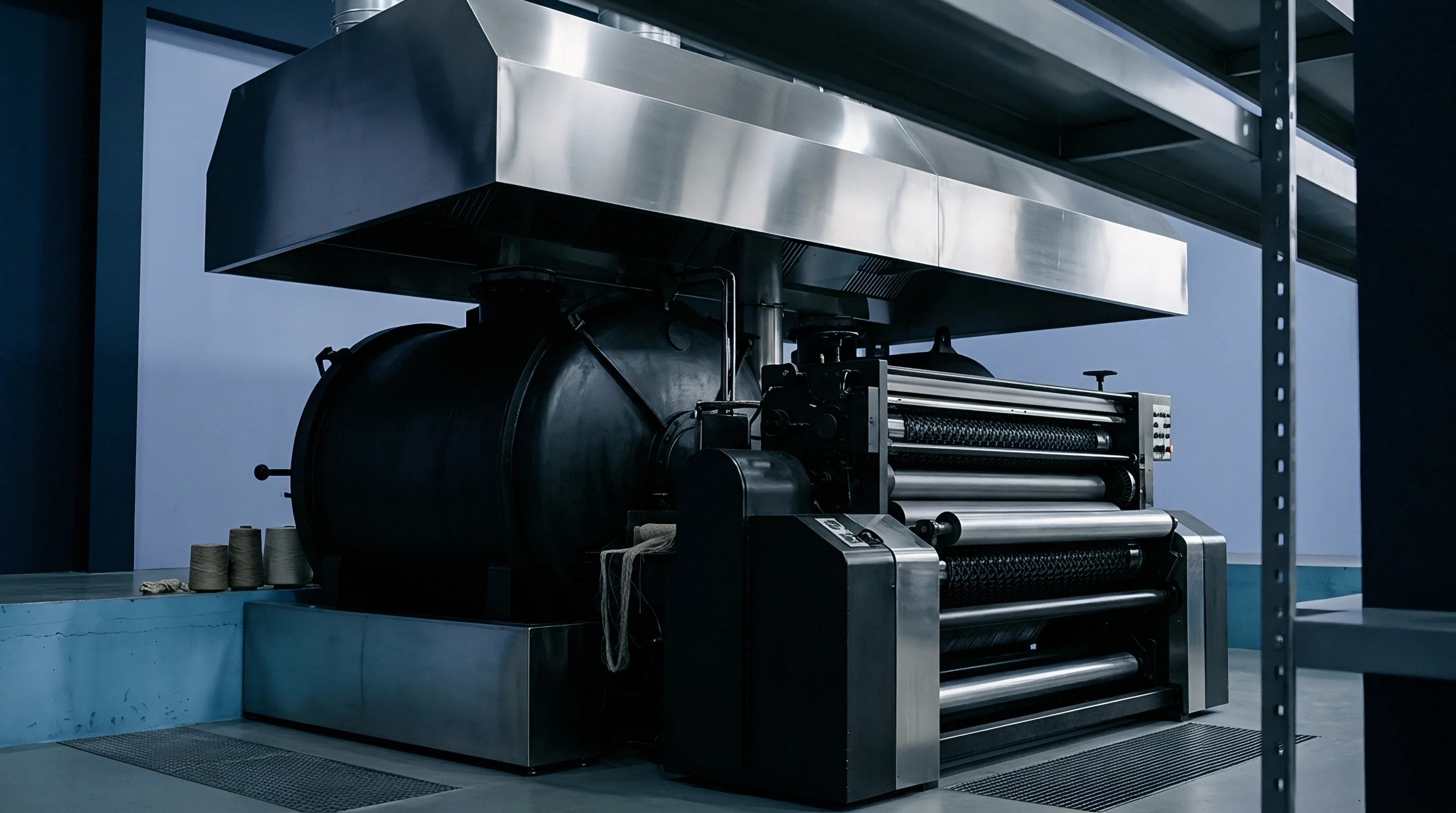
Downstream of the breaker unit, continuous mechanical scutching relies on paired counter-rotating turbines equipped with radial steel or wooden beating blades. Rubber-faced belts grip the fiber strands and convey the material sideways through two sequential turbine drums ~ the first treating the root ends of the flax stems, the second treating the tops. Blade tip velocity, clearance between opposing blade edges, turbine drum diameter, and line throughput speed define the kinetic energy transferred per gram of processed fiber mass.
Running standard 1.2-meter scutching drums at 220 to 280 revolutions per minute produces tip velocities of 12 to 18 meters per second. At these speeds, the striking edge of the scutching knife hits the hanging fiber fringe, combining intense centrifugal force with high-frequency flexural vibrations. This dislodges broken shive particles from the fiber bundle, projecting them downward through grid bars while continuous long fiber stays locked in the overhead conveyor belt.

Fluted Roll Configuration and Impact Mechanics
The transition from coarse to fine roller fluting controls the size distribution of generated shive fragments. Initial coarse breaker rollers use deep flutes with a pitch of 25 to 35 millimeters to break stiff outer straw stems into manageable segments. Intermediate and fine rollers bring fluting pitches down to 10 millimeters, creating high-density transverse fractures along the xylem cylinder.
Excessive roller pressure crushes the woody core into fine dust that embeds within the fiber bundle, whereas insufficient pressure leaves large intact xylem pieces attached to the bast sheath.
| Process Stage | Mechanical Variable | Standard Setting | Defect Mechanism Under High Setting | Defect Mechanism Under Low Setting |
|---|---|---|---|---|
| Breaker Unit | Roller Pressure | 3.5 to 5.0 bar | Fiber crushing, micro-fibrillar degradation | Incomplete xylem fracture, large attached shives |
| Breaker Unit | Flute Speed Ratio | 1.15 to 1.25 | Excessive longitudinal fiber shearing | Insufficient decortication clearance |
| Root Turbine | Blade Tip Velocity | 14.5 m/s | Transverse bundle snapping, elevated tow ratio | High residual shive mass, unretted bark retention |
| Top Turbine | Blade-to-Grid Clearance | 4.0 to 6.0 mm | High mechanical fiber entanglement, nepping | Incomplete cleaning of fine cortical tissues |
| Conveyor Gripper | Lateral Transit Speed | 25 to 40 m/min | Insufficient dwell time, non-uniform cleaning | Over-scutching, excessive long fiber loss |
Grid bar adjustment beneath the scutching turbines sets the ejection trajectory of freed shives and short fibers. Radial grid clearances set too close to the blade arc create severe shearing forces that scrape technical fiber surfaces, inducing localized fibrillation and reducing bundle cohesion. Conversely, excessive grid clearance allows airborne shive particles to re-enter the fiber stream via turbulent air eddies generated by the high-speed rotating drum assembly.

Defect Generation and Tow Conversion Mechanics
Mechanical scutching inevitably divides incoming bast straw mass into four main product fractions: long scutched fiber (line fiber), short scutched fiber (scutching tow), shives (woody core waste), and fine organic dust. Maximizing line fiber extraction while keeping residual shive low requires fine adjustments to mechanical variables across the plant. High kinetic energy inputs reduce residual shive percentages but convert valuable long fiber into lower-value scutching tow through transverse tensile failure.
The conversion of long fiber into tow follows an exponential relationship relative to turbine blade velocity. As blade tip speed exceeds 16 meters per second, high-velocity impacts overcome the tensile threshold of weakened retting zones along the stem length. Broken long fibers drop from the central gripper belts into tow collection chutes located beneath the turbine grid bars.
This mechanical tow contains a high concentration of coarse shives and requires subsequent mechanical shaker-cleaning steps to recover marketable short technical fiber.
A sequence of mechanical operations converts raw retted straw into clean long fiber bundles through targeted mechanical energy application:
- Mechanical Straw Infeed Alignment spreads retted straw uniformly onto the intake apron to ensure consistent layer mass before entering the fluted breaker rolls.
- Transverse Xylem Crushing fractures the rigid inner woody cylinder into discrete segments without damaging the outer bast fiber sheath.
- Root End Scutching Passage subjects the lower half of the fiber bundle to high-velocity blade impacts inside the primary turbine casing.
- Mid-Line Gripper Inversion transfers the partially cleaned bundle to the secondary belt conveyor, exposing the un-scutched top ends to the secondary turbine.
- Top End Scutching Passage removes residual bark and shive fragments from the upper, branch-heavy portion of the plant stems.
- Ejection and Delivery Separation drops freed shives through lower grid assemblies while delivering continuous line fiber bundles to the output sorting station.
Blade clearance settings below three millimeters convert up to eight percent of continuous line fiber into low-value scutching tow within single-pass turbine operations.
Airflow patterns inside the turbine enclosure significantly influence defect redeposition. High-speed rotation transforms the blade assembly into a radial centrifugal fan, driving air currents outward at velocities matching the blade tip speed. If mill extraction systems fail to maintain negative static pressure inside the turbine housing, turbulent recirculating vortexes force fine shive fragments back onto moist, freshly exposed fiber bundles.
Installed vacuum extraction channels located directly beneath the beating grid must maintain linear air intake velocities between 22 and 28 meters per second to clear suspended particulate matter continuously.
Increasing turbine rotor speed can improve cleaning performance without altering long fiber integrity provided straw moisture remains constant, but mill floor measurements show that raising drum speed beyond calibrated parameters drives up the short-fiber ratio regardless of moisture stability.


Gravimetry

Standard Manual Separation and Gravimetric Quantification
Accurate quantification of defect content in scutched bast fibers requires precise analytical separation techniques to distinguish structural plant contaminants from pure cellulosic fiber mass. The primary standard method relies on manual separation combined with gravimetric mass balance determination. Testing protocols such as ISO 2370 and modified ASTM D1444 procedures specify extracting representative laboratory samples weighing between 50 and 100 grams from freshly scutched fiber bales.
The sample must be conditioned in a standard atmosphere of 20 degrees Celsius and 65 percent relative humidity for 24 hours prior to testing.
Operators perform manual separation using micro-pincers and low-power optical magnification to detach every visible non-fiber particle from the technical bundle mass. The extracted contaminants are categorized into three physical fractions: coarse shive fragments exceeding two millimeters in length, fine woody particles under two millimeters, and unretted epidermal or cortical skin strips. Each fraction is weighed on an analytical balance precise to 0.1 milligrams.
The mass percentage of total residual shive is calculated using the dry weight of the initial fiber sample following oven-drying at 105 degrees Celsius to constant mass.
Manual gravimetric extraction offers high accuracy but suffers from low throughput and extreme vulnerability to operator subjectivity. Distinguishing between a heavily lignified, coarse technical fiber bundle and a thin, elongated cortical strip requires operator training. Analytical processing of a single 50-gram sample can demand up to three hours of manual labor, making real-time process monitoring during industrial scutching impossible via manual gravimetry alone.

Are Optical Sieve Systems Replacing Gravimetric Separation?
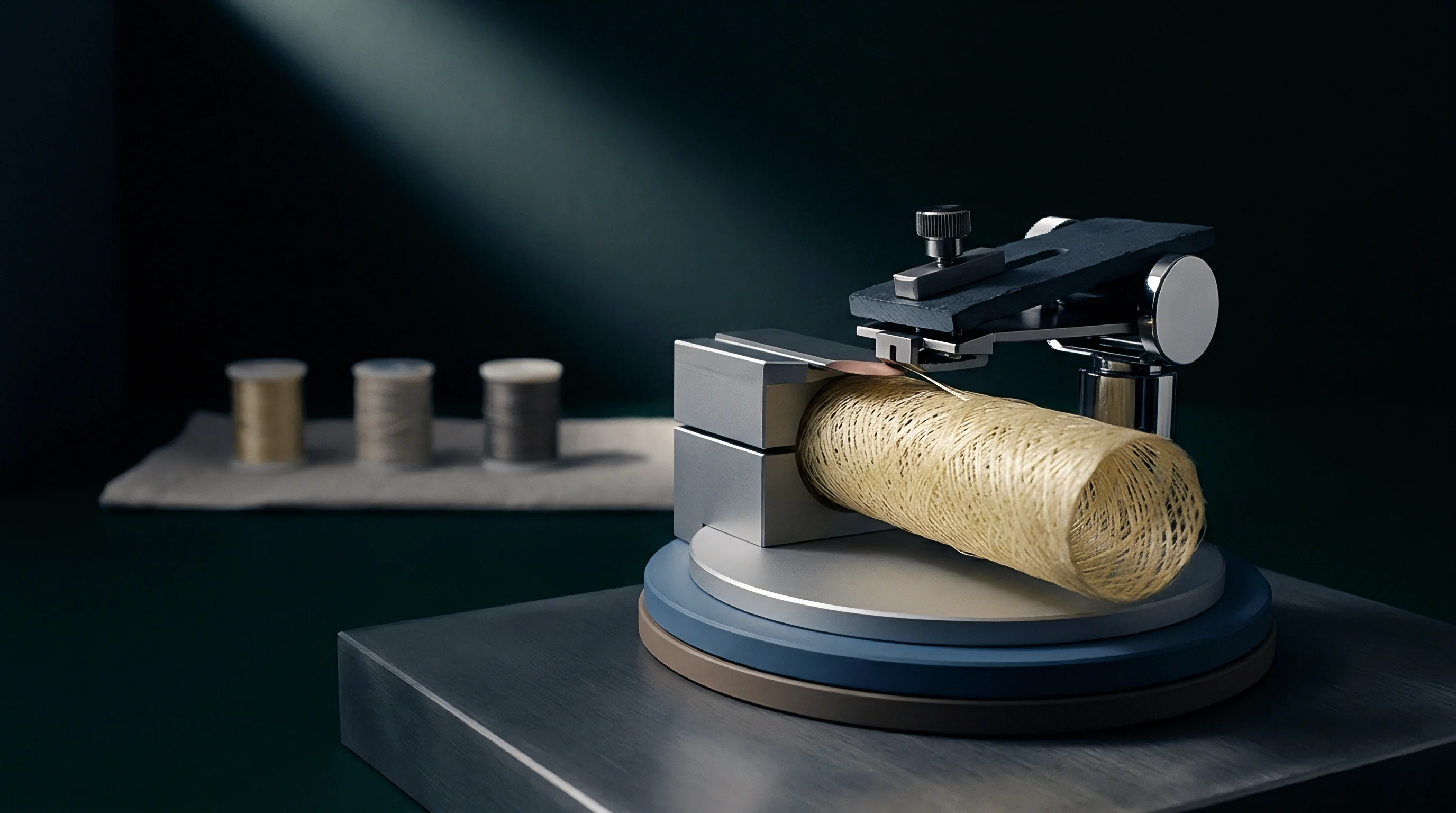
Automated optical sieve and digital image analysis systems have been introduced to replace manual extraction in industrial quality assurance laboratories. These systems disperse a degraded or opened fiber sample across a high-contrast conveyor belt or within an illuminated air-flow channel. High-resolution line-scan cameras capture multi-spectral images of the falling material stream, utilizing color thresholds, spatial aspect ratios, and opacity metrics to classify particles into fiber, shive, bark, and dust populations within seconds.
| Analytical Parameter | Manual Gravimetric Extraction | Dynamic Optical Image Analysis | Sieve Machine Mechanical Separation |
|---|---|---|---|
| Sample Mass Capacity | 50 to 100 g | 10 to 25 g | 200 to 500 g |
| Testing Dwell Time | 120 to 180 minutes | 3 to 5 minutes | 15 to 20 minutes |
| Measurement Accuracy | High (0.01% mass limit) | Moderate (pixel resolution bounded) | Low to Moderate (size bounded) |
| Operator Subjectivity | High human variance | Low (algorithm deterministic) | Low (mechanical size threshold) |
| Particle Aspect Separation | Excellent physical discrimination | High spatial resolution capability | Zero aspect ratio discrimination |
| Capital Equipment Cost | Low (basic laboratory balance) | High (optical sensor array) | Moderate (mechanical shaker apparatus) |
Optical systems determine particle volume by calculating two-dimensional projection areas and assuming standardized particle densities. Because woody shive density ranges between 0.25 and 0.45 grams per cubic centimeter, whereas compact bast fiber bundles possess a real density near 1.50 grams per cubic centimeter, algorithms converting optical area measurements to mass percentages must apply dynamic mass-density correction factors. Without precise calibration against gravimetric baseline standards for specific plant varieties, optical systems underestimate dense shive inclusions hidden inside overlapping fiber webs.
Defect Classification Criteria and Threshold Mapping
Defining acceptable defect thresholds requires categorizing contaminants according to their impact on subsequent mechanical yarn processing. Coarse shives create localized thick places during yarn drafting, leading to immediate end-breaks on ring-spinning frames or structural flaws in spun yarns. Fine shive particles, while less prone to causing yarn breakage, survive chemical bleaching and appear as visible dark specks in finished woven or knitted fabrics.
Commercial grading frameworks divide residual defect content into four distinct metric classes:
- Class I Pinpoint Dust encompasses non-cellulosic particles smaller than 0.5 millimeters that pass through standard mill cleaning grids during carding without damaging card clothing.
- Class II Fine Woody Shive consists of xylem particles between 0.5 and 2.0 millimeters in length that require mechanical hackling or intensive carding to dislodge from the technical fiber bundle.
- Class III Coarse Structural Shive comprises rigid xylem fragments between 2.0 and 15.0 millimeters long that disrupt drafting rolls and cause thread breakages during spinning.
- Class IV Epidermal Ribbons includes unretted outer stem bark strips longer than 15.0 millimeters that bind adjacent technical fibers together, preventing uniform bundle opening.
Contractual sales specifications under European Flax trade terms mandate that standard scutched line fiber must contain less than 1.5 percent total residual shive mass. Premium wet-spinning grades specified for high-count yarns enforce strict caps below 0.6 percent total defect mass, with Class III and Class IV contaminants strictly limited to zero occurrences per 100 grams of tested material.
The standard supply contract executes under European Flax Rule 4.2, which dictates that any delivered lot exceeding 2.0 percent total shive mass permits the buyer to reject the entire shipment or claim a non-negotiable five percent price reduction per additional 0.5 percent defect mass increment above baseline.
Extraction

Mass-Balance Audit Trajectories across Scutching Mills
Evaluating defect quantification requires conducting mass-balance audits across the entire scutching mill process flow. Raw retted flax entering the facility arrives in high-density round or square bales with field moisture content varying widely across harvest lots. A continuous scutching line transforms this raw incoming agricultural input into purified output streams.
Tracking mass conversion efficiencies establishes whether elevated shive levels in finished long fiber stem from improper machine tuning or non-uniform raw material retting states.
A standard mass-balance equation models the mechanical input-to-output distribution across the scutching line:
M_straw (1 – MC_straw) = M_line (1 – MC_line) + M_tow (1 – MC_tow) + M_shive (1 – MC_shive) + M_dust (1 – MC_dust)
In this expression, M represents total measured mass for each respective fraction, while MC represents the fractional moisture content measured via oven-drying or calibrated high-frequency capacitance meters. Discrepancies in mass balance equations frequently stem from unmeasured moisture loss caused by frictional heat generated within high-speed scutching turbines. Air leaving the turbine casing routinely exhibits temperatures 5 to 12 degrees Celsius above ambient room air, driving off volatile moisture and distorting wet-basis weight measurements.
A mass-balance audit across a continuous 3.0-metric-ton-per-hour scutching line establishes real-world yield and defect losses. The raw input consisted of Normandy-grown flax straw entering the breaker rolls at an initial moisture content of 9.2 percent. The line operated at a turbine rotor speed of 240 revolutions per minute with a fixed conveyor transit speed of 32 meters per minute.
| Output Product Fraction | Wet Mass Output (kg) | Moisture Content (%) | Dry Mass Output (kg) | Dry Mass Fraction (%) |
|---|---|---|---|---|
| Raw Straw Input | 3,000.0 | 9.20 | 2,724.0 | 100.00 |
| Scutched Line Fiber | 762.7 | 8.80 | 695.6 | 25.54 |
| Scutching Tow (Short Fiber) | 381.3 | 8.60 | 348.5 | 12.79 |
| Coarse Shives (Grid Ejected) | 1,425.0 | 9.40 | 1,291.1 | 47.40 |
| Fine Dust and Volatiles | 431.0 | 3.50 | 388.8 | 14.27 |
Dry mass calculations reveal a true total conversion efficiency of 25.54 percent scutched line fiber relative to dry raw straw mass. Subsequent analytical testing of the scutched line fiber output via manual gravimetric separation recorded a residual shive mass of 1.12 percent. This value confirms effective mechanical removal of the central xylem core, though the high percentage of generated scutching tow (12.79 percent) indicates that the turbine blade impact settings operated near the upper limit of structural bundle breakage.
Loss Mechanisms and Fiber Damage Propagation
Fiber loss during mechanical scutching occurs through three main physical mechanisms: transverse tensile failure, longitudinal bundle shearing, and grid clearance drag. Transverse failure happens when the turbine knife strikes an unretted or locally decayed stem segment, exceeding the ultimate tensile strength of the technical fiber. The severed bundle breaks away from the gripper transport mechanism and drops into the lower waste chute.
Longitudinal bundle shearing results from excessive friction between adjacent straw stems as they pass through the breaker rolls. If the fluted rolls lack accurate axial alignment, lateral shear forces split the primary fiber bundles into ultra-fine filaments before they enter the scutching turbine. These micro-filaments lack sufficient structural bending stiffness to span the gap across the turbine grid bars, causing them to be swept into the scutching tow stream by high-velocity exhaust air currents.
Systematic misalignment of breaker roll fluting increases short fiber tow generation by 4.2 percent while elevating residual shive contamination in the line fiber stream.
Grid clearance drag occurs when long fiber ends pass through the narrow gap between rotating blade edges and stationary counter-knives or grid bars. Excessive proximity creates a scissoring action that trims the delicate, flexible root and top tips of the technical fiber bundles. While this trimming action improves bundle length uniformity, it simultaneously reduces overall line fiber yield and elevates short fiber accumulation in the waste pit beneath the turbine drums.
Failure to calibrate scutching turbine clearances to match variations in straw stem diameter results in a direct loss of high-value line fiber yield, shifting revenue toward low-margin scutching tow and waste fractions.
The physical transformation of incoming retted straw into cleaned technical fiber bundles involves progressive reduction of woody stem attachments through successive mechanical impact zones.
Processing under-retted straw forces mill operators to choose between two commercially disadvantageous outcomes: running turbines at standard speeds to preserve fiber length produces line fiber containing up to 4.5 percent residual shive, whereas elevating turbine speeds to strike off the stubborn xylem core destroys up to one-third of total line fiber mass through aggressive mechanical breakage.
Variations in retting uniformity along the length of a single flax field create fluctuating mechanical resistance that constantly shifts the balance between effective shive separation and catastrophic fiber fracture.

Valuation

Commercial Penalty Schedules and Value Adjustments
The final value of scutched bast fiber depends directly on the measured level of residual shive contamination and fiber length distribution. In global commodity markets, pricing for scutched line fiber relies on baseline grade definitions established by international trade associations such as the Alliance for European Flax-Linen and Hemp. Raw fiber lots undergo systematic sampling at mill dispatch, where certified graders assign quality scores based on color, strength, fiber bundle fineness, softness, and defect percentage.
When laboratory testing or visual grading reveals defect percentages exceeding baseline contractual specifications, standardized commercial penalty schedules apply. Value deductions are calculated using non-linear percentage discounts applied to the base price per metric ton. Defect levels above established maximum tolerances grant the purchasing mill full right of rejection, forcing the scutching operator to absorb return shipping costs or liquidate the lot at steep discounts on the open market.
| Measured Residual Shive Content (%) | Commercial Quality Category | Price Adjustment Factor | Downstream Application Compatibility |
|---|---|---|---|
| Less than 0.50% | Premium Long Line (Grade A) | +5.0% Surcharge Premium | High-count wet spinning (Nm 50 to Nm 80) |
| 0.50% to 1.00% | Standard Fine Line (Grade B) | 100% Contract Base Price | Medium-count wet spinning (Nm 26 to Nm 39) |
| 1.01% to 1.50% | Commercial Standard (Grade C) | -3.5% Price Discount | Coarse wet spinning and dry spinning (Nm 10 to Nm 24) |
| 1.51% to 2.20% | Sub-Standard / Defective | -12.0% Price Discount | Coarse dry spinning and non-woven technical textiles |
| Greater than 2.20% | Rejected Lot | Mandatory Rejection or -30% Out-of-Spec Liquidation | Pulp, paper, and industrial insulation materials |
Price adjustments ripple across the entire value chain. A scutching mill delivering a 20-metric-ton container of line fiber priced at 4,200 Euros per ton faces an immediate loss of nearly 10,000 Euros if average shive levels shift from 0.8 percent to 1.6 percent. This financial penalty reflects the additional mechanical energy, reduced machine efficiency, and increased yarn break rates that spinning mills incur when processing heavily contaminated raw material.

Yarn Spinning Impact and Processing Surcharges
Spinning mills processing scutched line fiber with elevated shive content incur substantial operational surcharges. During the hackling phase, where long fiber bundles are combed through series of progressively finer pins, residual shives cause pin breakage and premature wear on expensive hackling machinery. A single coarse shive trapped in a comb pin can bend or break adjacent pins, requiring machine stoppage and costly comb strip replacement.
During wet spinning, remaining shive fragments absorb aqueous chemical solutions at different rates than pure cellulosic fiber. When the yarn bundle passes through hot-water drafting baths, unretted bark or shive fragments resist softening, preventing smooth drafting of individual filaments. The result is non-uniform yarn thickness, characterized by thin places that snap under drafting tension and thick places that fail to twist properly, leading to high end-break frequencies on ring-spinning frames.
Tracking processing performance at a high-count wet spinning mill measures the direct cost impact of raw fiber shive levels on yarn manufacturing efficiency. Processing Grade A fiber containing 0.45 percent residual shive yielded an average of 1.2 yarn end-breaks per 100 spindle-hours on Nm 39 yarn. Processing Grade C fiber containing 1.35 percent residual shive under identical temperature and draft settings raised the end-break rate to 4.8 per 100 spindle-hours, forcing a 15 percent reduction in spindle speed to maintain line continuity.
High end-break frequencies elevate direct labor costs by requiring extra operator intervention to piece broken yarn ends. Machine efficiency drops from a target of 94 percent down to 81 percent, increasing electricity consumption per kilogram of produced yarn and diluting mill throughput capacity. Spinning mills reflect these operational costs by demanding strict quality guarantees and origin certificates from fiber suppliers before signing long-term purchasing agreements.
Traceability mechanisms further complicate commercial valuation. Buyers demanding European Flax or Masters of Linen certification require full verification that mechanical scutching occurred within authorized geographical zones under audited environmental conditions. A fiber batch meeting physical shive tolerances but lacking valid batch-level transaction certificates fails compliance audits at destination ports, preventing the importer from applying origin-specific quality labels to finished textile products.
Can real-time multi-spectral sensor arrays mounted inside industrial scutching turbines accurately predict downstream yarn end-break rates before the scutched fiber bundle ever enters a hackling frame?