Linen Yarn Count Conversions and Basic Count Calculations
Linear density conversions for linen require applying official moisture regain factors to Lea and Tex counts to fix structural fabric weights accurately.


Spool
Flax yarn measurement relies on traditional length-per-mass numbering systems. Long-staple fibers processed by wet spinning produce dense, uniform strands, whereas short tow fibers spun dry yield coarser, hairier yarns. In commercial trade, linen is predominantly measured using the indirect Lea count, where one Lea represents 300 yards of yarn weighing exactly one pound.
Because flax fibers draft irregularly ~ the bundle diameter fluctuating with fiber division and pectin extraction ~ mass per unit length establishes yarn grade far more reliably than optical diameter.
Under the Lea system, yarn length remains fixed while mass varies. Direct systems express mass per unit length, whereas indirect systems measure length per unit mass, meaning higher Lea counts denote finer threads. A 14 Lea yarn yields 4,200 yards per pound, while a 40 Lea yarn yields 12,000 yards per pound.
For warping and weft insertion, linear density determines fabric weight, reed selection, and structural alignment; miscalculating it leads directly to incorrect warp setts and loom stoppages.
Linear density governs finished cloth weight, but dry-spun yarns occupy noticeably more volume than wet-spun strands of the same nominal count. During wet spinning, water acts as a lubricant that allows fibrils to draft tightly together, yielding a compact cross-section with high inter-fiber cohesion. Dry spinning leaves air pockets and protruding fibrils along the core.
Consequently, a 25 Lea wet-spun thread occupies less space in a reed dent than a 25 Lea dry-spun thread, despite both sharing identical mass per unit length.
Weaving calculations require precise linear equivalents rather than rounded conversions. Sourcing across European and Asian supply chains involves reconciling the indirect English Lea system with the direct Tex framework. Traditional mills track lots in Lea, whereas electronic rapier looms use creels and sensors calibrated in Tex or Metric count.
Reconciling these numbers requires testing at standardized moisture levels.
Because flax is a hygroscopic cellulose fiber, moisture shifts yarn mass without changing yarn length. When warehouse or spinning shed humidity climbs, unadjusted weighings show a falsely coarse count. Standard laboratory protocols fix atmospheric conditions at twenty degrees Celsius and sixty-five percent relative humidity to ensure yarn count reflects actual fiber mass rather than absorbed water vapor.
At twenty degrees Celsius and sixty-five percent relative humidity, wet-spun linen retains a standard commercial moisture regain of twelve percent.
Errors in yarn count determination carry over into every mechanical stage that follows. When incorrect linear density values enter production planning, specific failure modes emerge:
- Reed overcrowdings cause excessive abrasion in the shed, leading to filamentation and end breaks during warp shedding.
- Insufficient cover factors generate sleazy cloth structures that fail standard dimensional stability testing after wet processing.
- Weight discrepancies force fabric rejections when delivered mass per unit area falls outside specified buyer tolerances.
- Tension imbalances produce wavy selvages and bow defects across the usable cut width of the greige roll.
When yarn is invoiced without adjusting for actual moisture content, the mill passes structural variance to the weaver before packages ever reach the creel. Relying on nominal Lea counts without checking regain causes compounding errors in loom setts, miscalculated yarn consumption, and off-spec finished weights that wet finishing cannot rectify.

Arithmetic
Converting between linen numbers and metric units relies on fixed physical constants. The Metric count (Nm) defines the number of 1,000-metre hanks per kilogram, or metres per gram. Deriving the conversion factor between Lea and Metric count starts with base definitions: one Lea equals 300 yards (274.32 metres) per pound (0.45359237 kilograms).
Dividing 274.32 metres by 0.45359237 kilograms gives 604.774 metres per kilogram for a 1 Lea thread.
Dividing 604.774 by 1,000 establishes the direct conversion constant: 1 Lea equals 0.604774 Metric count. To find the Metric count from a known Lea value, multiply the Lea number by 0.604774. Inversely, dividing Metric count by 0.604774 (or multiplying by 1.65351) yields the Lea count.
Tex expresses linear density directly in grams per 1,000 metres. Converting Lea to Tex involves dividing 1,653.51 by the Lea number, meaning a 30 Lea yarn converts to 55.12 Tex and a 10 Lea yarn equals 165.35 Tex.
Similar constants govern other fiber systems. English cotton count (NeC) uses 840-yard hanks per pound; dividing 300 yards by 840 yards yields a conversion factor of 0.35714, making a 42 Lea linen yarn equivalent in mass to a 15 NeC cotton yarn. Denier measures grams per 9,000 metres and is calculated from Lea by dividing 14,881.6 by the Lea value.
Applying these precise ratios prevents calculation errors when engineering union fabrics or blending flax with synthetic filaments.
| Linen Count (NeL) | Metric Count (Nm) | Direct Mass (Tex) | Cotton Count (NeC) | Filament Equivalent (Denier) |
|---|---|---|---|---|
| 10 Lea | 6.05 Nm | 165.35 Tex | 3.57 NeC | 1488.16 Denier |
| 14 Lea | 8.47 Nm | 118.11 Tex | 5.00 NeC | 1062.97 Denier |
| 25 Lea | 15.12 Nm | 66.14 Tex | 8.93 NeC | 595.26 Denier |
| 30 Lea | 18.14 Nm | 55.12 Tex | 10.71 NeC | 496.05 Denier |
| 40 Lea | 24.19 Nm | 41.34 Tex | 14.29 NeC | 372.04 Denier |
| 60 Lea | 36.29 Nm | 27.56 Tex | 21.43 NeC | 248.03 Denier |
Establishing official commercial weight requires applying standard regain allowances to bone-dry fiber mass. ISO 2060 defines the laboratory method for determining yarn linear density: skeins of known length are reeled under controlled tension, dried in a ventilated oven at 105 degrees Celsius until reaching constant weight, and then corrected by the official twelve percent commercial moisture regain allowance for linen.
ISO 2060 specifies yarn count determination using reeled skeins conditioned to standard atmospheric equilibrium prior to weighing.
Correcting unconditioned laboratory weighings to commercial count follows five steps:
- Determine the oven-dry mass of the reeled test skein using an analytical balance accurate to 0.001 grams.
- Calculate the unadjusted dry linear density in Tex by dividing dry mass in grams by total skein length in kilometres.
- Apply the official commercial regain coefficient by multiplying the oven-dry Tex by 1.120 to incorporate the twelve percent moisture allowance.
- Convert the corrected Tex value into Lea by dividing 1,653.51 by the corrected Tex figure.
- Compare the calculated commercial Lea against the spinning mill invoice declaration to verify compliance within standard specification tolerances.
Folding multiple single strands together improves yarn tensile strength and weaving efficiency, but calculating the resultant count requires accounting for take-up from twist contraction. In the Lea system, a 2/40 Lea yarn is nominally equivalent in weight to a 20 Lea single strand, but twist contraction increases mass per unit length by two to four percent, reducing final meterage.
Tex handles folded structures additively: combining two 41.34 Tex singles produces a base mass of 82.68 Tex. Factoring in a typical three-percent twist contraction raises the final density to 85.24 Tex, which converts to 19.40 Lea rather than the nominal 20.00 Lea. Structural calculations for heavy duck, upholstery, or industrial canvas must incorporate this contraction to prevent underestimating warp yarn consumption.
Commercial contracts routinely bind deliveries to clear linear density boundaries. ISO 2060 establishes an allowable count tolerance of plus or minus three percent relative to contracted specifications. When testing shows deviations outside this window, buyers typically issue formal debit notes to adjust invoice weights to actual delivered lengths.

Reed
Reed selection determines warp spacing and structural stability across the loom. The combination of warp ends per centimetre, weft picks per centimetre, and yarn linear density dictates the cover factor ~ the proportion of fabric surface obstructed by yarn. In metric calculations, the fractional cover factor is obtained by dividing thread density per centimetre by the square root of the Metric count.
Setting warp density requires knowing the effective packing diameter of the yarn. Theoretical yarn diameter in millimetres is estimated by dividing the square root of Tex by a packing coefficient, which averages 31.6 for wet-spun linen due to high fiber alignment and minimal void space. A 25 Lea yarn (66.14 Tex) yields an estimated diameter of 0.257 millimetres.
In plain weave, warp and weft alternate over and under each other, requiring clearance for every yarn crossover.
Yarn crimp adds directly to raw material requirements. As warp yarns flex over and under weft picks, they follow an undulating path, meaning weaving one metre of cloth requires more than one metre of yarn. Warp crimp ranges from six percent in dense canvas up to eighteen percent in loose draperies.
High warp tension forces weft threads to bend more sharply, increasing weft yarn consumption and narrowing the fabric on the loom.
Dry spun linen yarns require lower warp sett density than wet spun yarns of identical nominal count to prevent excessive friction in the shed.
Loom setups must accommodate the tensile limits and cross-sectional bulk of the yarn. On rapier looms running at 450 picks per minute, warp ends experience severe friction in the reed wires. High-tenacity wet-spun yarns tolerate wide shed openings, whereas dry-spun yarns fail if the sett exceeds eighty-five percent of the theoretical jammed limit.
For plain weave, maximum sett equals 1 / (2 × yarn diameter), which for a 0.257 millimetre yarn gives 19.4 ends per centimetre.
| Yarn Count (NeL) | Metric Count (Nm) | Warp Sett (Ends/cm) | Weft Sett (Picks/cm) | Fractional Cover (Warp) | Fabric GSM (Greige) |
|---|---|---|---|---|---|
| 12 Lea | 7.26 Nm | 12.0 | 11.5 | 0.445 | 335 GSM |
| 14 Lea | 8.47 Nm | 13.5 | 13.0 | 0.464 | 320 GSM |
| 25 Lea | 15.12 Nm | 18.0 | 17.0 | 0.463 | 235 GSM |
| 30 Lea | 18.14 Nm | 20.0 | 19.0 | 0.470 | 218 GSM |
| 40 Lea | 24.19 Nm | 23.0 | 22.0 | 0.468 | 188 GSM |
| 60 Lea | 36.29 Nm | 28.0 | 27.0 | 0.464 | 152 GSM |
Calculating greige fabric weight per square metre combines yarn count, sett, and crimp into a single equation summing warp and weft mass. Warp mass per square metre equals ends per centimetre multiplied by 100, divided by Metric count, and adjusted for warp crimp. Weft mass is calculated identically using picks per centimetre and weft crimp.
Sizing compounds add three to eight percent to greige weight, which is subsequently lost during wet scouring.
Wet spinning significantly alters yarn packing volume and resultant linear density compared to dry methods.
Thick slubs in linen yarn can create noticeable reed marks. When setting up a rapier loom, technicians examine yarn regularity before selecting reed wire gauge and dent spacing. Threading two ends per dent suits standard apparel fabrics, while three or four ends per dent diffuses reed lines in fine sheer goods.
Setting up the weaving sequence requires balancing several production parameters:
- Yarn irregularity coefficient determines whether open dent spacing is required to prevent thick slubs from catching in the reed wires.
- Warp sizing percentage must be calculated based on yarn Tex to provide adequate film coverage without causing strand stiffness.
- Loom reed width needs adjustment to account for calculated weft crimp and structural width loss during off-loom relaxation.
- Shedding opening angle requires optimization based on yarn tensile limits to balance clear shed clearance against warp fatigue.
Underestimating weft take-up produces greige rolls that come off the loom under standard width. Forcing the fabric to target width on finishing tenters weakens tear strength and pulls thread density outside contract limits.
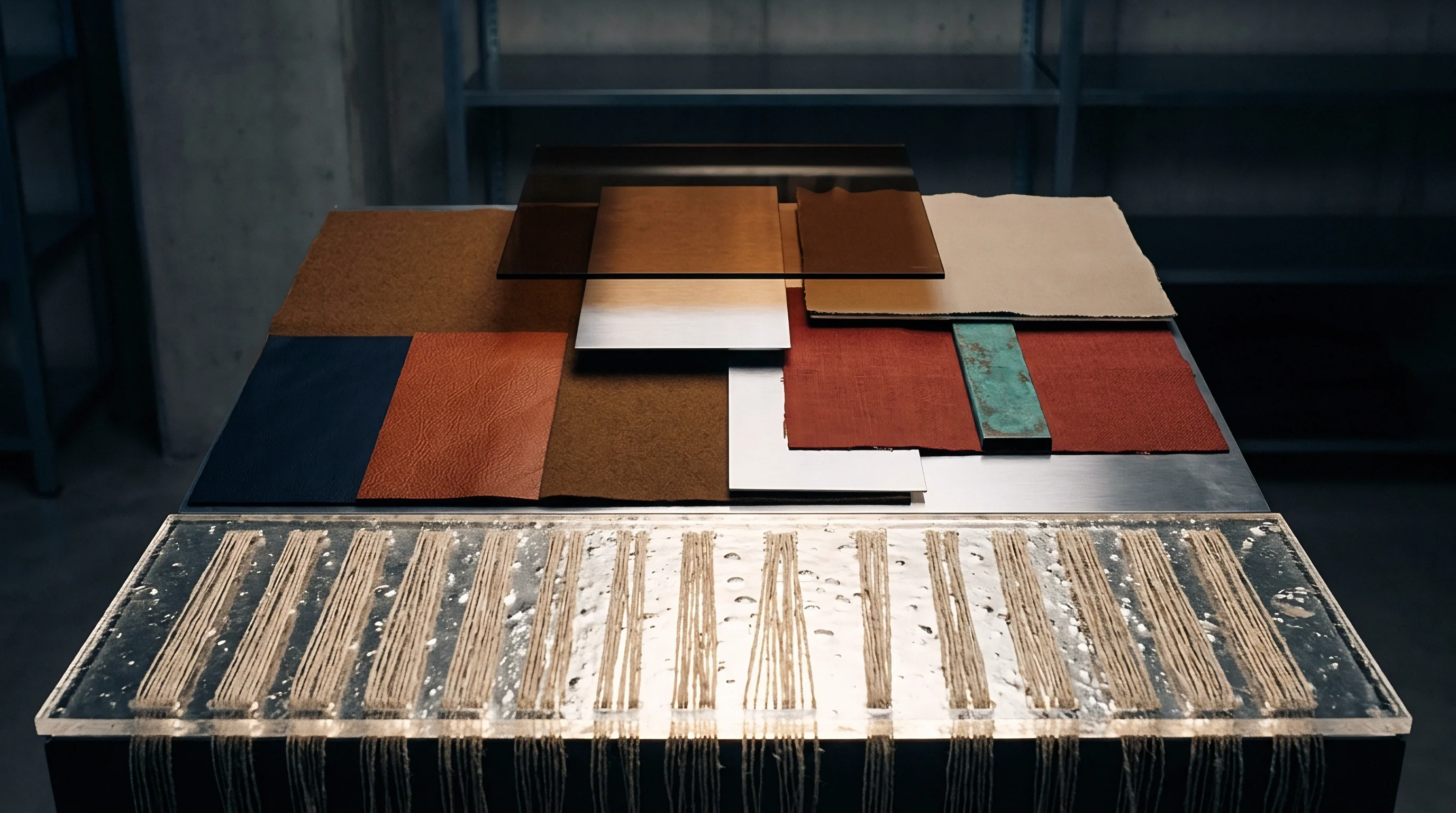
Batch
Lot uniformity governs weaving efficiency on high-speed looms and ensures level dyeing during piece finishing. Because raw flax quality shifts with seasonal retting and harvest conditions, spinning mills blend bales before carding to minimize variation. Nonetheless, shifts in count, twist per metre, and moisture uptake persist between lots, making it standard practice to dedicate single yarn batches to individual warps.
Small shifts in average yarn count alter cloth mass and material costs across long production runs. A two-percent drift over a 20,000-metre weaving program changes total fiber consumption substantially. When a nominal 30 Lea yarn drifts to 29.1 Lea because of drafting fluctuations, warp mass consumption per hour increases immediately.
Thin spots along a linen yarn create localized weak points with reduced linear density and lower breaking tenacity. When the shed opens at high speed, peak tension strikes the warp; if local strand strength falls below this threshold, the end breaks. Each break forces a weaver to re-thread the yarn through droppers, heald eyes, and reed dents, increasing loom downtime and conversion costs per metre.
Calculating fabric weight without accounting for warp and weft crimp underestimates total raw yarn mass requirements.
Incoming quality assurance involves pulling sample hanks across pallets according to ISO 2859-1 sampling plans to verify count, twist, and tensile strength prior to warping. Testing tracks breaking force and elongation at break. Linear density uniformity is measured by the count Coefficient of Variation, with values above 2.5 percent indicating poor spinning control.
Seasonal retting differences explain part of the annual variance in count, but accepting lot deviations without laboratory testing exposes weaving sheds to structural defects and unchecked material losses.
Shipment verification requires reviewing standardized mill documentation before packages are loaded onto warping creels. Incoming dossiers must include analytical measurements verified by standardized testing protocols:
- Oven dry mass test reports conforming to ISO 2060 indicating exact regain adjustments applied to the lot.
- Single strand tensile profiles providing mean force at break in Centinewtons and elongation percentage at break.
- Uster irregularity metrics listing thin places, thick places, and neps per thousand metres of continuous thread.
- Twist level verifications detailing turns per metre and twist direction for both single and plied package structures.
Standardized test records provide the contractual basis for resolving quality disputes. Without verified testing data, buyers lose the leverage needed to negotiate invoice adjustments or return out-of-spec yarn once packages are drawn onto beams.

Ledger
Cost engineering converts yarn linear density and loom parameters into finished costs per linear metre. Raw yarn represents fifty to seventy percent of total greige manufacturing expense. Because linen is sold by gross weight including standard regain, converting cost per kilogram into thread cost per metre requires factoring in linear count and waste allowances.
Yarn consumption per woven metre includes warp crimp, weft crimp, selvage trims, and warping waste. Total warp length equals one metre multiplied by one plus the warp crimp percentage, plus two percent for warping and sizing waste; dividing this length by Metric count yields warp weight. Weft consumption is calculated using reed width rather than cut width to capture waste trimmed at the selvages by rapier cutters.
Loom operating cost depends on insertion speed and pick density. At twenty picks per centimetre, a rapier running at 400 picks per minute produces 1.20 metres per hour at one hundred percent efficiency (400 divided by 20 picks/cm yields 20 cm/min, or 12.0 metres per hour). Actual production efficiency typically runs between eighty and ninety-two percent due to stops and beam changes.
Warp breaks on coarse or uneven yarns quickly erode efficiency. When loom efficiency drops from eighty-eight percent to seventy-eight percent on a dry-spun warp, fixed machine rates spread over fewer metres, raising unit conversion costs.
Scouring and bleaching remove natural pectins, waxes, and sizing agents, causing greige linen to lose mass during wet processing. Weight loss ranges from eight percent for semi-bleached fabric to fifteen percent for full whites. greige fabric specifications must be engineered with extra thread density and mass to meet finished weight targets after finishing.
Total landed cost per finished metre combines warp and weft raw material, sizing, loom charges, and wet finishing fees. Establishing accurate yarn conversion calculations allows procurement teams to verify mill consumption estimates and assess margins before committing to production runs.
Substituting high-count single dry-spun yarns with lower-count plied wet-spun alternatives alters yarn volume, loom efficiency, and raw material cost while preserving tensile properties.