Loom Backrest Height Alignment Principles for Flax Shedding Clearance
Raising backrest height creates asymmetric warp tension, clearing hairy flax shed openings without exceeding the breaking strain of inextensible linen yarns.
Geometry
Shed Symmetry and Warp Sheet Tension Differentials
The relative positions of the rear warp beam, whip roll, harness frames, and front breast beam govern the mechanical path of every end through the loom. Setting equal path lengths for the top and bottom sheets produces a symmetrical shed at crossover. When that shed opens fully at back dead center, both warp lines undergo the same displacement from the horizontal neutral plane.
Because flax fibers lack elasticity, wet-spun linen yarns reach their breaking point at 1.5 percent to 2.2 percent elongation, compared to ring-spun cotton which stretches past 6 percent before failing.
Running pure flax warps in a symmetrical shed causes immediate clearance problems. High flexural rigidity and surface hairiness make adjacent bast fibers cling to each other instead of separating cleanly as the frames split. The bottom sheet sags under the weight of microscopic shives and loose fiber ends.
When the rapier or projectile enters the shed, these slack bottom threads drift into the insertion channel, causing warp breaks, temple cuts, and floats.
Flax Fiber Tensile Limit and Strain Bounds
Raising the whip roll above the breast beam plane intentionally breaks shed symmetry. This height difference forces the bottom sheet to cover a longer path than the top sheet as the shed opens, increasing both static and dynamic tension on the lower ends. Held taut, these bottom threads form a flat plane across the raceboard that stays clear of the insertion element.
This added strain must be measured against the limits of the yarn. Raising the backrest by 20 millimetres adds roughly 0.45 percent dynamic strain to the bottom sheet at full aperture. On a linen warp with only 1.8 percent total strain capacity, that adjustment takes up a large portion of the yarn’s remaining working margin.
Raising it too far stretches the bottom sheet past its yield point, fatiguing the yarn and causing frequent breaks at the drop wires.
Finding the proper setup means lifting the backrest just enough to separate clingy flax fibers without pushing total yarn strain into the fracture zone ~ a balance that shifts with every change in yarn count or reed density.

Line
Vertical Displacement off Horizontal Plane
Alignment starts by setting a datum line from the top edge of the breast beam to the center of the warp beam shaft. Backrest height is measured with a hardened steel depth gauge against the side-frame machining pads. On modern rapier looms running heavy flax, backrest height usually ranges between 10 millimetres and 35 millimetres above horizontal zero.
Dense warps require greater elevation to force a clean opening through the reed.
- Mount the magnetic digital protractor directly onto the top edge of the breast beam to verify that the chassis is level.
- Loosen the backrest support bracket clamping bolts on both the drive and off-side frames together.
- Turn the jack screws to raise the whip roll until the dial indicator reads 15 millimetres above horizontal center for light linens, or 28 millimetres for heavy canvases.
- Check lateral parallelism with a laser alignment bar across the whip roll surface to keep total height variance under 0.5 millimetres across the reed width.
- Torque the frame clamp bolts to specification before turning the loom main shaft by hand.

Raceboard Friction and Heald Frame Clearance
Raising the warp line shifts where the yarn sheets cross relative to the reed lay. The higher backrest presses the bottom sheet flat against the race plate or guide teeth. As tension in the bottom sheet increases, so does friction along the raceboard; lifting the backrest too far drags the flax yarns over the surface, shaving off fibers and building up static dust behind the reed.
Table 1 shows the impact of backrest height on dynamic tension and warp stoppage rates for a 220 gram per square metre wet-spun linen plain weave (Nm 26 warp, 24 ends per centimetre, running at 380 picks per minute).
| Backrest Lift (mm) | Top Sheet Tension (cN/end) | Bottom Sheet Tension (cN/end) | Shed Clearance Angle (degrees) | Warp Breaks per 100k Picks |
|---|---|---|---|---|
| 0 (Symmetric) | 28.5 | 28.2 | 14.2 | 4.85 |
| 10 | 24.1 | 33.6 | 18.5 | 2.10 |
| 20 | 19.8 | 39.4 | 22.1 | 0.85 |
| 30 | 15.2 | 46.8 | 24.8 | 1.65 |
| 40 | 11.0 | 55.3 | 26.2 | 6.40 |
| Data gathered on a 190 cm flexible rapier loom; warp yarn wet-spun 100% flax Nm 26, sizing pick-up 8.5%, total warp ends 4,560. | ||||
At correct alignment, the bottom sheet rests against the raceboard with just enough pressure to prevent flutter without creating surface fuzz. If the bottom sheet floats even one millimeter above the raceplate when the rapier enters, insertion stops increase immediately.
Raising the warp sheet high enough to clear the raceboard entirely allows a clean shed opening, but it accelerates wear on the yarn as it passes through the heald eyes.
Drag
Fiber Cling and Entanglement Mechanics
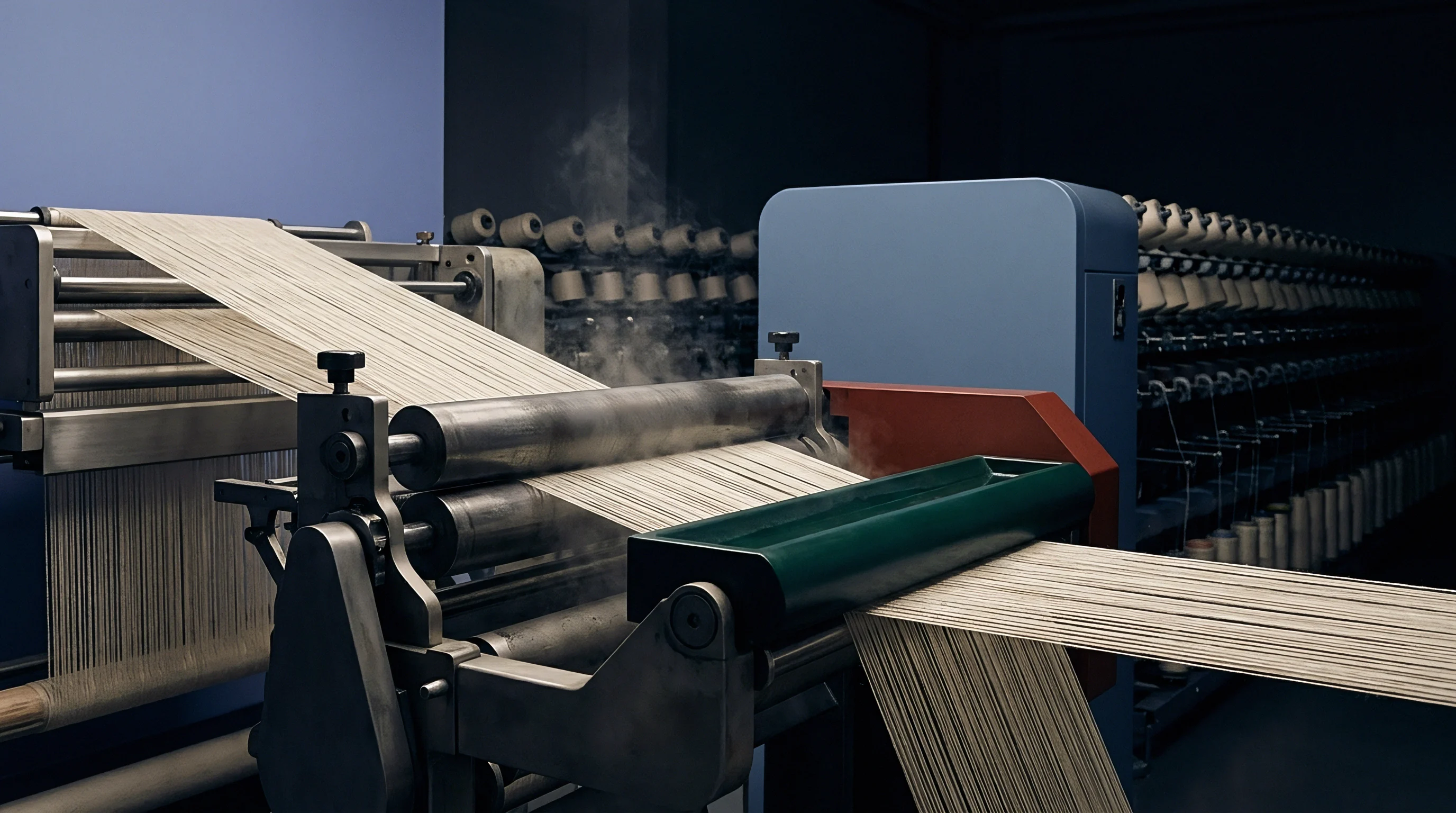
Flax warp threads cling together through mechanical fiber entanglement rather than static charge. Surface pectin and cortical cell fragments give the yarn a high directional friction coefficient. As adjacent ends move past each other during shedding, protruding micro-fibrils catch and pull neighboring threads out of position.
Asymmetrical tension breaks these fiber linkages. Raising the backrest increases the tension difference between crossing warp threads. The tighter bottom sheet stays taut while the looser top sheet moves upward; the increased pull on the lower ends draws them straight through interfering surface fibers, snapping micro-fibril bridges before they can mat.
This separation happens within the first 30 degrees of shaft rotation past crossover.
Does Backrest Elevation Increase Yarn Abrasion during Shed Opening?
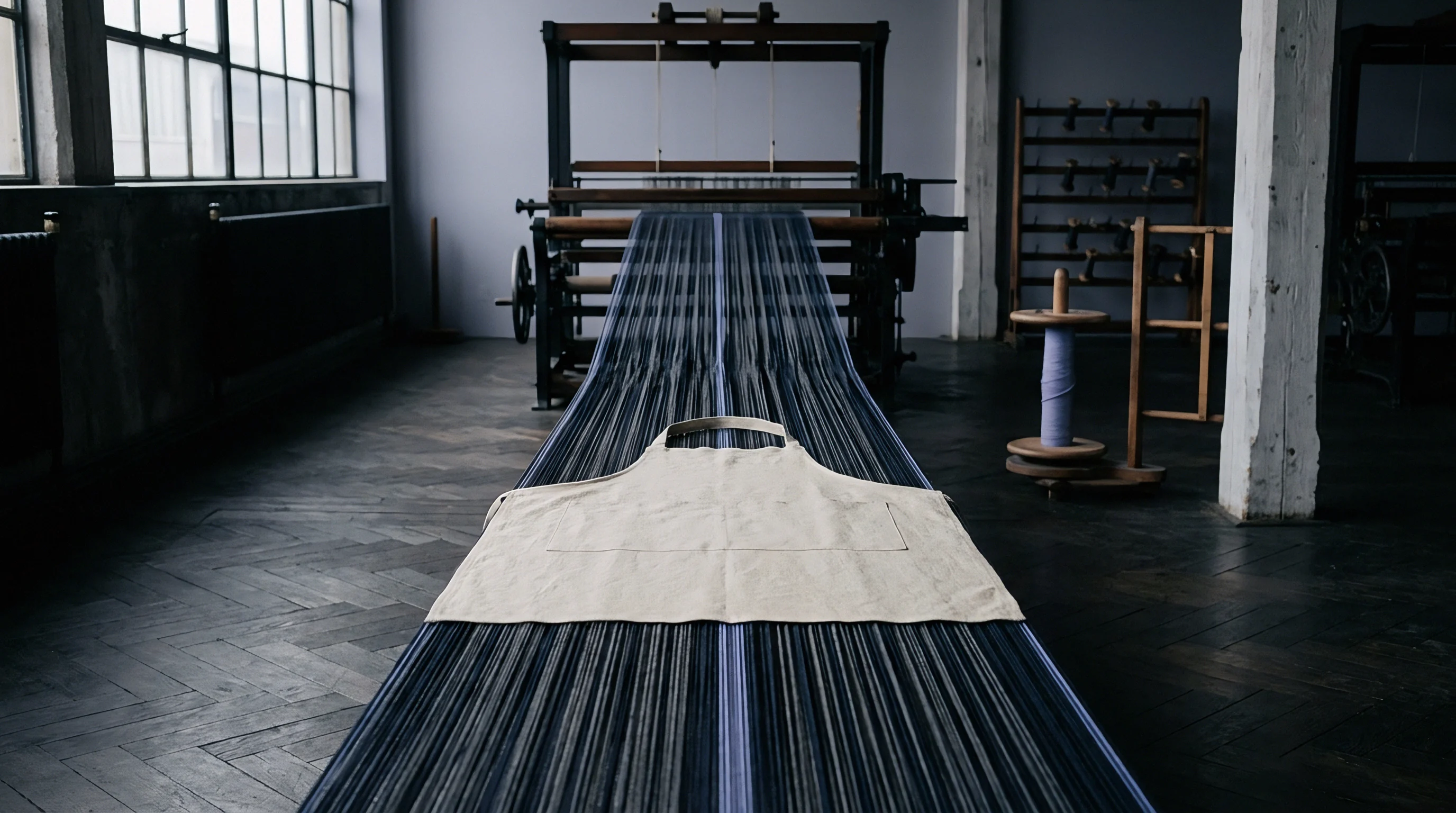
Creating an asymmetric shed concentrates wear at specific contact points along the yarn path. The tight bottom sheet experiences higher normal forces as threads travel through drop wires, heald eyes, and reed dents. Because flax has low loop tenacity, this localized friction quickly wears through protective size coatings, exposing raw bast fibers to direct abrasion.
The mechanical friction generated by an asymmetric warp shed increases size shedding at the harness eyes by up to thirty percent when sizing film plasticizers are omitted.
Setting backrest height requires checking how well the size film holds up through the harness zone. Lower-grade starch formulas can flake off under high tension differentials, generating dust that clogs heald eyes and increases end breaks. Sizing used for asymmetric shedding needs flexible synthetic polymers or modified fats to maintain film integrity under uneven cyclic loads.
The practical limit for backrest elevation is reached when abrasion damage causes more warp stops than poor shed clearance did in the first place.

Compliance
Whip Roll Spring Dynamic Deflection Settings
Dynamic backrest systems compensate for the rigid nature of flax yarn during high-speed shedding. Passive whip rolls use calibrated torsion springs or hydraulic dampers to absorb tension surges at beat-up and peak shed aperture. As the harness frames open, the backrest assembly yields forward against spring resistance, capping tension spikes.
Without this movement, an elevated backrest can drive warp stress past the breaking point within milliseconds of reaching back dead center.
Spring rates must match the warp end count and yarn count. Stiff springs keep the backrest rigid, which maximizes clearance but transfers full dynamic stress directly to the yarn. Soft springs collapse too easily, losing the tension difference needed to separate sticky fibers.
Spring pre-load must be matched to the calculated tensile modulus of the warp sheet.
Table 2 shows how dynamic ease-off movement affects peak tension and yarn elongation across different flax yarn counts at a fixed 20 millimetre backrest lift.
| Yarn Count (Nm) | Whip Roll Deflection (mm) | Peak Warp Strain (%) | Peak Tension (cN/end) | Yield Deflection Clearance Status |
|---|---|---|---|---|
| Nm 10 (Heavy) | 4.2 | 1.15 | 62.0 | Complete separation, zero cling |
| Nm 14 (Medium) | 5.8 | 1.30 | 45.5 | Complete separation, zero cling |
| Nm 26 (Fine) | 7.5 | 1.52 | 31.2 | Optimal clearance, low breakage |
| Nm 39 (Ultra-Fine) | 9.1 | 1.78 | 22.4 | Marginal clearance, slight hairiness |
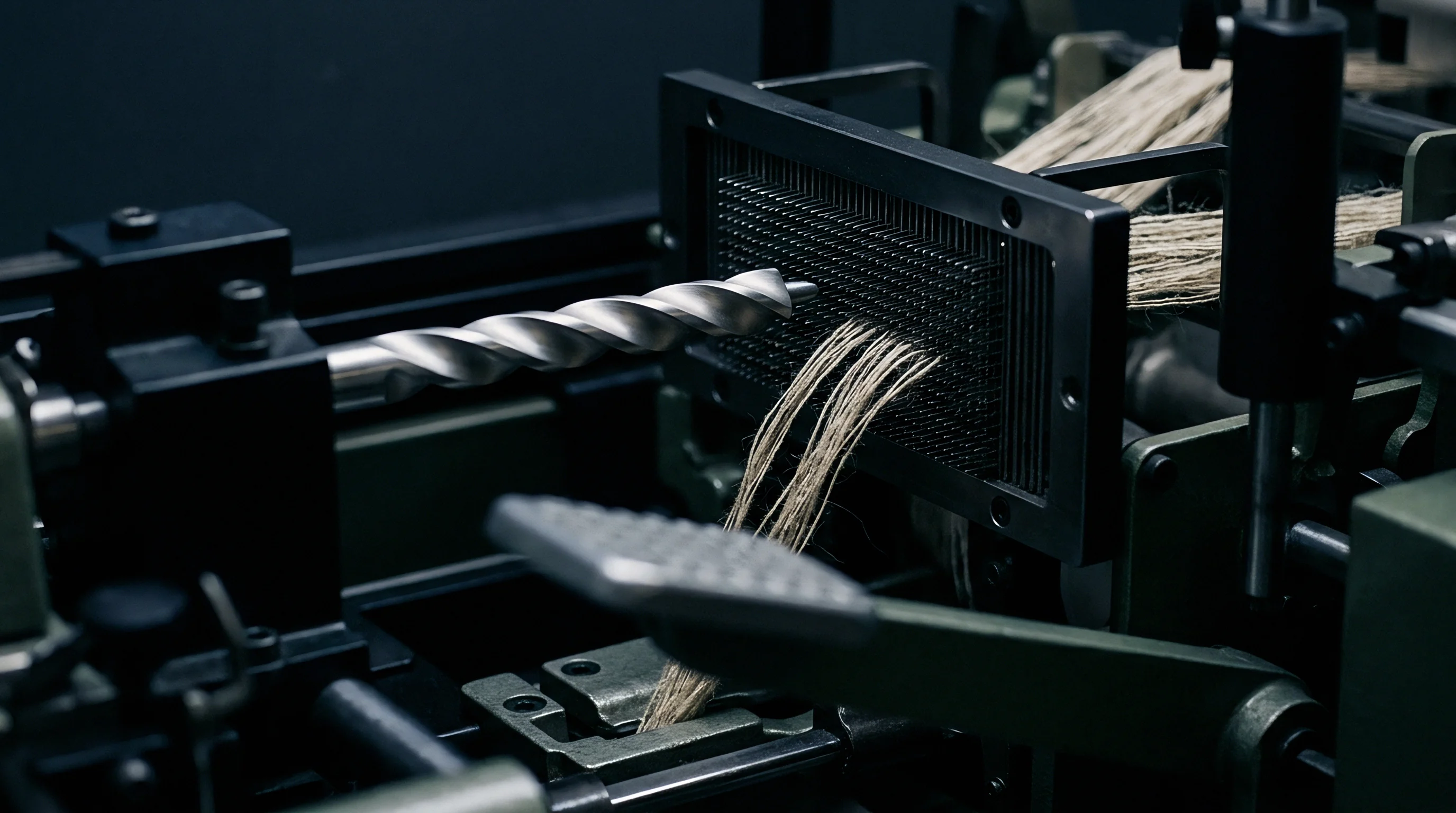
Ease-Off Motion Synchronisation for Low-Elongation Fibres
Active backrest drives replace passive spring systems on high-speed rapier and air-jet looms weaving linen. An eccentric linkage or servo motor moves the whip roll in phase with the loom main shaft. The mechanism draws the backrest back during harness crossover to maintain baseline tension, then drives it forward at maximum aperture to relieve strain on the bottom sheet.
ISO 5239 testing protocols confirm that active ease-off mechanisms reduce peak warp tension spikes in bast fiber weaving by twenty-two percent compared to rigid whip roll mountings.
Phase timing governs clearance performance. If the ease-off stroke peaks too early, bottom-sheet tension drops before the rapier head enters the shed, causing yarn sag and insertion faults. If it peaks too late, the movement occurs after maximum aperture, failing to protect the yarn from over-stretching as the shed opens.
- Eccentric Crossover Lead advances whip roll motion by 10 to 15 degrees ahead of harness crossover to prevent dynamic tension drops during shed closure.
- Dwell Time Calibration holds the backrest at maximum forward displacement while the filling inserter passes through the warp shed.
- Shed Opening Amplitude adjusts whip roll stroke length between 3 millimetres and 12 millimetres depending on heald frame lift.
- Restitution Spring Pre-load removes mechanical backlash from drive linkages, maintaining positional accuracy against reversing inertia forces.
Yarn breakage on linen warps can stem from irregular spinning quality as well as uncalibrated backrest ease-off dynamics.
Tally
Loom Stoppage Frequency and Weaving Shed Overhead
Every warp stop on a flax weaving line carries a clear financial cost. When shed clearance fails because of incorrect backrest alignment, warp breaks rise alongside filling stops caused by obstructed yarn. In a shed running 50 rapier looms on Nm 26 pure linen, an increase from 1.0 to 3.5 warp stops per loom-hour undermines overall operating profitability.
Take a typical weaving setup: a loom operating at 400 picks per minute generates 24,000 picks per hour. At 20 picks per centimetre, theoretical output is 12 linear metres per hour. A standard target efficiency of 85 percent yields 10.2 metres per loom-hour.
If warp stops increase from 1.0 to 3.5 per hour, weaver downtime per machine grows by 12 minutes every hour, dropping loom efficiency to 68 percent. Output falls to 8.16 metres per loom-hour ~ a loss of 2.04 metres per machine every hour across the plant.

Capacity Calculations for Dense Pure Linen Fabrics
Cost calculations per metre must include the unrecoverable time lost to manual defect repairs, tying broken warp ends, and fixing floats on greige fabric.
- Direct Labor Premium increases as weavers are forced to handle fewer looms per section due to constant manual interventions.
- Greige Defect Downgrading reduces second-quality fabric value by 30 to 50 percent when uncorrected floats wind onto the take-up roll.
- Energy Consumption Overhead remains constant per loom-hour whether the machine is running or sitting idle during tying.
- Sizing Polymer Waste rises when pick-up rates are artificially elevated to mask poor mechanical clearance in the shed.
Standard sourcing master agreements mandate a maximum greige fabric defect count of no more than fifteen points per one hundred square metres under ASTM D5430 four-point inspection rules.
Determining true cost per metre requires connecting mechanical setup to overall commercial metrics. Assuming a machine overhead rate of 18.50 USD per loom-hour, operating at 10.2 metres per hour puts overhead at 1.81 USD per linear metre. When poor backrest alignment reduces output to 8.16 metres per hour, overhead rises to 2.26 USD per linear metre.
On a 50,000 metre order, that difference adds 22,500.00 USD in overhead costs alone, eroding operating margins before inspection even starts.
Controlling backrest geometry turns flax shedding clearance into a predictable, engineered process. Adjusting backrest height to suit the mechanical limits of flax yarn provides clean clearance while keeping peak warp strain within safe operating limits. Standardizing these setup protocols improves loom efficiency, reduces greige fabric faults, and stabilizes unit costs across linen production runs.