Loom Allocation Optimization Models for Flax Fabric Mills
Optimize flax fabric loom allocation by matching yarn elongation and cover factor to rapier or projectile loom mechanics, minimizing beam changeovers and trim waste.


Variables
The physical nature of bast fibers imposes sharp mechanical limits on linen weaving. Because flax yarn stretches far less than cotton or synthetics, warp tension at shed opening is the main driver of loom stops. Scheduling models for flax mills must therefore ground their allocations in exact measurements of yarn properties, insertion limits, and cloth geometry.

Physical Fiber Constraints and Warp Dynamics
With an ultimate elongation typically between 1.5% and 2.5%, flax yarns offer virtually no yield buffer under sudden stress. Peak tension spikes strike the yarn bundle full force every time a high-speed loom opens the shed. Wet-spun yarns are more uniform and stronger than dry-spun yarns of the same count, which permits faster picking; dry-spun lots show wider count variation (CV%) along with more thick slubs and thin spots.
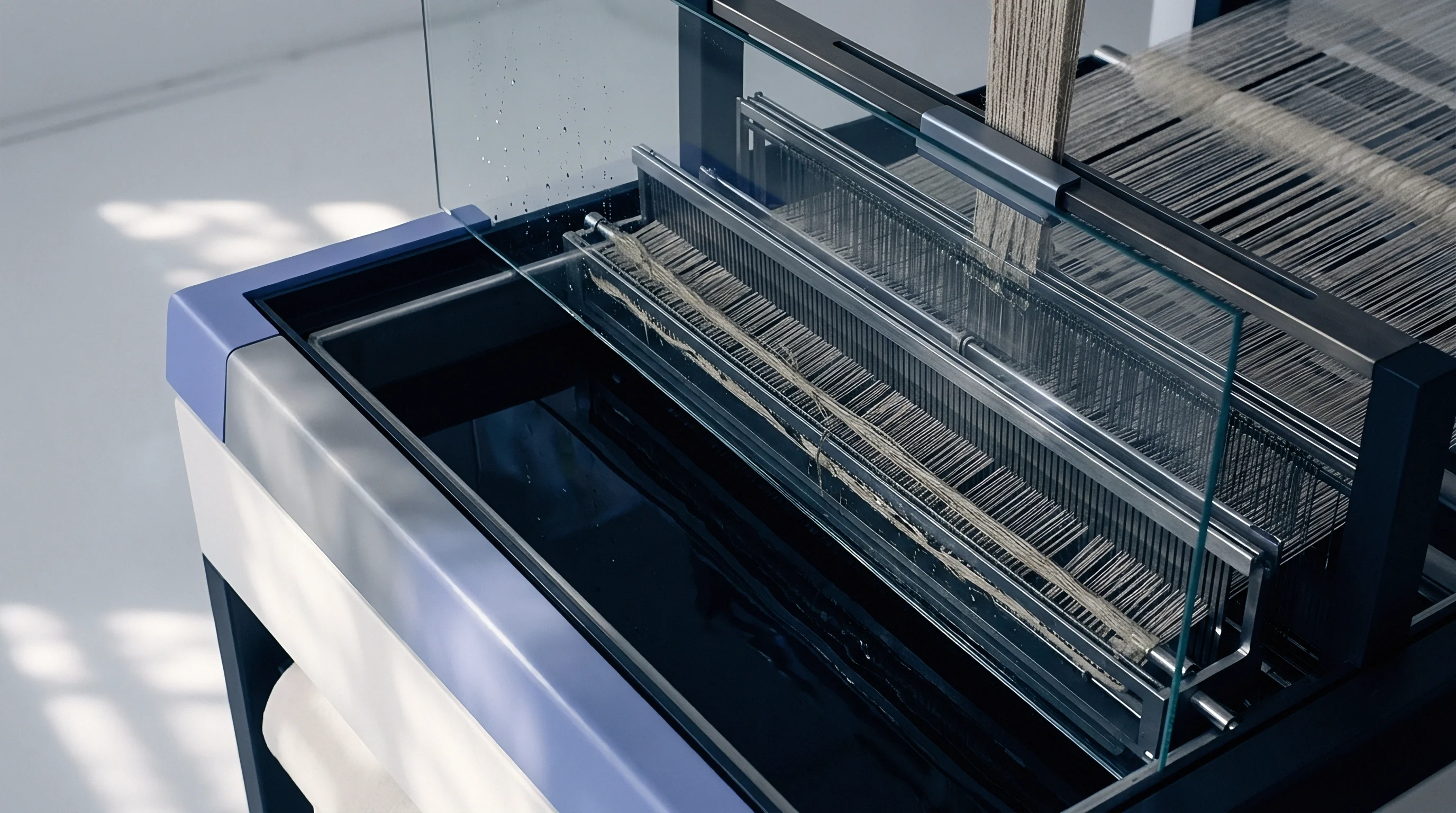
Shed performance hinges on warp preparation. Flax sizing formulations combine modified starches with synthetic lubricants to lay down surface fibers and withstand reed abrasion. Target pick-up levels require tight control: over-sized yarn turns brittle, while under-sized yarn rubs into fuzz and breaks under the reed, flaking off inside the heald wires.
- Yarn Tensile Elongation ~ Flax yarns stretch very little, requiring precise backrest roller motion to absorb shed opening loads.
- Slub Frequency Count ~ Coarse inclusions per thousand metres affect insertion clearance on rapier heads, driving up stop rates.
- Sizing Retention Level ~ Starch pick-up is held between 8% and 12% dry mass weight to cushion ongoing reed friction.
- Warp Sheet Tension ~ Static load on heald wires must not exceed 45 grams per end during full shed opening to prevent brittle fiber breaks.
Unlike synthetic fibers, flax offers almost no working stretch under load.
Even wet-spun warps require closely controlled sizing to run reliably.
Reed Density and Cloth Cover Arithmetic
Matching a fabric to a loom shed comes down to how ends per centimetre align with yarn count. The cover factor dictates how much mechanical force the reed needs to pack picks into the fell, with dense constructions like heavy duck or uniform sheeting generating heavy beat-up resistance.
Cover factor calculation for flax uses the classic Peirce formula adjusted for bast fiber density:
K = (ends per cm / sqrt(Nm)) + (picks per cm / sqrt(Nm))
Here Nm denotes metric yarn count. Plain weaves run into mechanical beat-up limits once cover factors pass 22, triggering fell bounce and uneven pick spacing. Twill and satin weaves lower that resistance by reducing warp-weft interlacing, which makes higher pick densities possible on the same frames.
A 100% wet-spun flax warp of Lea 40 running at 400 picks per minute loses 3.2% in loom efficiency for every 0.5% increase in yarn irregularity CV percentage.
Allocation models have to account for these cover thresholds. Putting a heavy plain-weave linen with a cover factor of 21 on an underpowered frame risks motor overload and reed marks. Routing dense structures to heavy-duty projectile or rigid rapier looms protects both fabric quality and the machinery.
Heavy linen damasks with dense warps require wider shed openings than lightweight plain-weave canvases.

Pitch
Aligning fabric specifications with the right insertion mechanism directly controls mill output and stop frequencies. Because of flax’s unique physical properties, it behaves quite differently across air-jets, flexible rapiers, rigid rapiers, and projectiles. Optimization models must account for these mechanical realities to avoid severe bottlenecks on the weave floor.

Insertion Mechanisms and Machine Selection
Rapiers lead in flax weaving because rigid or flexible grippers carry the weft across without subjecting uneven yarns to harsh pneumatic drag. Flexible rapier heads clear thick slubs smoothly through the shed. Air-jets run much faster, but demand clean, low-hairiness yarn; running coarse dry-spun flax through air nozzles leads to constant filling stops as fiber halos catch in the air stream.
Projectile machines provide wide reed widths, handling double-width sheetings up to 360 centimetres across. The heavy steel projectile clamps the filling firmly and carries it across wide sheds at steady velocity, though high initial tension can snap weaker dry-spun yarns at the break detector.
| Loom Mechanism | Max Reed Width (cm) | Max Speed (PPM) | Yarn Count Limit (Lea) | Target Stop Rate (per 10^5 picks) |
|---|---|---|---|---|
| Flexible Rapier | 220 | 550 | Lea 10 to Lea 80 | 1.2 |
| Rigid Rapier | 190 | 420 | Lea 6 to Lea 60 | 0.8 |
| Air-Jet | 190 | 800 | Lea 25 to Lea 100 (Wet-Spun) | 3.5 |
| Projectile | 360 | 380 | Lea 12 to Lea 70 | 1.5 |
Air-jet weaving relies on exceptionally low yarn defect counts.
Excessive insertion tension easily snaps brittle bast yarns.

When Does Beam Sharing Reduce Changeover Overhead?
Grouping orders with identical warp specs avoids hours of downtime spent re-threading heald eyes and reed dents. When a mill runs several items on a standard sett ~ like 24 ends per cm of Lea 30 ~ it can mount a common warp beam across neighbouring looms, cutting changeover downtime from eight hours down to a forty-five-minute knotting routine.
- Air-Jet Weft Stoppages ~ Hairy fibers drag against the nozzle channel wall, triggering false short-pick trips.
- Rapier Clamp Slippage ~ Coarse slubs get jammed in gripper teeth, letting untrapped filling ends halt the machine.
- Projectile Tension Spikes ~ Heavy yarn counts strain the projectile clamp, snapping ends at the selvage transfer point.
To comply with ISO 7211 construction tolerances, total picks per centimetre must stay within plus or minus 2.5% of the engineered target, or buyers retain full rights to reject the lot.
Models optimize beam sharing by grouping orders by warp count, reed sett, and width, even if weft density or pattern differs. Matching beam changes to delivery deadlines prevents premature beam cuts and cuts down on warp tail waste.
Excessive yarn hairiness from third-party spinning is often cited to exempt mills from contracted efficiency guarantees.

Formulation
Building an optimization model for a flax mill involves balancing machine hours, reed width usage, and changeover delays. Mixed-Integer Linear Programming (MILP) offers a standard framework for allocating multiple styles across various loom groups. The objective function maximizes net margin while factoring in direct running costs, setup expenses, and trim waste penalties.

Linear Integer Programming for Loom Shed Optimization
The objective balances profitability against penalties for late deliveries and changeover overhead. Set indices represent looms (i), styles (j), and time periods (t). Decision variables track the metres of style j woven on loom group i during period t, while binary variables capture beam setup transitions.
Let X_{i,j,t} represent the production volume in metres. Let Y_{i,j,t} represent a binary variable equal to 1 if loom i is set up for style j in period t, and 0 otherwise. The objective function is formulated as:
Maximize Z = Sum_{i,j,t} (P_j – C_{i,j}) X_{i,j,t} – Sum_{i,j,t} S_{i,j} Y_{i,j,t} – Sum_{j,t} W_j UN_j,t
Where P_j represents the wholesale selling price per metre of style j, C_{i,j} represents the variable production cost per metre on loom family i, S_{i,j} represents the total changeover and warp mounting cost for style j on loom i, W_j is the penalty cost per unmet metre, and UN_j,t is the unfulfilled order volume.
Linear programming highlights and balances machine bottlenecks.
Setup duration scales directly with warp density.
Available reed width bounds total usable output.
Model constraints encompass loom capacity bounds, delivery due dates, and machine width compatibility:
1. Capacity Constraint: Sum_j (X_{i,j,t} / Speed_{i,j}) <= Available_Hours_{i,t} Efficiency_{i,j}
2. Width Limit Constraint: Cloth_Width_j <= Max_Reed_Width_i - Min_Selvage_Allowance
3. Demand Balance: Sum_{i,t} X_{i,j,t} + UN_{j,T} = Order_Volume_j
4. Beam Length Limit: Sum_{j in Group_k} X_{i,j,t} <= Max_Beam_Metres_k
Worked Allocation Model across Multi-Width Rapier Frames
Consider a plant with twelve 190 cm rapiers, eight 220 cm rapiers, and four 340 cm rapiers taking on four concurrent orders. Parameters specify style details, linear volume, reed widths, and due dates across a four-week window. Weaving a single narrow panel on a 340 cm frame wastes capacity, whereas double-width layouts (two panels side by side) make full use of the reed space.
| Style ID | Order Metres | Cloth Width (cm) | Assigned Loom Group | Multi-Panel Setup | Loom Efficiency % | Loom Hours Required | Trim Waste % |
|---|---|---|---|---|---|---|---|
| L-101 (Tabby Sheeting) | 15,000 | 150 | 340 cm Rapier | Dual Panel (300 cm) | 88% | 194 | 2.1% |
| L-204 (2/1 Twill Apparel) | 8,000 | 140 | 190 cm Rapier | Single Panel | 84% | 168 | 3.5% |
| L-305 (Heavy Canvas) | 5,000 | 180 | 220 cm Rapier | Single Panel | 79% | 142 | 1.8% |
| L-408 (Jacquard Damask) | 12,000 | 160 | 340 cm Rapier | Dual Panel (320 cm) | 75% | 355 | 2.4% |
Multi-panel setups protect overall reed capacity.
Warp and reed widths govern final trim waste.
Frequent warp end breaks cut into overall efficiency.
The optimization assigns Styles L-101 and L-408 as dual-panel layouts on the 340 cm rapiers, lowering loom-hour consumption by 32% compared to single-panel runs on 190 cm looms. The trim waste figure includes the center tuck-in selvage needed to slit double-width rolls during grading.
Running double-width cloth on wide projectile machines produces lower unit costs than running single-panel rolls across several narrow rapier frames.
Overall capacity utilization hits 91.4% across the twenty-four looms over four weeks. Changeovers take up 3.8% of available time, and preventive maintenance claims 4.8%. The solution ensures all four orders finish inside their delivery windows, avoiding late fees.
Underestimating warp changeover time in the weekly schedule starves downstream looms, leading to delivery penalties and wasted operator labor.

Disruption
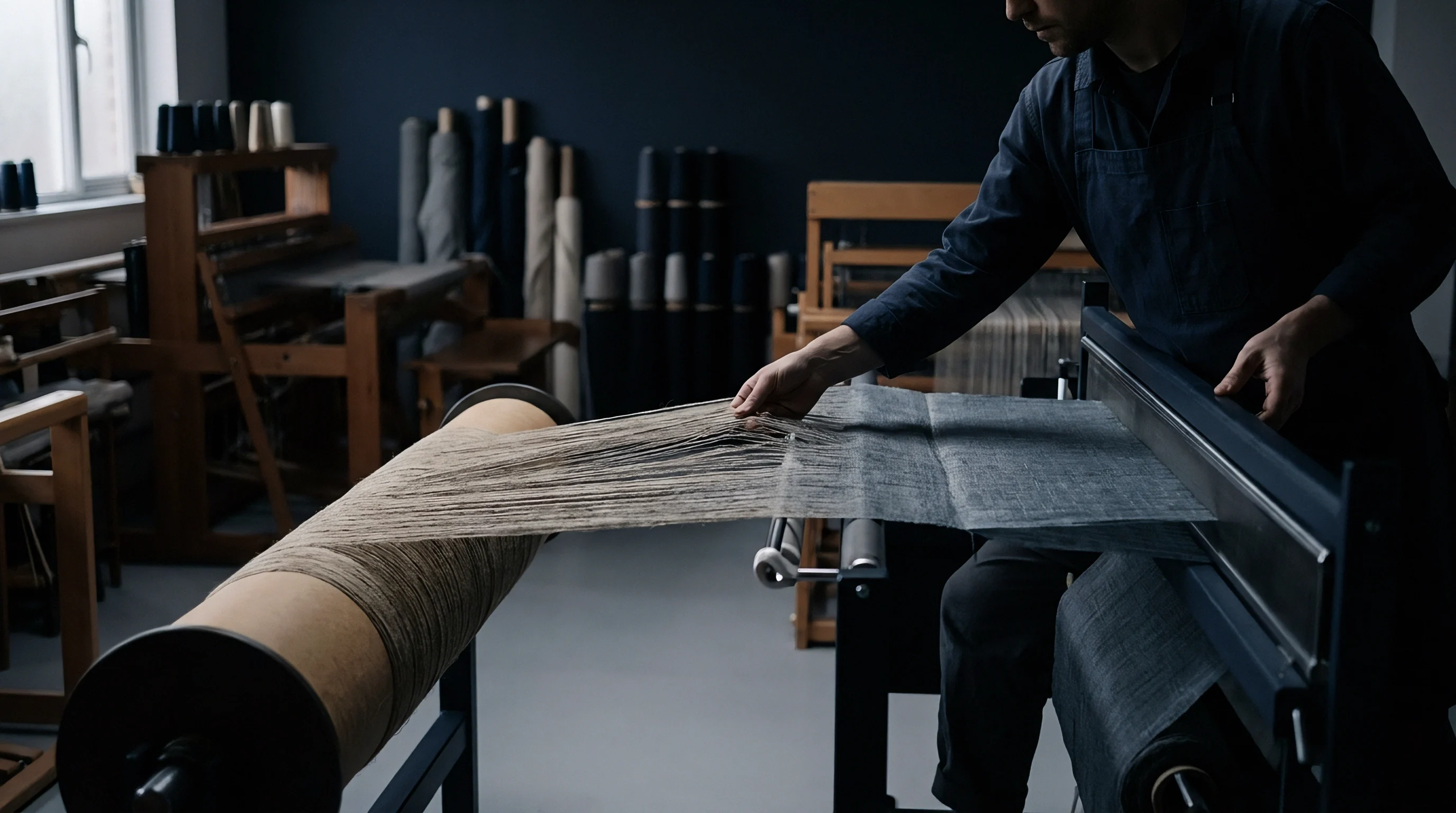
Sudden stops caused by variable yarn quality require fast, real-time schedule adjustments. When a warp lot carries high slub counts or erratic tensile strength, affected looms suffer frequent end breaks. Fixed schedules quickly break down under these conditions, making rolling-horizon models necessary.

Dynamic Rescheduling under Yarn Quality Variance
Spikes in end breaks trigger logic to shift sensitive styles off high-speed frames onto slower, lower-tension machinery. When a loom exceeds 4.5 warp breaks per operating hour, efficiency falls below breakeven; monitoring systems then flag the beam lot and recalculate queue priorities.
Rescheduling algorithms run heuristic searches or constrained MILP updates to shift problematic warps onto rigid rapier frames, dropping insertion speeds by 15% to reduce dynamic shock. At the same time, top-tier yarn beams are routed to fast air-jets to regain lost yardage.
Slub density directly dictates achievable insertion speed.
Off-spec yarn lots quickly accumulate downtime costs.

Buffer Management in Flax Warping and Slashing
Weaving operations depend on maintaining a steady buffer of warped beams ahead of slashing. Inadequate beam inventory leaves looms sitting idle during yarn breaks or sizing cleanups. A reserve of at least two fully sized beams per loom group should stay ready for mounting.
- Review yarn break logs across active looms at four-hour intervals.
- Flag style runs exceeding two warp breaks per 10,000 picks for speed reduction.
- Move troubled warp orders from air-jets to flexible rapiers within two hours.
- Update linear model parameters to reflect current loom efficiencies.
- Alert warp preparation to expedite substitute beams for displaced queues.
A drop in shed relative humidity below 65% dries out flax yarn, causing a sharp spike in warp end breakage.
Humidity control directly affects weave room stability. Flax fibers need 70% to 75% relative humidity to maintain flexibility; if levels drop, brittle yarn failure spikes across all frame types, throwing off baseline efficiency targets in the model.
Whether real-time monitoring sensors can fully automate tension adjustments without operator oversight remains an open operational question.
Validation
Inspection verifies that scheduled production met buyer specifications. Inspecting greige fabric catches mechanical defects ~ from poor loom selection, improper warp tension, or worn reeds ~ before wet finishing, protecting margins prior to further processing.
Greige Defect Classification and Demerit Scoring
Grading greige rolls on inspection tables exposes alignment issues before fabric moves to wet processing. The ASTM D5430 four-point system is the standard for scoring flax goods, assigning penalty points to linear flaws like warp streaks, heavy ends, and missing picks based on defect length.
| Defect Classification | Defect Length / Nature | Penalty Points | Root Mechanical Cause |
|---|---|---|---|
| Minor Stop Mark | Less than 3 inches | 1 Point | Improper loom motor brake stopping position |
| Major Warp Streak | 3 to 6 inches | 2 Points | Bent reed wire or worn heald eye |
| Continuous Reed Mark | 6 to 9 inches | 3 Points | Incorrect reed denting pattern or wire misalignment |
| Severe Drop-Out | Greater than 9 inches | 4 Points | Weft insertion failure with broken drop-wire trip mechanism |
Greige grading scores dictate final quality settlements.
Twill constructions reduce shed opening tension.
Dual-beam arrangements equalize ground yarn crimp.
Physical Cloth Property Testing Standards
Finished linen must undergo lab testing for tensile strength, tear resistance, and dimensional stability. ISO 13934-1 sets requirements for strip tensile testing, and ISO 13937-2 covers Elmendorf tear testing. While flax is naturally strong when dry, harsh scouring or bleaching degrades cellulose fibers and lowers final strength.
- Four-Point Score Limit ~ Greige rolls must not exceed 28 penalty points per 100 square metres under ASTM D5430.
- Bow and Skew Tolerance ~ Fill alignment must stay within 2.5% of total width to prevent pattern distortion.
- Selvage Tension Uniformity ~ Uneven edge threads require temple roller adjustment to prevent selvage tears in finishing.
Lab records of greige defect rates provide valuable feedback to planning models, refining efficiency assumptions and yarn quality thresholds for future runs.

Settlement
How efficiently loom capacity is assigned directly translates into per-metre costs on customer invoices. Scheduling choices govern unit manufacturing costs, warp setup amortization, and margin per machine hour.

Amortization of Setup Charges and Beam Costs
Minimum order quantities decide how effectively warp preparation amortizes over production length. Warping, sizing, and threading demand significant labor and machine time; when orders drop below 3,000 metres, setup costs take up a disproportionate share of unit manufacturing expense.
Total unit cost per finished metre calculates as:
C_total = (C_yarn + C_sizing + (Cost_per_Loom_Hour / (Speed_PPM 60 / Picks_per_Metre Efficiency)) + (Setup_Cost / Order_Metres)) / (1 – Waste_Rate)
Here Cost_per_Loom_Hour covers power, labor, room overhead, and depreciation. Running Lea 30 linen on a flexible rapier at $18.50 an hour and 85% efficiency gives a base weaving cost of $0.62 per metre. Amortizing warp setup over a small 2,000-metre order adds $0.24 per metre, whereas spreading it over 10,000 metres adds just $0.05.

Capacity Reservation and Landed Cost Mechanics
Dedicated loom-hour billing protects mill margins while setting clear pricing tiers for custom weaves. Buyers reserving specific loom capacity carry the financial risk of setup delays tied to custom yarn sign-offs, and standard supply contracts impose explicit penalties for unassigned capacity windows.
Standard reservation clauses levy a 15% billing penalty on buyers canceling booked loom hours within twenty-one days of scheduled beam mounting.