Weaving Efficiency and Warp Break Optimization in High Speed Linen Production
Optimizing sizing formulation, humidity, and shed geometry reduces flax warp breaks to achieve 86 percent efficiency on high-speed looms.
Kinematics
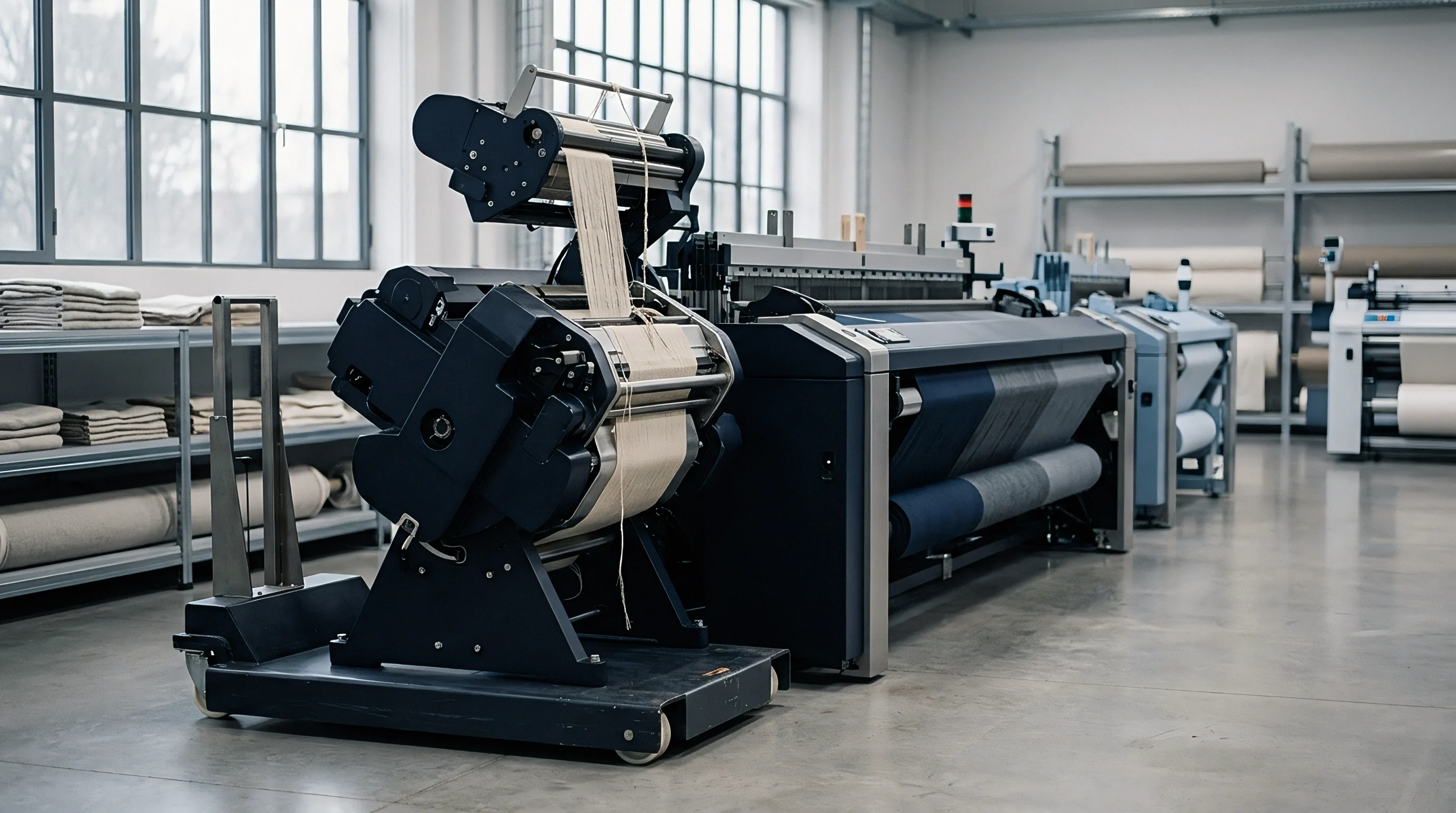
Linen yarn spun from 100 percent long-staple flax has a brittle stress-strain profile. Where combed cotton yields three to seven percent elasticity before rupture, wet-spun linen fractures at an elongation between 1.5 and 2.2 percent. Running this fiber on a modern weaving loom above 500 picks per minute exposes the warp sheet to rapid peak loads during shed opening and beat-up.
Dynamic tension pulses on each cycle can easily exceed the static tensile limit of weak yarn segments, driving up warp breaks if mechanical timing is uncalibrated.
Peak warp tension occurs when the shedding motion reaches full open position as the backrest roller oscillates forward. On rapier looms operating at 550 picks per minute, the crank cycle grants roughly 110 milliseconds for shed movement, dwell, and reed beat-up. Acceleration forces during shed division generate local peak tension values between 18 and 28 centinewtons per tex.
Lacking the intercellular flexibility to absorb these impulses elastically, flax fibers fail primarily at thin places, un-spliced joints, or sections with low twist multipliers.

Shed Symmetry and Peak Tension Distributions
Asymmetrical shed geometry distributes mechanical strain unequally between the top and bottom warp sheets. Raising the backrest roller 10 to 15 millimeters above the breast beam centerline lengthens the path of the top warp sheet while slackening the bottom line, creating distinct tension profiles over crank rotation:
| Shed Line Setting | Top Sheet Tension (cN/tex) | Bottom Sheet Tension (cN/tex) | Beat-up Peak Strain (%) | Observed Warp Breaks per 100,000 Picks |
|---|---|---|---|---|
| Symmetrical (Zero Height) | 22.4 | 22.1 | 1.95 | 4.8 |
| Asymmetrical (+10 mm) | 16.8 | 26.3 | 1.42 | 2.1 |
| Asymmetrical (+18 mm) | 13.2 | 31.5 | 2.18 | 6.4 |
High bottom-sheet tension maintains thread separation above the raceboard so the rapier head or air-jet main nozzle does not snag adjacent ends. Lowering top-sheet tension reduces peak stress during shed opening, cutting warp end cleavage breaks across the main body of the fabric.
The peak dynamic tension during shed opening must not exceed 75 percent of the single-strand yarn breaking load measured under standard atmospheric conditions.
Tension peaks also concentrate during reed beat-up. When the reed drives the pick into the cloth fell, friction between warp and weft pulls the warp sheet forward against the let-off brake. In plain weave linen constructions with cover factors above 18, beat-up resistance sends a backward surge of kinetic force through the heddle eyes.
Hydropneumatic or spring-loaded backrest assemblies absorb energy during this beat-up stroke, flattening the spike and protecting low-elongation flax fibers from shock rupture.
Yarn linear density dictates maximum allowable loom speed. Fine wet-spun linen yarns of Nm 60 (16.6 tex) tolerate far lower peak dynamic forces than coarse yarns of Nm 26 (38.4 tex). Increasing machine speed from 450 to 600 picks per minute elevates dynamic tension exponentially rather than linearly, as structural vibration in the harness frames amplifies peak loads.
Spinners frequently blame yarn quality for shed stoppages when the actual culprit is uncompensated frame resonance at high speeds.
Sizing
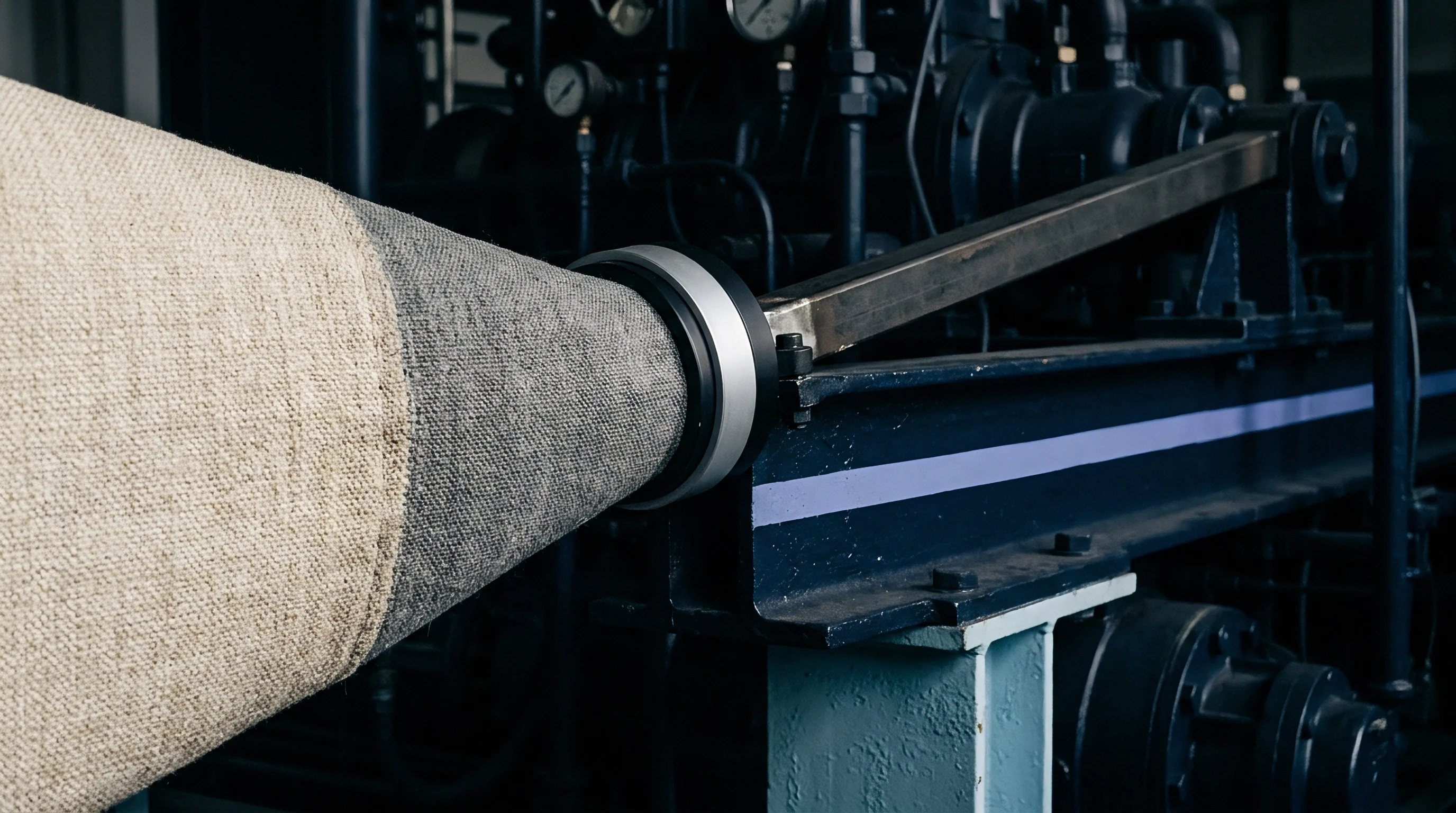
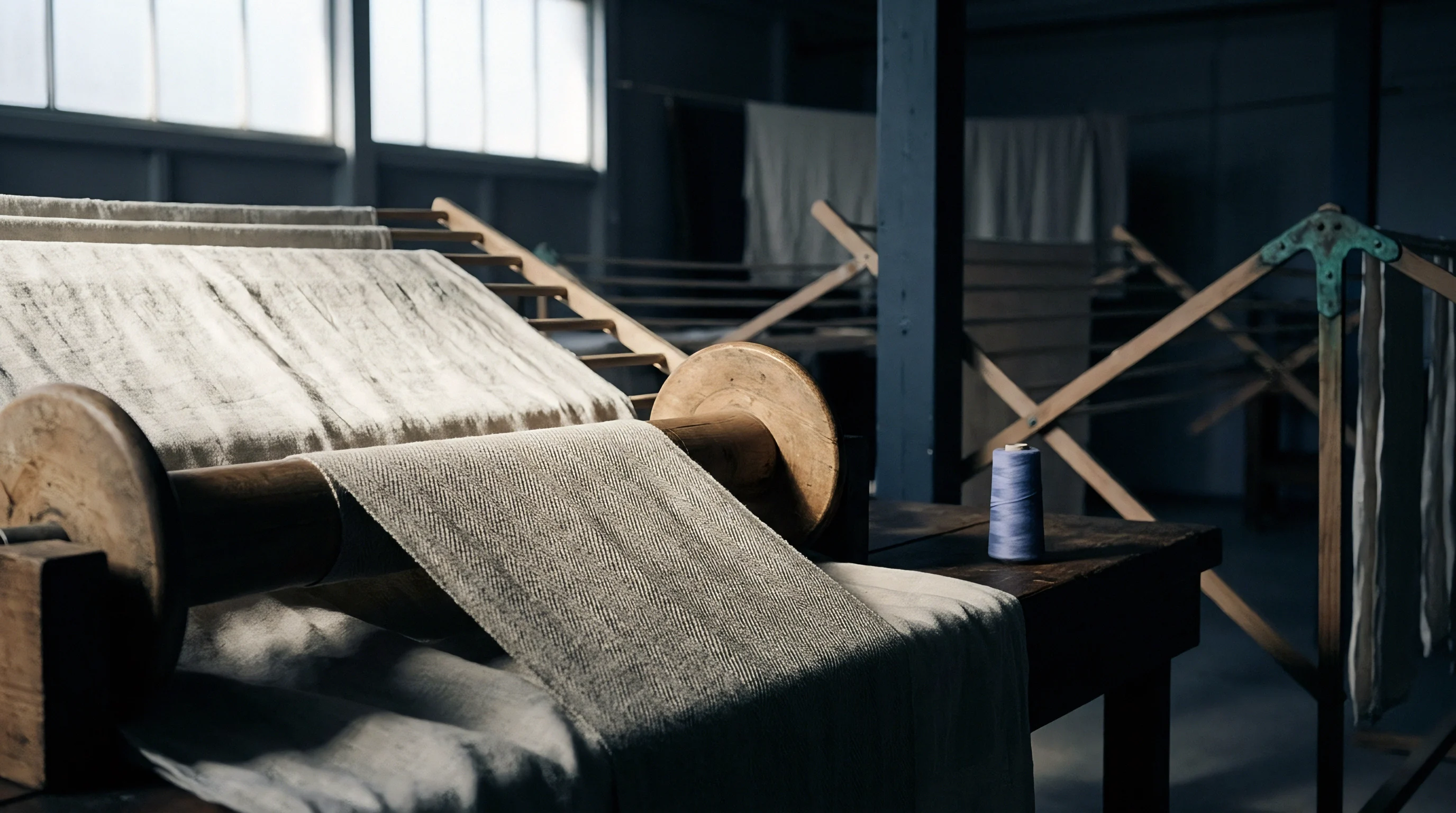
Unsized flax yarn cannot endure the abrasive action of high-speed loom components. As heddle wires shift and the reed moves across the warp sheet at 600 cycles per minute, surface fibers strip off into tiny lint balls known as fuzz buttons. These buttons lock adjacent warp threads together, preventing clean shed openings and forcing loom stops via drop-wire detection.
Sizing coats the yarn core with a protective film, binding loose surface fibers to the yarn body while building abrasion resistance.
Linen sizing formulations differ fundamentally from standard cotton recipes. Raw flax contains natural pectic substances, hemicellulose, and waxes that resist aqueous absorption. High-viscosity native starches yield poor penetration and leave brittle surface shells that flake off inside the drop-box area.
Chemically modified starches combined with synthetic film formers give optimal strength, flexibility, and desizabilty.
Formulation Parameters for High-Speed Warp Preparation
An effective size liquor balances film toughening with fiber lubrication. A standard formulation for high-speed rapier production on Nm 39 long-staple linen comprises modified potato starch, polyvinyl alcohol, and an emulsified tallow lubricant.
| Component Class | Chemical Agent | Dry Add-on Rate (%) | Viscosity at 85 C (mPa s) | Target Function |
|---|---|---|---|---|
| Primary Binder | Hydroxyethylated Potato Starch | 6.5 – 8.0 | 35 – 45 | Cohesiveness and core penetration |
| Co-Binder | Low-Viscosity PVA (88% hydrolyzed) | 2.5 – 3.5 | 12 – 18 | Film elasticity and tensile strength |
| Lubricant | Sulfonated Tallow Wax | 0.8 – 1.2 | N/A | Surface coefficient of friction reduction |
| Hygroscopic Agent | Refined Glycerol | 0.5 – 0.8 | N/A | Moisture retention in low-humidity sheds |
Size encapsulation needs to cover the yarn surface without completely filling internal fiber interstices. Penetrating too deeply stiffens the linen yarn, impairing bending recovery and leaving it vulnerable to brittle fractures under beat-up impact. Target size add-on ranges between 8.5 and 11.0 percent by dry weight for pure linen warp lines.
- Preset slasher squeeze-roller pressure to 22 kilonewtons across a 2200 millimeter face width to regulate liquor pick-up uniformity.
- Maintain size box liquor temperature at 85 degrees Celsius within a tolerance of plus or minus two degrees to prevent starch viscosity shifts.
- Control cylinder drying temperatures across a six-cylinder dryer train using a descending thermal gradient from 115 degrees to 75 degrees Celsius.
- Regulate warp sheet moisture regain at the slasher delivery head to land between 9.5 and 11.5 percent.
- Apply aqueous wax emulsion via a post-drying kiss-roll to reduce static electricity and lower the yarn-to-metal friction coefficient below 0.18.
ISO 105-X12 tests confirm that yarn-to-metal friction coefficients above 0.22 triple the rate of shed fuzz accumulation within the first two hours of continuous loom operation.
Dry-can temperature control prevents thermal shock to flax fibers. Over-drying yarn below six percent moisture content bakes the natural pectins, destroying yarn pliability and triggering brittle failures at the loom. Under-drying results in sticky warp beams that lock during unwinding, causing high tension spikes that snap ends behind the backrest roller.
Precise moisture sensors on the slasher delivery beam automatically adjust machine crepe speed to keep yarn moisture inside the target band.
Incorrect size liquor pH causes chemical degradation of natural pectin bonds. Alkaline size baths above pH 8.5 strip flax waxes rapidly, forcing extra lubricant additives to compensate. Maintaining size liquor between pH 5.5 and 6.5 protects the natural structure of the fiber while allowing complete starch cross-linking on the surface.
Neglecting bath monitoring leads to starch dust shedding in the weaving shed, clogging pneumatic reed valves and seizing heddle eyes.

Reed
Loom motion hardware dictates shed geometry and clearance during high-speed insertion. Linen yarn features natural slubs, loose fiber clusters, and thick places created during wet spinning. Standard stainless steel reed dent profiles pinch these irregular yarn features as the warp sheet moves up and down.
A trapped end remains caught inside the dent gap, generating local abrasion that wears through adjacent warp ends until a double-end break triggers the stop motion.
Tunnel reeds designed for air-jet looms or polished wide-dent reeds for rapier looms require specialized surface treatments when weaving linen. Micro-polished dent wire surfaces reduce friction against the yarn. Titanium nitride coatings applied to reed wires increase hardness above 2000 Vickers, keeping abrasive flax fibers from grooving the metal channels over months of beat-up motion.
Could Reed Width Reduction Prevent Edge Breaks?
Reducing reed width cuts outer selvage tension by limiting the angular distortion of warp ends at the extreme edges of the shed. Outer ends travel at a sharper angle from backrest to temple cutters than center ends, experiencing higher lateral friction against the reed wire. Narrowing the reed draw by 5 to 8 percent while widening waste selvage zones balances end tension across the entire reed space, eliminating up to 40 percent of edge-end warp breaks.
Heddle wire selection directly influences yarn clearance and lint accumulation. J-hook and C-hook end loops allow slight lateral float, accommodating slubs without trapping the thread against adjacent wires. Mono-wire steel heddles with nickel-plated eyes present smooth surfaces that minimize fiber abrasion.
- Heddle eye size must exceed the nominal yarn diameter by a factor of four to allow unhindered passage of wet-spun flax slubs without catching on the metal loop edge.
- Harness frame alignment requires precision laser leveling within 0.5 millimeters of pitch tolerance across the frame beam width to prevent crooked shed openings.
- Drop wire weight requires matching to yarn count, using 0.7-gram wires for fine Nm 60 yarns and 1.5-gram wires for coarse Nm 26 constructions to avoid false loom stops.
- Temple roll selection demands synthetic rubber sleeves with helical grooves rather than spiked metal rings, preventing mechanical puncture of brittle outer flax threads.
Shed angle adjustment balances clearance against dynamic strain. Wider shed angles simplify weft insertion by opening a large clearance window for rapier heads, but elevate peak warp tension. Dropping the shed angle from 30 degrees down to 24 degrees reduces peak yarn elongation by 22 percent.
This setup demands precise rapier entry and exit timing to avoid clipping the warp sheet as the shed closes.
Rule of thumb: increase heddle frame depth clearance by one millimeter for every five yarn count steps courser than Nm 40 to accommodate fiber slubs without mechanical binding.
Backrest position and geometry dictate the tension recovery loop during beat-up. Dual-scale oscillating backrest systems maintain a constant warp path length throughout the shedding cycle. As harness frames separate, the backrest pivots forward under spring control, yielding extra warp length.
When the shed closes for beat-up, the backrest returns to its rearmost position to restore sheet tension for clean cloth formation.
Uncalibrated backrest springs allow warp threads to develop slackness on shed closure. These slack ends twist around neighboring threads, forming double-warp entanglements that snap during the next shedding cycle. Fine-tuning spring compression against total warp count keeps individual thread lines running clean through the reed dents.
Stoppage
Warp break optimization relies on systematic root-cause diagnosis at the loom frame. Machine-level stop motion loggers classify halts into warp breaks, weft stops, and manual interventions. Analyzing how warp stops are distributed across loom width, harness position, and time intervals separates mechanical faults from yarn defects.
High-speed linen weaving sheds achieve efficiency levels above 88 percent only when warp stops fall below 1.2 stops per loom-hour per 100,000 ends.
Diagnostic Classification of Warp Failures
Inspecting broken yarn tails under illuminated magnification reveals the precise mechanical or structural mechanism responsible for the stoppage:
| Fracture Morphology | Physical Appearance | Primary Root Cause | Corrective Action |
|---|---|---|---|
| Clean Tensile Snap | Sharp, flat fiber ends with minimal splay | Peak tension surge exceeding yarn strength | Reduce shed lift angle or lower backrest height |
| Abraded Fuzz Ball | Matted cluster of loose fiber behind break point | Insufficient size coat or grooved reed dent | Increase starch binder ratio or replace reed |
| Slub Trap | Thick yarn thick-place wedge inside heddle eye | Inadequate heddle eye clearance or knot defect | Switch to large-eye heddles or adjust clearers |
| Entanglement Snap | Twisted multi-end break zone across two dents | Low warp tension during shed closure phase | Increase let-off base tension or tighten springs |
Mapping break locations across the cloth width separates edge effects from center-sheet failures. Breaks concentrated within 10 centimeters of the selvage point to improper temple alignment, sharp selvage drop-wires, or excessive draw-in angles. Breaks distributed evenly across the entire width signal sizing defects, excessive overall tension, or ambient humidity drift in the weaving shed.
Standard contract clause: ASTM D5430 Four-Point Grade inspection penalizes weaving sheds if greige cloth exhibits more than four continuous warp-break repair marks per 100 running meters.
Relative humidity inside the weaving shed acts as a critical process parameter. Flax is a hydrophilic fiber whose tensile strength increases when saturated with moisture. Dry linen yarn running at 50 percent relative humidity demonstrates a 30 percent reduction in tenacity compared to yarn conditioned at 75 percent relative humidity.
Maintaining weaving shed conditions between 70 and 78 percent relative humidity at 22 degrees Celsius preserves yarn toughness and lowers static electrification.
Letting shed humidity drop below 65 percent causes immediate spikes in warp breakage. Dry flax fibers turn brittle, size coatings crack, and static charges cause adjacent ends to repel each other into the path of the rapier grip. Modern high-speed sheds utilize localized ultrasonic humidification manifolds positioned directly under the warp sheets behind the harness frames, maintaining local micro-climate moisture without wetting machine electronics.
Costing
Warp break frequency directly governs loom productivity, shed efficiency, operator loading, and overall landed fabric cost per meter. When a loom stops on a warp break, it loses production picks while running up overhead costs. Operator efficiency dictates how fast a broken end is located, drawn through the drop wire, heddle eye, and reed dent, and tied back to restart the machine.
Average repair time per warp break ranges between 45 and 90 seconds depending on loom accessibility and weaver skill.

Worked Financial Calculation of Stoppage Impact
Consider a weaving shed running 50 high-speed rapier looms producing fine plain-weave linen fabric (160 gsm, Nm 39 warp, 22 ends/cm, 20 picks/cm, reed width 1.90 meters) at 550 picks per minute. The base operating parameters establish target capacity:
- Theoretical production rate equals 1.65 meters per hour per loom at 100 percent run efficiency.
- Direct loom operation cost is fixed at 18.50 USD per loom-hour, covering power, depreciation, climate control, and labor.
- Base warp stop rate stands at 3.2 stops per loom-hour under un-optimized sizing and machinery settings.
- Optimized warp stop rate drops to 0.9 stops per loom-hour following shed geometry tuning and size mix adjustment.
- Average downtime per stop equals 60 seconds (0.0167 hours), including weaver walk time and automated slow-motion start cycles.
Un-optimized operation loses 3.2 minutes (0.0533 hours) per loom-hour to warp break repairs alone. Additional stops for weft clears, beam changes, and maintenance reduce net loom efficiency to 74 percent. Production lands at 1.221 meters per loom-hour.
Dividing the 18.50 USD loom-hour operational cost by 1.221 meters yields an operating machine cost of 15.15 USD per finished meter of greige linen fabric.
Implementing optimized warp-break parameters reduces warp downtime to 0.9 minutes (0.015 hours) per loom-hour. Total net loom efficiency rises from 74 percent up to 86 percent. Production output increases to 1.419 meters per loom-hour.
Machine operating cost drops to 13.03 USD per meter, generating a direct cost saving of 2.12 USD per meter on machine conversion costs alone.
| Efficiency Level (%) | Output (Meters / Loom-Hour) | Conversion Cost (USD / Meter) | 10,000 Meter Order Machine Cost (USD) | Cost Variance Against Base Line (%) |
|---|---|---|---|---|
| 70 | 1.155 | 16.02 | 160,200 | +5.7 |
| 74 (Base Un-optimized) | 1.221 | 15.15 | 151,500 | 0.0 |
| 80 | 1.320 | 14.02 | 140,200 | -7.5 |
| 86 (Optimized Shed) | 1.419 | 13.03 | 130,300 | -14.0 |
| 90 | 1.485 | 12.46 | 124,600 | -17.8 |
Higher loom efficiency alters weaver allocation ratios. When warp stop rates drop from 3.2 down to 0.9 stops per hour, one weaver can manage 24 modern looms instead of 8 un-optimized looms without extending machine stop-time queues. Reducing shed labor requirements lowers conversion costs further, protecting commercial margins on large-volume linen contracts.
Whether modern ultra-high-speed air-jet looms running above 800 picks per minute can process pure wet-spun linen warps without causing catastrophic fiber fragmentation remains an open technical challenge for machine builders and sizing chemists.