Flax Yarn Mechanical Response and Basic Crimp Interchange Fundamentals
Flax yarn stiffness forces dynamic crimp interchange during beat-up, where warp tension directly converts warp curvature into weft deflection.

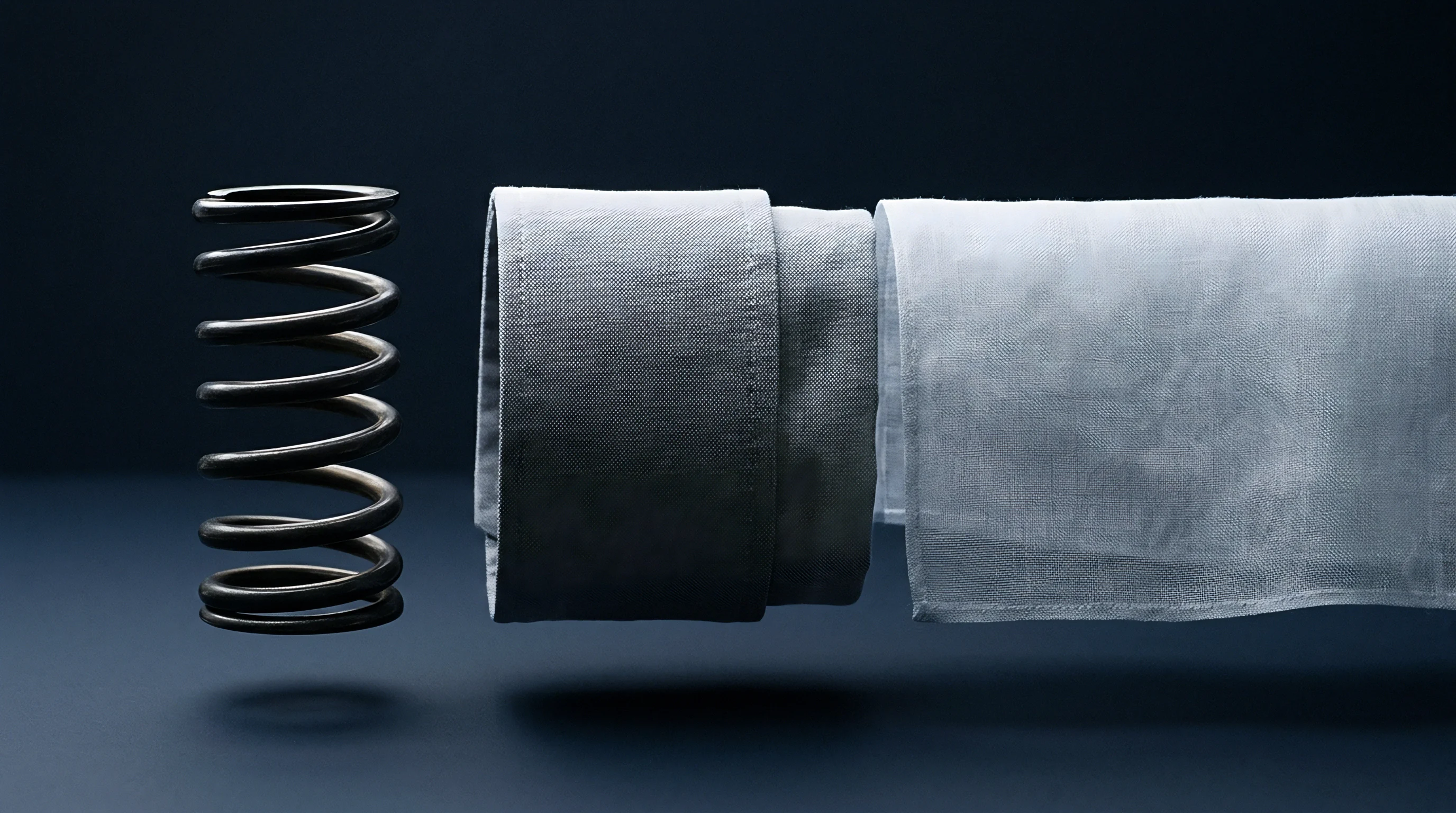
Strand
Conditioned at 20 degrees Celsius and 65 percent relative humidity, wet-spun 26 Nm flax yarn shows an initial secant modulus between 12 and 18 GPa. The tensile stress-strain behavior of long-staple linen strand follows a non-linear curve, where initial linear elastic response terminates rapidly at approximately 0.3 percent strain. Past this yield threshold, progressive shear deformation occurs within the amorphous inter-cellular matrix.
Cellulose microfibrils within elementary flax fibers align at an angle of 8 to 11 degrees relative to the fiber axis ~ a low helical angle that grants the strand exceptionally high initial stiffness compared to cotton or wool. Matrix yielding corresponds directly to pectin and hemicellulose polymers slipping under load.
Dry-spun flax yarns have a looser structural orientation, requiring higher twist multipliers in the fiber bundles to achieve minimal cohesion. This extra twist forces outer elementary fibers into steeper helical paths, reducing effective axial tensile modulus to 6 or 8 GPa. Tenacity drops from the 38 to 52 cN/tex typical of wet-spun long flax down to 14 to 22 cN/tex in dry-spun tow yarns.
Work to break remains constrained by ultimate tensile elongation, which rarely exceeds 2.5 percent in high-grade wet-spun strands.
At 85 percent relative humidity, moisture plasticizes the pectin matrix and improves stress distribution among elementary fibrils, raising wet-spun flax yarn ultimate tenacity by 15 percent.
Because flax is a hydrophilic bast fiber, moisture absorption fundamentally alters its rheology. Water molecules penetrate non-crystalline inter-fibrillar zones, weakening intermolecular hydrogen bonds while plasticizing the pectin matrix. This allows elementary fibers to realign under tension before catastrophic fiber slip occurs, raising wet yarn tenacity relative to bone-dry values.
Tensile testing per ISO 13934-1 requires strict climate stabilization; unconditioned samples produce misleading strength peaks and artificial stiffness metrics.
| Yarn Type | Yarn Count (Nm) | Tenacity (cN/tex) | Break Strain (%) | Initial Modulus (GPa) |
|---|---|---|---|---|
| Wet-Spun Long Flax | 26 | 42.5 | 2.1 | 15.4 |
| Wet-Spun Long Flax | 39 | 48.0 | 1.8 | 16.8 |
| Dry-Spun Tow Flax | 14 | 18.2 | 2.8 | 7.2 |
| Dry-Spun Tow Flax | 20 | 16.5 | 2.4 | 6.8 |
Viscoelastic creep complicates long-term warp tension control. When held under static loads exceeding 30 percent of ultimate tensile strength, the pectin matrix on the loom beam slips irreversibly, causing permanent plastic elongation within hours. Stress relaxation develops rapidly during mill stoppages, driving beam tension down exponentially over an idle shift.
Mechanical models must account for this non-recoverable strain to prevent warp end slackness upon loom re-start.
In contemporary bast fiber research, the exact threshold where crystalline cellulose dislocation slip takes over from inter-cellular pectin flow under dynamic high-frequency tensile cycling remains unresolved.

Curvature
Thread geometry inside woven fabric follows strict mechanical conservation rules. Crimp represents the additional yarn length consumed as threads weave over and under perpendicular lines relative to flat cloth length. In a standard plain weave structure, warp crimp percentage and weft crimp percentage exist in dynamic equilibrium.
Peirce’s classical geometry models threads as circular cylinders wrapped around planar axes, where path length depends on yarn diameter, end sett, pick sett, and modular central bending radius.
Increasing warp sheet tension flattens the warp path toward a straight line through the shed, pulling warp crimp down toward zero. This displacement forces weft yarns to deflect around rigid warp ends, increasing weft crimp immediately to maintain structural spacing. Total fabric thickness equals the sum of the flattened warp diameter and the fully bent weft diameter ~ a physical trade-off known as crimp interchange.
ISO 7211-3 specifies that crimp measurements require an applied un-crimping tension calculated precisely as five-tenths centinewtons per tex of the yarn under evaluation.
Flexural rigidity governs crimp resistance. Because bending modulus scales with the fourth power of effective yarn diameter, coarse flax yarns resist the sharp curvature demanded by tight weave setts. High pickage constructions force severe cross-sectional flattening at crossover contact points, collapsing circular profiles into elliptical ones.
Contact pressure during weaving flattens the major axis of wet-spun yarn by 20 to 35 percent.
Take a plain weave linen fabric specified at 20 ends per centimetre and 18 picks per centimetre, using 26 Nm wet-spun flax yarn in both directions. Linear density measures 38.46 tex, giving a theoretical yarn diameter of 0.203 millimetres assuming standard packing density. Space per end equals 0.500 millimetres for warp and 0.555 millimetres per pick for weft.
Un-crimped modular lengths measure 0.535 millimetres per repeat for warp (7.0 percent initial crimp) and 0.582 millimetres for weft (4.8 percent crimp). Applying 120 N of loom warp tension draws out the warp line, reducing warp crimp to 2.2 percent while weft crimp automatically escalates to 9.1 percent, contracting cloth width by 4.3 percent at the loom fell.
- Modular path length establishes the physical quantity of yarn allocated to a single repeat unit of the weave matrix.
- Thread axis deflection determines the vertical peak-to-trough distance traversed by the undulating thread system.
- Cross-sectional ellipticity alters the effective contact boundary area where crossing yarn systems intersect.
- Crimp ratio balance expresses the relative ratio of warp crimp percentage to weft crimp percentage in finished greige fabric.
Flax yarns with high bending rigidity consistently force structural crimp into the opposing yarn system during beat-up.


Tension
Dynamic shedding causes continuous tension fluctuations across the warp sheet, with loom speed dictating cyclic strain frequency. High-speed rapier looms operating at 350 picks per minute subject warp ends to tension spikes exceeding 3.5 cN per tex during shed opening. Because flax yarn has low strain-to-break and high stiffness, the warp line cannot absorb shed displacement through elasticity alone, requiring backrest rollers mounted on mechanical or electronic spring dampers to cushion peak loads.

Where Does Crimp Interchange Stabilize across the Weaver’s Beam?
Beat-up is the critical instant of crimp interchange. As the reed forces the newly inserted weft pick against the fabric fell, fell displacement depends on warp tension, backrest roller positioning, and shed timing. Closing the shed before beat-up completes locks the weft pick under maximum warp clamping force, trapping high warp crimp into the cloth structure.
Late shed closure allows the weft pick to slip backward, increasing weft crimp and reducing cloth pick density.
| Loom Phase | Shed Angle (deg) | Warp Tension (cN/tex) | Warp Crimp (%) | Weft Crimp (%) |
|---|---|---|---|---|
| Dwell Phase | 0 | 1.8 | 5.8 | 5.2 |
| Shed Opening | 120 | 3.6 | 3.1 | 8.0 |
| Beat-Up Peak | 350 | 5.2 | 1.9 | 9.6 |
| Shed Relaxation | 180 | 2.1 | 5.2 | 5.9 |
Off-loom relaxation triggers immediate structural shifting. Greige cloth under tension on the take-up roll retains non-equilibrium crimp values. Once released from the roll, axial warp tension disappears and high internal strain energy in the bent weft threads forces axial contraction.
Warp crimp increases within minutes of doffing, shortening fabric length by 3 to 6 percent while width expands slightly. Technicians must measure this off-loom dimensional shift 24 hours post-weaving to confirm finished specification targets.
- Lower backrest roller height to equalise top and bottom shed sheet length during harness lift.
- Advance harness timing to lock beat-up force before the reed reaches front dead centre.
- Increase main warp let-off tension baseline until fell line movement drops below one millimetre per beat-up stroke.
- Adjust temple cylinder clamp teeth to restrain lateral fabric fell contraction behind the reed strip.
Incorrect warp tension settings generate irreversible reed marks, fell line instability, and structural pick variation across the bolt length.

Finish
Wet processing destabilizes greige crimp balance as water exposure causes fibers to swell. Fully saturated flax fibers expand radially by up to 15 percent while changing less than 1 percent in axial length. Because fixed thread spacing set by the reed cannot accommodate these thicker yarn cross-sections without geometric adjustment, the bending radius sharpens and threads travel longer wave paths around opposing yarns.
Hot alkaline scouring extracts natural waxes, pectins, and hemicellulose binder residues, reducing yarn flexural rigidity. With non-cellulosic components removed, scoured yarns bend around crossover points with lower mechanical resistance. In hot washing liquors above 80 degrees Celsius, stress relaxation accelerates, releasing internal strains locked into the fiber network during high-tension spinning and weaving.
Tensionless mechanical drying maximizes warp shrinkage, restoring structural crimp equilibrium lost during loom warp drawing.
Tensionless drying permits maximum dimensional relaxation as continuous industrial tumble dryers agitate wet fabric with high-velocity airflow. Unconstrained drying allows the warp line to pull inward, swelling warp crimp values to finished levels. Warp contraction during finishing reaches 8 to 12 percent on dense plain weaves, whereas weft contraction ranges between 2 and 5 percent depending on temple settings applied on the stenter frame.
Over-extending fabric width on the stenter overrides natural crimp equilibrium, artificially lowering weft crimp and leaving fabric prone to severe laundering shrinkage.
Finishing mills frequently attribute chronic width variation and diagonal skewing to irregular initial raw flax retting yields rather than uncalibrated stenter chain clip tensions.

Booking
Accurate capacity calculations demand exact crimp allowance factors; standard warp yield equations fail if crimp interchange dynamics are ignored. A mill booking a 10,000 metre order of finished linen fabric must purchase yarn based on un-crimped length requirements. If finished warp crimp measures 8.5 percent, theoretical warp length required equals 10,850 metres.
Factoring a 2.5 percent warping room yarn waste and a 1.5 percent loom waste allowance, total raw warp yarn length reaches 11,284 metres per warp line.
| Sett (Ends x Picks / cm) | Yarn Count (Nm) | Warp Crimp (%) | Loom Speed (PPM) | Shed Efficiency (%) | Loom Output (m/hr) | Yarn Demand (g/m) |
|---|---|---|---|---|---|---|
| 16 x 14 | 26 | 5.2 | 380 | 88 | 14.32 | 118.2 |
| 20 x 18 | 26 | 7.8 | 350 | 84 | 9.80 | 152.4 |
| 24 x 22 | 39 | 9.4 | 320 | 79 | 6.89 | 122.8 |
Loom hours dictate commercial cost, and weft insertion rates on rigid flax warps are constrained by yarn break frequency. Linen warps average 1.5 to 3.5 warp stops per 100,000 picks on modern rapier machines. Dense setts increase beat-up resistance, requiring reduced loom running speeds to avoid brittle end breaks; dropping loom speed from 380 picks per minute down to 320 picks per minute increases machine time cost per metre by 18.7 percent.
Shed efficiency drops as pickage increases because fine setts require higher warp tension to preserve a clean shedding shed line. Higher tension elevates end breakage rates, and stop-time repair duration scales with operator loading on the shed floor. Ultimately, the cost per finished metre combines yarn consumption mass, warp sizing application cost, beam tying charges, and total allocated loom hours.
- Take-up factor calculation must combine both structural crimp contraction and wet processing finish shrinkage.
- Loom hour rate allocation applies machine overhead charges against actual net production output metres per shift.
- Warp waste allowance incorporates extra yarn lengths required for beam tying, drop wire threading, and reed denting scrap.
- Weft yarn delivery allowance compensates for waste tail clip removal on rapier insertion systems.
Standard delivery contracts mandate that fabric construction specs must cite ISO 7211-2 pick and end counts alongside target mass per unit area measured under ISO 3801 tolerances.