Hydromechanical Couplings Governing Inter Thread Shear Relaxation Dynamics in Ultra High Density Flax Warp Sheets
Optimal hydromechanical control of ultra-dense flax warps relies on balancing pectin plasticization against radial swelling to minimize shear locking.


Swell
When unspun flax bundles absorb liquid or vaporous moisture, the transverse geometry of the cellulosic filaments changes before the warp beam enters the harness. Primary cell walls in Linum usitatissimum consist of parallel microfibrils embedded in an amorphous matrix of pectin, hemicellulose, and structural proteins. As ambient relative humidity climbs above sixty percent, water molecules penetrate the non-crystalline interstitial zones, breaking intermolecular hydrogen bonds between adjacent polymer chains.
Driven inward by capillary forces, this rapid water absorption causes volumetric expansion almost entirely in the radial direction ~ expanding radially by fifteen to twenty-four percent while axial length shifts by less than one percent.
In an ultra-high density warp sheet where tight thread spacing leaves minimal void volume, transverse expansion forces neighboring ends directly against one another. For example, a warp running thirty-eight ends per centimetre of single-ply count Nm 50 flax has an initial packing density with inter-yarn clearance under ten micrometres. As liquid moisture is absorbed during sizing or conditioning, individual yarn diameters swell from a dry baseline average of 0.14 millimetres up to 0.17 millimetres, completely closing the remaining geometric clearance.
Radial expansion of ultimate flax bundles reaches eighteen percent at ninety percent ambient relative humidity under fifteen cN per tex warp tension.
Once lateral clearance is eliminated, spatial expansion turns into localized normal contact stress between adjacent threads, with higher setts multiplying these contact points. This hydromechanical coupling alters both the structural boundary conditions of the yarn array and the mechanical resistance of individual filaments to bending and compression. Transverse compression deforms the circular yarn cross-section into an elliptical profile, widening the contact area between parallel warp ends, so inter-yarn contact pressure rises exponentially as volumetric swell exceeds the available inter-thread porosity inside the reed dent.
| Yarn Count (Nm) | Warp Sett (ends/cm) | Moisture Regain (%) | Radial Swelling (%) | Inter-Yarn Stress (MPa) | Inter-Thread Friction (µ) |
|---|---|---|---|---|---|
| Nm 39/1 | 32 | 6.5 | 2.1 | 0.12 | 0.28 |
| Nm 39/1 | 32 | 12.0 | 11.4 | 0.85 | 0.34 |
| Nm 39/1 | 32 | 18.5 | 21.8 | 2.45 | 0.48 |
| Nm 58/1 | 42 | 6.5 | 1.8 | 0.25 | 0.26 |
| Nm 58/1 | 42 | 12.0 | 10.8 | 1.60 | 0.38 |
| Nm 58/1 | 42 | 18.5 | 20.5 | 4.10 | 0.54 |
Bound water in the pectin matrix acts as a plasticizing agent, lowering the glass transition temperature of hemicellulosic regions below room temperature. This softening allows microfibrils to slip past one another under lower mechanical loads, causing the structural modulus of single flax fibers to drop by thirty to forty-five percent as moisture regain rises from five percent to sixteen percent. Lower fiber bending rigidity partially counteracts the increase in lateral contact stress; ultimate mechanical resistance across the dense warp sheet comes down to the balance between reduced fiber stiffness and heightened inter-yarn friction.
Capillary transport across the warp sheet causes uneven moisture distribution along the warp beam length. Outer yarn layers absorb atmospheric vapor faster than inner layers, creating radial gradients of swelling pressure through the beam depth. As the warp unwinds under tension, sections with different moisture levels enter the drop wires and heald wires at varied dimensions.
High-density warps with uneven moisture uptake show localized tension variations across the sheet width, making thread-to-thread contact forces unpredictable and triggering localized dynamic binding during shedding.
Sizing formulations applied to ultra-dense flax warps need to account for hydromechanical swelling during drying. Native starches and carboxymethyl cellulose films coat the yarn surface, trapping moisture inside the fiber core or blocking atmospheric uptake. When these sized yarns enter high-humidity weaving sheds, how fast water vapor diffuses through the sizing film dictates when inter-thread swelling begins.
If swelling pressure in the flax core exceeds the tensile yield strength of the dried coating, the film ruptures.
Severe shedding lock-up on high-density flax warps is often attributed to defective sizing chemical batches when the actual cause is uncontrolled ambient relative humidity driving radial fiber swelling beyond the geometric limit of the reed dent.

Slip
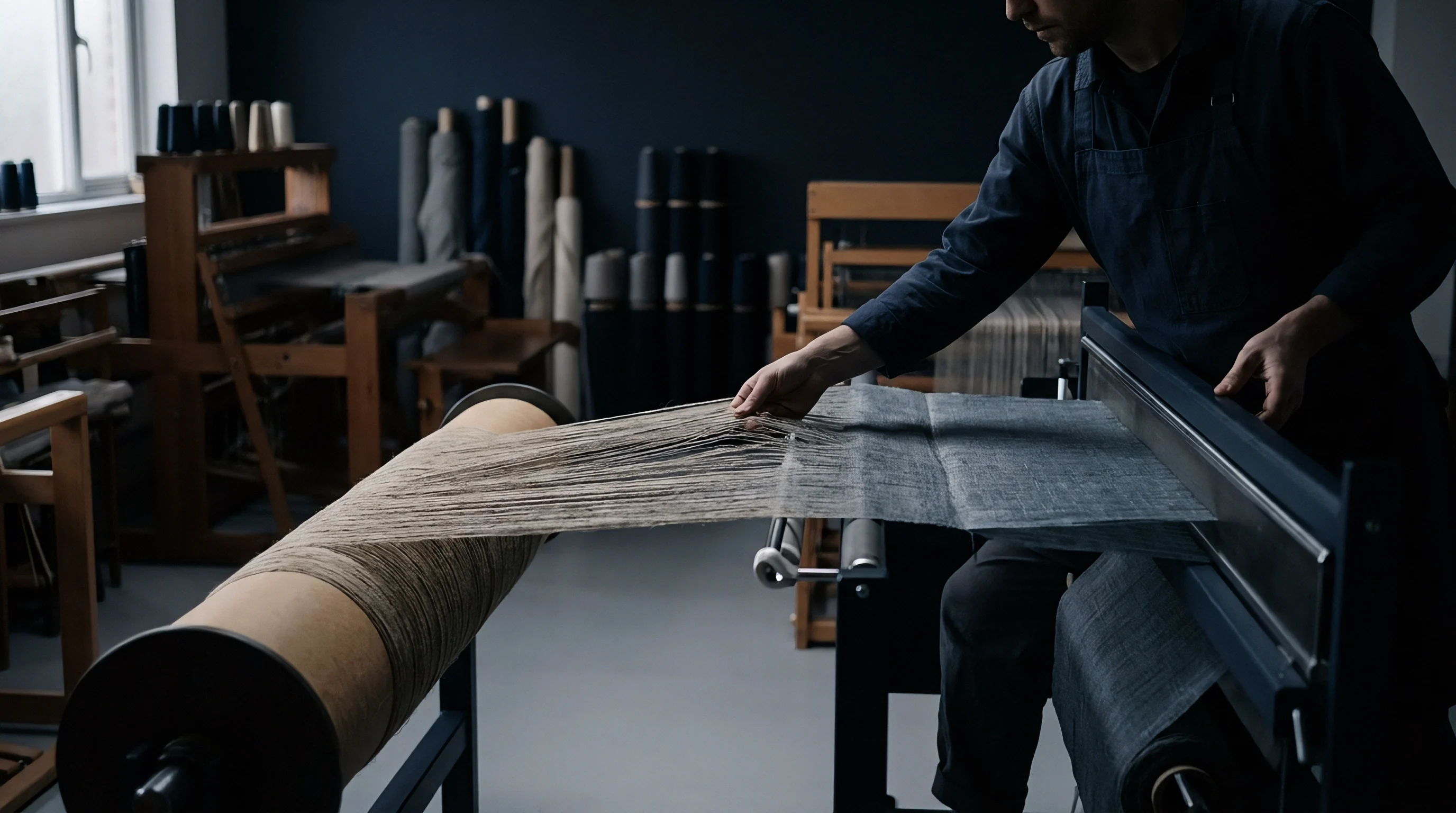
The relative movement of adjacent flax threads during shed formation generates localized shear stress at every crossover point. In high-density weaves with cover factors over ninety percent, contact between threads occurs along continuous axial lines rather than isolated points. When heald frames move in opposite directions to open the shed, neighboring warp threads slide against each other under high normal forces, causing saturated or plasticized hemicellulose networks within the fibers to show non-linear viscoelastic shear relaxation under cyclic displacement.
Viscoelastic Relaxation Kinetics in Plasticized Cellulosic Networks
Under constant mechanical strain, shear relaxation in wet flax yarns follows a dual-regime decay curve. A fast initial relaxation occurs within five to fifteen milliseconds of shed movement as free water molecules shift rapidly inside the yarn’s macropores. A slower secondary phase extends over several seconds, governed by the gradual conformational rearrangement of pectin macromolecules and bound water clusters inside the cell wall.
Shear stress generated during beat-up dissipates through both mechanisms at rates set by instantaneous moisture content and temperature.
Dynamic friction testing reveals a pronounced stick-slip transition during slow shedding cycles on dense flax constructions. At low sliding velocities where water acts as a lubricant, thin-film boundary lubrication dominates, creating high static friction coefficients that resist initial movement. Once motion begins, local hydrodynamic fluid films form between fibers and lower the kinetic friction coefficient.
As sizing films dissolve under moisture in ultra-high density sheets, this jump from static to kinetic friction causes rapid micro-shocks along the warp line, driving high-frequency tension oscillations across the warp sheet.
Flatter yarn cross-sections in high-density sheets disperse contact pressure and prevent local shear locking.
Inter-thread contact generates significant frictional heating during continuous high-speed loom operation. Local temperature spikes at contact points accelerate free water evaporation, causing sharp shifts in local moisture regain. Drier areas show an immediate rise in shear resistance, increasing the yield stress needed for inter-thread sliding.
This localized binding results in broken ends, reed wear, and severe structural defects in the greige fabric.
- Inter Thread Shear Yield Point Failure occurs when lateral contact stress exceeds the shear strength of the sizing film, causing local sizing rupture and fiber entangling.
- Stick Slip Motion Instability manifests as high-frequency warp tension spikes during shed separation, causing premature yarn fatigue and end breaks behind the drop wires.
- Asymmetric Crimp Distribution Fault results from uneven shear relaxation between warp ends during beat-up, creating longitudinal density bands in the finished cloth.
- Hydromechanical Yarn Flattening Defect arises when sustained transverse contact pressure permanently deforms yarn cross-sections, changing fabric porosity and air permeability.

Shear Stress Decay Curves under Dynamic Tension Cycling
Cyclic tension loads from the loom crank drive continuous shifts in inter-thread shear stress. When the shed opens fully, peak warp tension coincides with maximum lateral contact pressure between crossing threads. This pressure suppresses instantaneous shear relaxation, allowing stress to accumulate over consecutive loom revolutions.
If loom speed outpaces the relaxation rate of the plasticized pectin matrix, residual shear stresses build up along the warp line and demand greater force to complete subsequent beat-up cycles.
As yarn cross-sections flatten under transverse pressure, modified twist factors in combed flax yarns alter the structural angle of outer fibers relative to the yarn axis, changing the effective inter-thread friction coefficient. High-twist yarns present a steeper helix angle that increases mechanical interlocking between opposing fiber surfaces during shear displacement. Conversely, low-twist yarns flatten more easily under normal pressure, spreading the contact area while reducing peak contact stress.
Balancing twist against warp density is essential for controlling hydromechanical shear relaxation during weaving.
At loom insertion rates exceeding six hundred picks per minute, the governing mechanism behind the transition from hydrodynamic fluid film lubrication to direct solid-body cell wall friction at thread contact zones remains a primary technical constraint.
Draft
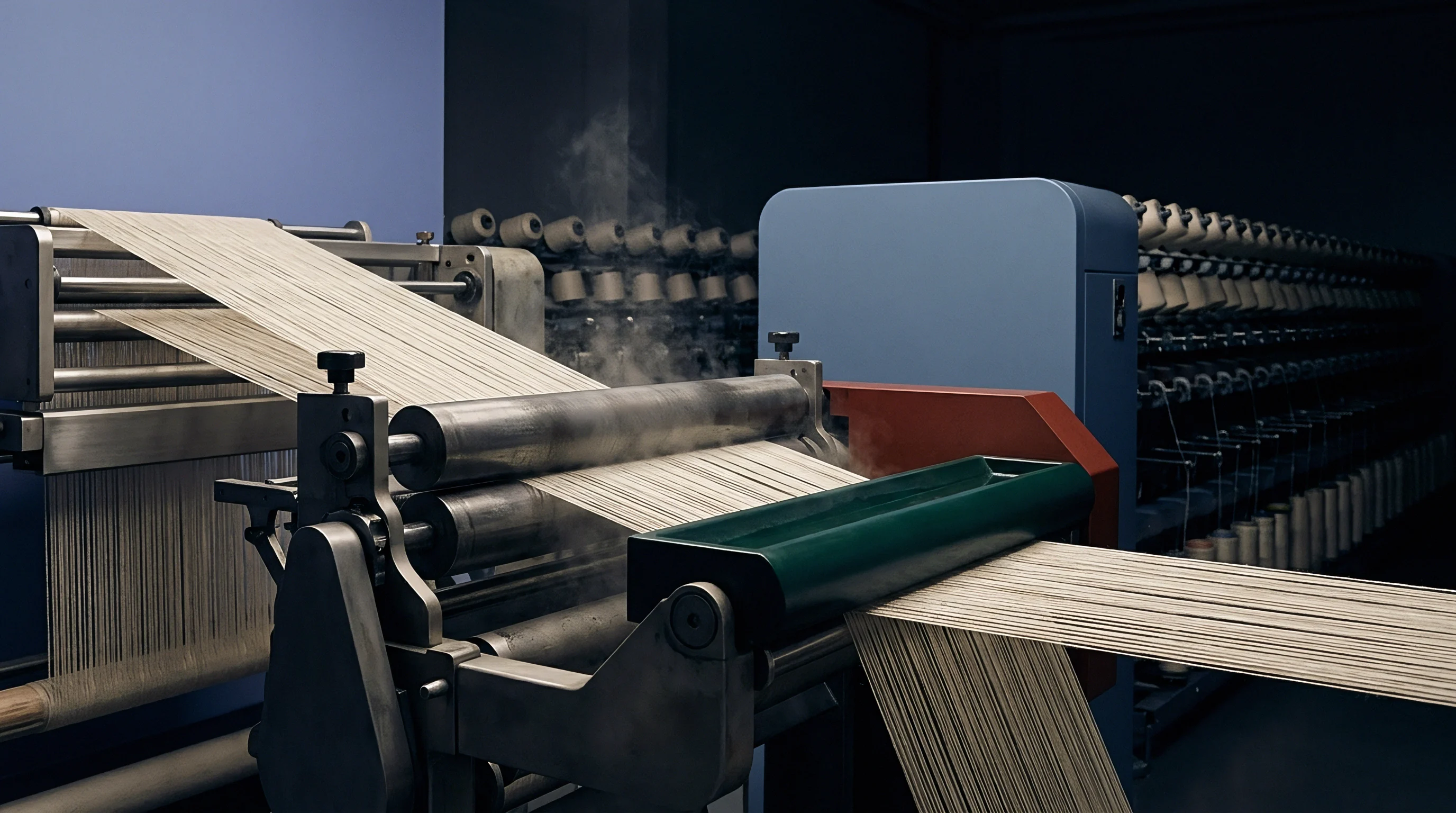
Shedding mechanisms operating on ultra-high density flax warps face substantial mechanical drag from fluid viscosity and tight geometric packing. Harness frames must overcome both the inertia of the dense warp sheet and viscous drag from liquid films bridging adjacent threads. Reed packing mechanics become exceptionally severe when weaving full-width fabrics with cover factors near or above ninety-five percent, where beat-up forces escalate non-linearly as higher moisture elevates friction inside the reed dents.
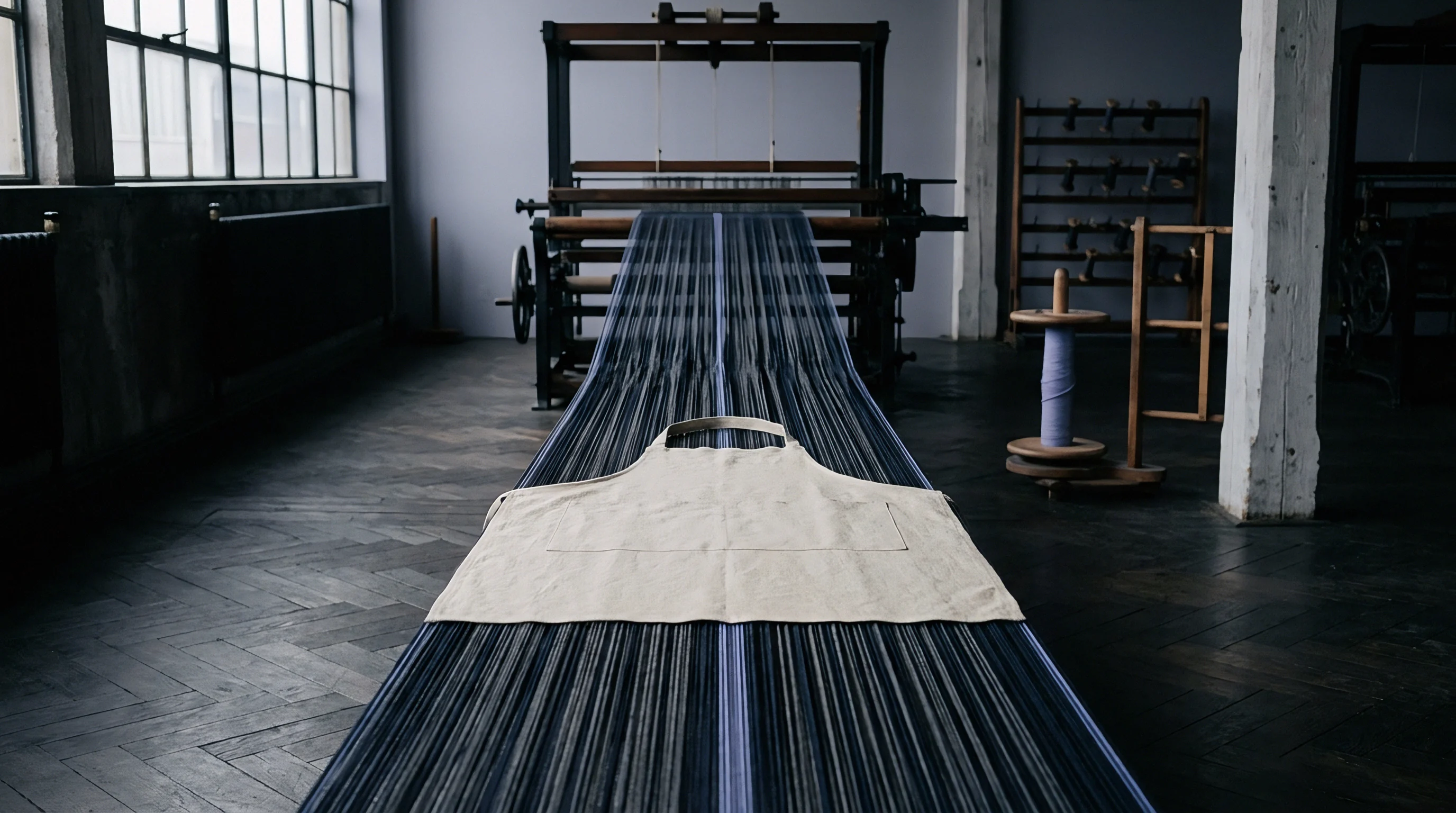
How Does Fluid Drag Shift Beat up Force?
As the reed pushes the wet pick into the cloth fell, interstitial liquid is forced out of the compaction zone, generating transient hydrodynamic pressure waves in front of the reed wire. This fluid pressure resists the forward movement of the pick, demanding higher peak beat-up forces from the main drive. Fluid drag scales with the square of loom operational speed and inversely with the cube of inter-thread gap clearance.
High fluid drag alters the effective fell position during continuous weaving. When beat-up force fails to overcome hydromechanical drag, the cloth fell drifts forward away from the back rest, reducing the mechanical packing ratio. As a result, the finished fabric has fewer picks per centimetre than intended by the loom gearing settings.
Compensating for this drift requires higher warp tension, which increases yarn stress and accelerates warp end breaks across the harness assembly.
- Align the harness frame height to create an early-shedding timing window, allowing shear relaxation to initiate three to five degrees before beat-up impact.
- Adjust ambient shed relative humidity to fifty-eight percent, preventing excess moisture absorption while maintaining sufficient pectin ductility.
- Increase back-rest roller height by fifteen millimetres relative to the breast beam to equalize tension differentials between top and bottom shed lines.
- Select a full-dented reed specification with polished oval-wire profile to maximize spatial clearance and reduce lateral squeeze forces on wet warp ends.
- Set the warp let-off motion to dynamic force sensing mode, suppressing tension spikes caused by stick-slip transitions during shed crossover.
Because shed geometry governs thread friction, rapier insertion systems handle dense, wet flax warps more reliably than air-jet systems, relying on positive mechanical propulsion to carry filling yarn through the shed. Air-jet looms struggle on ultra-high density warps because surface water droplets and micro-fibril halos attenuate the air stream, causing short picks and filling stops. While rapier grippers maintain mechanical control over the pick, high inter-thread friction in the shed still increases the risk of the rapier head snagging tight warp ends.
| Machine Type | Warp Sett (ends/cm) | Loom Speed (PPM) | Size Pick-Up (%) | Peak Beat-Up Force (N/m) | Shed Efficiency (%) |
|---|---|---|---|---|---|
| Positive Rapier | 36 | 380 | 10.5 | 2100 | 88.5 |
| Positive Rapier | 44 | 310 | 14.0 | 3400 | 81.2 |
| Negative Rapier | 36 | 420 | 10.5 | 2350 | 84.0 |
| Negative Rapier | 44 | 340 | 14.0 | 3850 | 74.5 |
| Air-Jet Insertion | 36 | 600 | 8.0 | 1950 | 62.0 |
| Projectile Loom | 44 | 280 | 12.0 | 3100 | 89.0 |
Excessive moisture in the warp sheet during high-speed beat-up drives liquid into the reed wires, forming a slurry of sizing agents, loose fiber fragments, and water. This slurry collects inside the reed dents, narrowing effective clearance and compounding lateral friction on subsequent picks. Over time, these dent deposits accelerate reed wire erosion and leave dark, continuous streaks along the warp axis of greige fabric rolls.
Ignoring how ambient relative humidity couples with beat-up peak resistance leads directly to mechanical overload on the loom sley drive ~ causing cracked drive cranks, premature reed damage, and irreversible warp-way barre defects across whole cloth bolts.

Gauge
Measuring shear relaxation dynamics in high-density flax warps requires specialized metrological protocols that capture simultaneous mechanical loading and fluid interaction. Standard tensile testing of single dry yarns fails to predict multi-thread contact under wet shedding conditions. Biaxial shear testing apparatuses equipped with environmental control chambers offer the required platform for evaluating these hydromechanical dynamics.
Laboratory test protocols need to replicate the cyclic deformation frequencies and moisture gradients found in commercial weaving sheds. Fast Fourier Transform analysis of dynamic tension signals along the warp line reveals stress frequencies from two to twenty Hertz, tied to main crank speeds and shedding harmonics. Test equipment must apply cyclic biaxial tension while continuously monitoring transverse shear stress decay across multi-thread sheet samples.
Standard test atmospheres under ISO 139 mandate twenty degrees Celsius and sixty-five percent relative humidity to lock viscoelastic properties before tension testing.
Testing under modified ISO 7211-2 standards allows accurate determination of crimp distribution and thread density across varying moisture loads. Samples conditioned to equilibrium at specified relative humidity levels undergo uniaxial and biaxial tensile loading following ISO 13934-1. Measuring inter-thread pull-out force provides quantifiable shear yield stress values for specific yarn-size-moisture combinations, with the friction coefficient derived by dividing measured pull-out force by the calculated lateral normal force on the sample array.
- Equilibrium Regain Standard ISO 139 mandates forty-eight hours of pre-conditioning at standard atmospheric conditions prior to mechanical deformation testing.
- Warp Sett Determination ISO 7211-2 specifies direct counting under fixed glass templates at minimum five distinct locations across the full usable cloth width.
- Tensile Tensile Yield Evaluation ISO 13934-1 uses constant rate of extension strip tests to determine peak force and elongation at break for conditioned warps.
- Fabric Abrasion and Pilling ISO 12945-2 measures surface fiber degradation under defined orbital motion to quantify size film retention performance.
Advanced characterization incorporates rheological measurement of liquid sizing solutions alongside solid-state mechanical testing of dried sizing films. Rotational rheometers track the shear-thinning behavior of native and modified starch formulations at actual sizing bath temperatures. Strong shear-thinning characteristics promote deeper penetration of the size into the inner yarn core, keeping surface film thickness down while reinforcing internal fiber-to-fiber cohesion.
Optical displacement sensors and high-speed vision systems monitor thread cross-section deformation inside the shedding zone in real time. Image processing algorithms compute instantaneous contact area, ellipticity ratio, and thread spacing during high-speed shedding cycles, providing optical measurements to validate finite element models of viscoelastic compaction in multi-fiber assemblies.
Supply agreements for technical linen fabrics require explicit clauses defining maximum permissible thermal-hygroscopic relaxation shrinkage under ISO 5077 testing methods, holding the weaver to strict dimensional stability tolerances across all delivered production batches.

Booking
Production costing for ultra-high density flax fabrics depends directly on achievable loom speeds and shed efficiency. High inter-thread friction and dynamic shear locking force reductions in loom operating frequency to keep warp breakages acceptable. Dropping operating speed from four hundred to three hundred picks per minute imposes a twenty-five percent penalty on hourly fabric yield, driving up fixed overhead per linear metre.
Commercial Capacity Mechanics and Loom-Hour Costing
Loom-hour rates cover direct power consumption, shed floor footprint, operator labor, capital depreciation, and humidification loads. Weaving ultra-dense flax warps forces ambient humidification plants to run at capacity to maintain target regain levels, adding utility expenses to every booked loom hour. When loom efficiency drops from eighty-five percent to seventy percent because of frequent warp stops from shear damage, the effective cost per metre rises non-linearly.
Sizing formulation costs make up a major portion of raw material expenditure for ultra-dense warps. Premium modified starches combined with synthetic PVA or acrylic binders double chemical costs per kilogram compared to simple native starch mixes. However, higher chemical expenses are offset by fewer warp end breaks, higher achievable loom speeds, and lower defect rejection rates at the inspection frame.
Commercial margins remain strictly tied to these underlying operational metrics.
| Cost Vector Element | Standard Sizing Baseline | Hydromechanical Optimized | Cost Variance (%) |
|---|---|---|---|
| Yarn Preparation & Sizing Chemical ($/kg) | 1.85 | 3.40 | +83.8 |
| Target Loom Operating Speed (PPM) | 320 | 390 | +21.8 |
| Average Loom Efficiency (%) | 72.5 | 86.0 | +18.6 |
| Warp Stop Rate (breaks/10^5 picks) | 4.2 | 1.1 | -73.8 |
| Total Loom Hours Consumed (hours) | 315 | 218 | -30.8 |
| Fixed Loom-Hour Amortized Rate ($/hour) | 28.50 | 28.50 | 0.0 |
| Net Weaving Cost per Metre ($/m) | 0.898 | 0.621 | -30.8 |
| Final Landed Fabric Cost per Metre ($/m) | 4.12 | 3.78 | -8.25 |
Beam preparation economics favor longer warp runs to amortize setup and drawing-in labor for high-density harness configurations. Manually or automatically drawing in a forty-end-per-centimetre warp sheet on a three-metre-wide loom involves threading over twelve thousand individual ends through drop wires, heald eyes, and reed dents. With drawing-in costs exceeding fifteen hundred dollars per beam load, running short warps under two thousand metres severely inflates setup cost allocation per metre.
Weave capacity contracts require explicit agreement on greige quality grading standards, specifically ASTM D5430 four-point inspection thresholds. Dense flax warps are particularly prone to warp-way defects, reed marks, and starting marks caused by loom stops under high tension. Setting clear point-deduction allowances per hundred square metres protects the buyer against unserviceable fabric rolls while giving the weaver workable operational tolerances.
Achieving higher warp density without inflating finished fabric prices beyond commercial viability requires flatter yarn profiles and sizing formulations optimized to preserve shed efficiency.