Tensile Metric Determination in Scutched Long Staple Flax Fibre
Stelometer bundle testing at 3.2 millimeter gauge length with gravimetric tex verification establishes accurate tensile tenacity limits for long staple flax purchasing.


Grip
Clamping bundle specimens controls how stress spreads across individual technical fibers during testing. Jaws need to grip the bundle firmly enough to prevent slippage under tension without crushing outer cell walls. Standard Pressley clamps fitted with leather or polyurethane liners use flat contact faces to absorb minor surface unevenness along scutched stems.
Scutched flax fibers display anisotropic strength properties.
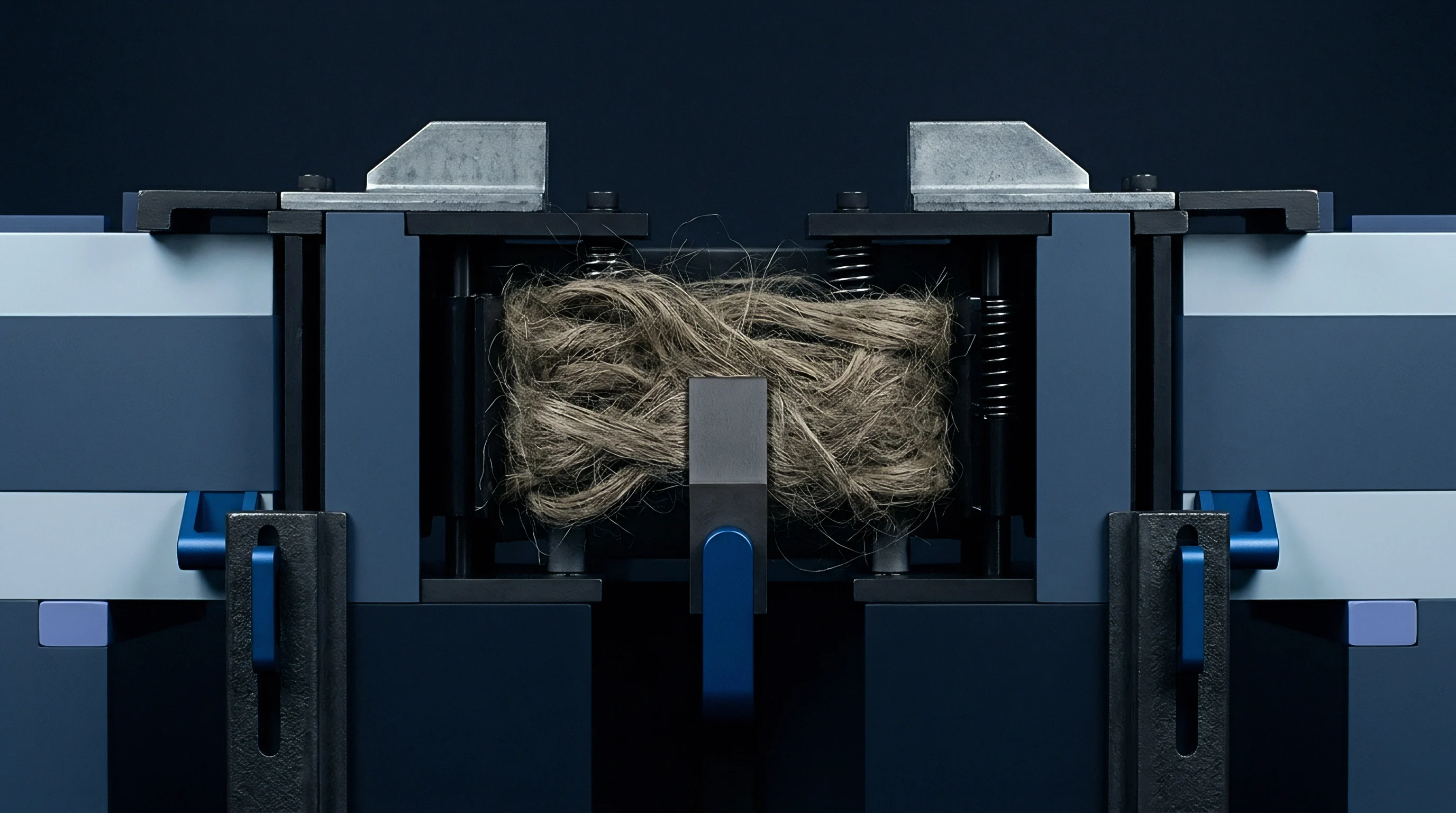
Jaw Surface Dynamics and Micro-Slippage Mechanics
Flat anvils distribute pneumatic pressure evenly across the width of the bundle, preventing stress from concentrating in single spots. Unpadded hardened steel faces crush peripheral fibers before central fibers take on full tension. Actuating clamps pneumatically maintains consistent gripping pressure during elongation, avoiding the pressure loss common with manual screw clamps.
Consistent pneumatic pressure keeps fibers from slipping in the jaws.
Leather linings cushion the jaws and reduce deformation.
- Peripheral Fiber Crushing occurs when rigid clamp faces shear outer fibers before load distributes to the core.
- Internal Strand Friction leads to uneven load bearing as central filaments slip past clamped outer fibers.
- Pneumatic Pressure Decay causes jaws to separate gradually over extended tensile cycles.
- Viscoelastic Liner Failure shifts the effective zero-gauge baseline during high-volume testing runs.
Gauge Length Calibration Parameters
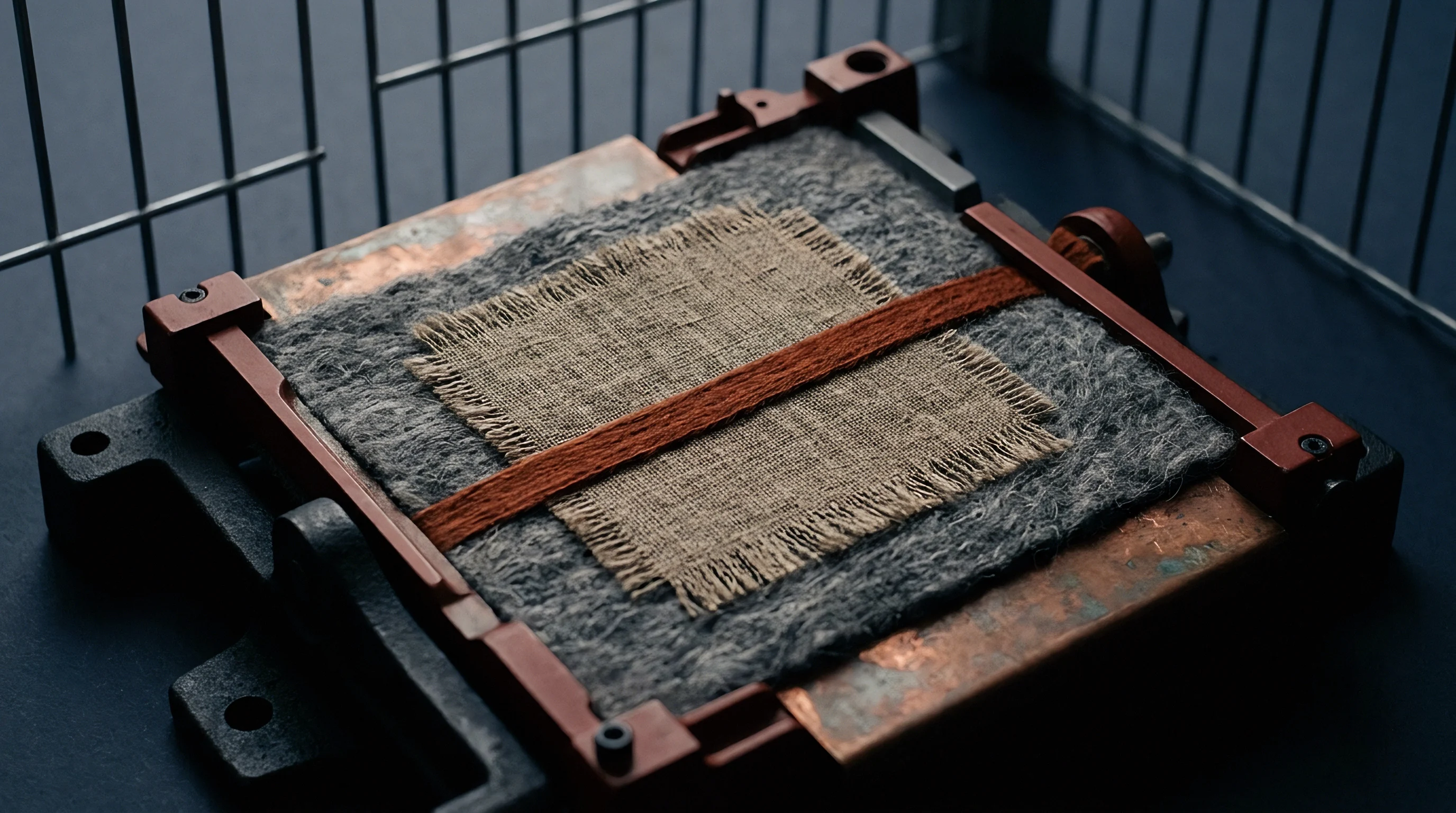
Accurate tensile measurements depend on exact separation between clamp faces. A zero millimeter gauge length measures the shear strength of elementary cell walls directly, while a 3.2 millimeter gauge length captures the response of the pectic middle lamella. Calibrated spacer keys fix this distance between Pressley jaws before clamping the specimen bundle.
| Gauge Length mm | Clamping Pressure bar | Liner Material | Failure Load CoV percent | Dominant Failure Mode |
|---|---|---|---|---|
| 0.0 | 6.0 | Synthetic Leather | 4.2 | Elementary Cell Wall Rupture |
| 3.2 | 6.0 | Synthetic Leather | 5.8 | Combined Wall and Pectic Shear |
| 3.2 | 4.5 | Vulcanized Rubber | 8.9 | Inter-Fiber Slippage |
| 10.0 | 6.0 | Polypeptide Leather | 11.4 | Middle Lamella Matrix Separation |
Securing the bundle perimeter stops internal strand movement without shearing outer cell walls.
Incorrect clamping force skews stress readings, measuring jaw break artifacts rather than true fiber strength.


Density
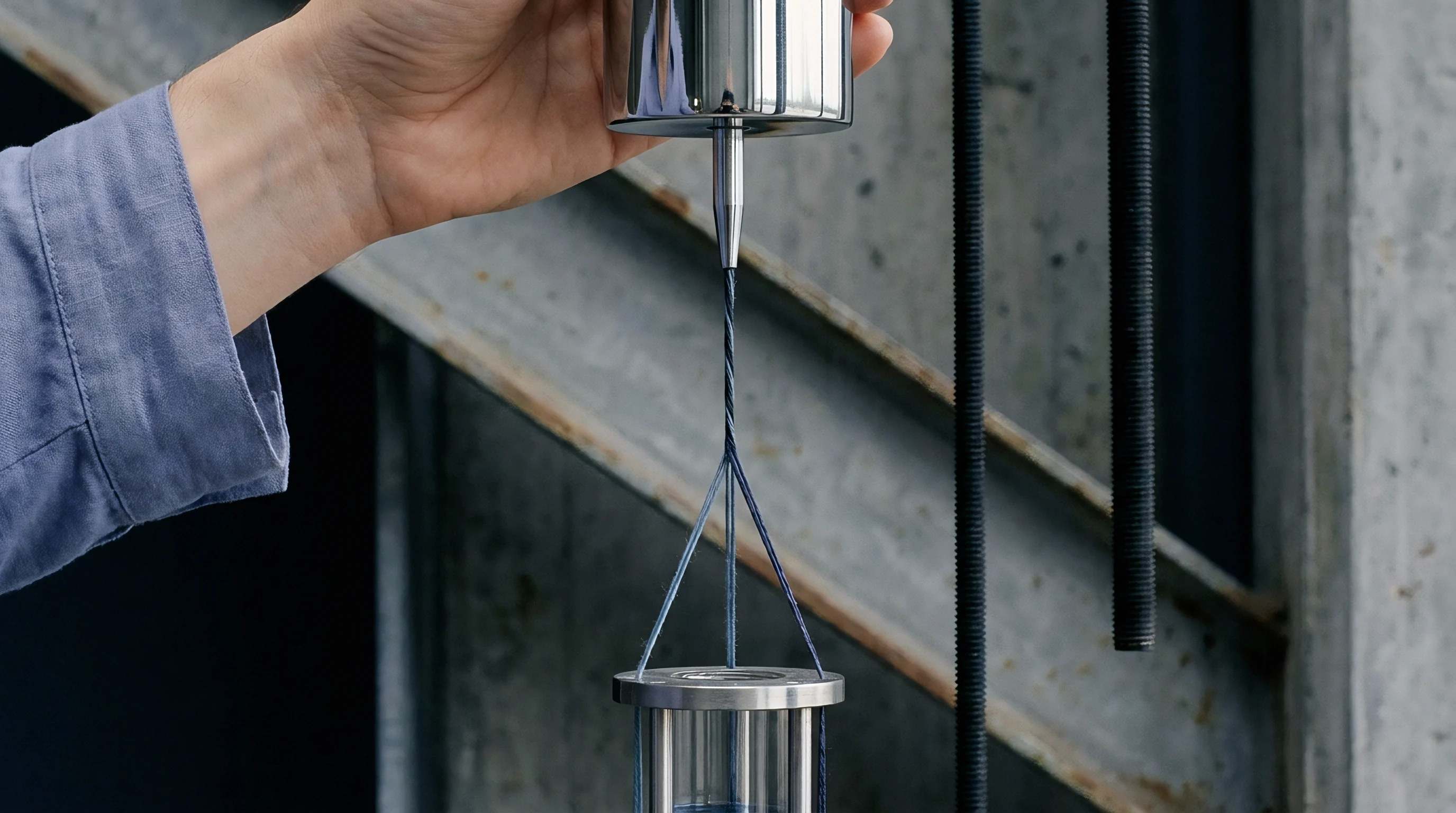
Converting raw breaking force to specific tenacity relies on linear bundle mass. Expressing fiber strength in centinewtons per tex requires measuring mass per unit length across the exact length held between the jaws.
Gravimetric weighing determines this linear mass.

Linear Mass Determination Protocols
Vibroscopic frequency testing determines linear mass from the fundamental acoustic vibration of a single fiber under set tension. Because technical flax strands vary widely in cross-sectional shape, vibroscopic testing is less reliable here than direct gravimetric measurement. Gravimetric methods involve trimming the broken specimen to a fixed length and weighing it on a microbalance accurate to one microgram.
Acoustic resonance measures linear density on single fibers.
Standard ISO 3060 bundle preparation mandates trimming specimen ends to exactly fifteen millimeters post-rupture for gravimetric mass determination.

Gravimetric Cut-and-Weigh Calibration
Calculating accurate tex values requires strict trimming procedures right after tensile failure.
- Mount the pre-conditioned flax ribbon in the clamp under the specified pretension weight.
- Pull the sample mechanically until the bundle breaks completely.
- Remove both broken bundle halves from the jaws using precision forceps.
- Align the broken ends and place them into a dual-blade cutter set to fifteen millimeters.
- Cut the assembly to obtain a central fiber segment measuring exactly fifteen millimeters.
- Transfer the cut segment to an analytical microbalance and record its dry mass in milligrams.
- Divide the total mass by the cut length to calculate linear density in tex.
Low tenacity readings are frequently attributed to microbalance calibration drift or improper trimming tools rather than poor fiber quality.

Moisture
Atmospheric humidity changes crystalline packing and hydrogen bonding inside flax cellulose microfibrils. Absorbed water plasticizes the amorphous pectin matrix around elementary fibers, which paradoxically increases single-fiber tensile resistance.
Higher humidity swells the cellulosic matrix.
Absorbed water molecules reinforce internal hydrogen bonding.

What Equilibrium Duration Guarantees True Regain Stability?
Conditioning long-staple scutched flax requires extended exposure to standard laboratory conditions at twenty degrees Celsius and sixty-five percent relative humidity. Standard procedure calls for twenty-four hours in open mesh trays before testing. Shortening this time leaves hydrogen bond networks underdeveloped, which artificially lowers measured tenacity.
| Relative Humidity percent | Moisture Regain percent | Mean Tenacity cN per tex | Elongation at Break percent | Youngs Modulus GPa |
|---|---|---|---|---|
| 50.0 | 8.2 | 42.1 | 1.8 | 18.5 |
| 65.0 | 12.0 | 51.4 | 2.3 | 22.1 |
| 75.0 | 14.5 | 56.8 | 2.7 | 20.8 |
| 85.0 | 17.1 | 59.2 | 3.1 | 17.4 |
A thirty percent increase in moisture regain raises average bundle tenacity by nearly nine centinewtons per tex under standard test temperatures.

Pectic Matrix Hydration and Tensile Enhancement
Absorbing water swells elementary cell walls, allowing microfibrils to align more directly along the fiber axis when pulled. This alignment increases breaking load up to an optimal saturation point near standard regain. Beyond that point, excess moisture weakens the pectic glue between elementary fibers, causing failure through inter-fiber slippage instead of cell wall rupture.
Testing laboratories continue to study whether variations in field-retting across harvest years shift this moisture saturation threshold.


Tenacity
Specific breaking force measures the strength of scutched flax bundles normalized against linear mass. Tensile values measured on a Stelometer or automated test frame indicate the upper limit of spinning performance for long-staple lots.
Elementary cell walls rupture before the surrounding pectin shears.
Higher cN/tex values allow fibers to be drafted into finer yarns.
Low tenacity leads to frequent end breaks during spinning.

Stress-Strain Profile Analysis in Technical Fibers
The linear start of a stress-strain curve reflects elastic stretching in crystalline cellulose microfibrils. As axial load builds, the slope bends where hemicellulose and pectin interfaces begin to yield plastically. High-grade scutched flax shows a steep elastic rise with little plastic elongation before snapping abruptly.
Linear tenacity metrics directly correlate with maximum achievable yarn count limits in high-speed wet spinning operations.

Bundle Tensile Conversion Calculations
Calculating specific tenacity combines raw breaking force, specimen length, and dry mass. For example, a scutched long-staple bundle breaks under an applied force of 88.2 Newtons (8993 centinewtons). The clamping gauge length is set to 3.2 millimeters, and after rupture, the central 15 millimeter section of the bundle is cut and weighed at 1.80 milligrams.
First, calculate bundle linear density in tex:
Linear Density = Mass in milligrams / Length in meters
Linear Density = 1.80 mg / 0.015 m = 120 tex
Next, determine specific tenacity in centinewtons per tex:
Tenacity = Breaking Force in centinewtons / Linear Density in tex
Tenacity = 8993 cN / 120 tex = 74.94 cN/tex
To convert specific tenacity in cN/tex to volumetric tensile stress in Megapascals, multiply by the density of solid flax polymer (1.54 grams per cubic centimeter):
Tensile Stress in MPa = Tenacity in cN/tex Fiber Density in g/cm3 10
Tensile Stress = 74.94 1.54 10 = 1154.08 MPa
This calculation assumes zero void volume inside the bundle and uniform fiber geometry across the clamped length.

Structural Parameters Governing Yield
Several structural features dictate the ultimate bundle strength of long-staple lots.
- Cellulose Crystallinity Index dictates structural rigidity and peak tensile capacity in elementary cell walls.
- Degree of Polymerization reflects average cellulose chain lengths in primary cell wall layers.
- Middle Lamella Integrity determines shear resistance between elementary fibers during high-tension drafting.
- Retime Duration Control prevents enzymes from breaking down pectic binder compounds during field retting.
| Tenacity Grade | Bundle Tenacity Band cN per tex | Equivalent Strength MPa | Maximum Spin Limit Nm | Commercial Allocation |
|---|---|---|---|---|
| Superior Long Staple | > 55.0 | > 847 | Nm 80 – Nm 110 | Fine Apparel and Luxury Bedding |
| Standard Commercial | 42.0 – 54.9 | 646 – 845 | Nm 39 – Nm 79 | Household Textiles and Apparel |
| Coarse / Medium | 30.0 – 41.9 | 462 – 645 | Nm 18 – Nm 38 | Upholstery and Heavy Canvas |
| Substandard Low Tensile | < 30.0 | < 462 | < Nm 18 | Blended Yarns or Technical Nonwovens |
Standard sales contracts reference ISO 3060 standards, granting buyers the right to renegotiate prices or reject shipments outright if delivered lots fall short of agreed cN/tex thresholds.


Landed
Commercial value depends on physical tensile properties verified when shipments reach destination spinning mills. Length distribution, moisture levels, and tenacity metrics dictate whether long-staple fiber moves smoothly through hackling and drafting without excessive breakage.
Wet spinning requires high bundle tenacity.
Substandard cN/tex ratings trigger financial penalties.
Commercial Tenacity Tolerances in Sourcing Contracts
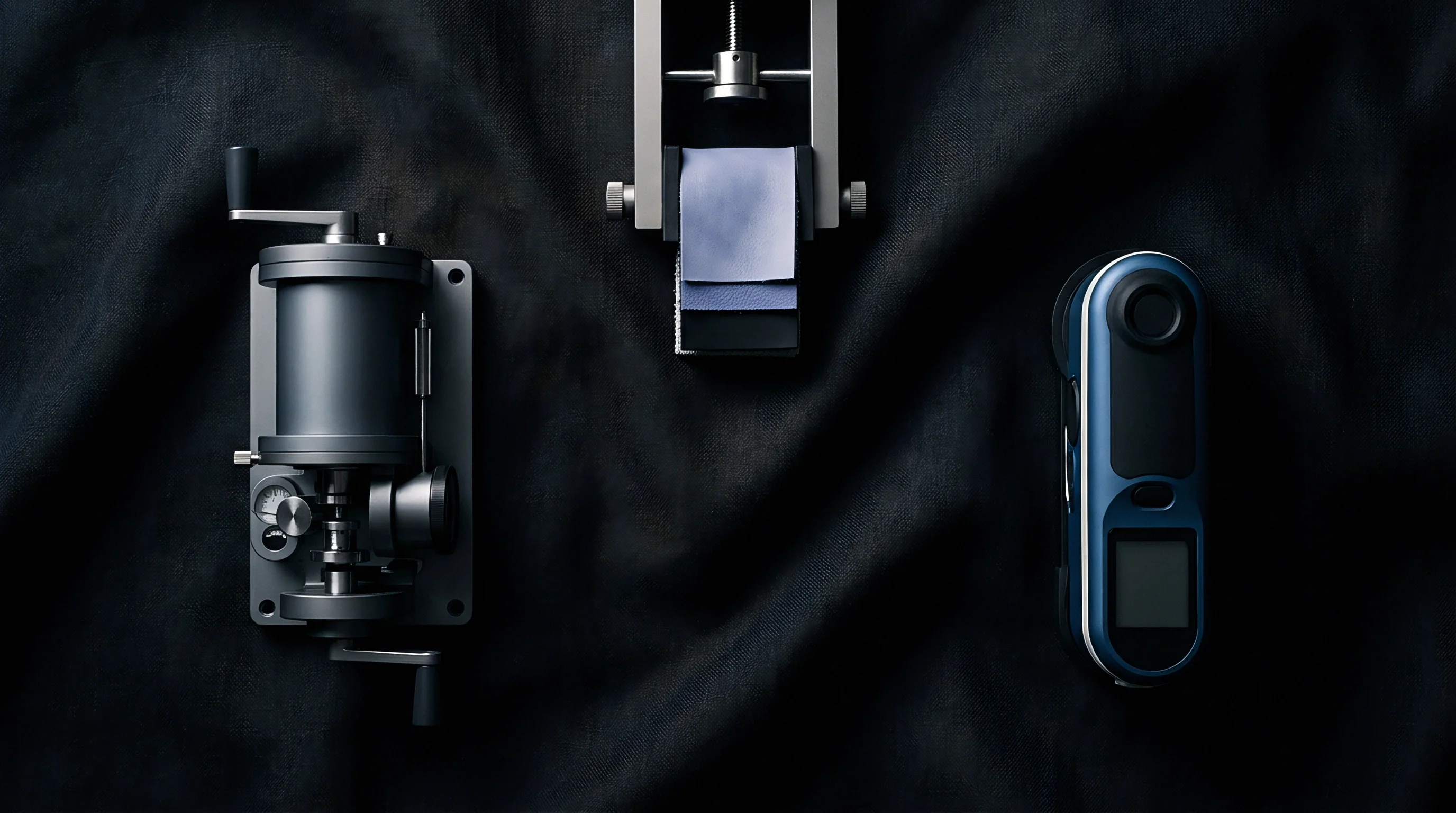
Buyers specify minimum tenacity based on targeted yarn fineness. Delivering fiber below contracted strength leads to frequent breaks in the drafting zone, lowering spinning frame efficiency and creating excess comb waste during hackling. Sourcing contracts apply tiered price reductions when delivered metrics drop below specified thresholds.

Surcharge Adjustments for Low Tenacity Consignments
Contracts tie final prices directly to destination test reports from accredited independent laboratories. If mill tests show tenacity below contracted limits, buyers apply discounts to cover higher spinning waste and lower yarn yield.
Scutched long-staple flax with low tenacity consistently generates excess comb waste during hackling.