Verifying European Flax Certificates across Global Processing Tiers
European Flax verification requires matching batch Transaction Certificates with valid supplier Scope Certificates and auditing mill mass-balance yields.


Chain
European Flax certification verifies Western European origin for long flax fibres grown in France, Belgium, and the Netherlands. The Alliance for European Flax-Linen & Hemp oversees the standard, issuing two distinct instrument types that track material through global processing stages. Downstream processors in Asia or Eastern Europe often misinterpret these documents, offering corporate-level scope approvals as proof for specific yarn or fabric shipments.
Auditing a supply line requires validating both the corporate scope of each subcontractor and the batch-specific transaction papers issued for each physical movement of material.

Scope Certificates and Transaction Certificates
Operational claims depend on a two-part documentary structure under ISO 17065 accredited certification bodies. A Scope Certificate confirms that a processing facility possesses the infrastructure, mass-balance accounting systems, and organizational controls needed to handle certified fibre. It carries an annual expiration date and names permitted operations, such as scutching, spinning, weaving, or wet finishing.
Holding a Scope Certificate does not prove that a given shipment contains certified flax. That verification requires a Transaction Certificate, which records the transfer of a specific lot between seller and buyer, detailing net weight, fibre species, and the unique Scope Certificate number of the issuing facility.
European Flax certification rules dictate that a Transaction Certificate lacking the seller’s verified Scope Certificate number invalidates the origin claim for that batch.
When fibre leaves Western European scutching plants and enters spinning facilities in China or Vietnam, the chain of custody shifts from physical segregation to audited accounting systems. Chinese wet-spinners purchase certified scutched flax alongside uncertified material from regional sources. A valid Scope Certificate held by a spinner permits that facility to process certified lots, but every outgoing yarn consignment demands a corresponding Transaction Certificate issued by an accredited body like Bureau Veritas or Control Union.
Importers accepting commercial invoices or mill declarations without matching Transaction Certificates expose their supply lines to uncertified fiber substitution.

Standard Boundaries across Trade Bodies
Distinct regulatory and commercial boundaries separate European Flax from alternative linen credentials. While European Flax tracks raw material origin from field to yarn or fabric anywhere in the world, Masters of Linen enforces a strict geographic constraint, demanding that every processing step from field to yarn and finished cloth occurs entirely within European territory. OEKO-TEX Standard 100 assesses chemical residues in finished textiles, certifying human-ecological safety without verifying geographic origin or agricultural source.
Global Organic Textile Standard covers organic farming criteria, whereas European Flax measures premium long-staple fibre origin regardless of organic status.
| Standard Name | Issuing Body | Geographic Scope | Chain of Custody Model | Off-Shore Processing Validity |
|---|---|---|---|---|
| European Flax | Alliance for European Flax-Linen & Hemp | Fibre growth in FR, BE, NL; global transformation | Transaction Certificates via ISO 17065 bodies | Valid with mill Scope and Transaction Certificates |
| Masters of Linen | Alliance for European Flax-Linen & Hemp | 100 percent European production from field to fabric | Strict territorial audit across all processing tiers | Invalid if spun or woven outside Europe |
| OEKO-TEX Standard 100 | OEKO-TEX Association Laboratories | Global testing laboratories | Analytical laboratory testing of finished chemical profile | Valid globally for chemical compliance only |
| GOTS Flax | GOTS Approved Certifiers | Global organic agricultural land | Transaction Certificates with organic mass balance | Valid globally if organic inputs are certified |
Discrepancies between standard scopes create serious compliance traps during import clearance. A fabric vendor offering an OEKO-TEX certificate alongside a raw flax origin certificate creates an illusion of complete traceability. Customs authorities testing non-preferential origin claims evaluate physical transformation records and official origin documents rather than environmental safety labels.
When an enterprise specifies European Flax yarn, the purchase contract must explicitly specify: All deliveries shall be accompanied by official Transaction Certificates issued by an accredited third-party certifier referencing the seller’s valid European Flax Scope Certificate number.


Bale
Verification begins at the intake bay where raw fibre arrives in compressed units wrapped in protective strapping. Scutching facilities process retted flax straw into long fibre, tow, and shive, affixing physical bale tags that identify the scutching lot, field harvest region, and pressing date. These physical markers form the primary evidence linking agricultural harvest data to industrial mill records.
Auditors cross-reference bale tag serial numbers against scutcher delivery notes to confirm that raw material enters processing plants with intact origin identifiers.

Scutcher Documentation and Intake Logistics
Raw fibre shipments arrive at spinning mills accompanied by detailed scutching records and transport manifests. Scutching enterprises in Normandy or Flanders assign batch numbers to specific farm deliveries, recording moisture content, fibre yield percentage, and staple length. When spinners take delivery of these compressed units, mill clerks log individual tag numbers into intake ledgers.
Discrepancies between shipped weights and logged receipt weights indicate material loss or untracked batch splitting during transit across maritime shipping routes.
- Bale Tag Logging verifies physical barcode numbers, gross weight, and scutching lot identifiers against shipper packing lists upon mill arrival.
- Moisture Verification measures internal core regain percentages to ensure weight calculations conform to commercial standards before intake entry.
- Storage Bin Assignment places verified shipments into dedicated, labeled warehouse zones to prevent commingling with uncertified stock.
- Batch Ledger Entry records certified volume inputs into the mill mass-balance software prior to release for hackling and combing operations.
Because mill intake controls set the baseline for all downstream mass-balance calculations, missing or altered physical tags break the traceability link before spinning commences, forcing auditors to treat affected lots as non-certified commercial fibre.

Physical Lot Segregation in Fibre Stores
Fibre warehouses maintain segregation through visual marking and physical spatial separation. Scutched long flax fibre earmarked for certified production lines stays isolated from standard uncertified stock. Mill managers install floor-painted boundaries and dedicated rack systems to prevent accidental mixing during material transfer to hackling units.
When physical segregation fails, mass-balance accounting models cannot salvage the origin claim for that production cycle.
Physical isolation of certified bales within Asian spinning mills remains the primary defense against intentional or accidental fibre commingling.
Physical batch separation increases storage overhead and complicates daily internal logistics within high-volume spinning facilities.

Yield
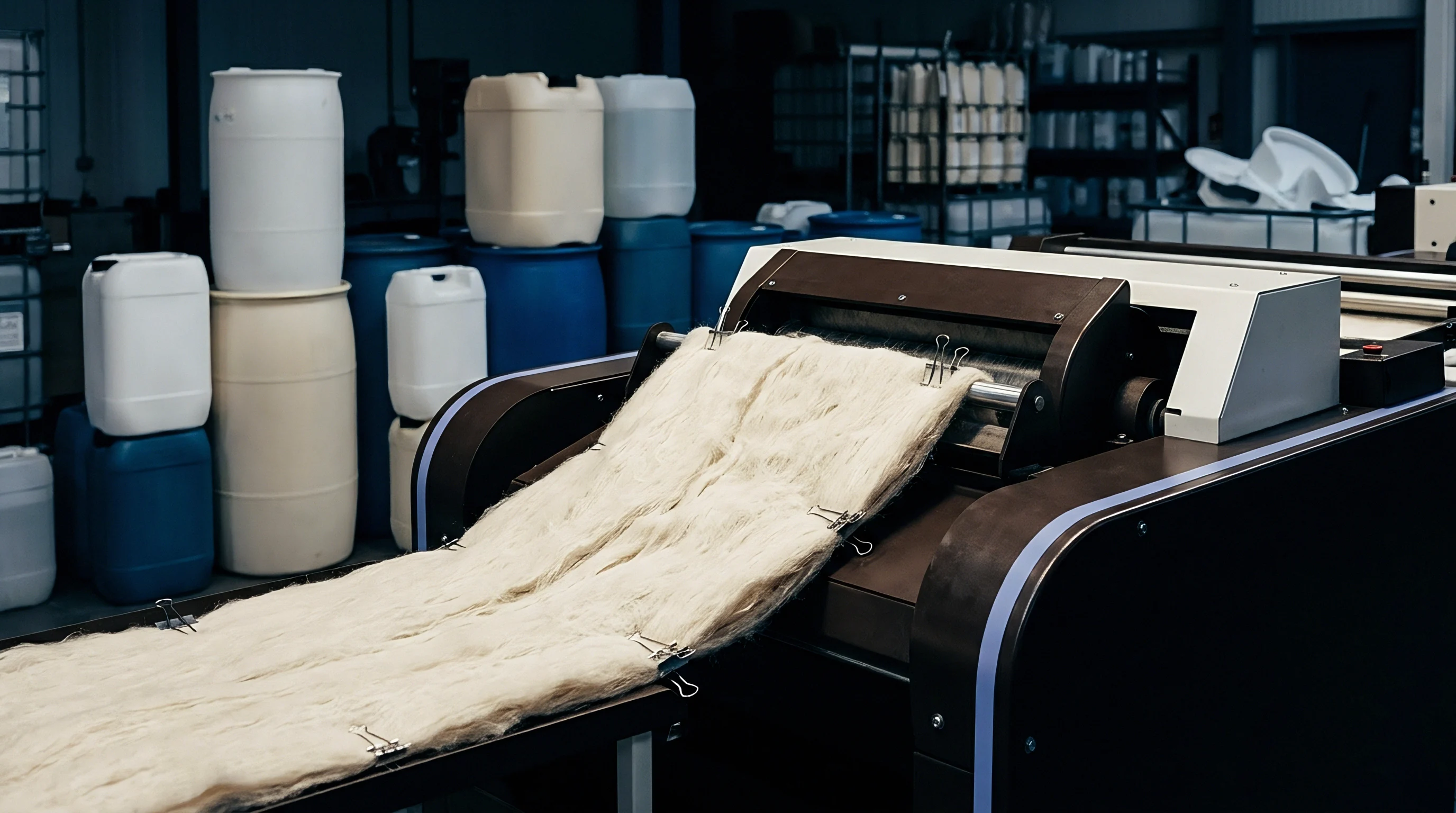
Transformation of long flax fibre into spun yarn involves successive mechanical processing stages that generate operational mass loss. Scutched fibre undergoes hackling to align filaments and eliminate short impurities, producing hackled sliver and hackling tow. Hackled sliver proceeds through drawing, roving, and wet spinning, where water baths and mechanical drafting convert roving into fine yarn.
Each mechanical tier removes unrecoverable waste and generates recyclable by-products, altering the net weight of certified material moving through the facility.

Where Does Provenance Break in Off-Shore Spinning?
Mass balance breakdowns occur when spinning facilities blend certified European long flax with low-cost domestic or regional flax tow to reduce raw material expenditure. Off-shore processors operating in high-volume textile hubs face commercial pressures that incentivize batch dilution. When a mill receives 10,000 kilograms of certified long flax fibre, hackling operations reduce that mass to approximately 6,500 kilograms of hackled sliver, with 3,000 kilograms recovered as hackling tow and 500 kilograms discarded as shive and dust.
If the mill subsequently delivers 9,000 kilograms of fine yarn claimed as 100 percent European Flax, dilution has taken place.
Auditors detect yield manipulation by calculating conversion ratios across every transformation step. Standard wet spinning yield ratios dictate that one kilogram of hackled sliver yields approximately 0.92 to 0.95 kilograms of greige yarn, accounting for moisture adjustments and roving waste. Unusually high yield metrics point to uncertified tow or synthetic fibre substitution during drawing, placing the burden of proof back on the buyer.
When mass-balance inputs do not align with physical yarn outputs, certification agencies suspend Transaction Certificate issuance for the affected production run.
| Processing Tier | Input Material | Primary Output | Standard Yield Range | Documentary Evidence Required |
|---|---|---|---|---|
| Scutching | Retted Straw | Long Flax Fibre | 12% – 16% straw weight | Scutcher Delivery Note & Field Tag Log |
| Hackling | Scutched Long Fibre | Hackled Sliver | 62% – 68% fibre weight | Hackling Machine Yield Sheet & Waste Ledger |
| Roving & Wet Spinning | Hackled Sliver | Fine Greige Yarn | 91% – 95% sliver weight | Spinning Lot Frame Record & Moisture Report |
| Weaving / Knitting | Boiled / Bleached Yarn | Woven Greige Cloth | 95% – 98% yarn weight | Loom Beam Log & Fabric Weighbridge Ticket |
| Finishing / Dyeing | Greige Cloth | Finished Linen Fabric | 88% – 94% greige weight | Dye House Yield Log & Chemical Shrinkage Sheet |

Mass-Balance Loss Formulas across Tiers
Reconciliation formulas calculate acceptable output volumes by multiplying raw input mass by stage-specific yield factors. For a given input batch Min of certified scutched fibre, maximum allowable output yarn mass Myarn follows the equation:
Myarn = Min × Yhackle × Ysπn × (1 + Δ R)
where Yhackle represents hackling efficiency (typically 0.65), Ysπn represents wet spinning yield (typically 0.93), and Δ R accounts for official commercial moisture regain adjustments. Standard commercial regain for flax yarn stands at 12 percent under ISO 6741 testing conditions, compared to raw fibre regain averages between 10 and 14 percent depending on atmospheric storage environments.
- Unreported Waste Substitution occurs when mills replace hackling waste with uncertified fibre lots to maintain output weight ratios.
- Moisture Regain Inflation involves over-wetting finished yarn packages to inflate billable mass before weighing and packing.
- Commingled Tow Blending mixes high-grade long flax sliver with short-staple tow without updating material accounting logs.
- Transaction Certificate Rollover uses valid historical transaction certificates to cover current uncertified production volumes.
Sourcing managers calculating supply allocations apply a cumulative loss factor of 38 to 42 percent when estimating finished fabric weight from raw scutched fibre purchases. Failure to account for these physical loss factors during supplier audits leads to incorrect suspicion of fraud or, conversely, leaves the buyer blind to systemic batch substitution.
Accepting unverified weight increases between spinning and weaving tiers exposes downstream buyers to complete loss of chain-of-custody validity across international distribution channels.

Paperwork
Documentary verification requires systematic cross-checking of commercial, logistics, and certification records. Custom inspectors and independent auditors scrutinize transaction records to verify that every kilogram of imported fabric aligns with certified agricultural inputs. Paperwork discrepancies represent the single most common trigger for certification suspension and customs clearance delays.

Transaction Certificate Audit Workflows
Auditors validate Transaction Certificates by connecting input data to mill shipping manifests. A valid Transaction Certificate issued by an accredited certifier explicitly lists the net mass of certified product, the buyer and seller corporate details, the transport document numbers, and the precise product description including fibre content percentages. Verification teams cross-reference these certificates against bill of lading records and commercial invoices to confirm physical shipment matching.
Documentary integrity requires an unbroken sequence of Transaction Certificates matching invoice line items and shipping weights.
A complete audit dossier pairs every commercial transaction with its corresponding certification record, proving physical continuity across international boundaries.

Customs Classification and Origin Declarations
Customs agencies classify flax fibre, yarn, and woven fabric under Chapter 53 of the Harmonized System. HS Code 5301 covers raw or processed flax fibre, HS Code 5306 governs flax yarn, and HS Code 5309 applies to woven fabrics of flax. Importers claiming preferential origin tariffs or specific environmental status submit detailed origin declarations based on processing records.
Non-preferential origin rules dictate that substantial transformation occurs where processing results in a change of HS tariff heading or specific processing operations like weaving or wet spinning.
- Request the seller’s valid European Flax Scope Certificate and verify its active status on the official Alliance public database.
- Obtain the specific Transaction Certificate for the yarn or fabric lot prior to shipping container dispatch from the export port.
- Cross-check net weight figures on the Transaction Certificate against the packing list, bill of lading, and commercial invoice.
- Verify that the Harmonized System code on customs entries matches the material stage described on the certificate.
- Archive the complete document chain, including mill intake logs and weighbridge certificates, for a minimum five-year audit retention window.
When origin documentation fails during a customs audit, non-preferential origin reverts to the country where spinning or weaving occurred, regardless of where the flax grew. A rule of thumb dictates that physical proof of origin lives in the mill transaction logs rather than in vendor sales declarations.


Warranty
Commercial contracts move provenance claims into legally binding obligations between buyers and suppliers. Certified European Flax fibre commands a price premium of 15 to 30 percent over standard uncertified flax, depending on market demand, crop yield variations in Western Europe, and global yarn availability. Buyers paying this premium require explicit contractual protection against document failure, batch substitution, and regulatory non-compliance in destination markets.

Surcharge Calculations per Metre
Evaluating the financial impact of certified sourcing requires translating fibre surcharges into finished fabric costs per linear metre. Take a 100 percent linen woven fabric with a target weight of 200 grams per square metre at a cuttable width of 1.5 metres, yielding 300 grams of fabric per linear metre. Accounting for cumulative processing waste of 40 percent from scutched fibre to finished fabric, producing one linear metre of this fabric demands approximately 0.50 kilograms of raw scutched flax input.
Assume a base market price of 5.00 USD per kilogram for standard uncertified scutched flax, against a certified European Flax price of 6.25 USD per kilogram, reflecting a 1.25 USD per kilogram provenance surcharge. The raw material surcharge per linear metre calculates as 0.50 kilograms multiplied by 1.25 USD, resulting in a direct raw material premium of 0.625 USD per linear metre. Adding third-party certification audit fees, transaction certificate issuance costs (typically 50 to 150 USD per certificate), and dedicated administrative handling adds approximately 0.08 to 0.15 USD per metre depending on order volume.
| Processing Configuration | Base Fibre Cost ($/kg) | Certified Surcharge ($/kg) | Document Fee per Order ($) | Fabric Surcharge ($/m) | Unverified Claim Exposure Risk |
|---|---|---|---|---|---|
| Fully European Processing (MOL) | 5.00 | 2.50 | 200 | 1.45 | Low: High territorial regulatory oversight |
| Asian Spinning / Asian Weaving | 5.00 | 1.25 | 100 | 0.73 | High: Batch substitution in off-shore mills |
| European Spinning / Asian Weaving | 5.00 | 1.85 | 150 | 1.08 | Medium: Controlled yarn input, off-shore weave |

Contract Clauses for Non-Compliant Deliveries
Sourcing agreements incorporate precise warranty language that shifts financial risk back to the supplier when provenance claims fail audit verification. Standard indemnity terms require suppliers to refund the certified price premium, cover third-party laboratory testing costs, and accept full financial responsibility for customs penalties or re-labelling requirements resulting from unverified origin claims, though audit fees remain with the importer.
A comprehensive contract clause specifies: Supplier warrants that all goods delivered under this agreement strictly conform to European Flax chain-of-custody requirements. Supplier shall provide valid Transaction Certificates matching each shipment net weight within ten days of vessel departure. In the event of documentary failure or material non-compliance confirmed by independent audit, Supplier agrees to refund the certified surcharge, indemnify Buyer against regulatory fines, and accept return of non-compliant inventory at Supplier’s sole expense.
Enforcement of these terms relies on withholding final payment balances until third-party certifiers issue matching Transaction Certificates for delivered consignments. Retaining five to ten percent of contract value until document verification finishes provides necessary leverage to compel supplier compliance across global processing tiers.