Reconciling Non Preferential Origin Criteria with Section XI Note 7 Edging Rules for Hybrid Flax Synthetics
Adding synthetic edge finishes under Section XI Note 7 shifts tariff lines to made-up goods but fails to change non-preferential origin from base fabric weaving.


Fringe
Subheading 7 of Section XI in the Harmonized Tariff Schedule establishes explicit parameters for classifying textiles as made-up articles rather than woven piece goods. A fabric moving across borders transitions from tariff Chapter 53 or Chapter 55 into Chapter 63 when edge treatments fulfill legal threshold conditions. These conditions include folded hems, overlock stitching, draw-thread fringing, or applied synthetic bindings along one or more borders.
Customs officers examine physical roll borders to establish whether trimming transforms an intermediate bolt into a finished consumable item.

Harmonized System Note Seven Structural Criteria
Legal notes governing textile classification specify six distinct manufacturing states that assign made-up status to a fabric. Hemming along raw cut edges converts continuous roll stock into discrete finished goods regardless of dimensions. Heat-sealed borders featuring compressed synthetic salvage lines meet this definition when thermo-bonding prevents unraveling.
Overlock edge stitching applied to a hybrid flax-polyester textile changes the tariff line from raw woven cloth to completed household linens or industrial covers.
Fringing produced by withdrawing warp or weft threads creates an identical classification outcome. Binding applied via separate synthetic ribbon tape attached along fabric ends forces a tariff shift under heading 6307. Flax absorbs moisture.
When continuous yardage undergoes simple border trimming without complete perimeter finishing, tariff analysts reject made-up status and retain classification under primary weaving headings.
Edge trimming applied to woven hybrid textiles changes tariff classification under Harmonized System rules without automatically altering the legal country of non-preferential origin.

Boundary between Piece Goods and Edged Articles
Roll goods containing hybrid flax-synthetic yarns present distinct analytical challenges when border processing occurs in a secondary location. A woven fabric consisting of 55 percent flax and 45 percent polyester filament retains its status under heading 5309 or 5515 while on continuous beams. The application of decorative overlock edging or synthetic piping along cut panel lengths pushes the material directly into Chapter 63.
Tariff classification changes immediately upon application of the edge finish.
Importers frequently assume that securing a fabric edge through minor stitching confers a new origin upon the completed article. Customs administrations evaluate substantial transformation under separate legal standards than those dictating basic tariff placement. Simple hem stitching, overlocking, or ribbon binding represents minor finishing work.
The underlying base cloth dictates country designation when origin rules require primary yarn production or base weaving operations.
A mill in Jiangsu supplied panel lengths featuring overlock synthetic thread borders to an importer, declaring that local border finishing altered the non-preferential origin from the primary weaving country to the finishing port.

Blend
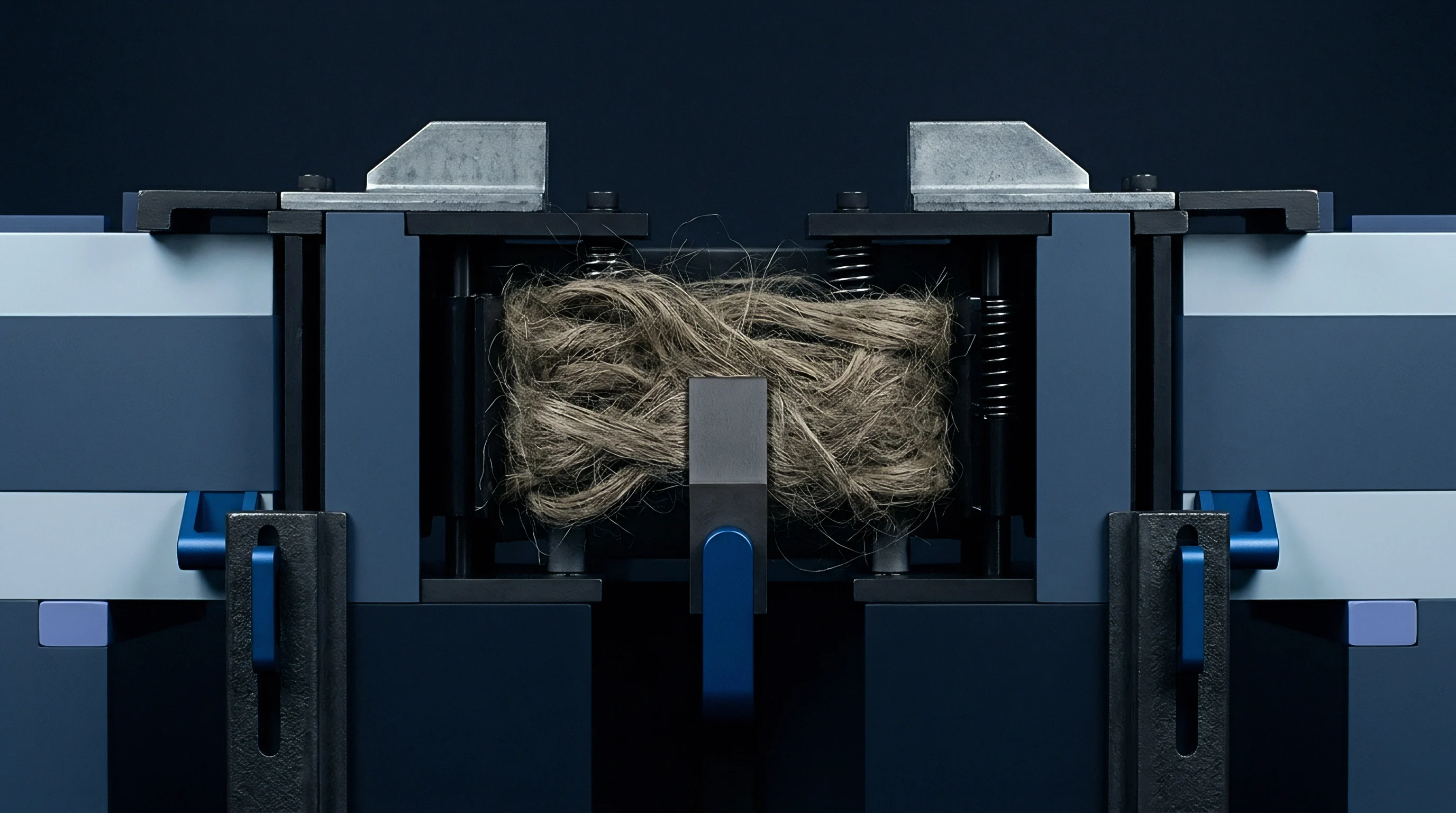
Accurate verification of hybrid flax-synthetic textiles depends on precise laboratory extraction of fiber ratios. Standard physical testing measures dry fiber mass alongside official moisture regain values to assign relative raw material percentages. Flax carries an official moisture regain factor of 12.0 percent under ISO 1833 standards, whereas polyester carries a regain factor of 0.4 percent and polyamide carries 6.2 percent.
Calculating true fiber weights requires converting commercial ambient mass into standard dry mass corrected for regain factors.

Quantitative Fiber Analysis and Moisture Regain Corrections
Laboratory testing protocols utilize solvent dissolution or chemical digestion to separate cellulosic flax fibers from synthetic filament matrixes. Sulfuric acid dissolution dissolves cellulose to isolate synthetic polymer residuals, leaving clean polyester filaments for dry mass weighing. Failing to adjust raw dry weights for standard regain allowances distorts declared fiber compositions by several percentage points.
A fabric weighed under high ambient humidity shows artificially inflated flax content due to moisture absorption.
Duty rates vary by heading. Corrected fiber mass dictates whether a hybrid construction falls under flax-predominant headings or synthetic-predominant headings. When flax content exceeds 50 percent by dry corrected weight, Chapter 53 governs the primary base fabric classification.
If synthetic staple fibers or filaments exceed 50 percent of total dry corrected mass, Chapter 54 or Chapter 55 takes precedence prior to evaluating edging criteria under Section XI Note 7.
Standard laboratory testing under ISO 1833 requires correcting dry fiber mass for twelve percent official flax moisture regain before certifying composition percentages.

What Triggers Reclassification under Chapter Fifty Three?
Composition thresholds dictate primary headings prior to applying made-up article rules. When a mill blends 52 percent flax tow with 48 percent polyester staple yarn, yarn composition sits near the classification tipping point. Ambient moisture testing without standardized dry-oven drying artificially pushes flax weight above 50 percent.
Importers face tariff adjustments if customs laboratories re-test samples following ambient conditioning and establish synthetic dominance.
The table below summarizes official regain corrections and target classification headings across typical hybrid flax-synthetic fabric specifications.
| Declared Blend Composition | Official Regain Flax % | Official Regain Synthetic % | Corrected Mass Dominance | Base HS Heading |
|---|---|---|---|---|
| 55% Flax / 45% Polyester Filament | 12.0 | 0.4 | Flax Dominant | 5309 |
| 48% Flax / 52% Polyester Staple | 12.0 | 0.4 | Polyester Dominant | 5515 |
| 60% Flax / 40% Polyamide 6,6 | 12.0 | 6.2 | Flax Dominant | 5309 |
| 45% Flax / 55% Elastomeric Filament | 12.0 | 1.5 | Synthetic Dominant | 5407 |
Auditing mill-floor mass balances requires checking yarn intake records against physical greige production. The following operational steps guide auditors through verification of blend inputs at the spinning facility.
- Raw Fiber Weight Verification Reconciliation starts by comparing raw flax scutcher bale weights against synthetic staple intake invoices across specific batch production runs.
- Sliver Combing Reconciliation Spinners verify sliver draw-frame delivery logs to confirm blending ratios prior to roving and yarn twisting operations.
- Yarn Moisture Content Normalization Technicians extract yarn samples from creels and subject them to oven-drying at 105 degrees Celsius until mass stabilizes.
- Greige Beam Mass Calculation Weavers log warp beam weights and wet-pick thread counts to ensure fabric construction matches spinning mill output declarations.
Polyester regains zero point four percent. Weight determines primary classification. Blend ratios calculated on wet ambient fiber introduce legal vulnerabilities into customs entries.


Tariff
Determining non-preferential country of origin involves evaluating where the final substantial transformation occurred. European Union customs regulations under Article 60 of the Union Customs Code define origin as the location where goods underwent their last economically justified processing. United States Customs and Border Protection applies specific textile origin rules codified in 19 CFR 102.21.
Both legal frameworks isolate minor finishing from primary manufacturing processes when assigning origin to woven textiles.

Substantial Transformation Limits for Minor Edging Operations
Under 19 CFR 102.21, edging, hem stitching, overlocking, or attaching synthetic borders to woven cloth does not confer origin. Origin follows the base fabric. If greige flax fabric weaving occurred in China, shipping that fabric to Vietnam for overlock edging with polyester thread leaves the non-preferential origin as China.
The tariff heading shifts from 5309 to 6307 upon edging, but origin remains tied to the loom state.
Simple edging creates no origin. European Union non-preferential rules set out in Annex 22-01 specify that made-up operations such as simple hemming or edging fail to satisfy origin-conferring transformation thresholds for textiles of Chapter 63. The primary origin rests where the fabric was woven.
Sourcing managers who misinterpret tariff shifts as automatic origin shifts generate significant customs non-compliance exposure.
Customs authorities across major import markets reject origin changes derived solely from minor edge stitching or synthetic ribbon binding on woven base fabrics.

Comparison of Non Preferential Origin Standards across Jurisdictions
Different import jurisdictions apply specific legal tests to establish whether an edging process changes origin. The table below outlines how customs authorities evaluate hybrid flax-synthetic textiles subjected to edging operations.
| Customs Authority | Governing Legal Code | Tariff Shift Result | Origin Determination Rule | Conferring Stage |
|---|---|---|---|---|
| United States CBP | 19 CFR 102.21 | Heading 5309 to 6307 | Origin stays in weaving country | Fabric Weaving |
| European Union Customs | UCC Annex 22-01 | Heading 5309 to 6307 | Edging excluded from origin rules | Fabric Weaving |
| HM Revenue & Customs | UK Origin Rules 2021 | Heading 5309 to 6307 | Complete assembly required | Fabric Weaving |
| Japan Customs | Customs Tariff Law Art. 68 | Heading 5309 to 6307 | Substantial processing threshold unmet | Fabric Weaving |
Importers encounter situations where failure modes compound during entry processing. The list below identifies critical breakdown points in compliance documentation for hybrid textile shipments.
- Mismatched Tariff Shift Declarations Declaring a change in origin based on a tariff heading jump from Chapter 53 to Chapter 63 without proving primary fabric transformation.
- Omission of Fiber Regain Adjustments Submitting laboratory reports that state fiber composition without specifying dry-oven testing conditions or official regain calculations.
- Incomplete Loom Shed Documentation Failing to secure weaving mill dockets that confirm raw flax origin prior to secondary conversion and edging.
- Unverified Synthetic Trim Origin Claiming origin changes based on high synthetic content added purely through peripheral binding or edge embroidery.
The weaving mill holds the proof. Whether secondary processing involving functional elastomeric edging might eventually achieve substantial transformation status if the trim cost exceeds eighty percent of total finished product value remains an open legal issue before customs appellate tribunals.


Assembly
Manufacturing hybrid flax-synthetic articles often spans multiple countries, creating complex documentation trees. Consider a production flow where French flax fiber ships to China for yarn spinning and fabric weaving into continuous yardage. The woven hybrid fabric consists of 60 percent flax and 40 percent polyester filament.
The greige fabric moves to Vietnam, where workers cut the cloth into individual panel lengths and apply an overlock edge finish using Japanese nylon thread.

Multi Country Supply Chain Worked Scenario
Evaluating this scenario requires tracking both tariff classification shifts and non-preferential origin criteria at each stage. In China, raw flax yarn and polyester filaments are woven into fabric under heading 5309. The cost structure of the unedged fabric in China stands at 4.20 US dollars per linear meter.
Transport to Vietnam adds 0.30 US dollars per meter. In Vietnam, edge stitching and cutting operations add 0.50 US dollars per meter in labor and 0.15 US dollars per meter in synthetic thread costs.
Upon export from Vietnam to the United States or European Union, the product enters under heading 6307 due to Note 7 edging rules. The tariff classification shifts from piece goods to made-up articles. The non-preferential origin remains China because weaving occurred in China and Vietnamese edging operations constitute minor finishing under 19 CFR 102.21 and UCC Annex 22-01.
Scutcher receipts establish raw volume.

Calculation of Value and Mass Contributions from Edging Materials
Secondary edging materials introduce minor weight and value contributions to the finished textile article. Analysts calculate total article weight to confirm whether added edging thread shifts fiber dominance percentages. Take a panel measuring 1.0 meter by 2.0 meters, weighing 400 grams in base fabric mass.
Base fabric composition contains 240 grams of flax and 160 grams of polyester.
Adding 12 grams of polyamide overlock thread along four borders increases total panel mass to 412 grams. Flax content drops from 60.0 percent in greige state to 58.2 percent in finished edged state. Polyamide contributes 2.9 percent to total mass, while polyester accounts for 38.8 percent.
Flax remains the dominant single fiber by mass. Base classification stays rooted in flax-dominant categories prior to Note 7 application.
Calculations of finished fabric mass must incorporate the exact weight of secondary edging threads to verify that original fiber dominance ratios remain intact.
The standard supply agreement must state that edge finishing performed in intermediate countries shall not alter the country of origin stated on customs entry declarations unless written customs rulings confirm substantial transformation.

Log
Defending non-preferential origin claims during customs audits requires a complete chain of custody file. Customs investigators request mill-level records tracing raw flax from scutching facilities through spinning, weaving, edging, and final packing operations. An importer unable to present linked batch numbers across each conversion node faces re-determination of origin, duty recalculations, and administrative penalties.

Audit Proof Requirements for Entry Declarations
Commercial invoices must reflect true manufacturing steps rather than intermediate broker claims. Yarn purchase dockets must show lot numbers that match loom set-up logs at the weaving facility. Dyeing and finishing invoices must list identical fabric roll batch codes to prove continuous identity of the hybrid material.
When secondary edging occurs at an external subcontractor, the subcontract work order must detail input roll numbers and output finished panel counts.
Customs rejects incomplete dossiers. Scutcher certificates confirm fiber harvest regions, while mill weighing receipts verify raw material mass entering draw-frames. Synthetic filament purchase orders prove fiber type and denier specifications.
Linking these records creates an unbroken audit record that substantiates both blend percentages and base fabric origin.

Financial Exposures in Non Compliant Marking
Importers who incorrectly declare origin based on intermediate edging location face severe commercial liabilities. Mislabeling country of origin on physical articles violates destination market marking laws, triggering mandatory product re-marking or re-exportation orders. Port storage charges accumulate rapidly while goods remain held under customs detainment orders.
Financial penalties scale based on statutory negligence provisions. Importers pay duty deficiencies alongside interest penalties spanning open historical entries. Unsubstantiated origin claims destroy supply chain predictability and forfeit regulatory compliance standing across border control agencies.
Assemble a customs origin defense file by executing the following step-by-step documentation collection procedure.
- Obtain raw flax scutcher certificate specifying farm harvest region, bale batch numbers, and physical weight receipts.
- Collect synthetic polymer filament supplier invoices detailing yarn denier, filament count, and manufacturing plant locations.
- Secure spinning mill blend records showing exact dry fiber input mass for flax tow and synthetic staple lots.
- Retrieve weaving shed loom logs matching spun yarn lot numbers to greige fabric beam identifications.
- Extract secondary converter work orders showing greige roll receipts, cutting panel yields, and overlock edging thread specifications.
- Compile intermediate transport bills of lading proving physical transport routes between weaving mills and edging subcontractors.
- Attach official laboratory fiber composition analysis reports performed under dry-oven conditions according to ISO 1833.
Misdeclaring non-preferential origin on edged hybrid textiles results in entry rejection, mandatory seizure of non-compliant inventory at the port of entry, retroactive assessment of elevated column-one duty rates, and statutory civil penalties calculated as a multiple of declared domestic entry values.