Measuring Hackled Flax Bundle Linear Density Using Microbalance Weighing
Microbalance weighing of cut hackled flax bundles establishes true technical fibre linear density to fix wet spinning limits and enforce raw lot contracts.

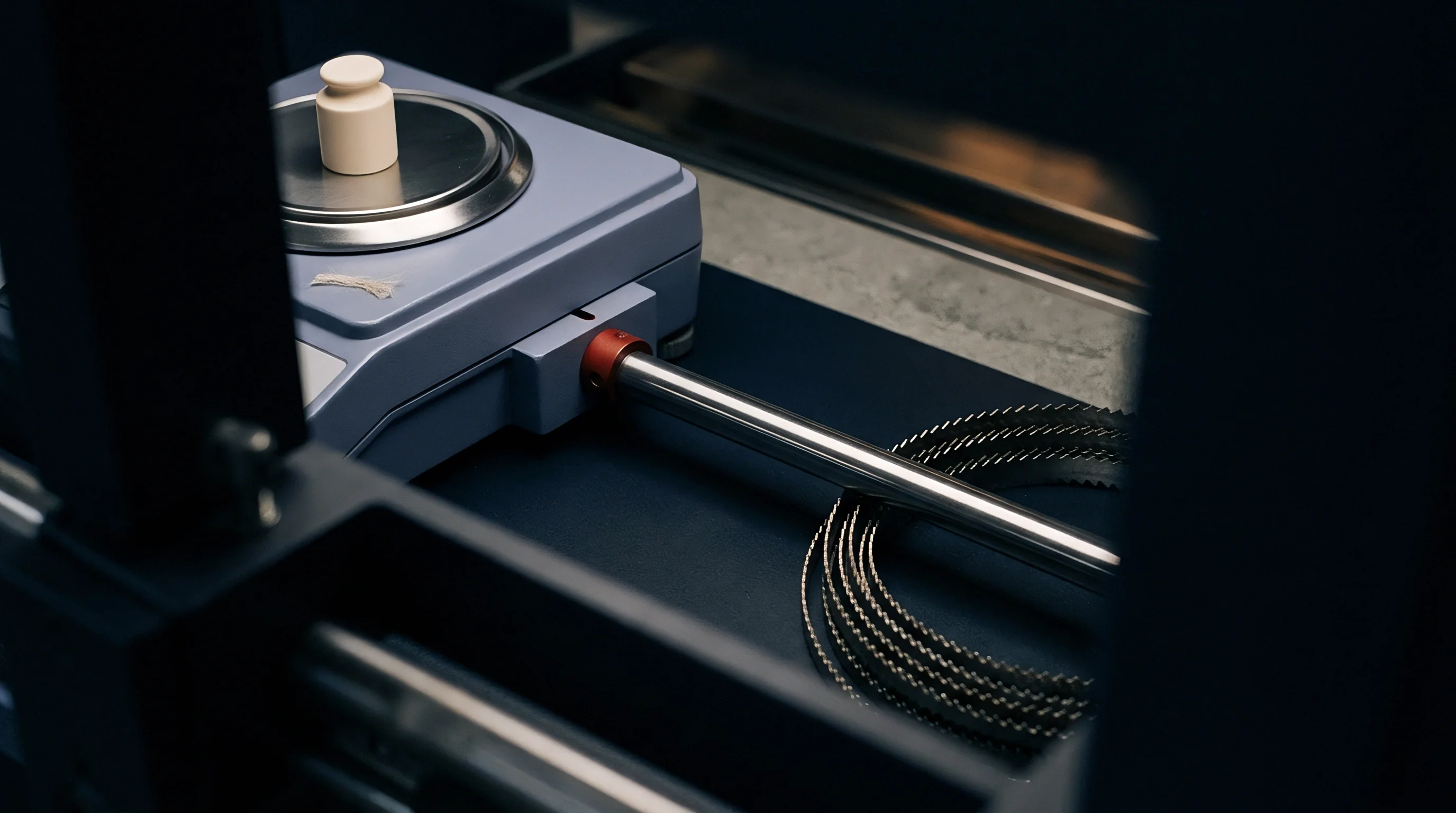
Razor
A precision steel cutter with two ground tungsten carbide blades drops across a tensioned clamp to isolate thirty milligrams of hackled bast strands to a uniform twenty-millimetre test length. Taken directly from the hackling comb, the specimen consists of parallel technical bundles stripped of root ends and coarse flaggy tips. Operators transfer the severed segments directly into an anti-static aluminium boat using watchmaker forceps.
Any axial tension applied during clamping alters the sample: excessive pull elongates the crimp and draws bundles past the blade perimeter, whereas slack clamping leaves bowed segments that weigh more per unit length than straight ones. Laboratory technicians verify blade gap distance using an optical micrometer set against gauge blocks certified to ISO 3650 standards.
Microbalance weighing requires mechanical and thermal isolation from the ambient mill room floor. The pan detects mass changes down to one-tenth of a microgram, making it sensitive to drafts from room air currents, vibration from nearby cards, and static attraction from operator gloves. Placing an active polonium-210 ionizing blower or a piezoelectric deionizing bar across the chamber dissipates surface charges on dry flax pectins within three seconds.
Technicians record tare mass immediately before placing the specimen on the pan, allowing twenty seconds for the draft shield to stabilize thermally before logging the raw weight.
- Dull cutting edges pinch the outer bast cortex rather than shearing it cleanly, pulling unmeasured tail filaments into the cutting zone.
- Operator grip torque compresses the technical bundle sheath unevenly, fracturing brittle cortical cells so unweighed debris drops into the waste tray.
- Static pan interaction induces artificial negative mass drift when ambient relative humidity drops below thirty percent.
- Specimen transfer delay exposes dried pectin structures to ambient humidity, shifting gravimetric readings before the draft shield is closed.
A fifty-bundle sample sheared with worn blades skews linear density upward by an average of 1.8 tex due to unsevered peripheral filaments.
Preparation errors during the cutting phase propagate directly into yarn drafting calculations. If technicians gather technical bundles without pre-combing them through a handheld brass dressing pin strip, crossed fibres enter the cutting zone obliquely. Oblique cuts produce segments longer than the nominal gauge length of the cutting apparatus, creating an artificial positive bias in mass per unit length.
When a laboratory accepts severed bundles showing feathered ends or crushed cortical walls, the resulting linear density figures overstate raw fiber coarseness, leading spinners to set overly wide draft roller gaps that generate excessive slubs and thin spots during spinning.

Regain
Moisture content alters the physical mass of plant pectins and cellulose chains within minutes of exposure to ambient air. Bast bundles absorb water vapor rapidly through their porous technical sheath, expanding in cross-section as total mass increases. Standard testing under ISO 139 mandates pre-conditioning in a dry atmosphere below ten percent relative humidity at fifty degrees Celsius, followed by complete moisture equilibrium in a standard atmosphere maintained at twenty degrees Celsius and sixty-five percent relative humidity.
Equilibrating thirty-milligram bundle clusters takes twenty-four hours inside an unsealed conditioning cabinet with laminar airflow.
Commercial contracts price flax line on conditioned weight adjusted by the official commercial moisture regain value. ISO 6741 assigns hackled flax line a commercial allowance of twelve percent moisture regain against oven-dry mass. When a microbalance records conditioned specimen mass, that measurement combines dry cellulose, structural pectins, hemicellulose, residual waxes, and absorbed atmospheric water.
Calculating absolute dry bundle linear density involves drying test bundles in a ventilated oven at one hundred and five degrees Celsius until consecutive weighings spaced fifteen minutes apart differ by less than zero point zero five percent.
| Conditioning State | Relative Humidity (%) | Equilibrium Regain (%) | Mass Correction Factor | Tenacity Shift (cN/tex) |
|---|---|---|---|---|
| Oven Dry | 0.0 | 0.00 | 1.000 | -4.2 |
| Lab Atmosphere Standard | 65.0 | 10.25 | 0.907 | 0.0 |
| Commercial Allowance | 72.5 | 12.00 | 0.893 | +1.1 |
| Saturated Atmosphere | 90.0 | 18.40 | 0.845 | +3.8 |
Under the terms of ISO 2370 clause 7, linear density determinations carry contractual authority only when corrected to the standard commercial moisture regain of twelve percent.
Omitting dry mass verification creates systemic disputes between fibre suppliers and wet spinning mills. European scutchers deliver scutched and hackled flax line packed inside high-density bales wrapped in polypropylene covers. If a bale absorbs condensation during maritime transit, incoming microbalance evaluations indicate heavier linear density values than the actual cellulose core possesses.
Buyers rejecting lots on the basis of raw unconditioned mass readings penalize processors who could run the fiber cleanly once conditioned down to standard regain. The contract specification governing raw fibre mass adjustment dictates whether billing settles against oven-dry weight plus allowance or against incoming unconditioned net weight.

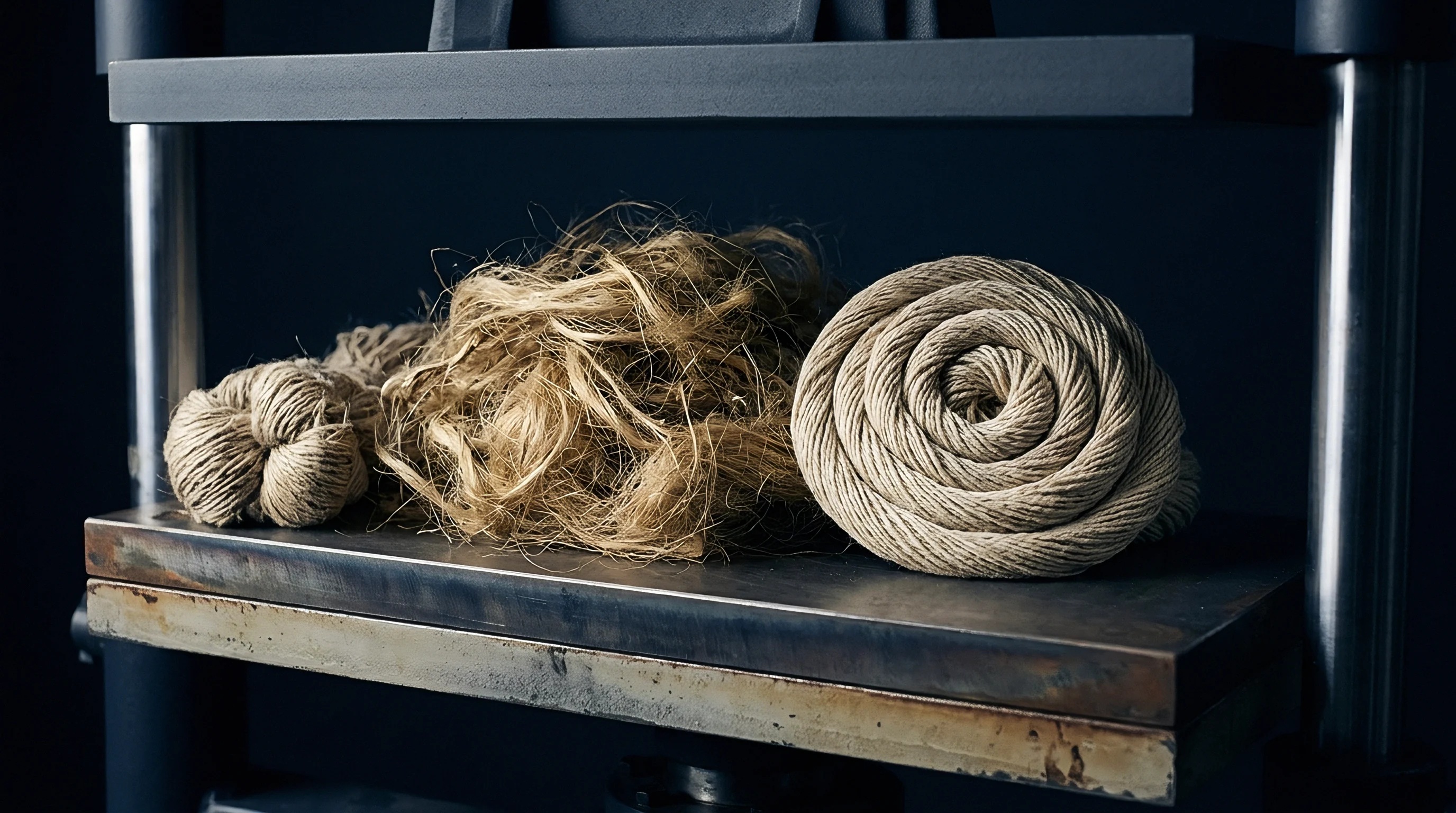
Spread
Natural variation across individual plant stems produces wide distributions in technical bundle cross-sections. A single hackled line sliver contains technical bundles ranging from two tex down to zero point two tex. Elementary fibres inside each bundle measure ten to thirty micrometres in diameter, held together by middle lamella pectins that break down irregularly during retting.
Microbalances record the gross weight of the compound bundle, so measured linear density reflects both the number of elementary cells in the bundle cross-section and the residual mass of intercellular cement.

Which Uncertainty Factor Governs Microbalance Error Budgets?
Instrumental uncertainty splits into balance drift, operator cutting precision, and natural biological variance. The balance mechanism exhibits repeatability within zero point two micrograms when mounted on an active anti-vibration marble table. Operator cutting variation across a twenty-millimetre span accounts for an error margin of zero point one five millimetres, introducing an instrumental calculation uncertainty of zero point seven five percent in linear density.
Biological variance across fifty distinct technical bundles drawn from a single hackled lot introduces a coefficient of variation between thirty-five and fifty-two percent ~ dwarfing instrumental balance precision by two orders of magnitude.
| Fibre Classification | Target Fineness (tex) | Metric Count (Nm) | Specimens Required | Observed CV (%) |
|---|---|---|---|---|
| Extra Fine Hackled Line | 0.25 – 0.45 | 2200 – 4000 | 100 | 36.5 |
| Medium Hackled Line | 0.46 – 0.75 | 1330 – 2170 | 80 | 41.2 |
| Coarse Hackled Line | 0.76 – 1.20 | 830 – 1315 | 60 | 45.8 |
| Carded Machine Tow | 1.21 – 2.50 | 400 – 825 | 50 | 51.4 |
| Values reflect gravimetric evaluations of twenty-millimetre bundle cut lengths equilibrated at standard atmosphere conditions. | ||||
Consider a testing series performed on a forty-tonne shipment of Grade 3 dew-retted Normandy line flax. Technicians cut fifty bundles to twenty millimetres length, obtaining a mean bundle weight of twelve point six micrograms, which yields a calculated mean linear density of zero point six three tex, equivalent to metric count Nm 1587. The standard deviation across this set settles at zero point two eight tex.
The sampling plan mandates testing eighty bundles rather than fifty to bring the standard error of the mean below five percent at a ninety-five percent confidence level. Stopping at thirty bundles can shift reported mean fineness by up to fifteen percent, depending on random inclusion of coarse basal bundles.
Individual technical flax bundles within a single comb lot routinely display linear density values ranging from zero point two to two point four tex.
Establishing test repeatability requires strict mechanical discipline across sample extraction. Technicians divide the laboratory sample into twenty zones, pulling five single bundles per zone using blunt tweezers under an illuminated glass while combing out loose debris. During extraction, technicians visually verify that each bundle remains distinct along its entire cut span without branch junctions or entangled neighbours.
When branches occur, the operator discards the specimen rather than tearing it apart manually, because manual splitting fractures the pectin matrix and sheds cortical debris onto the work surface.
Testing one hundred bundles per fifty-bale batch may not capture the true tail of the bundle coarseness distribution in lot volumes exceeding twenty metric tonnes. Processors handle this residual uncertainty by instituting continuous sliver monitoring on drafting passages immediately following the first drawing frame. The question remains whether automated optical image analysis measuring bundle diameter distributions under lateral compression can eventually replace gravimetric microbalance cutting without losing contractual standing across international commodity ports.
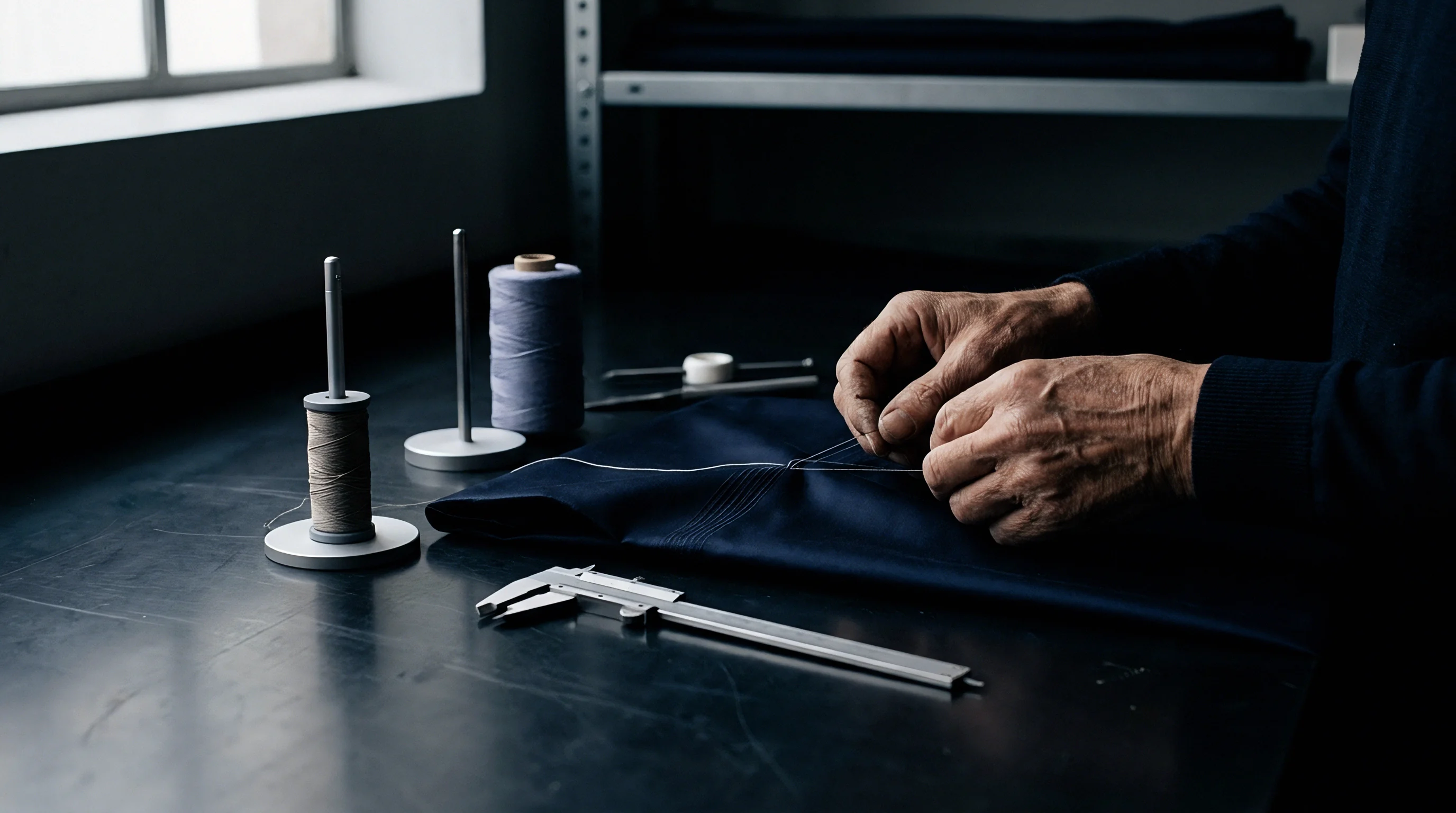
Draft
The distribution of bundle linear density sets the absolute physical spinning limit during yarn manufacturing. Wet spinning mills submerge flax roving in warm water baths maintained between fifty and seventy degrees Celsius immediately prior to drafting. This thermal soaking softens inter-fibre pectins, allowing technical bundles to split into finer sub-bundles and elementary fibres under drafting roller shear, though roving frames tend to amplify mass variance.
Coarser bundles with higher linear density demand greater normal pressure from draft rollers to prevent undrafted clump slippage, while fine bundles draft out smoothly into level yarn matrices.

Can Wet Pectin Dissolution Alter Clamped Linear Density?
Warm water alters the cohesive bonds holding technical bundles together without reducing individual elementary cell mass. When technical bundles carry high linear density due to incomplete retting, middle lamella pectins remain insoluble at moderate trough temperatures. Drafting rollers then fail to slide individual filaments past one another, generating high drafting force peaks that snap elementary fibres instead of sliding them apart.
This spikes yarn unevenness on the ring frame and produces frequent spinning breaks that idle spindles and drop overall floor efficiency.
- Heavy bundle cores resist hot water softening inside the spinning trough, emerging from the front drafting rollers as thick, unseparated slubs.
- Pectin cement dissolution liberates elementary fibres cleanly when bundle linear density averages below zero point five tex at incoming inspection.
- Roller slip events proliferate whenever bundle linear density exceeds one point two tex, causing localized thin places and yarn count variation.
- Excessive flag split at bundle ends creates fly waste in the ring frame drafting zone, contaminating adjacent bobbins and lowering yarn tenacity.
A comparison to drawn wire illustrates the challenge: while metal billets draw through dies by plastic deformation, bast bundles draft strictly through discontinuous sliding friction mediated by liquid lubrication and adhesive dissolution. If incoming bundle linear density is irregular, drawing rollers exert erratic grip forces across the fibre ribbon. The resulting yarn develops short-wave mass variation that no downstream winding or clearing frame can eliminate.
Drafting tenacity inside the wet spinning trough increases exponentially whenever average bundle linear density rises above zero point eight five tex.
When wet frames running at thirty metres per minute experience high breakage rates and yarn count variations, microbalance data showing excessive bundle coarseness points to raw material failure. High floor downtime can equally stem from neglected water trough temperatures, insufficient roller pressure, or inadequate conditioning of roving bobbin packages prior to spinning.

Stipulation
Commercial contracts for high-grade hackled flax line link pricing directly to certified linear density brackets verified by accredited testing laboratories. Bales accompanied by test certificates confirming average bundle linear density below zero point four five tex command premium pricing across European and Asian trading desks. Buyers specifying flax for fine linen apparel requiring wet-spun counts of lea 60 or lea 80 inspect bundle fineness certificates before clearing payment documentation.
If incoming microbalance audits show bundle linear density exceeding the contractual specification ceiling, buyers initiate formal price adjustments or return rejected material at supplier expense.
| Bundle Linear Density (tex) | Achievable Wet Count (Lea) | Achievable Metric Count (Nm) | Hackling Yield Waste (%) | Finished Fabric Price Shift ($/m) |
|---|---|---|---|---|
| 0.30 – 0.40 | 70 – 90 | 118 – 152 | 8.5 | +1.45 |
| 0.41 – 0.55 | 50 – 66 | 84 – 112 | 12.0 | +0.60 |
| 0.56 – 0.75 | 30 – 46 | 50 – 78 | 18.5 | Base Price |
| 0.76 – 1.10 | 16 – 28 | 27 – 47 | 26.0 | -0.85 |
Consider a commercial purchase of twenty metric tonnes of dew-retted line flax priced at five dollars and fifty cents per kilogram base rate, intended for wet-spun lea 60 shirting fabric. The contract specifies an incoming bundle linear density ceiling of zero point five zero tex verified by ISO 2370 gravimetric microbalance cutting. Audit testing across twenty composite bale samples reveals an actual average bundle linear density of zero point six eight tex.
Spinning this coarser fibre limits yarn production to lea 40 rather than lea 60, reducing yarn value while raising hackling and preparing waste by six point five percent.
Every percentage point increase in processing waste adds directly to the cost per delivered square metre of finished woven fabric. Coarse bundles shed short fibre into the preparing cards and drawing gills, shifting the raw material yield balance toward low-value tow. When raw fibre linear density drifts from zero point four five tex to zero point six five tex, the raw material cost per square metre of finished two-hundred-gram linen fabric increases by twenty-four cents due to poor fibre yield and spindle inefficiencies.
Buyers protect project margins by enforcing strict penalty deductions on commercial invoices whenever bundle linear density exceeds contract limits, as finer bundles yield lighter yarn while coarser stock increases finished fabric weight.