Predicting Non-Linear Fiber Bundle Jamming and Chemical Extraction across Variable Flax Retting Grades
Residual pectin above 3 percent prevents fiber bundle flattening, inducing premature mechanical yarn jamming that cuts rapier loom efficiency by 19 percent.


Straw
Field retting controls the boundary between pectin dissolution and cellulose degradation across every hectare of dew-retted flax. Microorganisms, primarily filamentous fungi such as Cladosporium herbarum and Epicoccum nigrum, colonize the flax stem during field exposure, secreting polygalacturonases that cleave the alpha-1,4-galacturonosyl linkages within the middle lamella. When moisture cycles oscillate between dew formation and dry daytime aeration, enzymatic cleavage proceeds through the non-cellulosic matrix.
It leaves the crystalline bast fiber bundles intact while reducing inter-bundle adhesion. Variable weather patterns disrupt this enzymatic equilibrium, producing disparate retting grades within identical scutching lots.
Commercial grading schemes categorize dew-retted flax straw along an empirical continuum from Grade 1 (severely under-retted) to Grade 6 (over-retted, chemically degraded). Under-retted straw retains high concentrations of calcium pectate and non-structural hemicelluloses, cementing ultimate fibers into coarse, stiff structural bundles with an average diameter exceeding 45 micrometres. Over-retted material exhibits extensive enzymatic degradation of the primary cell wall, accompanied by fiber fibrillation, reduced tensile tenacity, and excessive scutching tow generation.
Processing variability at the decortication stage generates non-uniform bundle cross-sections that disrupt downstream spinning and cloth construction.
| Retting Grade | Residual Pectin Content (wt%) | Lignin Content (wt%) | Bundle Linear Density (tex) | Fiber Tenacity (cN/tex) | Bundle Transverse Stiffness (GPa) |
|---|---|---|---|---|---|
| Grade 1 (Under-retted) | 4.8 to 5.6 | 3.8 to 4.5 | 4.2 to 5.5 | 38.5 to 44.0 | 12.5 to 14.2 |
| Grade 2 (Slightly under-retted) | 3.6 to 4.7 | 3.1 to 3.7 | 3.2 to 4.1 | 45.0 to 52.0 | 9.8 to 12.3 |
| Grade 3 (Optimal standard) | 2.2 to 3.5 | 2.4 to 3.0 | 2.1 to 3.1 | 54.0 to 62.5 | 6.4 to 9.5 |
| Grade 4 (Slightly over-retted) | 1.4 to 2.1 | 1.9 to 2.3 | 1.5 to 2.0 | 42.0 to 48.0 | 4.5 to 6.2 |
| Grade 5 (Severely over-retted) | 0.8 to 1.3 | 1.4 to 1.8 | 1.1 to 1.4 | 28.0 to 35.0 | 3.1 to 4.3 |
| Data measured at 20 degrees Celsius and 65 percent relative humidity following ISO 139 conditioning. Biochemical fractions determined via high-performance liquid chromatography and Klason gravimetric lignin determination. | |||||
Physical bundle dimensions dictate the mechanical limits of wet-spun flax yarns. Coarse bundles with elevated residual pectin resist lateral compression during mechanical drafting, producing roving slubs and uneven yarn cross-sections. Fine bundles derived from advanced retting yield flexible, uniform yarns that pack tightly during shedding.
The relationship between biochemical retting grade and fiber geometry defines the mechanical boundary conditions for downstream interlacing.
Dew-retted flax straw possessing residual pectin concentrations above 4.2 percent yields stiff fiber bundles that elevate warp break frequency to 3.8 stops per hundred thousand picks on high-speed rapier machinery.
Uneven fungal colonization across field swaths produces wide standard deviations in bundle linear density. Stems situated at the soil interface experience accelerated biological degradation compared to stems positioned on the swath exterior. This spatial variance transfers directly into the decorticated scutching stricks.
Mechanical hackling lines cannot homogenize these biochemical gradients, so spinner-side blending must balance high-pectin and low-pectin lots before wet spinning or chemical extraction begins. European scutchers frequently state that damp harvest conditions leave no choice except baling unevenly conditioned straw to prevent absolute rot.

Alkali
Sodium hydroxide boiling baths remove non-cellulosic gum components from raw bast fiber bundles through saponification and alkaline hydrolysis. Pectin macromolecules contain polygalacturonic acid methyl esters that dissolve when exposed to caustic concentrations between 8 and 18 grams per litre at liquor ratios of 1:10. Hydroxyl ions penetrate the bundle periphery, cleaving ester bonds and mobilizing low-molecular-weight polysaccharides into the aqueous phase.
Controlling bath temperature, reaction duration, and chelation chemistry governs the rate of lateral bundle division into discrete sub-bundles.
Variable retting grades alter chemical consumption kinetics during degumming. Under-retted flax lots require higher caustic concentrations and extended boil cycles to hydrolyze heavy calcium pectate reserves, while over-retted material rapidly suffers cellulose depolymerization under identical bath parameters. Incomplete extraction leaves rigid pectin bridges between adjacent elementary fibers.
Over-extraction strips the middle lamella completely, breaking the continuous filament-like bundles into short individual fibers that lack the mechanical cohesion needed for warp tension stability.
Effective chemical degumming schedules follow a tightly calibrated sequence:
- Alkaline scouring strips surface waxes, free hemicelluloses, and inter-cellular pectin deposits using 12 grams per litre caustic soda paired with 2 grams per litre tetrasodium ethylenediaminetetraacetate at 98 degrees Celsius for 60 minutes.
- Counter-current hot rinsing removes solubilized sodium pectate soaps and residual alkali at 80 degrees Celsius, preventing re-deposition onto the fiber bundle surfaces during bath discharge.
- Organic acid neutralization stabilizes the extraction equilibrium via 1.5 grams per litre acetic acid at 45 degrees Celsius, neutralizing core alkaline pockets within dense bundle structures.
- Peroxide oxidative bleaching eliminates residual lignin chromophores without degrading the cellulose degree of polymerization, applying 4 grams per litre hydrogen peroxide buffered to pH 10.5.
- Surfactant softening application deposits cationic lubricating emulsions at 0.5 percent on weight of goods, reducing inter-fiber friction for subsequent high-speed mechanical processing.
Degumming baths lacking chelating agents fail to sequester divalent calcium and magnesium ions liberated from the middle lamella. These polyvalent cations re-crosslink soluble polygalacturonate chains, forming insoluble calcium pectate precipitates that adhere to fiber surfaces. Precipitated pectate increases bundle surface roughness by up to 40 percent.
This roughness elevates yarn-to-metal friction against reed dents, drop wires, and heald eyes during weaving shed formation.
Standard ISO 1833 chemical fractionation confirms that retaining between 1.8 and 2.4 percent residual pectin preserves optimal bundle cohesion while achieving yarn compressibility.
Degradation of the cellulose degree of polymerization during harsh degumming drops wet yarn tenacity below commercial processing thresholds. When caustic concentrations exceed 20 grams per litre at prolonged high temperatures, alkali cracking occurs along cellulose microfibril slip planes. Tensile strength drops precipitously.
Yarns manufactured from over-treated fibers break under shedding cyclic strain, causing catastrophic mill down-time, heavy warp shedding waste, and costly rejection of off-spec greige rolls.

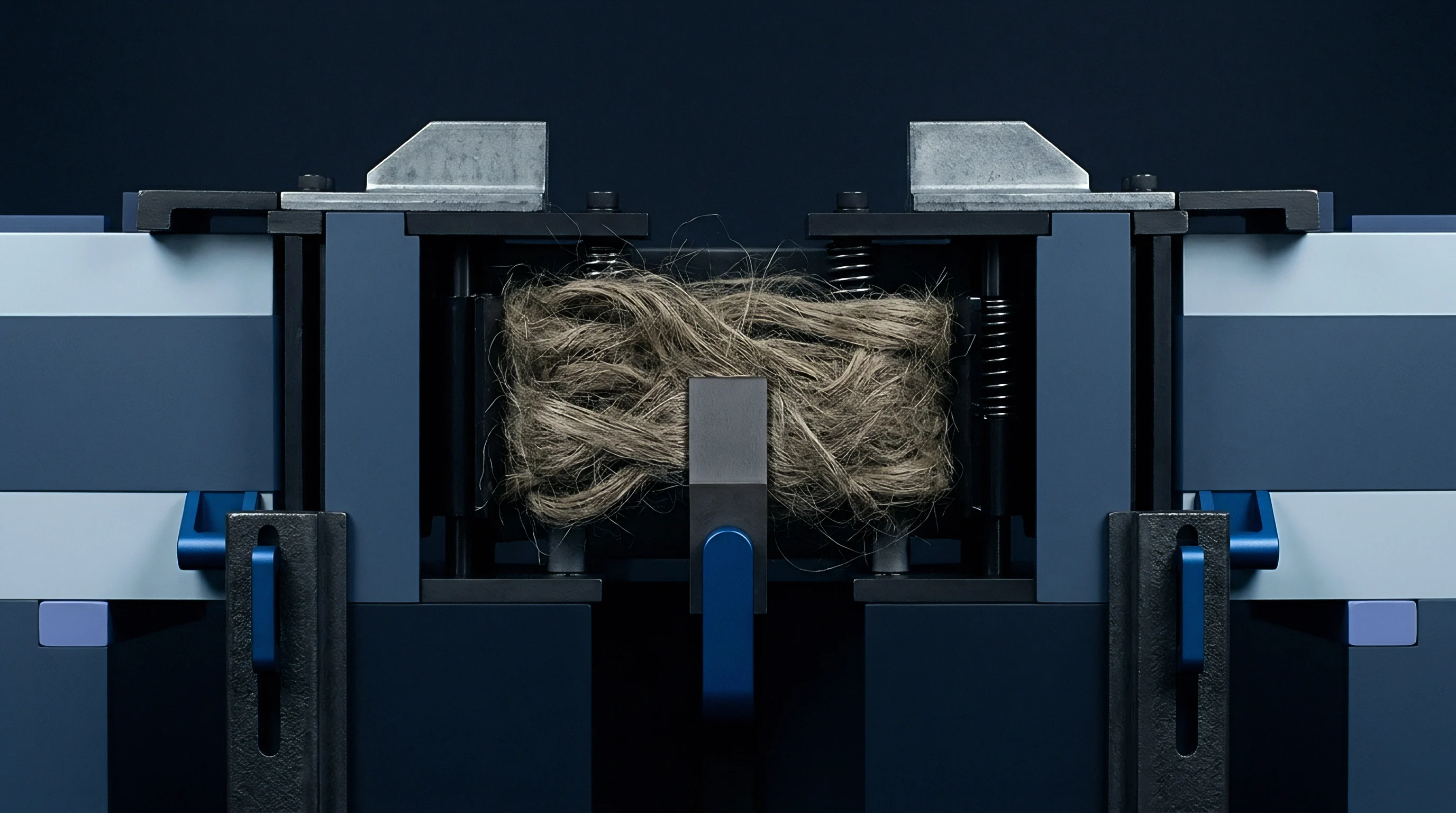
Geometry
Bundle cross-sectional morphology departs significantly from idealized circular geometry, exhibiting lenticular and polygonal shapes with variable aspect ratios. Under mechanical tension, these irregular bundles rotate, flatten, and compress inside the woven crimp structure. Classic textile mechanics models assume uniform cylindrical yarns that deform linearly under transverse pressure.
Flax yarns contain heterogeneous collections of elementary bast fibers cemented by residual pectin, resulting in non-linear transverse compression moduli that stiffen sharply as compaction increases.
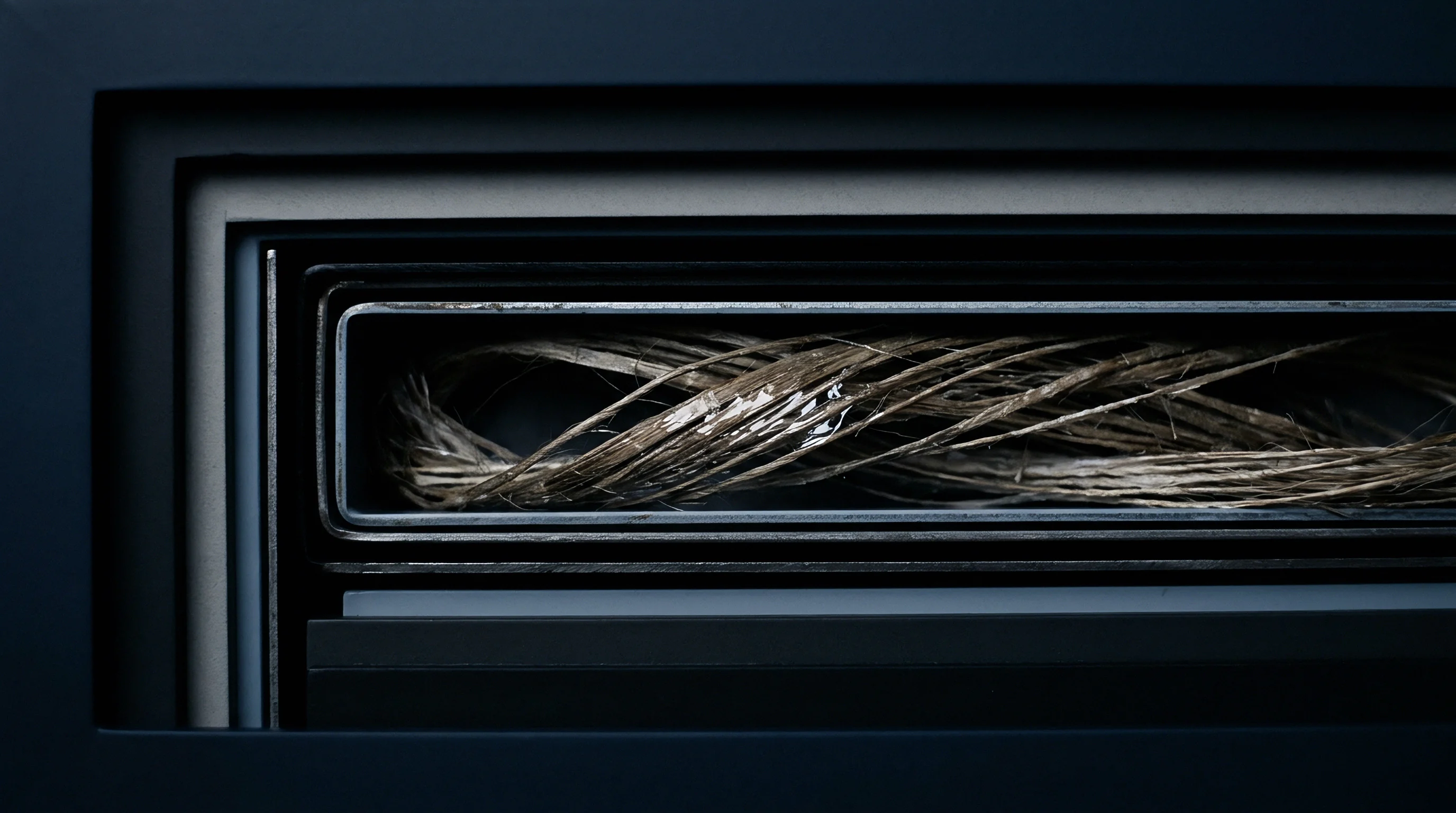
Predictive Packing Mechanics and Jamming Limits
Peirce geometric relationships govern the boundary conditions where warp and weft yarns reach physical jamming. At the jamming limit, interlacing yarns touch continuously along their contact contours, preventing further pick insertion without severe structural distortion. In standard plain cloth structures, the jamming limit relates yarn spacing, yarn diameters, and thread axis curvatures.
Because flax bundle yarns compress non-linearly, effective yarn diameter decreases under low beat-up force before locking into an incompressible solid state as intra-bundle voids collapse.
Bundle flattening changes the geometric cover factor calculation. The effective transverse diameter ratio, defined as major axis width divided by minor axis height, shifts from 1.15 in uncompressed yarn to 2.10 under typical warp sheet tensions of 0.45 centinewtons per tex. This transverse spreading increases optical cloth cover while simultaneously accelerating the onset of physical jamming during beat-up.
Thread density calculations that fail to incorporate retting-grade-dependent compressibility predict achievable pick counts that prove mechanically impossible on the loom.
| Yarn Count (Nm) | Retting Grade Origin | Residual Pectin (wt%) | Initial Major Axis (mm) | Compressed Height (mm) | Theoretical Jamming Sett (picks/cm) |
|---|---|---|---|---|---|
| Nm 26 (38.5 tex) | Grade 1 (Under-retted) | 5.1 | 0.31 | 0.24 | 18.5 |
| Nm 26 (38.5 tex) | Grade 3 (Standard) | 2.8 | 0.38 | 0.18 | 23.0 |
| Nm 26 (38.5 tex) | Grade 5 (Over-retted) | 1.0 | 0.44 | 0.14 | 27.5 |
| Nm 39 (25.6 tex) | Grade 1 (Under-retted) | 4.9 | 0.25 | 0.19 | 23.5 |
| Nm 39 (25.6 tex) | Grade 3 (Standard) | 2.6 | 0.30 | 0.14 | 29.0 |
| Nm 39 (25.6 tex) | Grade 5 (Over-retted) | 1.1 | 0.35 | 0.11 | 34.5 |
Can Mathematical Models Accurately Forecast Warp Jamming?
Empirical models incorporating non-linear compaction terms modify the classic Peirce jamming equation by substituting variable compressed thicknesses for rigid circular diameters. When transverse load increases, fiber bundle packing follows a power-law relationship where compressive resistance escalates inversely with porosity. Stiff bundles derived from under-retted flax resist early compaction, shifting the physical jamming point toward lower pick densities.
Yarns produced from thoroughly degummed bundles flatten readily, allowing the loom to insert additional picks before beat-up forces spike exponentially.
Cloth structural stability depends directly on this compaction mechanics. In tight plain constructions such as 185 grams per square metre apparel linens, under-retted warp yarns refuse to flatten around weft interlacing points. The resulting crimp remains concentrated entirely in the weft system, creating unbalanced tensile properties between warp and weft directions.
Well-degummed yarns balance crimp distribution evenly between both yarn systems, optimizing structural shear resistance and drape coefficient.
Coarse, high-pectin flax bundles lock into mechanical jamming at pick counts 15 to 20 percent below the theoretical thresholds calculated for idealized circular yarns.
Warp tension adjustments cannot compensate for intrinsic bundle stiffness once mechanical jamming locks the yarn intersection points. Increasing beam brake pressure simply stretches the crystalline cellulose core without inducing further lateral bundle flattening. Beat-up force rises exponentially once intra-bundle voids collapse.
Flatter bundles always yield denser cloth before reaching the mechanical beat-up boundary.

Insertion
Loom shed mechanics convert bundle geometry into dynamic operational stresses during every revolution of the main drive shaft. On modern negative rapier looms running at 550 picks per minute, the insertion channel demands precise clearance between upper and lower warp sheets. Yarns spun from variable retting grades exhibit erratic hairiness and bundle flaking, generating fiber debris that accumulates in the reed dents and drop wires.
Stiff warp yarns resist shedding deflection, increasing peak cyclical tension at maximum shed opening.
Beat-up resistance forces multiply when approaching the geometric jamming limit. As the reed approaches cloth fell, the newly inserted pick must displace existing warp crimp against friction. Under-retted warp yarns present high frictional drag coefficients due to residual encrusting pectins, requiring up to 350 Newtons per metre of beat-up force to seat the pick.
Excessive beat-up resistance induces cloth fell bounce, reed wear, starting marks, and cyclic warp slackening during the back-shed cycle.
Processing flax warp yarns on high-speed weaving equipment exposes distinct mechanical failure modes:
- Warp end snapping occurs when peak cyclic shed tension exceeds the lower yield point of localized thin spots in non-uniform wet-spun yarns.
- Lint accumulation shedding generates dense fiber debris pockets inside heald eyelets, restricting warp passage and causing yarn abrasion failures.
- Cloth fell displacement creates severe pick density irregularities and starting marks whenever the loom halts for manual defect clearing.
- Reed dent deflection develops when excessive beat-up resistance against jammed yarn bundles exerts lateral pressure on thin reed wires.
Air-jet insertion systems exhibit acute sensitivity to flax bundle surface variation. Un-extracted pectin clusters create erratic aerodynamic drag profiles along the yarn body, causing pick trajectory instability inside the profiled reed tunnel. Late pick arrivals trigger optical sensor stops, dragging machine efficiency below commercial thresholds.
Rapier insertion maintains positive mechanical control of the weft tip, making it the preferred technology for heavy or variable flax yarns.
Applying specialized modified potato starch sizing at 7.5 percent dry add-on encapsulates loose bundle surface fibrils, reducing friction-induced loom stoppages by 65 percent on dense plain cloth.
Weaving shed efficiency hinges upon stabilizing warp yarn dynamic tension within a narrow processing window of 0.35 to 0.55 centinewtons per tex. Exceeding this boundary stretches the yarn beyond its elastic recovery limit, introducing permanent deformation and latent micro-cracks in the cellulose fibrils. These micro-cracks manifest later as finished cloth tears during caustic scouring or wet finishing.
Shed managers often ponder whether continuous acoustic emission monitoring at the cloth fell can detect the exact millisecond bundle jamming initiates before mechanical yarn failure occurs.


Ledger
Loom capacity allocation and financial yield reflect the direct interaction between raw fiber grade, chemical degumming losses, and machine runnability. A shed operating 40 rapier looms on heavy linen constructions incurs substantial overhead costs that escalate rapidly whenever stop frequencies climb. Processing un-homogenized retting grades directly degrades machine productivity, converting planned operating margins into unscheduled loom-hour losses.

Operational Capacity Modeling and Financial Metrics
Consider a standard production run delivering 20,000 linear metres of 150-centimetre-wide plain linen cloth at 220 grams per square metre, constructed with Nm 26 warp and Nm 26 weft at 18 ends per centimetre and 16 picks per centimetre. On rapier looms running at 480 picks per minute, theoretical running time total equals 1,111 loom hours. Under Grade 3 optimally retted and extracted fiber, average loom efficiency reaches 88 percent, requiring 1,262 booked loom hours over a 21-day operating window.
With overhead and depreciation priced at 28.50 euros per loom hour, base machine conversion cost equals 35,967 euros, or 1.80 euros per linear metre.
When the mill loads an un-degummed Grade 1 under-retted flax lot, bundle stiffness and shedding friction increase warp stop frequency from 1.1 to 4.2 stops per hundred thousand picks. Machine operational efficiency plunges to 69 percent. Total required run time inflates to 1,610 loom hours, adding 348 hours of unplanned machine time.
Conversion cost rises to 45,885 euros, imposing a cost penalty of 0.50 euros per finished linear metre on machine time alone. Adding the yarn price differential and chemical sizing re-formulation drives the total cost inflation over 22 percent above budget.
| Fiber Grade and Processing Route | Chemical Mass Loss (wt%) | Loom Efficiency (%) | Warp Stops (per 100k picks) | Total Loom Hours (20k m) | Weaving Conversion Cost (EUR/m) |
|---|---|---|---|---|---|
| Grade 1 (Raw / Minimum Scour) | 3.5 | 69 | 4.2 | 1,610 | 2.29 |
| Grade 2 (Standard Scour) | 7.2 | 79 | 2.5 | 1,406 | 2.00 |
| Grade 3 (Optimized Degumming) | 11.8 | 88 | 1.1 | 1,262 | 1.80 |
| Grade 4 (Mild Alkaline Extraction) | 14.5 | 84 | 1.8 | 1,322 | 1.88 |
| Grade 5 (Over-retted / Bleached) | 18.2 | 73 | 3.6 | 1,522 | 2.17 |

Sourcing Protections and Acceptance Criteria
Commercial contracts for greige linen purchasing must incorporate quantitative biochemical and mechanical thresholds to prevent the delivery of un-weaveable lots. Relying entirely on visual scutching grade certificates exposes the buyer to concealed processing risks, as retting variances hide beneath surface hackling. Procurement dossiers should specify maximum allowable residual pectin content alongside yarn transverse compressibility metrics.
Incoming yarn quality protocols require verification against clear physical baselines before mounting warps on loom beams. Testing fiber bundle linear density dispersion via automated vibroscopic analysis isolates coarse bundle populations before sizing. Lots exhibiting coefficient of variation in linear density above 24 percent trigger mandatory re-scouring or chemical re-extraction schedules before beam warping proceeds.
Standard purchase contracts incorporating strict defect point allocation under ASTM D5430 Four-Point System penalize suppliers for starting marks and reed distortions caused by bundle jamming. When a lot arrives with residual calcium pectate exceeding 3.0 percent by dry weight, standard commercial indemnity clauses shift all consequential loom-hour downtime charges, sizing additive surcharges, and off-spec greige degradation penalties directly back to the yarn spinner.