Gravimetric Linear Density Determination for Natural Bast Fibers
Gravimetric linear density determination isolates conditioned cut fiber bundles on microbalances to establish precise tex and dtex spinnability limits for bast stock.


Morphology
Unlike synthetic monofilaments or uniform seed hairs, natural bast fibers harvested from flax, hemp, ramie, or jute stems have an asymmetrical cellular structure. Ultimate individual cells, measuring 10 to 40 millimeters long with diameters from 12 to 30 micrometers, bind together through a middle lamella of pectins, hemicellulose, and lignin. This matrix holds hundreds of elementary cells in parallel alignment, creating the commercial technical bundle.
Linear density measurements evaluate this aggregate bundle rather than an isolated cell, with effective mass per unit length changing continuously along the strand as individual fibers start and stop at staggered intervals.
Cross-sectional area along a flax or hemp tape can vary by upwards of 40 percent across 50 millimeters. Secondary cell wall thickness varies with retting quality, stem position, and soil moisture during cell wall deposition. Dew-retted crops grown under dry conditions often show incomplete pectin breakdown, yielding coarse, tenacious technical bundles that resist division during scutching.
Over-retted straw suffers cellulose chain breakdown; it produces slender bundles that split easily under low shear, but fail under tension during draw-frame drafting. Because bast cross-sections are irregular, polygonal, and contain lumen voids of changing size, standard geometric or optical calculations cannot deliver reliable fineness metrics.
At 65 percent relative humidity and 20 degrees Celsius, water-retted flax long line displays an average bundle linear density of 1.65 decitex, whereas under-retted dew flax from the same harvest batch registers 2.85 decitex.
Mapping mass distribution along these irregular strands relies on gravimetric measurement of controlled cut lengths. The test converts the total mass of a known count of parallelized fibers into tex, decitex, or metric fiber number (Nm) ~ the total length in meters supplied by one gram of fiber. Accurate gravimetric results require accounting for non-cellulosic material: residual gums, waxes, and pectins contribute directly to measured mass without adding tensile strength to the yarn structure.
| Standard Designation | Target Fiber State | Cut Length (mm) | Specimen Size (Fibres) | Conditioning Parameters |
|---|---|---|---|---|
| ISO 2370 | Flax technical bundles | 10.0 or 20.0 | 500 to 1000 | 20°C ± 2°C, 65% ± 4% RH |
| ISO 1973 | Decorticating bast / stapled fibers | 10.0, 20.0, or 50.0 | 200 to 500 | 20°C ± 2°C, 65% ± 4% RH |
| ASTM D1577 | Combed bast sliver / tow | 20.0 or 30.0 | 300 to 600 | 21°C ± 1°C, 65% ± 2% RH |
| GB/T 5882 | Ramie and hemp degummed strands | 20.0 | 500 | 20°C ± 2°C, 65% ± 4% RH |
Elementary Fibers and Technical Bundles
Hackling combs break down coarse technical bundles into finer sub-units, setting the ultimate limit for yarn fineness. Raw, unhackled dew-retted flax typically measures between 3.0 and 6.0 decitex, which drawing and roving gradually reduce through mechanical cleavage and fiber friction. Sampling must account for processing stage: testing raw scutched flax indicates field retting quality rather than true spinnability, whereas testing hackled sliver captures the fineness available to the spinning frame draft zone.
Pectin Matrix and Cohesive Variance
Residual gums increase gravimetric weight readings without adding usable fibers to the draft zone. Inconsistent retting leaves localized concentrations of calcium pectate along the fiber core, creating artificial mass spikes during weighing. The microbalance registers this pectin cluster as a coarser fiber, but in wet spinning, the draft rollers hit it as a rigid clump, breaking the end.
Mistaking these pectin heavy spots for true cellulosic thickness leads to wrong roller gauge settings, producing thick places in the sliver and erratic yarn strength.

Specimen
Preparing fiber bundles for gravimetric analysis requires thorough mechanical alignment to eliminate short-fiber skew and crimp distortion. Sampling begins with multi-point extraction across the fiber lot, taking hand-drawn tufts from the core, mid-layer, and exterior surfaces of opened bales to compile a 50-gram gross sample. Drawing this stock manually through hand combs with decreasing pin spacing removes shive, unretted bark, short fibers, and entanglements, leaving a clean, parallel ribbon of straight filaments.
Once parallelized, the ribbon is laid across a velvet cutting board fitted with dual parallel razor blades set to a cut length of precisely 10.0 or 20.0 millimeters using a hardened tool-steel gauge block. Clamping jaws grip both ends of the ribbon before the blades lower. Knife blades must cut cleanly without dragging or pulling strands out of alignment, since length distortion compromises the linear density calculation.
- Comb Sample Ribbon Hand-draw fifty grams of raw stock through coarse and fine hand combs until zero crossing fibers remain across the longitudinal axis.
- Purge Floating Staples Sweep short, unaligned fibers from the tail of the ribbon using a carding brush under constant downward hand pressure.
- Mount Specimen in Clamp Secure the combed ribbon within a dual-jaw clamping fixture loaded to a uniform tension of 0.05 centinewtons per decitex.
- Execute Precision Shear Lower twin parallel tungsten carbide razor blades in a single continuous movement across the clamped ribbon to yield exact 20.0 millimeter bundle lengths.
- Count Individual Strands Transfer the severed bundle to an illuminated velvet dissecting board and count every single fiber strand using magnifying optics and needle forceps.
Sampling Protocols for Heterogeneous Strands
Because natural fibers vary in length, pulling tufts by hand can bias sampling toward longer strands. A comb sorter aligns fiber ends along a baseline so representative length groups can be isolated before cutting. Samples cut from the mid-section of long-line flax yield finer linear density values than those taken from the stem base, where secondary lignin deposits add weight without spinnable length.
To find the lot’s true average linear density, samples are cut from three equidistant points along the full strand length.
Cutting Template Precision and Clamp Tension
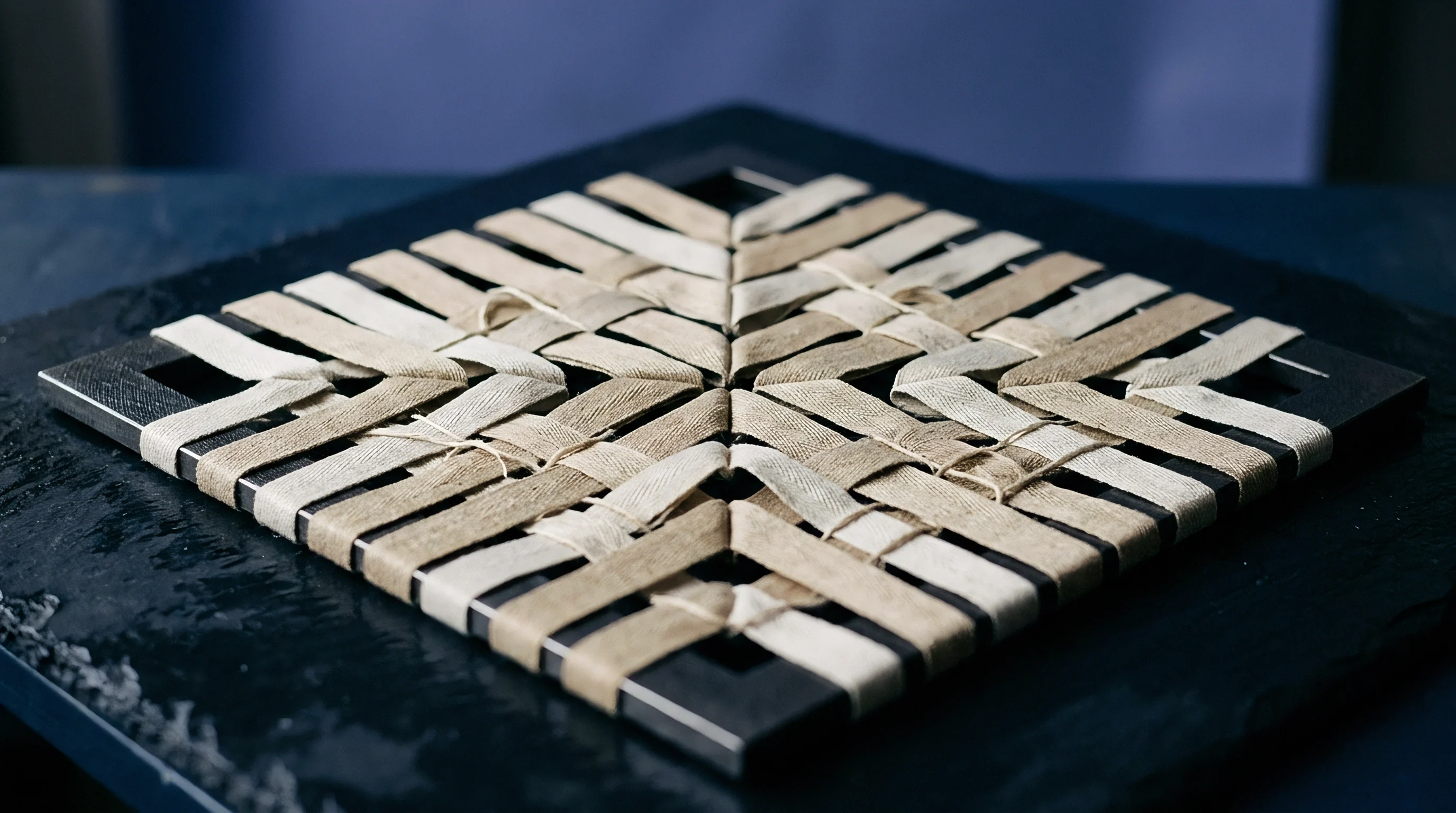
If clamping tension is too low, bowed or crimped fibers remain in the cutting zone. A fiber cut while curved has a true physical length greater than the 10.0 millimeter template width, artificially raising sample weight and overstating decitex. Applying a controlled preload before cutting prevents this error.
Conversely, excessive clamping tension elastically stretches the fibers; once cut and released, they contract shorter than the template width, understating decitex.
Batch linear density fluctuations often trace back to seasonal rainfall variations during field retting.

Balance
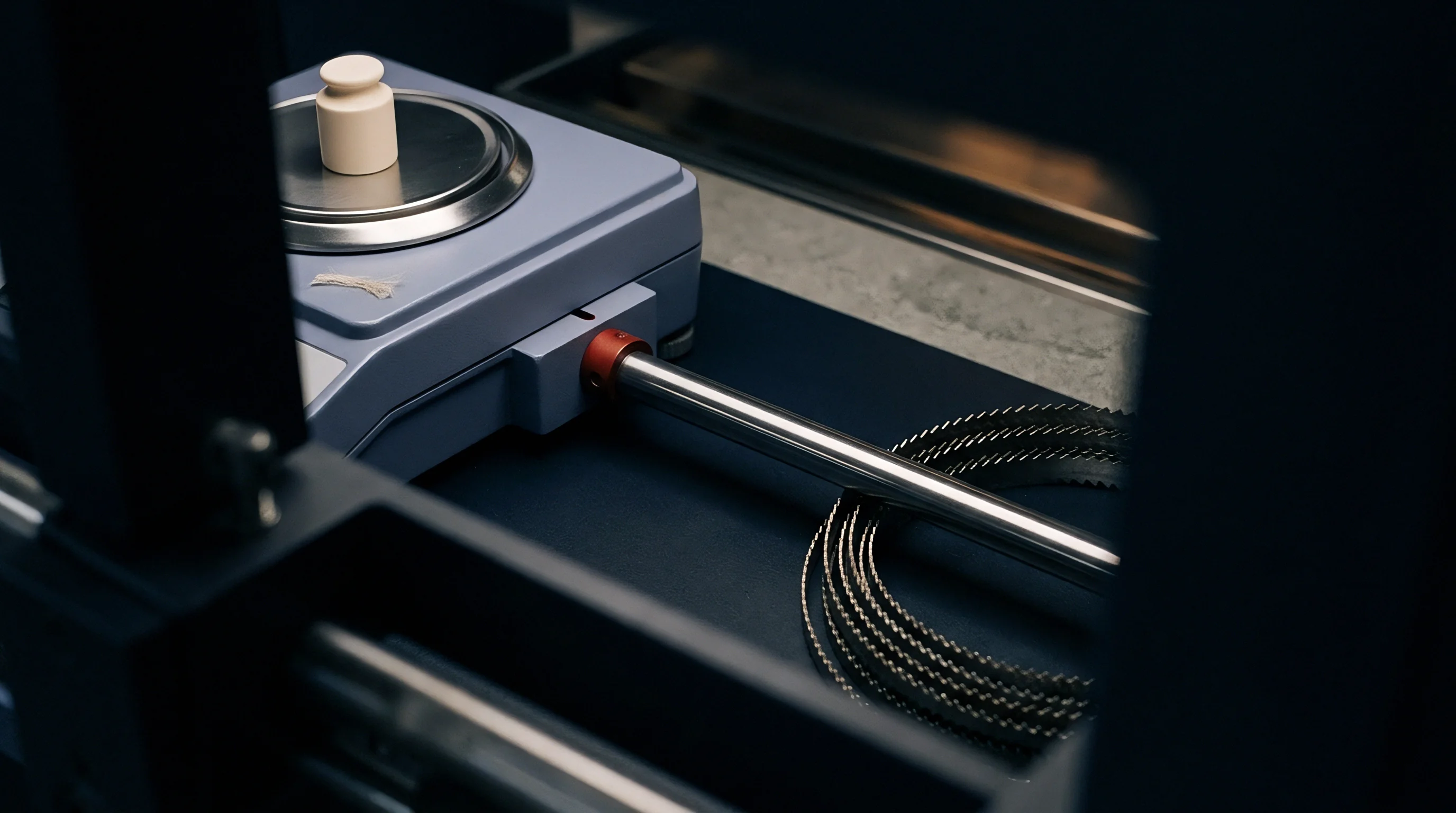
Weighing cut fiber bundles requires analytical microbalances with 0.001 milligram resolution, as specified in ISO 2370 and ISO 1973 protocols. Static electricity poses a major issue at microgram levels: dry ambient air or synthetic tweezers readily charge isolated bast fibers, producing electrostatic pull against the weighing pan or draft shield walls. Passing each cut specimen through an inline ionizing bar before placement dissipates static, while keeping draft shields closed during stabilization prevents air currents from shifting the pan zero.
Linear density calculations convert raw bundle mass and counted strand numbers into standard textile fineness units. The formula for linear density in decitex relies on the absolute mass of the cut bundle, the total number of counted strands in that bundle, and the precise cut length provided by the template:
Linear Density (dtex) = (10000 × Mass (mg)) / (Fiber Count × Cut Length (mm))
Alternatively, the metric fiber number (Nm) expresses the inverse of linear density, defining the total length in meters provided by one gram of fiber material:
Metric Fiber Number (Nm) = (Fiber Count × Cut Length (mm)) / (Mass (mg) × 1000)

Gravimetric Calculations across Tex and Metric Number
For example, take a gravimetric test on hackled long-line flax. A ribbon is prepared under standard clamp tension and cut to 20.0 millimeters. Under optical magnification, exactly 500 individual technical fiber strands are separated and counted from the cut section.
After passing through an ionizing field, the cut bundle weighs 1.650 milligrams on the microbalance pan. Applying the decitex calculation yields:
Linear Density = (10000 × 1.650 mg) / (500 × 20.0 mm) = 1.65 dtex
To convert this result into metric fiber number (Nm):
Nm = (500 × 20.0 mm) / (1.650 mg × 1000) = 10000 / 1.650 = 6060 m/g (or Nm 6060)
By contrast, a dew-retted tow sample cut to 10.0 millimeters with 400 counted strands weighing 1.120 milligrams yields 2.80 decitex (Nm 3571). The 1.15 decitex difference between these two lots alters processing: the 1.65 dtex material can spin to fine wet-spun yarns up to Nm 60, whereas the 2.80 dtex tow stock reaches its structural limit near Nm 26.

Can Microbalance Gravimetry Resolve Fiber Bundle Splitting Dynamics?
A static weighing gives the mass of a bundle at a single point in processing, but cannot show whether a 2.5 dtex result comes from a single un-cleaved fiber or three loose 0.8 dtex elementary fibers lightly entangled together. To predict drafting performance on a ring frame, mass readings should be paired with tensile testing or cross-sectional fiber counts.
Microbalance calibration protocols require zeroing with non-magnetic ceramic tweezers inside a vibration-isolated Faraday cage.
Weighing errors increase when sample size drops below 200 strands, where missing just five fibers adds a 2.5 percent error to linear density. On the other hand, samples over 1000 strands lead to operator fatigue and counting mistakes under the scope. Working with 400 to 600 strands offers the best compromise between weighing resolution and counting accuracy.
Degumming
Residual pectins, hemicelluloses, and surface waxes add weight without contributing to yarn strength. Raw bast fibers can contain up to 20 percent non-cellulosic material by mass, so finding true cellulosic linear density requires chemical extraction. Standard lab degumming boils raw bundles in 2 to 5 grams per liter sodium hydroxide (NaOH) with a non-ionic wetting agent for 60 minutes, dissolving pectins and saponifying fats to leave clean ultimate filaments.
Stripping the pectin matrix splits technical bundles into finer elementary units: raw flax measuring 3.2 decitex often drops to 1.2 ~ 1.5 decitex after degumming. Sourcing specifications must state whether target values apply to raw scutched stock or degummed fiber. Quoting 1.3 dtex without specifying a degummed state leads to commercial disputes if delivered raw bales test at 2.8 dtex on an as-received basis.
| Fiber State / Processing Stage | Residual Gum Content (% Mass) | Gravimetric Linear Density (dtex) | Equivalent Metric Fiber Number (Nm) | Maximum Spinnable Wet-Spun Count (Nm Yarn) |
|---|---|---|---|---|
| Raw Scutched Flax (Dew Retted) | 14.5 ~ 18.0 | 3.50 ~ 5.00 | 2000 ~ 2857 | Nm 18 ~ 24 |
| Hackled Long Line Sliver | 8.0 ~ 11.0 | 1.80 ~ 2.40 | 4166 ~ 5555 | Nm 36 ~ 50 |
| Roving Bleached / Boiled (Trough Ready) | 3.5 ~ 5.0 | 1.30 ~ 1.60 | 6250 ~ 7692 | Nm 60 ~ 80 |
| Fully Laboratory Degummed (NaOH) | 0.5 ~ 1.2 | 1.05 ~ 1.25 | 8000 ~ 9523 | Nm 100 ~ 120 |

Chemical Pre-Treatment and Mass Alteration
Boiling in alkali too long degrades amorphous cellulose. Chemical concentration, temperature, and agitation must be kept within tight limits; excessive treatment dissolves crystalline cellulose, artificially lowering decitex values below what commercial roving lines achieve. Standard cleaning uses 2.0 g/L NaOH at 98 degrees Celsius for 45 minutes, followed by a 1.0 g/L acetic acid wash and thorough deionized water rinses.
Standard Atmosphere Conditioning and Moisture Regain
Hydroxyl groups along cellulose chains absorb moisture readily, with dry flax absorbing up to 12 percent of its weight under ambient conditions. Weighing unconditioned fiber gives unstable results that swing with the weather. ISO 139 requires pre-conditioning samples in a low-humidity oven at 50 degrees Celsius for two hours, followed by at least 24 hours in a standard atmosphere at 20.0 degrees Celsius (± 2.0°C) and 65.0 percent relative humidity (± 4.0% RH) before weighing.
ISO 6741-1 establishes an official commercial moisture regain allowance of 12.0 percent by mass for scutched flax and hackled sliver subjected to commercial gravimetric settlement.
Weighing before reaching moisture equilibrium skews commercial shipment values. A 3 percent change in moisture content shifts the calculated mass of a 100-tonne lot by 3000 kilograms of dry weight. Corrected commercial mass is calculated using standardized regain factors:
Commercial Mass represents the dry mass of the fiber bundle multiplied by the factor (1 + Standard Regain Allowance / 100).
Moisture Regain defines the mass of water present in the fiber specimen expressed as a percentage of the oven-dry fiber mass.
Oven-Dry Mass specifies the constant mass achieved by a fiber specimen after drying in an ventilated oven at 105 degrees Celsius (± 2°C).
Hysteresis Effect accounts for the phenomenon where fibers reaching equilibrium from an over-wet state retain more water than fibers reaching equilibrium from a dry state.
Commercial contracts specify that reported linear density values must derive from oven-dry mass adjusted by the official 12.0 percent regain allowance.


Drafting
Fiber linear density directly affects performance in draw frame and wet-spinning draft zones. Cross-sectional fiber count determines whether yarn maintains integrity under tension, with stable spinning requiring at least 30 to 35 fibers in cross-section. Spinning 1.8 decitex fiber into Nm 60 yarn (166 decitex) puts about 92 fibers in the cross-section, allowing smooth drafting.
Using 3.5 decitex coarse tow for that same Nm 60 count leaves only 47 fibers, leading to frequent end breaks and drafting waves.
Finer linear density permits higher draft ratios in roving and spinning. Smaller fibers present more surface area per unit mass, generating the inter-fiber friction needed to control short fibers as roll speeds accelerate. Coarse bundles provide less surface contact, allowing un-drafted clumps to slip through the nip and produce periodic thick and thin spots in the sliver.
- Draft Wave Surliness Coarse fiber bundles slip through drafting roll nips without accelerating, creating thick slubs followed by ultra-thin yarn sections.
- Roller Lapping High surface-area fine fibers catch on damp top apron rollers in wet spinning frames, wrapping around the rolls and breaking the yarn end.
- Roving Twist Migration High variance in bundle linear density prevents uniform twist insertion, leaving coarse bundle zones under-twisted and fragile.
- Fly Waste Accumulation Weak, short elementary fibers split off coarse bundles during high-speed draft zone acceleration, building up as air-borne dust across ring rails.

Hackling Yield and Fiber Fineness Correlation
Hackling refines bundle linear density by drawing scutched flax across comb pins of increasing density, splitting coarse fibers and discarding shive and short fibers as tow. Refining raw flax from 3.5 dtex down to 1.6 dtex hackled sliver requires finer pin counts and longer dwell times, dropping long-line yield from 65 percent to 48 percent by weight and shifting material into lower-grade tow.
Sliver Levelness and Spinning Frame Limits
Sliver levelness depends on controlling linear density variability (CV%). Raw bast fibers routinely show CV% values above 45 percent within a single sliver sample. Autolevelers use mechanical or optical sensors to track incoming mass fluctuations and adjust draft ratios dynamically.
High variance forces rapid, heavy adjustments, increasing wear on gears and drive belts.
Finer gravimetric linear density yields higher total fiber surface area, increasing inter-fiber friction and stabilizing drafting control at high frame speeds.
Coarser linear density fibers demand lower spinning frame speeds and higher twist multipliers to prevent structural yarn collapse under winding tension.
Tariff
Raw fiber pricing follows certified linear density tiers, with fine long-line flax (1.4 to 1.7 decitex) commanding market premiums over standard 2.2 to 2.8 decitex stock. Purchase contracts incorporate financial penalties for out-of-spec shipments tested at port arrival inspection. If a lot contracted at 1.60 dtex tests at 1.95 dtex, the spinning mill must alter its plan, diverting the fiber from fine apparel yarns to heavier home textiles.
Determining landed cost per spinnable meter requires accounting for hackling yield loss, moisture corrections, and process waste allowances. Fiber fineness thus affects economics at every stage down to the finished loom state.
| Grade Classification | Target Linear Density (dtex) | Raw Fiber Price ($/kg Landed) | Hackling Long Line Yield (%) | Effective Line Fiber Cost ($/kg) | Landed Cost per 10,000m at Nm 40 ($) |
|---|---|---|---|---|---|
| Fine Long Line (Water Retted / Enzyme) | 1.35 ~ 1.60 | 6.20 | 52.0 | 11.92 | 2.98 |
| Standard Dew-Retted Long Line | 1.80 ~ 2.20 | 4.50 | 62.0 | 7.25 | 1.81 |
| Coarse Dew-Retted Tow Stock | 2.80 ~ 3.50 | 2.80 | 78.0 (Carded) | 3.58 | 0.89 |
| Cottonised Bast Fiber (Stapled) | 1.20 ~ 1.40 | 5.10 | 85.0 (Opener) | 6.00 | 1.50 |

Fineness Tolerances in Commercial Contracts
Commercial purchase orders specify strict target ranges. A typical contract for premium hackled flax sliver sets a 1.65 dtex baseline with a ± 5.0 percent tolerance band, tested by an accredited neutral laboratory under ISO 2370 protocols across five independent bales per 10-tonne container load. Average readings between 1.74 dtex and 1.82 dtex trigger a mandatory 3.5 percent price rebate per kilogram, while mean readings above 1.82 dtex entitle the buyer to reject the entire container lot.
Landed Cost Calculations per Spun Meter
Buying fiber on raw price alone can be misleading. Fine 1.50 dtex long-line flax at 6.20 per kilogram aχeves high efficiency for fine yarn counts, producing fabric that uses less raw mass per meter. Lower-grade 2.40 dtex fiber at $4.50 per kilogram reduces upfront material cost but limits processing to coarse Nm 26 yarn counts.
Coarser yarn requires higher linear density to aχeve target strength, increasing total fiber mass per square meter of fabric. The finer stock yields lighter, higher-value fabric with better hand, generating higher commercial margins per spun meter than the cheaper, coarse alternative.
Calculating the true net cost per meter of spun yarn requires combining the clean fiber purchase price, waste factors, and draft frame production speeds into a single operational forμla:
Cost per Spun Meter (/m) = Fiber Cost ($/kg) / (Yarn Metric Count × 1000)
Applying this formula to fine 1.50 dtex fiber processed into Nm 50 yarn under a hackling yield of 0.52 and spinning efficiency of 0.88 yields a clean fiber cost component of $0.271 per 1000 meters. The same calculation applied to a 2.10 dtex fiber processed into Nm 30 yarn under a hackling yield of 0.62 and spinning efficiency of 0.90 yields a clean fiber cost component of $0.290 per 1000 meters. The initial price premium paid for finer gravimetric linear density fibers is fully offset by the extended length coverage achieved in fine-count yarn spinning.