Lot to Lot Fibre Variance Costed as a Waste Allowance
Lot-to-lot flax variance costed via hackling yield formulas protects mill margins by adjusting line sliver pricing before wet spinning.

Crate
Raw Stock Heterogeneity and Bast Fiber Metrics
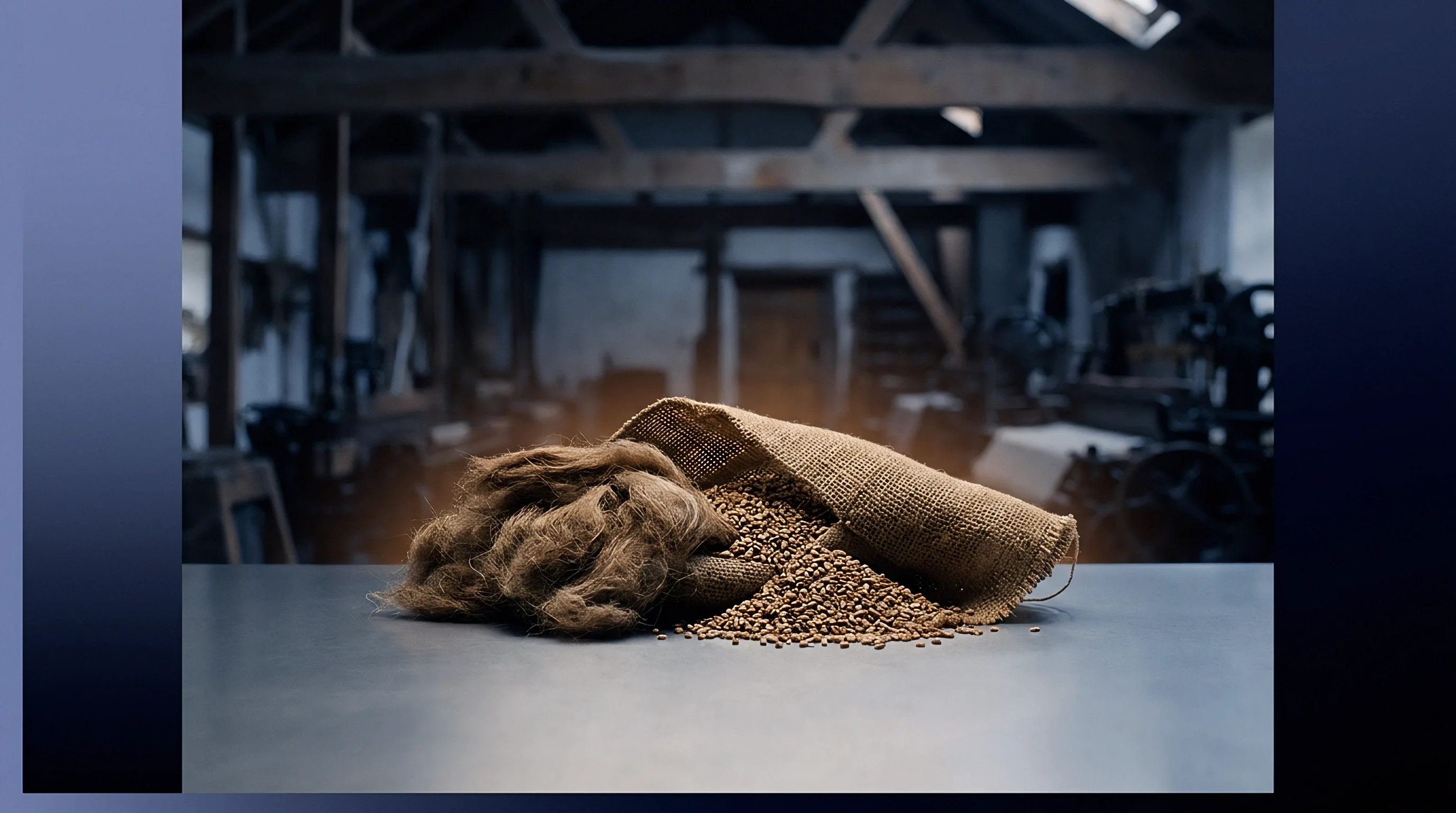
Incoming shipments of scutched long flax arrive tightly bound, with moisture levels, bundle lengths, and shive percentages varying by growing region. Flax grading begins at the bale. Agricultural origin dictates early cell wall development ~ early season rain shifts the ratio of crystalline cellulose to amorphous hemicellulose inside the primary bast fiber wall.
With dew-retted stock from European fields or domestic Heilongjiang harvests, differences in field retting time create sharp variations in bundle cohesion and pectin breakdown. Over-retted material sheds fiber bundles easily during scutching, but losing those inter-cellular pectins lowers individual bundle tenacity under mechanical draft. Under-retted stock holds onto structural pectins, resisting pin penetration during combing and raising coarse shive counts in the hackled sliver.
Evaluating raw scutched flax bales requires core sampling across three points per shipment. Cores drawn from outer layers often show lower moisture readings than central samples because of atmospheric desorption in transit. Standard commercial mass calculations under ISO 6741 set an official allowance of twelve percent regain for flax fiber, but delivered moisture routinely swings between eight and fourteen percent across a single container delivery.
Moisture shifts the scale directly: a two percent deficit across a twenty-tonne container removes four hundred kilograms of fiber weight, raising the effective cost per clean kilogram long before material reaches the hackling line.

Hackling Yield Degradation and Shive Content
Processing scutched long line flax into parallel hackled sliver yields two main products: dressed line fiber and hackling tow. As scutched flax enters the first hackling machine, it runs through continuous pinned aprons that split, straighten, and strip away cortical bark fragments from coarse bundles. The recovery rate of dressed line relative to raw fiber input is the hackling yield.
High-grade long-staple flax yields fifty-eight to sixty-five percent line fiber, thirty to thirty-five percent hackling tow, and loses the rest as organic dust and heavy shive waste. Inconsistent, lower-grade lots drop below forty-six percent hackling yield, dumping heavy volume into lower-value tow categories.
Shive content in raw stock directly drives waste rates across the comb beds. Shives are lignified woody core fragments left on the bast fiber bundles after scutching. When dense shive clusters hit the fine pins on final hackling drums, mechanical forces snap long fiber bundles into short fragments.
That converts valuable long-staple line fiber into low-value tow, driving up waste percentages and shortening average fiber length in the remaining sliver. Length distribution histograms shift left, widening the coefficient of variation in staple length and introducing short fibers that disrupt subsequent drafting during yarn prep.
Relative humidity fluctuations inside the bale storage warehouse alter fiber bundle flexural rigidity before mechanical hackling begins.
Physical Defect Modes in Scutched Bales
Raw fiber lots entering processing plants carry structural defects from poor harvesting, improper retting, or aggressive scutching, all of which alter comb extraction rates.
- Bark Adhesion comes from incomplete retting where epidermis tissue remains glued to outer cortical fiber bundles, bending hackling pins and increasing comb waste.
- Decayed Fiber Bundles result from localized fungal over-retting during long field exposure, causing fibers to disintegrate inside fine comb beds.
- Tangled Straw Heads happen during rough mechanical harvesting, criss-crossing fibers so bundles rupture under draft instead of splitting cleanly lengthwise.
- Cortical Shive Clusters are coarse woody core fragments that jam fine pin bars, forcing unscheduled stops for cleaning and raising short-fiber loss.
Quantifying these physical defects before production provides the baseline figures needed to measure incoming material risk. When scutched flax carries high bark adhesion, mills must widen pin gaps on early hackling passes, softening the combing action and letting coarse bundle structures slip down the line. These coarse fibers break drafting aprons and, upon reaching draw frames, distort drafting force distribution to cause local weight variations in the drawn sliver that show up as thick and thin places in wet-spun yarn.

Financial Impact of Uncontrolled Material Variance
Sourcing long-staple flax means pricing raw lot variance into the initial purchase rather than swallowing processing losses at the spinning frame. A batch of scutched flax bought at four dollars and fifty cents per kilogram with an expected hackling yield of sixty percent produces long line sliver at a net raw fiber cost of seven dollars and fifty cents per kilogram, excluding conversion expenses. If retting inconsistencies drop actual yield to fifty-two percent on the next shipment, net raw fiber cost for that line sliver jumps to eight dollars and sixty-five cents per kilogram.
That is a fifteen percent increase in raw material cost per kilogram of spinnable sliver from physical lot variance alone.
Absorbing this difference without waste allowances in the contract erodes mill margins fast. Hackling tow retains some value, selling at roughly twenty to thirty percent of the raw flax price, but tow sales do not cover the lost line fiber volume. When fine-count yarn contracts demand high metric numbers, poor hackling yields force operators to slow down drafting speeds, compounding financial losses through dropped machine output and higher energy use per kilogram of yarn.
Late rains during the growing season alter field retting beyond commercial control, driving down yields.


Assay

Laboratory Measurement of Flax Fineness and Length
Predicting how flax will spin requires lab testing raw fiber properties before loading bales onto the opener line. Lab metrics establish baseline lot compliance. Measuring fineness in flax requires different methods than wool or cotton because of the multicellular structure of bast fiber bundles.
Under ISO 2370, fineness is expressed as the metric fiber number ~ the length in meters of one gram of fiber bundles. Fine long-line grades register metric numbers between 1000 and 1500, while coarse tow falls below 400. High metric numbers signal thin, flexible bundles that form fine, even yarns at high spinning counts.
Determining length distribution involves manual or automated comb sorters that group conditioned fiber samples by length. Long-staple line flax requires a mean staple length above 500 millimeters, with minimal material under 200 millimeters. A wide distribution curve indicates excessive short fibers, causing erratic drafting on wet-spinning frames.
Testing requires a conditioned room at twenty degrees Celsius and sixty-five percent relative humidity; dry fiber bundles lose flexibility and shatter during comb sorting, artificially inflating short-fiber figures.

Tensile Strength and Microstructural Integrity
Single fiber and bundle tenacity measurements define the mechanical limits of raw flax during wet drafting and twist insertion. ISO 2370 jaw settings measure bundle tenacity on conditioned fiber slivers. Flax fibers owe their high tensile strength to tightly oriented cellulose microfibrils aligned at a narrow spiral angle of ten to eleven degrees along the fiber axis.
This microfibrillar structure produces bundle tenacity values between 45 and 65 centinewtons per tex ~ far above upland cotton varieties. Bundle tenacity governs wet spinning speed.
| Fiber Property | Standard Method | Target Range (Line Flax) | Acceptable Spread | Operational Impact of Out-of-Spec Values |
|---|---|---|---|---|
| Metric Fiber Number (Fineness) | ISO 2370 | 1100 – 1450 Nm | ± 75 Nm | Low values cause coarse yarn, end breaks, and high hairiness. |
| Bundle Tenacity | ISO 2370 / Pressley | 48.0 – 62.0 cN/tex | ± 4.0 cN/tex | Low strength causes drafting zone yarn ruptures on wet frames. |
| Mean Staple Length | Comb Sorter / ISO 6741 | 550 – 680 mm | ± 30 mm | Short staple content elevates hackling comb waste percentages. |
| Moisture Regain | ISO 6741 Oven Dry | 11.5 – 12.5 % | ± 1.0 % | Low moisture causes static loading and fiber shattering. |
| Shive Weight Content | Gravimetric Separation | 0.8 – 1.5 % | ± 0.3 % | High shive count damages fine hackling pins and increases nep load. |
| Laboratory test conditions: 20°C ambient temperature, 65% relative humidity per ISO 139 standard conditioning environment. | ||||
Low bundle tenacity indicates microstructural damage from over-retting, aggressive scutching, or chemical breakdown during storage. When drawn through hot wet-spinning troughs, weak fibers collapse early as hot water softens middle lamella pectins between cells. That softening drops the drag force needed for smooth fiber slippage, causing draft waves in the sliver and frequent end breaks at the spindle.

Nep Formation and Impurity Quantification
Nep counts and residual shives determine whether hackled line sliver is suitable for fine linen weaving. Nep counts rise in over-retted stock. In flax, neps are small, tightly rolled tangles formed when thin, weak, or damaged fibers roll up against the hackling pins.
Optical web scanners count neps per hundred grams of carded or hackled web to establish quality tiers for yarn production.
Measuring shive impurities relies on gravimetric extraction, shaking woody particles free from fiber samples over calibrated sieves. Excess shive in line sliver creates immediate processing hazards. Large shives jam in drafting roller nips, lifting top rollers and allowing raw, un-drafted sliver to pass into the spinning zone.
Smaller fragments get wrapped into the yarn core, forming hard, dark specks that repel dye during finishing and leave pale spots on finished fabric.
A two-unit drop in metric fiber number combined with high shive counts elevates wet-spinning end breaks beyond forty stops per thousand spindle hours.
Structured Protocol for Incoming Lot Inspection
Receiving material at the mill requires strict testing to catch out-of-spec fiber before bales enter production.
- Bale Core Sampling requires taking five hundred grams of raw fiber from ten percent of randomly selected bales in each container shipment.
- Conditioning Phase requires holding test samples in a standard atmosphere chamber for twenty-four hours to equalize moisture regain.
- Gravimetric Moisture Assay uses oven-drying at one hundred and five degrees Celsius to determine true dry mass and net commercial mass.
- Comb Sorter Length Analysis measures staple length distribution, recording mean length and the short-fiber percentage below two hundred millimeters.
- Bundle Tenacity Assay measures break force across twenty conditioned fiber ribbons to calculate mean tenacity in centinewtons per tex.
Following this lab protocol stops sub-standard lots from reaching the opening room and contaminating active production lines. Catching low tenacity at the loading dock allows managers to reject non-compliant shipments, claim price adjustments, or reroute coarse lots to low-count dry spinning before wasting machine hours.
Testing bundle tenacity offers a reliable sign of wet-spinning performance long before sliver reaches the trough.

Spindle
Drafting Behavior on Wet and Dry Spinning Lines
Converting hackled line sliver into uniform linen yarn requires controlling fiber bundle movement in the drafting zone. Flax spinning follows two main routes: wet spinning for fine to medium counts, and dry spinning for coarse yarns and heavy industrial fabrics. Wet spinning runs roving through a hot water bath kept between sixty and seventy-five degrees Celsius before final drafting.
The hot water softens pectin bonds holding elementary fibers together, letting them slide past each other. This liquid drafting thins the fiber bundle down to fine metric counts from Nm 26 up to Nm 100.
| Hackling Yield Tier | Target Yarn Count | Fly Waste Rate (%) | Frame Stops per 1000 Spindle Hours | Combing Noil Extraction (%) |
|---|---|---|---|---|
| Tier 1 (Yield > 60%) | Nm 60 Wet-Spun | 1.8 % | 12 – 18 | 8.5 % |
| Tier 2 (Yield 52 – 59%) | Nm 40 Wet-Spun | 2.9 % | 22 – 32 | 12.0 % |
| Tier 3 (Yield 45 – 51%) | Nm 26 Wet-Spun | 4.2 % | 38 – 50 | 16.5 % |
| Tier 4 (Yield | Nm 14 Dry-Spun | 6.1 % | 55 – 75 | 22.0 % |
Uneven fineness across a single raw lot disrupts this drafting equilibrium. When a lot has a wide spread in metric fiber numbers, thick un-retted bundles fail to soften completely in the hot trough. These stiff bundles resist drafting forces, triggering stick-slip motion between the back and front rollers.
Fly waste spikes in the drafting zone. The yarn comes out with heavy mass variation ~ slubs where un-drafted bundles pulled through, followed by thin spots where surrounding fine fibers were over-drafted to compensate.

End-Breakage Dynamics and Machine Efficiency
End breaks on wet-spinning frames directly drive down mill efficiency and raise labor costs. Spinning frame breaks stop production lines. Breaks multiply when drafting tension exceeds the momentary tensile strength of the strand at the delivery roller nip.
Variable tenacity, localized short-fiber clusters, and residual shives are the primary physical causes of frame stops.
Mill trials tracking wet-spinning frame stops per hundred spindle hours show that when lot variance pushes end breaks from fifteen up to forty-five per thousand spindle hours, operator workloads triple. Operators must manually piece broken ends, increasing frame downtime and lowering total efficiency. High break rates also increase yarn waste, as broken ends get sucked into collector flutes, converting hot-water-treated roving into low-value pneumafil that cannot be fed back into line fiber processing.
Excessive short fiber content in hackled sliver forces operators to increase roving twist, which restricts liquid drafting inside the wet-spinning trough.

Operational Audit Sequence for Machine Trial Verification
Testing raw material compatibility on the spinning floor requires a systematic trial under controlled conditions.
- Mount ten test roving bobbins from the candidate raw lot onto dedicated test spindles of a wet-spinning frame.
- Calibrate hot water trough temperature to exactly sixty-eight degrees Celsius and set front-to-back draft ratios to match baseline count targets.
- Run test spindles for four continuous hours, logging every end break, slub stop, and lap-up.
- Collect and weigh all pneumafil fly waste and trough sludge produced by the test spindles during the run.
- Take five full yarn bobbins per spindle for evenness testing, tensile breaks, and hairiness analysis.
This trial isolates raw lot performance from room atmosphere shifts. Gathering exact figures on break frequency and fly waste allows spinning managers to set fair cost surcharges on variable lots. Fiber exceeding baseline break limits can be penalized or redirected to coarser yarn counts before full-scale production runs.

Downstream Quality Impacts on Finished Fabric
Yarn unevenness from fiber variance causes severe quality problems through weaving and finishing. Thin sections from bad drafting have low twist density and poor tensile strength, causing warp breaks on high-speed looms. A single warp break on an air-jet loom halts the entire machine, cutting weaving efficiency and leaving horizontal start-up marks across the fabric surface.
Thick spots and neps spoil fabric appearance and hand feel. During dyeing, dense shive cores buried inside thick yarn sections take up dye differently than surrounding cellulose fibers, leaving visible color specks across the cloth. Unmanaged raw fiber variance turns premium apparel linen into seconds, forcing weavers to sell finished goods at heavy markdowns.
Running inconsistent fiber lots without adjusting frame draft settings leads to severe count variation, frequent loom stops, and irreversible dye shade bars in finished fabric.

Margin
Converting Hackling Loss and Fiber Variance into Metre Costing
Financial accounting in flax yarn manufacturing depends on converting physical yield losses directly into money per finished linear metre of fabric. Landed fiber price is only the starting point. Yield calculations determine the actual cost structure across hackling, carding, preparing, roving, wet spinning, winding, and weaving.
To set baseline yarn costs, engineers use a multi-stage yield formula incorporating raw material base cost, cumulative processing waste, and byproduct credits. Waste allowances protect mill margins; unhedged variance destroys fine-count economics.
Consider a practical manufacturing scenario producing an Nm 39 line linen yarn intended for a light plain-weave shirting fabric weighing 150 grams per square metre at a finished width of 150 centimeters. The raw scutched long flax is landed at $5.20 per kilogram. Under standard production parameters, hackling yield is target-rated at 58%, yielding dressed line fiber while generating 34% hackling tow and 8% invisible shive dust loss.
Hackling tow is credited back to the cost model at a realization price of $1.30 per kilogram.
The net raw material cost per kilogram of hackled line fiber comes from subtracting the tow credit from the gross material input cost:
Gross Raw Material Input per kg Line = Raw Fiber Price / Hackling Yield Ratio Gross Material Input = $5.20 / 0.58 = $8.965 per kg
Tow Credit per kg Line = (Tow Yield Ratio / Hackling Yield Ratio) Tow Realization Price Tow Credit = (0.34 / 0.58) $1.30 = $0.762 per kg
Net Line Fiber Base Cost = Gross Material Input – Tow Credit Net Line Fiber Base Cost = $8.965 – $0.762 = $8.203 per kg of clean line sliver
Subsequent spinning prep, wet spinning, and winding introduce an additional cumulative waste factor of 12% (drawing lap waste, roving fly, trough waste, and winding clearings). The un-recovered waste multiplier for spinning is 1 / (1 – 0.12) = 1.136. Adding direct spinning conversion costs of $4.50 per kilogram of finished yarn gives the landed net yarn cost per kilogram:
Net Yarn Cost per kg = (Net Line Fiber Base Cost 1.136) + Spinning Conversion Cost Net Yarn Cost per kg = ($8.203 1.136) + $4.50 = $9.318 + $4.50 = $13.818 per kg of Nm 39 yarn
A four percent price penalty per finished metre applies when fine line fiber shifts two metric numbers below contract grade.
Translating yarn cost into finished fabric cost requires incorporating loom consumption. A fabric weighing 150 grams per square metre at a 1.50-metre width takes 225 grams of yarn per linear metre, excluding weaving waste. Factoring in a standard 6% weaving waste allowance (selvedge waste, loom bobbin ends, and warp sizing loss), true yarn consumption per linear metre works out to 0.225 / (1 – 0.06) = 0.2393 kilograms per linear metre.
Yarn Material Cost per Linear Metre = Yarn Mass Consumption Net Yarn Cost per kg Yarn Material Cost per Linear Metre = 0.2393 kg $13.818/kg = $3.307 per linear metre
Now consider the financial disruption when an unhedged raw fiber lot exhibits severe variance, dropping actual hackling yield from the expected 58% down to 49%, while increasing hackling tow output to 41% and shive loss to 10%. Due to fiber breakage during processing, spinning waste also increases from 12% to 17%.
Recalculating under degraded lot parameters:
Gross Material Input = $5.20 / 0.49 = $10.612 per kg Tow Credit = (0.41 / 0.49) $1.30 = $1.087 per kg Net Line Fiber Base Cost = $10.612 – $1.087 = $9.525 per kg of clean line sliver
Spinning Waste Multiplier = 1 / (1 – 0.17) = 1.2048 Net Yarn Cost per kg = ($9.525 1.2048) + $4.50 = $11.475 + $4.50 = $15.975 per kg of Nm 39 yarn
Yarn Material Cost per Linear Metre = 0.2393 kg $15.975/kg = $3.822 per linear metre
Physical lot variance pushes net yarn material cost from $3.307 up to $3.822 per linear metre ~ an increase of $0.515 per linear metre, or 15.6%. On a standard ten-thousand-metre run, this unhedged variance consumes $5,150.00 of operating margin if fabric sales prices stay locked by contract.
Why Do Hackling Yield Shifts Alter Metre Pricing?
Hackling yield shifts directly alter the mass ratio of high-value line fiber to low-value tow extracted from every incoming kilogram of scutched flax. Because line fiber carries the primary financial burden of fine yarn production, any drop in yield inflates the raw mass cost assigned to the remaining clean sliver. Lower yield also correlates with higher short-fiber fractions, driving up spinning fly waste and frame breaks.
This double compounding effect raises raw material costs and downstream processing costs at the same time, driving up the final price per linear metre of cloth.
| Yarn Count Target | Raw Fiber Base ($/kg) | Contracted Hackling Yield (%) | Actual Hackling Yield (%) | Baseline Yarn Cost ($/kg) | Actual Yarn Cost ($/kg) | Fabric Cost Variance ($/m) |
|---|---|---|---|---|---|---|
| Nm 26 (Coarse Line) | $4.10 | 54.0 % | 50.0 % | $10.15 | $10.82 | +$0.24 / m |
| Nm 39 (Medium Line) | $5.20 | 58.0 % | 49.0 % | $13.82 | $15.98 | +$0.52 / m |
| Nm 60 (Fine Line) | $7.80 | 62.0 % | 53.0 % | $20.45 | $23.90 | +$0.88 / m |
| Nm 80 (Ultra-Fine Line) | $11.50 | 65.0 % | 55.0 % | $29.80 | $35.10 | +$1.32 / m |
| Summary baseline calculations assume standard 150 GSM plain weave fabric at 1.50m width and fixed spinning conversion costs. | ||||||

Three-Case Sensitivity Modeling for Waste Allowances
Evaluating commercial sourcing risk requires sensitivity bands that map financial outcomes across best-case, expected, and worst-case fiber performance.
In Case A (Optimized Lot Performance), high-uniformity European dew-retted flax achieves a 63% hackling yield with only 8% total spinning waste. Net yarn landed cost drops to $12.45 per kilogram, bringing woven fabric material cost down to $2.98 per linear metre and expanding mill operating margin nine percent above budget.
In Case B (Standard Base Specification), raw fiber performs exactly to contract specifications at a 58% hackling yield and 12% spinning waste. Net yarn landed cost hits the budgeted $13.82 per kilogram, delivering the targeted fabric material cost of $3.31 per linear metre.
In Case C (Degraded Lot Performance), severe length variance and high shive content cut hackling yield to 46% while pushing spinning waste to 19%. Net yarn cost jumps to $17.10 per kilogram, driving fabric material cost to $4.09 per linear metre ~ wiping out mill margins and producing a net loss on the contract.
Documentation Requirements for Waste Reconciliation
Structuring commercial contracts to recover cost overruns from fiber variance requires strict documentation procedures.
- Certified Weight Tickets must record gross, tare, and net incoming container weights along with gravimetric moisture regain test certificates.
- Hackling Yield Reconciliation Sheets must track input scutched flax mass against output dressed line sliver, hackling tow mass, and heavy shive waste totals.
- Spinning Frame Waste Logs must record pneumafil collection mass, trough clearing sludge mass, and winding yarn clearing weights.
- Independent Laboratory Test Dossiers must provide ISO 2370 fineness, staple length distribution, and bundle tenacity verification for contested lots.
Maintaining full documentation across these four checkpoints creates an airtight audit trail. When raw fiber fails to hit contractual hackling yields, this verified data lets buyers debit supplier accounts directly for the exact dollar difference per linear metre of fabric.
Yield loss metrics derived from actual mill hackling runs provide the ultimate quantitative baseline for settling lot variance claims.
How far can digital image analysis of raw fiber web samples replace traditional gravimetric hackling trials when establishing waste allowance tiers on commercial contracts?


Clause

Engineering Contractual Waste Allowance Terms
Protecting mill operations from raw flax variance requires drafting explicit contract terms with clear performance boundaries and financial remedies. Broad quality descriptions like high grade or clean scutched flax offer zero protection when yield drops on the floor. Sourcing specifications must set numerical targets, tolerance bands, and mandatory price adjustment formulas tied directly to standard lab test methods.
A proper contract specification includes baseline figures for metric fiber number under ISO 2370, bundle tenacity, moisture regain under ISO 6741, and minimum hackling yield percentages. The text should explicitly state that delivered lots falling outside tolerance bands trigger automatic invoice debits or lot rejections at supplier expense. Contract terms enforce physical lot boundaries.

RFQ Waste Allowance Specification Clauses
Commercial Request for Quotation documents require clear clauses governing waste allowance calculations and lot variance settlements.
Clause 4.1 (Delivered Moisture and Mass Reconciliation): All shipments of scutched flax fiber shall be invoiced based on commercial mass calculated per ISO 6741, utilizing an official moisture regain allowance of twelve percent. Delivered moisture content exceeding thirteen point five percent shall result in an immediate invoice deduction equal to the excess water mass weighed at container destination.
Clause 4.2 (Hackling Yield Guarantee and Price Adjustment): The seller guarantees a minimum dressed line hackling yield of fifty-eight percent by mass on incoming raw fiber lots. Should verified industrial hackling trials yield less than fifty-eight percent line fiber, the buyer shall adjust the net payable invoice price downward according to the following formula: Invoice Reduction = Contract Base Price ((Guaranteed Yield Percentage – Actual Verified Yield Percentage) / Guaranteed Yield Percentage) 1.25 penalty multiplier.
Clause 4.3 (Fiber Tenacity and Spinning Rejection Thresholds): Delivered fiber lots shall exhibit a minimum bundle tenacity of forty-eight centinewtons per tex when tested per ISO 2370. Any delivered lot registering a mean bundle tenacity below forty-four centinewtons per tex shall be classified as non-compliant, granting the buyer the absolute right to reject the shipment, demand full replacement within fourteen calendar days, and invoice the seller for all return freight charges and mill downtime penalties incurred.
Claim Thresholds and Dispute Resolution Procedures
Filing claims against non-compliant raw fiber shipments requires following set sampling and arbitration timelines. When incoming lot tests show off-spec fineness or low hackling yields, the buyer must issue a formal dispute notice within ten business days of opening the container. Holding intact, sealed bale samples from the disputed lot is mandatory for third-party lab arbitration.
Arbitration protocols require sending sealed reference samples to an independent certified textile testing lab. Results from that reference lab are final and binding. If independent testing confirms physical parameters fall below contractual limits, the supplier absorbs testing fees, applies agreed price adjustments, or funds immediate container return and replacement without recourse.
Updating standard purchasing contracts to include explicit ISO test tolerances and automatic yield-based price adjustments shifts lot variance risks back to the supplier where they belong.