Modeling Multi Beam Tension Variance and Speed Penalties in Heavy Linen Jacquard Damask Surcharges
Heavy linen Jacquard damask surcharges compensate for low loom speeds and dual-beam crimp variance required to prevent structural warp defects in stiff flax yarns.


Physics
Woven damask structures rely on contrast between warp-face and weft-face satins, where yarn float lengths vary sharply across identical pattern repeats. When heavy wet-spun flax yarns, such as Lea 14 to Lea 25 (71 to 40 Tex), execute these opposing floats, warp yarn consumption diverges immediately between the ground and the Jacquard figure. A plain weave or three-end twill ground consumes warp yarn quickly due to crimp percentages often exceeding 12 to 14 percent, while an eight-end satin damask figure floats over adjacent picks with crimp as low as 3.5 percent.
Running both from a single warp beam causes rapid, severe tension imbalance across the loom width.
As weft picks pack into the fell, high-crimp ground ends pull tight while low-crimp figure ends go slack. That slackness produces floating warp loops, messy shed openings, and mispicks caused by rapier heads snagging untensioned linen fibers. Trying to force both weaves onto a single beam by tightening the beam brake breaks ground warp ends almost immediately, as flax elongates less than 2.5 percent before snapping.
Because heavy linen yarns lack the elasticity needed to absorb cyclic tension spikes as the shed opens, multi-beam shedding setups are essential on high-speed rapier looms.
A 14-Lea wet-spun flax warp running an eight-harness damask structure generates a crimp differential of 9.8 percent between the satin figure and the plain-weave ground.

Warp Crimp Differential and Beam Feed Dynamics
Primary warp beams feed the ground ends, while secondary beams supply the figure. Mechanical feed rates on the loom let-off motor must run independently, driven by real-time tension sensors mounted on separate back-rest rollers. This difference in warp delivery speed dictates the weave geometry, with warp delivery per beam calculated directly from thread density, yarn diameter, and float geometry.
Flax fibers are stiff, which amplifies tension spikes at the crest of the shed when heavy yarns undergo shedding. When the Jacquard harness lifts ends for an eight-end warp satin figure, the yarn needed for the shed opening depends on the float length of preceding picks. The secondary beam must adjust let-off speed instantly to prevent tension drops across large figure transitions.

Failure Modes in Single-Beam Flax Shedding
Weaving heavy linen Jacquard damask from a single warp beam creates immediate structural defects throughout the greige cloth. Wet-spun linen offers virtually zero margin for slack before shedding collapses.
- Shedding Catenary Sag occurs when low-crimp figure threads lose tension, causing warp ends to hang low in the shed lane and catch on the rapier tape.
- Fell Line Reversal develops when tension imbalances between ground and figure ends pull the cloth fell line out of alignment with the reed.
- Reed Abrasion Striations emerge when overly tight ground threads scrape against reed wire edges during beat-up, causing longitudinal fiber fraying.
- Beat-Up Rebound Faults happen when slack warp ends fail to hold weft picks firmly in place, letting picks slip backward before the next shed closes.
Ignoring crimp differentials during warp preparation causes permanent structural bow and skew in the off-loom cloth that no finishing stenter can correct.

Velocity
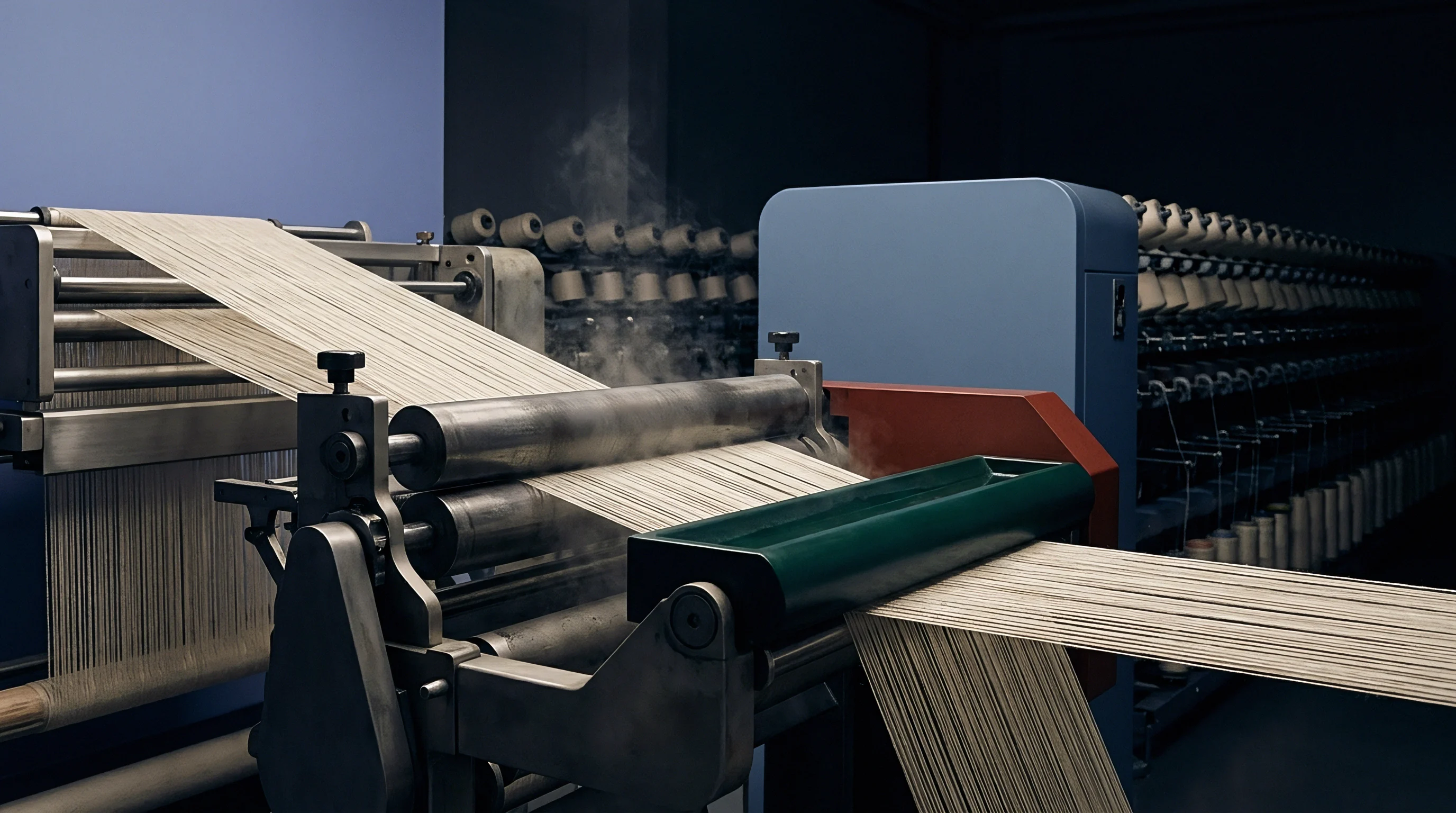
Loom speeds drop sharply when weaving heavy linen Jacquard damask compared to standard cotton or synthetic production. Where modern flexible rapier looms run standard weaves above 600 picks per minute (PPM), heavy linen damask on dual beams limits shed speed to between 280 and 380 PPM. This mechanical speed ceiling stems from the physical mass of the Jacquard harness assembly, high peak tension on heavy flax ends, and the time stiff linen fibers require to settle after shedding before weft insertion begins.
Jacquard shed openings for heavy linen must remain wider than standard settings to give rapier heads clear passage through hairy flax yarns. Moving harness cords, mail eyes, and lingoes over these greater vertical distances creates substantial kinetic energy. Accelerating 12,000 to 18,000 Jacquard harness cords places extreme mechanical stress on the electronic Jacquard head, forcing operators to turn down main drive speeds to keep vibration within safe limits.
| Yarn Count (Lea) | Weave Structure | Maximum Speed (PPM) | Beam Configuration | Standard Efficiency (%) |
|---|---|---|---|---|
| 12 Lea (83 Tex) | 5-Harness Damask / Tabby Ground | 290 | Dual Beam | 68 |
| 18 Lea (55 Tex) | 8-Harness Damask / Twill Ground | 330 | Dual Beam | 72 |
| 25 Lea (40 Tex) | 8-Harness Damask / Satin Ground | 375 | Dual Beam | 76 |
| 35 Lea (28 Tex) | 12-Harness Damask / Satin Ground | 410 | Triple Beam | 78 |

Rapier Insertion Mechanics in Stiff Flax Warps
Weft insertion through heavy linen warps involves high frictional resistance. Wet-spun flax yarns have small surface protrusions that catch on each other during shed crossing. High-speed insertion using rigid or flexible rapiers creates heavy drag against these stiff warp ends.
Lowering insertion velocity reduces thread-on-thread friction, keeping yarn hairiness from balling up into lint slubs that cling to warp ends and cause shed interference breaks.
Dual-beam setups further complicate insertion because the two warp sheets vibrate at different resonance frequencies. Running under higher mechanical tension, the ground warp sheet vibrates faster during beat-up than the lower-tension figure sheet. Loom control systems must match insertion speed to the combined fundamental frequency of both sheets to prevent harmonic flutter at the fell line.
Operating a 12,000-hook electronic Jacquard head above 350 PPM on 18-Lea linen increases harness cord thermal wear rates by 40 percent.
Shedding Dwell Time Requirements
Stiff linen yarns require an extended shed dwell angle so the weft can pass completely without pinching. Standard weaving cycles set shed dwell at roughly 110 degrees of main shaft rotation, but heavy Jacquard damask requires angles expanded to 135 degrees. Expanding the dwell angle compresses the remaining rotation into shorter angular windows, escalating acceleration forces on Jacquard harness hooks and requiring lower machine RPM to protect the mechanism.
Motor torque limits cap machine speed when lifting broad ground areas alongside dense figure patterns. When a pattern change commands a sudden lift of 70 percent of all warp ends, electrical load on the Jacquard drive spikes. Programmed speed curves slow the loom down automatically during these high-lift cycles, introducing variable speed execution across the repeat length.
Heavy flax moving through Jacquard harness eyes at standard speeds accelerates yarn abrasion, making these speed reductions necessary.

Calculus
Commercial pricing for heavy linen Jacquard damask uses surcharges to convert speed drops and multi-beam setup delays into a cost per running metre. Loom capacity sells on time: a loom running at 320 PPM produces far fewer metres per shift than one running at 550 PPM, while consuming equivalent overhead, electricity, labor, and floor space. Surcharge models split these operational costs into three components: speed penalties, multi-beam setup fees, and efficiency drop buffers.
The baseline loom-hour rate reflects the cost of running a wide Jacquard loom equipped with electronic shedding heads, dual let-off motors, and continuous humidification. At a baseline rate of $45.00 per loom hour, standard cotton running at 500 PPM with 85 percent weaving efficiency establishes a specific cost per metre. Calculating the financial penalty for heavy linen damask requires quantifying the lost pick production per hour.
| Cost Vector | Baseline Value | Heavy Damask Value | Variance Factor | Financial Impact ($/m) |
|---|---|---|---|---|
| Loom Speed (PPM) | 520 PPM | 310 PPM | -40.38% | +$2.85 |
| Shed Efficiency (%) | 82% | 70% | -14.63% | +$1.12 |
| Setup & Beam Change | 2.5 Hours | 7.0 Hours | +180.00% | +$0.95 |
| Harness Cord Wear | $0.12/m | $0.42/m | +250.00% | +$0.30 |
| Total Cumulative Damask Surcharge per Metre | +$5.22 | |||

Worked Surcharge Derivation Example
To establish the price per metre for an 18-Lea linen damask with 28 picks per centimetre (71 picks per inch), assume a baseline loom rate of $48.00 per hour on a 360 cm reed width loom. At a reduced speed of 320 PPM and a target shed efficiency of 72 percent, effective loom production drops accordingly.
Effective speed equals 320 multiplied by 0.72, giving 230.4 picks per minute. Total pick output per hour equals 230.4 picks multiplied by 60 minutes, totaling 13,824 picks per hour. Dividing 13,824 picks by 2,800 picks per metre (28 picks/cm 100 cm) yields an output rate of 4.937 metres per loom hour.
Dividing the $48.00 loom-hour rate by 4.937 metres gives a direct operational cost of $9.72 per metre. By comparison, a standard plain weave running at 480 PPM at 82 percent efficiency produces 8.434 metres per hour, coming out to a direct operational cost of $5.69 per metre. That leaves a speed penalty surcharge of $4.03 per linear metre before accounting for multi-beam mounting fees.

Multi-Beam Mounting and Amortization Schedules
Adding a secondary or tertiary warp beam requires auxiliary harness drop systems, secondary let-off gearing, and dedicated mounting brackets. The setup process consumes machine availability, generating an amortized surcharge spread across the production order.
- Primary Beam Alignment requires mounting the main ground warp beam, setting electronic let-off load cells, and checking initial stop-motion drop wire weights.
- Secondary Beam Rack Installation involves positioning the upper beam cradle, connecting the auxiliary servo motor harness, and threading figure ends over elevated guide rollers.
- Jacquard Harness Re-Leasing demands manual alignment of multi-beam thread sheets through dual-tier reed dents to prevent warp crossovers behind the heddle eyes.
- Tension Calibration Protocol executes dynamic pre-tensioning of both warp sheets using independent sensors before engaging automatic motor drives.
When order volumes fall below 1,500 linear metres, the fixed setup cost of dual-beam preparation cannot amortize efficiently, requiring a flat-rate batch surcharge on the invoice.
Orders shorter than 1,000 metres on wide-format Jacquard looms absorb a setup amortization charge exceeding 18 percent of total landed cloth cost.
Production scheduling matrices dictate that multi-beam Jacquard configurations must run continuously for at least 72 loom hours to recover line preparation downtime costs.


Inspection
Quality audits for multi-beam heavy linen damask demand strict inspection procedures focused on tension-induced defects. Inspection frames running at standard speeds miss subtle warp tension variations that manifest as latent defects during industrial washing or finishing. Technical inspectors examine greige rolls under dual-angle grazing illumination to detect tension shadow bands caused by uneven beam decay rates.
Monitoring beam diameter decay throughout the run remains vital. As the secondary figure beam unwinds at a different rate than the ground beam based on pattern density, the effective radius of each beam shifts continuously. Electronic let-off systems calculate torque adjustments using beam diameter sensors; when these sensors drift out of calibration, tension variance spikes across the warp sheet.

Defect Classification under ASTM D5430 Four-Point System
Heavy linen damask flaws originating from speed penalties and tension imbalances carry severe point penalties under the ASTM D5430 inspection standard. Inspectors categorize faults by length and severity to record recurring structural defects caused by machine miscalibration.
- Tight Ground Ends appear as narrow, raised longitudinal ridges across the fabric face, earning 4-point penalties when extending over 230 millimetres in length.
- Slack Figure Floats manifest as loose surface loops where warp ends failed to clear the weft insertion path, resulting in immediate 4-point assignments due to high snagging risk.
- Start-Up Marks occur following loom stoppages when tension relaxes differently across ground and figure beams, leaving light or heavy transverse bands across the cloth width.
- Shedding Shadows present as subtle density gradients in the damask pattern caused by transient speed reductions during high-lift Jacquard pattern cycles.

In-Line Load Cell Verification Procedure
Checking actual thread sheet tensions during loom operation requires physical verification using handheld tensiometers or continuous in-line beam load cell logs.
- Stop the loom during a standard plain ground sequence and allow static tension to equalize across all harness levels for 30 seconds.
- Apply a calibrated digital yarn tensiometer to a bundle of ten adjacent ground warp ends situated between the back-rest roller and the drop wires, recording the millinewton load.
- Repeat the measurement across ten adjacent figure warp ends originating from the upper beam assembly, confirming the tension offset ratio.
- Restart the loom at target production speed and record dynamic tension fluctuations over three complete Jacquard pattern repeat rotations.
- Verify that dynamic tension spikes on the ground warp sheet do not exceed 25 percent of nominal yarn tensile strength.
Dynamic load cell logs reveal whether transient tension spikes stem from mechanical let-off gear backlash or electrical drive acceleration delays.


Clause
Procurement contracts covering heavy linen Jacquard damask must integrate explicit mathematical limits governing speed surcharges and multi-beam operational costs. Vague provisions regarding standard mill surcharges regularly lead to disputes when speed reductions drop loom output below original quotes. Effective contracts specify baseline parameters, setting precise speed caps, beam consumption ratios, and allowed surcharge adjustment bands.
Standardized agreements incorporate ISO 7211 methods to measure weave crimp percentages, binding both parties to verified technical data. By embedding calculated crimp ratios in the contract, buyers prevent artificial inflation of multi-beam surcharges on simplified pattern variations.

Preventing Surcharge Double-Counting in Multi-Beam Contracts
Commercial protection against overlapping fees requires clear separation between baseline loom-hour rates and performance-based speed penalties. Suppliers occasionally attempt to include speed reduction penalties while simultaneously billing for low efficiency percentages, effectively charging twice for lost loom time. A clean contract structure ties all speed-related price shifts to a single baseline efficiency equation.
The contract clause defines maximum permissible speed surcharges using capped percentages tied to yarn count and pick density thresholds. If a buyer’s pattern design demands a speed drop exceeding the agreed cap, the mill provides electronic loom logs demonstrating that mechanical shedding limits require the reduction.
Contract clauses capping speed penalties at 15 percent above standard loom-hour baselines force mills to optimize shedding geometry before penalizing buyers.

Sample Speed Penalty and Beam Ratio Clause Text
Incorporating precise technical terminology into the purchase order establishes clear legal parameters for price adjustments during production runs.
“The unit price per linear metre incorporates a multi-beam weaving surcharge calculated on a baseline production speed of PPM at % shedding efficiency. Should the specified Jacquard design demand a continuous weaving speed reduction below PPM due to warp crimp differential exceeding percent as measured per ISO 7211-3, the seller may apply a verified speed penalty surcharge not to exceed per metre per 10-PPM reduction increment. Any speed adjustment requires submission of electronic loom control logs demonstrating harness motor thermal limits or documented end-break rates exceeding 4.5 breaks per 100,000 picks.
No auxiliary setup fees shall apply to production orders exceeding linear metres per pattern repeat setup.”
This language ties financial exposure for speed penalties directly to audited machine performance logs, eliminating arbitrary supplier surcharges.


Margin
Landed cost calculations for heavy linen damask demand careful management of profit margins against physical yield losses. While reducing loom speed increases direct operational cost per metre, running looms too fast triggers end breaks that create severe fabric defect markdowns. The optimal commercial margin sits at the precise balance point where running speed maximizes hourly dollar yield without crossing into quality-grade downgrades.
When high end-break rates occur due to excessive speed, weaver labor costs surge as operators spend shifts knotting broken flax ends and clearing shed obstructions. A stopped loom generates zero revenue while still incurring floor space allocation costs. Operating at a controlled, lower PPM rate delivers higher overall monthly margins by maintaining consistent 100-percent inspection pass rates.
| Running Speed (PPM) | End Breaks / 10^5 Picks | First-Quality Yield (%) | Direct Production Cost ($/m) | Net Landed Margin (%) |
|---|---|---|---|---|
| 280 PPM | 1.2 | 98.5% | $11.20 | 22.4% |
| 320 PPM | 2.1 | 97.0% | $9.80 | 26.8% |
| 360 PPM | 4.8 | 89.0% | $9.10 | 18.2% |
| 400 PPM | 9.5 | 74.5% | $8.95 | -4.5% |
Yield Loss and Landed Cost Sensitivity
Secondary processing costs elevate the financial impact of weaving defects. Heavy linen Jacquard damask undergoes extensive bleaching, mercerization, and soft-tumble finishing. Defective fabric carrying 4-point tension marks still absorbs full chemical and energy costs during processing, compounding the loss on every second-quality metre.
Sourcing managers account for this multiplier when evaluating supplier speed surcharge quotes.
Accepting a $1.50 per metre speed penalty surcharge to run a loom at 310 PPM instead of 360 PPM frequently yields net cost savings by preserving greige cloth integrity through wet finishing. Premium heavy linen damask relies on pristine surface smoothness across broad satin floats, an aesthetic feature ruined when high shedding speeds create yarn hairiness across stiff flax warps.
Calculating the true margin requires analyzing yarn count selection, beam setup configurations, machine speed caps, and final inspection yield logs as an interconnected operational system.