Hackling Yield and Wet-Spinning End Breakage in Blended Bast Bales
Optimizing hackling pin density and wet-spinning trough temperature stabilizes draft forces, reducing bast yarn end breakage below fifteen breaks per thousand spindle hours.
Strand
Opening bales during industrial bast fibre processing quickly exposes spatial variation in density, moisture regain, and non-cellulosic binder content. High-density pressing of blended flax and hemp creates compressed zones where technical fibre bundles entangle irregularly, directly affecting draft force. Linear density measurements under ISO 1973 show that unhackled bast bundles in commercial bales typically range from 15 to 30 dtex, while individual elementary fibres measure between 1.5 and 3.2 dtex.
How cleanly these bundles separate under mechanical stress depends largely on retting quality; spectrophotometric analysis of enzymatic and water-retted stock shows that residual pectin levels above 4.5 percent by weight prevent clean bundle splitting in early carding and drafting.
Fibre cohesion relies on the structural integrity of the middle lamella, where calcium pectates and hemicellulose hold adjacent elementary fibres together into technical strands. When processing blended lots that pair dew-retted Western European flax with water-retted hemp or ramie, uneven retting introduces serious operational issues. While over-retting weakens the cellulose matrix, under-retting leaves stubborn pectin bridges that resist opening.
As these mismatched fibres move through the opening line, the weaker, over-retted material degrades in length, turning potential long-line yield into low-value short tow.
Moisture in incoming bales varies between 8 percent and 14 percent under standard warehouse conditions. To set official commercial mass, sample lots tested per ISO 6741 require conditioning at 20 degrees Celsius and 65 percent relative humidity. This variable moisture alters surface friction along the fibres.
Dry bast fibres fracture brittely during initial opening, forming micro-cracks along crystalline cell walls, whereas overly damp fibres clump together, feeding unevenly into the hackling machine and overloading the first pin rows.
Unresolved retting differences and moisture gradients across blended bales lead directly to uncontrolled fiber breakage, higher short-fiber counts in the output sliver, and severe drafting force spikes on the spinning frame.

Comb
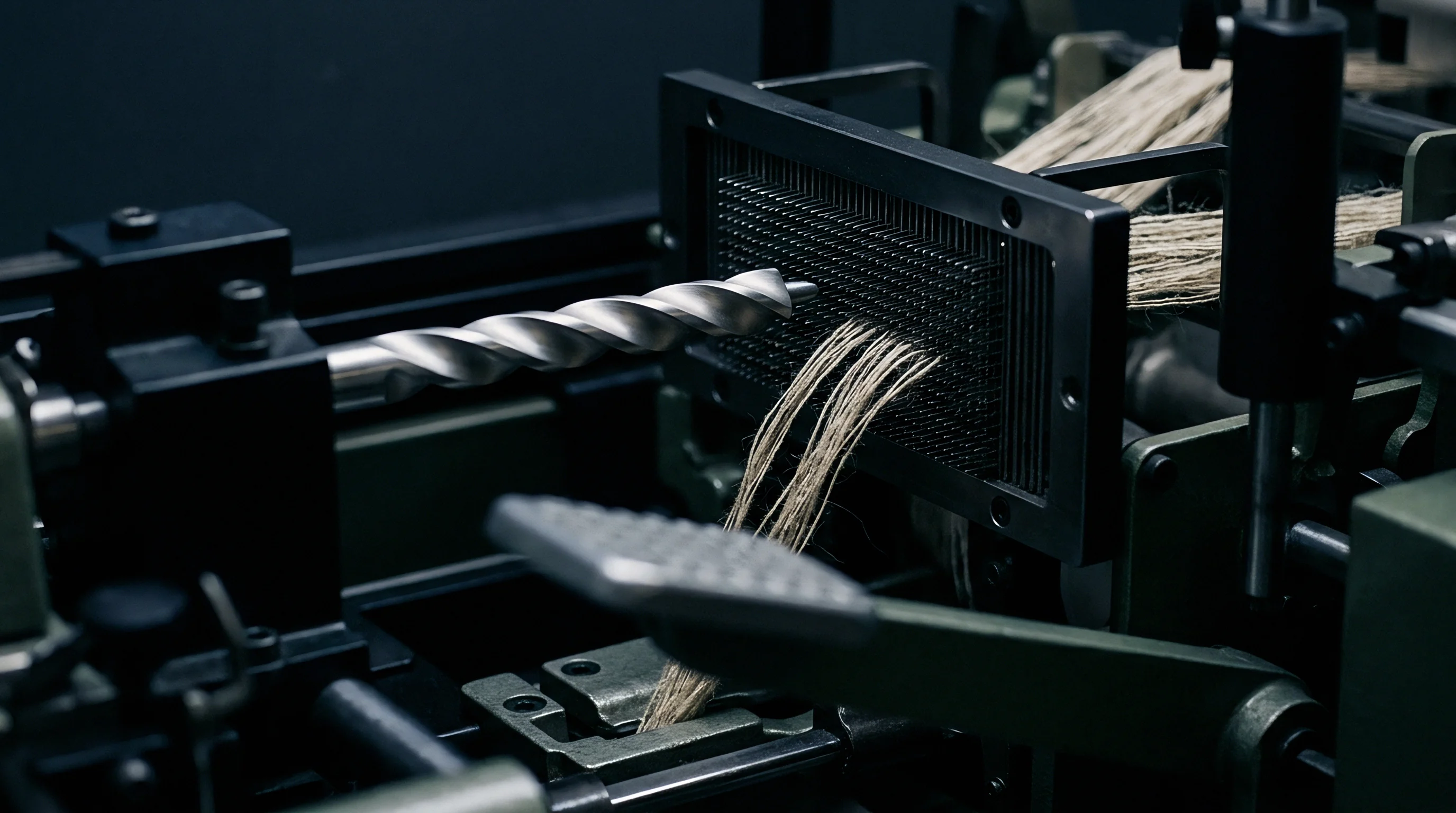
Raw bast bundles are converted into parallelized sliver through progressive pin action on the hackling machine, where settings mark the line between long-line yield and hackling tow. Hackling fields use graduated pin grids ~ ranging from coarse arrangements at 2 pins per linear centimetre to fine finishing grids with 18 pins per linear centimetre ~ to align fibres and shear unretted bundles. As continuous chain transports carry fibre hanks through opposing pin beds, mechanical impacts break weak zones in the pectin sheath, clearing technical fibres of shive remnants and short fragments.
| Pin Density (pins/cm) | Feed Speed (m/min) | Long Line Yield (%) | Hackling Tow (%) | Shive Content (%) |
|---|---|---|---|---|
| 2 to 4 | 12.5 | 78.2 | 16.1 | 1.85 |
| 6 to 8 | 10.0 | 71.4 | 22.8 | 0.72 |
| 10 to 14 | 8.0 | 64.1 | 29.5 | 0.28 |
| 16 to 18 | 6.5 | 58.9 | 34.8 | 0.09 |
| Data normalized for 50/50 dew-retted flax and water-retted hemp blend at 12% moisture regain. | ||||
Slower hackling speeds preserve long fibre integrity when processing coarse bast blends.
Hackling yield measures the percentage of parallelized long-line fibre recovered against raw bale input weight. High-grade long flax can reach yields of 65 percent under optimal conditions, but blended bales with hemp or lower-tier tow stock often yield only between 48 percent and 55 percent. The remaining mass becomes hackling tow, dust, and discarded shive.
To prevent catastrophic end breaks in wet spinning, shive content must fall below 0.3 percent by weight prior to sliver drafting, with the exact separation threshold set by pin geometry, penetration depth, and chain speed.
Fibre length distribution changes noticeably across successive hackling stages. Analyzing output sliver from mismatched initial staple lengths shows a distinct bimodal curve: flax averaging 600 millimetres in raw hanks shortens to stable technical bundles between 250 and 350 millimetres after fine combing, whereas co-processed hemp often fractures into segments between 80 and 150 millimetres because of higher lignin cross-linking. This discrepancy in staple length destabilizes sliver cohesion during drawing.
- Pin Deflection Defect bending or dulling of fine hackling pins caused by unretted thick bast nodes, leading to uncombed fibre clumps in the output sliver.
- Sliver Nepping formation of rolled, entangled fibre balls resulting from excessive linear chain speeds on high-moisture bast stock.
- Transverse Fiber Splitting longitudinal cracking of technical bundles driven by overly aggressive pin penetration depth in low-humidity processing environments.
- Shive Entrapment retention of woody stem fragments within dense fibre hanks caused by insufficient coarse-bed pin action.
Low hackling yields frequently trace to raw bale contamination or irrecoverable weather damage during field retting.
Bath
Roving from hackled bast sliver passes through a hot water trough right before entering the drafting zone of the wet-spinning frame. Temperature and chemical balance in the trough change how residual pectins bind the technical fibres. Bath temperatures maintained between 60 degrees Celsius and 70 degrees Celsius dissolve calcium pectates and soften insoluble protopectins into a viscous fluid, enabling controlled inter-fibre slippage.
Conversely, cold or under-heated trough fluid halts pectin extraction and leaves sheaths rigid, forcing fibres to draft as coarse, unyielding bundles rather than smooth strands.

Where Do Unretted Pectin Bridges Snap during Drafting?
Because drafting zones require uniform speed, unretted pectin bridges fail to soften when immersion time drops below the thermodynamic threshold needed to transfer heat into dense bundle cores. On high-speed frames operating above 25 metres per minute delivery, roving dwell time in the trough drops below two seconds. Under these conditions, hard pectin sheaths force drafting rollers to exert extreme tension on the strand, causing unyielding bridges to snap abruptly in the main draft zone and triggering force spikes that exceed bundle tensile strength.
At a trough temperature of 68 degrees Celsius and pH 6.2, unretted flax-hemp sliver exhibits a 42 percent reduction in drafting force.
| Trough Temp (°C) | Surfactant (g/L) | pH Level | Draft Force (cN) | End Breakage Rate (ends/1000 sp. hr) |
|---|---|---|---|---|
| 40 | 0.0 | 7.0 | 480 | 68.5 |
| 60 | 0.5 | 6.5 | 310 | 24.2 |
| 68 | 1.2 | 6.2 | 215 | 11.8 |
| 80 | 2.0 | 5.5 | 185 | 29.4 |
Chemical additives in the trough water help solubilize pectin without breaking down core cellulose microfibrils. Adding small amounts of non-ionic wetting agents lowers surface tension to speed fluid penetration into dense roving. Keeping bath pH between 6.0 and 6.5 avoids aggressive hydrolysis of structural alpha-cellulose while softening the middle lamella, whereas temperatures above 75 degrees Celsius or overly alkaline conditions degrade polysaccharides too far ~ stripping surface friction and causing slippage, thin spots, and roving collapse.
This balance between thermal dissolution rates and high-speed mechanical draft ultimately sets the limit on throughput speed in modern spinning rooms.

Spindle
Final yarn formation occurs in the spinning zone, where the drafted strand leaves the front delivery rollers and receives twist from the high-speed spindle assembly ~ a stage where any breakage halts ring frame production. Spinning tension combines drafting resistance, balloon tension, and traveler friction against the ring. Delivered yarns are tested under ISO 2062 to establish single-strand breaking force and elongation at break; if drafting force spikes from unsoftened fibre clusters, instant strand tension exceeds the breaking tenacity of the wet assembly, causing an end break.
Adherence to ISO 2062 yarn strength parameters maintains single-strand breaking force above eleven centinewtons per tex across all tested skeins.
Take a wet-spinning frame producing Nm 26 (38.4 tex) yarn from a 60 percent flax and 40 percent hemp roving at a delivery speed of 18 metres per minute, spindle speed of 6,200 revolutions per minute, and a draft ratio of 14.5. This inserts a nominal twist of 344 turns per metre. Under baseline conditions, single-strand tensile strength averages 14.5 cN/tex with a tenacity coefficient of variation of 12 percent.
If coarse bundle inclusions raise local mass variability ~ pushing yarn count CV to 18 percent ~ the lower tail of the strength distribution falls below the operational balloon tension threshold of 4.2 cN/tex. That overlap between peak tension and local weak points drives end breakage up from 12 breaks per 1,000 spindle-hours to 45 breaks per 1,000 spindle-hours.
- Bale core temperature and moisture verification prior to opening.
- Fineness and bundle length distribution testing using optical fiber diameter analysis.
- Hackling pin alignment calibration and mass-yield balancing across comb beds.
- Roving density uniformity checks on drawing frames via capacitive mass sensors.
- Trough temperature and surfactant concentration monitoring during wet drafting.
- Single-strand tensile testing per ISO 2062 to verify breaking force and yarn CV percentage.
Residual shive content above point five percent accelerates drafting roller wear and creates localized stress points in wet roving.
Because sliver weight sets final count and high twist slows drafting flow, matching the roving twist factor to trough dwell time ensures stable draft mechanics without premature strand separation.
Ledger
Commercial performance in bast fibre spinning depends on the net yield converting raw bale purchases into shippable yarn cones. Raw fibre buying costs represent only part of total expenditure; hackling yield losses, tow penalties, combing waste, roving scrap, and spinning downtime heavily drive up the effective cost per kilogram of finished yarn.
| Blend Ratio (Flax/Hemp) | Target Count (Nm) | Hackling Yield (%) | Spinning Waste (%) | Yarn Yield (kg/100kg raw) | Effective Cost ($/kg yarn) |
|---|---|---|---|---|---|
| 100 / 0 (Pure Line) | 39 (25.6 tex) | 64.0 | 3.5 | 61.8 | 12.40 |
| 70 / 30 (Blended) | 26 (38.4 tex) | 58.0 | 5.2 | 55.0 | 9.85 |
| 50 / 50 (Blended) | 18 (55.5 tex) | 52.0 | 7.8 | 48.0 | 8.60 |
| 30 / 70 (Tow Blend) | 12 (83.3 tex) | 45.0 | 10.5 | 40.3 | 7.20 |
Calculating landed fabric cost means tracking fibre yield losses through weaving or knitting efficiency. Running Nm 26 blended yarn with an end breakage rate of 35 breaks per 1,000 spindle-hours adds direct labour costs for piecing, increases bobbin scrap, and requires more yarn splices. Under ISO 2062 testing, spliced zones retain only 75 percent to 85 percent of parent yarn tenacity, leaving weak points that fail during warp preparation and shed opening.
At standard mill margins, every 1 percent increase in spinning frame waste adds roughly 1.8 percent to the net cost per linear metre of woven fabric.
Contracts specify exact parameters for raw bale yield guarantees, maximum permissible shive percentages, and allowable end breakage windows. Before accepting a lot, procurement requires verification of mean staple length, dtex spread, and chemical retting consistency. Standard agreements enforce a 1.5 percent price reduction for every 1.0 percent drop in hackling yield below baseline contract specifications.