Managing Moisture Regain Spread and Hackling Waste Disputes in Cross Border Flax Sourcing
Commercial mass calculations based on ISO 6741 oven-drying protocols protect buyers from paying landed mass prices on sea-transit moisture uptake in flax.


Swell
Cross-border shipments of scutched flax expose raw fibre to microclimates that alter material mass well before hackling. Scutched flax is a hygroscopic bast fibre made of cellulose microfibrils embedded in hemicellulose and pectin. Water vapor enters this composite through sorption, settling into amorphous cellulose regions and hydroxyl binding sites.
Under ISO 6741, commercial contracts set the standard moisture regain threshold at 12.00 percent under laboratory conditions of 20°C and 65 percent relative humidity. In transit, ocean containers pass through humid shipping lanes and ports where ambient relative humidity ranges between 50 percent and 98 percent, shifting bale moisture before unpacking. Flax also exhibits sorption hysteresis: a bale desorbing from saturation retains more moisture than one absorbing water at the exact same relative humidity.
Moisture levels shift constantly during transit, fundamentally altering raw fibre mass.
As dry flax absorbs airborne moisture at sea, individual technical fibres expand unevenly across their cross-sections. Primary cell walls swell outward, altering the density of bales compressed under hydraulic pressure. Bales packed at 10.0 percent moisture regain in European origin warehouses take on ambient vapor over forty days at sea.
Upon arrival at Asian container terminals, outer layers can reach 15.5 percent regain while the core remains at 11.2 percent. This regain gradient complicates initial weighing and sampling, leaving the buyer paying freight and import duties on absorbed water weight. Conversely, when shipped from humid coastal ports into dry inland spinning regions, bales desorb moisture and lose mass between loading and the mill floor.
Relying on unadjusted destination scale weights then causes shortfalls for suppliers who sold stock on physical bill of lading mass.

Micro-Structural Sorption Mechanics
Cell wall geometry controls the rate and depth of water vapor absorption in scutched line flax. Technical flax strands consist of elementary fibres bonded by middle lamellae rich in pectins and hemicelluloses. Pectins act as hydrophilic sinks, drawing in free water rapidly at high relative humidity.
As water penetrates the middle lamella, the adhesive matrix between elementary fibres softens and expands, opening micro-voids along the fibre axis. This intra-fibre moisture lowers the bundle’s initial modulus and increases elongation at break, while longitudinal swelling remains below one percent.
Sorption kinetics follow a non-linear isotherm. Below 30 percent relative humidity, water binds tightly as a monomolecular layer to exposed hydroxyl groups on cellulose chains. Between 30 percent and 70 percent relative humidity, secondary water layers condense inside inter-crystalline pores.
Above 70 percent relative humidity, capillary condensation occurs within larger cellular lumen spaces. Flax stored in humid holds gains mass rapidly through capillary uptake. The resulting increase in fibre cohesion causes strands to stick together.
When damp bales enter the bale breaker, clumping disrupts uniform tuft feeding, and sticky fibres wrap around feed rollers, producing variable sliver weights during carding and dressing.
Scutched flax stored at 85 percent relative humidity gains 3.8 percent mass above commercial regain standards before micro-structural saturation occurs.

Ocean Freight Microclimates and Hysteresis
Containerised sea transit subjects compressed bales to continuous thermal and moisture cycles. Solar heating raises internal container temperatures above 50°C during the day, driving moisture out of outer bale layers into the headspace air. Nighttime cooling drops wall temperatures below the dew point, dripping liquid water back onto top-tier bales.
This condensation creates localized spots where moisture regain exceeds 18.0 percent. Heat combined with excess moisture triggers enzymatic breakdown of middle lamella pectins, weakening fibre bundles prior to mechanical processing.
Hysteresis complicates post-transit moisture reconciliation. A bale reaching 14.0 percent moisture regain by desorbing from a saturated state exhibits different dimensions and mechanical properties than one reaching 14.0 percent regain by absorbing moisture from a dry state. Desorbing fibres retain open pores and higher matrix mobility, whereas absorbing fibres remain compact until forced open by moisture.
Weighing bales without accounting for their prior moisture path introduces systematic errors into landed mass calculations.
| Shipping Route Segment | Ambient Temp (°C) | Ambient RH (%) | Equilibrium Regain (%) | Mass Deviation vs Standard (%) | Primary Test Standard |
|---|---|---|---|---|---|
| Northern Europe Export Terminal | 18 ± 2 | 65 ± 5 | 12.0 | 0.00 | ISO 6741-1 |
| Equatorial Sea Transit (Container) | 48 ± 5 | 92 ± 4 | 16.8 | +4.80 | ISO 139 |
| Destination Port Container Yard | 32 ± 3 | 80 ± 6 | 14.2 | +2.20 | ISO 6741-2 |
| Inland Mill Storage (Unconditioned) | 22 ± 4 | 45 ± 5 | 9.6 | -2.40 | ISO 2370 |

Transit-Induced Quality Degradation Vectors
Physical shifts during cross-border transit introduce specific material failure modes that lead directly to financial claims between buyer and seller:
- Surface Mold Spore Activation occurs when localized moisture regain exceeds 16.5 percent inside sealed containers, fostering fungal growth that discolors outer fibre layers and breaks down pectin bonds.
- Hydraulic Bale Strap Rupture develops as internal fibre swelling exerts outward pressure against steel binding wires, collapsing bale stacks during port discharge.
- Desiccation Embrittlemen manifests when dry container air currents drop outer layer moisture below 7.5 percent, forming micro-cracks along technical fibre nodes that increase fiber fragmentation during mechanical opening.
- Core Moisture Occlusion takes place when vapor gets trapped inside high-density 250-kilogram bales, preventing core regain from equalizing even after seven days of mill warehouse conditioning.
Ignoring transit moisture shifts guarantees disputes over invoice weights, landed yields, and downstream spinning performance. Establishing conditioning baselines immediately upon breaking container seals separates sea-transit moisture shifts from actual fibre mass shortfalls. Accepting unconditioned container weights shifts the financial burden of ocean vapor absorption straight onto the buyer’s balance sheet.

Yield
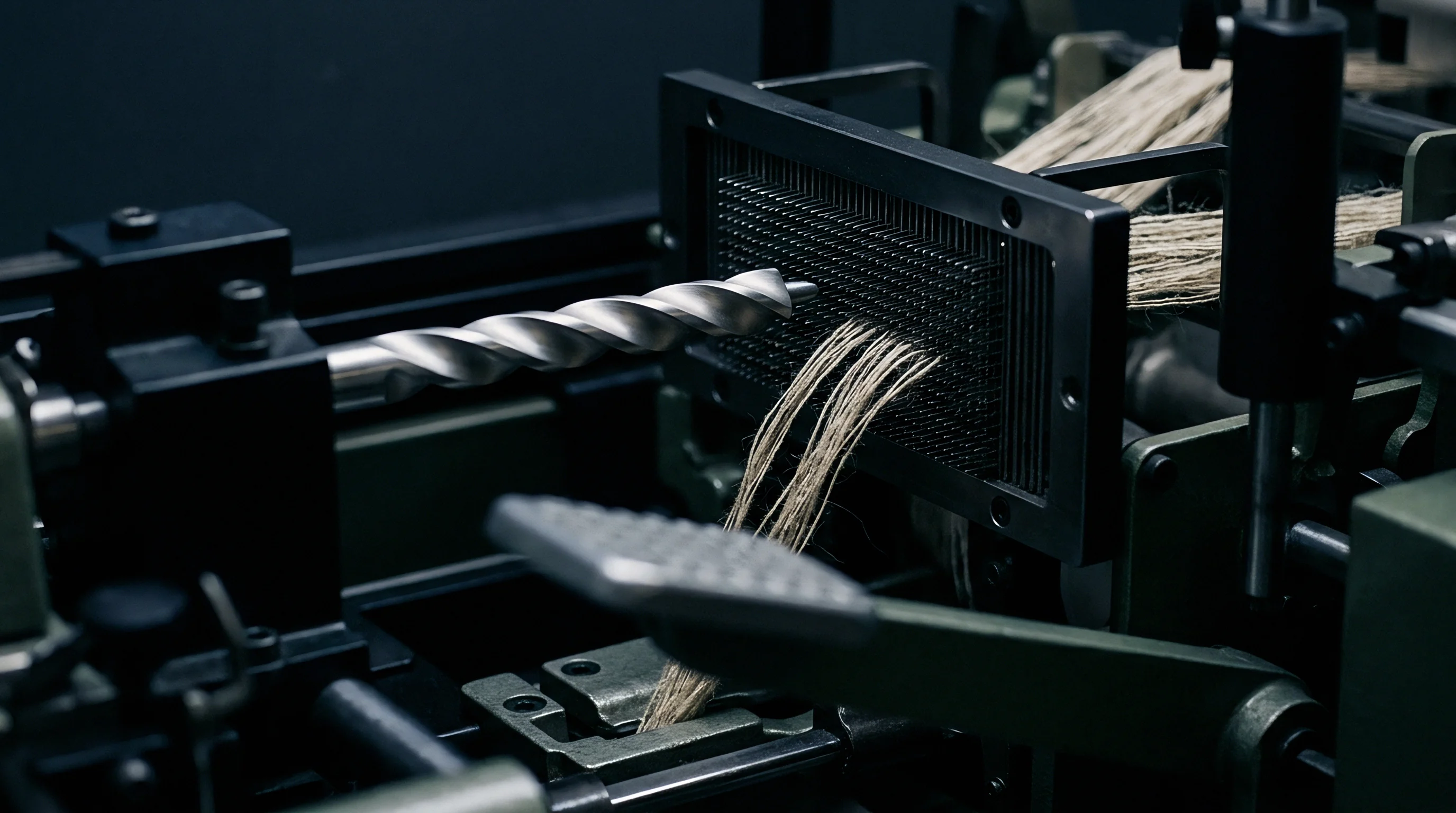
Hackling transforms raw scutched flax into dressed long line fibre while removing short tow, shives, and un-retted outer bark. The machinery uses rotating pins on iron bars to comb out tangled fibers, align technical bundles, and split coarse strands into finer filaments. The proportion of dressed long line fibre recovered from raw scutched flax determines the processing efficiency of the spinning preparation line.
Scutched flax lots yielding 62 percent long line fibre produce noticeably different yarn economics than lots yielding 52 percent long line from the same initial bale mass. Moisture regain variation is the primary mechanical driver of this yield instability.
Dry fibre breaks easily under impact.
Fibre moisture dictates how technical bundles respond when comb pins strike them. When scutched flax enters the hackling machine at moisture regain levels below 10.5 percent, individual filaments become brittle. Advancing comb pins shear long-line strands, converting potential long-staple fibre into short hackling tow.
This premature breakdown reduces long-line yield while increasing low-value tow volume. Conversely, when moisture regain exceeds 13.5 percent, high cohesion causes strands to stick to pin surfaces. Sticky fibres resist splitting, leading to incomplete shive removal, pin loading, and excessive fibre wrapping around stripper bars.
Comb Pin Kinematics and Fiber Partitioning
Hackling subjects scutched flax stricks to progressive combing across graduating tool fields. Coarse pins at the entry separate large entangled bundles, while fine pins at the exit handle delicate splitting down to target metric linear densities. The mechanical efficiency of pin action depends on controlling bundle friction.
Water acts as an internal lubricant within the inter-fibrillar matrix; maintaining moisture regain between 11.5 percent and 12.5 percent allows cellulose microfibrils to slide past one another without fracturing during pin insertion.
Uneven moisture distribution distorts the yield split between long line and hackling tow. Under-retted flax processed under dry conditions suffers heavy bundle rupture: comb pins snap stiff, lignified bast structures, dropping fragments into the tow box. Over-retted flax processed with excess moisture stretches elastically before tearing late, leaving long, uneven tails on hackled stricks.
Both extremes alter the mass balance of the output, triggering commercial disputes over delivered fibre grade.
Under-retted fibre bundles increase hackling comb resistance and transfer long-line potential into low-value tow.
Shive Clearance and Retting Mechanics
Shives are woody core fragments of the flax stem that remain attached to technical fibres after scutching. Effective hackling must strip away these impurities to produce clean sliver suitable for fine yarn spinning. The bond strength between shive and fibre depends on how thoroughly the stock was retted.
Water-retted flax typically shows cleaner shive detachment than dew-retted stock because enzymatic breakdown of the middle lamella is more uniform. Dew-retted flax from variable weather carries persistent shives that force operators to run aggressive combing schedules.
When high shive content forces mill operators to intensify hackling through tighter pin density or higher comb speeds, mechanical waste rises sharply. Denser pin fields generate friction, driving up temperatures inside the hackling chamber. This local heat dries the processing zone, dropping fibre moisture regain by 1.0 to 1.5 percent during combing.
As moisture falls during processing, fibre breakage escalates, converting high-value line flax into low-value waste.
| Scutched Grade Designation | Retting Method | Long Line Yield (%) | Hackling Tow (%) | Shive & Dust Loss (%) | Final Line Fineness (Nm) |
|---|---|---|---|---|---|
| Water-Retted Prime Line | Tank Water | 64.5 ± 1.2 | 29.0 ± 1.0 | 6.5 ± 0.5 | 280 ± 15 |
| Dew-Retted Superior Grade | Field Dew | 58.0 ± 1.5 | 34.5 ± 1.2 | 7.5 ± 0.6 | 220 ± 12 |
| Dew-Retted Standard Grade | Field Dew | 52.5 ± 1.8 | 38.0 ± 1.5 | 9.5 ± 0.8 | 180 ± 10 |
| Dew-Retted Coarse Stock | Under-Retted Dew | 44.0 ± 2.2 | 43.5 ± 1.8 | 12.5 ± 1.0 | 135 ± 8 |

Standard Operational Hackling Waste Audit Sequence
Determining true hackling yield potential requires a standardized physical audit to isolate fibre quality from machine calibration errors:
- Sample ten random bales from the delivered consignment, taking 2.5-kilogram test stricks from the center and outer layers of each bale.
- Condition all test stricks in a climate-controlled laboratory at 20°C and 65 percent relative humidity for 48 hours until mass reaches equilibrium.
- Weigh the conditioned test stricks on a calibrated digital balance to establish baseline mass.
- Pass the conditioned stricks through a standardized test hackling machine operating at fixed pin density profiles and controlled speed settings.
- Collect and weigh dressed long-line stricks, hackling tow, and dropped shive waste separately right after combing is complete.
- Calculate percentage yield ratios against initial conditioned mass to establish contractual compliance.
Suppliers routinely attribute low long-line yields to aggressive mill settings rather than poor raw fibre quality, contending that improper comb pin geometry, elevated room temperatures, or excessive drafting speeds destroy viable long line. Running audited benchmark samples through standard test hackles under verified climate conditions counters these arguments.

Tolling
Financial settlement on cross-border flax shipments relies on converting physical scale weights into commercial invoice mass. Scutched flax is traded per metric ton based on commercial mass rather than raw weight recorded at port scales. Commercial mass balances the dry matter content of the shipment against the standardized commercial moisture regain rate of 12.00 percent.
When arrival moisture strays from agreed specifications, contract adjustment formulas recalculate the payable invoice mass. Omitting or miscalculating these adjustments transfers sub-grade material costs directly onto the buyer.
Invoice settlement depends directly on dry mass.
Determining commercial mass requires establishing the absolute dry mass of representative samples through oven drying under ISO 6741-2 protocols. Laboratory technicians weigh sample specimens, place them in forced-air drying ovens at 105°C until weight stabilizes, and record dry mass. Commercial mass equals dry mass multiplied by 1.12, reflecting the official 12.00 percent moisture regain allowance.
If a 20-ton shipment arrives at 15.00 percent actual moisture regain, paying against raw scale mass instead of calibrated commercial mass results in paying for 522 kilograms of excess water.

How Does Moisture Hysteresis Shift Invoice Weights?
Hysteresis distorts invoice calculations when sellers use absorption-based moisture meters at loading while buyers perform desorption-based oven drying upon mill arrival. High-frequency electrical resistance meters track surface moisture, which varies with ambient temperature. These meters under-report core moisture inside dense bales that absorbed water during transit.
When the buyer opens bales at destination, oven-drying tests reveal higher true regain figures, creating immediate discrepancies between billed mass and received commercial mass.
Sellers often dispute mill oven tests by arguing that samples absorbed ambient moisture during unpacking ~ a conflict that escalates when contracts lack clear arbitration terms. Establishing base commercial mass on joint sampling at the port of entry by independent survey agencies eliminates post-unpacking disputes. Contracts should explicitly specify that joint sampling results override supplier loading certificates.
Contracts governed by ISO 6741 specify commercial mass calculations based on oven-dry weighing, invalidating ambient weight claims at port of entry.

Hackling Waste Allowance Mechanics
Hackling waste disputes center on financial penalties tied to long-line yield shortfalls. Contracts typically specify a baseline long-line yield ~ such as 58 percent ~ with a sliding price adjustment for every percentage point deviation. If a delivered lot yields only 53 percent long line, the buyer’s raw material cost per kilogram of dressed sliver rises.
The financial formula must adjust the landed price per ton downward to compensate for both missing long-line volume and the lower market value of excess tow generated during hackling.
Tow commands a significantly lower price than line fibre. A five percent shift from long line to hackling tow reduces the financial yield of a raw fibre lot. Without explicit sliding-scale waste clauses, buyers are left negotiating discretionary claims with foreign suppliers long after material processing begins.
Structuring automatic price correction matrices around standardized hackling tests protects operating margins against raw grade variation.
| Billed Gross Mass (MT) | Billed Regain (%) | Arrival Regain (%) | Oven-Dry Mass (MT) | Calculated Commercial Mass (MT) | Financial Adjustment (USD) |
|---|---|---|---|---|---|
| 22.50 | 12.00 | 12.10 | 20.07 | 22.48 | -$90.00 |
| 22.50 | 12.00 | 14.50 | 19.65 | 22.01 | -$2,205.00 |
| 22.50 | 12.00 | 16.20 | 19.36 | 21.68 | -$3,690.00 |
| 22.50 | 12.00 | 9.80 | 20.49 | 22.95 | +$2,025.00 |

Worked Calculation of Invoice Weight Adjustment
Consider a cross-border purchase order for 100 metric tons of dew-retted line flax contracted at 4,500 USD per metric ton, based on standard 12.00 percent commercial regain. On arrival at the destination port, joint sampling shows an average moisture regain of 14.80 percent across the shipment, while scale weights record 102.50 metric tons gross mass due to absorbed transit water.
First, calculate total oven-dry mass from the gross physical mass:
Oven Dry Mass = Gross Physical Mass / (1 + Arrival Regain / 100)
Oven Dry Mass = 102.50 / (1 + 0.1480) = 89.2857 metric tons.
Second, calculate the true commercial mass based on the 12.00 percent standard commercial regain factor:
Commercial Mass = Oven Dry Mass (1 + 0.1200)
Commercial Mass = 89.2857 × 1.12 = 100.0000 metric tons.
Although port scales registered 102.50 metric tons, the actual commercial mass equals exactly 100.00 metric tons. Invoicing on raw scale weight at 102.50 metric tons yields a bill of 461,250 USD. Restricting payment strictly to calculated commercial mass caps the invoice at 450,000 USD, preventing an overpayment of 11,250 USD for water absorbed during ocean transport.
Commercial Verification Protocol Checklist
Mitigating financial losses on cross-border flax purchases requires enforcing specific commercial verification controls prior to invoice settlement:
- Gross Mass Verification requires weighing containers on certified weighbridges immediately upon discharge at the destination port, deducting container tare weights verified against ISO data plates.
- Core Moisture Sampling mandates extracting core-boring specimens from at least 10 percent of delivered bales per container, using sealed specimen jars to prevent ambient vapor loss before oven testing.
- Oven-Drying Arbitration requires gravimetric dry-mass determination per ISO 6741-2 at 105°C until consecutive weighings 15 minutes apart show less than 0.05 percent mass change.
- Commercial Invoice Recalculation mandates adjusting landed billing amounts against true commercial mass figures before opening letters of credit or executing final telegraphic transfers.
Executing moisture reconciliation calculations on every incoming shipment prior to approving payment documentation ensures compliance. Under standard international flax trading terms, commercial mass calculated from oven-dry testing governs final payment amounts, superseding bill-of-lading weights recorded at the port of origin.


Trough
Hackled long-line flax moves from preparation frames to wet-spinning rooms, where sliver undergoes drafting in hot water troughs prior to twist insertion. Wet spinning softens residual pectins within hackled fibre bundles, enabling smooth drawing down to fine yarn counts like Nm 39 or Nm 50. Water trough temperature, immersion duration, and sliver moisture content govern drafting resistance at the spinning frame.
Variations in hackling yield and moisture regain travel directly into the spinning trough, disrupting drafting mechanics and compromising yarn quality.
Excess water alters trough dynamics and directly impacts final product value.
Sliver entering the roving process with uneven moisture causes variable twist insertion on the roving frame. Dry spots along the sliver absorb higher local twist, forming hard roving segments that resist drafting in the wet-spinning trough. Moist spots accept less twist, creating weak sections that draft prematurely and generate thick and thin yarn defects.
When roving enters the wet-spinning trough at 60°C to 70°C, unevenly twisted roving absorbs water inconsistently. Hard-twisted segments fail to soften fully during their two-second passage through the trough, causing roller slip, high end-breakage rates, and elevated Uster CV percentage values.

Drafting Zone Hydro-Mechanics
The wet-spinning trough softens intercellular pectins so elementary fibres within hackled bundles can slide past one another under drawing roller tension. Hot water relaxes hydrogen bonds holding hemicellulose chains together. As roving travels through submerged guide paths, water temperature must stay within 65°C ± 2°C for uniform pectin plasticization.
If water temperature drops below 58°C, pectin softening remains incomplete, pushing up drafting force and causing draft waves that degrade yarn evenness.
Initial fibre moisture alters trough heating dynamics. Dry roving entering the trough absorbs water aggressively, cooling the water boundary layer surrounding the fibre bundle and delaying heat penetration into the strand core. Damp roving carries pre-hydrated cell walls that heat rapidly, enabling prompt drafting.
Mixing dry and damp bobbins on the same spinning frame creates spindle-to-spindle count variations, forcing operators to run frames below maximum operating speeds.
Fluctuations in sliver regain alter drafting resistance in the spinning trough and degrade yarn linear density uniformity.

Yarn Quality Impacts and Spinning Floor Loss
Inconsistent hackling yields harm wet-spinning efficiency. When hackling fails to clear short tow and shives, residual shives enter the roving strand. During wet drafting, rigid shives pass between nip rollers and disrupt fibre alignment.
A shive passing through the drafting zone triggers local tension spikes, snapping adjacent filaments and causing end breaks. This forces operators to tie splices or run automatic piecers, inflating labor costs and introducing defects that appear as slubs in woven cloth.
Excessive short tow in hackled sliver alters the fibre length distribution curve. Fine wet spinning requires high mean fibre length and low short fibre content. Short fibres cannot bridge the gap between drafting rollers, floating uncontrolled in the drafting zone to form clumps, yarn neps, and uneven linear density profiles.
Mills forced to process poorly hackled flax see end-breakage rates exceed 80 breaks per 1,000 spindle-hours, converting profitable spinning runs into net financial losses.
Adjusting wet-spinning trough chemistry provides minimal compensation for major variations in hackling yield.

Redress
Resolving disputes over moisture regain spread, hackling waste shortfalls, and poor spinning performance requires structured contracts and rigorous claim protocols. Cross-border flax supply chains span multiple jurisdictions where informal agreements crumble upon material failure. Master purchase contracts must incorporate explicit technical specifications, sampling standards, and dispute resolution mechanisms to eliminate ambiguity when physical shipments deviate from laboratory offer sheets.
Full conditioning requires time, and unrecovered tow degrades total lot value.
Contracts must establish clear tolerance bands for moisture regain, long-line hackling yield, shive content, and metric fibre fineness. A standard purchase agreement might permit moisture regain between 11.0 percent and 13.0 percent without price penalty. Regain between 13.1 percent and 15.0 percent triggers automatic commercial mass invoice recalculation, while values above 15.0 percent grant the buyer the contractual right to reject the shipment or demand supplier-funded re-conditioning.
Defining explicit operational boundaries stops minor material variations from escalating into lengthy legal disputes.
ISO Sampling Protocols and Binding Arbitration
Dispute resolution depends entirely on sampling integrity. Sampling conducted unilaterally by mill personnel after bales enter local warehouse storage carries no weight in international commercial arbitration. Contracts must reference ISO 2370 for fibre fineness and ISO 6741 for commercial mass verification.
Sampling must take place at the port of discharge or container unsealing station under the direct supervision of an accredited independent inspection agency like SGS or Control Union.
The joint inspection protocol selects a representative sample size based on the square root of the total container bale count. Inspectors extract core samples from top, middle, and bottom bale layers using sealed pneumatic coring tubes, splitting each sample into three identical parts: one for buyer laboratory testing, one for seller verification, and one sealed reserve kept by the independent surveyor for binding arbitration. If buyer and seller tests differ by more than 0.5 percent moisture regain or 1.5 percent hackling yield, the sealed reserve sample is submitted to an agreed referee laboratory whose findings are final and binding on both parties.

Dispute Dossier Assembly Requirements
Recovering costs on sub-standard flax shipments requires assembling a comprehensive technical dossier within contractually mandated notification windows:
- Independent Inspection Certificates providing verified scale weights, container seal numbers, and core-boring sample collection logs signed by certified surveyor personnel.
- Oven-Drying Laboratory Reports detailing gravimetric moisture determination procedures, tare weights, dry mass figures, and commercial mass calculations executed under ISO 6741-2.
- Standardized Hackling Test Logs documenting long-line yield, hackling tow mass, shive percentage, and comb pin settings from audited test frame runs.
- Spinning Floor Impact Metrics tracking end-breakage rates per 1,000 spindle-hours, Uster CV percentage curves, and yarn linear density deviations recorded during trial runs.
Submitting incomplete claim dossiers allows suppliers to attribute quality disputes to internal mill operational failures. Enforcing strict joint sampling timelines and standard test methods ensures raw material shortfalls lead to prompt financial restitution rather than uncompensated production losses. Thorough technical documentation paired with explicit contract language protects buyer capital across cross-border bast fibre supply chains.
Systematic verification protects operating margins whenever transit moisture shifts raw mass.