Flax Fibre Fineness Determination and Bundle Tenacity Correlations
Flax technical bundle fineness dictates maximum spinnable yarn count while 3.2 millimetre gauge tenacity governs wet-spinning end breaks and hackling yield economics.


Gauge
Flax grading starts at the bundle. Determining technical fibre fineness requires separating structural aggregate dimensions from individual elementary fibre characteristics. Elementary flax fibres exhibit diameters between 10 and 20 micrometres, but scutching and hackling machinery process technical bundles composed of multiple elementary cells bonded by middle lamellae.
Direct optical diameter measurements often yield inaccurate fineness assessments because technical bundles display non-circular, irregular cross-sections. Industry practice relies on linear density expressed in tex or decitex, alongside indirect pneumatic resistance measurements to quantify fineness across commercial lots.
Air-flow determination operates under the principle that a packed bed of fine fibres presents higher resistance to fluid flow than a bed of coarse fibres of equal mass. Standardized test procedures, such as ISO 2370, utilize compressed air drawn through a pre-weighed plug of raw or hackled flax line. The resulting pressure drop correlates directly with the specific surface area of the bundle assembly.
Higher specific surface area indicates finer technical bundles. The method provides rapid feedback on the hackling room floor, although variations in fibre cross-sectional ellipticity and residual shive content can distort the pressure differential.
Air-flow fineness determinations conducted on water-retted flax line fibre at 65 percent relative humidity yield a linear density reading between 1.8 and 2.4 tex per bundle unit.
Gravimetric linear density determination serves as the definitive calibration reference when pneumatic meters encounter variable fiber density. Technicians cut straightened, combed bundle groups to a precise length and measure their dry mass on analytical balances. Calculating linear density from fixed-length cuts establishes true mass per unit length, bypassing geometric assumptions inherent in optical and airflow devices.
- Extract representative fibre slivers from five distinct points within the unbaled lot core.
- Comb the technical bundle sample manually through a steel pins bench hackle to remove loose shive and short tow elements.
- Condition the straightened fibre assemblies for twenty-four hours inside a climate-controlled atmosphere maintained at twenty degrees Celsius and sixty-five percent relative humidity.
- Cut the central bundle segment to a precise length of fifty millimetres using a dual-blade precision cutter block.
- Weigh the trimmed specimen on an analytical balance reading to an accuracy of zero point zero one milligrams.
Linear density dictates limit count. Fine bundles contain a greater number of individual elements in any cross-section of draft sliver at a given yarn count. This structural density increases inter-fibre contact area during drafting, stabilizing the strand before twist insertion.
Coarse bundles with elevated linear density values yield fewer elements per sliver cross-section, causing drafting waves, localized strand thinning, and sudden frame stoppages.
It remains unclear whether modern optical diameter analysis systems can isolate pectin bridge thickness from true wall thickness in high-speed commercial delivery streams.
Clamp
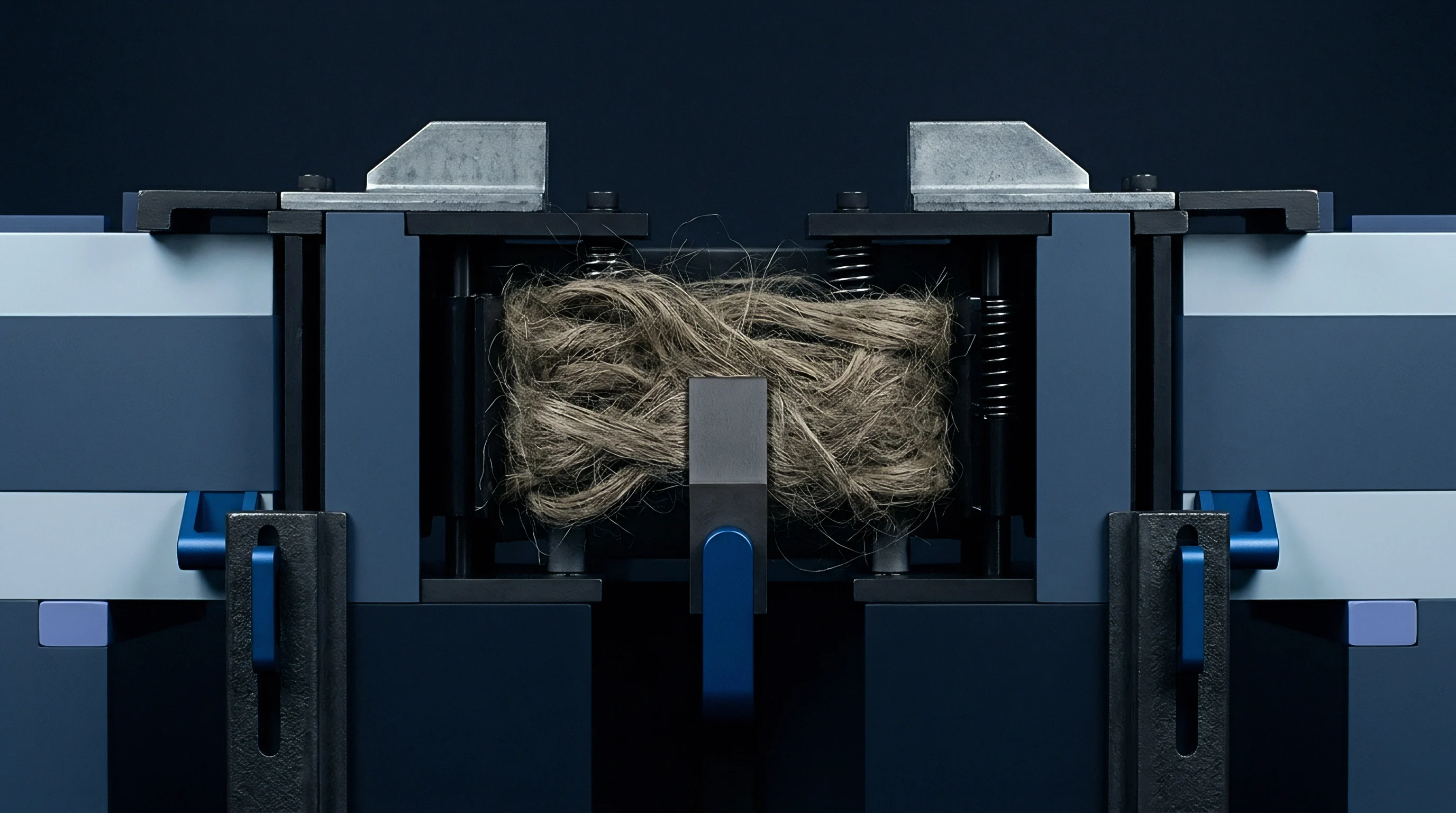
Testing mechanical strength in bast fibre structures demands precise separation between intrinsic cellulose wall strength and intercellular adhesive strength. Bundle tenacity determination utilizes specialized flat-clamp jaw assemblies mounted on Stelometer or Pressley tensile testers, modified from cotton testing procedures to accommodate longer flax strands. Standard specimen preparation requires mounting combed, aligned bundle ribbons between heavy brass clamps tightened under calibrated torque wrenches to prevent fibre slippage during loading.
Gauge length selection fundamentally alters the failure mode observed during tensile loading. Zero gauge testing places clamping jaws in direct contact, forcing immediate fracture across individual elementary fibre walls. This configuration measures maximum ultimate tensile strength derived from crystalline microfibrillar cellulose structures.
Zero gauge measures cellulose strength. In contrast, setting clamp spacing to 3.2 millimetres or 10 millimetres introduces an inter-fibre shear component into the loading force profile.
Zero-gauge bundle testing reflects true cellulose crystalline integrity, whereas extended gauge lengths evaluate the shear strength of the intercellular pectin matrix.
At extended gauge lengths, stress transfers across the middle lamella through viscous pectin and hemicellulose networks holding elementary fibres inside the technical bundle. Under-retted fibres containing thick, rigid pectin layers display high shear resistance under low strain, but fail prematurely due to stress concentration around stiff bundle junctures. Over-retted fibres with degraded middle lamellae allow elementary cells to slip past each other at low force thresholds, resulting in depressed bundle tenacity values despite perfect internal cellulose wall integrity.
| Retting Process | Linear Density (tex) | Zero-Gauge Tenacity (cN/tex) | 3.2 mm Gauge Tenacity (cN/tex) | Pectin Content (%) | Maximum Spinnable Count (Nm) |
|---|---|---|---|---|---|
| Water Retted Line | 1.85 | 62.4 | 44.1 | 1.8 | 80 |
| Dew Retted Line | 2.40 | 55.2 | 36.8 | 2.4 | 60 |
| Enzyme Retted Line | 1.95 | 58.0 | 40.5 | 2.1 | 70 |
| Green / Unretted Line | 4.20 | 64.0 | 28.3 | 5.6 | 26 |
| Dew Retted Tow | 3.80 | 48.1 | 26.5 | 2.8 | 30 |
| Data measured at 20 degrees Celsius and 65 percent relative humidity following ISO 6741 conditioning protocols. Tenacity determined via Stelometer tensile tester using 11.8 kg load cell. | |||||
Clamp spacing changes test failure modes. The ratio between 3.2 millimetre tenacity and zero-gauge tenacity serves as a direct indicator of retting quality and structural bundle homogeneity. High tenacity ratios signify uniform load distribution across fine technical strands without premature shear failure of the intercellular cement.
Low ratios signal either incomplete retting with localized stress risers or over-retting characterized by severe middle lamella dissolution.
High bundle tenacity measured at extended clamp distances guarantees superior drafting cohesion during wet spinning operations.


Swell
Fibre cross-sectional dimensions alter dynamically when exposed to liquid media during processing. Pectin binds elementary fibres together. Water absorption forces non-cellulosic middle lamellae components to hydrate, changing bundle density, inter-fibre friction, and drafting resistance.
Finer technical bundles display higher specific surface area, allowing more rapid liquid penetration in the hot water spinning trough. This accelerated hydration softens remaining pectins, enabling smooth inter-fibre sliding during high-draft attenuation.
Can Intercellular Pectin Integrity Predict Spinning Breakage?
Pectin retention directly governs the correlation between measured bundle fineness and high-speed spinning performance. Consider a 20-tonne shipment of dew-retted long flax line exhibiting an initial bundle linear density of 2.2 tex and a 3.2 millimetre gauge tenacity of 38 cN/tex. Chemical analysis reveals a residual pectin content of 2.2 percent by weight.
During wet spinning into an Nm 50 yarn, hot water troughs held at 65 degrees Celsius soften this pectin layer, lowering effective bundle shear strength while reducing bundle linear density to 1.4 tex through thermal-mechanical division at the drafting zone.
When residual pectin drops below 1.2 percent due to over-retting, hot trough immersion dissolves the middle lamella completely before twist application. The sliver loses structural integrity under the draft rollers, inducing high end-breakage rates. Conversely, if pectin content exceeds 3.5 percent from under-retting, the bundle resists thermal softening in the trough.
The intact bundle arrives at the drafting nip with an effective linear density of 3.2 tex. The drafting rollers crush the rigid bundle, generating severe thickness variations along the yarn axis and forcing high frame end-breakage.
Finer technical bundles distribute drafting tension across a broader inter-fibre contact surface, minimizing localized stress spikes in wet-spinning troughs.
Correlating fineness determination with bundle tenacity demands evaluating the specific tenacity per unit mass across varying bundle diameters. Fine technical bundles exhibit higher 3.2 millimetre gauge tenacity than coarse bundles from the same crop lot. Finer assemblies contain fewer internal voids and lower structural eccentricity, distributing applied tensile stress evenly across all constituent elementary cell walls.
- Elementary fibre pullout occurs when the intercellular pectin layer degrades beyond the threshold required to anchor adjacent cellulose walls under drafting tension.
- Transverse structural splitting manifests when mechanical hackling fractures the outer secondary walls of under-retted technical bundles without reducing bundle thickness.
- Localized stress concentration develops where non-cellulosic shive remnants remain bound to the technical fiber bundle, creating rigid flexural failure points.
- Premature slippage breakdown appears in over-retted stock where low calcium pectate concentrations allow elementary fibers to drift apart prior to twist insertion.
Microfibrillar angle variations within the secondary cell wall modulate ultimate elementary fibre tenacity. Cellulose microfibrils oriented parallel to the long fibre axis yield high tensile moduli and low extension at break. Higher microfibrillar angles increase elongation capacity while lowering overall bundle tenacity.
Fine bundles with low microfibrillar angles deliver superior tensile efficiency, converting individual fibre strength into bundle cohesion with minimal structural loss.
| Spinning System | Target Yarn Count (Nm) | Required Bundle Tenacity (cN/tex) | Max Fibre Bundle Tex | Trough Temp (deg C) | Drafting Waste (%) |
|---|---|---|---|---|---|
| Wet Spun High Count | 70 – 100 | 42.0 – 48.0 | 1.50 – 1.80 | 70 | 3.2 |
| Wet Spun Medium Count | 36 – 60 | 35.0 – 41.0 | 1.85 – 2.30 | 60 | 4.5 |
| Dry Spun Tow Coarse | 10 – 24 | 26.0 – 32.0 | 3.10 – 4.20 | Ambient | 7.8 |
| Sliver Blended Cottonised | 18 – 40 | 22.0 – 28.0 | 2.20 – 2.80 | Ambient | 11.2 |
Mismatching bundle fineness with draft zone nip distances breaks continuous sliver flow, generating persistent thick-and-thin defects that force mill shutdowns and double rewinding losses.

Margin
Commercial valuation models for raw flax line tie offer prices directly to hackling yield and spinnable count capacity. Coarse, heavy fibre bundles require intensive pin combing inside hackling machines to reach spinnable fineness. Intensive hackling splits coarse bundles mechanically, but converts valuable long line fibre into lower-value tow scrap.
Hackling waste destroys mill profit. Every unit increase in initial bundle tex increases hackling tow production by up to three percent by weight, shifting raw material yield from high-margin long line into discounted tow categories.
Achieving an Nm 60 wet-spun yarn without excessive end breaks requires a line fibre bundle tenacity exceeding thirty-eight centinewtons per tex at a three point two millimetre gauge.
Fibre tenacity governs yarn strength. Spinning mills calculate landed yarn margins by balancing raw fibre procurement cost against yarn break rates and mill efficiency figures. Purchasing fine line fibre with high 3.2 millimetre gauge tenacity allows spinners to operate wet-spinning frames at maximum speed with minimal end breaks per hundred spindle-hours.
High frame productivity offsets higher raw material input costs per kilogram, dropping total manufacturing expense per finished metre of woven cloth.
| Fibre Grade Designation | Landed Price (EUR/kg) | Hackling Yield (%) | Spinnable Limit (Nm) | Frame End Breaks (per 100 sp-hr) | Fabric Cost (EUR/m at 150gsm) |
|---|---|---|---|---|---|
| Water Retted Prime Line | 5.20 | 72.5 | 80 | 12 | 2.15 |
| Dew Retted Standard Line | 3.85 | 64.0 | 50 | 28 | 2.42 |
| Dew Retted Coarse Line | 2.90 | 52.0 | 30 | 54 | 2.88 |
| Dressed Hackled Tow | 1.80 | 88.0 | 20 | 42 | 1.95 |
Calculating finished fabric economics exposes the cost penalties associated with substandard bundle tenacity. A standard 150 gram per square metre plain weave linen cloth requires Nm 39 wet-spun warp yarn. Utilizing standard line fibre at 3.85 Euros per kilogram with 64 percent hackling yield produces yarn at an operational cost including frame stoppage downtime.
Switching to coarse line fibre priced at 2.90 Euros per kilogram reduces initial raw material outlay, but drops hackling yield to 52 percent while frame end-breakage increases to 54 breaks per hundred spindle-hours. Net woven fabric cost rises by 0.46 Euros per linear metre due to wasted fibre mass and lost loom efficiency.
Overseas merchants frequently maintain that excessive hackling waste stems entirely from improper mill humidity rather than substandard initial bundle tenacity.

Receipt
Preventing financial losses from variable fibre shipments demands rigorous incoming acceptance protocols based on objective bundle measurements. Purchase contracts must bind quality specifications directly to standard laboratory test methods, defining clear tolerance limits for both linear density and bundle tenacity values. Raw bale inspection requires representative sampling plans according to ISO 6741, ensuring moisture content corrections match standard commercial regain allowances before invoices are cleared.
- Linear density verification requires dual testing via gravimetric cut-and-weigh and standardized air-flow resistance to eliminate core density discrepancies.
- Gauge length ratio determination demands evaluating the quotient between zero-gauge and three point two millimetre tenacity to confirm retting quality.
- Hackling loss benchmarking mandates running a five-kilogram pilot lot through a laboratory pin comb before approving full shipment drawdown.
- Moisture content adjustment compels calculating landed invoice weights against dry mass corrected for standard commercial regain percentages.
Standard regain is twelve percent. Wet spinning dissolving remaining pectins alters yarn density and finished fabric drape. Sourcing contracts that incorporate explicit fineness and tenacity limits eliminate subjective grading disputes between mill buyers and fibre merchants.
Specifying a minimum 3.2 millimetre gauge bundle tenacity of 36 cN/tex alongside a maximum linear density of 2.2 tex provides legal protection against substandard retting lots. Lot variance increases end breaks.
Including an explicit 3.2 mm gauge tenacity threshold in the purchase specification shifts financial liability for hackling scrap back to the primary fiber seller.
Contractual language specifying ISO 2370 fineness compliance with a two percent maximum variance clause forces the seller to replace substandard lots at their own expense before spinning frames are loaded.