Moisture Regain Correction Calculations for Gravimetric Flax Fineness Testing
Gravimetric flax fineness testing requires correcting bone dry bundle mass to 12% standard regain to prevent count errors and landed cost distortions

Oven
Accurate measurement of linear density in scutched long flax and hackled sliver requires driving off unbound moisture to determine absolute dry mass. Standard gravimetric methods weigh a cut bundle before and after thermal drying, converting mass per unit length into millitex or metric count. Flax fiber bundles hold hygroscopic water within amorphous cellulose regions and non-cellulosic encrustants; uncorrected moisture systematically inflates measured fiber density, distorting downstream spinning calculations and raw material valuations.
The protocol requires isolating parallel filaments, cutting the bundle to a set length, and tracking mass loss under controlled heating. Atmospheric humidity alters the apparent weight of exposed flax within minutes. A reliable baseline therefore depends on tight control over drying temperatures, verified vessel tare weights, and swift transfers to the balance.
Thermal Desiccation Parameters for Cut Bundles
Standard gravimetric procedures specify a continuous continuous 105 degrees Celsius in forced-air ventilated chambers. Temperatures above 107 degrees Celsius degrade residual pectins and hemicelluloses, releasing chemically bound hydroxyl groups that distort dry mass readings. Staying below 103 degrees Celsius leaves moisture trapped inside the dense bast elementary fiber bundles.
Chamber airflow needs to maintain four to six volume replacements per minute so vapor does not accumulate around specimen containers.
Specimens remain in the chamber until reaching mass constancy ~ less than 0.05 percent variation between two weighings taken twenty minutes apart. Fine hackled line flax bundles weighing 100 milligrams to 500 milligrams typically stabilize within ninety minutes at 105 degrees Celsius. Coarser tow fibers with embedded shive particles can require up to one hundred eighty minutes as moisture migrates more slowly through hydrophobic shive cell walls.
| Fibre Grade | Preparation Method | Target Cut Length (mm) | Drying Temperature (°C) | Exposure Duration (min) | Dry Mass Target (mg) |
|---|---|---|---|---|---|
| Hackled Line Flax | Comb parallelized bundle | 10.0 | 105 ± 2 | 90 | 150 to 250 |
| Scutched Long Flax | Hand aligned carded sliver | 10.0 | 105 ± 2 | 120 | 200 to 300 |
| Combed Tow | Guillotine cut sliver | 5.0 | 105 ± 2 | 150 | 300 to 500 |
| Carded Card Tow | Randomized web section | 5.0 | 105 ± 2 | 180 | 400 to 600 |

Specimen Cutting and Mass Determination
Preparing test samples under ISO 2370 requires sharp razor arrays to yield clean, uniform ten-millimeter fiber segments. Cuts must be square without stretching individual filaments, which creates localized necking and alters the mass-to-length ratio across the sample. Standard cutters use parallel tungsten carbide blades spaced exactly ten millimeters apart and clamped to a uniform mechanical torque.
Upon removal from the desiccator, specimen bundles require immediate transfer into airtight weighing vessels. At fifty percent relative humidity, warm fiber absorbs moisture from ambient air at rates exceeding 0.02 percent mass gain per minute. Metal weighing tins with ground-glass stoppers protect samples during transfer to analytical balance pans, while handling components without gloves transfers skin oils that disrupt milligram-scale readings.
A continuously operated heating chamber with verified ventilation maintains stable drying conditions across sequential batch runs.

Moisture
Flax fibers are inherently hygro-reactive due to the hydrophilic polysaccharide chains in their structure. Cellulosic microfibrils contain abundant hydroxyl groups that readily form hydrogen bonds with atmospheric water vapor, causing total moisture content to shift continuously with ambient humidity and temperature.
Since gravimetric fineness testing determines mass over a fixed filament length, uncorrected moisture directly inflates measured linear density. Failing to adjust for water weight causes fine filaments to be misclassified as coarse strands, altering downstream valuation and landed weights.
Sorption Hysteresis in Bast Fibres
Equilibrium moisture content depends on whether a fiber strand approaches equilibrium from a wet or dry state. Desorption curves sit higher than adsorption curves across all humidity levels; a sample drying down from eighty percent relative humidity retains more water at sixty-five percent relative humidity than an identical sample conditioned upward from twenty percent. Under standard laboratory conditions, this equilibrium mass split reaches up to 1.5 percent regain.
This hysteresis reflects structural shifts in amorphous cellulose regions during wetting and drying. As moisture leaves the matrix, adjacent cellulose chains draw together and form inter-chain hydrogen bonds. When dry fiber reabsorbs water, these bonds resist breaking, leaving fewer open hydroxyl sites for initial sorption.
Reliable gravimetric fineness testing requires pre-conditioning protocols that ensure all samples enter testing along the adsorption path.
Flax fibers conditioned along the desorption path retain approximately 1.2 percent higher moisture regain than fibers conditioned along the adsorption path at 20 degrees Celsius and 65 percent relative humidity.

Non-Cellulosic Constituents and Water Retention
Lignin, hemicellulose, and pectic substances in the middle lamella absorb water faster than the crystalline alpha-cellulose core. Raw scutched flax contains twenty to twenty-five percent non-cellulosic material by dry mass, driving moisture variation across retting methods. Water-retted flax, containing less pectin than dew-retted material, exhibits distinct regain behavior under identical conditions.
Elementary flax fibers also feature a central lumen that retains liquid through capillary condensation. Fine long-staple line flax contains narrow lumens with high capillary suction that retain water tenaciously, whereas coarse green flax holds extra moisture within thick primary cell walls where unretted pectin forms gel networks.
Testing unconditioned bast fibers without correcting for environmental regain differences produces several characteristic laboratory failure modes:
- Hysteresis Regain Bias occurs when specimens conditioned from higher ambient humidity yield lower apparent metric counts due to unmeasured residual water retention.
- Pectin Regain Masking happens when high-pectin green flax retains excess water, causing coarse fineness ratings for fibers that possess fine microfibrillar geometry.
- Desiccant Saturation Drift arises when spent silica gel in transfer vessels permits ambient re-absorption before analytical balance mass recording finishes.
- Thermal Evaporation Delays emerge when dense tow fibers retain core moisture during shortened drying cycles, understating absolute dry mass figures.
Discrepancies in delivered fineness values are frequently attributed to transit weather conditions rather than inconsistent laboratory drying procedures.


Formula
Calculating linear density in millitex or metric count requires adjusting raw weights against standardized regain coefficients. The core equation converts bone-dry mass into standard conditioned mass using an official regain percentage defined by standards organizations. For pure flax fibers, ISO 6741 sets this standard commercial moisture regain at twelve percent of dry mass.
Linear density expresses mass per unit length. Working from dry mass and applying the regain formula determines the equivalent mass at standard commercial regain, allowing direct comparisons between lots tested in different ambient environments.

Deriving the Correction Equation
Gravimetric fineness expresses the mass per unit length of parallel filaments under dry or standard conditions. Linear density in millitex equals the bundle’s total mass in milligrams divided by the combined length of all cut filaments in meters, multiplied by one thousand. The formula for unadjusted dry fineness T_dry in millitex is:
T_dry = (m_0 / L_total) 1000
where m_0 represents the bone-dry mass of the bundle in milligrams, and L_total is the cumulative length of all filaments in the bundle in meters. Total length L_total equals the number of cut filaments n multiplied by individual cut length L_cut in meters.
To convert dry fineness T_dry into corrected fineness T_std at the official standard regain R_std of twelve percent, the equation adjusts mass by the regain factor:
T_std = T_dry (1 + (R_std / 100)) = (m_0 / (n L_cut)) (1 + (R_std / 100)) 1000
When testing specimens weighed at an uncorrected ambient moisture regain R_ambient without thermal oven drying, the corrected standard fineness requires adjusting the ambient mass m_ambient by both ambient regain and standard regain:
T_std = (m_ambient / (n L_cut)) ((1 + (R_std / 100)) / (1 + (R_ambient / 100))) 1000
Metric count N_m relates inversely to linear density in millitex according to the relationship:
N_m = 1000000 / T_std
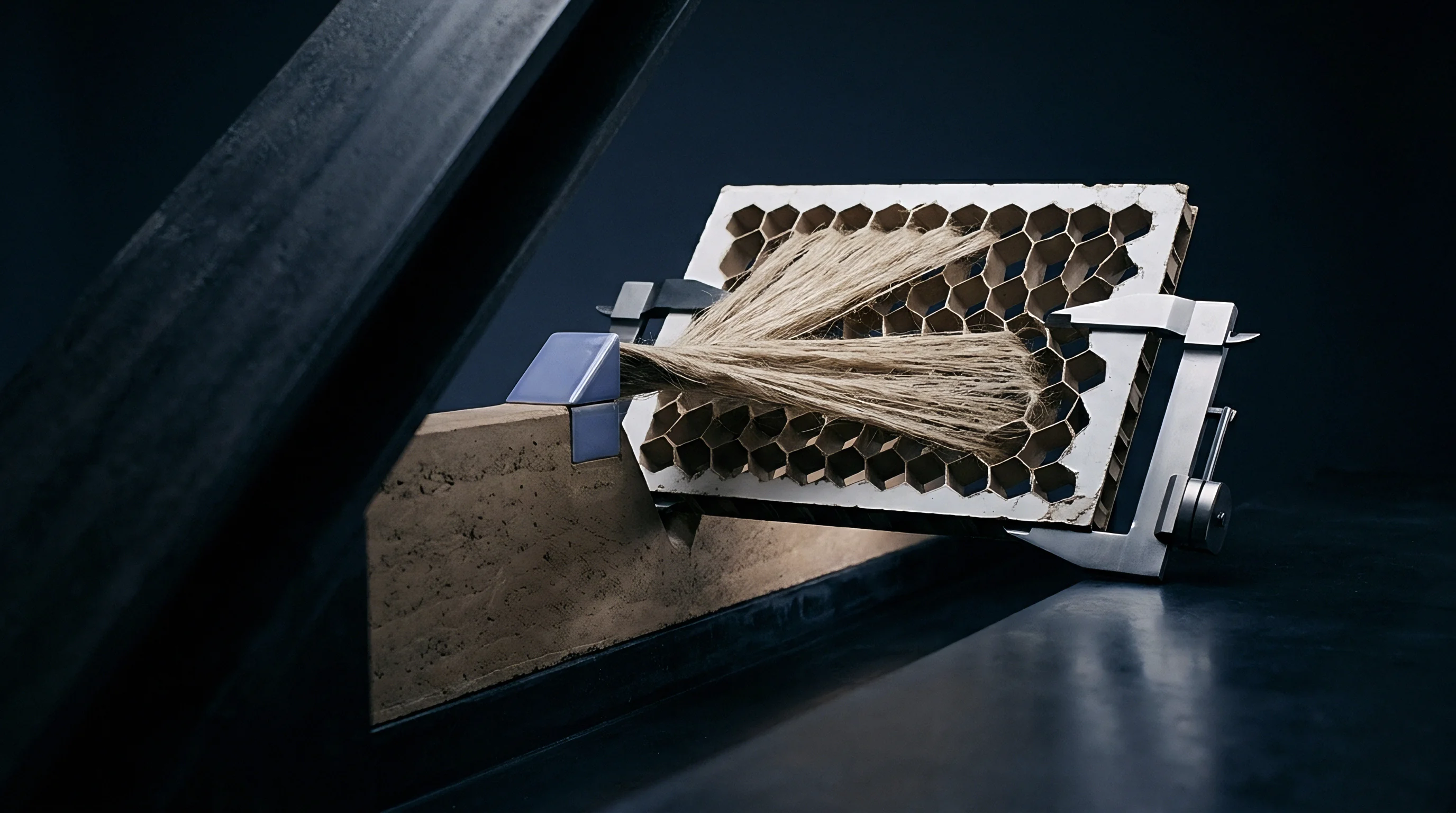
How Does Regain Shift Metric Fibre Fineness?
Unadjusted mass measurements understate the true metric count whenever ambient humidity pushes a specimen’s water content above baseline. Take a test sample of hackled line flax with 500 parallel filaments cut to 10.0 millimeters (0.010 meters). The cumulative length L_total is 5.0 meters, and the sample yields a bone-dry mass m_0 of 1.250 milligrams in the drying vessel.
Calculating dry fineness without regain correction yields:
T_dry = (1.250 / 5.0) 1000 = 250.0 millitex
This dry linear density corresponds to a dry metric count of:
N_m_dry = 1000000 / 250.0 = 4000 Nm
Applying the standard flax regain correction of 12.0 percent adjusts the mass to account for official commercial moisture content:
T_std = 250.0 (1 + 0.12) = 280.0 millitex
The resulting corrected metric count becomes:
N_m_std = 1000000 / 280.0 = 3571 Nm
If a technician weighs this bundle at an ambient moisture regain of 8.5 percent without oven drying ~ mistaking ambient mass for dry mass ~ the balance reads 1.356 milligrams. Calculating fineness directly from that raw ambient figure yields 271.2 millitex (3687 Nm), introducing an 8.8 millitex error compared to the true standard value of 280.0 millitex.
ISO 6741 mandates an official commercial moisture regain factor of twelve percent by weight for pure flax fiber mass calculations.
| Ambient Relative Humidity (%) | Specimen Regain (%) | Oven-Dry Mass (mg) | Uncorrected Fineness (mtex) | Corrected Fineness at 12% Regain (mtex) | Metric Count Shift (Nm) |
|---|---|---|---|---|---|
| 45 | 6.5 | 1.250 | 266.3 | 280.0 | +184 |
| 55 | 8.5 | 1.250 | 271.2 | 280.0 | +116 |
| 65 (Standard) | 10.5 | 1.250 | 276.3 | 280.0 | +48 |
| 75 | 13.0 | 1.250 | 282.5 | 280.0 | -32 |
| 85 | 16.0 | 1.250 | 290.0 | 280.0 | -123 |

Step-by-Step Gravimetric Calculation Protocol
Executing a test sequence requires precise weighing, exact cut lengths, and systematic adjustments. Following the workflow in order minimizes cumulative experimental error.
- Sample fifty grams of hackled long flax sliver or scutched fiber from three distinct locations within the incoming commercial bale.
- Parallelize fibers by hand combing through a fine metal pin comb to remove loose neps, short fragments, and unretted shives.
- Mount the comb-aligned fiber strand inside a dual-blade cutter block clamped to five Newton-meters of torque.
- Cut the central bundle portion to yield parallel filaments measuring exactly 10.0 millimeters in length.
- Count out exactly five hundred individual filaments under five-times optical magnification using fine brass tweezers.
- Record the initial mass of the specimen bundle on an analytical balance reading to 0.01 milligrams.
- Place the open weighing bottle containing the bundle inside the ventilated oven set to 105 degrees Celsius for ninety minutes.
- Insert the stopper, transfer the bottle to a desiccator containing fresh silica gel, and cool for twenty minutes.
- Weigh the sealed bottle containing the dry fiber to determine absolute dry fiber mass m_0.
- Calculate corrected linear density in millitex using twelve percent standard regain and calculate metric count N_m.
Flawed regain corrections cause spinning mills to set drawing frame draft ratios incorrectly, resulting in out-of-spec yarn linear density and frequent end-breaks during wet spinning.


Scale
High-precision analytical balances reading to four decimal places are sensitive to convection currents around hot containers. Weighing specimens immediately after removing them from the oven skews readings, as thermal updrafts and buoyancy lift the balance pan to create artificial mass losses that ruin fineness calculations.
Balance drift caused by thermal gradients introduces up to 0.08 milligrams of error on small fiber bundles during laboratory testing. Since tests on fine line flax use total specimen masses under two milligrams, an error of 0.08 milligrams shifts calculated fineness by more than four percent.
Instrument Calibration and Thermal Buoyancy
Weighing hot specimen tins inside balance cabinets generates upward air currents that lift the balance pan, making the displayed mass lower than the actual combined weight of container and fiber. To avoid buoyancy artifacts, containers must cool inside sealed desiccators to room temperature before weighing.
Analytical balances used for ISO 2370 compliance require weekly calibration using certified Class E2 stainless steel weights. Conditions inside the balance enclosure must remain within standard parameters ~ 20 degrees Celsius plus or minus 1 degree, and 65 percent relative humidity plus or minus 2 percent ~ with draft shields closed while readings stabilize.
Cooling specimen containers inside desiccators for twenty minutes eliminates thermal buoyancy errors on analytical balances.
Cut Length Verification and Edge Distortion
Precision guillotine cutters must maintain zero blade deflection across multi-filament tow bundles to ensure uniform length. As blades wear down, they begin to make angled cuts, yielding filaments that exceed the target ten-millimeter cut length.
Dull blades compress and bend fibers before shearing through the bundle. This bending adds 0.2 to 0.5 millimeters to the actual cut length beyond what the spacers dictate; on a ten-millimeter sample, an unmeasured 0.3 millimeter increase introduces a systematic 3.0 percent error into linear density calculations.
Validating laboratory gravimetric equipment requires systematically reviewing physical cutter condition and balance stability through a structured verification checklist:
- Blade Edge Sharpness requires inspection under fifteen-times magnification every five hundred cuts to detect micro-chipping and edge dulling.
- Clamping Block Pressure demands torque wrench verification to maintain five Newton-meters of uniform holding force during cutting.
- Desiccant Activity State requires monitoring self-indicating silica gel for color changes indicating moisture saturation inside cooling vessels.
- Balance Pan Centering demands optical alignment verification to prevent corner-load errors during milligram mass determinations.
How much of the total fineness variance observed in commercial retting trials stems from cutter blade micro-wear rather than genuine agronomic fiber differences?

Commercials
Contractual invoicing for raw bast filaments and spun yarns applies a standardized regain factor to convert conditioned weight into official billed mass, preventing disputes over moisture absorbed during ocean transit. Buying raw flax at ambient weight without regain adjustments leaves spinners paying line-fiber prices for trapped atmospheric water.
Landed costs depend directly on linear density and moisture adjustments. Fine line flax, which commands premium prices per kilogram, must satisfy strict fineness ratings derived from standard regain calculations. Flawed adjustments cause misgrading, overpayment, and misconfigured spinning machinery.
Contractual Weight Adjustments and Allowance Rates
International trade contracts for linen yarn cite ISO 6741 standards, which set official regain for pure flax products at twelve percent. If bales arrive at a mill with moisture above twelve percent, buyers calculate weight deductions against the invoice. When bales arrive below twelve percent, sellers apply upward adjustments to reach standard commercial mass.
The mathematical equation for calculating commercial invoiced mass M_commercial from raw landed mass M_landed and measured regain R_actual is:
M_commercial = M_landed ((1 + (R_official / 100)) / (1 + (R_actual / 100)))
where R_official represents twelve percent for flax fiber. A ten metric ton shipment arriving at fourteen percent moisture regain yields a commercial mass of 9.824 metric tons, resulting in a net deduction of 176 kilograms of paid fiber weight.
| Billed Shipment Weight (kg) | Measured Moisture Regain (%) | Corrected Commercial Mass (kg) | Variance Factor (%) | Net Financial Exposure per 10 Metric Ton Lot ($) |
|---|---|---|---|---|
| 10,000 | 10.0 | 10,181.8 | +1.82 | +$9,100 |
| 10,000 | 11.0 | 10,090.1 | +0.90 | +$4,500 |
| 10,000 | 12.0 (Standard) | 10,000.0 | 0.00 | $0 |
| 10,000 | 13.0 | 9,911.5 | -0.88 | -$4,400 |
| 10,000 | 14.0 | 9,824.6 | -1.75 | -$8,750 |
| 10,000 | 15.0 | 9,739.1 | -2.61 | -$13,050 |
Landed Yield and Metre Costing Impacts
Yarn yield fluctuates whenever moisture levels vary between raw bale intake and the roving frames. Wet spinning mills draw hackled sliver through hot water baths at 60 degrees Celsius to soften pectin bonds during drafting. If linear density calculations for incoming fiber contain uncorrected regain errors, draft gear settings won’t produce target yarn counts.
Unadjusted fineness values distort calculated yarn yields per kilogram. A line flax lot incorrectly rated at 250 millitex instead of its true corrected value of 280 millitex leads technicians to set overly aggressive drafting ratios on wet spinning frames. That causes excessive yarn breakage, increasing waste by up to 4.5 percent and driving up production costs per woven meter of finished linen fabric.
Raw fiber sales contracts follow ISO 6741 moisture regain testing protocols, automatically adjusting invoice totals whenever measured regain strays by more than 0.5 percent from official commercial limits.