Comb Sorter Staple Profiling for Long-Staple Linen Yarn Qualification
Comb sorter profiling establishes staple length distribution, short fibre content, and drafting bounds to guarantee target yarn counts and fabric yield.
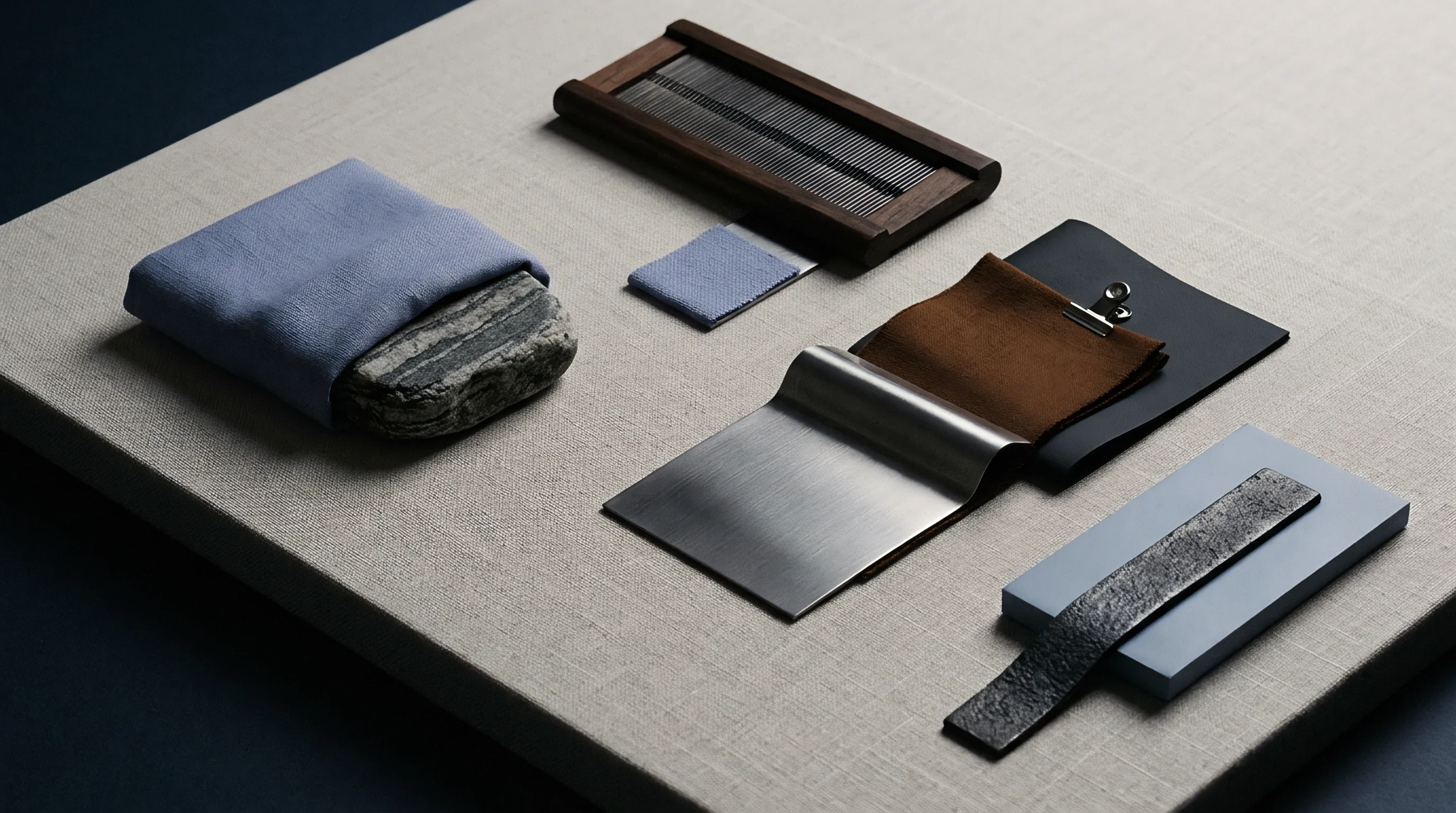

Comb
Manual pin-bed separation instruments remain the standard for isolating long bast fibre bundles before wet spinning. Mechanical cotton staplers and optical sliver analyzers designed for short fibres cannot evaluate hackled flax line stock ranging from 150 mm to over 500 mm in length. A modified Durow comb sorter uses two parallel beds of precision steel needles spaced at 1 mm intervals to hold the bundle securely without fracturing the multi-cellular technical fibres.
Preparing the specimen requires 24 hours of climate control at 20°C and 65% relative humidity. Moisture equilibrium ensures that residual pectins binding the elementary flax ultimate fibres maintain natural viscoelasticity during manual clamping and drawing.
Sampling begins at the hackling frame output. Operators select sliver segments across ten randomly chosen hackling heads to build a composite lab sample of 20 grams. The specimen is manually straightened without applying draft tension that could induce false fibre slippage.
Using broad-faced velvet-lined nipper clamps, the operator grips the protruding fibre tips from the primary comb bank, slowly pulling the longest fraction out from the main mass.
- Mount the composite 20-gram hackled flax sliver into the lower comb bed with fibre tips aligned uniformly along the baseline pin row.
- Depress the top comb assembly down into the fibre mass to lock the lower half of the bundle against lateral movement.
- Grasp the projecting fibre ends with the velvet nipper clamp, exercising smooth axial pulling force to extract the longest free fibres without snapping individual technical filaments.
- Transfer the drawn tuft onto a black velvet-covered array board, aligning the lower roots precisely along a ruled horizontal zero line.
- Drop successive needle rows on the front comb bank one by one, repeating the clamp extraction for progressively shorter fibre fractions until the entire sample is sorted.
- Depress the rear comb set and reverse the sorter array to gather short elementary fragments and dressed tow remnants remaining in the needle roots.
Aligning fibres across the velvet array surface demands steady manual dexterity. Each successive tuft lies adjacent to the previous extract, moving strictly from longest to shortest along the horizontal axis. Misalignment of root tips introduces immediate error into the upper quartile staple measurement.
When sorting long-staple flax line, coarse bundle splits must not be confused with true length variation; stiff, under-retted technical fibres drag shorter adjacent fibres along during extraction, artificially smearing the array profile.
Rough hand-pulling across unconditioned flax sliver fractures delicate technical bundles and invalidates length distribution metrics.
Visual inspection and traditional mill sorting are sometimes relied upon instead of formal comb sorter diagrams for hackled line stock.

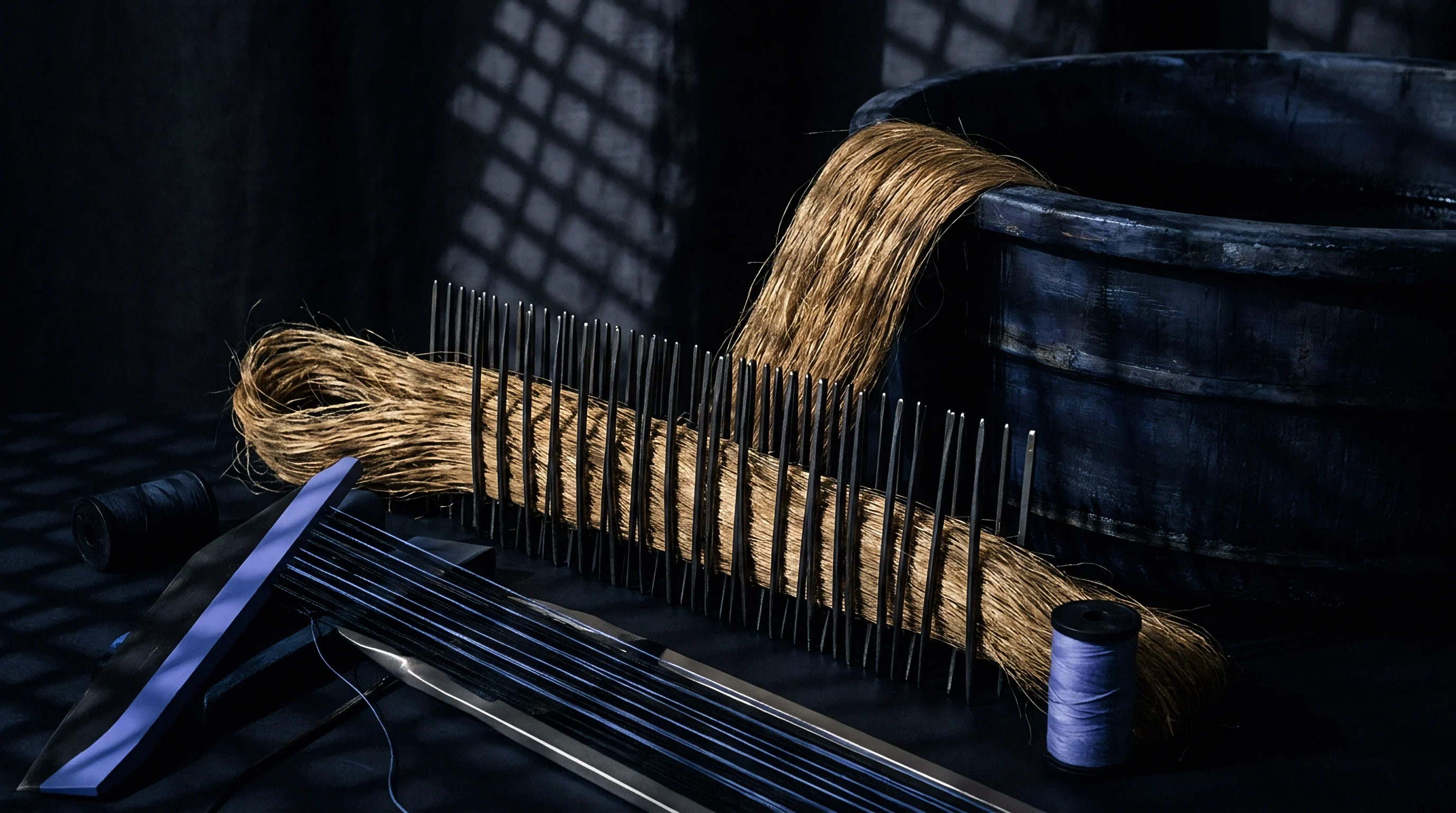
Diagram
Plotting fibre mass against sorted bundle lengths yields the Johannsen staple curve. The baseline of the array indicates cumulative fibre count or weight percentage, while vertical ordinates record absolute bundle length in millimetres. From this cumulative curve, laboratory technicians determine four primary numerical indicators: Upper Half Mean Length, Mean Length, Modal Staple Length, and Short Fibre Content.
Short fibre content in long-staple flax qualification measures the mass proportion of fibres below 50 mm ~ the boundary where fibres cease contributing to drafting cohesion in wet spinning and instead cause float-fibre defects in the yarn core.
Upper Half Mean Length serves as the standard purchasing metric for line flax. Premium water-retted French hackled line flax exhibits an Upper Half Mean Length of 240 mm under standard ISO 2370 testing on 500-fibre sorter arrays. This benchmark value relies on uniform retting chemistry; over-retting breaks down middle lamella pectins excessively, dropping the Upper Half Mean Length by up to 30 mm, whereas under-retting leaves un-cleaved technical bundles that artificially inflate length readings by 45 mm due to bundle stiffness.
The ratio between Upper Half Mean Length and Mean Length defines the length uniformity ratio. Higher ratios indicate a tight, homogeneous staple population ideal for high-speed drafting frames.
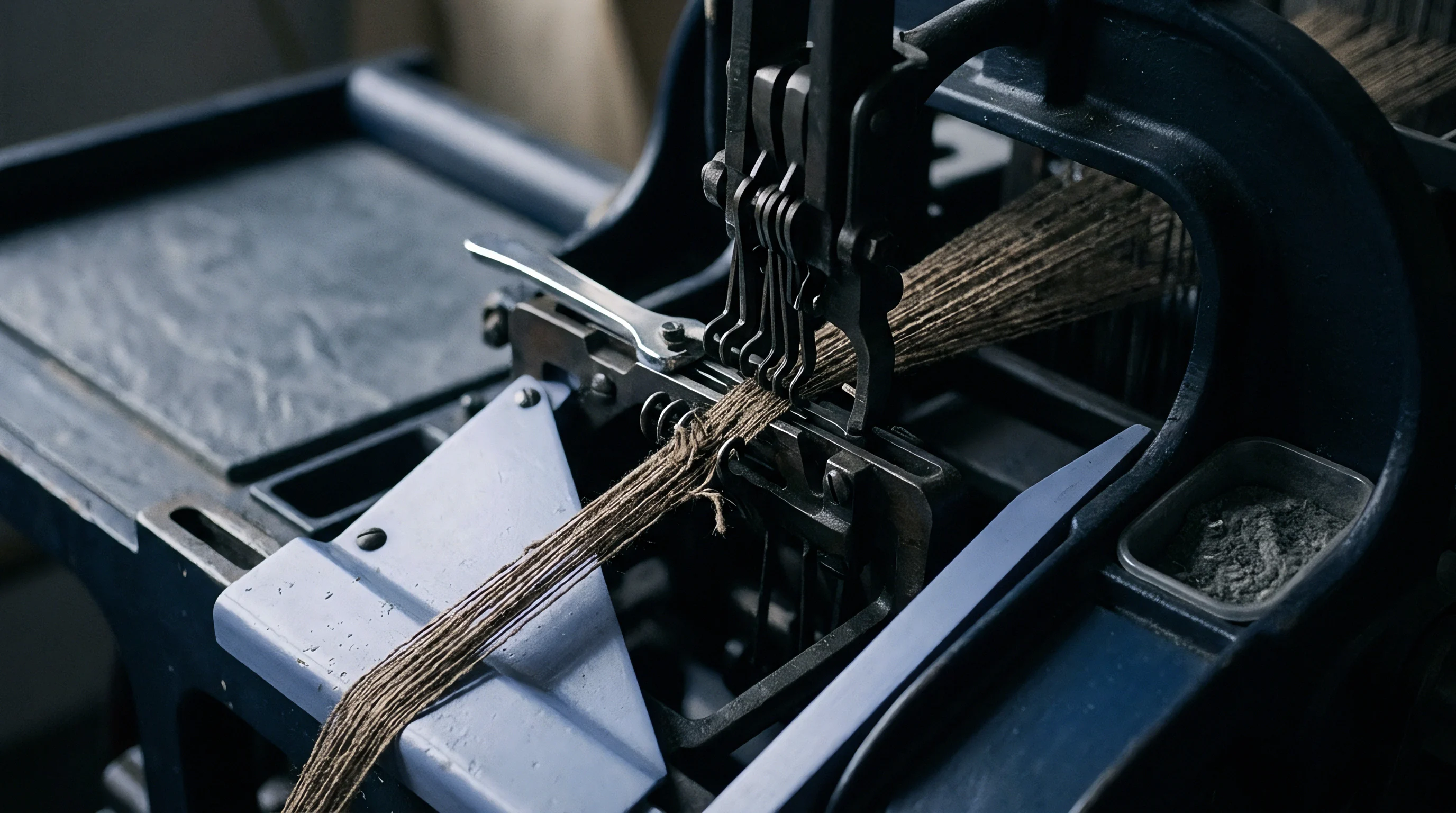
When Does Comb Sorting Outperform Optical Fibre Analysis?
Automated optical systems measure individual elementary fibre lengths rapidly by image analysis, but they perform poorly on un-degummed bast fibres. Flax exists inside the plant stem as technical fibre bundles held together by hemicellulose and pectin gums. Optical scanners often mistake a single branched technical fibre bundle for multiple short fibres or incorrectly register overlapping long fibres as a single continuous filament.
Comb sorter arrays physically separate bundles by drafting resistance, providing a direct physical representation of how fibres behave under mechanical drawing rollers in the mill.
| Fibre Grade Designation | UHML (mm) | Short Fibre Content (<50mm %) | Uniformity Ratio (%) | Length CV (%) |
|---|---|---|---|---|
| Water-Retted Hackled Line Grade 1 | 265 | 4.2 | 82.5 | 22.1 |
| Dew-Retted Hackled Line Grade 2 | 215 | 8.5 | 74.1 | 28.6 |
| Dressed Hackling Tow Grade A | 135 | 16.8 | 63.4 | 36.2 |
| Cottonised Flax Scuttered Stock | 38 | 48.5 | 45.0 | 52.4 |
Evaluating the short fibre tail on the comb sorter array dictates spinning boundary calculations. High short fibre content increases yarn mass variation (Uster CV%) and creates excessive fly dust around the ring frame. When short fibre content exceeds 12% in long-staple line flax, drafted roving loses structural integrity, leading to uncontrolled slippage in the spinning trough.
A dew-retted line flax lot displaying a length coefficient of variation above 30 percent causes continuous end breakage on fine-count wet frames.
Standardizing automated image profiling to match manual comb sorter accuracy on un-degummed technical bast fibre bundles remains an open subject among international standards committees.

Ratch
Drafting roller nip distances on long-staple spinning frames ~ the ratch setting ~ depend directly on the upper staple boundary identified in the comb sorter diagram. Setting the ratch narrower than the longest technical fibres in the sliver causes the front delivery rollers to grip the fibre tip while the back rollers still hold its tail, snapping fibres, jamming the frame, or scarring the roller apron. Setting the ratch too wide leaves an un-clamped zone between roller nips where short fibres float without guidance.
These float fibres clump together under drafting tension, generating thick slubs followed immediately by thin, weak yarn segments.
In wet spinning, sliver passes through a hot water bath maintained between 60°C and 70°C before entering the drafting zone. Heat and moisture soften residual pectins inside the technical fibre bundles, allowing individual elementary fibres (typically 15 mm to 25 mm long) to slide past one another. This secondary drafting action allows line flax to spin down to fine metric counts such as Nm 80 (12.5 tex).
The dynamic drafting force threshold at which residual pectins shear inside the 65°C wet-spinning trough ranges from 12 cN to 38 cN depending on retting degree. Because no laboratory standard measures dynamic trough shear under mill speed conditions, spinners specify a strict maximum short fibre content below 7% on incoming comb sorter profiles to limit float-fibre drafting waves.
Consider a wet-spinning frame processing Nm 40 (25 tex) yarn at a delivery speed of 18 metres per minute, with a frame ratch set at 75 mm. Slivers containing 8% short fibre content run smoothly with an end breakage rate of 18 breaks per 1,000 spindle hours. When feeding a cheaper lot containing 18% short fibre content under identical mechanical settings, drafting force fluctuates wildly between 8 cN and 45 cN.
Float fibres accumulate behind the front roller nip until drawn through as a mass slub. End breakage spikes to 62 breaks per 1,000 spindle hours, and frame efficiency drops from 94% to 78%.
- Excessive ratch width creates wide unguided drafting zones that cause slub formation and high yarn count variation.
- Pinched long fibres occur when the ratch setting sits below the comb sorter upper quartile length, snapping line fibres and destroying yarn strength.
- Pectin shear failure happens when bath temperatures drop below 55°C, preventing bundle slippage and causing roving breakage at the back roller nip.
- Float fibre clustering generates periodic thin places in wet-spun yarn that fail under tension during high-speed weaving warping.
Fibre cohesion mechanisms in flax processing mirror early industrial textile techniques developed in 18th-century Baltic shipping ports, where water-retted Riga line flax commanded price premiums over inland dew-retted stock due to predictable bundle uniformity and salt-water rot resistance. Modern high-speed automatic winders demand that same structural fibre uniformity to maintain package density and splicing integrity.
Maintaining wet-spinning trough water at 65°C lowers pectin shear force and smooths draft resistance across long bast bundles.
Setting frame ratches wider than the upper quartile length of the staple profile increases float-fibre population, pushing yarn mass variation beyond acceptable quality limits and causing severe surface defects in woven fabrics.
Limit
Material tolerance thresholds defined on incoming mill delivery contracts act as the primary operational defense against spinning room failure. Long-staple linen yarn qualification relies on establishing count-specific staple profiling limits prior to bale dispatch. Spinning fine wet-spun yarns demands exceptionally clean, long, and uniform line flax sliver, whereas coarse dry-spun tow yarns tolerate shorter mean lengths and wider length distributions.
Contractual specifications state explicit bounds for Upper Half Mean Length, Short Fibre Content, and Length Coefficient of Variation. If a delivered lot breaches these bounds, processing penalties or lot rejections trigger automatically. The table below details qualification thresholds across standard linen yarn count ranges.
| Target Spun Count Range (Nm) | Min UHML (mm) | Max SFC <50mm (%) | Max Length CV (%) | Spinning Process Route |
|---|---|---|---|---|
| Nm 60 to Nm 100 | 240 | 5.5 | 22.0 | Hot Wet Spinning Frame |
| Nm 26 to Nm 50 | 190 | 9.0 | 27.0 | Warm Wet Spinning Frame |
| Nm 14 to Nm 24 | 140 | 14.0 | 32.0 | Semi-Wet or Dry Spinning Frame |
| Nm 6 to Nm 12 | 90 | 22.0 | 40.0 | Dry Tow Spinning Frame |
Verification protocols demand systematic bale sampling upon mill arrival. Standard quality assurance procedures call for opening 5% of delivered bales per lot. Comb sorter arrays are prepared in triplicate for each sampled bale.
If test results fall outside contract bounds, a joint re-test takes place using reference laboratory equipment before final rejection settlement.
- Comb sorter length arrays providing full numerical length distribution, upper half mean length, and short fibre content percentages.
- Fineness certification reporting metric fibre number (Nm) measured in accordance with ISO 2370 air-flow or gravimetric test protocols.
- Retting degree analysis documenting residual pectin content and bundle cohesion forces under wet drafting conditions.
- Moisture regain reports verifying lot mass conditioned to standard industrial allowance figures.
- Shive and impurity content measuring percentage mass of non-fibrous epidermal bark and woody stem fragments.
Drafting performance remains tightly linked to raw material compliance. When fibre lots pass incoming comb sorter qualification, ring frame production reaches optimal efficiency. Downstream weaving mills experience fewer stop-marks and higher fabric yield per loom hour.
Contract clauses specifying maximum allowable short fibre content under ISO 2370 protect spinners against low-yield, heavily fractured flax lots.
Standard purchase agreements incorporating ISO 2370 staple profile thresholds place direct financial liability for frame downtime onto the fibre dresser upon receipt of non-conforming comb sorter diagrams.
Invoice
Financial settlements negotiated across cross-border flax fibre transactions depend directly on clean hackled line yields and target spun count capacity. Raw scutched flax undergoes hackling to comb out short fibres, coarse tangles, and residual shives, converting raw straw stock into parallel hackled line flax and hackling tow by-product. The financial yield equation balances the raw fibre purchase cost against hackled line output and tow waste credit.
Consider a commercial evaluation of a 10,000 kg lot of scutched flax landed at €4.20 per kg. Comb sorter profiling identifies two potential fibre quality profiles within the market supply stream for Grade 1 long-staple material. Profile A displays an ideal staple structure with an Upper Half Mean Length of 250 mm and a Short Fibre Content of 5.0%.
Profile B represents a degraded, over-handled lot showing an Upper Half Mean Length of 195 mm and a Short Fibre Content of 14.5% due to aggressive machine scutching.
Processing Profile A through the hackling machine produces a 62% hackled line yield (6,200 kg) and a 31% hackling tow yield (3,100 kg), with 7% dust and shive loss. Hackling tow holds a market value of €1.10 per kg as a by-product sell-off. The net raw material cost allocated to the clean hackled line flax calculates as follows:
Total Raw Material Input Cost: 10,000 kg × €4.20/kg = €42,000. Less Tow Waste Credit: 3,100 kg × €1.10/kg = €3,410. Net Cost of Line Flax: €42,000 – €3,410 = €38,590.
Effective Clean Line Fibre Cost per kg: €38,590 / 6,200 kg = €6.22 per kg.
Profile A line flax easily spins down to fine Nm 50 yarn (20 tex). At this count, 1 kg of line flax yields 50,000 metres of yarn. Accounting for wet-spinning transformation costs of €3.80 per kg, the final spun yarn cost reaches €10.02 per kg (€0.200 per 1,000 metres).
Woven into a standard 180 g/m² plain weave linen fabric at 150 cm finished width, the raw material cost contribution equals €1.80 per linear metre of fabric.
Processing Profile B under identical machine conditions drops the hackled line yield to 51% (5,100 kg) because short, fractured bundles comb out into lower-value hackling tow (42% yield, or 4,200 kg). Net cost calculation for Profile B line flax:
Total Raw Material Input Cost: 10,000 kg × €4.20/kg = €42,000. Less Tow Waste Credit: 4,200 kg × €1.10/kg = €4,620. Net Cost of Line Flax: €42,000 – €4,620 = €37,380.
Effective Clean Line Fibre Cost per kg: €37,380 / 5,100 kg = €7.33 per kg.
Furthermore, due to high short fibre content and low length uniformity, Profile B line flax cannot hold an Nm 50 count without excessive end breakage. The mill must cap spinning limit at a coarser Nm 30 count (33.3 tex). Transformation costs for coarse wet spinning run at €2.90 per kg, making the spun yarn cost €10.23 per kg.
Yielding only 30,000 metres per kg, the yarn cost per 1,000 metres jumps to €0.341. In the same 180 g/m² finished fabric, raw material and yarn processing costs escalate to €2.46 per linear metre, representing a 36.6% cost penalty over Profile A fabric.
Hackling machine yield fixed at 62% line flax and 31% tow waste holds true for Grade 1 Normande long-staple flax under standard mill operational benchmarks. However, this yield balance depends strictly on scutching moisture content staying between 12% and 14%. Dropping scutching moisture down to 10% increases fibre brittleness, transferring 8% of valuable line fibre into lower-priced hackling tow and severely altering the landed cost structure.
A lower raw kilogram price sheet never compensates for high short fibre content once hackling waste and spinning count caps enter the mill ledger.