Characterizing Viscoelastic Size Film Fracture Dynamics under High Frequency Air Jet Shedding Stresses
Viscoelastic size film failure under high frequency air jet shedding stems from dynamic glass transition shift and energy dissipation limits.


Shed
Modern air-jet weaving machines operating above nine hundred picks per minute subject warp ends to cyclic deformation frequencies reaching twenty hertz. The protective size coating applied during warp preparation must withstand high velocity cyclic extension, flexural bending, and intense friction against machine elements. As insertion speeds increase, the time window for mechanical stress relaxation within the polymer film shrinks to milliseconds.
When the mechanical deformation rate exceeds the molecular relaxation capacity of the size film, stress concentration builds within the matrix rather than dissipating harmlessly as heat.
Clean sheds yield higher picks. Sizing quality dictates loom output. High velocity air dries film.
The spatial geometry of the shed creates asymmetric strain distributions along the yarn axis. Warp threads positioned in the top and bottom shed lines experience peak extension twice per loom cycle, while the neutral position releases tension momentarily. This rapid stress cycling induces micro-fatigue within the sizing film, altering its structural cohesion prior to weft insertion.

High Velocity Kinematics and Extension Rates
Warp yarns experience rapid vertical displacement as harness frames move between upper and lower reversal points. At twelve hundred picks per minute, the harness frame completes a full stroke in fifty milliseconds, imposing strain rates on the warp sheet that reach fifty percent per second. The instantaneous extension applied to the sized yarn depends on shed angle, back-rest roller location, and harness lift distance.
Higher shed openings improve weft clearance but multiply tensile strain peaks on the outer fiber bundles.
Flexural strain breaks stiff sizing. Repeated flexural deformation around heald eyes and drop wires causes internal shearing between the polymer matrix and the underlying fiber core. Unmodified starch coatings fail rapidly under these conditions because their crystalline regions cannot accommodate localized shearing.
Synthetically modified hydrocolloid formulations incorporate flexible polymer chains that yield under shear without immediate matrix rupture.
Mechanical Energy Input at High Weft Rates
Kinetic energy transferred to warp sheets during harness motion accumulates cyclic mechanical strain within the protective chemical coating. A portion of this energy stores elastically within the film, while the remainder dissipates through viscous flow. The balance between stored and dissipated energy governs whether the coating remains intact or undergoes structural degradation during a long production run.
- Back-rest roller deflection imparts initial continuous tensile load across the warp sheet.
- Drop wire contact adds localized bending moments and mechanical friction to individual ends.
- Heald eye displacement creates sharp angular deflection and strain rate peaks at maximum opening.
- Reed beat-up impacts the cross-over point, delivering high impulse shear loads to the sizing layer.
- Fell displacement releases residual tension while transferring stress into the newly formed cloth.
Drop wires register broken ends. Reed friction generates localized heat. The continuous mechanical input from these five stages elevates local film temperature, shifting the viscoelastic response of the coating during continuous weaving operations.
Cyclic extension amplitudes exceeding three percent at twenty hertz strain rates trigger micro-yield in unmodified starch film within four thousand loom revolutions.
Failure to match size film viscoelasticity to shedding frequencies accelerates warp thread fragmentation, driving down weaving shed productivity and increasing greige fabric mend costs.
Rheology
Polymeric protective films applied during warp preparation exhibit pronounced time-dependent mechanical deformation when subjected to cyclic extension cycles. The material response combines elastic energy storage, characterized by the storage modulus, and viscous energy dissipation, represented by the loss modulus. The ratio of loss modulus to storage modulus defines the loss tangent, which serves as a primary indicator of energy damping capacity within the sizing layer.
Viscous flow relaxes shedding stress. PVA retains tensile elasticity. Under high frequency air-jet shedding, a high storage modulus preserves yarn structure against peak tensile loads, while an adequate loss tangent prevents destructive stress accumulation.
If the loss tangent falls too low, the film behaves as an ideal brittle elastic solid, accumulating micro-damage until catastrophic cracking occurs across the film cross-section.

Oscillatory Mechanical Analysis and Loss Modulus Shift
Testing temperature and excitation frequency govern the mechanical response of polyvinyl alcohol and starch composite films under tension. Raising the oscillation frequency from one hertz to twenty hertz shifts the effective glass transition temperature of the polymer film upward by ten to fifteen degrees Celsius. A size formulation that behaves flexibly during slow-speed laboratory hand-sampling turns glass-brittle under high speed production conditions.
Low moisture shifts glass transition. Fine yarns demand elastic film. Sizing films operating near their glass transition region exhibit strong frequency-dependent stiffness.
When air-jet loom speeds escalate, the short deformation time scale shifts the polymer matrix from a rubbery entropic elasticity regime into a rigid enthalpic elasticity regime, drastically reducing ultimate elongation at break.
Glass Transition and Environmental Moisture Interaction
Relative humidity within the weaving shed alters plasticization levels within hydrocolloid films. Water molecules enter the amorphous regions of starch and polyvinyl alcohol matrices, disrupting inter-chain hydrogen bonds and increasing molecular mobility. Water acts as a powerful plasticizer, lowering the glass transition temperature and increasing film ductility under dynamic stress.
| Formulation Base | Storage Modulus E’ (GPa) | Loss Modulus E” (MPa) | Loss Tangent tan δ | Glass Transition Tg (°C) |
|---|---|---|---|---|
| Native Corn Starch | 3.85 | 115.5 | 0.030 | 68.5 |
| Thin-Boiling Starch / PVA (80/20) | 2.92 | 160.6 | 0.055 | 54.2 |
| Hydroxyethyl Starch / PVA (50/50) | 2.10 | 157.5 | 0.075 | 41.8 |
| Fully Hydrolyzed PVA / Acrylic | 1.45 | 130.5 | 0.090 | 32.0 |
| Data recorded via oscillatory DMA tensile testing at 20 Hz excitation frequency under controlled atmospheric conditions. | ||||
Excessive moisture absorption compromises film cohesive strength. When shed humidity exceeds seventy-five percent, water plasticization reduces the film storage modulus below the threshold required to anchor outer fibers into the yarn core. The film becomes tacky, increasing metal-to-yarn friction at drop wires and reed dents.
- Polyvinyl Alcohol Ratio balances tensile strength against film flexibility across high frequency deformation cycles.
- Carboxymethyl Cellulose Content controls moisture absorption rates and stabilizes film modulus against relative humidity drops.
- Plasticizer Addition Level lowers glass transition temperature below ambient weaving shed operating conditions.
- Modified Starch Viscosity determines yarn core penetration depth while maintaining surface film continuity.
ISO 13934 testing protocols executed at standard atmosphere confirm that size films with loss tangents below zero point zero five exhibit double the frequency of brittle fractures under high strain rates.
The exact molecular relaxation rate that prevents energy accumulation without causing adhesive bond failure at the fiber boundary remains undetermined for hyper-velocity weaving cycles.

Fracture
Microscopic breakdown within size film matrices initiates through craze formation under repetitive peak tension forces. Craze zones contain fibrils of oriented polymer separated by nano-scale voids, developing perpendicular to the applied tensile stress vector. Under continuous twenty-hertz shedding cycles, these crazes coalesce into transverse microcracks that propagate rapidly across the film thickness.
Microcracks reduce warp tensile strength. Brittle film yields early hairiness. Yarn abrasion raises loom stops.
Once a crack reaches the fiber-matrix interface, the stress field concentrates at the fiber surface, initiating delamination along the length of the warp strand. Fiber ends release from the core, creating hairiness that interferes with adjacent warp ends and blocks the air-jet insertion channel.
Craze Initiation and Crack Propagation Mechanisms
Sub-micron void spaces form within the polymer matrix under localized stress concentrations near embedded surface fibers. High strain rate loading prevents polymer chain entanglement relaxation, causing local tensile stress to exceed matrix cohesive strength. Cracks propagate through brittle failure modes when the mechanical energy release rate exceeds the critical fracture toughness of the size film.
Shed height dictates extension amplitude. Non-uniform size distribution along the warp yarn creates weak spots where localized strain reaches twice the nominal strain average. These thin film sections fracture early in the weaving process, exposing naked fiber bundles to abrasive metal contacts.

How Does Strain Rate Escalation Drive Brittle Transition?
When harness frame frequencies exceed fifteen hertz, molecular polymer chains lack sufficient time to undergo viscous relaxation. The effective Deborah number, defined as the ratio of polymer relaxation time to the deformation time scale, exceeds unity. Under these conditions, the size film transfers into an elastic brittle state, where fracture energy drops to a fraction of its low-speed value.
| Size Matrix Type | Tensile Yield Strain (%) | Critical Fracture Energy J_ic (kJ/m²) | Micro-crack Onset Cycles | Film Flaking Rate (g/m²) |
|---|---|---|---|---|
| High-Viscosity Acid-Thinned Starch | 1.8 | 0.42 | 1,200 | 4.85 |
| Esterified Starch Blend | 2.6 | 0.85 | 4,500 | 2.10 |
| PVA / Carboxymethyl Cellulose | 4.2 | 1.65 | 18,000 | 0.45 |
| PVA / Polyacrylate Co-Polymer | 5.8 | 2.40 | 45,000 | 0.12 |
Repeated impact loading from air-jet reed beat-up generates compressive shear waves that travel down the warp ends. These stress waves reflect off the harness eyes, producing localized standing wave patterns where crack initiation accelerates.
- Transverse Microcracking originates across surface voids where localized strain exceeds matrix yield capacity.
- Interfacial Delamination separates the protective polymer skin from spun fiber outer walls under shear stress.
- Adhesive Debonding releases fiber bundles from the core matrix, generating yarn hairiness during reed travel.
- Brittle Flaking produces fine sizing powder that clogs air-jet main nozzles and optical weft sensors.
Size films with higher viscous loss dissipation resist repetitive impact fatigue far better than ultra-high modulus coatings.
Sizing chemical vendors frequently attribute weaving shed dust accumulation to improper warp dry-can drying profiles rather than inherent polymer strain limitations.

Bench
Laboratory evaluation of protective warp films demands specialized testing equipment capable of replicating high-frequency shedding stress cycles. Standard static tensile testers operating at constant pull speeds fail to reveal high strain rate brittle transition behavior. Accurate characterization requires dynamic mechanical thermal analysis combined with custom cyclic fatigue instruments operating at production-equivalent excitation frequencies.
Free film preparation requires precise drawdown techniques over Teflon substrate plates to ensure uniform specimen thickness. Film specimens must cure under controlled relative humidity and temperature for forty-eight hours prior to mechanical testing to ensure consistent moisture equilibrium. Thickness variations exceeding five percent introduce stress concentration artifacts that fluster dynamic modulus calculations.
High-Frequency Acoustic Emission and Crack Detection
Piezoelectric sensors attached to vibrating warp strands record micro-structural damage signals long before visible film breakdown occurs. Microcrack formation releases high-frequency elastic stress waves that travel through the fiber substrate to the sensor. Spectral analysis of acoustic emission event energy separates film matrix cracking from individual fiber ruptures.
Acoustic event rate spikes signal imminent film degradation. Sizing formulations that exhibit low acoustic emission event counts across fifty thousand stress cycles consistently produce lower warp stop rates on the air-jet weaving floor.
Simulated Shedding Endurance Laboratory Test Methods
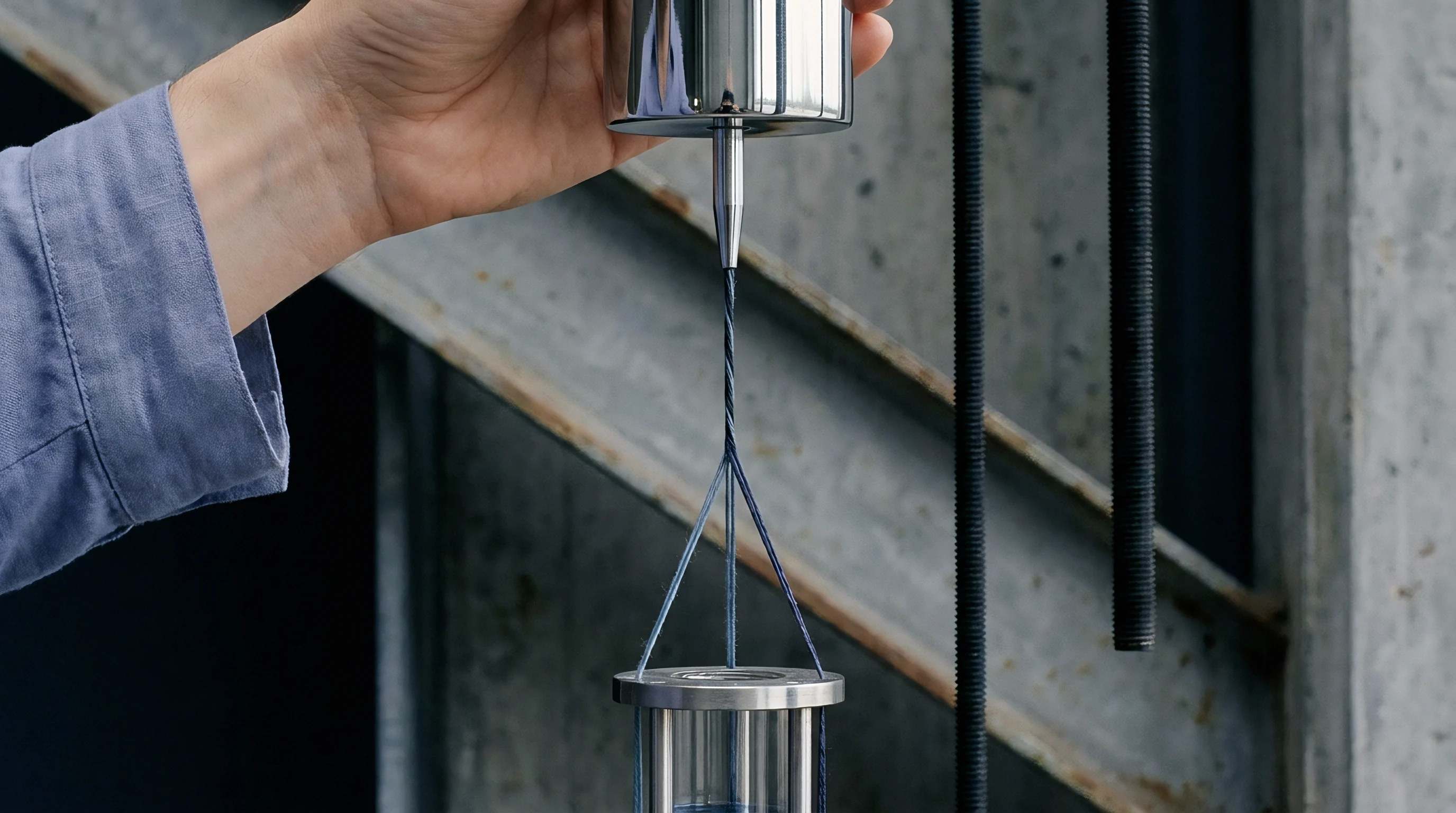
Custom mechanical rig setups subject single sized ends to combined cyclic tension, bending, and abrasive friction. The test instrument replicates harness motion, drop wire drag, and reed dent impact at frequencies up to twenty-five hertz while continuous yarn hairiness meters track fiber break counts. Sizing pick-up percentage must be verified via gravimetric desizing analysis before fatigue testing begins.
- Dynamic Mechanical Profile Data specifies storage modulus, loss modulus, and glass transition temperature across operating frequencies from five to twenty-five hertz.
- Film Thickness Uniformity Certificates confirm cross-sectional consistency across the full warp sheet width within three percent tolerance.
- Moisture Equilibrium Curves state water absorption percentages at relative humidity steps between fifty and eighty percent.
- Abrasion Resistance Test Logs record shedding cycle counts prior to initial yarn hairiness emergence under ten grams warp tension.
Acoustic emission signal counts spike dramatically when size film microcracks coalesce into macro-scale surface spalling.
Incorporation of ASTM D5430 class-four fault limits into gray cloth purchase contracts holds sizing houses accountable for loom stops caused by film flaking.
Modulation
Formulation adjustment balances structural film cohesion against energy dissipation capability during high speed air-jet weaving. Substituting high molecular weight polyvinyl alcohol for unmodified starches elevates matrix toughness and ultimate strain at break. Incorporating synthetic acrylic co-polymers increases film flexibility without sacrificing dry strength or water solubility during desizing operations.
Excess starch raises shedding dust. Correct chemistry preserves loom speed. Sizing formulations containing balanced hydrocolloid ratios reduce flaking residues in air nozzles and optical detectors, lowering cleaning maintenance downtime.
Landed fabric cost calculations must incorporate both raw sizing chemical expenditures and shed efficiency adjustments resulting from warp stop variations.
Plasticization Strategies and Co-Polymer Blends
Chemical modification through polyol addition disrupts hydrogen bonding between starch chains, increasing material compliance. Glycerol and sorbitol plasticizers lower the glass transition temperature, preventing brittle micro-fractures under rapid strain cycles. Excess plasticizer addition reduces film tensile strength, leading to premature film shedding under high warp sheet tensions.
PVA blends reduce shedding dust. Plasticizer migration degrades long-term film elasticity. Formulators select internal plasticization techniques, such as grafting flexible ether groups directly onto the starch backbone, to prevent plasticizer volatilization during warp dry-can processing.

Loom Speed Calibration and Tension Management
Adjusting harness frame lift height reduces peak yarn elongation during shed formation. Operating air-jet looms at ninety percent maximum rated velocity matches the deformation rate to the molecular relaxation capacity of standard modified starch films, eliminating catastrophic flaking without requiring expensive synthetic polymer additives.
| Formulation Strategy | Size Additive Cost ($/kg) | Loom Efficiency (%) | Warp Stops per 100k Picks | Landed Metre Cost ($/m) |
|---|---|---|---|---|
| 100% Native Potato Starch | 0.85 | 82.4 | 3.85 | 1.42 |
| 80/20 Modified Starch / Low-Viscosity PVA | 1.65 | 91.2 | 1.40 | 1.28 |
| 50/50 Etherified Starch / Fully Hydrolyzed PVA | 2.85 | 95.6 | 0.45 | 1.21 |
| High-PVA / Synthetic Acrylic Co-Polymer | 4.20 | 96.8 | 0.22 | 1.24 |
Higher initial chemical cost yields lower total fabric manufacturing cost by mitigating warp end break downtime on high-capital air-jet machinery. Correctly matching the viscoelastic relaxation time of the film to the air-jet shedding cycle frequency maintains warp integrity across millions of loom revolutions.