Optimizing Wet Spinning Trough Parameters for Fine Linen Yarns
Fine linen wet spinning demands trough water at 65 to 75 degrees Celsius with controlled surfactants to dissolve middle lamella pectins before the drafting nip.
Bath
Fine linen yarns spanning metric counts from Nm 39 (25.6 tex) up to Nm 60 (16.7 tex) and beyond depend entirely on the physical state of the flax roving as it enters the drafting zone. Dry line flax enters the wet spinning frame as a twisted, boiled, or unboiled roving wound onto perforated plastic bobbins. The technical objective of the spinning trough is the controlled plasticization and partial dissolution of the pectins and hemicelluloses binding individual elementary ultimate fibers together within the technical fiber bundle.
Elementary flax fibers possess an individual length ranging between 20 to 40 millimeters and a transverse diameter of 15 to 25 micrometers. In dry spinning or semi-wet spinning operations, the technical bundle remains intact, restricting the finest spinnable yarn count to coarser counts such as Nm 18 (55.5 tex) or Nm 24 (41.6 tex). The wet spinning trough delivers hot water, often supplemented with process auxiliaries, to weaken the middle lamella.
This allows individual ultimate fibers to slide smoothly past one another under the drafting force of the fluted rollers rather than snapping under uncontrolled tensile stress.
Water temperature at 70 degrees Celsius reduces drafting resistance in dew-retted line flax roving by over forty percent compared to ambient hydration.
Process control over the spinning bath governs the drafting stability of fine counts. Sub-optimal trough settings generate rapid drafting failures, severe hairiness, thick-and-thin defects, and excessive spindle stop rates on the ring frame. A mill operating fine counts balances thermal energy, immersion duration, and fluid chemistry against frame production speeds.
Pectin Hydrolysis and Fiber Sliding Mechanics
Calcium and magnesium pectates form the primary chemical adhesive inside the bast tissue middle lamella. When immersed in hot water, the thermal excitation destabilizes the ester linkages and polygalacturonic acid chains. The structural cohesion of the bundle softens proportionally with rising water temperature and dwell time.
This structural release enables the drafting zone, situated between the retaining rollers and the drawing rollers, to attenuate the roving down to a linear density of only a few elementary fibers per cross-section. Without adequate pectin softening, the drafting force spikes erratically. High drafting forces pull fiber clumps through the nip simultaneously, producing slubs followed by voids, or break the roving entirely before twist insertion can secure the yarn structure.
The standard failure consequence is severe yarn count variation accompanied by dropped ends across the spinning rail.
Heat
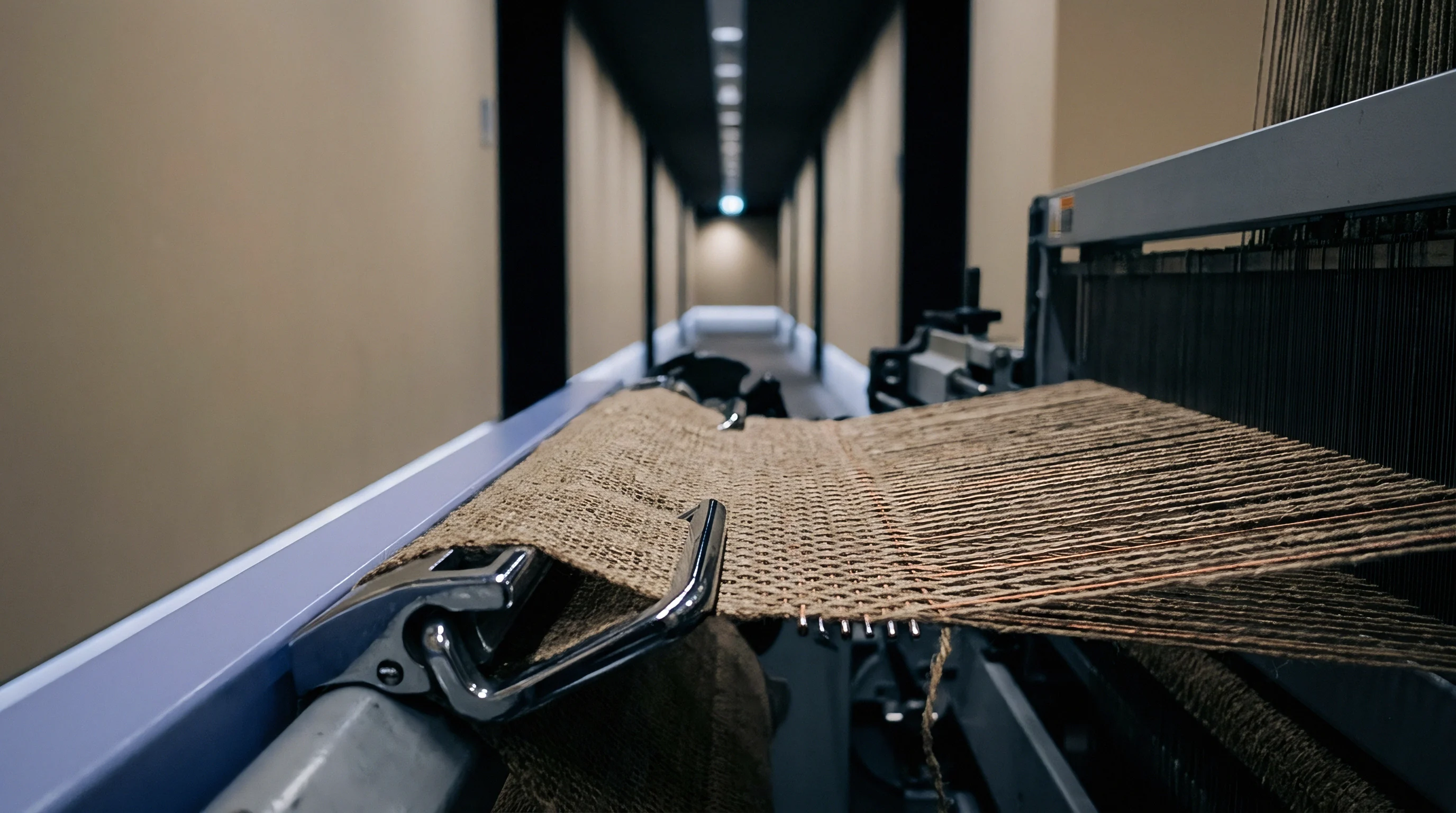
Thermal energy inside the wet spinning trough dictates the speed and depth of water penetration into the core of the roving strand. Industrial wet spinning troughs maintain water temperatures between 55 degrees Celsius and 80 degrees Celsius, depending directly on the target yarn count, raw material retting level, and roving preparation.
Operating below 60 degrees Celsius leaves the middle lamella pectins rigid, particularly on unboiled dew-retted line flax. The drafting rollers encounter high mechanical resistance, which increases torque demands on the drafting drive and causes slippage at the rubber-covered pressing rollers. Operating above 75 degrees Celsius accelerates pectin dissolution to a degree that weakens the cohesive friction between elementary fibers, causing uncontrolled floating fibers and fiber drafting breaks before the spinning triangle.
| Yarn Count (Nm) | Trough Water Temp (°C) | Immersion Path (mm) | Wetting Agent Conc (g/L) | Spindle Speed (RPM) | Tenacity Range (cN/tex) |
|---|---|---|---|---|---|
| Nm 39 (25.6 tex) | 60 to 65 | 180 to 220 | 0.5 to 1.0 | 5800 to 6200 | 28.0 to 32.5 |
| Nm 48 (20.8 tex) | 65 to 70 | 220 to 260 | 1.0 to 1.5 | 5400 to 5800 | 29.5 to 34.0 |
| Nm 60 (16.7 tex) | 70 to 75 | 240 to 300 | 1.5 to 2.0 | 4800 to 5200 | 31.0 to 36.5 |
| Nm 75 (13.3 tex) | 75 to 80 | 280 to 340 | 2.0 to 2.5 | 4200 to 4600 | 32.5 to 38.0 |
Thermal Gradient Distribution across Trough Length
Individual trough sections on continuous spinning frames house between 40 and 120 spindles. Temperature gradients across the trough length introduce spindle-to-spindle count variations and uneven yarn hairiness. Troughs heated by direct low-pressure steam injection often suffer from localized hot zones exceeding 85 degrees Celsius near steam inlet nozzles, while dead corners drop below 50 degrees Celsius.
Closed-loop water circulation circuits equipped with external plate heat exchangers maintain trough temperatures within a tight tolerance band of positive or negative 1.5 degrees Celsius across the entire machine rail. Uniform thermal exposure ensures that every roving package undergoes identical pectin plasticization prior to drafting roller engagement.
The operational standard across fine counts rejects direct open-pipe steam injection without mechanical circulation.
Passage
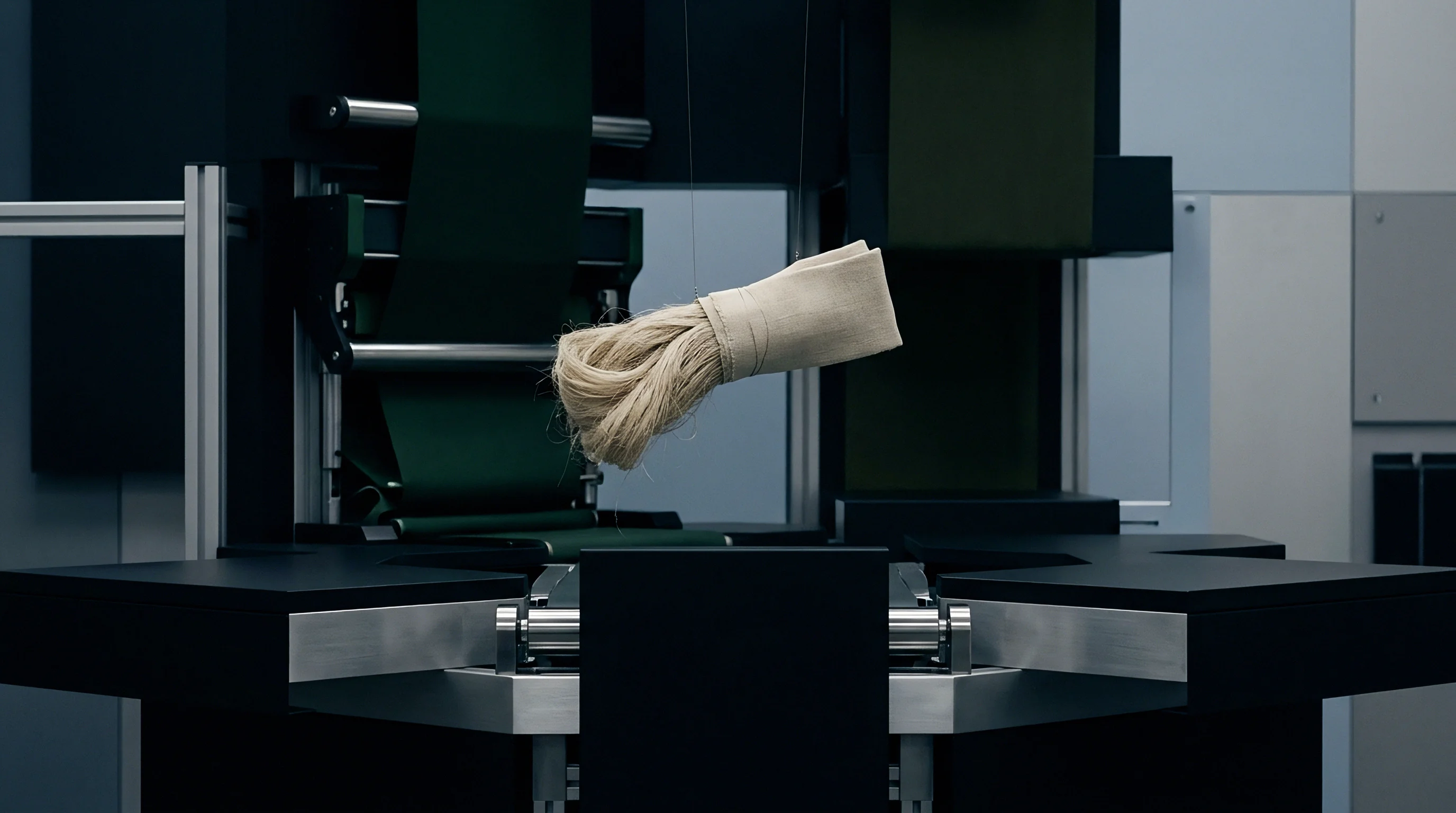
The physical transit of the roving through the spinning bath governs the liquid absorption volume. Immersion depth and path trajectory determine the exact duration of contact between the hot liquor and the moving fibrous assembly. When frame delivery speeds rise to maximize output, immersion time contracts unless guide geometry compensates accordingly.
Submerging the roving requires submerged ceramic or stainless steel guide rods positioned between the roving creel and the back retaining nip. Altering the vertical position of these guide rods modifies the contact angle and total submerged length from 150 millimeters to 350 millimeters.
Can Guide Geometry Offset Delivery Speed Fluctuations?
Increasing delivery speeds from 18 meters per minute to 26 meters per minute reduces roving bath residence time by over thirty percent when using stationary guide rods. Compensating for this reduced dwell time requires extending the physical path length by adjusting the lower guide bracket downward into the deepest section of the trough.
Insufficient immersion time leaves the core fibers of the roving dry, creating a stiff center surrounded by a softened perimeter. This differential hydration produces split drafting, where the softened outer fibers draft out smoothly while the dry core fibers pass as unattenuated bundles, generating severe yarn diameter irregularity.
A wet linen spinning contract requires roving immersion time to remain above 0.8 seconds to prevent dry-core drafting faults.
Fine yarn counts demand higher immersion times than coarse yarns because the total drafting ratio is substantially larger, often set between 15 and 25 on long-staple wet frames. The high draft ratio requires total separation down to elementary fibers, demanding complete transverse hydration across the entire roving cross-section.
The adjustment of guide depth matches the precise delivery speed on each frame to secure continuous chemical saturation.
Surfactant
Water alone exhibits a high surface tension of approximately 72 millinewtons per meter at room temperature, which drops to around 63 millinewtons per meter at 70 degrees Celsius. Flax fibers carry residual natural waxes, cutin, and lignified fractions on their outer surfaces that repel pure water. Adding specialized chemical auxiliaries to the wet spinning trough lowers bath surface tension to below 32 millinewtons per meter, driving rapid liquor penetration into the tight twists of the roving.
Nonionic wetting agents and mild softening surfactants applied at concentrations between 0.5 grams per liter and 2.5 grams per liter accelerate core wetting without generating excessive foam in agitated troughs. Rapid penetration prevents dry roving cores at high linear yarn speeds.
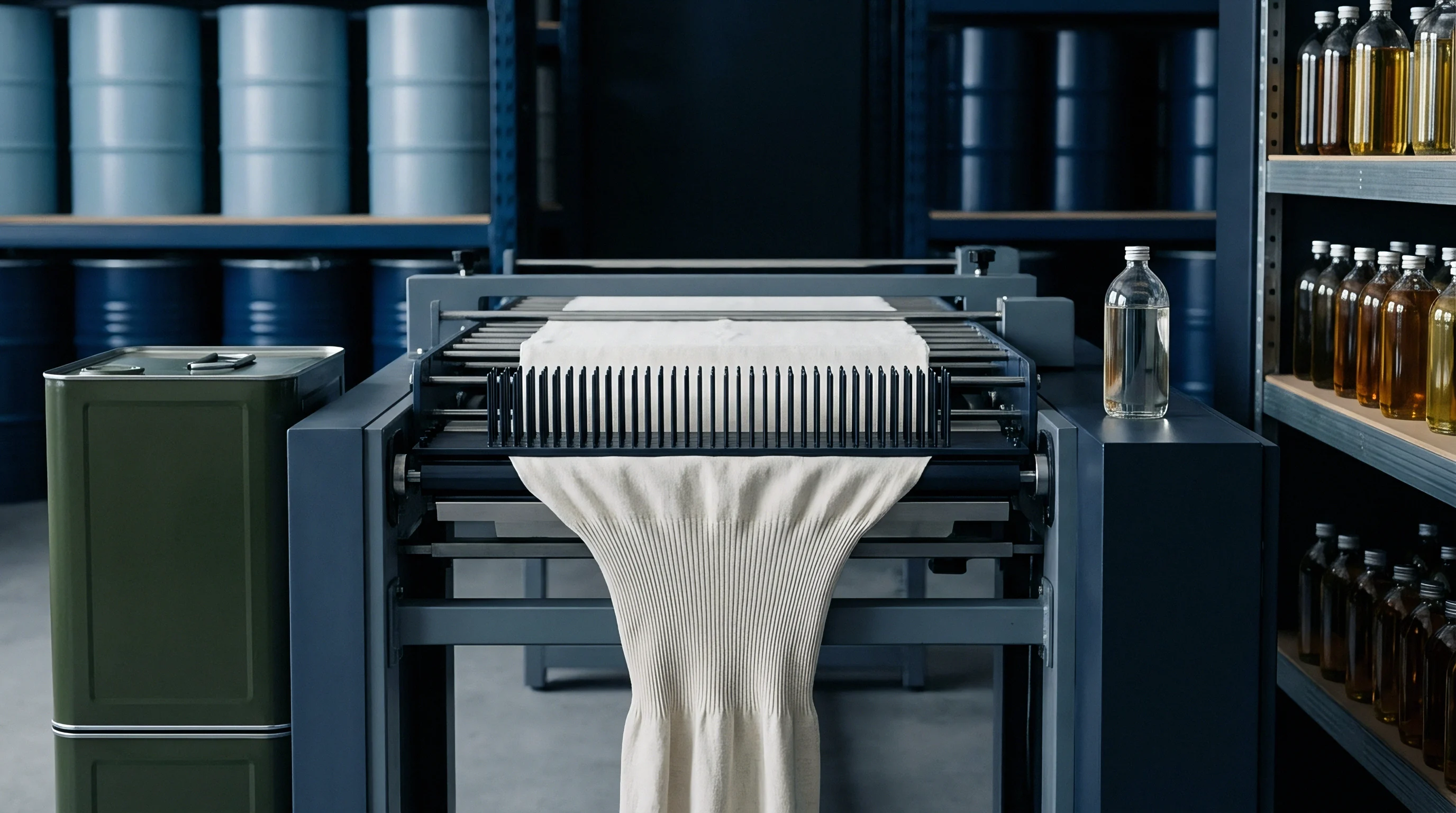
Auxiliary Formulations and Foaming Risks
Anionic surfactants provide rapid wetting action but tend to generate high volumes of stable foam under the continuous mechanical agitation caused by moving rovings and water circulation pumps. Foam accumulates on guide rods, causing roving vibrations, tension fluctuations, and dry fiber entrainment. Ethoxylated fatty alcohols and low-foaming polyether-modified silicones provide rapid wetting speeds while remaining stable at temperatures up to 80 degrees Celsius.
- Raw Roving Degreasing Agents accelerate the dispersion of surface waxes, permitting immediate moisture penetration across dew-retted stock within 0.4 seconds of bath entry.
- Pectin Dispersing Auxiliaries prevent dissolved calcium pectates from precipitating back onto ceramic thread guides, machine rollers, and ring surfaces.
- Synthetic Fiber Lubricants reduce frictional drag over the retaining guides and drafting nips, moderating roving tension spikes before entering the drafting zone.
- Chelating Compounds bind free calcium and magnesium ions in hard water supplies, protecting bath stability and preserving consistent pectin extraction efficiency.
Chemical dosing must remain linked to fresh water top-up rates. Automated dosing units metering surfactants into closed-loop feed lines ensure uniform chemical concentration across three continuous working shifts.
Suppliers often attribute poor yarn hairiness and low strength to raw flax lot quality when the root fault sits in neglected surfactant replenishment tanks.
Draft
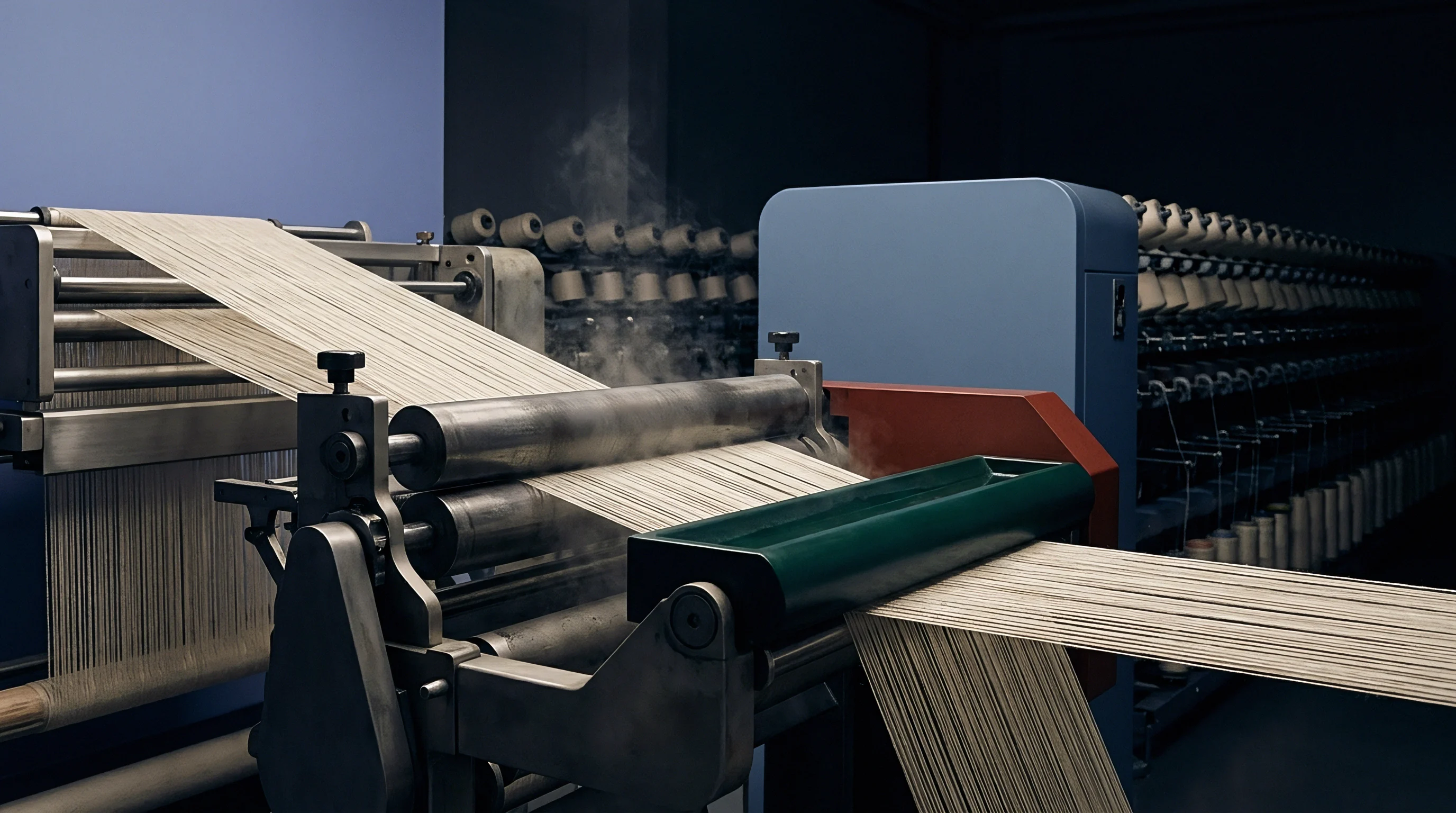
Drafting in wet linen spinning takes place in a narrow zone situated immediately downstream of the trough exit. The ratch distance, which represents the distance between the retaining roller nip and the drawing roller nip, is set according to the staple length of the elementary fibers rather than the long composite bundles. For line flax wet spinning, typical ratch settings range from 45 millimeters to 70 millimeters, contrasting sharply with the 200 to 400 millimeter settings utilized in dry long-staple bast fiber drafting.
The wet roving leaves the bath carrying between 100 percent and 180 percent water by dry weight. As the fluted drawing rollers accelerate the fibers, water acts as both a lubricant and a cohesive medium. Surface tension forces within the thin liquid films between wet ultimate fibers maintain parallel alignment and prevent the strand from flaring outward into excessive yarn hairiness prior to twist insertion by the ring and traveler.
Excessive water carrying on fine roving packages washes out required inter-fiber cohesion and causes draft slippage at the bottom drawing roller.
The retaining roller pressure is critical; insufficient load allows the wet, lubricated roving to slip through without proper attenuation. Roller pressures between 40 decanewtons and 80 decanewtons per boss are standard, applied via heavy spring loading or pneumatic pressure arms.
Roller Fluting Profiles and Nip Dynamics
Drawing rollers on wet frames operate in harsh, wet environments containing dissolved pectins, fiber debris, and acidic process water. The top drafting rollers utilize specialized synthetic rubber cots with shore hardness ratings between 85 and 95 Shore A, or traditional fluted brass rollers matched against helical fluted steel bottom rollers. The fluting pitch and profile mechanically grip the lubricated fiber assembly, preventing localized drafting slippage.
| Yarn Count (Nm) | Ratch Distance (mm) | Total Draft Ratio | Top Roller Hardness (Shore A) | Nip Load (daN/boss) |
|---|---|---|---|---|
| Nm 39 (25.6 tex) | 60 to 68 | 12.0 to 16.0 | 85 to 88 | 50 to 60 |
| Nm 48 (20.8 tex) | 52 to 60 | 15.0 to 18.5 | 88 to 92 | 55 to 65 |
| Nm 60 (16.7 tex) | 46 to 54 | 17.0 to 22.0 | 90 to 95 | 60 to 70 |
| Nm 75 (13.3 tex) | 42 to 48 | 20.0 to 26.0 | 92 to 95 | 65 to 75 |
The drafting force is monitored through periodic load cell auditing across the roller stands. An unstable drafting force profile directly indicates fluctuating bath conditions or erratic roving twist levels.
The resulting yarn quality depends on whether the drafting system achieves pure elementary fiber displacement or suffers clump pull-through from incomplete retting degradation.
Waste
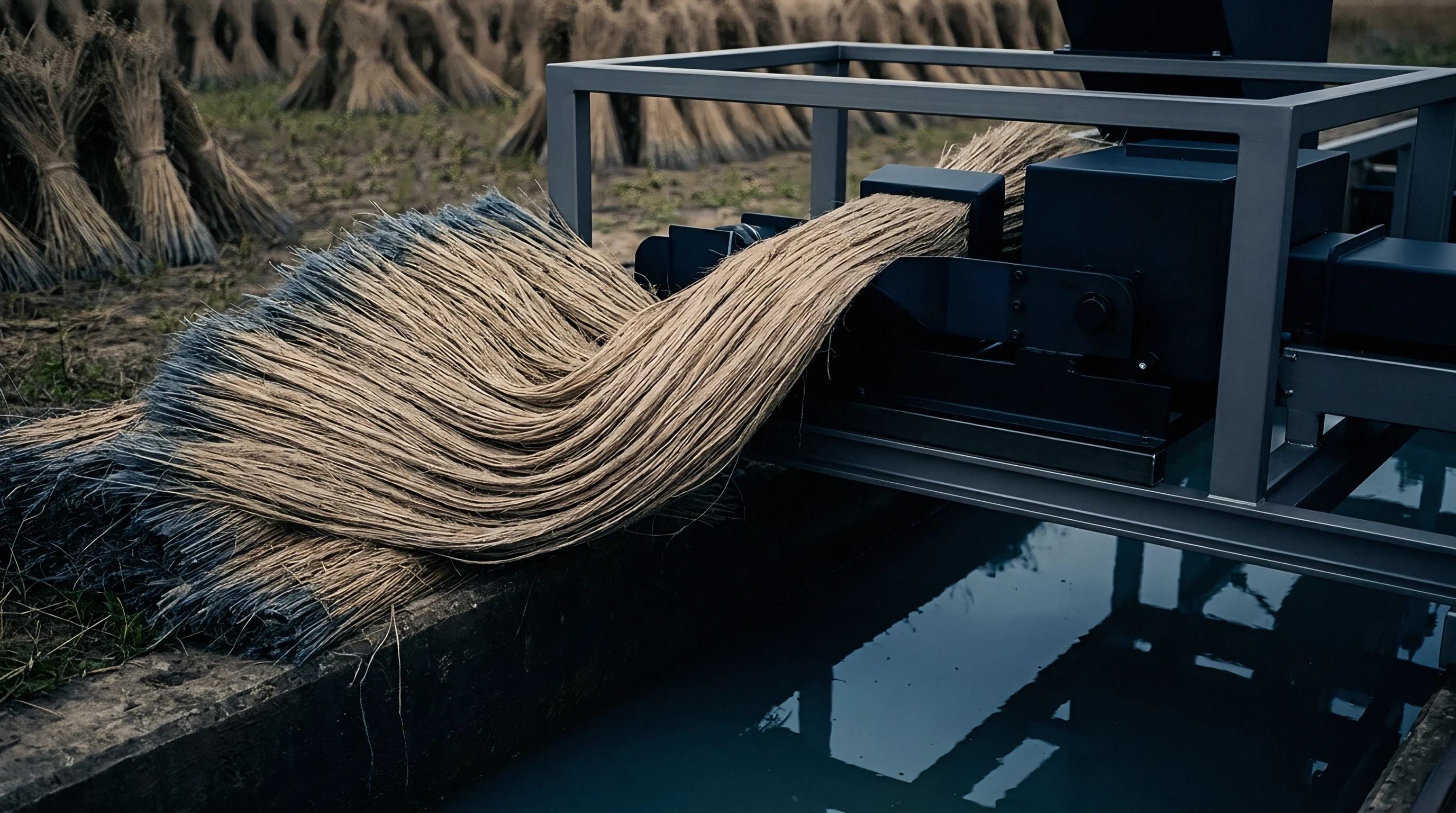
The wet spinning trough generates a concentrated liquid effluent and solid fiber slub waste that directly impacts operational yield and spinning floor cleanliness. As rovings pass through the hot water bath, soluble components dissolve, shedding up to 5 percent of roving dry mass into the liquor. This discharge contains water-soluble sugars, degraded pectins, hemicelluloses, mineral salts, and processing surfactants.
Without regular trough blowdown and automated filtration, dissolved solids accumulate rapidly, turning the bath turbid, acidic, and viscous. High pectin concentration in the recirculating water redeposits sticky residues onto the ceramic guides, drafting aprons, and fluted rollers. These deposits accumulate short fly fibers, forming laps around the drafting rollers that force frame stoppages and create yarn breaks.
Effluent Filtration and Bath Turnover Rates
Fine count spinning mills establish continuous water exchange protocols to prevent bath saturation. Fresh water makeup rates are maintained at 0.5 to 1.5 liters per spindle per hour. Overflow channels carry contaminated liquor through multi-stage mechanical wedge-wire screens to remove suspended fiber fragments before routing the stream to thermal recovery units and wastewater treatment plants.
Process bath biological oxygen demand (BOD) and chemical oxygen demand (COD) require continuous monitoring. High bath temperatures accelerate the thermal degradation of dissolved organic carbohydrates, producing volatile organic acids that drop the bath pH from neutral 7.0 down to acidic ranges between 4.2 and 5.0. Acidic process water corrodes machine steel components and alters the swelling behavior of the flax cell walls.
A standard quality specification for linen yarn weaving performance mandates an evenness coefficient of variation below twelve percent, which cannot be achieved when contaminated bath residues cause roller lap friction.