Viscoelastic Stress Decay Mechanics in Dense Flax Yarns
Dense flax yarn stress decay stems from matrix shear along cellulose microfibrils, requiring active let-off compensation to prevent restart density defects.

Relaxation
Longitudinal tension applied to high-count bast bundles decays across logarithmic time scales. The initial elastic response originates within crystalline cellulose fibrils aligned along the cellular axis, while subsequent load dissipation occurs inside the surrounding matrix of amorphous hemicellulose, lignin, and pectin polymers. High internal packing constraints force these macromolecular chains to redistribute shear forces across adjacent elementary fibers.
When sustained mechanical strain holds a flax yarn at fixed elongation, secondary hydrogen bonds within the amorphous polysaccharides rupture, reform at lower potential energy states, and release stored internal stress.
Sustained warp extension at two percent elongation produces a thirty-eight percent loss in peak tensile load within six hundred seconds under standard laboratory conditions of twenty degrees Celsius and sixty-five percent relative humidity.

Primary Mechanisms of Load Loss in Bast Bundles
Wet-spun flax yarns exhibit pronounced viscoelastic phenomena caused by the structural hierarchy of the bast bundle. Elementary fibers, measuring ten to thirty micrometers in diameter, adhere to one another through a middle lamella rich in polygalacturonides and rhamnogalacturonans. Tensile forces induce axial strain within individual cell walls while shearing the interfibrillar matrix.
The cellulose microfibrils possess a spiral angle of eight to eleven degrees relative to the fiber axis. Applied tension rotates these crystalline helices toward the axial plane, compressing the non-cellulosic matrix and driving viscous flow.
Chain slippage within the amorphous zones exhibits non-linear behavior under high initial loads. The rate of stress dissipation correlates directly with the density of the yarn cross-section. Compact ring-spun and wet-spun configurations restrict lateral fiber mobility, intensifying localized shear stresses at contact zones between neighboring elementary fibrils.

When Do Microfibril Dislocation Bands Slip?
Transverse defects, termed dislocation marks or kink bands, develop along flax fibers during mechanical decortication and scutching. These damaged locations interrupt the crystalline continuity of the secondary cell wall. Under sustained static strain, dislocations act as localized stress concentrators that initiate permanent plastic slip at load thresholds below the theoretical yield point of pristine native cellulose.
Internal stress relaxation within dense yarns follows a two-stage temporal progression. The rapid primary phase lasts between one and sixty seconds, dominated by entropic elasticity loss within amorphous pectin domains. The secondary phase extends across hours, governed by the slow uncoiling of cellulose microfibril aggregates and the permanent destruction of calcium-pectate cross-links.
Dense structural packing prolongs the relaxation continuum by restricting moisture ingress, which otherwise accelerates viscous dissipation through plasticization.
Fibers with higher crystalline fractions sustain tension longer than poorly retted bundles containing elevated pectin residues.

Twist
Mechanical cohesion in dense flax strands depends on the radial pressure generated by helical yarn geometry. The twist multiplier determines the balance between axial load-bearing capacity and transverse shear dissipation. High twist levels elevate the inward normal force exerted by outer fibers upon inner bundle cores, altering the relaxation kinetics of the composite yarn.
Which Twist Factors Restrain Amorphous Flow?
Yarn consolidation levels directly shift the relaxation modulus across extended dwell periods. When the twist multiplier αmetric exceeds one hundred and twenty, transverse compressive forces restrict the lateral displacement of individual elementary fibers. This mechanical constraint impedes macromolecular chain realignment in the amorphous middle lamella, slowing the rate of stress dissipation under continuous warp line load.
Lower twist multipliers permit rapid inter-fiber slippage, causing the yarn to behave like a fluid dashpot rather than a viscoelastic solid under high static strain.
| Yarn Count (Nm) | Twist Multiplier (αm) | Initial Tension (cN/tex) | Decay at 60s (%) | Decay at 3600s (%) | Residual Modulus (cN/tex) |
|---|---|---|---|---|---|
| 9.6 | 85 | 14.2 | 28.4 | 46.2 | 7.6 |
| 9.6 | 115 | 18.7 | 21.1 | 37.5 | 11.7 |
| 15.0 | 95 | 16.5 | 25.8 | 42.1 | 9.5 |
| 15.0 | 125 | 21.3 | 18.6 | 33.2 | 14.2 |
| 26.0 | 105 | 19.8 | 22.9 | 39.8 | 11.9 |
| 26.0 | 135 | 24.6 | 15.4 | 29.1 | 17.4 |
| 39.0 | 110 | 22.1 | 20.3 | 36.4 | 14.0 |
| 39.0 | 140 | 27.8 | 13.8 | 26.5 | 20.4 |

Radial Packing Density and Interfilament Friction
The cross-sectional packing fraction of wet-spun flax reaches values between 0.70 and 0.82, leaving minimal void space between elementary bast filaments. As tension stretches the yarn, the helical path of the outer filaments generates a compressive inward force proportional to the square of the twist angle. This inward pressure increases static friction between adjacent cell walls, counteracting axial slippage.
Under high twist, transverse compression forces elementary fibers into intimate contact, transferring shear stress directly through the middle lamella. When this interfacial layer yields, stress decay accelerates across the entire yarn core.
- Interfibrillar Pectin Shearing occurs when transverse frictional resistance drops below the viscous shear threshold of the non-cellulosic middle lamella.
- Microfibril Helix Reorientation shifts crystalline domains toward the principal yarn axis, dissipating internal strain energy without causing macroscopic fiber separation.
- Dislocation Band Collapse concentrates localized strain at scutching damage sites, producing irreversible plastic elongation in individual elementary fibers.
- Cortical Layer Cleavage separates outer fiber bundles from the central core under excessive torsional and tensile loads.
Higher twist levels reduce warp relaxation, but extreme twist elevates yarn brittleness and accelerates abrasive shedding during high-speed shed changes.

Dwell
Machine interruptions alter the stress equilibrium of the warp sheet. During normal loom operation at four hundred picks per minute, yarn elements experience cyclic tension peaks lasting less than eighty milliseconds per shed change. When the loom stops for bobbin changes, warp repair, or shift changeovers, the yarns remain held at static peak extension.
Stress decay proceeds continuously throughout this standstill.
ISO 13934 test protocols verify that uncompensated bast yarn tension drops exceeding twenty percent during standstill periods generate visible starting marks across the finished woven substrate.

Cyclic Shed Opening and Static Standstill Decay
The warp line operates under dynamic tension fluctuations between the closed shed position and the fully open shed geometry. In dense plain constructions, the beat-up stroke imposes an additional transient load spike on the warp ends. Under continuous cycling, the short duration of the peak load prevents substantial viscous flow, maintaining a high dynamic elastic modulus.
During an unscheduled stoppage with the shed open, the upper and lower warp sheets undergo differential stress relaxation. The shed geometry forces one sheet to sustain higher extension than the other, resulting in asymmetric stress decay. Upon restarting, the relaxed warp yarns fail to provide normal beat-up resistance, causing pick density deviations across the restart zone.
| Downtime Duration (s) | Upper Sheet Decay (%) | Lower Sheet Decay (%) | Residual Warp Tension (cN/end) | Pick Spacing Error (mm) | Visual Fault Grade (ASTM D5430) |
|---|---|---|---|---|---|
| 10 | 8.4 | 6.1 | 312 | +0.04 | Acceptable |
| 30 | 14.7 | 10.8 | 288 | +0.09 | Acceptable |
| 120 | 23.2 | 16.5 | 251 | +0.18 | Minor Defect |
| 300 | 31.6 | 22.4 | 218 | +0.32 | Major Defect |
| 1800 | 41.2 | 29.8 | 184 | +0.55 | Major Defect |
| 3600 | 47.5 | 34.1 | 162 | +0.72 | Critical Defect |
| Warp specification: Nm 26/1 wet-spun flax, 28 ends per centimeter, reed width 185 cm, nominal running tension 350 cN per end at 21 degrees Celsius and 68 percent relative humidity. | |||||
Asymmetric Crimp Redistribution across Shed Pauses
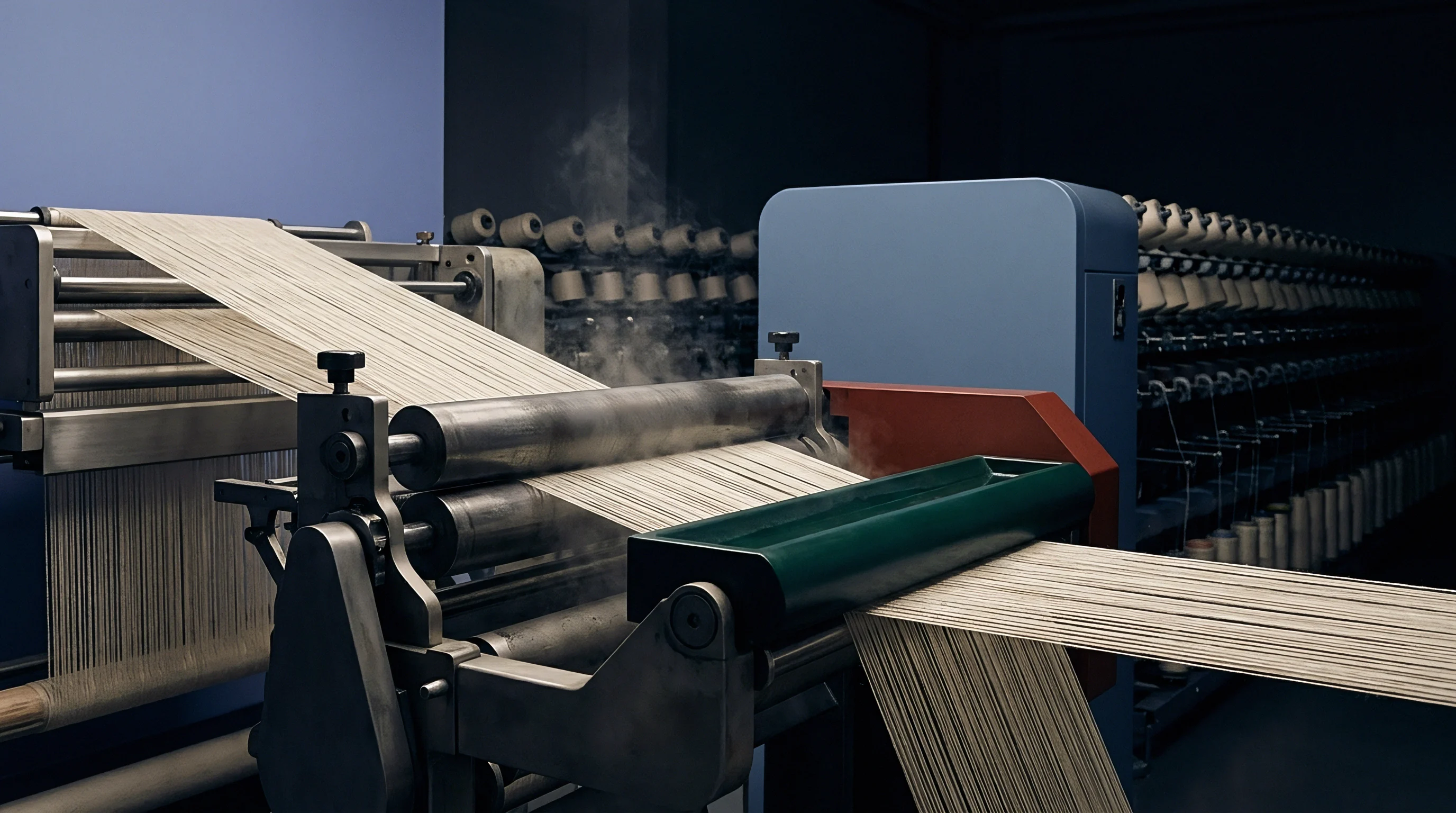
Tension discrepancies between warp and weft yarns induce severe structural distortion when the loom pauses. In dense interlacing patterns such as 1/1 plain weave or 2/2 twill, interlacing crimp geometry depends on continuous equilibrium between warp tension and weft insertion resistance. When warp tension decays during a machine stop, the high lateral forces exerted by compressed picks force the warp ends to buckle out of the horizontal plane.
The displaced warp yarns absorb excessive crimp from the adjacent picks. When the main motor re-engages, the first inserted pick packs into an unstable, relaxed shed, producing dense bands or open cracks depending on whether the stop occurred on a crossing shed or an open shed.
- Tension Sensing identifies the drop in warp beam torque through continuous load cell monitoring at the back rest roller.
- Let-Off Backtracking rotates the warp beam in reverse by a calculated step increment to restore nominal baseline tension before main drive engagement.
- Shed Leveling closes the heald frames to equal height during dwell periods exceeding fifteen seconds to balance decay rates across both yarn sheets.
- Beat-Up Position Offsetting advances the sley position by a calibrated micro-distance on the initial restart pick to offset lost yarn modulus.
Ignoring shed-leveling protocols during long stops generates structural band defects that lead directly to the rejection of entire cloth rolls at the grading frame.

Modulus
Accurate prediction of stress relaxation in dense flax yarns requires mathematical characterization through generalized viscoelastic models. The classical linear elastic modulus fails to describe the behavior of bast fibers subjected to sustained strains. The time-dependent relaxation modulus E(t) incorporates multiple discrete relaxation times corresponding to distinct molecular motions within the complex composite cell wall.
A generalized Maxwell model combining several Maxwell elements in parallel with an isolated spring captures the multi-phase relaxation spectrum of wet-spun flax. Each Maxwell unit consists of a Hookean spring with stiffness Ei coupled in series with a Newtonian dashpot having viscosity ηi, yielding a characteristic relaxation time τi = ηi / Ei.
A dense flax yarn under steady strain loses more tensile resistance in sixty seconds than it does over the subsequent ten hours of continuous loading.

Constitutive Viscoelastic Modeling via Generalized Maxwell Elements
Stress decay behavior under constant strain ε0 follows the constitutive equation where total stress σ(t) equals the sum of decaying exponential terms plus an equilibrium stress term σ∞:
σ(t) = ε0
For wet-spun flax of count Nm 26, fitting experimental decay data across a time range of 0.1 to 3600 seconds resolves into three distinct relaxation times. The fastest relaxation spectrum (τ1 = 1.2 to 2.5 seconds) represents conformational changes and hydrogen bond breakage in the non-crystalline pectin matrix. The intermediate spectrum (τ2 = 35 to 60 seconds) corresponds to shear relaxation along the middle lamella interface between elementary fibers.
The long-term spectrum (τ3 = 800 to 1400 seconds) describes the reorientation of cellulose microfibrils and irreversible plastic flow across dislocation zones.
| Relative Humidity (%) | Equilibrium Modulus E∞ (cN/tex) | Spring Modulus E1 (cN/tex) | Time Constant τ1 (s) | Spring Modulus E2 (cN/tex) | Time Constant τ2 (s) |
|---|---|---|---|---|---|
| 45 | 16.8 | 5.4 | 2.8 | 4.2 | 68.4 |
| 55 | 14.2 | 6.1 | 2.1 | 4.8 | 52.1 |
| 65 | 11.5 | 7.3 | 1.6 | 5.6 | 41.3 |
| 75 | 8.9 | 8.8 | 1.1 | 6.7 | 29.5 |
| 85 | 5.7 | 10.4 | 0.6 | 8.1 | 16.2 |
Environmental Plasticization and Tensile Decay Verification
Water acts as a direct plasticizer within the hydrophilic polysaccharide matrix of the bast fiber. Moisture molecules infiltrate the amorphous regions, breaking inter-chain hydrogen bonds between adjacent hemicellulose polymers. This hydration increases free volume within the matrix, accelerating viscous flow under lower applied shear forces.
At forty-five percent relative humidity, the middle lamella maintains high rigidity, limiting sixty-second load loss to less than fifteen percent of initial peak tension. Increasing relative humidity to eighty-five percent doubles the rate of stress dissipation, lowering equilibrium modulus E∞ by sixty-six percent.
- Condition yarn packages for twenty-four hours in a controlled atmosphere matching ISO 139 specifications at twenty degrees Celsius and sixty-five percent relative humidity.
- Mount single yarn specimens in pneumatic tensile grips with an initial gauge length of five hundred millimeters using rubber-faced jaw inserts.
- Accelerate the crosshead at a constant rate of five hundred millimeters per minute until reaching a target elongation of two percent.
- Halt crosshead movement instantly upon attaining target extension, recording load data points at a minimum acquisition frequency of one hundred Hertz.
- Log load decay continuously for three thousand six hundred seconds across logarithmic time intervals.
- Calculate instantaneous relaxation rates and fit data curves to the three-term Maxwell model to establish spring-dashpot constants.
In weaving sheds lacking tight humidity regulation, localized moisture swings along the warp line cause variable relaxation rates, resulting in uneven beat-up density across the reed width. Whether modern chemical cross-linking treatments can stabilize amorphous pectin domains against moisture-induced stress relaxation without destroying the intrinsic flexural hand of woven linen remains an active dispute between yarn processors and finishing mills.


Ledger
Stress decay characteristics dictate the operational economics of running high-density linen on modern high-speed rapier and air-jet looms. Warp tension stability directly governs machine stops per hundred thousand picks, warp break frequencies, and grading penalties. When a mill fails to compensate for bast fiber stress relaxation, the landed cost per meter increases through lost efficiency and off-quality claims.
Shed humidity fluctuations exceeding five percent relative humidity shift warp relaxation rates enough to generate measurable pick density variations across a single beam length.

Loom Efficiency Penalties and Stop Mark Settlement
Warp preparation for dense flax demands specialized beam sizing and precise tension control. An uncompensated stop mark requires manual inspection and remediation. On a standard rapier loom running at four hundred and twenty picks per minute producing twenty-eight picks per centimeter, a single two-minute stoppage due to a false warp stop costs eighty-four potential inserted meters per hour across a forty-loom shed.
The commercial consequence of unmanaged viscoelastic stress decay appears on the final settlement sheet. If restart marks exceed the four-point limit defined in ASTM D5430, the buyer applies monetary deductions ranging from fifteen to forty percent of the greige price per meter. Slower running speeds reduce dynamic load peaks but elevate loom-hour allocations, driving up the baseline conversion cost per woven meter.

Commercial Recourse on Creep-Induced Density Variance
Finished linen specifications mandate tight tolerances on picks per centimeter and aerial weight. When warps suffer uncontrolled stress relaxation during weaving stops, local pick densities deviate by up to twelve percent from nominal targets. This variation causes width contraction irregularities and uneven shrinkage during subsequent desizing, scouring, and bleaching processes.
Purchasing contracts for high-density linen goods avoid general performance descriptors, establishing explicit testing requirements and monetary remedies for mechanical deviations.
Under international trade contracts governed by the International Bureau for the Standardisation of Man-Made Fibres rules adapted for natural bast yarns, structural defect allowances specify that any continuous piece containing more than three uncorrectable starting marks per fifty linear meters entitles the buyer to an immediate debit note covering fifteen percent of the invoice value for the affected roll, with defects exceeding five marks per fifty meters triggering full rejection of the dye lot.