Active Ease off Mechanical Calibration for Low Extension Flax Yarns
Active ease-off calibration couples positive mechanical linkages to shed timing, absorbing shedding peaks to keep low-extension flax warps below yarn break limits.
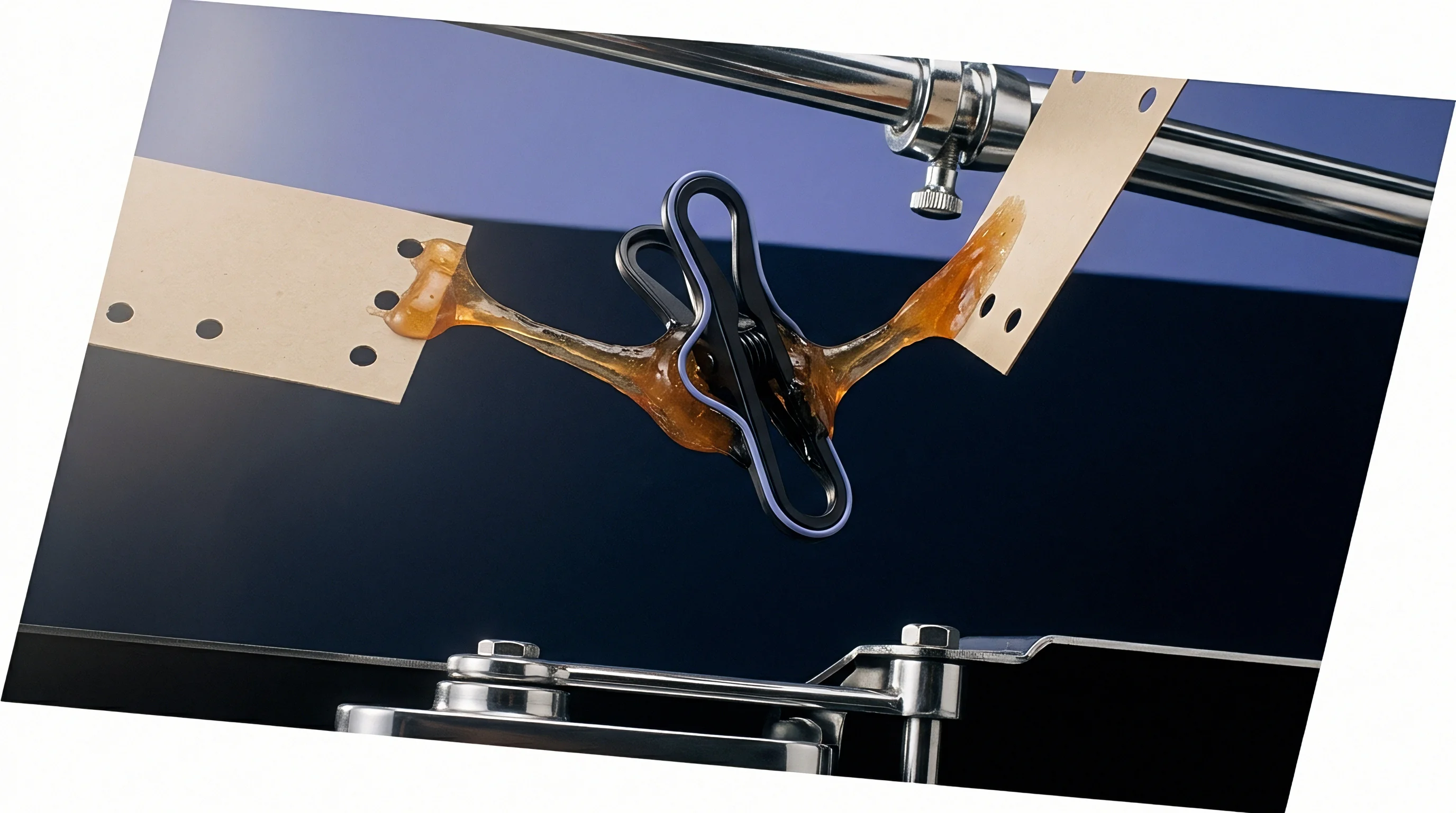

Link
Flax tow and line yarns have an elongation at break of 1.5% to 2.8% and an initial elastic modulus above 60 GPa. In a rigid warp path, shed opening displacement turns directly into destructive tensile spikes. Synthetic filaments and long-staple cotton stretch under shed lift, but bast fibers reach their rupture point within fractions of a millimeter if beam displacement is uncompensated.
An active mechanical ease-off linkage acts as a positively driven kinematic compensator, coupling the loom main shaft or dobby jack levers to an oscillating back-rest roller. As the shed opens, the linkage pushes the back-rest forward toward the heddles, yielding linear yarn length just as the rising and falling harness frames lengthen the shed path.
Static dead-weight and simple spring-loaded back-rest assemblies fail on low-extension linen warps. On modern rapier looms running between 350 and 550 picks per minute, mechanical inertia keeps a passive spring from reacting in the millisecond windows available. The spring stays compressed through the opening phase, forcing wet-spun or dry-spun flax fibers to take the full shedding strain ~ stripping yarn hairiness and causing ends to cling in the drop wires.
The active ease-off linkage replaces passive inertia with a positive drive rod connected to an eccentric crank or conjugated cam, enforcing an exact, repeatable geometric position on the oscillating roller at every degree of loom rotation.
A positive linkage displaces the oscillating roller in fixed mechanical register with shed expansion, bypassing the inertial lag of spring packs.
Setting the primary ease-off linkage requires calculating shed geometry with care. When harness frames lift for an 85 mm shed opening to allow rapier insertion, total warp path length from back-rest to cloth fell grows across a 28-shaft dobby. The stroke amplitude of the oscillating roller offsets this change.
Technicians alter stroke throw by adjusting the radial pin position on the eccentric drive disc, matching yarn counts from 14 Nm dry-spun flax up to 52 Nm wet-spun flax. If the throw is set too long, tension drops below the minimum needed for clean warp separation, causing faulty shed splits, skipped picks, and rapier entrapment.
Stiffer warps need earlier stroke compensation to stop peak tension from stripping outer fiber bundles. Unboiled, sized wet-spun flax with residual pectin content lacks internal compliance, so the mechanic advances or retards the drive eccentric against the main shaft degree wheel to align the ease-off dead-point with maximum harness lift. Correct alignment keeps cyclical warp tension inside a narrow band, protecting brittle bast fibers from mechanical shock.
Coarse yarn counts require wider stroke arcs than fine linen warps to clear identical shed geometry.
Geometry
Back-rest position determines the entry angle of the warp into the harnesses and how tension splits between upper and lower shed sheets. Raising the back-rest roller 20 mm above the horizontal plane of the cloth fell creates an asymmetrical warp path. The upper shed carries lower tension during beat-up, while the lower sheet pulls tight against the race board.
On low-extension flax yarns, this tension difference prevents yarn rollover and stops bottom-shed sag that would otherwise snag rapier guides during insertion at high pick densities.
The stroke displacement of the oscillating motion must follow a vector that bisects the angle between the warp line coming off the beam and the line continuing toward the drop wires. If the oscillation vector is misaligned, the roller pushes into the yarn at an acute angle, turning drive torque into surface abrasion against the flax bundles. That friction strips sizing starch and builds up lint snow under the drop wire box.
| Yarn Count (Nm) | Shed Opening (mm) | Oscillating Stroke (mm) | Phase Advance Relative to Heald Cross (deg) | Back-Rest Height Relative to Breast Beam (mm) | Warp Tension at Beat-Up (cN per end) |
|---|---|---|---|---|---|
| 14/1 wet-spun | 88 | 14.5 | +12 | +25 | 85 to 95 |
| 26/1 wet-spun | 82 | 11.0 | +8 | +18 | 55 to 65 |
| 36/1 wet-spun | 78 | 8.5 | +5 | +15 | 40 to 48 |
| 48/1 wet-spun | 74 | 6.5 | +4 | +10 | 30 to 36 |
Distance between the oscillating back-rest and the first harness frame controls the elasticity reservoir of the active shed. Increasing this working distance from 950 mm to 1250 mm reduces the linear strain percentage created by a fixed 80 mm harness lift. Where space is tight, as on high-density 24 ends per centimeter linen upholstery canvas, the technician tunes the eccentric link for a shorter, sharper stroke profile to avoid harness rub.
Rocker lever mechanical stops must align with the true dead centers of the drive connecting rod. If play remains in the spherical joint bearings, the back-rest roller rattles upon reversing direction at 400 picks per minute. That backlash sends harmonic flutter through the taut flax ends, breaking fiber nodes and causing end breaks right behind the lease rods.
ISO 7211-2 analysis correlates uncompensated shed stroke with localized yarn fatigue marks along the woven strip.
Asymmetry settings determine whether a plain weave or a 3/1 twill will run cleanly. When weaving twills with three frames down and one lifting, warp displacement on the back-rest is uneven from pick to pick. Moving the pull-rod clevis along the slotted rocker arm adjusts the leverage ratio of the ease-off linkage, resetting the stroke multiplier from 1:1 to 1:1.6.
This maintains clearance on lifting ends without letting stationary heddle groups go slack.
Modern electronic let-off drives are sometimes described as making mechanical back-rest stroke compensation redundant on fine bast fibers.

Synchrony
Active ease-off mechanisms have to work in sync with electronic warp let-off systems. The electronic let-off uses a servo motor to control beam rotation and hold average warp tension over hours of beam runout, but it cannot respond fast enough to adjust for individual shed openings. The servo handles long-term feed rates; the mechanical ease-off linkage handles peak-by-peak displacement.
If the mechanical stroke pulls the back-rest forward just as the let-off load cell detects temporary slack, opposing feedback loops cause motor hunting, creating visible, rhythmic bands of irregular pick density in the cloth.
Synchronizing the system means balancing load cell dampening against mechanical stroke timing. Sensors under the back-rest bracket measure total force across the width of the warp sheet, and stiff flax yarns transfer sharp force spikes to the bracket. The technician uses low-pass analog filtering or tunes servo gain parameters so the motor controller does not mistake the ease-off backstroke for an over-tension spike requiring an instant beam unwind.
A wet-spun 26 Nm linen warp loaded to 60 centinewtons per end experiences microsecond tension spikes exceeding 120 centinewtons when ease-off timing lags heald crossing by more than six crank degrees.
Connecting rod phase alignment fixes the angular position where the back-rest roller hits maximum forward displacement. Ideally, this peak coincides with maximum harness opening, usually between 160 and 180 degrees of the loom cycle. With low-extension linen, forward movement needs to start ahead of the harnesses ~ around 70 degrees ~ to offset flax yarn inertia and establish tension before reed impact.
- Phase angle timing sets the main shaft angle where the back-rest reaches full forward stroke, usually five to eight degrees ahead of heddle frame separation.
- Connecting rod stroke amplitude governs total linear roller displacement, adjusted through the eccentric radial slot to supply between 6 and 16 millimeters of stroke depending on yarn count.
- Electronic load cell dampening prevents the let-off servo from reacting to micro-variations during the mechanical cycle, keeping shed stroke isolated from overall beam feed rate.
- Proximity switch positioning aligns the zero-reference between the ease-off drive crank and the loom controller during crawling and startup.
Jacquard linen fabrics present unpredictable warp extension because end lift varies sharply from pick to pick. Fixed mechanical linkages supply a constant stroke regardless of pattern lift. To handle wide swings in lift, looms use conjugate dual-roller systems: a positively driven primary roller paired with a secondary roller mounted on a modulated torsion bar that absorbs tension spikes beyond the link’s travel.
Whether programmable servo back-rest actuators can equal the long-term reliability of oil-bath mechanical cams in continuous three-shift production remains an open question in commercial weaving sheds.
Defect
Poor ease-off calibration damages both yarn and finished fabric. Because low-extension flax has little plastic deformation, undersized stroke amplitude causes peak shedding tension to cross 50% of single-yarn tensile strength. At that load, flax fibers fracture internally along node cross-markings, leading to fuzzing in the drop wires, lint balling behind the reed, and frequent warp breaks.
Excessive stroke amplitude creates the opposite problem. If the back-rest moves too far forward or rests too long at its front dead-point, warp tension collapses entirely during heddle split. Loose ends cross behind the reed, causing stitching errors, float loops, and mispicks.
They also allow the cloth fell to drift back toward the harnesses, leaving prominent start marks after a pick repair.
| Calibration Error | Visual Fault Manifestation | Root Physical Mechanism | Four-Point Penalty Classification | Greige Rejection Risk Level |
|---|---|---|---|---|
| Insufficient linkage stroke | Warp breaks, hairiness balls, chafed warp streaks | Tensile spike exceeding flax yield point at shed peak | 3 to 4 points per continuous meter | Critical lot rejection |
| Excessive linkage stroke | Loose picks, stitching loops, harness floats | Total tension collapse at maximum shed opening | 2 to 4 points per affected repeat | High cut-out rate |
| Phase timing retarded | Beat-up fell distortion, starting marks | Ease-off roller returning late during reed beat-up stroke | 4 points per machine stop mark | Severe second-quality downgrade |
| Linkage bushing wear | Banded reed marks, cloudy irregular cover | Angular flutter and vibration across back-rest length | 1 to 2 points per linear meter | Moderate sorting required |
Wear in link pins and bearings can throw off calibration within weeks of continuous operation. Just 0.2 mm of slop in the rod end bearings turns into several millimeters of lost motion at the roller surface. That play produces uneven cloth cover and a cloudy appearance in plain-weave linens, where consistent thread alignment is critical.
Uneven tension across the width of the back-rest roller increases edge curl on dense fabrics. Because catch cords and temples hold outer edges under tighter control, the selvedges tolerate less slack than the middle of the warp sheet. The back-rest tube must maintain high torsional stiffness to deliver identical stroke movement from selvedge to selvedge.
Uncalibrated ease-off linkages push stop rates past four interruptions per 100,000 picks, dropping loom output and pushing first-quality yields below commercial standards.
Hours
Weaving mills sell loom time as much as fabric yardage. In high-density flax production, ease-off calibration directly affects operating speed, overall equipment effectiveness, and revenue per loom hour. Running a 28 ends per centimeter, 100% wet-spun linen canvas on a 220 cm rapier loom shows the difference clearly: without calibrated active ease-off, speed must be capped at 280 picks per minute to control warp breaks.
With a properly set positive ease-off linkage, the same loom runs cleanly at 420 picks per minute while warp stops drop from 6.5 down to 1.1 per 100,000 picks.
Translating stop rates into cost makes the financial impact obvious. Clearing a single warp stop on a modern rapier loom takes an operator about two minutes to trace the end, draw it through the heddle eye and reed dent, and restart. At five stops an hour, the loom loses nearly 17% of running time, pulling efficiency under 80%.
On fixed overhead of 35 to 45 dollars per loom hour, that loss adds 1.20 to 1.80 dollars per meter in weaving costs on standard 240 g/m² linen.
- Mechanical set-up charges cover four technician hours spent adjusting eccentric stroke cams, setting connecting rod lengths, and dialing in heddle cross angles before beam tying.
- Warp preparation standards require a minimum sizing pick-up of 7% to 9% modified potato starch to protect flax bundles against back-rest abrasion.
- Creel and knotting downtime is minimized by matching ease-off stroke to warp tension profiles, preventing yarn breaks during startup.
- Booking slot allocations depend on audited loom speeds and confirmed efficiency metrics before production contracts are signed.
Wear and maintenance schedules also depend on ease-off tuning. Uncompensated beat-up loads send high peak shocks back into the sley drive, harness eccentrics, and gearbox. Active ease-off systems absorb those forces mechanically, protecting loom tolerances over long production runs.
Sourcing specifications typically mandate ASTM D5430 four-point inspection standards and include contract clauses that bill downtime surcharges to yarn suppliers whenever warp-related stops exceed 2.0 per 100,000 picks.