Mechanical Losses and Fiber Tenacity in Industrial Flax Decortication
Controlled decortication moisture and roller clearances prevent fiber wall dislocations that degrade flax tenacity and trigger contractual price rebates.


Brake
Fluted steel cylinders crush the woody core of deseeded flax straw at twenty-two pairs per pass. Incoming straw carries between nine and twelve percent moisture by weight, registered on calibrated bale probes at the intake hopper. Below nine percent moisture, mechanical impact pulverizes both the woody xylem and the surrounding bast ring; above thirteen percent, adhesive pectin binds cortical tissues tightly to the inner core, resisting breaker roll separation.
The nip clearance between interlocking flutes sets the initial shear threshold, which operators dial down to fractions of a millimeter depending on straw stem diameter and cultivar stem wall thickness.
Mechanical decortication separates non-fibrous shive from spinnable bast ribbon through controlled bending and compression. A speed differential between successive roller pairs exerts longitudinal tension while the corrugated profiles crack the rigid woody stem, dropping broken shive fragments through under-grids into pneumatic collector ducts. Industrial lines run three to four metric tons of unretted or dew-retted straw per hour, generating substantial dust and acoustic energy.
The process demands exact control over nip pressures: excessive cylinder load fractures the primary cell walls of individual fibers before scutcher beaters ever touch the material.
| Processing Stage | Roller Configuration | Differential Ratio | Mass Yield Fraction | Dominant Material Component |
|---|---|---|---|---|
| Initial Breaker Feed | Coarse Flute 18 mm Pitch | 1.00 to 1.05 | 0.92 to 0.95 | Cracked Intact Stem |
| Intermediate Breaking | Medium Flute 12 mm Pitch | 1.08 to 1.15 | 0.68 to 0.74 | Partially Cleaned Bast Ribbons |
| Fine Breaker Pass | Fine Flute 8 mm Pitch | 1.18 to 1.25 | 0.48 to 0.55 | Coarse Fiber Bundles |
| Grid Underflow Discharge | Perforated Steel Grates | Static Ejection | 0.42 to 0.48 | Xylem Shive and Cortical Dust |
Dew-retting duration dictates stem friability under these mechanical loads. Field-retted straw exposed to alternating rain and solar radiation experiences fungal pectinolysis by Cladosporium herbarum and Epicoccum nigrum, cleaving the calcium polygalacturonate linkages between fiber bundles and the surrounding parenchyma tissue. Under-retted flax enters the fluted rolls with intact middle lamellae.
When breaker cylinders cannot dislodge the xylem without crushing the bast sheath itself, the resulting drag strips the cortical skin into short, tangled fragments.
High-speed video captures bundle failure along transverse stress points during roller transit. Flax fibers possess thick secondary walls composed of highly crystalline cellulose microfibrils oriented at an angle of eight to eleven degrees along the fiber axis. While this low microfibrillar angle grants the fiber bundle high tensile stiffness, it leaves the structure vulnerable to lateral shear.
Breaker flutes that pinch the stem too sharply cause immediate transversal buckling across the cellulose chains ~ damage that appears long before the fiber leaves the scutching line.
Improper breaker roller clearances produce severe shive contamination in the line flax alongside excessive tow formation that reduces the sellable output to low-value industrial byproduct.


Cleavage
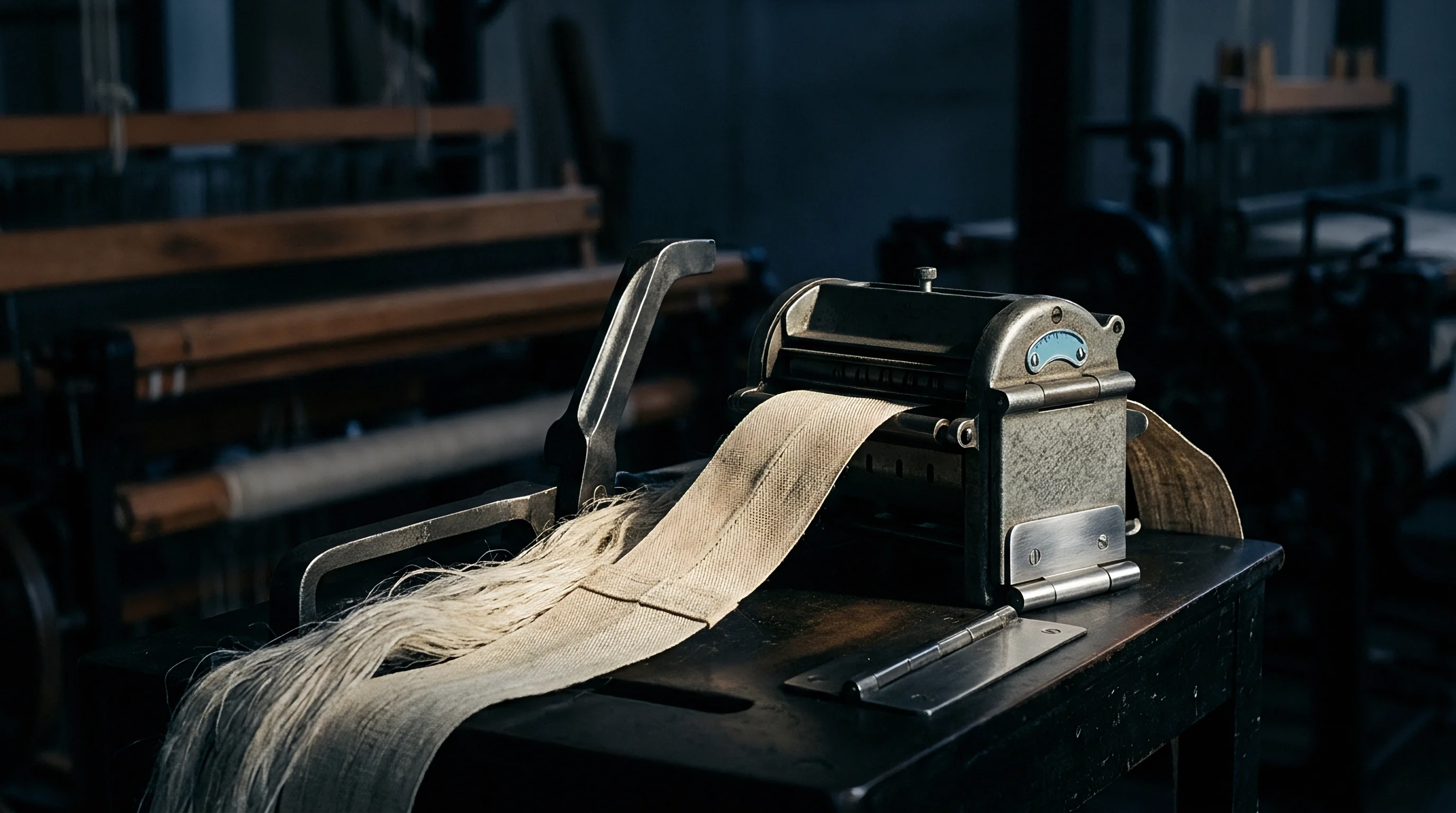
Rotary scutching turbines strike hanging flax stricks with blunt steel blades to peel residual shive away from the bast ribbons. The scutcher drums rotate at three hundred to four hundred revolutions per minute within semicircular grated enclosures. Rubber belts grip the root ends of the flax stems, exposing the tops to the first beating turbine, before a secondary grip reverses orientation to present the uncleaned roots to a second matching drum.
Blade impact velocity reaches twenty-two meters per second at the perimeter, delivering the kinetic energy needed to shear the interface between bast rings and shattered core fragments.
Where Do Scutching Beaters Fracture Bundles?
Impact occurs perpendicular to stem length where blades swipe downward against a fixed breastplate, splitting cohesive technical fibers into finer sub-bundles through lateral shear cleavage. Clean separation demands that the adhesive energy of the inter-fiber pectin matrix fall below the tensile rupture limit of individual elementary fibers. In completely retted straw, scutching yields long, parallel line flax stricks that retain eighty to ninety percent of their original stem length; in poorly colonized straw, blade impact simply snaps the bundle across its diameter.
Residual shive content above two percent by mass reduces the dry yarn breaking tenacity by four to seven centinewtons per tex across ring frames.
Every impact cycle strips a portion of the bast away as scutching tow ~ shorter, disordered fibers tangled with broken shive and cortical remnants. Machine tuning governs the ratio between scutched line flax and scutching tow: tighter blade-to-plate clearances increase shive ejection efficiency, but drive up tow losses. Modern turbines incorporate variable frequency drives on drum rotors to tune blade velocity to the moisture content of the incoming batch.
Humidity in the scutching hall must stay between sixty and sixty-five percent to prevent fiber dehydration under high air velocity.
The transition from technical bundle to individual commercial fractions follows a definite physical sequence across the scutcher:
- Mechanical Stripping removes the bulk shive fragments from the stem core by continuous blade impacts against the concave grid.
- Edge Cleavage splits the wide bast ribbons into narrow bundle groups along weakened pectin boundaries.
- Tow Extraction draws short and fractured fibers downward through the grid bars into the secondary collection chamber.
- Strick Straightening aligns the long fibers parallel to the holding belt ready for downstream manual dressing or automatic cross-conveying.
Fiber tenacity correlates directly with bundle length preservation during this mechanical division. A flax strick broken midway down its length loses structural continuity during subsequent drawing and drafting in the spinning shed. The ultimate single-cell tenacity of unblemished flax reaches eighty to one hundred centinewtons per tex, but technical bundles emerging from aggressive scutching drums drop to forty-five to sixty-five centinewtons per tex when impact blades fracture cell walls instead of separating adjacent cells along the middle lamella.
Damp straw yields supple bundles that slip around beater blades without separating cleanly from their woody core.

Defect
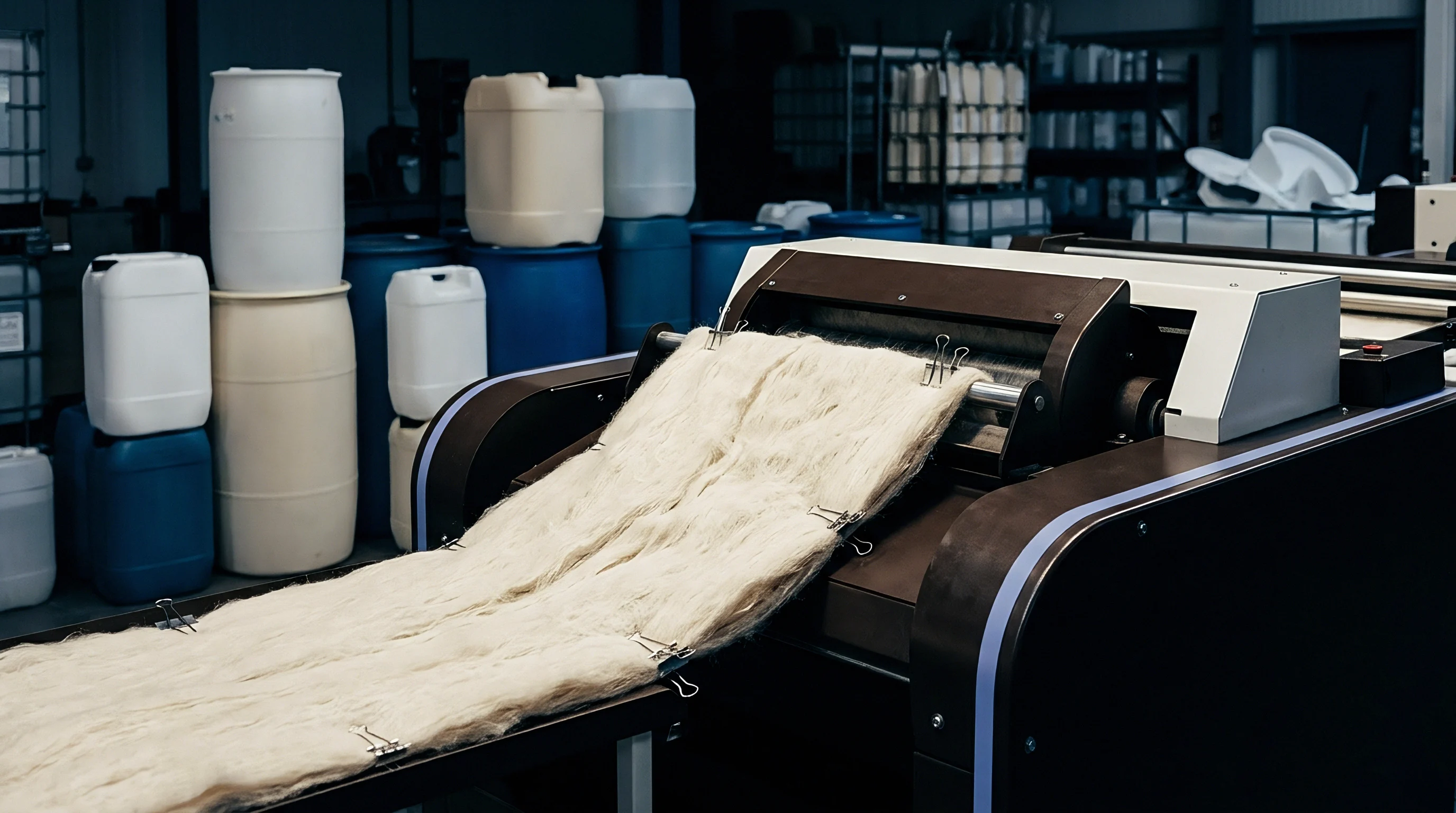
Polarized light microscopy reveals prominent transverse markings across decorticated flax fibers called dislocation zones or kink bands. These defects represent local plastic deformations where spiraling cellulose microfibrils buckle under compressive axial loads. Mechanical breaking and turbine scutching generate hundreds of these dislocations along every millimeter of single fiber length.
Acid hydrolysis tests demonstrate that these sites dissolve rapidly because crystalline cellulose converts to amorphous packing under severe shear strain, creating a mechanical notch that initiates early tensile failure under spinning tension.

Will Rotor Speeds Degrade Ultimate Tenacity?
Turbine rotational speed governs the kinetic energy transferred into the cellulose lattice at each blade pass; doubling rotor velocity quadruples the impact force applied across the strick over the breastplate. Laboratory tensile testing of single elementary fibers extracted from high-speed scutching lines shows a thirty percent drop in tenacity compared to gentle hand-scutched controls. That decline mirrors an increase in dislocation density from six defects per millimeter in manual samples to more than twenty-two defects per millimeter in industrial turbine stocks.
| Extraction Intensity | Rotor Peripheral Speed | Dislocation Density per mm | Tensile Tenacity in cN/tex | Elongation at Break Percent |
|---|---|---|---|---|
| Hand Scutched Reference | Static Lever | 5.8 to 7.2 | 78.4 to 86.2 | 2.8 to 3.2 |
| Industrial Low Velocity | 14 m/s | 11.4 to 13.9 | 64.1 to 71.5 | 2.3 to 2.6 |
| Industrial Standard Velocity | 19 m/s | 17.8 to 21.2 | 52.3 to 58.7 | 1.8 to 2.1 |
| Industrial High Velocity | 25 m/s | 26.5 to 33.1 | 38.9 to 44.6 | 1.3 to 1.6 |

Dislocation Densities and Tensile Loss
Each dislocation serves as a stress concentration point during yarn spinning. When a spinner wets the roving during wet ring spinning at sixty degrees Celsius, water penetrates the hydrophilic amorphous regions within the kink bands, disrupting remaining intermolecular hydrogen bonds between cellulose chains. Fibers with elevated dislocation counts experience premature single-cell rupture inside the spinning zone instead of smooth sliding between bundle elements ~ a failure that triggers yarn end-breaks, increases twist requirements, and degrades yarn evenness.
Consignments with average bundle tenacity under forty-eight centinewtons per tex trigger automatic rejection under standard wet spinning supply agreements.
Processors monitor fiber degradation by measuring bundle tenacity across a Stellometer or Favimat single-fiber tester. Sample preparation requires meticulous comb sorting to isolate parallel bundles with flat cut ends at a standard gauge length of three point two millimeters. Tensile testers record load-extension curves under conditioned atmospheres of twenty degrees Celsius and sixty-five percent relative humidity per ISO 139 standards.
Batches showing high coefficients of variation in breaking force typically carry uneven decortication damage caused by poorly spaced turbine drums.
High dislocation rates also complicate downstream bleaching and chemical finishing in the cloth state. Reactive dyes exhaust unevenly across fibers bearing dense transverse defects, producing microscopic dye speckling and inconsistent reflectance across woven surfaces. Mercerization in concentrated sodium hydroxide solutions swells these damaged zones disproportionately, weakening wet fabric during scouring runs.
In practice, the decorticator determines the physical performance of the finished fabric long before the sliver reaches the hackling shop.
Elevated breaker speeds were run to meet weekly consignment volumes against wet field delivery schedules.

Mill
Incoming inspection procedures at spinning mills in Zhejiang and Jiangsu cross-check scutching delivery certificates against raw material mass balances. A standard forty-metric-ton consignment of dew-retted straw delivered to an industrial scutching line yields predictable output fractions under balanced machine settings: straw input with twelve percent moisture splits into line flax, scutching tow, shive, and filter dust during continuous turbine operation.
An audit of a forty-metric-ton raw straw delivery under standard industrial parameters reflects this distribution:
- Scutched Line Flax yields six point four metric tons, representing sixteen percent of total incoming straw mass.
- Scutching Tow yields three point six metric tons, comprising nine percent of processed weight.
- Ejected Woody Shive totals twenty-two metric tons, accounting for fifty-five percent of overall straw bulk.
- Moisture Evaporation Losses remove one point two metric tons through pneumatic heat dissipation, equal to three percent mass reduction.
- Heavy Particulate Dust captures six point eight metric tons in cyclone separators, completing the balance at seventeen percent.
The ratio of line flax to scutching tow measures decortication quality directly. Balanced operations maintain a line-to-tow ratio between one point six and one point eight to one for dew-retted Western European straw, whereas aggressive turbine settings push this ratio down to one point one to one, converting prime long fiber into cheap tow. The scutching unit documents this split on its internal shift ledger, and mill auditors reconcile these production ledgers against weighbridge receipts and the issuance of European Flax scope certificates.
Scutching line efficiency stays optimal when the long fiber mass exceeds sixty percent of total extracted bast substance.
Traceability breaks occur when mills blend European Flax certified scutching tow with non-certified domestic or Russian fiber stocks during secondary carding. Transaction certificates issued under ISO 17065 certification must trace each bale number directly back to a certified scutching facility. Scutcher bale tags indicate the batch number, farmer cooperative identification, harvest year, and line flax yield grading.
The Chinese importing mill must maintain an airtight mass balance between imported long fiber bales and outbound wet-spun yarn invoices.
Standard hackling operations at the spinning mill subject scutched stricks to intersecting combs with increasing pin densities. These machines separate coarse technical fibers into fine spinning slivers, combing out an additional twenty to twenty-five percent of short fiber as hackling tow. If the decorticator induced high dislocation counts during breaking, the hackling pins fracture these weakened fibers directly; hackling waste spikes, sliver yields collapse, and the spinner absorbs the mechanical loss in finished yarn costs.
Purchase specifications explicitly incorporate standard arbitration terms stipulating that delivery lots yielding hackling waste three percentage points above agreed base levels transfer all intermediate processing costs back to the scutcher.
Rebate
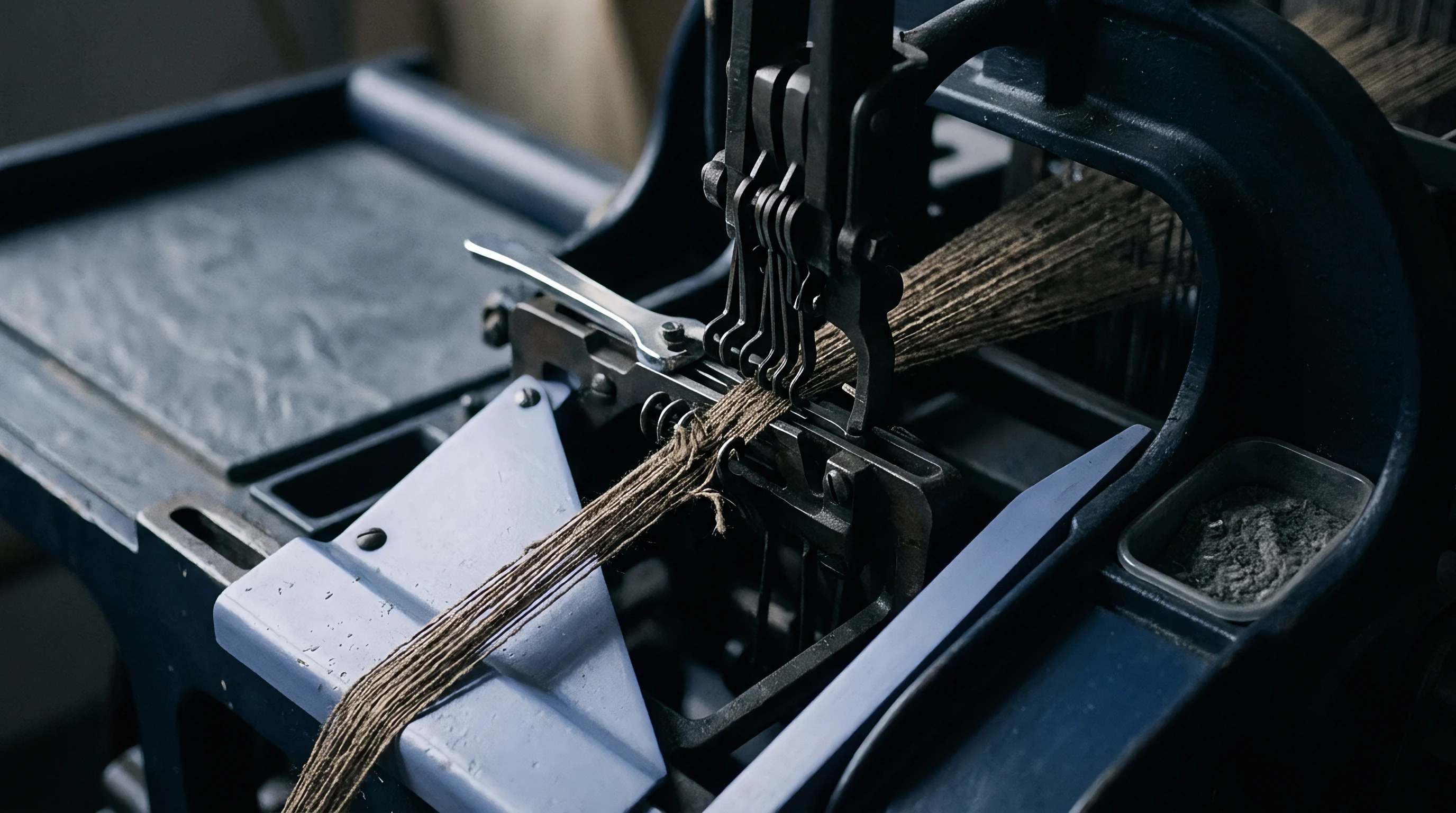
Commercial contracts define clear rebate schedules when scutched fiber properties fall below guaranteed laboratory baselines. Buyers price European long line flax on a metric ton basis indexed to tensile tenacity, shive cleanliness, and hackling sliver yield. The base contract assumes an average bundle tenacity of fifty-four centinewtons per tex, measured at zero gauge length with a Pressley clamp; if arrival testing indicates tenacity values between fifty and fifty-two centinewtons per tex, the contract enforces an automatic price deduction of three percent across the entire invoice value.
| Tested Tenacity Range | Tested Shive Content | Contractual Action | Financial Settlement | Certification Implication |
|---|---|---|---|---|
| Above 54 cN/tex | Under 1.5 Percent | Unconditional Acceptance | Par Invoice Value | European Flax Maintained |
| 50 to 53.9 cN/tex | 1.5 to 2.5 Percent | Commercial Discount | 3 to 5 Percent Price Rebate | European Flax Maintained |
| 46 to 49.9 cN/tex | 2.6 to 4.0 Percent | Severe Downgrade | 8 to 12 Percent Price Rebate | Downgraded to Blending Stock |
| Below 46 cN/tex | Above 4.0 Percent | Consignment Rejection | Full Chargeback with Freight | Certificate Scope Cancelled |
Tenacity values dropping below forty-six centinewtons per tex disqualify the batch from pure linen spinning, forcing the mill to reroute the fiber into low-count dry spun yarns or cotton-blended rotor spinning systems. This downgrade imposes financial penalties on the raw material vendor: the price differential between first-grade wet spinning line flax and secondary blending tow averages two thousand two hundred to two thousand eight hundred euros per metric ton on European spot markets, which the buyer deducts from the supplier balance using bonded warehouse inspection reports.
Laboratory validation demands rigorous sampling across the warehouse floor. Inspectors pull ten random subsamples per five-metric-ton bale lot, drawing long fiber bundles from both the center and perimeter of unopened bales, and technicians condition the specimens for twenty-four hours in controlled environments before running tensile tests. If the initial series yields borderline figures, standard trade rules require secondary verification by an independent testing facility accredited under ISO 17025, with costs assessed to the party whose findings are overturned.
Documented origin status adds a distinct commercial surcharge above bare physical fiber metrics: bales carrying verified European Flax documentation command a fifteen to twenty percent price surcharge over undocumented long line fiber of equivalent tensile tenacity. When physical scutching damage forces the downgrading of a certified lot to generic blending fiber, the buyer loses the premium value of the certification entirely. Customs declarations in destination markets demand unbroken provenance chains to qualify for preferential duty rates or to support origin-dependent retail claims.
Unproven provenance claims convert certified raw material investments into generic trade assets without commercial recovery.
Spinning mills protect margins by applying dynamic penalty equations directly inside the enterprise procurement interface. A mill manager inputs bale inspection data, and the software recalculates the net payable balance before the bank releases the letter of credit. This automatic settlement protects the spinning mill from bearing the economic consequences of aggressive scutching drum speeds upstream, settling the cost of cell wall damage on the decortication operator who traded fiber tenacity for daily throughput.
The industry continues to deliberate whether online optical dislocation sensors on commercial scutching lines will ever replace retrospective bundle tensile testing at the receiving dock.