Quantifying Structural Bundle Fragmentation Dynamics during Multi Passage Drawing of Hackled Line Slivers
Multi passage gilling divides technical flax bundles from 24 tex down to 4.2 tex through controlled pin friction, preserving staple length while lowering sliver CV.


Pin
Faller bed density governs mechanical shear forces within the drawing zone. Hackled line slivers enter the first drawing passage as thick, cohesive ribbons of technical flax bundles held together by inter-bundle pectinous middle lamellae. Steel needles mounted on faller bars penetrate these moving structures, establishing mechanical control over individual fibre groups during velocity transitions between feed rollers and drafting rollers.

Faller Field Kinematics
Inter-roller distance establishes the drafting zone length where pinned bars engage the bast ribbon. Front rollers pull technical bundles through the faller field at linear speeds five to eight times greater than back roller delivery rates. Faller bars advance along top and bottom screw tracks at speeds set slightly higher than back roller surface speed, maintaining a positive lead of two to five percent.
This speed differential pulls incoming bundles taut, driving steel pins deep into the sliver mass before drafting forces accelerate individual fibre groups forward.
Pin density escalates across successive drawing passages. First passage faller bars carry 2.5 to 3.2 pins per centimetre, accommodating heavy aggregate slivers without clogging or bent needles. Fourth passage frames employ fine faller bars carrying 6.0 to 7.2 pins per centimetre to control isolated micro-bundles.
Pin height decreases from 14 millimetres in early passages to 10 millimetres in final passages, matching the declining cross-sectional bulk of attenuated slivers.
- Mount first-passage faller bars equipped with 2.8 pins per centimetre set to a faller speed matching 103 percent of back-roller linear surface speed.
- Adjust front-roller nip pressure to 1.8 kilonewtons per nip position to prevent slip during initial attenuation.
- Set the nip-to-faller clearance to 22 millimetres to avoid crushing technical bundle ends as needles drop out of the working zone.
- Increase pin density to 4.5 pins per centimetre on second passage frames while narrowing inter-roller distance by 15 percent.
- Verify needle straightness across all faller bars every 120 operating hours using an optical alignment gauge.

Mechanical Penetration Mechanics
Steel needles enter the moving bundle at an angle between 12 and 15 degrees relative to the vertical plane. Downward penetration separates parallel technical bundles along weakly bonded longitudinal interfaces. Line flax slivers resist sudden draft.
Resistance originates from the spatial distribution of non-cellulosic cements binding elementary fibres into aggregate bundles. Pinned faller bars split these aggregates longitudinally, converting coarse technical bundles into thinner parallel structures prior to velocity attenuation.
Faller pins control individual sliver dynamics. Excess needle density in early passages crushes bundles, generating short fiber scraps and elevated waste rates. Insufficient pin density allows floating bundles to bypass draft control, producing thick slubs in drawn slivers.

Friction
Cohesive resistance between adjacent technical bast bundles prevents uncontrolled bundle floating during draft. Surface friction in flax drawing depends on relative humidity, residual wax levels, pectin hydration, and pin restraint. Friction forces must exceed the yield strength of inter-bundle pectin bonds while remaining lower than the axial breaking tenacity of individual elementary flax cells.
Inter-Bundle Shear Forces
Axial sliding occurs when draft forces exceed the static surface adhesion of middle lamella polymers. Bast bundles slip past one another along longitudinal cleavage planes during attenuation. Inter-fibre friction coefficients measured per ISO 2370 range from 0.38 for raw dew-retted line flax down to 0.22 for heavily lubricated or enzyme-treated stock.
Higher friction values demand higher faller pin pressure to prevent uncontrolled drafting waves, whereas lower friction values risk complete sliver draft separation under light roller loads.
Moisture shifts inter-bundle cohesion rapidly. Processing environments maintained at 68 to 72 percent relative humidity preserve hydration in middle lamella pectins, maintaining predictable surface stick-slip behaviour. Dropping relative humidity below 55 percent causes pectin embrittlement, raising inter-bundle friction by 40 percent and causing localized bundle snapping instead of smooth sliding.
Relative humidity variations between 55 percent and 70 percent shift inter-bundle friction coefficients from 0.44 down to 0.26 during third passage drawing of Heilongjiang dew-retted line flax.
Middle Lamella Pectin Degradation
Non-cellulosic cement compounds undergo mechanical fracture when draft speed accelerates past critical thresholds. Pectins and hemicellulose bind elementary fibres into complex technical bundles measuring 20 to 60 tex. Shear stress imparted by faller pins and inter-bundle friction splits these cements.
Transverse shear forces tear open the middle lamella without cleaving individual cellulosic cell walls, gradually reducing bundle linear density across each passage.
Over-drying raw flax before drawing causes severe internal stress during shear division. Thermal moisture extraction below five percent regain hardens middle lamella structures, preventing clean inter-bundle shear separation. Fiber orientation governs draft force.
When bundles enter pins out of axial alignment, transverse forces snap technical fibers into short fragments instead of dividing them longitudinally.
Inadequate humidity control during pin drafting causes irreversible inter-bundle breakage, doubling sliver mass variance and raising yarn end-break rates at wet-spinning frames by up to 35 percent.


Division
Technical flax bundles reduce in linear density from an initial 28 tex down to 4.5 tex across successive gilling operations. Progressive mechanical splitting divides heavy compound bundles into fine sub-units. Division rate depends directly on cumulative draft, faller pin density, and the number of drawing passages applied to the hackled line sliver.
Transverse Cleavage Kinetics
Longitudinal splitting splits thick composite bundles along intercellular boundaries without shortening ultimate cell lengths. Elementary flax fibers measure 15 to 30 millimetres in length with individual diameters between 12 and 22 micrometres. Technical bundles entering the hackling room contain between 20 and 80 elementary fibers bound side-by-side.
Pinned drawing passages systematically reduce the number of elementary cells per technical bundle. Passage one yields sub-bundles averaging 18 to 24 elementary cells. Passage four reduces bundle cross-sections down to 3 to 6 elementary cells.
Higher draft increases longitudinal cleavage. Splitting dynamics follow non-linear rate equations across drawing passages, with the highest division rate occurring during passage two where bundle thickness matches faller pin spacing.
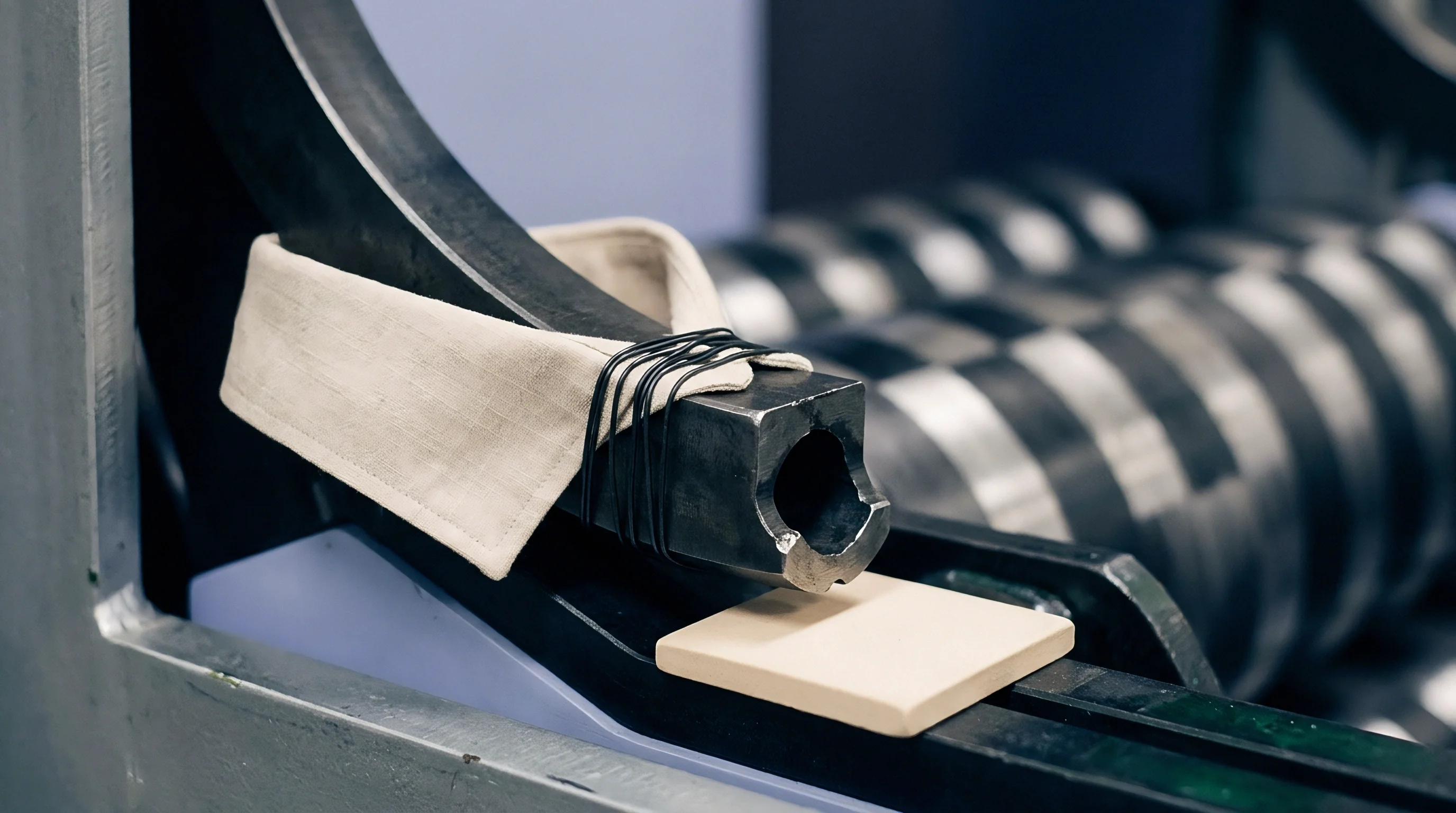
Worked Passage Fragmentation Model
Assume a 500-kilogram lot of hackled line flax presenting an initial bundle linear density of 24.5 tex entering the first drawing frame. The mill processes this lot through four sequential pin-gilling passages to prepare sliver for wet spinning into Nm 50 yarn (20 tex final yarn count).
| Drawing Passage | Faller Pin Density (pins/cm) | Passage Draft Ratio | Mean Bundle Linear Density (tex) | Mean Technical Bundle Diameter (μm) | Sliver Mass Uniformity (Uster CV%) |
|---|---|---|---|---|---|
| Passage 1 (Intersecting) | 2.8 | 6.2 | 14.2 | 78.5 | 8.2 |
| Passage 2 (Intersecting) | 4.2 | 7.0 | 7.8 | 52.1 | 5.8 |
| Passage 3 (Single Bed) | 5.5 | 7.5 | 4.6 | 36.4 | 4.1 |
| Passage 4 (Finishing Bed) | 6.8 | 8.0 | 2.9 | 24.8 | 3.2 |
| Data gathered under ISO 2370 test conditions on Heilongjiang Grade 1 Long-Staple Line Flax at 20 degrees Celsius and 65 percent relative humidity. | |||||
Pectin bonds fail under shear. The initial passage reduces mean bundle diameter from 112 micrometres down to 78.5 micrometres, representing a 30 percent reduction in technical bundle cross-sectional area. Subsequent passages achieve smaller absolute diameter reductions but drive bundle refinement down toward elementary fibre boundaries.
By passage four, average technical bundle weight reaches 2.9 tex, supplying the fine, highly parallel structure necessary for high-count wet spinning.
Failure modes emerge when machine parameters violate physical bundle properties:
- Pin Deflection Defect occurs when needle beds overload with excessive sliver mass, causing pin bending, uneven penetration, and thick un-split bundle clusters in delivered slivers.
- Transverse Cell Fracture results from excessive front-roller draft speed on dry fibers, breaking elementary cells across their axis rather than splitting middle lamellae.
- Drafting Wave Instability develops when distance between back and front rollers exceeds maximum fiber staple length, allowing unpinned short bundle groups to move uncontrollably.
- Roller Lapping Malfunction happens when static charges or high moisture cause fine divided micro-bundles to adhere to top rubber roller surfaces instead of advancing to coiling cans.
Sliver delivery contracts specify a maximum allowable linear mass variation of 4.5 Uster CV% at the fourth draw-frame passage to guarantee count consistency on wet-spinning frames.
Suppliers often attribute elevated sliver mass variation to micro-variations in crop retting degree rather than uncalibrated nip pressures across drawing passages.
Sliver
Linear mass variation along drawn ribbons directly influences downstream roving twist distribution. Heterogeneous bundle fragmentation creates local mass fluctuations along the sliver length. Doubling multiple slivers at the draw-frame feed table mitigates short-term irregular bundle division, blending thick and thin segments into a uniform delivered weight.

Does Multi Passage Gilling Reduce Structural Nep Frequency?
Nep counts drop when pin densities escalate progressively from 2.5 to 6.8 pins per centimetre across four passages. Neps in line flax consist of tightly tangled micro-bundles, residual shive particles, and rolled fiber fragments. Mechanical pin action pulls tangled fibers straight while splitting structural neps into linear aligned filaments.
Improper drafting gauge settings create rolled neps when loose fiber ends fold back during high-speed draft roll contact.
Coarse bundles shorten during passage. Repeated pin impacts fragment rigid un-retted shive bits, allowing air extraction systems mounted above faller beds to remove particulate debris before roving preparation.

Mass Variations and Doubling Ratios
Combining four to eight delivery ribbons at the feed table cancels periodic wave patterns generated by roller eccentricity. Passage one applies a doubling ratio of 6:1 or 8:1 to aggregate raw hackled slivers. Passage four reduces doubling to 2:1 or 4:1 as sliver mass evens out and bundle fineness stabilizes.
| Frame Passage | Doubling Ratio | Total Draft Range | Front Roller Pressure (daN/cm) | Target Sliver Weight (g/m) | Target Uster CV% |
|---|---|---|---|---|---|
| Passage 1 | 8:1 | 5.5 – 6.5 | 45 | 18.0 | 7.5 – 8.5 |
| Passage 2 | 6:1 | 6.0 – 7.2 | 40 | 12.5 | 5.5 – 6.5 |
| Passage 3 | 4:1 | 6.5 – 7.8 | 35 | 6.0 | 4.0 – 4.8 |
| Passage 4 | 2:1 | 7.0 – 8.5 | 30 | 2.5 | 3.0 – 3.6 |
Sliver mass uniformity dictates thread quality. Correct doubling arrangements prevent long-term count drift across bobbin sets, keeping yarn Lea count variations within commercial specification limits.
Maintaining a 4:1 doubling ratio on third-passage gilling reduces periodic mass wave amplitude by 60 percent compared to single-sliver drafting routes.
Standard purchase terms require delivery of sliver lots with no continuous mass deviation exceeding three percent of declared linear weight over any ten-metre sample length.
Attenuation
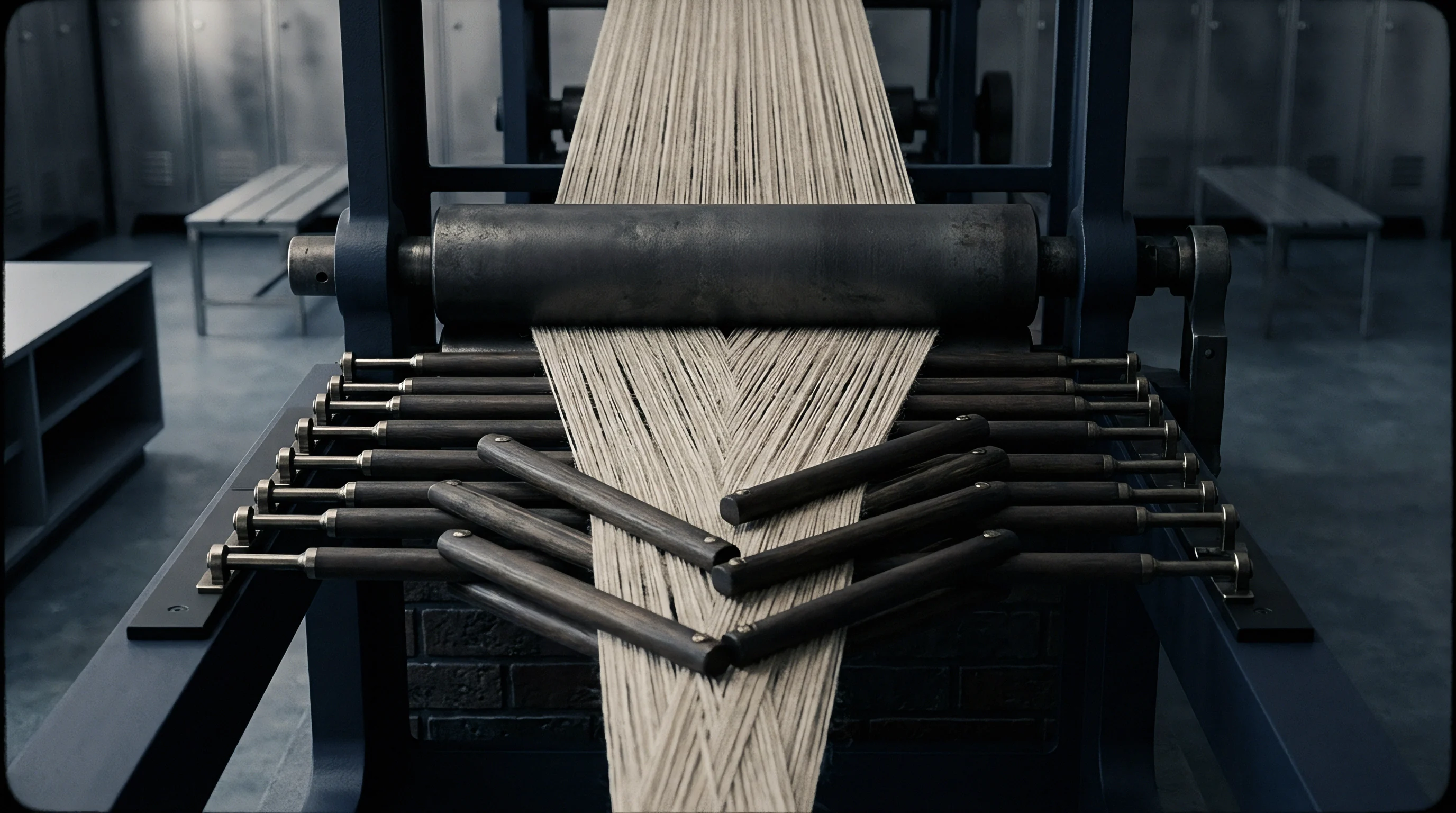
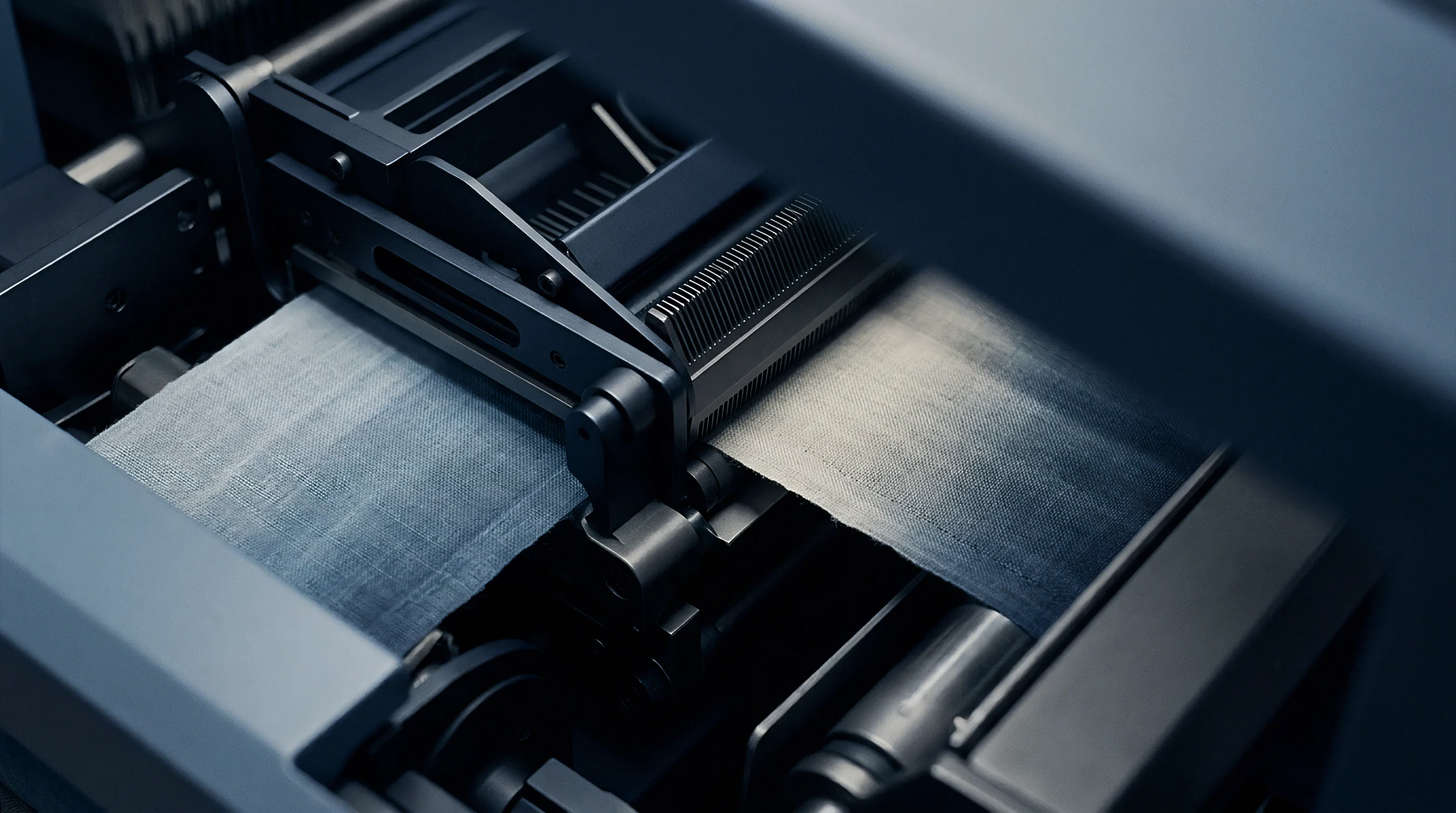
Velocity differentials between back feed rolls and front draft rollers elongate the delivered fibrous structure. Drawing frames pull parallelized bundles past pin fields, reducing total sliver cross-sectional area while increasing total length. Controlled attenuation arranges divided micro-bundles into linear end-to-end orientations along the sliver axis.

Staple Length Retention
Fibre breakages occur when drafting force overcomes axial tensile strength of individual elementary cell walls. Hackled line flax contains long technical fibers ranging from 450 to 800 millimetres. Excessive draft ratios or aggressive faller pin speeds break these long fibers into shorter lengths, lowering mean staple length and increasing short-fiber content below 50 millimetres.
Fine linear density demands small pin pitch.
Drawing splits coarse bast ribbons. Machine settings must balance bundle division against fibre breakage. Preserving average staple length above 350 millimetres through passage four ensures high yarn tenacity in wet-spun yarns.

Speed Draft and Slip Dynamics
Front roller surface speed running at 120 metres per minute induces transient slipping in loose bundle structures. Synthetic rubber top roller covers with hardness ratings between 75 and 85 Shore A prevent slip while resisting grooving from coarse flax fibers. Lower Shore hardness leads to surface indentations that disrupt uniform clamping pressure across the nip line.
Roving frames inherit draft defects. Periodic thickness variations introduced by slip during drawing amplify into severe slubs during roving twisting, causing downstream spinning frame end breaks.
- Verify Relative Humidity ~ Confirm ambient hall humidity remains between 65 and 70 percent to maintain optimal pectin flexibility during high-speed draft.
- Inspect Top Roller Covers ~ Measure roller hardness using a Shore A durometer, discarding top rollers showing hardness values exceeding 88 Shore A or surface grooving deeper than 0.1 millimetres.
- Check Faller Timing ~ Align faller bar drop timing to prevent pins from tearing bundle tails as bars exit the bottom screw track.
- Calibrate Nip Gauge Settings ~ Adjust front roller nip distance to match target mean bundle staple length, preventing double-clamping of long line fibers.
Front roller nip pressure settings below 30 decanewtons per centimetre cause localized bundle slipping, raising short-term mass variation on final draw-frame slivers.
What specific threshold of mechanical energy input during multi-passage gilling marks the transition from beneficial longitudinal middle lamella shear splitting to destructive cell wall fracture in long-staple line flax?
Invoice
Mill yield calculations translate fibre bundle fragmentation control into landed costs per linear metre of woven linen. Hackling room scrap, draw-frame waste, and spinning end-break rates dictate final financial performance. Proper management of bundle division dynamics during drawing maximizes fine yarn count yield from raw hackled line stock.

Commercial Count Yields
Target spinning counts of Nm 60 demand a final draw-frame linear density below 0.55 grams per metre. Coarse slivers containing undivided 15-tex technical bundles cannot spin into fine yarns; end breaks escalate rapidly as frame draft tries to force thick bundles through narrow spinning nozzles. Efficient pin drafting splits initial 25-tex bundles down to 2.8-tex micro-bundles, enabling spinning mills to achieve fine yarn counts without purchasing higher-priced raw fiber grades.
Fibre yield settles the final invoice. Lower draw-frame waste rates directly increase the total linear metres of spun yarn produced per tonne of imported scutched flax.

Landed Metre Economics
Raw fibre prices sitting at 5.20 Euros per kilogram produce variable yarn costs depending on hackling comb scrap and drawing waste. Draw-frame waste consists of faller fly, short fibre drops, and sliver piecing trim. Controlling bundle fragmentation dynamics keeps total draw-frame waste below 2.2 percent of input sliver weight.
| Target Yarn Count (Nm) | Raw Fiber Grade Requirement | Required Draw Passages | Final Sliver Tex | Total Fiber-to-Yarn Yield (%) | Estimated Fabric Cost (€/m at 150g/m2) |
|---|---|---|---|---|---|
| Nm 26 (Dry Spun) | Medium Dew-Retted Line | 3 | 4.2 | 78.5 | 2.45 |
| Nm 39 (Wet Spun) | Good Dew-Retted Line | 3 | 3.1 | 74.2 | 3.10 |
| Nm 50 (Wet Spun) | Prime Water/Enzyme Line | 4 | 2.5 | 71.0 | 3.85 |
| Nm 60 (Wet Spun) | Superior Hackled Line | 4 | 1.8 | 66.8 | 4.95 |
Wet spinning relies on micro-bundle split. Splitting technical flax bundles down to fine micro-bundles during draw-frame gilling unlocks higher spinnable counts from given raw material lots. Mills optimizing faller pin density, draft distribution, and inter-bundle friction achieve higher Lea counts while reducing raw fiber cost per finished metre of fabric.