Converting Airflow Resistance to Metric Count in Hackled Line Flax
Airflow resistance converts to metric fibre count via specific surface area, establishing spinnable yarn count limits prior to spinning commitment.


Chamber
Air permeability measurements on hackled flax slivers provide empirical data on specific surface area, which is vital given how demanding fineness checks are for long line flax. Unlike short-staple cotton or continuous synthetic filaments, bast fibre strands form multi-cellular bundle structures bound by non-cellulosic pectins, hemicellulose, and residual lignin. Volumetric airflow testing evaluates resistance when a steady stream of dry air passes through a compressed plug of these parallel fibres.
At a constant mass and volume, finer technical bundles present a larger surface area to the air stream, generating higher viscous friction and a steeper pressure differential across the specimen.
Applying porosimetry to long-staple flax requires adapting standard airflow chambers, such as the WIRA apparatus or modified Micronaire instruments specified under ISO 2370. Standard cotton testing chambers pack a fixed sample weight into a set volume, but flax slivers vary considerably in fibre length and bundle architecture. The test chamber holds five grams precisely.
Aligning hackled line strands parallel to the longitudinal axis of the chamber prevents air channeling along the walls, ensuring uniform flow distribution across the transverse section of the fibre plug.
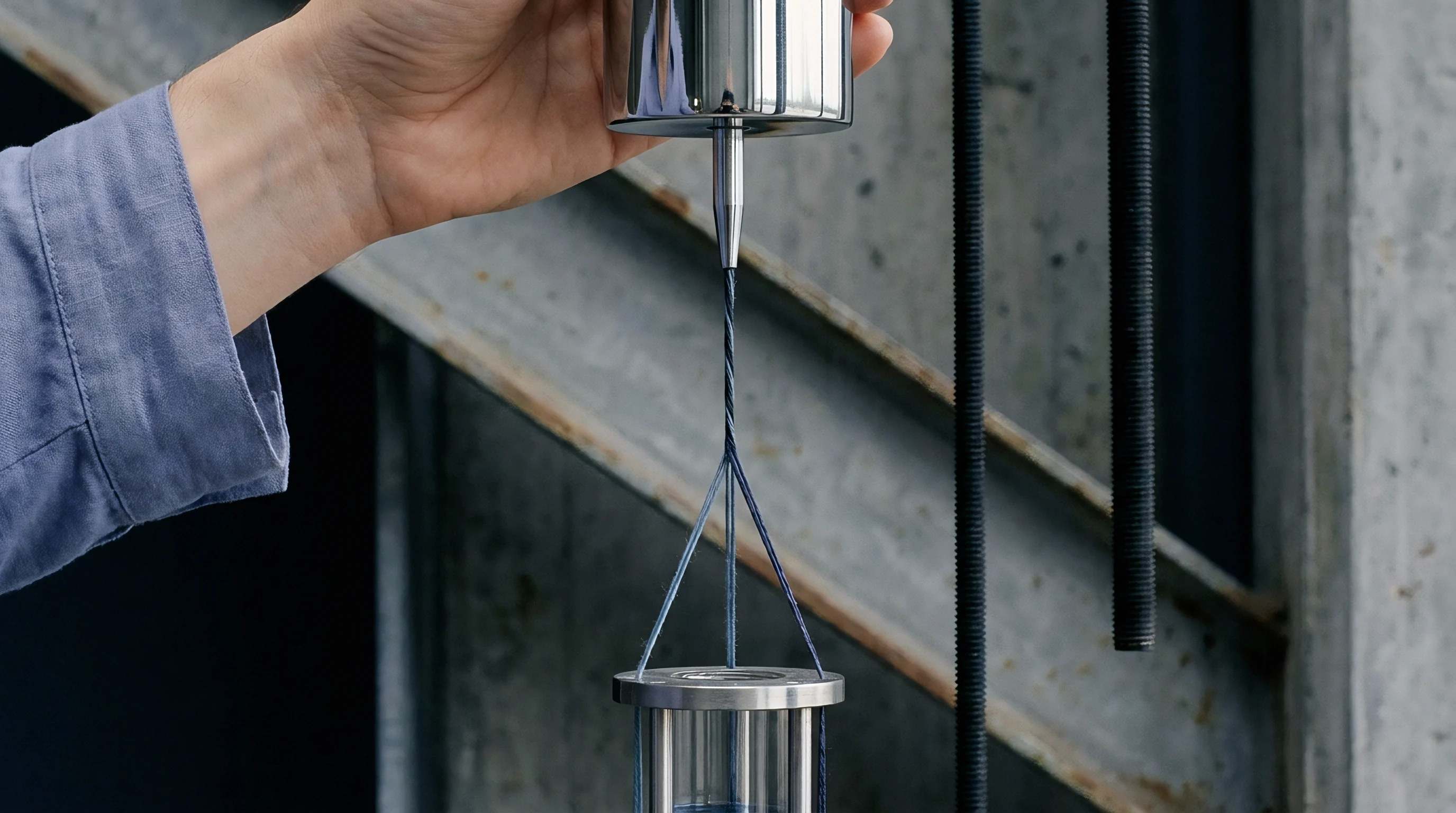
Aerodynamic Permeability in Technical Fibre Bundles
Air forced through a compressed flax plug encounters viscous drag along the outer walls of individual elementary fibrils. The internal geometry of the chamber creates a restricted flow bed where fluid dynamics obey Darcy’s law for porous media. Permeability depends directly on plug porosity and the total external surface area of the fibres per unit volume.
Coarser flax bundles with intact outer cortical tissue leave large interstitial voids, permitting higher air velocity at low differential pressure. Well-hackled, highly divided line flax packs tightly, creating tortuous capillary pathways that increase flow resistance dramatically.
Fibre density reaches one point five grams. Water density equals one gram per millilitre. Standard air temperature remains twenty degrees Celsius.
When testing flax under ISO 2370, relative humidity must remain stabilized at sixty-five percent within a two percent variance band. Moisture sorption alters both the physical dimensions of the bast strands and the internal chamber porosity. Water molecules adsorbed onto the fibre cell walls swell the cross-sectional area, reducing interstitial channel size while artificially elevating measured pressure drops.
Correcting raw flow readings for moisture regain ensures that measured resistance correlates strictly with geometric fineness rather than ambient humidity fluctuations.

Sample Mass and Compression Geometry
Standardized testing relies on an exact specimen quantity packed into a fixed cylindrical volume. Deviations in sample mass alter plug packing density, shifting measured pressure differentials independently of fibre fineness. Laboratory protocol fixes the test specimen mass at 5.000 grams, weighed to a precision of 0.001 grams on an analytical balance.
Inserting the prepared flax bundle into the testing chamber involves a uniform compression plunger that sets the internal volume to exactly 12.5 cubic centimetres, yielding a bulk packing density of 0.40 grams per cubic centimetre.
| Compression Volume (cm³) | Packing Density (g/cm³) | Air Flow Rate (L/min) | Pressure Drop ΔP (kPa) | Calculated Surface Area S₀ (m²/g) |
|---|---|---|---|---|
| 15.0 | 0.333 | 10.0 | 1.42 | 0.285 |
| 12.5 | 0.400 | 10.0 | 2.15 | 0.342 |
| 10.0 | 0.500 | 10.0 | 3.88 | 0.418 |
| 8.5 | 0.588 | 10.0 | 5.95 | 0.491 |
Operating outside the target 0.40 grams per cubic centimetre packing density skews the linear relationship between pressure drop and specific surface area. Over-compressing the sample collapses micro-capillaries between ultimate fibres, generating non-linear flow drag that flatters bundle fineness claims. Under-compressing allows peripheral bypass flow where air passes along the chamber boundaries without interacting with internal fibre surfaces.
Loading an incorrect sample mass into the chamber alters pressure readings by up to eighteen percent, leading to false fineness classifications that cause frame stoppages to exceed fifteen end-breaks per one hundred spindle-hours during wet spinning.

Differential
Pressure drops measured across compressed bast bundles reflect aerodynamic friction rather than direct geometric diameter. Translating differential pressure readings into absolute physical dimensions requires mathematical models that account for fluid viscosity and bed tortuosity. The pressure differential across the specimen chamber serves as the primary raw data point in airflow porosimetry.
Higher differential values signal fine, well-separated flax strands, whereas low pressure drops indicate coarse or inadequately hackled line stock.
Modelling flow through packed fibre beds relies on the Kozeny-Carman equation. The equation relates pressure drop per unit length to fluid velocity, air viscosity, volumetric porosity, and specific surface area per unit volume. For hackled line flax, specific surface area S0 acts as the bridge between aerodynamic resistance and geometric linear density.
Because flax fibres possess irregular non-circular cross-sections ranging from polygonal to kidney-bean shapes, optical microscopy or projection diameter measurements often fail to capture true hydrodynamic mass distribution. Airflow resistance averages these geometric irregularities across millions of fibre cross-sections within the plug.

Kozeny Carman Adaptations for Non Circular Cross Sections
Empirical hydrodynamic models treat porous beds as collections of uniform capillary tubes. Technical flax strands deviate from this ideal geometry due to lumen voids, ribbon-like longitudinal twists, and variable cell wall thickness. Adapting the Kozeny-Carman relationship for hackled flax involves introducing an empirical shape factor, k, commonly designated as the Kozeny constant.
For random parallel fibre beds aligned along the flow axis, empirical testing establishes k at approximately 5.25. The specific surface area per unit mass S correlates with volumetric specific surface area S0 through fibre skeletal density ρ, where ρ equals 1.52 grams per cubic centimetre for pure, dew-retted flax cellulose.
Calculating specific surface area S0 from measured pressure differential Δ P utilizes the expanded Kozeny-Carman expression:
Δ P = frack · η · Q · L · S02 · (1 – ε)2ε3
where η represents dynamic air viscosity (1.81 × 10⁻⁵ Pa·s at standard conditions), Q denotes volumetric flow rate, L is plug length, and ε represents total bed porosity calculated as 1 – (packing density / ρ). Solving for S0 yields the aerodynamic surface area per unit volume, which inversely relates to effective aerodynamic fibre diameter de.
A five-gram hackled line flax specimen tested at a packing density of 0.40 grams per cubic centimetre under standard ambient conditions yielding a pressure drop of 2.15 kilopascals corresponds to a specific surface area of 0.342 square metres per gram.

Impact of Residual Pectin and Moisture on Flow
Non-cellulosic plant gums remaining on hackled strands alter air velocity by filling micro-voids within the fiber bundle matrix. Unretted bark artificially inflates bundle resistance. When retting stops prematurely, residual middle-lamella pectins cement individual elementary cells into thick, rigid technical ribbons.
These un-split ribbons reduce total accessible surface area while altering packing mechanics inside the test chamber. Excessively gummy flax resists compression, leaving structural voids that permit artificial air channeling and generate deceptively low pressure drop readings.
- Cut hackled line sliver into uniform test lengths of exactly thirty millimetres using a dual-blade rotary cutter to eliminate end fringe effects.
- Condition prepared specimens in a standard atmosphere of twenty degrees Celsius and sixty-five percent relative humidity for twenty-four hours to achieve equilibrium moisture regain.
- Weigh five grams of conditioned sample on an analytical balance calibrated to one tenth of a milligram.
- Feed the weighed bundle into the cylindrical chamber, maintaining parallel longitudinal alignment with the chamber walls.
- Lock the compression plunger at the designated twelve point five cubic centimetre volume mark to establish the baseline packing density.
- Initiate regulated airflow through the chamber at ten litres per minute, recording the differential pressure gauge reading once flow stabilizes after five seconds.
Elevated airflow resistance often stems from surface friction caused by residual epicuticular wax or incomplete post-scutch drying rather than superior hackling split efficiency.
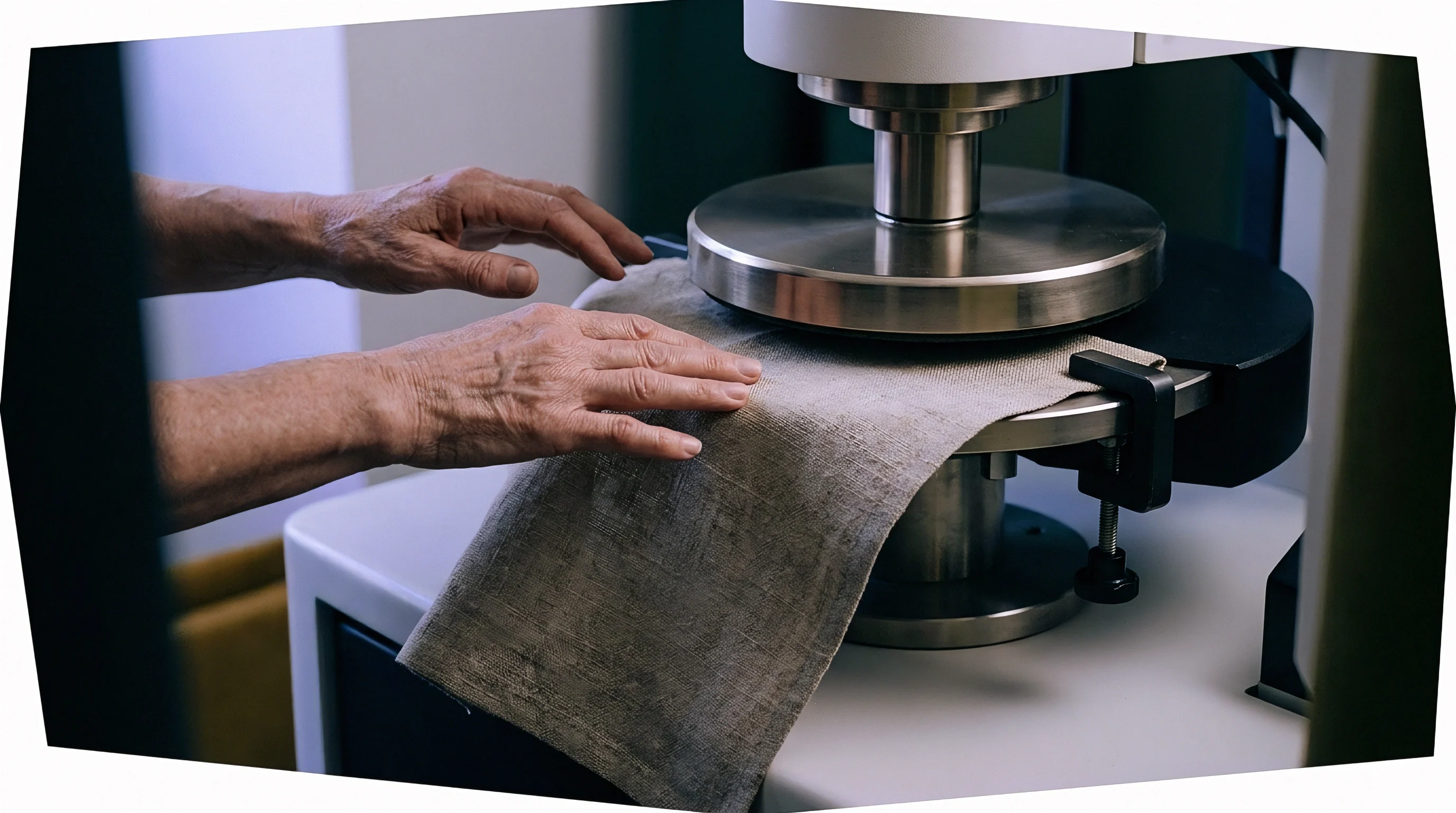

Regression
Translating measured airflow resistance into metric fibre fineness demands empirical correlation curves validated against gravimetric references. Metric fibre count (Nmf) defines the length in metres of one gram of single fibre strand. Converting aerodynamic specific surface area S0 or pressure differential Δ P to Nmf relies on calibration equations derived from gravimetric cut-and-weigh reference methods such as ISO 1973.
While porosimetry measures surface area, spinning performance responds directly to linear density, making accurate regression modeling essential for mill operations.
Fibre linear density expressed in millitex (mtex) represents mass in milligrams per kilometer of single fibre strand. For ideal cylindrical filaments, linear density relates to effective diameter de and density ρ through the geometric relationship mtex = fracπ4 · de2 · ρ · 10-3. Replacing de with its specific surface area equivalent (de = frac4S0) connects linear density directly to porosimetry data.
Because bast bundle splitting creates non-uniform cross-sections, direct geometric conversion understates true linear density, requiring empirical correction factors derived from extensive calibration testing across known flax grades.

Mathematical Derivation of Metric Fibre Fineness
Conversion algorithms transform volumetric surface area figures directly into linear density metrics. Standard empirical calibration curves established for hackled line flax under ISO 2370 map pressure drop readings (Δ P in kilopascals) or specific airflow resistance (Ra) directly to Nmf. The standard power-law regression equation takes the operational form:
Nmf = C1 · (Δ P)C2
where C1 and C2 represent empirical constants calibrated against gravimetric single-bundle weighings. For standard line flax tested on a five-gram chamber at 0.40 grams per cubic centimetre density, C1 equals 1450 and C2 equals 0.825. Metric fibre count Nmf relates inversely to linear density in millitex through the identity Nmf = frac1000Texf = frac1000000mtex.
| Pressure Drop ΔP (kPa) | Specific Surface S₀ (m²/g) | Effective Diameter dₑ (µm) | Linear Density (mtex) | Metric Fibre Fineness (Nm_f) |
|---|---|---|---|---|
| 1.20 | 0.245 | 26.8 | 857 | 1166 |
| 1.60 | 0.291 | 22.6 | 609 | 1642 |
| 2.00 | 0.332 | 19.8 | 468 | 2137 |
| 2.40 | 0.369 | 17.8 | 378 | 2645 |
| 2.80 | 0.404 | 16.3 | 317 | 3155 |
| 3.20 | 0.437 | 15.0 | 269 | 3717 |
Effective bundle diameter determines draft limits, and higher draft ratios demand uniform bundle fineness. Converting airflow readings through this mathematical framework allows technical directors to categorize incoming slivers into distinct fineness tiers before assigning raw material lots to specific spinning lines.
According to ISO 2370 Section 6.2, airflow fineness testing requires strict atmospheric conditioning at twenty degrees Celsius and sixty-five percent relative humidity, where non-compliance automatically invalidates certified metric fibre counts during official commercial arbitration.

How Do Variation Limits in Specific Surface Area Shift Predicted Yarn Counts?
Permeability fluctuations across a single commercial lot alter predicted spinning performance by shifting minimum cross-sectional fibre thresholds. Specific surface area readings vary across different portions of a hackled sliver due to non-uniform retting and variable hackling comb pin density. A five percent drop in measured surface area S0 corresponds to a ten percent increase in calculated linear density (mtex).
This shift increases the average fibre mass per unit length, reducing the total number of individual strands present in a given yarn cross-section at a target yarn count.
When the number of fibres in the yarn cross-section falls below critical stability limits, local draft waves develop during wet spinning, causing excessive thin spots and high end-breakage rates. Monitoring surface area distribution across multiple drawing passages identifies lot variance before roving preparation. Tightening tolerance limits on incoming airflow resistance ensures that drafting zones operate within stable mechanical limits, preventing frame stoppages and count variation in the finished linen yarn.


Cohesion
Drafting stability during yarn formation relies heavily on inter-bundle surface friction and staple length distribution. Converting fibre metric fineness (Nmf) to spinnable yarn metric count (Nmy) requires calculating the minimum number of fibres needed in the yarn cross-section (Nmin) to hold drafting tension without structural collapse. Finer individual strands increase inter-fibre contact area per unit yarn mass, enhancing frictional cohesion and permitting fine count spinning.
In wet-spinning operations, roving passes through a hot water bath prior to entering the drafting zone. Water at sixty-five degrees Celsius softens residual middle-lamella pectins, allowing technical fibre bundles to split into smaller elementary fibrils under mechanical draft. This secondary splitting action increases the effective metric fibre fineness during drafting, shifting Nmf upwards by a factor known as the splitting coefficient (φsplit).
For high-grade, fully retted hackled line flax, φsplit ranges between 1.35 and 1.60.

Inter Fibre Friction and Trough Splitting
Submerging roving in heated water dissolves outer gummy layers, allowing technical strands to divide into finer elementary units. Hot water softens inter-cellular pectin bonds. Finer strands generated in the trough increase total frictional contact area within the drafting zone.
As draft rolls draw the bundle down to final yarn weight, split elementary fibrils slide past each other smoothly, maintaining continuous cohesion along the strand axis.
Dry spinning, conversely, operates without thermal pectin softening. Un-split technical bundles enter the drafting zone at their raw airflow-tested fineness. The effective fibre fineness in dry spinning equals the measured Nmf without applying a splitting multiplier (φsplit = 1.0).
Consequently, dry-spun yarns require a much larger cross-sectional area and higher total fibre mass to achieve stable drafting, limiting dry-spun line flax to coarse count ranges.

Cross Sectional Fibre Thresholds for Stable Spinning
A critical minimum bundle count inside the yarn core prevents localized draft thin spots and structural failure. Twenty fibres form the structural minimum limit. For high-tenacity wet-spun line yarn, structural integrity demands a minimum cross-sectional threshold (Nmin) of 22 to 25 fibres.
For dry-spun yarns, Nmin rises to 35 to 40 fibres due to lower inter-bundle surface friction and reduced strand length uniformity.
Calculating maximum achievable yarn metric count (Nmy) combines airflow-derived metric fibre fineness (Nmf), the trough splitting factor (φsplit), and the minimum fibre threshold (Nmin):
Nmy = fracNmf · φsplitNmin
Applying a baseline airflow measurement of Nmf = 2100 to a wet-spinning line operating with a splitting factor of φsplit = 1.45 and a target threshold of Nmin = 24 fibres yields:
Nmy = frac2100 · 1.4524 = frac304524 = 126.8 Nm
This calculated value represents the theoretical maximum limit for stable spinning. In commercial practice, mills set target yarn counts ten to fifteen percent below this limit (105 to 115 Nm) to accommodate lot-to-lot fineness variance without inducing high frame end-breakage rates.
When drafting hackled line sliver on high-speed wet frames, maintaining a minimum of twenty-four individual fibre strands within the drafting zone cross-section prevents drafting waves and reduces spindle stoppages.
Operational failure modes in airflow conversion skew predicted spinnable yarn counts across processing lines:
- Moisture non-equilibrium ~ Testing unconditioned slivers introduces density calculation errors, causing overestimation of ultimate metric yarn limits.
- Fibre orientation bias ~ Packing slivers with misaligned or crossed strands creates artificial flow resistance, leading to false fineness readings.
- Shive entrapment ~ Entrained woody fragments increase local bundle bulk without contributing to cohesive surface contact, causing premature yarn rupture.
- Scale calibration drift ~ Uncalibrated differential pressure transducers introduce baseline measurement systematic errors across daily testing batches.
High retting degree paired with uniform airflow resistance allows lower twist insertion multipliers on wet spinning frames without sacrificing yarn tensile strength.

Projections
Financial calculations in linen spinning mills depend on predicting thread yields from raw material airflow data before commitment. Fibre purchase price represents only a fraction of total production cost; spinnable count capacity dictates sales revenue per operating frame hour. Purchasing coarse line flax that fails to spin to target metric counts forces mills to divert stock to heavier yarn constructions, destroying commercial margins on contract orders.
Quantifying raw material transformation economics involves mapping hackling yield, spinning efficiency, and draft capabilities back to airflow-derived fineness measurements. Higher Nmf values command substantial market price premiums because finer strands yield higher thread length per kilogram of raw fibre while generating less waste during comb drawing. Miscalculating fibre fineness on incoming raw material lots cascades directly into finished fabric pricing per linear metre.

Yield Losses and Draft Margin Economics
Hackling room short-fibre extraction directly determines net material cost per output kilogram. Coarse, poorly retted flax bundles break under hackling comb pins, producing high percentages of low-value tow fibre and reduced line yields. Fine, flexible hackled sliver passes through combing pins with minimal bundle breakage, maximizing long-line yield retention.
Excessive draft causes frame stoppages immediately, and hackling yield drops under coarse fibre inputs. When incoming line flax exhibits an airflow resistance corresponding to Nmf = 1600 instead of a contract specification of Nmf = 2200, attempting to wet-spin fine 80 Nm yarn results in extreme end-breakage rates exceeding 35 breaks per 100 spindle-hours. The mill must either reduce frame speed by twenty-five percent or draft the sliver to a coarser 50 Nm yarn, changing the product yield profile and recalculating raw material usage per woven metre.
Worked Conversion Model for High Count Wet Spun Yarn
Evaluating a forty-tonne consignment demonstrates how small shifts in tested airflow resistance propagate into landed fabric prices. Assume a baseline purchase of dew-retted French hackled line flax priced at 8.50 EUR per kilogram. The lot undergoes laboratory testing to establish airflow resistance and predict spinnable count limits across two distinct processing routes.
| Parameter | Option A (Conforming Fineness) | Option B (Sub-Standard Fineness) |
|---|---|---|
| Measured Airflow Pressure Drop ΔP (kPa) | 2.10 | 1.55 |
| Calculated Fibre Fineness (Nm_f) | 2260 | 1580 |
| Trough Splitting Factor (ϕ_split) | 1.45 | 1.35 |
| Effective Fibre Fineness (Nm_f_eff) | 3277 | 2133 |
| Target Minimum Fibres in Core (N_min) | 24 | 24 |
| Maximum Spinnable Yarn Count (Nm_y) | 136.5 | 88.8 |
| Commercial Assigned Spinning Count (Nm_y) | 110 (39 Lea) | 70 (25 Lea) |
| Hackling and Combing Yield (%) | 72.0% | 61.5% |
| Net Fibre Cost per Kg Spun Sliver (EUR) | 11.81 | 13.82 |
| Spinning Frame Efficiency (%) | 93.5% | 82.0% |
| Total Yarn Production Cost per Kg (EUR) | 18.40 | 22.15 |
| Landed Fabric Cost per Metre at 150 g/m² (EUR) | 2.76 | 3.32 |
Sub-standard fineness in Option B reduces hackling yield from 72.0% to 61.5% because coarse bundles rupture under pin tension, creating excess comb waste. The lower Nmf restricts maximum spinnable yarn count to 70 Nm instead of the target 110 Nm. Reduced spinning efficiency further inflates yarn transformation costs from 18.40 EUR to 22.15 EUR per kilogram. On a lightweight 150 gram per square metre plain-weave linen fabric, landed material cost rises from 2.76 EUR to 3.32 EUR per linear metre, a 20.3% cost penalty caused directly by uncorrected raw material fineness deficiencies.
A ten percent reduction in tested airflow resistance increases raw fibre transformation costs per kilogram by over twenty percent due to compound yield losses in hackling and reduced frame efficiency.
Executing an effective raw material qualification strategy requires clear decision points before committing incoming flax lots to specific yarn contracts:
- Fineness verification ~ Confirm incoming sliver airflow resistance meets specified Nmf thresholds within a three percent variance band.
- Splitting potential trial ~ Conduct hot water bath solubility testing on roving samples to verify pectin dissolution and empirical splitting factor limits.
- Count allocation routing ~ Route slivers exceeding target fineness to high-count wet spinning lines while diverting sub-standard lots to coarse dry spinning operations.
- Draft limit adjustment ~ Set frame draft ratios based on calculated Nmin thresholds to optimize spinning stability and minimize end breakage.
How significantly does retting residue alter porosity readings across long-staple lots grown under extreme dry-weather conditions during the dew-retting period?


Dossier
Commercial purchasing agreements require documented laboratory proof connecting airflow resistance readings to guaranteed metric counts. Sourcing practices must enforce technical verification standards before accepting raw material shipments. A comprehensive audit dossier eliminates commercial ambiguity, providing a legally binding link between mill floor airflow testing and contractual price adjustment clauses.
Acceptance paperwork specifies testing ambient conditions, sample preparation routines, and calibration records. The laboratory dossier serves as primary evidence during quality disputes, establishing whether raw material non-conformity stems from original fiber fineness deficiencies or improper processing conditions at the spinning mill. Complete documentation protects buyers against unverified supplier claims regarding raw material performance.

Quality Audit Dossier Elements
Lab reports require strict atmospheric control. Standardized documentation ensures that airflow fineness figures reported on commercial certificates match physical properties measured upon arrival at the mill bale store. Every batch report must link specific bale sample identifiers directly to calibrated airflow differential values, calculated specific surface areas, and derived metric fibre counts.
Validating laboratory reports involves cross-checking test parameters against international standards. Reports must explicitly declare compliance with ISO 2370 for airflow fineness and ISO 139 for atmospheric conditioning. Including raw transducer data and secondary gravimetric reference checks ensures complete technical transparency across the supply chain.

Commercial Acceptance Sampling Logic
Bale selection protocols mandate sampling ten percent of incoming containers to detect lot-to-lot variance. Opening selected bales requires taking test specimens from the top, middle, and bottom sections to compile a representative composite sample. Testing composite samples across multiple airflow runs establishes the statistical mean and coefficient of variation (CV%) for the entire shipment.
Contractual acceptance clauses stipulate strict tolerance bands around target metric fibre fineness limits. If the statistical mean Nmf falls more than five percent below contract specification, or if the fineness CV% exceeds eight percent, the contract triggers automatic price re-negotiation or lot rejection clauses. Sourcing contracts specify that testing costs incurred during dispute resolution fall entirely on the party whose claimed values fail laboratory verification.
Establishing clear technical protocols bridges the gap between laboratory fibre science and mill floor economic reality. Converting airflow resistance to metric count allows buyers to control yarn properties at the fibre level, locking in target cloth weights, spinning yields, and finished fabric costs prior to bale opening.