Moisture Sorption Dynamics in High Density Flax Bales
High-density flax baling retards core moisture diffusion, creating sorption hysteresis and degradation risks that require ISO 6741 commercial mass settlement.

Gradient
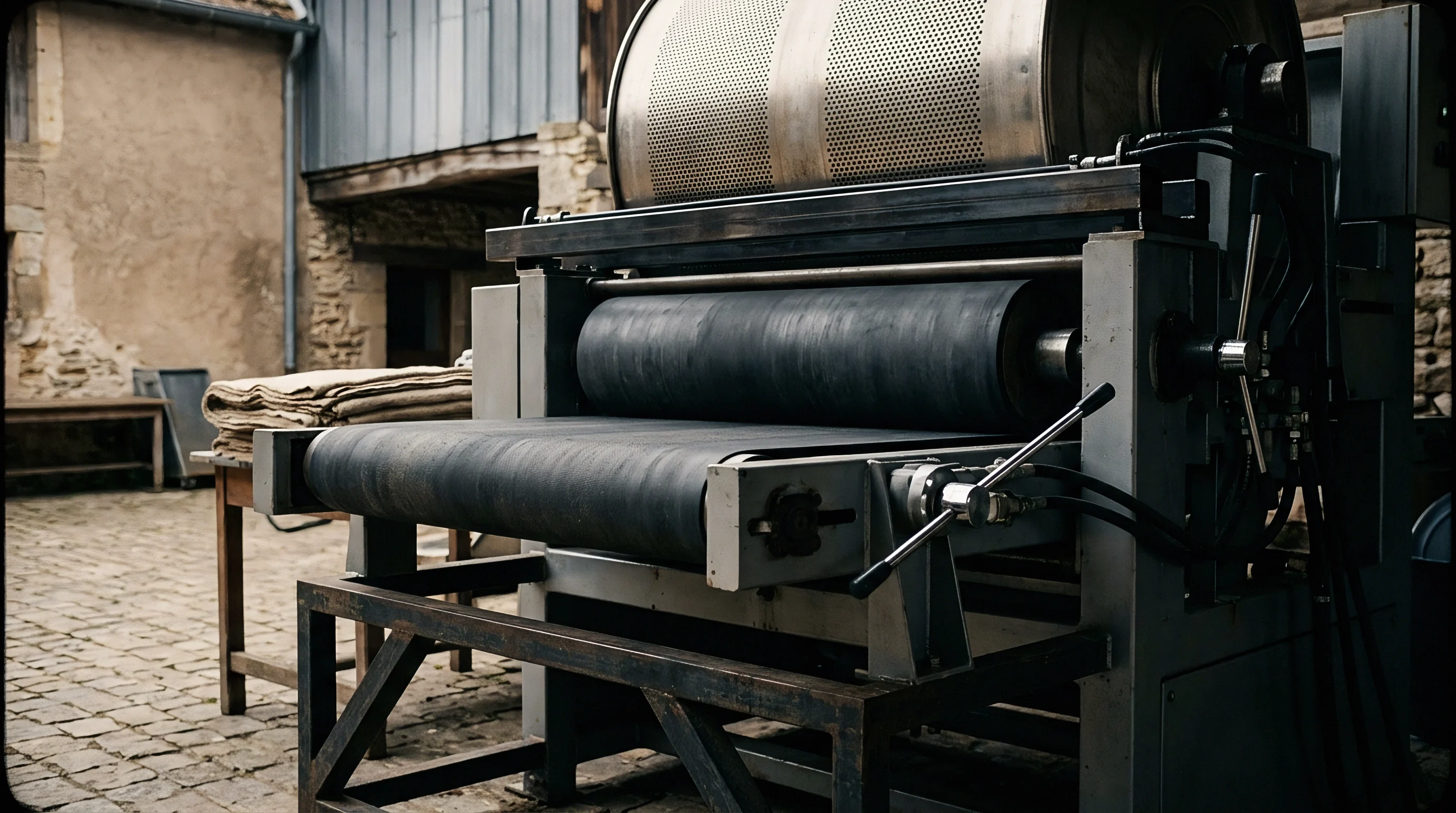
Density variation across high-compression flax packages alters the movement of atmospheric moisture into the bundle core. Hydraulic baling presses consolidate scutched flax line fibre or hackled sliver into rectangular blocks measuring 120 by 80 by 60 centimetres, applying compaction pressures between 18 and 25 megapascals. This pressure drives volumetric packing density from an uncompressed field state of 60 kilograms per cubic metre to a finished range of 280 to 420 kilograms per cubic metre.
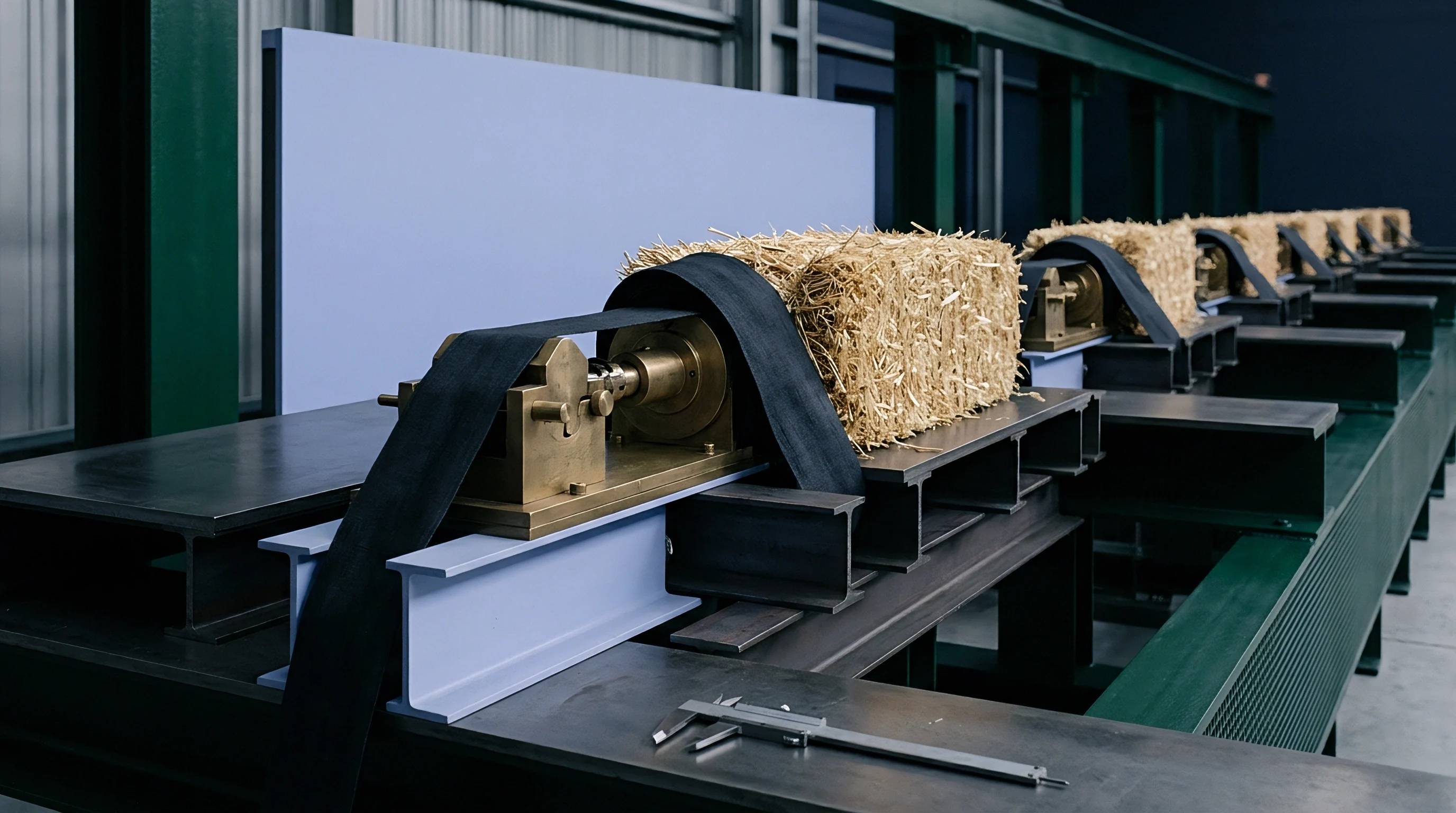
Steel or high-tensile polyester strapping holds the block under tension, creating localized density variations where the perimeter reaches up to 450 kilograms per cubic metre while internal core zones remain near 260 kilograms per cubic metre.
Inter-fibre macro-void fraction drops rapidly during compaction. In an uncompressed bundle, air-filled voids account for 78 percent of total bale volume. Compaction to 350 kilograms per cubic metre reduces this pore volume to 24 percent, restricting gaseous moisture convection through the interior.
Water vapor moving from ambient storage air must diffuse along tortuous micro-capillary paths rather than moving through open air channels. The effective diffusion coefficient of water vapor drops by two orders of magnitude, shifting mass transport from free convective dispersion to Knudsen diffusion and surface sorption along the hydrophilic bast fibre bundles.

Compaction Levels and Void Volume
Bale density governs the time required for a package to reach moisture equilibrium under fluctuating warehouse ambient conditions. High density limits quick moisture exchange, shielding inner fibre bundles from brief humidity spikes while creating persistent moisture concentration profiles across the bale radius during prolonged shipping cycles.
| Bale Type | Press Density (kg/m³) | Porosity Fraction (%) | Mean Pore Diameter (µm) | Vapor Diffusion Delay Rate (h/cm) |
|---|---|---|---|---|
| Low Density Tow | 180 to 220 | 0.62 | 45.0 | 4.2 |
| Standard Scutched Line | 280 to 320 | 0.38 | 12.5 | 18.6 |
| High Density Line | 360 to 400 | 0.22 | 3.8 | 46.1 |
| Ultra Press Dense Block | 420 to 460 | 0.14 | 1.2 | 88.4 |
Moisture profiles inside a 350 kilogram per cubic metre bale subjected to a step change in relative humidity from 50 percent to 80 percent reveal steep internal variations. Outer layers within five centimetres of the packaging film absorb ambient vapor within 48 hours, approaching an equilibrium moisture content of 11.5 percent. The core zone at a depth of 30 centimetres requires over 600 hours of continuous exposure to shift by a single percentage point of moisture regain.
Moisture meters reading surface layers record acceptable spinning conditions while core fibres remain below 8.0 percent moisture content, leading to fibre breakage during subsequent hackling operations.
A surface moisture reading taken from a compressed package provides zero structural evidence regarding the moisture content of the internal core.
Uneven moisture distribution across the bundle alters drafting force during yarn preparation. Dry core fibres lack the plasticizing moisture needed to relax secondary hydrogen bonds within the pectic middle lamella. When pulled through comb pins on a hackling machine, dry line fibre suffers bundle truncation, reducing average staple length from 650 millimetres to below 420 millimetres and generating high amounts of low-value tow waste.


Diffusion
Water uptake within raw flax bast bundles occurs through dual-stage sorption pathways governed by cellulose hydroxyl group availability. Flax fibre secondary cell walls contain 70 to 75 percent crystalline cellulose, 15 to 20 percent hemicellulose, and 2 to 5 percent pectin and lignin. Hydroxyl groups located on amorphous cellulose chains and hemicellulose matrices act as primary binding sites for atmospheric water molecules.
At relative humidity levels below 30 percent, water molecules chemisorb onto these free hydroxyl sites, forming a monolayer bound by strong hydrogen bonds with adsorption enthalpy exceeding 48 kilojoules per mole of water.
Increasing ambient relative humidity above 45 percent initiates multilayer physical condensation within amorphous domains and inter-microfibrillar spaces. The cell wall swells laterally, increasing technical fibre diameter by up to 14 percent while axial elongation remains under 1.5 percent. This anisotropic swelling alters internal pore geometry, opening previously closed capillary spaces to incoming water molecules.
Sorption behavior transitions from classical Fickian diffusion to non-Fickian structural relaxation sorption as the polymer network swells under osmotic swelling pressures.

Where Does Bound Water Transition to Free Water?
Bound water remains tightly held within cell wall micro-capillaries up to a local moisture regain of roughly 14 percent. Beyond this moisture level, capillary condensation fills macro-pores and the central lumen of individual ultimate fibres, depositing liquid water that operates under free water thermodynamics. Free water exhibits a water activity level (aw) exceeding 0.85, creating conditions where enzymes and micro-organisms become metabolically active within the baled fibre mass.
Sorption hysteresis produces a distinct moisture gap between wetting and drying pathways across identical environmental conditions. A bale reaching moisture equilibrium via absorption at 20 degrees Celsius and 65 percent relative humidity settles at 9.8 percent moisture regain. The same bale reaching equilibrium via desorption from a wet state under identical ambient conditions holds 11.9 percent moisture regain.
This 2.1 percent hysteresis spread alters fibre mass calculations, mechanical elasticity, and drafting friction during dry or wet yarn spinning.
| Relative Humidity (%) | Adsorption Regain (%) | Desorption Regain (%) | Hysteresis Spread (%) | Sorption Enthalpy (kJ/mol) |
|---|---|---|---|---|
| 30 | 4.8 | 6.2 | 1.4 | 52.1 |
| 50 | 7.2 | 9.1 | 1.9 | 46.8 |
| 65 | 9.8 | 11.9 | 2.1 | 43.2 |
| 80 | 13.4 | 15.8 | 2.4 | 41.5 |
| 90 | 18.1 | 21.3 | 3.2 | 40.2 |
Fibre tenacity changes directly with moisture regain levels within the cell wall. Unlike synthetic polymers or protein fibres, flax increases tensile strength as moisture content rises from dry states up to 12 percent regain. Water molecules plasticize the amorphous hemicellulose matrix, allowing crystalline microfibrils to realign under mechanical load and distribute tension evenly across the bundle cross-section.
Tensile strength measured via single fibre tests per ISO 5079 increases from 48 centinewtons per tex at 5.0 percent regain to 62 centinewtons per tex at 12.0 percent regain.
What remains uncalculated in current transport models is how transient thermal fluctuations during long-haul sea transit modify the sorption equilibrium boundaries of tightly strapped bundles.

Clamp
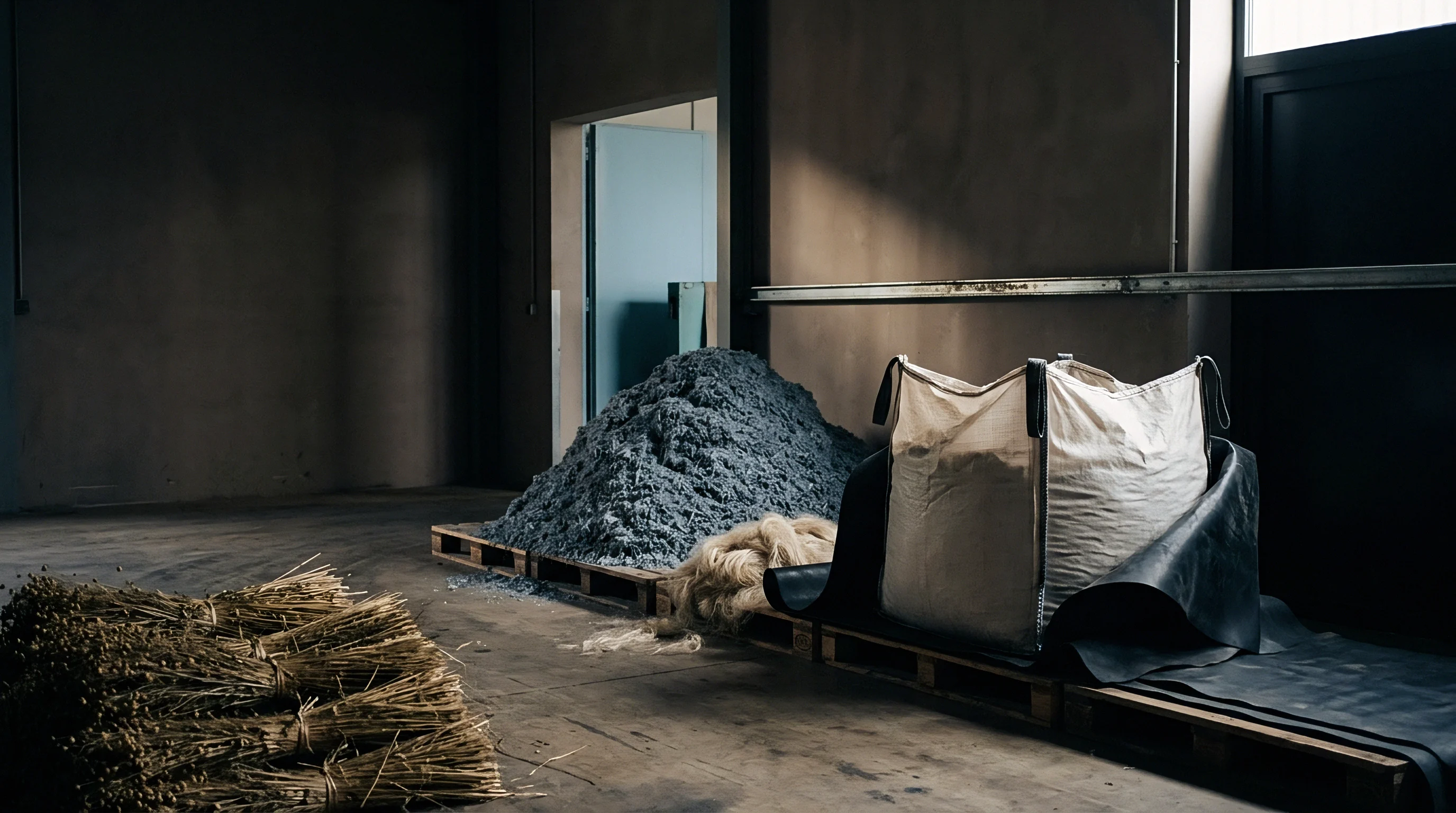
Steel strapping and mechanical press plates impose boundary constraints that alter vapor transport across compressed package surfaces. High mechanical compaction forces the perimeter fibres into tight parallel alignment, creating an outer skin with low transverse permeability. Air flow measurements across strapped package faces demonstrate an air permeability drop from 180 litres per square metre per second at uncompressed states down to less than 4 litres per square metre per second under final strap tension.
Package corners experience triaxial stress concentration during strapping, creating dense localized corners where volumetric density exceeds core density by 40 percent. These dense perimeter zones function as vapor barriers. Moisture entering or escaping the package moves predominantly through unstrapped end faces where fibre ends remain exposed to ambient air.
Directional diffusion anisotropy ratios reach five to one, favoring longitudinal vapor transport along the fibre axis over transverse transport across the compressed bundle width.
Mechanical Compression Effects
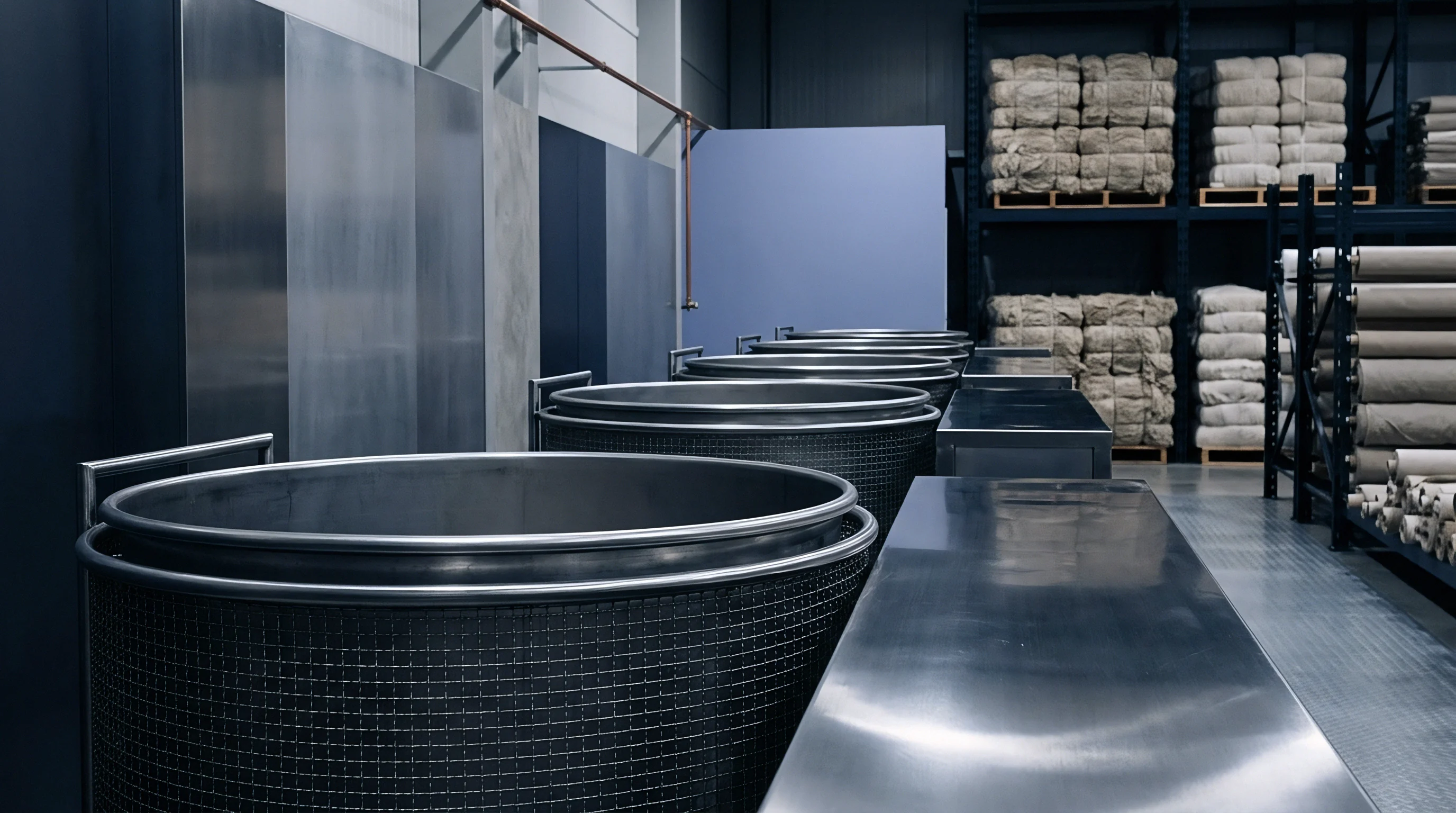
Storage of dense packages under high stacking loads exacerbates structural consolidation over time. Creep deformation of bast fibre assemblies under continuous mechanical stress reduces inter-fibre air space by an additional 5 to 8 percent over a six-month storage window. The reduced pore volume increases vapor diffusion resistance, extending the time required to achieve uniform moisture conditioning prior to hackling.
- Perimeter Compression Zone density reaches 420 kilograms per cubic metre, forming a tight exterior shell that retards ambient vapor exchange during short-term warehouse exposure.
- Internal Core Volume maintains lower compaction around 270 kilograms per cubic metre, remaining vulnerable to delayed moisture accumulation during extended ocean transit.
- Strapping Channel Crevices create localized micro-climates where air movement is zero and condensed liquid water gathers during rapid thermal cycles.
- Exposed Package Ends provide primary vapor entry paths where longitudinal capillary uptake rates exceed transverse surface absorption by five hundred percent.
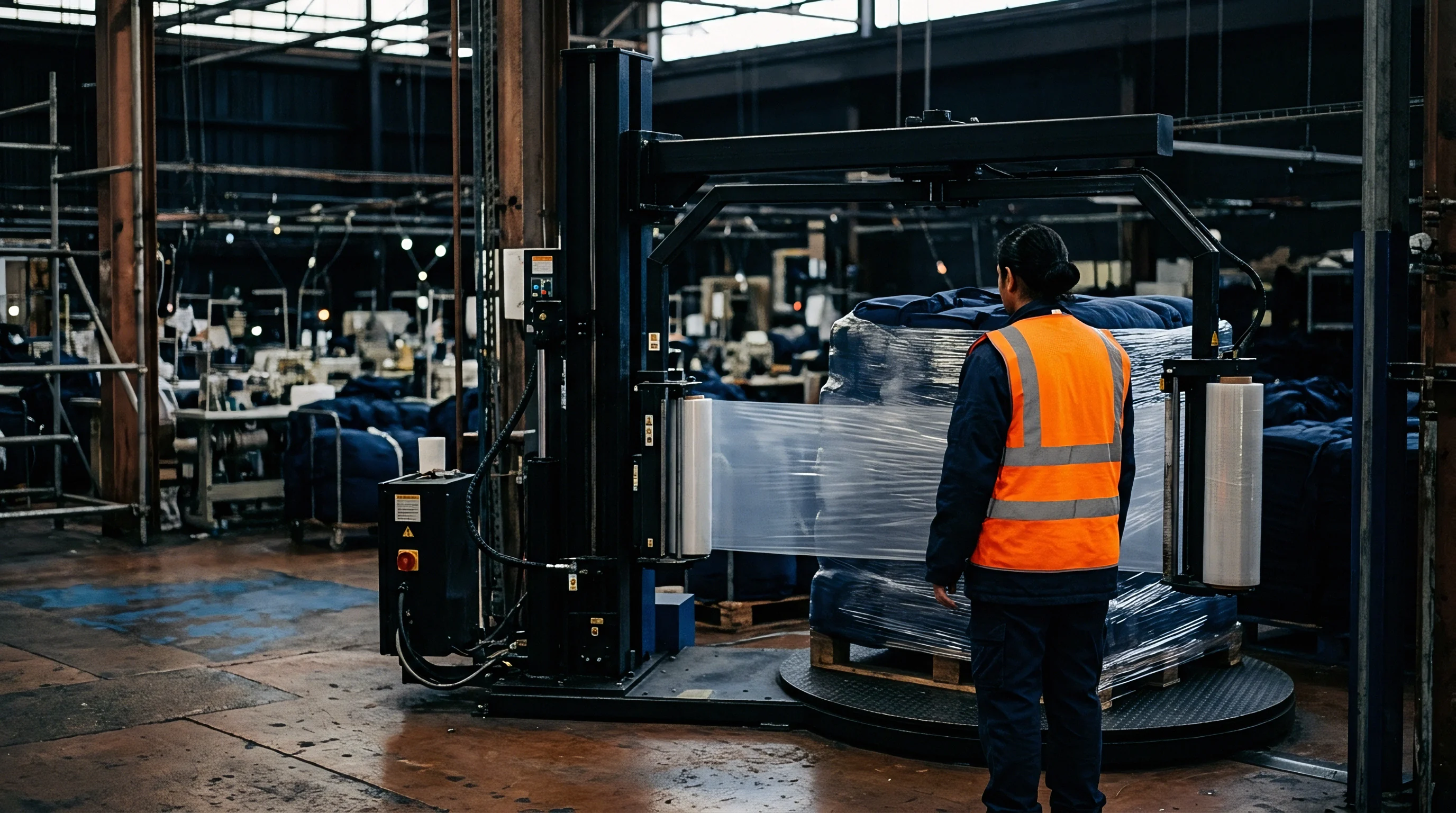
Packaging wrap choices govern vapor flux rates into pressed blocks. Polyethylene stretch wrap with low water vapor transmission rates (below 1.5 grams per square metre per 24 hours) prevents rapid moisture sorption during transit through high-humidity marine environments. Unwrapped or perforated polypropylene woven sacks permit continuous vapor exchange, causing internal moisture accumulation when packages traverse tropical sea routes where ambient dew points exceed 25 degrees Celsius.
Packaging film specifications dictate the rate of moisture exchange during maritime container transit.
Bale conditioning rules dictate holding pressed blocks in ambient mill conditions for a minimum of 14 days without outer strapping to allow internal moisture equilibration before comb processing.

Degradation
Elevated moisture levels within stored flax packages initiate biological and chemical breakdown of bast fibre components. Water activity levels above 0.75 trigger fungal spore germination, primarily species of Aspergillus, Penicillium, and Cladosporium present on raw scutched flax from field retting operations. These micro-organisms secrete cellulase and pectinase enzymes that hydrolyze structural polysaccharides, breaking down the middle lamella that binds ultimate fibres into technical fibre bundles.
Enzymatic hydrolysis degrades long-staple flax into short, weak fragments. As pectin and hemicellulose matrices break down, technical fibres lose bundle cohesion, causing excessive splitting during hackling. Single fibre tenacity drops rapidly when moisture content remains above 15 percent for more than 10 days at temperatures exceeding 25 degrees Celsius.
Stelometer tenacity testing per ISO 3060 shows strength losses up to 35 percent in mould-affected zones, rendering the fibre unsuitable for high-count wet spinning applications.

Microbial Activity and Thermal Spikes
Metabolic activity from dense microbial populations releases exothermic heat within insulated bale cores. Because compressed flax possesses low thermal conductivity (0.045 watts per metre-kelvin at 350 kilograms per cubic metre), heat generated by microbial respiration accumulates rapidly. Internal temperatures can rise from ambient levels of 20 degrees Celsius to over 60 degrees Celsius within 72 hours, accelerating hydrolytic breakdown and causing spontaneous thermal discoloration.
| Moisture Content (%) | Storage Temp (°C) | Incubation Time (Days) | Fungal Count (CFU/g) | Tenacity Retention (%) |
|---|---|---|---|---|
| 11.5 | 20 | 30 | 1.2 × 10³ | 99.2 |
| 13.8 | 25 | 30 | 4.5 × 10⁴ | 94.1 |
| 16.2 | 30 | 14 | 8.8 × 10⁶ | 76.5 |
| 19.5 | 35 | 7 | 3.2 × 10⁸ | 52.0 |
Thermal degradation alters fibre chemistry, darkening natural lustre and increasing free acid concentrations. Cellulose chain cleavage lowers the degree of polymerization (DP) from typical raw flax values of 2500 down to below 1100. Lower degree of polymerization directly correlates with reduced yarn tensile strength and increased yarn evenness variation (CV percent) on spinning frames.
Metabolic heat generated inside wet high-density packages permanently degrades cellulose degree of polymerization.
Suppliers routinely attribute internal discolouration and strength loss to residual field retting variation rather than inadequate moisture control during baling and storage.
Verification
Accurate moisture assessment in dense flax packages demands structured sampling protocols to overcome density and moisture gradients. Standard shallow stab probes reaching only 100 millimetres into a package measure exterior skin conditions while missing internal core variations. Electric resistance meters calibrated for wool or cotton yield errors up to 3.5 percent moisture content when applied to flax due to variable salt and ash concentrations in bast fibres.
Core extraction using hollow rotary drills provides representative samples through the full package thickness. A standard sampling protocol extracts cores along three orthogonal axes: top to bottom, side to side, and end to end. The extracted fibre core is divided into three equal segments corresponding to outer skin, intermediate zone, and central core.
Each segment undergoes immediate sealed container isolation to prevent moisture loss prior to laboratory testing.

Analytical Moisture Determination
Oven drying to constant mass per ISO 6741 serves as the reference laboratory method for moisture content and regain calculations. Specimens weighing at least 500 grams undergo drying at 105 degrees Celsius plus or minus 2 degrees Celsius in a forced-ventilation oven until successive weighings at 15-minute intervals show less than 0.05 percent mass change. Moisture regain is calculated as the loss of mass expressed as a percentage of the oven-dry fibre mass.
- Extract representative core samples across full package depth using a 25-millimetre internal diameter rotary sampling bit.
- Place extracted fibre immediately into hermetically sealed aluminium containers to prevent evaporative moisture loss during transport to the lab.
- Weigh sealed containers on a calibrated analytical balance with 0.001-gram precision to determine wet gross mass.
- Dry specimens in a ventilated oven at 105°C until reaching constant mass per ISO 6741 protocol specifications.
- Cool dried specimens inside a glass desiccator containing active silica gel for 45 minutes before recording final oven-dry mass.
High-frequency microwave attenuation meters offer non-destructive moisture measurement across full package volumes. Electromagnetic waves at 2.45 gigahertz attenuate in proportion to the dipole rotation of free and bound water molecules within the bundle. Calibrated microwave systems measure total water mass across the entire package path, providing average moisture content readings within 0.3 percent accuracy regardless of internal density gradients.
Standard trade contracts specify that moisture disputes must be settled by an accredited independent laboratory executing ISO 6741 oven-drying on core samples extracted within 72 hours of container unsealing, overriding all electronic probe readings taken at port entry.


Settlement
Commercial transactions for flax fibre rely on invoice adjustments based on official moisture regain allowances. The International Linen and Hemp Confederation (CIB) establishes the official moisture regain standard for flax fibre at 12.0 percent. When raw or processed flax is bought and sold by mass, the invoiced mass must reflect the equivalent weight of the fibre at this standard moisture level, preventing buyers from paying fibre prices for excess water weight.
Commercial mass calculations convert delivered net mass to standardized billable mass using verified laboratory regain figures. The formula for commercial mass (Mc) applies the delivered net mass (Md), the measured actual moisture regain (Ra), and the official standard regain (Rs = 12.0%):
Mc = Md × frac100 + Rs100 + Ra
If a 20-tonne shipment delivers at an actual measured moisture regain of 14.5 percent, the buyer receives excess water mass. Applying the commercial mass formula yields:
Mc = 20,000 kg × frac100 + 12.0100 + 14.5 = 20,000 × frac112.0114.5 = 19,563.3 kg
The standard commercial mass settles at 19,563.3 kilograms, requiring a 436.7 kilogram deduction from the invoiced mass. At a line flax price of 4.80 Euros per kilogram, this adjustment saves the buyer 2,096.16 Euros on the lot.

Worked Settlement Calculation under Variable Regain Conditions
Evaluating commercial settlement options under varying delivered moisture conditions highlights the direct financial exposure created by unadjusted weights. Take a 40-tonne lot of dew-retted line flax contracted at 5.20 Euros per kilogram delivered to a spinner.
| Delivered Mass (kg) | Measured Regain (%) | Official Regain (%) | Commercial Mass (kg) | Financial Adjustment (€) |
|---|---|---|---|---|
| 40,000 | 9.5 | 12.0 | 40,913.2 | + 4,748.64 |
| 40,000 | 11.0 | 12.0 | 40,360.4 | + 1,874.08 |
| 40,000 | 12.0 | 12.0 | 40,000.0 | 0.00 |
| 40,000 | 13.8 | 12.0 | 39,367.3 | – 3,290.04 |
| 40,000 | 15.2 | 12.0 | 38,888.9 | – 5,777.72 |
Delivering fibre below standard regain increases commercial mass, entitling the supplier to an upward price adjustment. A lot delivered at 9.5 percent regain contains extra dry cellulose mass, requiring the buyer to pay an additional 4,748.64 Euros. Purchasing dry fibre provides more usable spinning material per invoiced kilogram, offsetting the higher immediate invoice total through improved hackling yield and reduced end breakage on spinning frames.
Contractual agreements must define clear moisture tolerance thresholds. Moisture regain levels exceeding 16.0 percent expose shipments to biological degradation during transport, granting the buyer rights to reject the lot outright regardless of commercial mass price adjustments. Precise integration of ISO 6741 testing procedures into purchase orders ensures transparent commercial settlement and protects spinning mills from paying for water mass or receiving biologically damaged fibre bundles.
Unadjusted weight invoices transfer pure financial risk to the buyer when fiber packages cross climate zones.