Flax Fibre Separation Mechanics under High Density Hackle Combs
High density hackle combs divide technical flax bundles into elementary fibres through controlled transverse shear, trading long line yield against spinnable metric yarn count.
Clamp
Fibre Holder Pressure Distribution across Strands
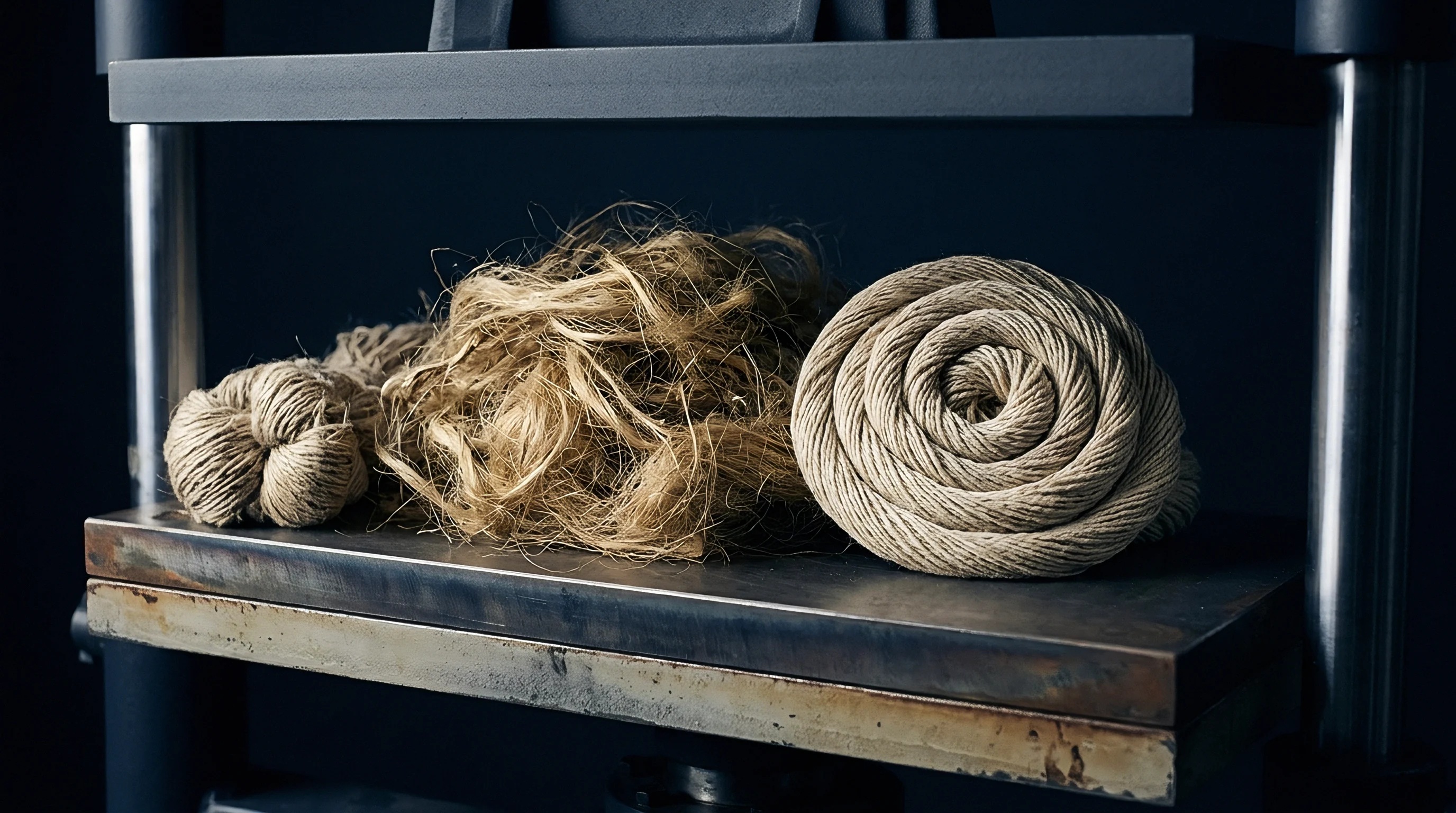
Holding flax bundles securely during mechanical combing requires precise nip-line pressure. Steel clamp plates compress raw scutched flax strands to anchor root and top ends as hackle pins pass through the exposed fringe. Too little grip lets strands slip, pulling whole technical fibres out of the matrix and into the tow collector.
Too much pressure crushes bast cell walls along the holder edge, leaving weak spots that snap later during drafting.
Pneumatic systems distribute clamping force evenly across wide holder beds, running between 0.45 MPa and 0.65 MPa depending on bundle weight and moisture. At 12 percent moisture regain, dressed flax compresses cleanly without cell wall damage. Below 9 percent regain, dry bundles crush brittly under those same pneumatic settings.
Holding the fringe securely is critical here, as breaking down technical bundles into elementary fibres easily leads to lost mass during early coarse passes.

Initial Comb Penetration and Boundary Shear
Combing starts as rotating hackle bars enter the suspended flax fringe just below the holder edge. Moving steel needles hit stationary strands, creating sharp shear forces where the pins enter. This impact splits raw technical bundles along their weak middle lamellae.
Pin speed needs to match the linear density of the fibre so primary cell walls do not shear across.
Linear velocity during initial penetration typically runs between 0.8 metres per second and 1.2 metres per second. Faster speeds generate shock loads that snap long line flax into short pieces. Slower speeds let bundles bend around pins without splitting apart longitudinally.
Most boundary shear concentrates within 15 millimetres of the holder lip; if clamp plates and hackle paths are out of alignment, this stress zone shifts, breaking more fibre and creating uneven sliver mass.
Poor clamping mechanics send high proportions of line fibre straight into tow boxes, degrading valuable long flax into low-value short fibre.


Density

Graduated Pin Pitch across Hackling Fields
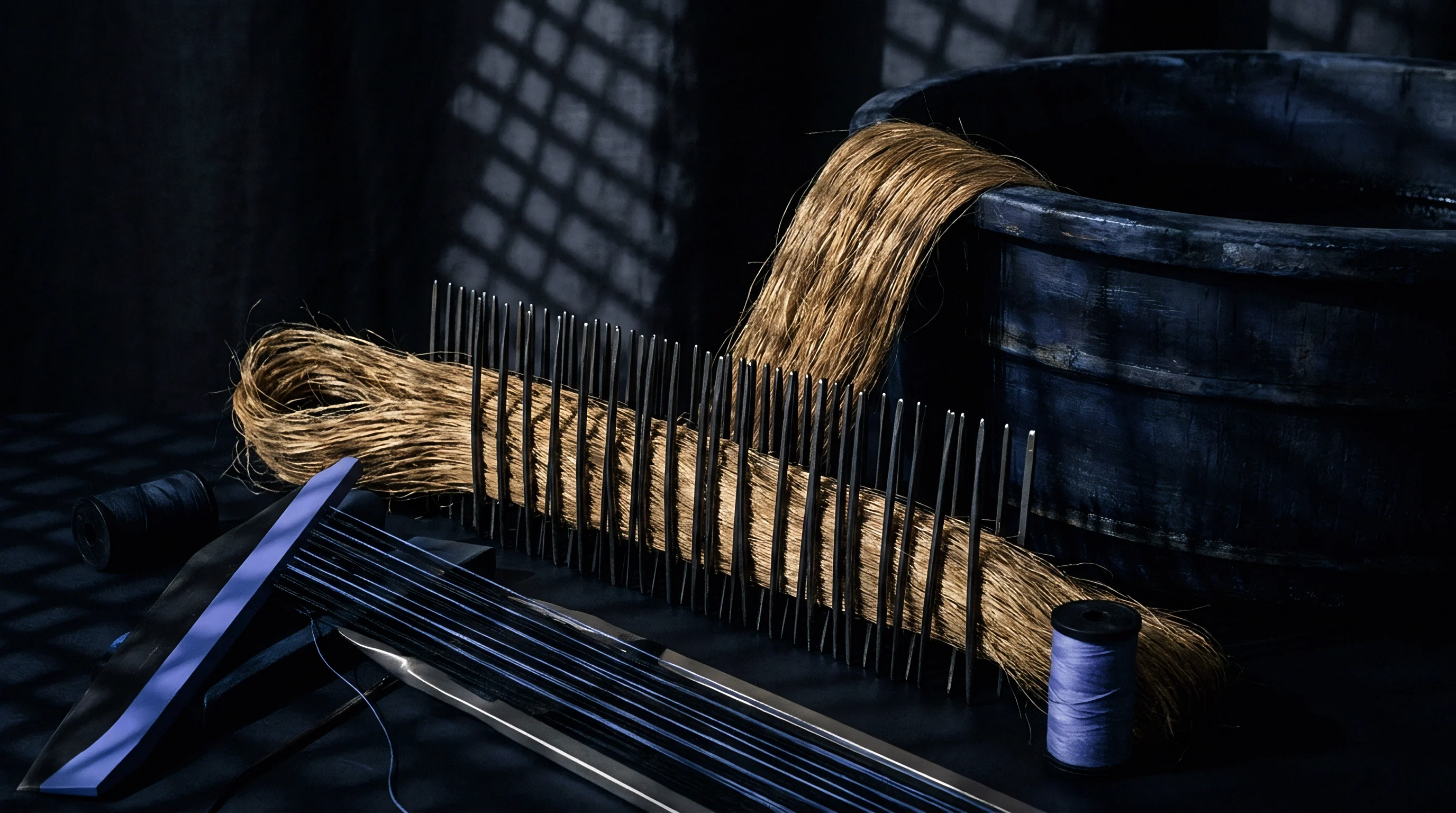
Hackling machines run flax through successive fields with higher pin counts. Early fields use coarse pins spaced at 2 to 4 pins per centimetre to straighten tangled strands and strip out residual shive. Intermediate fields ramp up to 6 to 12 pins per centimetre, starting the longitudinal split of technical bundles.
Fine fields reach 18 to 28 pins per centimetre to split the bast structure down to its finest state.
Pitch reduction follows a geometric curve aligned with the thinning fibre fringe. Needle diameters drop right along with pitch, from 1.5 millimetres in coarse beds to 0.35 millimetres on final high-density bars. Tapered needle profiles enter smoothly without puncturing elementary cell walls, preserving length while exposing maximum surface area for wet spinning.

Which Pin Layout Prevents Excessive Fibre Breakage?
Intersecting dual-bed layouts keep tight control over fibre movement during fine division. Top and bottom bars penetrate the suspended strand at the same time, balancing sideways forces so strands do not shift. Staggered pins cover the full width of the holder, while a half-pitch offset prevents collisions and applies even shear across each bundle.
| Hackling Stage | Pin Density (pins/cm) | Needle Diameter (mm) | Target Fibre Linear Density (dtex) | Primary Process Action |
|---|---|---|---|---|
| Coarse Entry | 2.0 – 4.0 | 1.50 – 1.20 | 35 – 50 | Shive removal and strand alignment |
| Intermediate Fine | 8.0 – 12.0 | 0.80 – 0.60 | 20 – 30 | Primary bundle longitudinal splitting |
| High Density | 18.0 – 24.0 | 0.45 – 0.35 | 12 – 18 | Elementary fibre separation |
| Ultra Fine Field | 25.0 – 28.0 | 0.30 – 0.25 | 8 – 11 | Micro-bundle refinement for fine counts |
High-density fields operating above 22 pins per centimetre demand exact mechanical tolerances. Pin wear or bent needles alter local pitch, creating wide passages where fibres pass untouched adjacent to constricted zones that tear incoming strands. Maintenance schedules require optical pin inspection after every 120 operating hours to maintain sliver uniformity standards.
- Pin Spearing Defect Needle points strike bundle cores directly, puncturing elementary cell walls and creating weakness points that snap during drafting.
- Lateral Strand Grouping Wide needle gaps allow technical bundles to pass without splitting, leaving coarse bundles in the delivery sliver.
- Transverse Pin Bending Needle deflection under high mechanical load narrows the working channel, crushing passing fibres into dense neps.
- Pin Tip Wear Dulled needle points push fibres downward instead of penetrating, increasing holder pull-out and line waste fractions.
High short-fibre fractions are frequently blamed on poor field retting when the real cause is uncalibrated pitch tolerance across high-density needle beds.

Friction
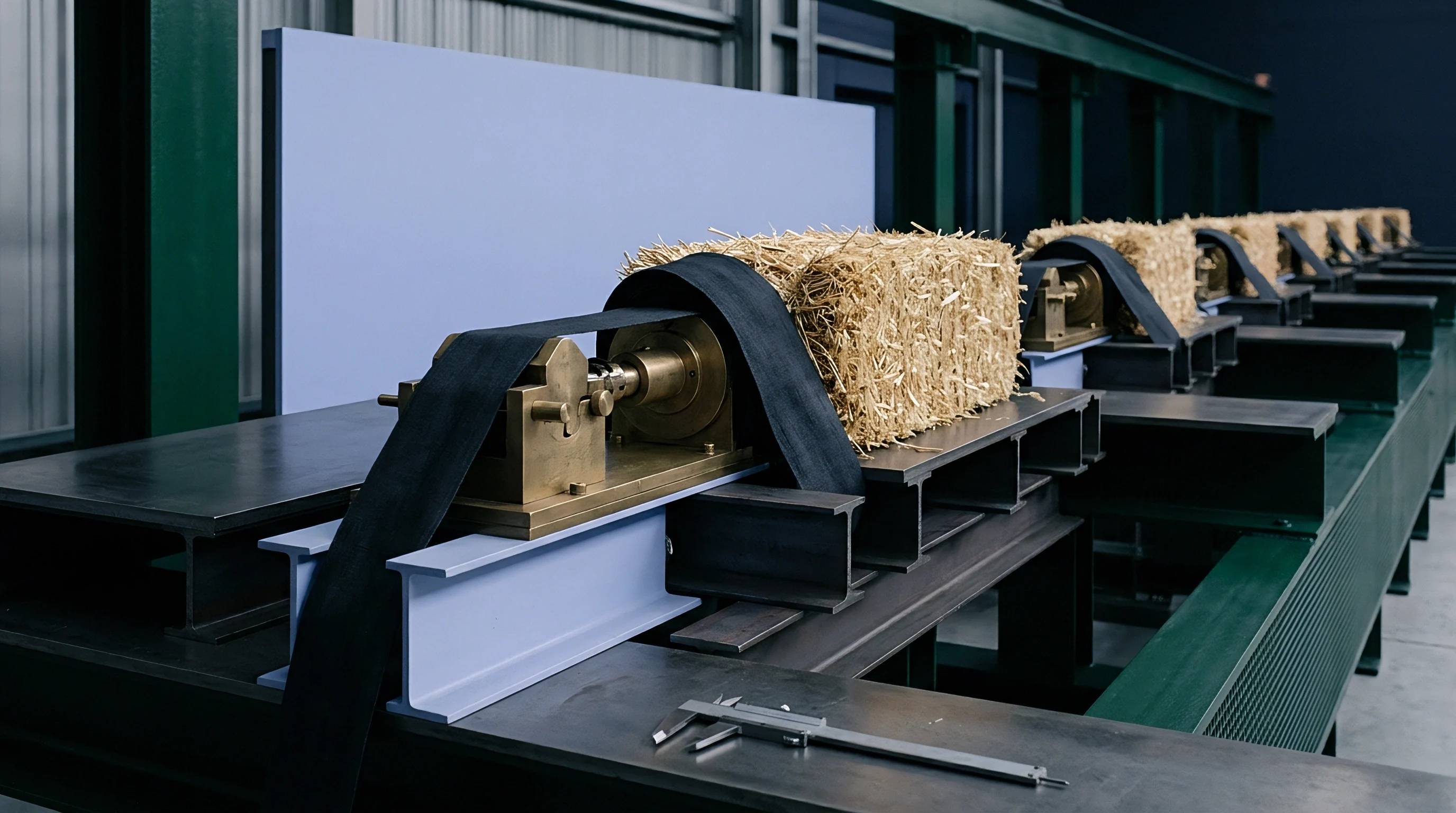
Pectin Lamella Cleavage under Transverse Shear
Elementary fibres are bound into technical bundles by pectins, hemicellulose, and lignin. Splitting them relies on shearing these chemical bonds without damaging the underlying cellulose core. As bundles pass through high-density fields, contact with polished steel pins generates the localized frictional shear needed to cleave middle lamellae.
Inter-bundle cohesion forces dictate the mechanical energy required to split technical flax strands during fine hackling passes.
The friction coefficient between dew-retted flax and hardened steel varies with sliding speed and surface moisture. At 65 percent relative humidity and 20 degrees Celsius, dynamic friction sits between 0.22 and 0.28. If friction drops below this, bundles slide past pins without splitting; if it rises too high, drag and frictional heat exceed single-fibre tensile strength, snapping strands instead of dividing bundles.
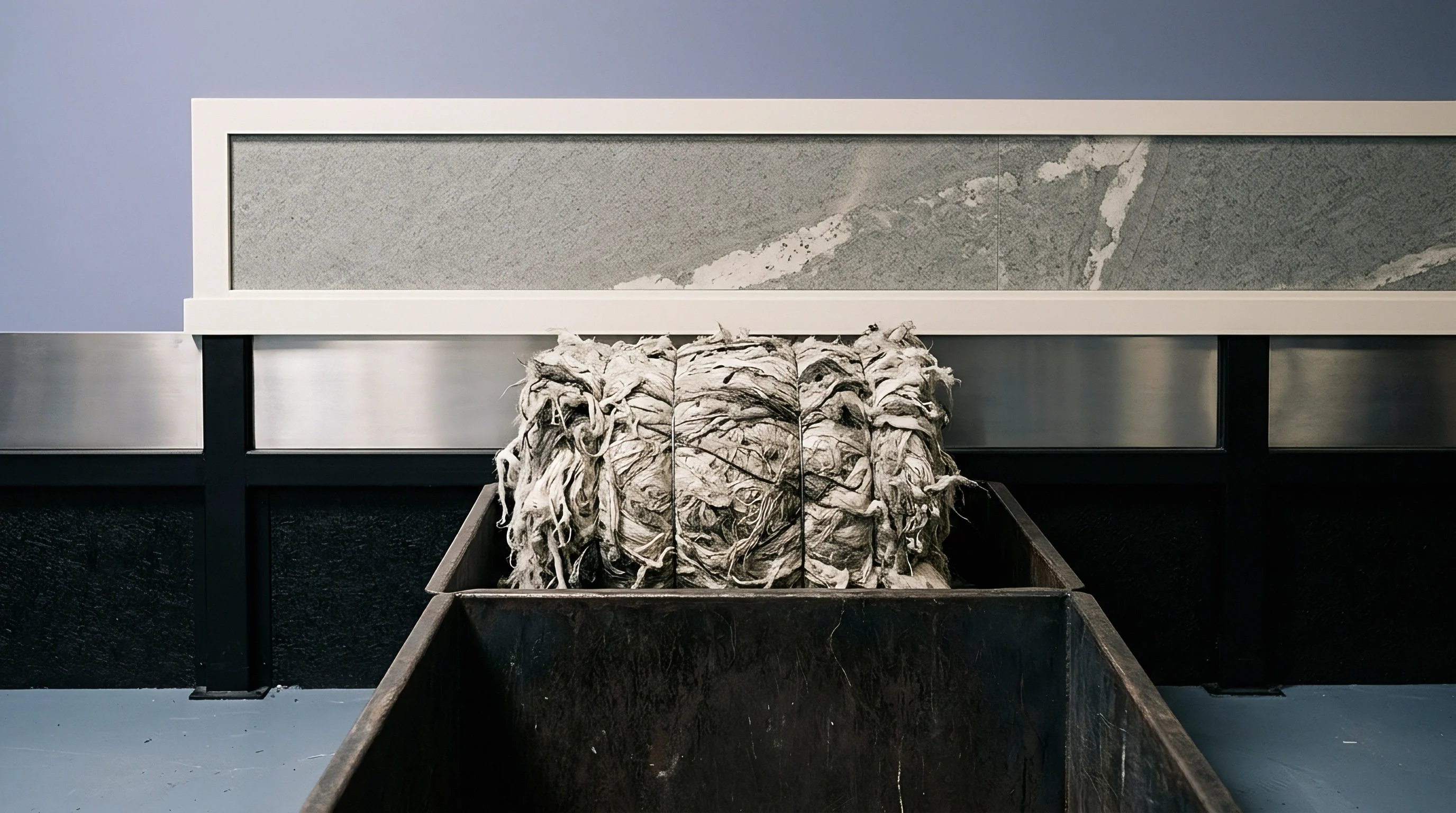
Moisture Regain Effects on Pin Pass Resistance
Water acts as a plasticizer within the pectin matrix. Higher relative humidity in the mill boosts fibre moisture regain and softens inter-cellular bonds. At 14 percent regain, the shear stress needed to cleave middle lamellae is roughly 35 percent lower than in dry fibre at 8 percent regain.
Managing ambient humidity keeps these forces steady through seasonal shifts.
Calculating shear forces in a high-density bed requires accounting for strand weight, pin geometry, and line speed. Take a technical bundle of 40 dtex entering a 22 pin per centimetre hackle bed at 1.1 metres per second. Each needle contact exerts roughly 0.15 Newtons of normal force on the strand.
At a friction coefficient of 0.25, that produces 0.0375 Newtons of frictional shear per pin contact.
Over a 120 millimetre penetration zone with 26 effective pin contacts, total shear force reaches about 0.975 Newtons. This exceeds the 0.70 Newton threshold needed to split the pectin matrix, while staying comfortably below the 2.40 Newton breaking limit of the bundle core. Controlling needle drag allows division down to elementary structures of 1.5 to 2.5 dtex without rupturing primary cell walls.
Consistent ambient humidity preserves inter-bundle lubrication during mechanical splitting.


Damage

Kink Band Formation under Needle Impact
Repeated impacts from fine needles damage bast microstructures if machine settings push past fibre elasticity limits. High-speed strikes send transverse shock waves down suspended strands, creating localized plastic deformations known as kink bands across cell walls. These kink bands weaken long line flax, reducing yarn tensile strength.
High needle impact velocities induce micro-fractures in bast cell walls long before full strand breakage occurs.
Under polarized light microscopy, kink bands appear as crosswise fissures through the secondary cell wall. Fibres with more than four kink bands per centimetre lose over 28 percent of their tensile strength during wet-spin drafting. Keeping entry speed low while increasing pin density preserves structural integrity without sacrificing fineness.
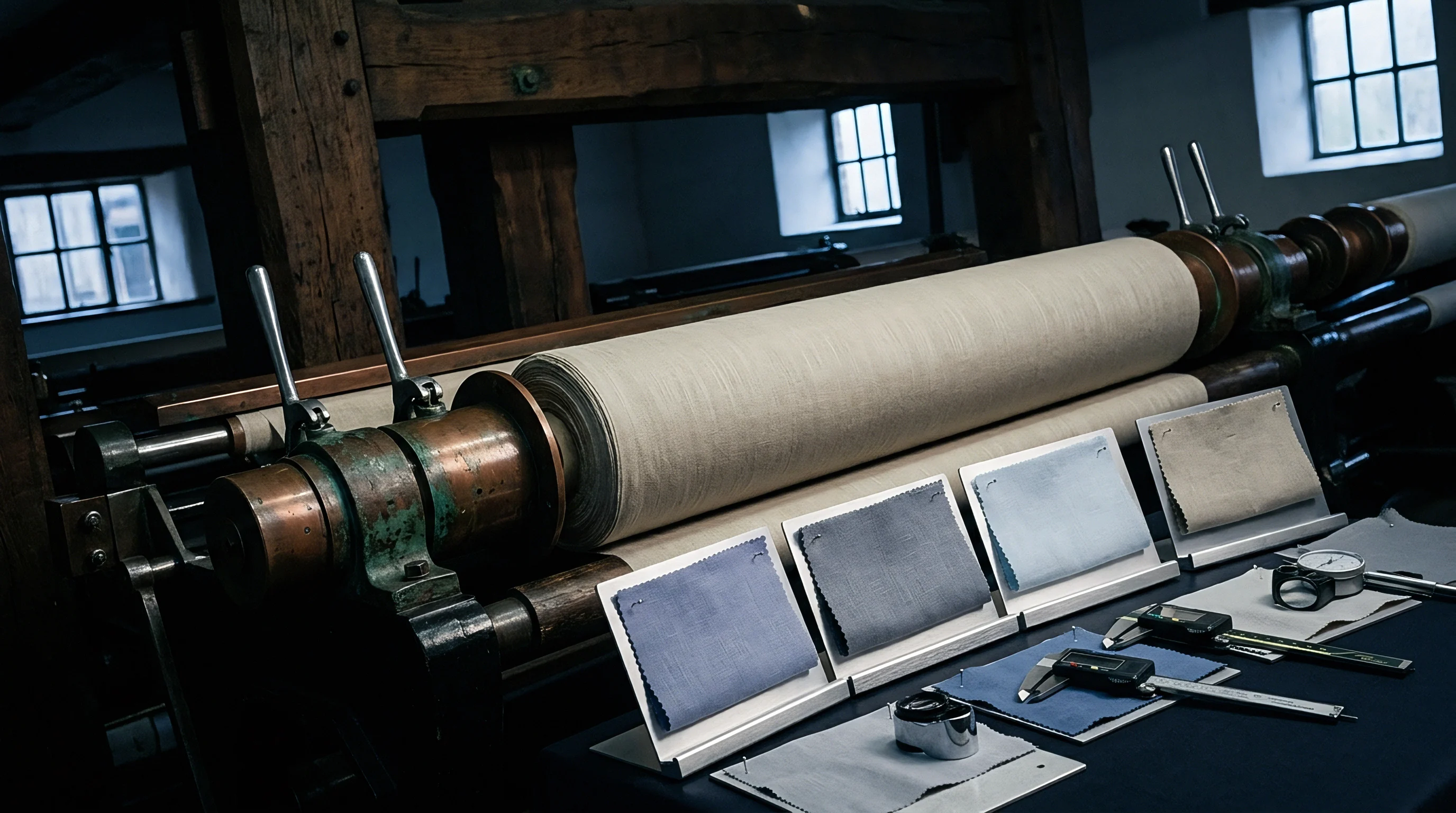
Tow Extraction Ratios and Fine Nep Generation
Overly aggressive combing drives long line fibre into short-fibre tow boxes. Physical damage turns up as snapped tips, reduced mean staple length, and small tangled clusters known as neps. When high-density beds operate with bent pins or off-timing drops, they scrape the fibre surface, creating fine neps that pass through drafting to produce thick spots in finished yarn.
| Hackling Intensity Setting | Mean Fibre Length (mm) | Kink Band Density (bands/cm) | Tow Waste Fraction (%) | Yarn Nep Count (neps/1000m) |
|---|---|---|---|---|
| Low Density Gentle | 680 | 1.2 | 18.5 | 12 |
| Optimal High Density | 620 | 2.4 | 22.0 | 24 |
| Severe Over-Combing | 490 | 6.8 | 34.5 | 98 |
| Misaligned Needle Bed | 410 | 9.1 | 41.0 | 165 |
- Inspect delivered long line sliver samples under polarized light every 500 kilograms to quantify cell wall kink band frequency.
- Measure mean staple length distribution using comb sorter apparatus to detect artificial shortening induced by needle impact.
- Weigh tow waste accumulation across coarse, medium, and fine hackling boxes to verify extraction balances against target curves.
- Audit pin straightness across high-density beds using visual alignment gauges to catch bent needles before nep generation escalates.
Standard delivery contracts specify that fine hackling must not reduce mean long line staple length by more than 12 percent relative to incoming scutched stock.
Qualification

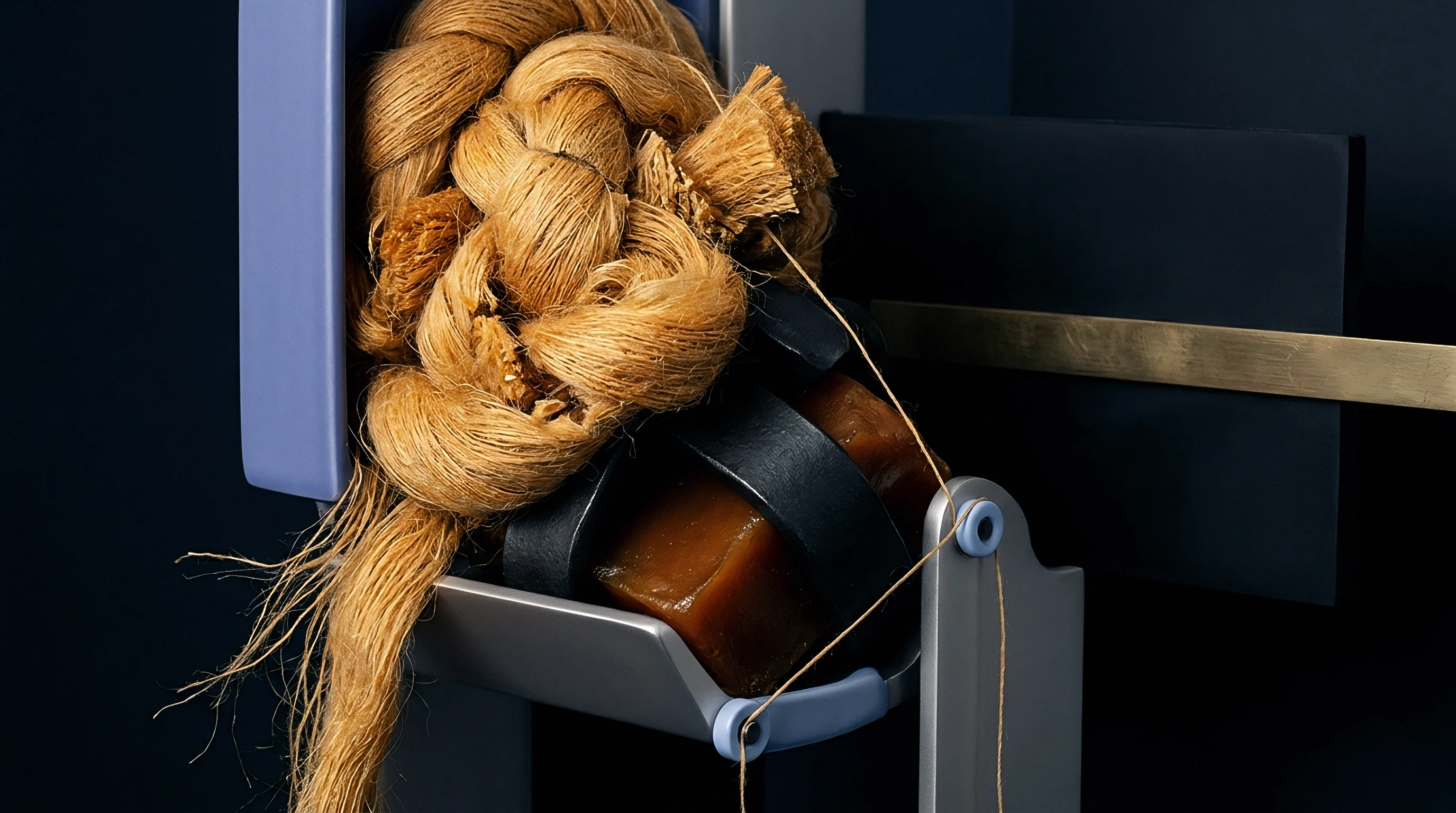
Laboratory Testing of Hackled Line Sliver
Qualifying hackled line flax requires thorough lab testing before committing lots to spinning frames. Sliver cans are sampled systematically ~ top, middle, and bottom ~ to catch machine variation. Testing focuses on linear mass uniformity, mean fineness, staple length distribution, and residual shive.
Standard ISO 2370 defines airflow testing protocols to determine the specific surface area and mean metric fineness of hackled flax fibres.
Mass evenness is checked on optical or capacitive testing units at 50 metres per minute. CV values for qualified fine-line sliver must remain below 4.5 percent over 100-metre test lengths. Spikes in mass variation point directly to uneven pin entry or slipping clamps.
Fineness Distribution Measurement via Airflow and Microscopy
Airflow instruments gauge resistance through a compressed plug of hackled fibre. Greater specific surface area indicates finer bundle splitting in high-density fields. Results are converted to metric count (Nm) or linear density in dtex; fine flax destined for Nm 60 yarn needs an average fineness between 12 and 15 dtex.
Optical microscopy checks these readings by measuring bundle diameters across a 500-fibre sample. Cumulative distribution curves show whether high pin density split bundles cleanly or just chopped coarse strands short. A narrow curve centered around 18 micrometres confirms consistent hackling, while a broad bimodal distribution signals uneven pin penetration.
- Airflow Fineness Index Measured per ISO 2370, confirming average bundle division achieved across high-density fields.
- Tensile Strength Index Measured per ISO 3060 using pressley clamps, requiring minimum values of 38 centinewtons per tex.
- Staple Length Spread Evaluated via tuft sorter, limiting short fibre content below 50 millimetres to less than 8 percent by weight.
- Residual Shive Mass Determined by manual separation over 50 grams of sliver, capping unretted woody particles at 0.15 percent maximum.
Whether airflow fineness readings accurately reflect spinning limits when bundle cross-sections are highly irregular remains a point of debate among mill technologists.


Valuation

Line Fibre Yield versus Achievable Spinnable Metric Count
Hackling mechanics drive yarn manufacturing economics. Increasing pin density yields finer line flax for higher metric counts (Nm), but aggressive combing pushes more short fibre into tow boxes and lowers high-value line yield. Sourcing managers balance line yield against target yarn counts to protect landed fabric margins.
Scutched flax at 4.20 Euros per kilogram yields different proportions of line fibre and tow depending on pin density settings. Gentle hackling yields 68 percent line flax suited for Nm 39 yarn. An aggressive high-density setup yields 54 percent line flax, but splits bundles fine enough to spin Nm 80.
The shifted mass becomes tow worth only 1.30 Euros per kilogram ~ a yield loss that fine yarn pricing must recover.
Finished Metre Cost Mechanics across Wet-Spinning Grades
Evaluating real financial outturns requires tracing yield all the way to finished woven cloth. Take a plain-weave linen fabric at 160 grams per square metre and 150 centimetres finished width. Weaving this specification from Nm 40 yarn consumes 0.240 kilograms of yarn per linear metre after contraction and finishing loss.
The same cloth woven from Nm 70 yarn uses 0.137 kilograms per linear metre.
Yield loss during high-density hackling shifts raw material cost burdens directly onto fine yarn count pricing.
Assuming raw scutched flax costs 4.50 Euros per kilogram, a standard hackling line with 65 percent line yield produces line stock at 6.15 Euros per kilogram after tow credit. Spinning this to Nm 40 yarn adds 3.80 Euros per kilogram in processing costs, bringing finished yarn to 9.95 Euros per kilogram. That puts the raw fibre cost for a linear metre of 160 GSM fabric at 2.39 Euros.
Running identical raw stock through a high-density line yielding 52 percent fine line raises line stock cost to 7.45 Euros per kilogram after tow credit. Spinning to Nm 70 yarn costs 7.20 Euros per kilogram in processing due to slower spindle speeds and frequent end breaks, bringing yarn to 14.65 Euros per kilogram. Combined fibre and spinning cost per linear metre of 160 GSM fabric works out to 2.01 Euros.
Higher per-kilogram spinning costs for fine yarn are partly offset by using less fibre mass per metre of cloth, putting profit leverage squarely on hackling yield control.
Commercial valuation models must account for pin density settings, line yield losses, and spindle speeds to establish true landed costs per finished metre.