Quantifying Microscopic Pectin Hydration Shear Thresholds under High Velocity Flax Shedding Dynamics
Hydrated pectin binder fails when shedding shear stress exceeds 4.5 kPa at 600 ppm, requiring 70% RH and protective sizing to prevent fiber breakdown.


Matrix
Technical flax yarns derive structural integrity from intercellular polysaccharides within the plant cell wall. Individual elementary fibers, possessing diameters between ten and thirty micrometres, bundle together to form technical fibers through a continuous middle lamella. This intercellular binder consists predominantly of pectic substances, hemicellulose, and structural proteins.
Within raw and partially scoured linen yarns, homogalacturonan domain structures form a cross-linked gel network stabilized by calcium ions and hydrogen bonds. The mechanical response of this inter-fibrillar adhesive under high-speed industrial shedding depends on its internal hydration state.
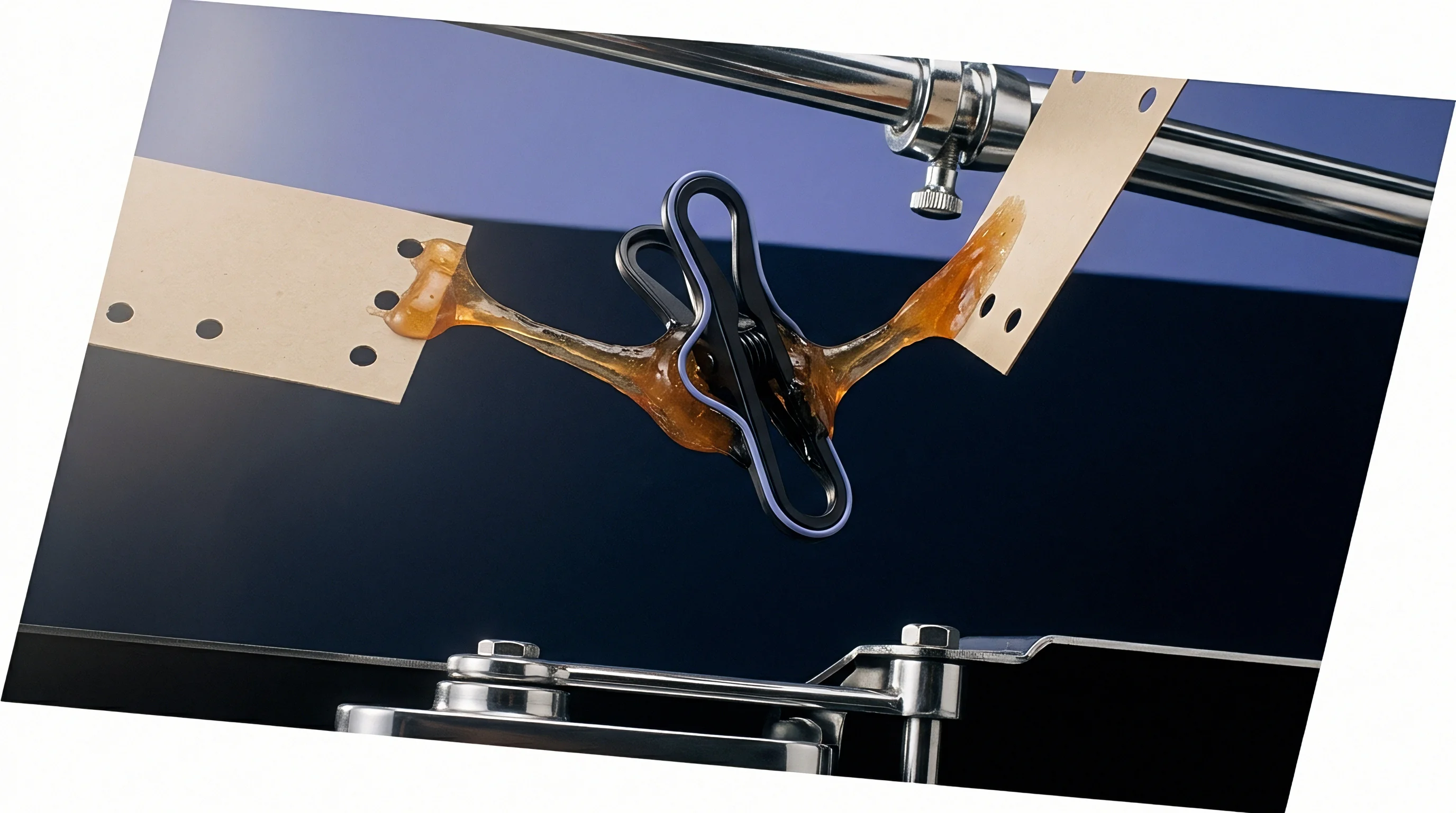
Flax Cell Wall Middle Lamella Composition
Individual bast fibers aggregate into technical bundles through an adhesive polysaccharide network. Homogalacturonan constitutes over sixty percent of the total pectin content within flax middle lamellae, accompanied by rhamnogalacturonan blocks bearing side chains of arabinans and galactans. Flax strands contain bound pectin.
The degree of esterification within this homogalacturonan backbone determines the hydrophobic and hydrophilic balance of the intercellular layer. Unesterified carboxyl groups coordinate with divalent calcium ions, creating rigid junction zones known as egg-box structures. Methylesterified groups disrupt these ionic bridges, forming flexible amorphous regions that readily absorb water molecules from ambient air.
Hydrated pectin films exhibit greater molecular compliance under low frequency tension than under rapid cyclic impact.

Polyuronide Water Binding and Plasticization
Homogalacturonan chains absorb ambient atmospheric moisture through hydroxyl hydrogen bonding. Bound water acts directly as an internal plasticizer within the pectin matrix. At low moisture regain levels below four percent, the polysaccharide matrix remains in a glassy state, characterized by a high elastic modulus exceeding two gigapascals and brittle fracture behavior.
As ambient relative humidity rises above sixty-five percent, equilibrium moisture content in the flax yarn increases beyond eight percent. Water acts as a plasticizer. This absorption triggers a glass transition phase change within the middle lamella, depressing the glass transition temperature below ambient weaving shed room temperatures and converting the pectin binder into a viscoelastic fluid film.
Maintaining stable ambient humidity preserves intercellular binder elasticity across variable spinning batches.


Kinematics
Rapier looms operating above five hundred picks per minute subject warp ends to intense cyclical accelerations. The geometric motion of the loom harness creates continuous vertical deflection of warp threads, opening and closing the shed twice per revolution. During high-velocity weaving, yarn linear displacement speeds reach three to six metres per second over stroke amplitudes of seventy to ninety millimetres.
High speed increases shear rate. These dimensional changes generate severe mechanical stress concentrations where individual warp yarns contact heddle eyes, drop wires, and reed dents.

Shed Peak Opening Accelerations at High Loom Speeds
Heddle frames moving under dobby drive mechanisms generate sinusoidal position curves with sharp acceleration spikes. Peak vertical acceleration of warp ends occurs near the point of shed reversal, where directional velocity transitions through zero. At an operating speed of six hundred picks per minute, acceleration values at the heddle eye exceed two hundred metres per second squared.
This acceleration induces dynamic tension spikes within the warp strand. Dynamic stress causes end breaks. The magnitude of these tension surges scales quadratically with loom speed, transferring mechanical energy directly into the outer surfaces of the yarn.

Contact Mechanics at Heddle Eyes and Reed Dents
As warp yarns pass through steel apertures, normal force vectors combine with linear axial motion. Sliding contact between the yarn perimeter and the polished steel surface of the heddle eye induces localized contact pressure exceeding fifteen megapascals. Heddle friction generates micro-heat.
This friction concentrates mechanical energy over microscopic contact zones of less than zero point zero five square millimetres. The resulting combination of compressive normal stress and rapid transverse motion establishes high local velocity gradients across the fiber cross-section.
Machinery vendors frequently attribute micro-fibril dust generation to inherent raw material variance rather than aggressive harness acceleration curves.

Shear
Hydrodynamic displacement within the intercellular binder layers follows non-Newtonian flow models during rapid yarn motion. When a hydrated flax yarn experiences rapid lateral deformation at a heddle eye, the internal pectin binder between elementary fibers undergoes intense mechanical shearing. Higher speed elevates strain rates.
The localized shear strain rate across the nanometre-thin middle lamella layer can exceed one hundred thousand reciprocal seconds during peak shedding motion. Under these extreme strain rates, the hydrated pectin film exhibits pronounced non-Newtonian pseudoplastic flow behavior, marked by dramatic viscosity reductions followed by structural micro-yield.

Microscopic Hydrodynamic Flow and Viscous Dissipation
Water-saturated pectin gels exhibit pronounced pseudoplastic behavior when velocity gradients cross critical boundaries. At low shear strain rates, the polymer chains remain entangled, maintaining an apparent dynamic viscosity above fifty pascal-seconds. As shear rates accelerate beyond ten thousand reciprocal seconds, shear thinning reduces dynamic viscosity below zero point five pascal-seconds.
This viscosity collapse permits internal sliding between adjacent elementary fibers. Hydration lowers matrix yield strength. Kinetic energy dissipated through viscous friction generates transient thermal spikes within the middle lamella, elevating local temperatures by three to eight degrees Celsius above ambient shed conditions.
| Equilibrium Moisture Regain (%) | Pectin Glass Transition Temp (°C) | Zero-Shear Viscosity (Pa·s) | Critical Shear Stress Threshold (kPa) | Primary Failure Mode |
|---|---|---|---|---|
| 4.2 | 58.5 | 420.0 | 14.8 | Brittle Inter-Fibrillar Cleavage |
| 6.5 | 34.0 | 85.0 | 8.2 | Controlled Viscoelastic Yield |
| 8.8 | 16.5 | 12.4 | 4.1 | Hydrodynamic Shear Breakdown |
| 11.2 | -2.0 | 1.8 | 1.5 | Fibril Slurry Slippage |

Mathematical Determination of Inter-Fibrillar Stress Thresholds
Calculating critical mechanical breakdown points requires analyzing sliding velocity relative to boundary film thickness. The hydrodynamic shear stress applied to the middle lamella scales as the product of dynamic pectin viscosity and the local velocity gradient across the inter-fibrillar gap. Consider a typical technical flax fiber bundle running on a rapier loom at six hundred and twenty picks per minute.
The thickness of the middle lamella between elementary fibrils averages forty nanometres. When warp acceleration drives relative inter-fibrillar movement at a velocity of zero point two metres per second, the resulting microscopic shear strain rate reaches five million reciprocal seconds.
Assuming a moisture regain of eight point eight percent, the hydrated pectin exhibits a dynamic viscosity of zero point zero zero nine pascal-seconds under high shear rate conditions. Multiplying dynamic viscosity by the shear strain rate yields a local hydrodynamic shear stress of forty-five hundred pascals, or four point five kilopascals. If the specific batch of flax possesses a pectin matrix with a degree of esterification of sixty-two percent, its critical shear yield stress threshold is measured at four point one kilopascals under identical temperature conditions.
Microscopic shear breaks bast bundles. Because the applied hydrodynamic shear stress exceeds the matrix yield threshold by four hundred pascals, the middle lamella undergoes structural shear failure, initiating inter-fibrillar slip.
At a yarn speed of six hundred picks per minute and a relative humidity of seventy-two percent, inter-fibrillar pectin films experience peak shear stresses exceeding four point five kilopascals.
Whether enzymatic modification of high-ester pectins prior to sizing can permanently elevate microscopic shear thresholds without impairing grey fabric scouring efficiency remains under investigation across industrial finishing plants.

Swell
Relative humidity within the weaving shed directly controls the equilibrium moisture content of flax fibers. As ambient humidity fluctuates, the diameter of flax yarns expands or contracts due to anisotropic transverse swelling of the cellular structure. Excess moisture increases yarn swelling.
An increase in relative humidity from fifty-five percent to seventy-five percent causes a radial yarn expansion of three to six percent, altering yarn packing density within the heddle eye and increasing mechanical contact forces during shed opening.

Where Does Pectin Shear Breakdown Occur?
Peak mechanical degradation takes place precisely where warp strands enter the apex of the harness lift. At this geometrical extremity, yarn tension reaches its absolute maximum while sliding velocity through the heddle eye simultaneously peaks. Hydrodynamic shear forces concentrated at the outer surface of the yarn overcome the cohesive energy of the hydrated pectin binder.
Fibril separation releases cell dust. The outer elementary fibers peel away from the technical fiber core, producing micro-fibrillar fuzz balls that migrate along the warp line.
- Fibril Cleavage creates micro-fractures in the middle lamella when shear rates exceed four thousand reciprocal seconds.
- Flax Dust Accumulation coats heddle eyes and reed dents, increasing sliding resistance on adjacent warp threads.
- Drop-Wire Shorting occurs when airborne pectin fragments bridge contacts on the warp stop motion frame.
- Reed Dent Clogging alters warp end density across the reed width, resulting in visible vertical streaks in finished fabric.

Fibril Debonding and Dust Generation Mechanics
When structural binder degradation occurs, technical flax bundles fracture into short elementary fibers. These liberated cell wall fragments form fine airborne dust mixed with pectin residues. This particulate matter accumulates on loom components, absorbing oil from drive chains and binding into sticky deposits inside reed dents.
Clean shed air preserves sensors. Sizing coats the fiber exterior. The buildup of abrasive residues further accelerates surface degradation on subsequent warp ends, driving a rapid rise in mechanical micro-faults.
Operating high-speed rapier sheds outside recommended humidity boundaries degrades yarn surface cohesion, increases warp end breakage, and elevates finished greige cloth reject rates.


Bench
Laboratory evaluation of internal plant adhesives relies on rotational rheometry combined with microscopic force measurement. Quantifying the precise point where hydrated pectin transforms from a protective elastic binder into a shearing fluid requires isolating middle lamella fractions and subjecting them to controlled strain sweeps. Standard testing verifies film strength.
Testing protocols establish clear acceptance boundaries for incoming yarn lots prior to sizing and warp preparation.

Atomic Force Microscopy and Rotational Rheometry Procedures
Lateral force spectroscopy measures nanoscale friction and film compliance on isolated fiber cell walls. By dragging a silicon nitride tip across the middle lamella exposed in cross-sectional fiber mounts, atomic force microscopy quantifies local frictional forces under controlled relative humidity chambers. Polymer films protect fiber cores.
Parallel-plate rotational rheometry performed on extracted flax pectin solutions provides bulk flow curves, defining shear stress as a function of shear rate across five orders of magnitude.
- Extract raw flax yarn samples and condition them at twenty degrees Celsius and sixty-five percent relative humidity for twenty-four hours.
- Mount single technical fibers into the atomic force microscope specimen stage using conductive carbon adhesive tape.
- Apply micro-lateral oscillatory shear forces across the intercellular middle lamella using a diamond-tipped micro-cantilever.
- Record shear stress values at strain rates ranging from one thousand to fifty thousand reciprocal seconds under controlled hydration.
- Determine the yield point where viscous plastic flow transitions into structural binder cleavage.

Standardized Fiber Shear Testing Sequence
Preparing valid flax samples for physical evaluation follows a four-step mechanical conditioning process. The measurement protocols evaluate both raw fiber matrix cohesion and the residual film strength after protective sizing application. Standardized criteria establish numerical thresholds that incoming yarn batches satisfy to earn qualification for high-speed weaving runs.
- Degree of Esterification governs water solubility and requires chemical verification before size formulation.
- Protective Size Film Thickness encapsulates exposed surface fibrils without creating stiff bridges between adjacent yarns.
- Relative Humidity Band maintains pectin hydration between target limits to prevent both film brittle fracture and excess viscous slip.
- Loom Speed Thresholds dictate maximum allowable shed opening angles to limit peak shear acceleration at heddle contact points.
Compliance with standard test limits for flax yarn abrasion resistance requires maintaining microscopic pectin shear breakdown below five percent of total binder volume.
| Standard Designation | Target Parameter | Test Condition / Methodology | Acceptance Limit | Operational Rejection Threshold |
|---|---|---|---|---|
| ISO 7211-2 | Warp End Count & Construction Density | Optical Counting under Standard Atmosphere | Target ± 1.5% | Deviation > 2.5% |
| ISO 13934-1 | Tensile Strength & Fibrillar Cohesion | Strip Method, 200 mm Gauge Length | ≥ 420 N per 5 cm | Failure < 380 N per 5 cm |
| ISO 12945-2 | Surface Fibrillation & Pilling Tendency | Modified Martindale Tester, 2000 Cycles | Grade 4 or Better | Grade < 3 (Severe Fuzzing) |
| ASTM D5430 | Four-Point Greige Defect Grading | Full-Width Fabric Inspection Frame | ≤ 28 Points / 100 m² | Defects > 40 Points / 100 m² |
Standard procurement contracts specifying maximum warp lint generation of less than zero point two grams per loom hour force mills to audit size add-on percentages and verify ambient hydration control prior to weaving qualification.


Margin
Commercial financial returns on linen weaving operations depend directly on maintaining continuous loom speed without yarn stoppages. Every warp end breakage caused by pectin shear failure halts the machine, incurring direct downtime labor costs and reducing overall shed capacity. Loom efficiency drops under lint.
High-velocity air-jet and rapier looms carry capital amortization charges that demand shed efficiency levels above eighty-five percent to sustain projected landed metre margins.

Loom Efficiency Loss and Downtime Financial Arithmetic
Unscheduled stops caused by fiber shedding degrade warp shed yield and increase fixed overhead allocation per metre. Consider a weaving shed operating one hundred high-speed rapier looms producing plain weave linen fabric at a density of twenty-two ends and twenty picks per centimetre. The target production speed is six hundred picks per minute, yielding nine metres of cloth per loom hour at one hundred percent theoretical output.
Fixed loom operating overhead, including electricity, depreciation, labor, and climate control, calculates at eighteen Euros per loom hour.
When un-optimized pectin hydration causes high shear breakdown, warp end breaks rise from zero point five to three point five stops per loom hour. Each stop requires an average repair time of three minutes by a skilled weaver, totaling ten point five minutes of lost production per loom hour. Operating efficiency falls from ninety-two percent to seventy-four point5 percent.
Net cloth yield drops from eight point two8 metres to six point seven metres per loom hour. Dividing eighteen Euros in fixed hourly loom cost by six point seven metres increases weaving overhead allocation from two Euros and seventeen Cents to two Euros and sixty-nine Cents per finished metre. Over a production run of fifty thousand metres, this efficiency collapse adds twenty-six thousand Euros in unrecoverable weaving cost.
Loom efficiency drops rapidly when accumulated flax lint bridges adjacent electrical drop wires in the warp stop motion.

Commercial Warp Specification and Sizing Economics
Protecting natural fiber structures through synthetic size encapsulation balances chemical cost against loom performance. Applying a protective size formulation containing high-purity polyvinyl alcohol and modified potato starch coats the outer perimeter of the flax yarn, forming a tough elastic sheath. This surface barrier shifts mechanical shear stress from the fragile intercellular pectin middle lamella to the synthetic polymer film.
Sizing formulations add between six percent and ten percent dry solids weight to the warp yarn, incurring chemical material costs of zero point twelve to zero point twenty-four Euros per kilogram of processed yarn.
| Sizing Add-On State | Shed RH (%) | Loom Speed (ppm) | End Breaks per 10&sup5; Picks | Shed Efficiency (%) | Landed Weaving Overhead (€/m) |
|---|---|---|---|---|---|
| Un-Sized Raw Flax | 62 | 450 | 8.4 | 68.5 | 3.12 |
| Standard Starch (6%) | 68 | 550 | 3.2 | 82.0 | 2.45 |
| PVA-Starch Blend (8%) | 71 | 620 | 1.1 | 91.5 | 2.18 |
| Polymer Encapsulated (10%) | 74 | 650 | 0.6 | 94.2 | 2.06 |
| Methods Note: Calculated on 190 cm grey reed width, 220 g/m² plain weave linen fabric, based on fixed loom hour rate of €18.00. | |||||
Proper alignment of sizing chemical formulation, loom shed moisture levels, and harness kinematics secures stable shedding performance while protecting landed metre margins across high-volume flax production runs.