Flax Technical Bundle Dissolution in Wet Spinning
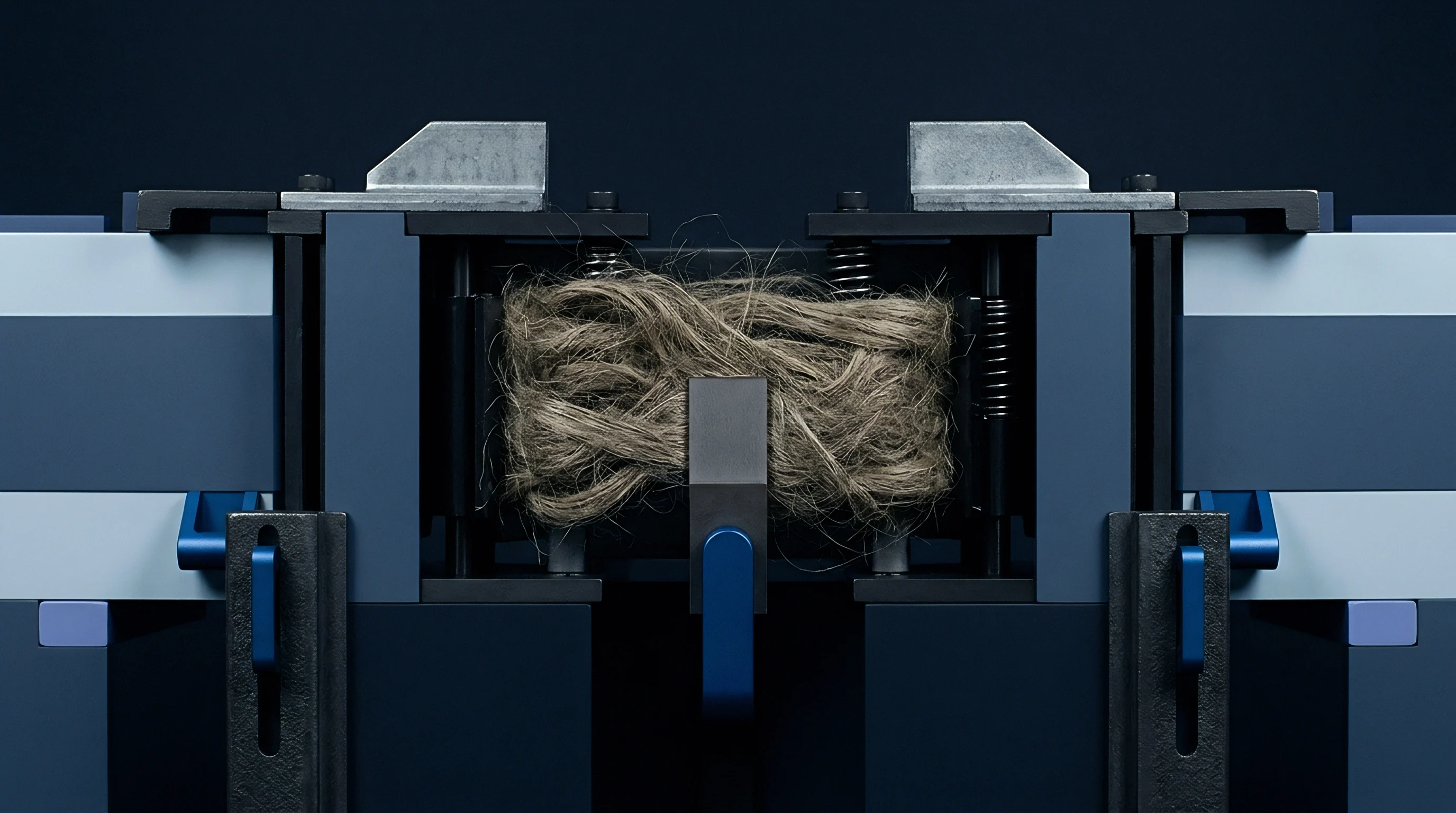
Controlled hot-water flume immersion softens pectin middle lamellae, enabling technical bundle splitting into fine elementary fibrils for high-count wet spinning.
Flume
Operational Mechanics of Technical Bundle Separation
In wet spinning, line flax rove enters a heated water trough to soften the middle lamella before drawing. This pectinaceous binder glues elementary bast fibres into multi-cellular technical bundles measuring 40 to 100 micrometres across. Unheated dry drawing cannot split these composite bundles into individual ultimates without breaking the cellulosic walls.
Immersing the rove in temperature-controlled water hydrates polygalacturonic acid chains, neutralizes divalent calcium bridges, and lowers transverse cohesive shear strength across inter-fibre boundaries. Drafting rollers can then slide the elementary fibrils past each other, yielding fine yarn numbers between metric count 40 and 120.
Flume operating temperatures dictate how quickly and evenly this interlamellar shear occurs. Water at 60 degrees Celsius needs long residence times to plasticize high-methoxyl pectins, whereas troughs held at 70 to 80 degrees Celsius accelerate macromolecular hydration within a 15 to 45 second dwell. If temperatures drop below 65 degrees Celsius, cohesive forces stay elevated, the roving resists drafting, and front rollers end up crushing the bundle rather than splitting it.
That crushing leaves coarse, irregular clusters in the drafted strand, causing slubs, thick spots, and high end-break rates at the spinning ring.
Adding alkalis or wetting agents to the trough shifts extraction equilibrium. Neutral demineralized water leaves the hemicellulose skeleton intact, preserving wet bundle tenacity through the draw. Small amounts of soda ash or surfactant move bath pH to 8.5, accelerating pectin sol-gel transitions ~ though this risks stripping structural pectins directly from the primary walls of ultimate fibrils.
Anyone evaluating frame performance calculates bath liquor turnover alongside the mechanical path length and feedwater chemistry.
Under-softened technical bundles cause roller lap-ups and raise thin-and-thick yarn imperfections during standard capacitive evenness testing.
Spinning mills balance thermal softening against fibre damage. High bath temperatures speed up drafting, but prolonged heat breaks down core cellulose and leaches excess gums into the circulating bath. This fouled liquor fouls delivery guides and creates uneven tension profiles across adjacent spindles.
Keeping bath setpoints between 68 and 72 degrees Celsius controls gum leaching while ensuring uniform softening, helping preserve line yield and suppress spindle stoppages on high-speed ring frames.
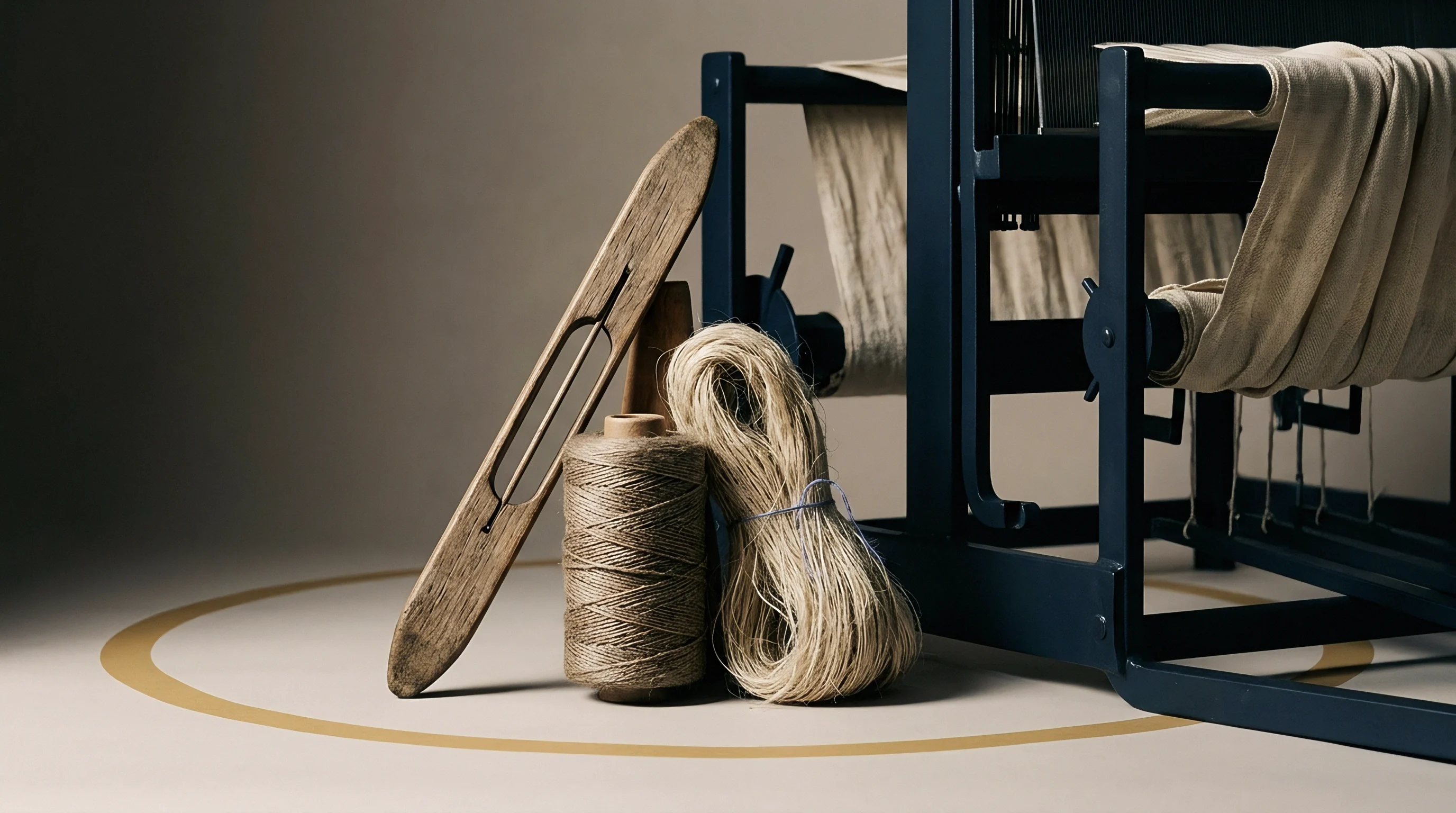
Lamella

Biochemical Architecture of the Middle Matrix
The middle lamella binding elementary flax fibrils consists of pectic polysaccharides, structural hemicelluloses, and residual polyphenols. Its pectins contain three main domains: homogalacturonan, rhamnogalacturonan-I, and rhamnogalacturonan-II. The smooth homogalacturonan regions consist of linear chains of alpha-1,4-linked D-galacturonic acid residues.
Calcium ions cross-link free carboxyl groups on de-esterified galacturonic units, forming dimeric associations known as the egg-box structural model. These calcium-pectate networks give bast fibre bundles their transverse tensile rigidity during scutching and hackling.
Rhamnogalacturonan-I introduces branching via alternating alpha-1,2-L-rhamnose and alpha-1,4-D-galacturonic acid backbones carrying neutral arabinan and beta-1,4-galactan side chains. These branched arabinogalactan chains interact directly with adjacent microfibrils to drive inter-cellular hydration. As water enters the bundle, it swells these hairy pectin domains, lowering shear resistance between cell walls.
Lignin residues and cinnamic acid derivatives in the cell corners restrict swelling, causing under-retted or highly lignified dew-retted crops to divide unevenly during processing.
| Fibre Fraction Component | Green Raw Flax (% dry mass) | Dew-Retted Line (% dry mass) | Wet-Spun Trough Loss (% dry mass) |
|---|---|---|---|
| Homogalacturonan Pectins | 4.2 to 6.5 | 1.8 to 2.4 | 0.8 to 1.3 |
| Rhamnogalacturonan and Galactans | 3.0 to 4.8 | 1.2 to 1.7 | 0.5 to 0.9 |
| Xyloglucans and Glucomannans | 2.5 to 3.8 | 1.9 to 2.5 | 0.2 to 0.4 |
| Calcium-Bound Polyuronides | 1.8 to 2.6 | 0.6 to 1.1 | 0.3 to 0.7 |
Thermal agitation in the warm trough mobilizes free calcium ions, destabilizing egg-box junctions. As non-covalent hydrogen bonds between neutral pectic branches and primary wall cellulose cleave, the matrix converts from a rigid gel into an amorphous viscoelastic fluid. This shift decouples elementary fibres without breaking primary cellulosic chains.
The elementary fibril stays intact, keeping a high degree of polymerization between 6,000 and 9,000, which ensures strong yarn tensile properties after drying.
Over-retted stock enters the flume with depleted middle lamellae containing less than one percent total residual pectin. When this roving hits the wet trough, what little adhesive remains dissolves entirely before reaching the nip rollers. Unsupported fibrils drift apart prematurely, causing drafting breaks and localized fiber buildup on fluted rollers.
Under-retted flax, by contrast, holds intact, calcified homogalacturonan chains that resist water softening; these lots resist inter-fibril shear, driving up drafting resistance, deflecting rollers, and producing coarse, brittle yarn.
Standard acid-insoluble residue tests and galacturonic acid colorimetric assays reveal these chemical differences before spinning contracts are signed. Lab checks of raw fibre composition spot variations that visual grading misses. Dew-retted flax harvested in wet seasons carries microbial enzyme residues that alter pectin solubility, whereas water-retted imports display uniform calcium extraction and predictable dissolution kinetics.
Specifying raw fibre with a verified pectin content between 1.6 and 2.2 percent dry weight prevents drafting failures in fine yarn counts.
Sufficient dwell time ~ twenty seconds in eighty-degree water ~ can offset initial retting deficits.
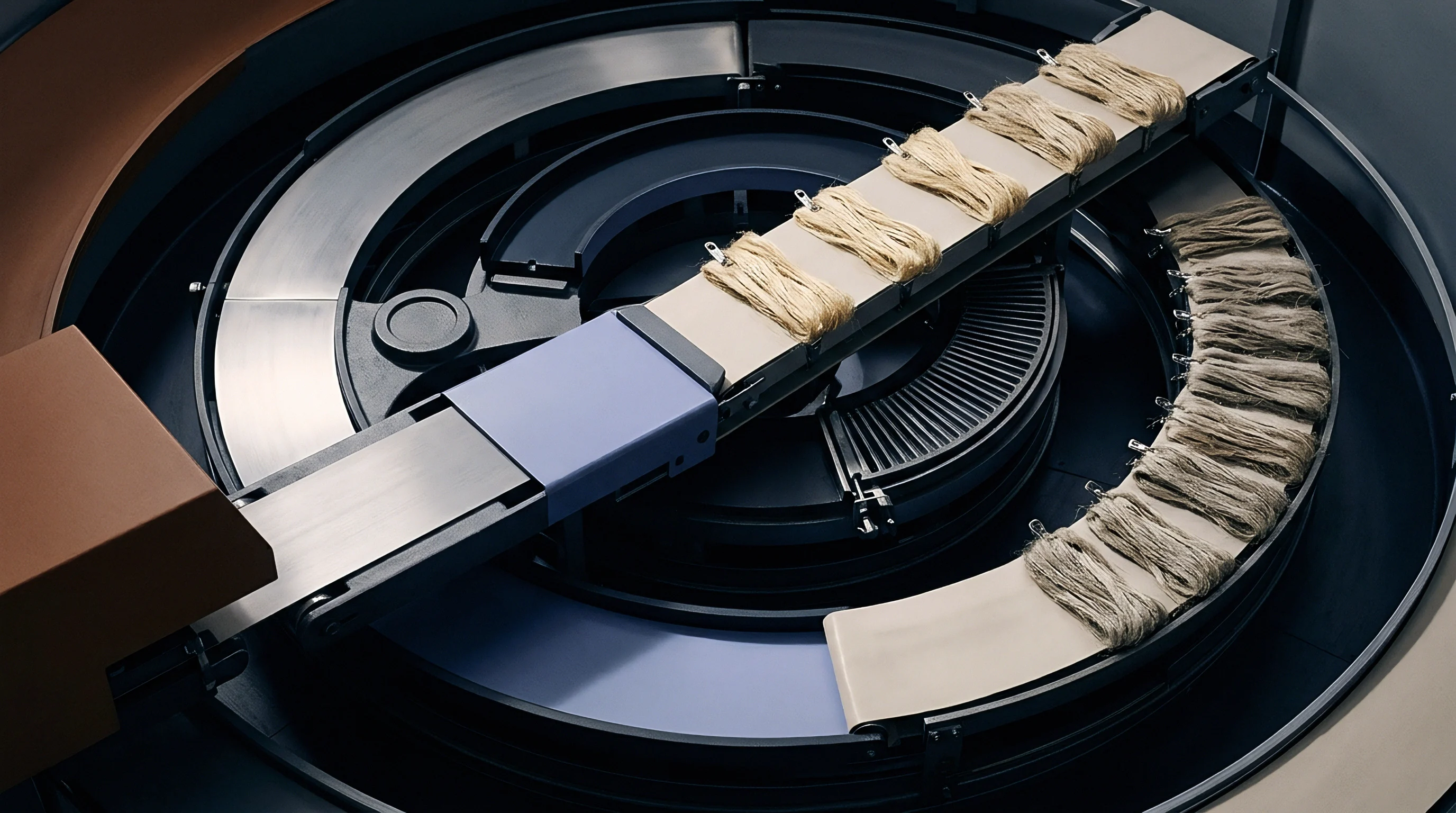

Draft

Kinematics of Viscoelastic Attenuation
The drafting zone of a wet-spinning frame elongates the heat-softened roving longitudinally. Standard wet frames run a short drafting reach between 60 and 85 millimeters, matching the 20 to 40 millimeter average length of elementary flax fibrils. Dry-spinning frames, in contrast, set reach between 180 and 220 millimeters to accommodate long technical bundles.
In wet drafting, back rollers feed the softened rove at 5 to 15 meters per minute, while fluted front rollers run at 50 to 180 meters per minute, establishing draft ratios from 8 to 20 depending on yarn count.
As the hydrated strand enters the nip, front rollers pull against the moving core. Water lubricates boundary layers between adjacent elementary fibrils, encouraging progressive sliding, while viscous drag from the softened pectic fluid prevents uncontrolled slippage. This controlled sliding splits technical bundles of 15 to 30 elementary fibrils down into narrow clusters of 2 to 4 ultimates.
So long as core hydration remains uniform, drafting forces stay stable.
Total bundle separation down to single elementary fibrils rarely exceeds seventy percent in commercial wet spinning, leaving fine multi-fibril clusters scattered through the yarn core.
Roving twist directly alters drafting behavior by applying radial pressure that resists inter-fibre slippage. If twist is too low, water penetrates the strand instantly, loosening outer fibrils and causing ballooning in the drafting zone. If twist is too high, it seals the inner bundle so moisture cannot reach the core during its short stay in the flume.
That dry core passes through the nip intact, forming hard, unattenuated clusters that snap under ring or flyer tension.
Roller pressure governs conditions at the nip line. Frames typically run saddle pressures between 12 and 22 decanewtons per roller boss to prevent slippage on brass and cast-iron flutes. Soft synthetic rubber aprons or elastomer coatings on press rollers cushion the contact point, protecting fine cellulosic tubes.
Insufficient pressure lets slick, wet fibres slip through, causing draft fluctuations and long thick faults; excessive pressure flattens damp fibres, fracturing thin secondary walls and creating fly that settles across spindle rails.
Front-roller delivery speed drives production economics, but running past 25 meters per minute cuts trough immersion time unless the flume path is extended. Shorter immersion hinders middle-lamella breakdown, leaving raw technical bundles intact. When drafting forces overpower yarn cohesion, drafting waves develop in the delivery strand, registering as cyclical mass variations at wavelengths that match drafting zone length.
Keeping draft uniform requires matching feed rates, trough temperatures, and clamping pressures.
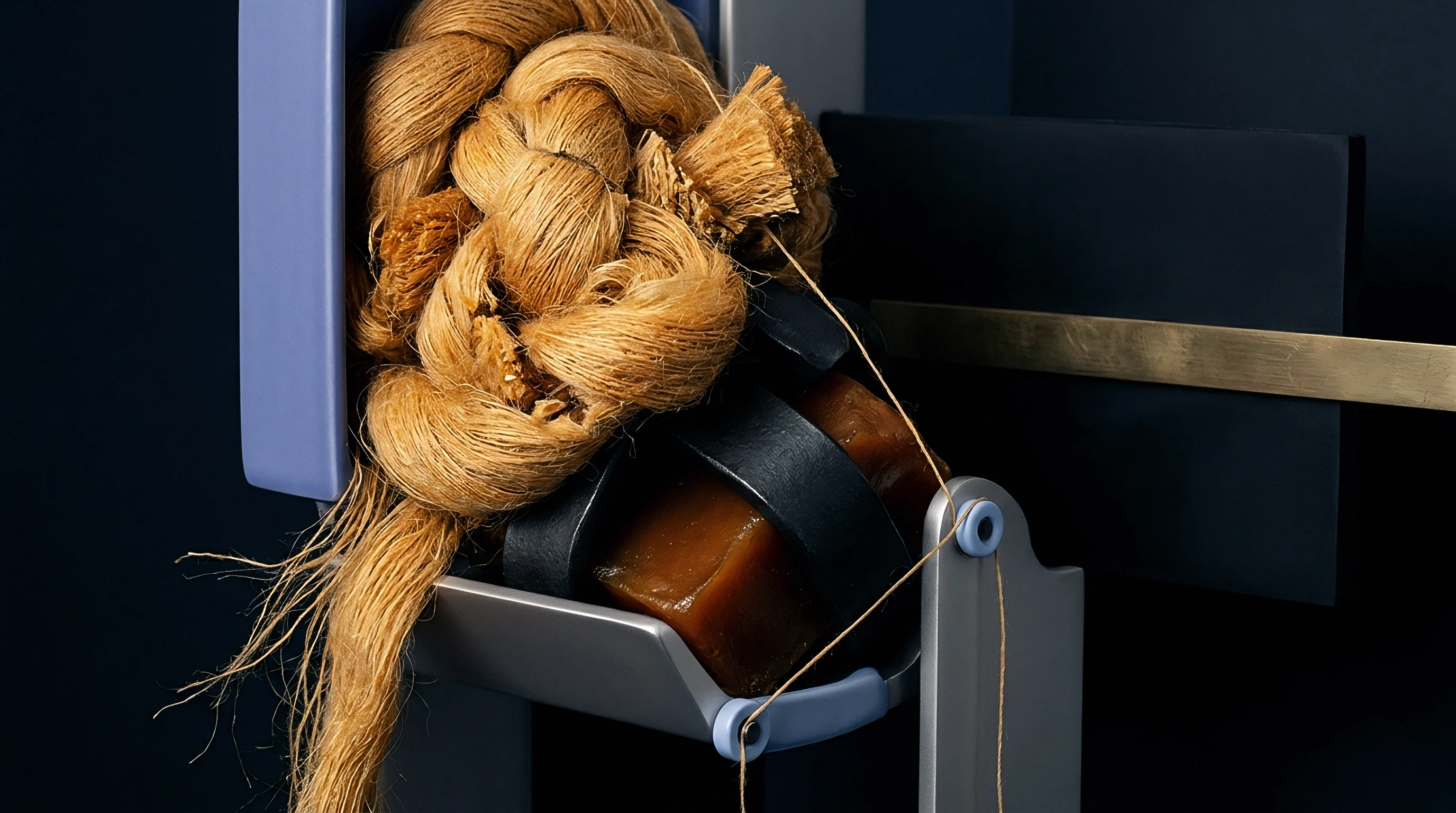
Flock

Which Physical Defects Signal Matrix Failure?
Incomplete technical bundle division during wet drawing leaves distinct defects along the yarn. When the pectin matrix plasticizes unevenly, bundles shear erratically to create thick patches alongside over-drafted thin zones. Thin zones lack the fibre count needed to withstand ring-spinning tension, causing frequent ends-down breaks.
Thick sections hold unseparated bundles that resist twist insertion, exposing raw, untwisted clusters on the yarn body that disrupt high-speed warping and weaving.
Specific defects appear when bundle separation deviates from target kinetics:
- Spear ends form when unsoftened core bundles snap under tension rather than slide, producing stiff, dagger-like clusters that puncture packaging and lower loom efficiency.
- Roller laps occur when degraded, gummy pectins stick to fluted delivery rollers, wrapping the drafted strand around the boss until an operator clears the spindle.
- Slub clusters happen when high roving twist blocks core hydration, pulling large unattenuated bundles through the nip and raising yarn unevenness.
- Fibril hairiness stems from aggressive chemical breakdown in the flume, stripping primary walls and letting short ultimate fibrils flare away from the yarn axis.
Cross-sectional analysis shows how incomplete matrix breakdown skews mass distribution. Microscopic views of Nm 39 line yarn reveal poorly split bundles forming irregular, oblong sections across the profile. Rather than 20 to 30 evenly distributed fibrils, the cross-section exhibits two or three dense technical clusters surrounded by loose ultimates.
This asymmetry shifts the structural neutral axis, causing torsional instability that shows up as yarn curling and snarling during winding.
On high-speed air-jet looms, yarns with poor bundle division drive filling stops and push fabric reject rates above three percent. Rigid, unseparated bundles cannot flex through shed changes, snagging on drop wires, heddles, and reed dents. When an unseparated bundle catches a warp yarn, friction abrades brittle cell walls into lint balls that foul the shed.
Thorough bundle breakdown produces rounder, smoother yarns that glide past adjacent ends without snagging, keeping modern looms running smoothly.
Spinning trials confirm that controlling trough water conditions reduces end breaks far more effectively than changing ring traveler weights. Stoppage rates fall from 45 breaks per 1,000 spindle hours to under 18 breaks when trough temperatures are raised from 58 to 72 degrees Celsius on identical roving lots. This stability shortens operator patrol cycles, cuts piecing faults, and protects efficiency.
Monitoring bundle attenuation in the drafting zone catches defects before rove reaches the twisting ring.
Failing to maintain bundle separation tolerances leads to rejections under international contracts that penalize elevated thin-and-thick counts under ISO 2060 testing.

Yield
Landed Economic Equations from Fibre to Yarn
The degree of bundle dissolution directly influences yield, waste volume, and manufacturing cost per kilogram. Complete dissolution allows elementary fibres to separate cleanly, but extracting too much non-cellulosic material reduces final yarn mass. Hot trough leaching strips between 4 and 9 percent of dry roving mass as soluble solids ~ a direct shrinkage loss that impacts mill cost calculations.
Inadequate dissolution, on the other hand, reduces chemical mass loss but triggers high mechanical waste and elevated reject rates downstream.
| Process Parameter | Under-Softened Flume (55°C) | Target Dissolution Flume (72°C) | Aggressive Alkaline Flume (85°C) |
|---|---|---|---|
| Roving Mass Leaching Loss (%) | 3.1 | 6.4 | 11.2 |
| Ring-Frame Waste Rate (%) | 4.8 | 1.9 | 3.7 |
| Finished Yarn Tenacity (cN/tex) | 21.4 | 28.5 | 22.1 |
| Spindle Ends-Down (/1,000 sp. hr) | 52 | 14 | 38 |
| Net Fibre-to-Yarn Conversion (%) | 83.2 | 86.8 | 78.5 |
Consider a 20 metric ton order of line flax roving intended for metric count 68 yarn. Sourcing premium dew-retted Belgian line flax costs 7.20 euros per kilogram landed at the mill. At an optimal 72 degrees Celsius, soluble leaching accounts for a 6.4 percent loss, while suction waste and lap-ups take 1.9 percent, resulting in an 86.8 percent net conversion efficiency.
That brings net fibre cost to 8.29 euros per kilogram of spun yarn before labor and equipment depreciation. The finished yarn handles smoothly through winding and twisting with few defects.
Running that same 20-ton lot through an under-heated trough at 55 degrees Celsius drops soluble mass loss to 3.1 percent. However, drafting resistance surges, causing frequent end breaks, lap-up waste of 4.8 percent, and frequent rewinding cut-outs. Mechanical waste climbs to 8.9 percent, driving net fibre conversion down to 83.2 percent and net fibre cost up to 8.65 euros per kilogram.
Accounting for machine downtime, rewinding labor, and downgrading yarn to package-dyed seconds adds another 0.75 euros per kilogram in overhead.
An aggressive alkaline trough at 85 degrees Celsius strips structural material heavily, causing an unrecoverable 11.2 percent chemical mass loss. Over-dissolving degrades bundle cohesion, raising drafting breaks to 3.7 percent and pushing net conversion down to 78.5 percent. Raw material cost rises to 9.17 euros per kilogram of yarn.
Crucially, over-dissolution weakens tensile strength ~ yarn tenacity falls from 28.5 cN/tex to 22.1 cN/tex, making the yarn unfit for high-tension warp applications.
Textile buyers specify linear density, tensile limits, and allowable mass variation on every order sheet. When yarns contain unseparated technical bundles, fabric finishers face uneven dye uptake: thick bundle walls absorb reactive and vat dyes at different rates than thin elementary ultimates. On finished linen, unsoftened bundles appear as pale, undyed streaks along the warp and weft.
These defects drop wholesale prices by 1.20 to 2.40 euros per linear meter on high-end apparel fabrics.
Auditors inspect waste bins beneath drafting frames to evaluate dissolution balance. High volumes of coarse, bristly sliver waste point to under-softening, while gummy, gelatinous residue signals over-extraction. Adjusting trough chemistry to target 86 to 88 percent net conversion hits the ideal economic window ~ preserving yarn tenacity, keeping waste low, and protecting profit margins on fine flax contracts.
Standard contract terms deduct two percent of invoice value for every ten percent increase in CV-mass beyond agreed thresholds.

Assay
Laboratory Qualification Protocols for Roving Lots
Before releasing fiber lots to the wet-spinning frame, the laboratory tests bundle separation properties. Incoming line flax roving undergoes chemical, thermal, and mechanical testing to predict drafting performance. Because standard dry tenacity tests tell little about wet attenuation, technicians conduct wet tensile draw-off tests using a constant-rate-of-extension tester equipped with a heated submersion chamber.
This setup records dynamic drafting force under simulated mill conditions.
- Roving sample conditioning requires holding fiber specimens in a standard atmosphere at 20 degrees Celsius and 65 percent relative humidity for 24 hours per ISO 139.
- Specimen immersion submerges a 200-millimeter length of roving in demineralized water at 70 degrees Celsius for 30 seconds without tension.
- Drafting-force measurement pulls the soaked specimen through clamps at a 75-millimeter gauge length at an extension rate of 50 millimeters per minute.
- Mass loss determination dries bath liquor extract at 105 degrees Celsius to calculate gravimetric leaching loss per ISO 6741.
- Fineness transition analysis measures linear density of the drafted strand via microscopic cross-section evaluation under ISO 1973.
The lab records the ratio of peak initial drafting force to steady-state sliding force. A high peak followed by an erratic sliding trace signals uneven middle-lamella breakdown. Uniform dissolution generates a smooth, continuous curve with peak values below 1.5 centinewtons per tex.
Lots exceeding 2.8 centinewtons per tex wet drafting resistance will jam rollers on fine-count frames, requiring re-classification or reassignment to coarse dry-spun yarns.
Fibre fineness measurements confirm the degree of physical separation. Undrafted line flax roving shows technical bundle fineness between 18 and 35 decitex. Effective wet drawing reduces structural fineness to 2.2 ~ 4.5 decitex, approaching individual elementary fibrils (1.4 to 2.8 decitex).
Comparing fineness before and after drafting via automated airflow or optical projection verifies trough chemistry performance; if post-draft fineness stays above 6.0 decitex, technicians adjust trough temperature and surfactant dosing.
Spectrophotometric ruthenium red staining offers fast visual confirmation of matrix extraction by binding specifically to unesterified galacturonic acid residues in the middle lamella. Glycerol-mounted cross sections of drafted yarn show magenta staining around elementary fibrils. Deep, continuous staining indicates incomplete matrix extraction, while light, intermittent staining confirms clean bundle division without damaging primary walls.
These testing protocols protect mills from running substandard raw material. Sourcing managers rely on drafting-force and fineness data to accept or reject incoming shipments. Skipping wet qualification leads to costly frame stoppages and off-spec yarn runs.
Systematically checking wet drafting dynamics aligns raw fibre selection with frame settings, ensuring steady output and high yields on premium linen yarns.
Standard specifications reject any line roving lot with a wet drafting force coefficient of variation exceeding twelve percent across ten tests.