Dew Retting Pectin Breakdown Principles in Flax Fibre Processing
Dew retting breaks middle lamella pectin into galacturonic acid to liberate flax line fibres, directly fixing hackling yield and wet-spun yarn tenacity.


Lamella
Flax stems contain discrete fibre bundles arranged in an annular ring within the cortical tissue between the epidermis and the inner woody core. Technical flax fibres consist of individual elementary cells, measuring 10 to 30 micrometres in diameter and 20 to 50 millimetres in length, bonded together by a complex inter-cellular matrix. This matrix sits within the middle intercellular boundary and consists primarily of pectic polysaccharides, hemicelluloses, phenolics, and structural proteins.
Pectin functions as the principal structural adhesive that maintains the physical cohesion of the technical fibre bundle along the entire stem length. Technical bundle splitting during mechanical extraction depends directly on selective chemical degradation of this inter-cellular pectin layer without compromising the structural cellulose microfibrils of the primary and secondary cell walls.
Flax stems contain discrete fibre bundles. Structural pectin in bast tissues is composed predominantly of homogalacturonan, a linear polymer of alpha 1 to 4 linked D galacturonic acid residues. Variable proportions of these galacturonic acid carboxyl groups carry methyl esterification, expressed as the degree of esterification.
In unretted green flax straw, the degree of esterification ranges from 50 to 75 percent. High esterification levels limit direct ionic interaction between adjacent polymer chains. Regions of unesterified homogalacturonan carry negative carboxylate charges that bind divalent calcium ions, forming rigid egg-box junction zones.
These calcium cross-links consolidate the middle intercellular layer into a semi-rigid gel that resists mechanical cleavage during scutching.

Structural Pectin Architecture in Bast Cell Walls
In addition to homogalacturonan, bast tissue pectin contains branched rhamnogalacturonan regions. Rhamnogalacturonan-I features a repeating backbone of alternating D galacturonic acid and L rhamnose residues, decorated with neutral side chains of 1 to 4 beta D galactans and 1 to 5 alpha L arabinans. These neutral side-chain polymers link structural pectin to adjacent hemicellulose fractions, specifically xyloglucans and glucomannans, anchored into the primary cell wall.
The spatial density of these side chains creates steric hindrance that limits enzyme accessibility during biological processing. Middle lamellae glue elementary fibres together.
| Polysaccharide Fraction | Glycosidic Backbone Structure | Degree of Esterification (%) | Target Cleavage Enzyme | Primary Breakdown Product |
|---|---|---|---|---|
| Homogalacturonan | 1,4-linked alpha-D-Galacturonic acid | 50 – 75 | Endo-polygalacturonase / Pectin lyase | Oligogalacturonides, D-Galacturonic acid |
| Rhamnogalacturonan-I | Alternating GalA and L-Rhamnose | 10 – 35 | Rhamnogalacturonase / Lyase | Rhamno-oligomers, free Rhamnose |
| Arabinan Side Chains | 1,5-linked alpha-L-Arabinofuranose | 0 | Endo-arabinanase | L-Arabinose monomer |
| Galactan Side Chains | 1,4-linked beta-D-Galactopyranose | 0 | Endo-beta-1,4-galactanase | D-Galactose monomer |

Polymeric Linkages and Cationic Calcium Bridges
Calcium cations form stable carboxyl bridges. Cohesion between elementary cells depends on the concentration of ionically complexed calcium within the unesterified homogalacturonan domains. During plant maturation, calcium pectate forms an insoluble network that resists water solubilization.
Dew retting relies on biological solubilization of this calcium pectate framework. As saprophytic microorganisms colonize the harvested straw on the soil surface, secreted extracellular enzymes cleave the polygalacturonan backbone, releasing bound calcium ions into moisture films covering the stems. This enzymatic cleavage reduces the average molecular weight of homogalacturonan from over 100 kilodaltons down to soluble fragments below 5 kilodaltons.
Unesterified homogalacturonan content below 1.2 percent by weight in scutched flax signals over-retting and primary cell wall damage.
The loss of high molecular weight pectin weakens the structural interface between elementary fibres within the technical bundle. Scanning electron microscopy of fully retted bast tissue reveals clean separations along the middle intercellular zone, while the primary cell wall surrounding individual lumen structures remains intact. Skips in pectin dissolution leave unsevered technical bundles that report as coarse, stiff ribbons during mechanical carding.
Conversely, excessive hydrolysis of middle intercellular polymers leads to complete bundle disintegration into short, unspinnable elementary cells during scutching and hackling. Whether industrial enzyme sprays applied during field swathing match the natural spatial selectivity of fungal hyphae across uneven canopy layers remains unanswered by high-throughput field trials.

Microbe
Colonization of cut flax straw lying on the field soil follows a distinct ecological sequence driven by ambient humidity, substrate availability, and temperature fluctuations. Initial saprophytic invaders consist predominantly of phyllosphere fungi present on the standing plant before harvest. Species such as Cladosporium herbarum, Epicoccum nigrum, Alternaria alternata, and Aureobasidium pullulans dominate the early retting phase.
These pioneering filamentous fungi consume simple soluble carbohydrates, sucrose, and low molecular weight organic acids present in the stem sap. Fungi colonize swath tissues after cutting.
As soluble sugars deplete within the first 7 to 10 days of field exposure, the fungal population shifts toward specialized pectinolytic saprophytes. Secondary colonizers including Rhizopus stolonifer, Mucor hiemalis, and specific soil-derived Fusarium species secrete a targeted battery of extracellular enzymes. Fungal enzymes target structural pectin networks.
These enzymes permeate the stem epidermis through mechanical fractures created during pull-harvesting and swathing, gaining direct access to the parenchyma and bast fibre tissues.

Fungal Succession and Pectinolytic Enzyme Secretion
Pectin degradation in field processing requires three primary enzyme classes operating in coordinated sequence. Pectin methylesterase removes methyl ester groups from galacturonic acid residues, releasing methanol and producing unesterified galacturonan. This de-esterification increases enzyme access for hydrolytic cleavage.
Endopolygalacturonase cleaves alpha 1 to 4 glycosidic bonds within unesterified galacturonan chains at random internal sites, causing rapid reduction in polymer viscosity. Exopolygalacturonase acts sequentially from the non-reducing ends of the chain, liberating individual galacturonic acid monomers.
Pectin lyases represent the alternative cleavage pathway, performing trans-elimination on highly esterified pectin molecules without prior de-esterification. Pectin lyase breaks alpha 1 to 4 glycosidic bonds while creating an unsaturated double bond between carbon 4 and carbon 5 at the non-reducing terminus. This lyase mechanism operates efficiently under neutral to slightly acidic pH conditions ranging from 5.5 to 6.8, matching the internal tissue environment of damp flax straw lying on soil.

Enzyme Activity Patterns and Methyl Ester Hydrolysis
Bacterial participation in field retting increases during prolonged wet weather when moisture levels in the swath exceed 80 percent relative humidity. Aerobic species of Bacillus, including Bacillus subtilis and Bacillus polymyxa, colonize the lower layers of the swath in contact with wet soil. These bacteria produce pectate lyases that target de-esterified polygalacturonate chains in the presence of calcium ions.
Bacterial pectate lyase activity exhibits optimum kinetics at pH 8.0 to 8.5, which occurs when localized fungal metabolism consumes organic acids and raises stem tissue pH.
Moisture readings exceeding 16 percent during bale compression trigger latent fungal activity that degrades cellulose polymer chains within stored line flax.
Enzymatic breakdown rates correlate directly with local microclimate conditions inside the swath. Dew formation at night provides the liquid surface film needed for fungal spore germination and enzyme diffusion through the stem epidermis. Solar radiation during daylight hours warms the swath, boosting enzyme reaction rates up to an optimum temperature window of 25 to 30 degrees Celsius.
Excessive heat above 40 degrees Celsius or dry desiccation below 12 percent straw moisture content halts enzyme production completely, freezing the retting process at its current stage. Dark grey discoloration across the straw stem indicates that fungal hyphae have breached the primary cell wall and begun consuming structural hemicellulose.


Field
Ambient climate factors dictate the rate and uniformity of biological retting across field swaths. Dew retting demands precise moisture control. Dew condensation during night hours supplies moisture to activate dormant fungal mycelia.
Capillary action draws liquid water into the cut stem ends and mechanical cracks in the outer epidermis. Daytime solar heating evaporates surface liquid while raising internal stem temperatures, accelerating enzyme kinetics. Swaths laid out on soil undergo continuous wetting and drying cycles that expand and contract the cortical tissue, creating micro-fractures that allow fungal hyphae to penetrate deep into the middle intercellular layers.
Rainfall washes soluble degradation products away. Precipitation leaches out monomeric galacturonic acid, residual sugars, and solubilized calcium ions from the stem matrix. Removing these reaction end-products prevents feedback inhibition of endopolygalacturonase enzymes.
Excessive rain causes over-wetting of the lower swath surface, creating anaerobic pockets that encourage non-selective clostridial bacterial growth. Mechanical turning of the flax swaths, performed 2 to 3 times per retting cycle using specialized swath turners, ensures equal light exposure, balanced moisture loss, and uniform fungal colonization across both sides of the stem ribbon.

Diurnal Moisture Dynamics and Swath Turning Schedules
Visual and physical monitoring of the swaths determines the target completion point. Over-retting weakens cellulose microfibril bundles. When saprophytic fungi consume middle lamella pectin completely, enzyme secretion shifts toward cellulolytic enzymes, specifically endo-1,4-beta-glucanase and cellobiohydrolase.
These cellulases hydrolyze amorphous regions of the structural cellulose microfibrils in the primary cell wall, causing permanent tensile strength loss in the technical fibres.
- Under-Retted Coarse Bundles incomplete pectin dissolution leaves thick technical fibres that resist drafting at the hackling comb and reduce yarn fineness potential.
- Cellulose Microfibril Weakening extended saprophytic fungi colonization degrades crystalline cellulose region II, dropping single-fibre bundle tenacity below 35 centinewtons per tex.
- Cortical Bark Adhesion insufficient polygalacturonase activity retains shive particles on the fibre ribbon, elevating nep counts during carding.
- Uncontrolled Fungal Staining excessive rain leaches phenolic compounds into cell lumens, causing dark grey discolouration that increases bleach chemical consumption during wet-finishing.

Degradation Kinetics and over Retting Risks
Controlling retting duration requires tracking cumulative thermal time and atmospheric relative humidity. Retting progress accelerates rapidly once ambient temperatures remain above 15 degrees Celsius with nightly relative humidity exceeding 90 percent for more than 6 consecutive hours. Under these conditions, a field cycle completes in 18 to 24 days.
Cold, dry conditions extend the necessary field duration to 45 days or more, increasing the risk of uneven retting across field topographies.
| Retting Phase Status | Stem Moisture Range (%) | Dominant Microbial Class | Biochemical Marker (Pectin Mass %) | Technical Fibre Bundle Quality Result |
|---|---|---|---|---|
| Green / Unretted | > 45 (freshly cut) | Phyllosphere epiphytes | 4.5 – 6.0 | Coarse, unseparable stems; scutching breaks fibres |
| Early Colonization | 25 – 40 | Pectolytic filamentous fungi | 3.0 – 4.5 | Partial epidermis loosening; high shive content |
| Optimum Retting | 14 – 20 | Fungal / Aerobic bacterial mix | 0.8 – 1.5 | Clean stem separation; high tenacity line fibre |
| Over-Retted | < 14 or > 80 (waterlogged) | Cellulolytic soil fungi | < 0.5 | Brittle, dark grey fibres; excessive hackling tow waste |
Flax turned out of sequence during persistent rainfall suffers irreversible tensile strength loss before the shive separates cleanly from the bast ribbon.


Assay
Determining retting completeness requires biochemical quantification of residual middle lamella components paired with physical fibre separation tests. Spectrophotometric measurement of uronic acids provides a direct quantitative baseline for residual pectin content. Laboratory testing utilizes 3-hydroxybiphenyl reagent to react with galacturonic acid extracted from scutched fibre samples using ammonium oxalate solutions at 85 degrees Celsius.
Absorbance measured at 520 nanometres correlates directly with total residual pectin mass. Unretted flax straw yields galacturonic acid levels of 45 to 60 milligrams per gram of dry fibre, whereas properly retted line flax reports values between 8 and 15 milligrams per gram.
Histochemical staining with ruthenium red offers rapid qualitative evaluation of cross-sectional pectin distribution. Ruthenium red binds specifically to unesterified carboxyl groups of galacturonic acid polymers. Microtome cross-sections of stem tissue treated with 0.05 percent ruthenium red solution show intense pink to red coloration within the middle lamellae of unretted bundles.
As retting advances, stain intensity within the intercellular spaces diminishes. Optimal retting displays zero red staining within the intercellular middle zones, while weak pink coloration remains restricted to the primary cell wall boundaries.

Spectrophotometric and Histochemical Retting Quantification
Physical measurement protocols validate chemical assays. Linear density of technical fibre bundles is measured per ISO 2370 using gravimetric techniques or airflow porosity methods. Fibre bundle tenacity testing per ISO 3060 utilizes a Stelometer or universal tensile testing frame equipped with flat-face clamps set at a 3.2-millimetre gauge length.
Certified line flax requires minimum bundle tenacity values of 40 centinewtons per tex with an elongation at break between 2.0 and 2.5 percent. Fibre bundles exhibiting tenacity values below 30 centinewtons per tex indicate severe fungal degradation of cellulose microfibrils caused by field over-retting.

How Does Residual Pectin Level Impact Hackling Yield?
Hackling separates long line from tow. Residual pectin content governs the force required to divide technical fibre ribbons into fine spinnable slivers during hackling. High residual pectin levels above 2.0 percent by weight increase inter-fibre cohesion within technical bundles.
When high-pectin flax passes through fine pin densities on hackling comb fields, high cohesion prevents clean longitudinal splitting, causing bundle snapping and increasing short-fibre tow production by 6 to 10 percent above baseline targets.
Fibre bundles that stain dark red under ruthenium dye retain excess inter-cellular pectin and require tighter pin density during hackling.
Standardized bench procedures ensure consistent evaluation of incoming raw material lots before mill processing begins.
- Sample ten 5-gram fibre specimens from randomized locations across five bales within the delivered lot.
- Condition the specimens at 20 degrees Celsius and 65 percent relative humidity for 24 hours per ISO 6741 standards.
- Extract soluble pectic polysaccharides using a 0.5 percent ammonium oxalate solution heated to 85 degrees Celsius for 120 minutes.
- Quantify total galacturonic acid concentrations via 3-hydroxybiphenyl spectrophotometry at 520 nanometres absorbance.
- Calculate residual pectin mass fraction against dry fibre weight to establish lot drafting suitability.
Suppliers often claim that dark grey surface tone represents high retting completeness rather than saprophytic degradation of structural cellulose.

Spinning
Pectin degradation levels directly dictate mechanical processing behavior from raw scutched flax to fine wet-spun yarn. Mechanical scutching breaks the inner woody core into small fragments called shives while leaving long bast fibre ribbons intact. Clean separation of shive from fibre depends on low adhesion forces at the parenchyma interface.
Residual pectin acts as a sticky binder; unretted straw retains shive particles through strong physical bonds, requiring higher turbine impact speeds during scutching. Increased mechanical impact fractures long line fibres, shifting yield from high-value long flax into low-value scutching tow.
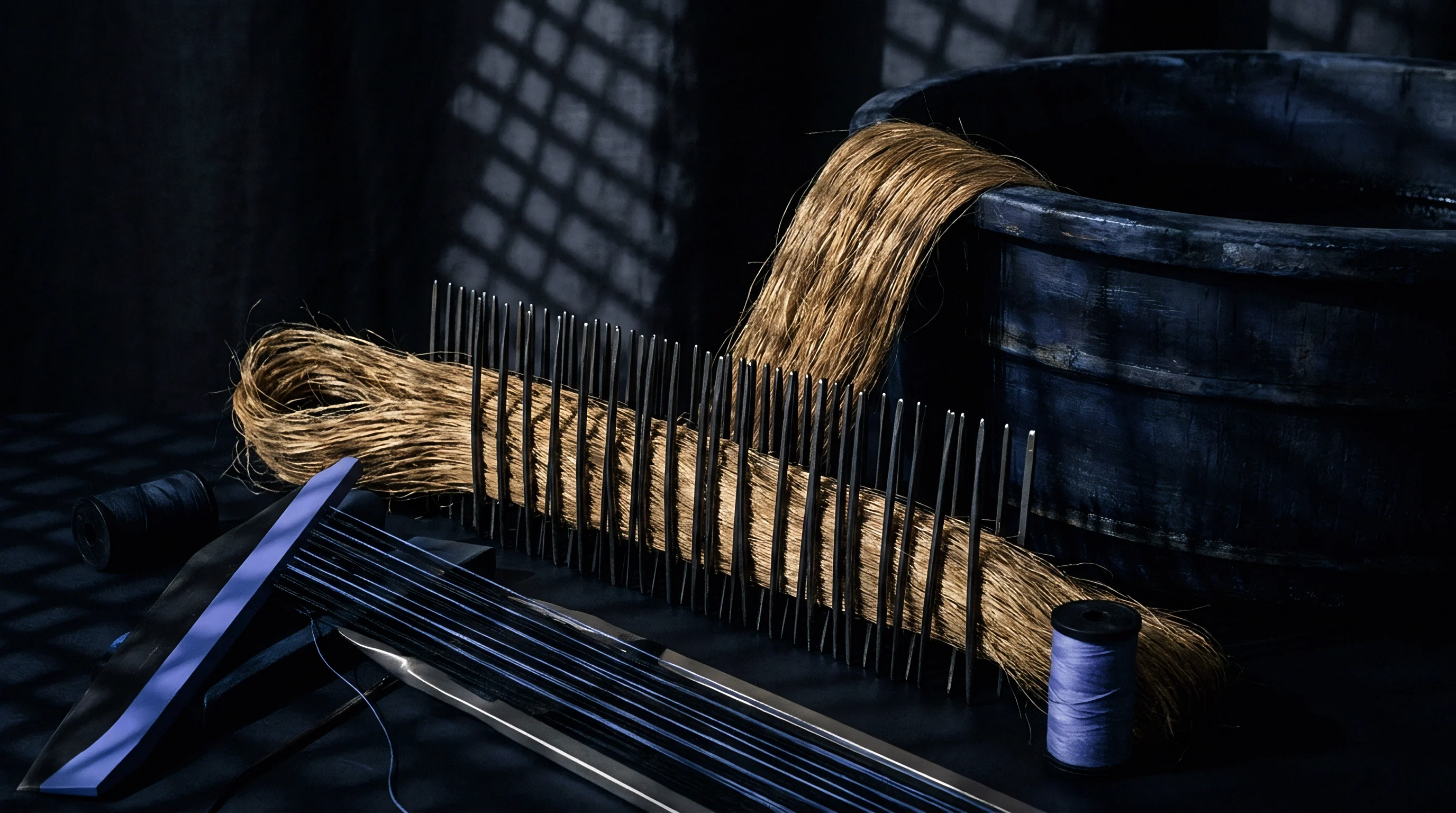
During hackling, technical fibre ribbons pass through progressive fields of rotating comb pins to align fibres, remove short fractions, and split bundles longitudinally. Controlled residual pectin content permits technical bundles to divide smoothly into fine sub-units without structural breakage. Unretted flax resists comb pin penetration, inducing high needle breakage and converting long line fibre into tow.
Over-retted flax lacks structural bundle cohesion, leading to excessive fiber shredding and high flyer waste in primary drafting operations.

Hackling Division and Sliver Cohesion Mechanics
Roving formation converts hackled sliver into lightweight twisted strands prepared for fine yarn spinning. Before wet spinning, roving packages undergo a hot water or alkaline boiling treatment known as roving preparation. Roving boiling dissolves remaining sticky gums.
Boiling roving packages in dilute sodium carbonate solutions at 80 to 90 degrees Celsius solubilizes residual pectin fractions that survived dew retting. Removing these remaining pectic adhesives permits individual elementary fibres to slide smoothly past one another during final drafting on the wet-spinning frame.
| Retting Grade Category | Hackling Long Line Yield (%) | Maximum Achievable Yarn Count (Nm) | Single-Yarn Tenacity (cN/tex) | Spinning End-Breakage Rate (per 1000 spindle-hours) |
|---|---|---|---|---|
| Under-Retted (Pectin > 2.2%) | 38.5 | Nm 26 | 18.5 | 85 – 120 |
| Optimal Line (Pectin 0.9 – 1.4%) | 54.2 | Nm 60 | 28.5 | 15 – 25 |
| Over-Retted (Pectin < 0.5%) | 31.0 | Nm 39 | 14.2 | 140 – 210 |

Hot Water Trough Pectin Softening in Wet Spinning
Wet spinning frames route roving through a hot water trough heated to 60 to 70 degrees Celsius immediately before entering the drafting zone. Hot water softens the remaining middle lamella pectin, reducing its elastic modulus and turning residual gums into a slippery lubricant. Softened pectin allows elementary fibres within the drafting zone to attenuate evenly without clump formation.
Wet spinning yields high tenacity yarns. As the drafted strand exits the front rollers, mechanical twist binds the aligned elementary fibres together, locking them into a dense, smooth yarn structure with high tensile strength and characteristic lustre.
Hot water trough temperature variations of five degrees Celsius alter the viscosity of softened residual pectin and introduce draft instability across the spinning zone.
Uneven pectin degradation along the straw stem manifests directly as thick and thin places in wet-spun yarn, driving up count coefficient of variation values. Contractual insertion of a maximum four percent short-fibre tow ratio allowance forces spinners to reject lots where over-retting causes fibre bundle disintegration during hackling.


Costing
Raw flax purchasing economics depend on conversion yields from landed straw to finished yarn. Pectin breakdown fixes final fabric yield. Sourcing high-grade dew-retted line flax requires analyzing waste generation across three distinct process boundaries: scutching yield, hackling yield, and wet-spinning attenuation efficiency.
Sub-standard pectin breakdown increases process waste, converting expensive long flax raw material into low-margin tow and carding waste.
Consider a commercial model evaluating a 20,000-kilogram lot of imported dew-retted flax straw priced at 0.85 Euros per kilogram landed at the primary mill. Scutching an optimally retted straw lot yields 20 percent long scutched line flax (4,000 kilograms) and 10 percent scutching tow (2,000 kilograms), with the remaining mass lost to shive, dust, and moisture. Hackling optimal scutched line flax yields 55 percent long line hackled sliver (2,200 kilograms) and 40 percent hackling tow (1,600 kilograms), with 5 percent comb waste.
At a raw scutched line fibre purchase price of 4.20 Euros per kilogram, the raw material cost component embedded in hackled line sliver calculates to 7.64 Euros per kilogram.

Yield Loss Arithmetic across Scutching and Hackling
If the same 20,000-kilogram straw lot is under-retted due to unfavorable field weather, residual pectin content remains elevated at 2.4 percent. High pectin cohesion reduces scutching line yield to 14 percent (2,800 kilograms) while elevating scutching tow to 16 percent. During hackling, stiff unseparable bundles increase needle breakage and shift long line yield down to 42 percent (1,176 kilograms).
The effective raw material cost embedded in hackled line sliver leaps to 10.00 Euros per kilogram, representing a 30.9 percent cost penalty caused entirely by incomplete pectin removal.
- Hackling Yield Baseline Verification requiring suppliers to guarantee minimum 52 percent long-line recovery prevents margin erosion during primary sliver formation.
- Residual Pectin Cap Enforcement specifying galacturonic acid concentration below 1.5 percent limits roving boiling cycles and chemical consumption in wet spinning.
- Tow Waste Discounting Clauses applying a dollar penalty per kilogram for short-fibre yield below contract specifications balances raw material outlay against carding waste.
Metre Price Mechanics for Fine Wet Spun Line Yarns
Unretted shive increases yarn nep counts. In fine linen yarn production, such as Nm 39 wet-spun yarn for high-end shirting, processing under-retted fibre increases spinning frame end-breakage rates from 20 to 95 breaks per 1,000 spindle-hours. Higher end-breakage forces machine speed reductions of 15 percent to prevent operator overload, directly increasing spinning labor and power costs per kilogram of finished yarn.
Linear density dictates spinnable yarn count. Additional fabric defects generated by thick yarn neps drive up weaving mending costs and reduce final fabric first-quality yields on 150-centimetre width finished cloth from 96 percent down to 88 percent.
Evaluating raw fibre purchasing options based strictly on initial landed bale price ignores the downstream yield losses caused by poor pectin breakdown chemistry. Certified fibre lots carrying detailed laboratory assays for residual galacturonic acid content and Stelometer tenacity command raw material price premiums of 0.35 to 0.50 Euros per kilogram. These premiums are fully offset by avoiding downstream hackling yield losses, excess roving boil chemical costs, and weaving efficiency penalties.
Calculated material conversion costs demonstrate that purchasing raw fibre with certified pectin degradation parameters protects spinner operating margins when producing high-count wet-spun linen.