Technical Flax Warp Kinematics in High-Speed Weaving
High-speed flax weaving requires asymmetric shed geometry and synchronized oscillating backrests to absorb rigid bast strain and suppress starting marks.
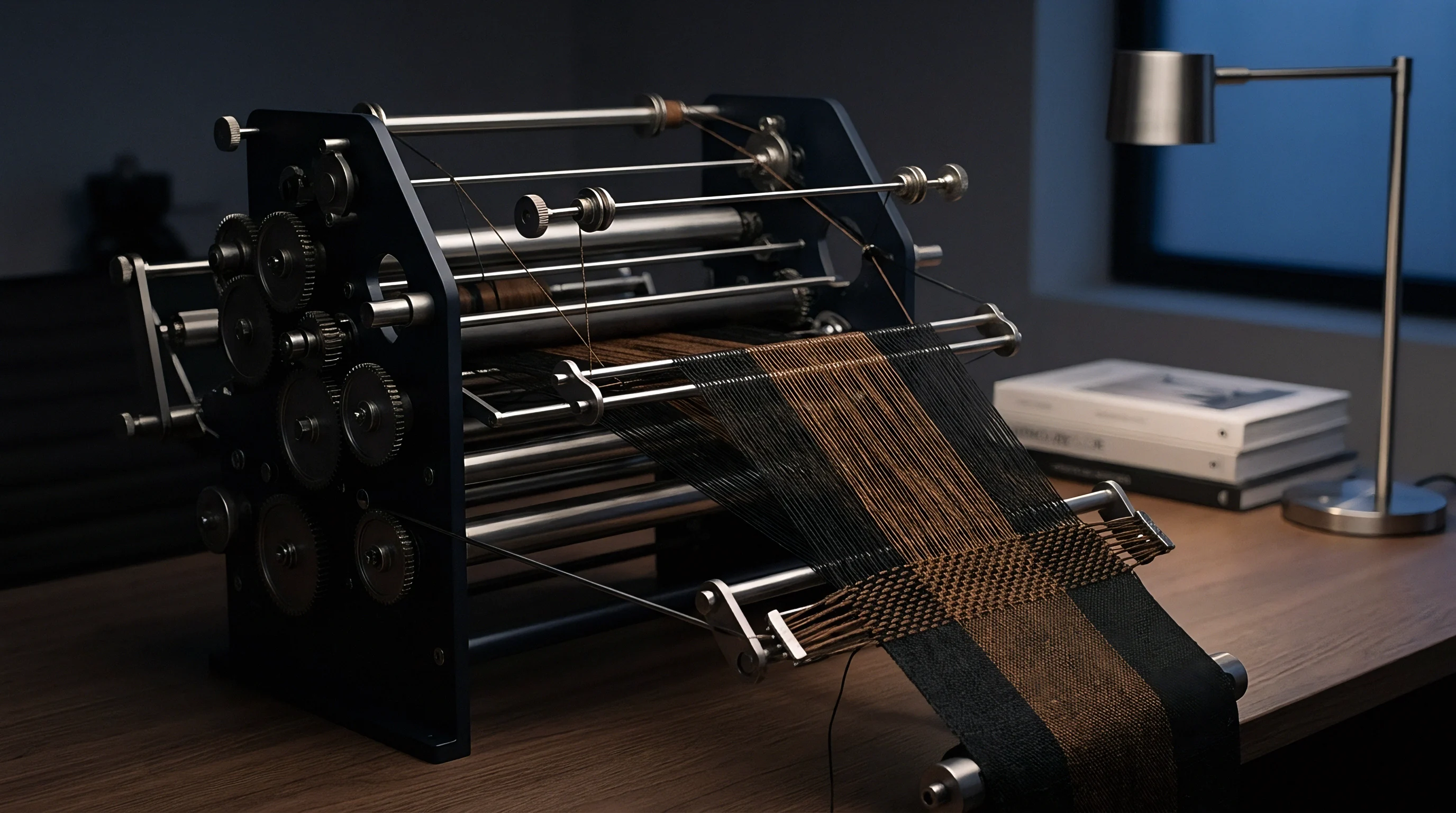
Shed
Flax tow yarns spun to 36 Nm exhibit an elastic limit below 1.8 percent elongation. Dry-spun line flax extends slightly further to 2.4 percent before structural failure occurs. These physical limits govern every kinematic parameter on a high-speed loom.
When a rapier machine operates at 550 picks per minute, the heald frames complete a full shedding cycle every 109 milliseconds. Synthetic fibers tolerate broad variations in displacement curves during this interval. Flax lacks synthetic yield.
The yarn absorbs the geometric lift of the heald frames as direct tensile strain. If the kinematic profile of the shedding motion fails to account for this rigidity, peak tensile stresses surpass the cohesive shear strength of the individual bast fiber bundles.
Shed opening geometry determines the survival rate of the warp ends across long production runs. A symmetrical shed divides the lift evenly above and below the cloth fell line. This equal division subjects both yarn sheets to identical strain paths.
In pure linen production, symmetrical opening causes severe structural clashing during shed closure. Flax yarns possess high surface hairiness composed of loose cortical fibrils. When the upper and lower sheets cross at the midpoint of the cycle, these fibrils interlock.
The resulting entanglement prevents clean separation before the rapier heads enter the shed line. An asymmetric shed geometry solves this mechanical interference by shifting the tension distribution.

Asymmetrical Frame Geometries
Loom kinematic profiles offset the backrest roller height to split tension unevenly across the upper and lower yarn sheets. Raising the backrest five to ten millimeters above the horizontal center line slackens the upper shed sheet while increasing mechanical load on the lower sheet. The slackened top sheet allows entangled bast fibrils to pull free without breaking.
The taut lower sheet creates a stable raceway along the sley profile for the rapier tape. This unequal division alters the mechanical strain cycle. Peak tension arrives fast.
The heavily loaded sheet absorbs up to seventy percent of the total cyclic elongation imposed by the cam or dobby motion.
Heald frame stroke distances must be minimized to preserve the yarn matrix. The first heald shaft requires an operational lift between 18 and 22 millimeters to clear the rapier head profile. The eighth or twelfth shaft in a dobby setup requires a lift approaching 36 millimeters due to geometric divergence from the cloth fell.
This geometric amplification creates severe stress differentials across the draft. Draft arrangements for dense flax qualities assign the highest-density ground ends to the front heald frames. The rear frames carry lower yarn counts or binder ends to prevent cyclic overextension.
Running 26 Nm wet-spun flax warp at 520 picks per minute generates peak dynamic stresses reaching 38 centinewtons per tex during shed crossing at twenty-four millimetres of heald displacement.
Tensile Stress Cycles under Rapid Displacement
Modern rapier head insertion drives alternating sheet movement within sixty milliseconds per machine rotation. The instantaneous acceleration of the heald frames induces dynamic stress peaks that exceed static let-off tension by two hundred to three hundred percent. A static warp tension set at 45 centinewtons per end routinely spikes to 140 centinewtons at maximum shed opening.
Flax bundles are composed of cellulose microfibrils cemented by pectin matrices with an orientation angle between 8 and 11 degrees relative to the fiber axis. This steep alignment yields an exceptionally high initial Young’s modulus of 50 to 80 GPa. The material cannot dissipate rapid acceleration energy through internal molecular reorientation.
Dynamic stress modeling indicates that jerk, defined as the first derivative of acceleration with respect to time, represents the primary driver of warp end cleavage during shedding. Standard eccentric cam profiles deliver sinusoidal displacement with moderate jerk values. High-performance electronic dobbies execute complex dwell profiles where the heald frame rests motionless for 120 to 140 degrees of mainshaft rotation to facilitate weft insertion.
The rapid braking and acceleration phases bounding this dwell period induce violent shock waves that propagate along the warp sheet from the heald eyes toward the warp beam. Without adequate absorption, these shock waves reflect off the lease rods and shear the brittle bast filaments at the heald eye interface.
| Yarn Type and Count | Heald Frame Stroke (mm) | Dwell Angle (degrees) | Static Tension (cN/end) | Peak Dynamic Tension (cN/end) | Warp Break Rate (stops/100,000 picks) |
|---|---|---|---|---|---|
| Wet-spun line flax 26 Nm | 20.5 | 130 | 42 | 128 | 1.8 |
| Wet-spun line flax 39 Nm | 19.0 | 140 | 30 | 98 | 2.4 |
| Dry-spun tow flax 16 Nm | 22.0 | 120 | 58 | 172 | 4.6 |
| Dry-spun tow flax 24 Nm | 21.0 | 130 | 38 | 122 | 3.9 |
Dwell optimization balances insertion duration against tensile fatigue. Extending the dwell angle beyond 140 degrees compresses the heald acceleration and deceleration phases into a narrow angular window. This compression escalates the peak inertial forces acting upon the warp yarns.
Conversely, reducing the dwell angle below 110 degrees truncates the open shed window, requiring extreme rapier tape velocities that generate destructive aerodynamic drag against the hairy linen surface. Production setups stabilize between 125 and 135 degrees of mainshaft rotation. Uncontrolled cyclic peak loads snap the outer line bast filaments, causing ballooning defects across the reed face that shut down the loom.


Wear
Yarn passage through steel drop wires strips the outer cortical layers of the bast bundle. Flax yarns do not present uniform, continuous cylindrical surfaces. They consist of discrete elementary fibers bundled together by middle lamellae composed of lignin and pectin.
Mechanical processing strips away protective gummy matter, leaving irregular fiber nodes exposed. When these nodes pass through drop wires, heald eyes, and reed dents, contact friction generates microscopic surface peeling. Micro-abrasion steadily removes material from the outer perimeter of the yarn.
The heald eyes wear. As abrasive flax passes through standard steel guides, the bast fiber cuts narrow grooves into the eyelets. These jagged micro-grooves act as cutting edges that sever subsequent yards of running yarn.
Drop wire geometry plays an underappreciated role in preventing structural degradation. Ultra-light drop wires weighing between 0.7 and 1.1 grams reduce mechanical drag but fail to drop decisively during high-speed yarn failures due to air currents generated by the sley motion. Heavier drop wires weighing 1.8 to 2.5 grams ensure positive electrical contact during end breaks.
These heavier weights exert excessive downward pressure on slack shed sheets. This downward force abrades the fragile size coating. The abrasive action strips the synthetic binder from the flax surface, exposing raw bast filaments to rapid destruction.
Guide Contact Abrasion Mechanics
Steel heald eyes exert continuous lateral friction on reciprocating linen yarns at production rates. As the frame rises, the yarn slides through the eye under acute angle deflections ranging from 12 to 28 degrees. Inserted ceramic eyelets provide low friction coefficients, but their sharp interior transitions chip brittle bast yarns during lateral flutter.
Profiled steel healds featuring nickel-chrome hard platings and polished eye perimeters deliver the best operational lifespan. The internal radius of the eye must accommodate the coarse nodes and occasional slubs characteristic of flax spinning without pinch effects. The heald eye length must reach at least 5.5 millimeters to distribute the normal force across a broader yarn contact area.
Reed dent friction introduces a separate degrading mechanism during the beat-up cycle. The reed sweep forces warp ends to slide longitudinally through narrow dent spaces under high local compression. A 190-centimeter reed holding 28 ends per centimeter in a plain interlacing creates tight clearance intervals.
High air temperatures generated by reed dent friction soften thermoplastic sizing compounds. The softened compounds rub off and accumulate as gummy deposits on the reed wires. These accumulations pinch adjacent warp ends, causing catastrophic cluster breaks across multiple dents.

Size Film Cohesion on Bast Bundles
Native starch formulations crack under repetitive elongation cycles without synthetic acrylic elastomeric binders. Starch films crack early. Unmodified potato or corn starch forms a crystalline, brittle matrix upon drying.
When subjected to the cyclic elongation described in shedding kinematics, pure starch shattered into dust within the first two hundred cycles of loom operation. High-performance sizing recipes for linen rely on a synergistic balance between modified potato starches, carboxymethyl cellulose, and cold-water-soluble polyvinyl alcohol or liquid polyacrylate dispersions. The synthetic polymers act as internal plasticizers that lower the glass transition temperature of the size film.
The sizing addon percentage on pure linen warp ranges between 8.5 and 12.0 percent by dry weight. Over-sizing encases the yarn in a rigid armor that eliminates the natural flexibility of the bast bundle, causing brittle snap fractures at the lease rods. Under-sizing permits the outer elementary fibers to separate from the yarn core, forming hairy clusters that jam the drop wire banks.
Sized flax warps demand strict relative humidity control in the weaving shed, sustained between 65 and 70 percent at 21 to 24 degrees Celsius. Low humidity dehydrates the size film, inducing brittleness, while excessive moisture plasticizes the starch matrix into a sticky gel that adheres to the metal surfaces of the loom.
- Fibrillar peeling strips elementary bast cells from the yarn core through continuous contact with stamped heald eye perimeters.
- Eyelet gumming occurs when softened sizing resins and loose cortical dust fuse inside the reed dent spaces.
- Slub entrapment severs coarse linen nodes when yarn clearance falls below eighty percent of the dent opening width.
- Drop wire false stops trigger loom shutdowns when high yarn vibration causes heavy mechanical detectors to bounce off the warp line.
Microscopic examination of shed debris confirms that size shedding proceeds through adhesive failure rather than cohesive rupture. The synthetic film pulls away from the smooth cellulosic exterior of the bast fibers because raw linen contains residual waxes that repel water-based size liquors. Pre-treatment desizing audits and alkaline scouring of the roving prior to wet spinning substantially improve sizing adhesion.
Mill technicians regularly assert that yarn split failures originate from uneven European retting seasons rather than defective sizing solids or excessive drop wire friction.

Beat
The reed pushes the newly inserted weft yarn into the cloth fell under rapid conjugate cam acceleration. The kinematic profile of the reed sweep determines how structural resistance develops within the cloth fell. In flax production, beat-up mechanics encounter an unyielding boundary.
Linen lacks transverse yarn compressibility. When a cotton or wool yarn strikes the cloth fell, the cross-section flattens from circular to elliptical, absorbing impact energy and facilitating close pick packing. Flax fibers maintain a rigid, polygonal cross-section stabilized by thick crystalline secondary cell walls.
The mechanical work required to displace the previous picks forward escalates exponentially as pick density rises.
Conjugate cam reed drives have entirely superseded standard four-bar crank linkages in modern high-speed linen operations. Crank linkages impose a pure sinusoidal sley motion where the reed velocity peaks precisely as it approaches the cloth fell. This velocity creates violent peak forces that hammer the fragile warp yarns against the reed wires.
Conjugate cam systems allow machine builders to tailor the velocity curve throughout the 360-degree cycle. The sley accelerates rapidly through the backward stroke to maximize insertion clearance, decelerates gently as the reed enters the cloth fell area, delivers a sustained squeeze at dead center, and retreats smoothly.
Is Asymmetric Geometry Mandatory for Flax?
Linen plain weaves require differentiated tension sheets to prevent warp ends from clinging during insertion. When an asymmetric shed geometry is applied, the beat-up action occurs under unequal sheet resistance. The slack upper sheet offers minimal opposition to the advancing reed, while the taut lower sheet acts as an anvil.
This asymmetry causes the newly inserted weft pick to deviate from the cloth plane, inducing a phenomenon termed cloth fell jumping. Short floats stiffen the fell. In high-density plain sheeting, the fell jumps vertically by two to four millimeters at each beat-up strike.
This violent vertical oscillation subjects the warp ends running through the front heald frames to intense cyclical bending fatigue.
To eliminate fell jumping without abandoning the benefits of asymmetric shedding, advanced looms incorporate a dynamic fell support. This stationary or micro-oscillating bar sits directly beneath the cloth fell, mechanically preventing downward deflection during reed impact. Stabilizing the fell geometry enables the reed to drive picks tightly into high-density constructions without shearing the warp ends at the fell line.
Without this mechanical stabilization, pick densities exceeding 22 picks per centimeter in 26 Nm linen plain weaves trigger systematic warp cut breaks along the selvedge borders.
Bast fibre bundles lack the transverse elasticity required to absorb sudden reed acceleration at cloth fell contact.

Cloth Fell Displacement Dynamics
Every forward swing of the sley pushes the edge of the woven structure forward by several millimetres. The distance the cloth fell moves forward under the impact of the reed is termed the fell displacement. In technical flax weaving, fell displacement must be tightly controlled to prevent starting marks and pick variation.
Because flax fibers display negligible elongation, the cloth fell springs back instantaneously once the reed retreats. If warp let-off tension drops by even five percent during a momentary machine stop, the cloth fell creeps rearward toward the reed line. Fell movement destabilizes pick density.
When the loom restarts, the first beat-up impacts an improperly positioned fell, generating a severe high-density band known as a starting mark.
Electronic take-up and let-off drives counteract fell relaxation through automated mechanical offsets upon loom stop. The main controller calculates the duration of the stop and commands the let-off motor to advance or reverse the warp beam by fractions of a millimeter before the clutch engages. The magnitude of this compensation depends upon the cover factor of the construction.
Highly jammed plain weaves demand a forward fell offset, while loose twill constructions require a backward retraction to equalize the initial pick distance.
| Cloth Construction | Ends/cm x Picks/cm | Warp Yarn Count (Nm) | Beat-Up Force (N/m reed width) | Fell Displacement (mm) | Maximum Achievable Speed (ppm) |
|---|---|---|---|---|---|
| Plain weave sheeting | 18.0 x 16.0 | 26 wet-spun | 2,150 | 1.85 | 580 |
| Dense plain canvas | 24.0 x 20.0 | 16 dry-spun | 4,600 | 3.40 | 420 |
| 2/1 Twill workwear | 26.0 x 22.0 | 39 wet-spun | 2,800 | 2.10 | 520 |
| 4-end Satin damask | 32.0 x 28.0 | 39 wet-spun | 2,450 | 1.60 | 540 |
The beat-up force data compiled above highlights the dramatic resistance generated by dense linen canvas. Generating 4,600 Newtons per meter of reed width pushes commercial weaving machinery to its structural engineering limits. Looms running this class of industrial flax cloth feature reinforced sley swords cast from nodular iron rather than extruded aluminum alloys.
The main drive motor rating must be scaled upward from 5.5 kW to 7.5 kW to sustain angular velocity through the impact phase. Engineering consensus remains divided over whether dynamic cloth-fell oscillation can be fully neutralized through electronic let-off algorithms without mechanical backrest dampers.
Sync
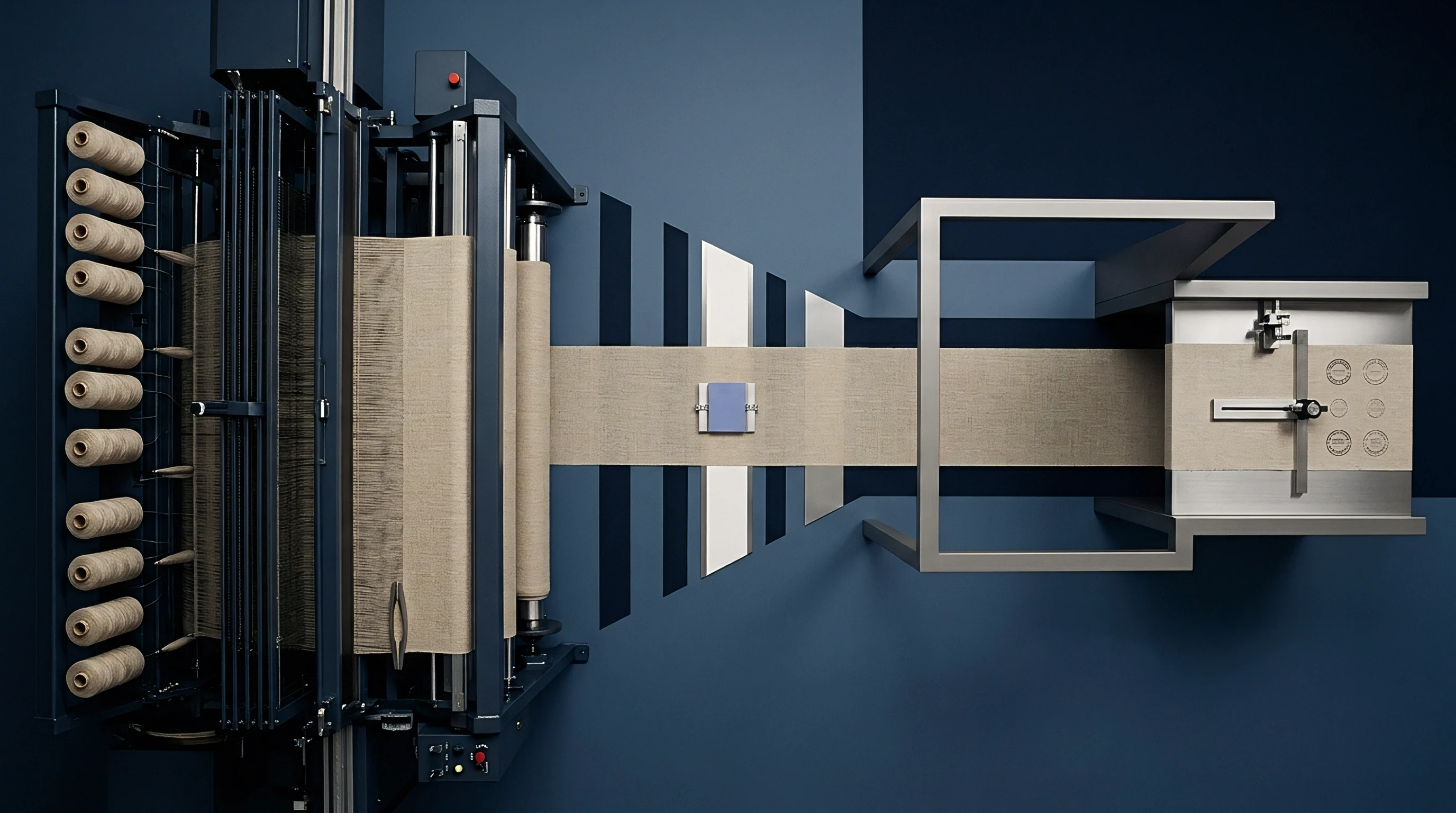
Coordinated machine drives govern the mechanical harmony between electronic let-off motors and the reciprocating backrest. The backrest roller is not a passive guide; it functions as an active kinematic compensator. As the heald frames open, the geometric path from the backrest to the cloth fell lengthens, demanding more yarn.
Flax cannot stretch to accommodate this path variation. Tension spikes shear bast fibres. The backrest must move forward and inward toward the heald frames in exact synchrony with shed opening to feed excess yarn into the working zone.
When the shed closes, the backrest must swing backward to take up yarn slack, preventing loose ends from sagging into the raceway.
Mechanical backrest systems drive this oscillation via eccentric cams linked directly to the main crankshaft. While reliable on older, slow-speed equipment, mechanical linkages suffer from fixed stroke geometries that cannot adapt to shifting beam diameters. Modern high-speed looms utilize spring-loaded or pneumatically damped oscillating backrests that respond dynamically to instantaneous tension spikes.
High-response electronic backrests driven by dedicated servo motors track the angular position of the mainshaft via optical encoders, adjusting the roller position thousands of times per minute.
Will Rapier Insertion Exceed Air Jet Velocity?
Positive tape drives carry flax weft yarns through the shed without the pneumatic dispersion that damages hairy bast bundles. Air-jet weaving propels the pick through an optical channel using high-pressure compressed air pulses delivered by a series of relay nozzles. While air-jet machines achieve insertion rates exceeding 1,200 picks per minute on continuous filament synthetics, they perform poorly on coarse linen.
The blast of compressed air strips fibers from the unshielded flax weft yarn, producing airborne fly waste that clogs the optical insertion sensors within hours. Rapier heads demand clean sheds. Loose ends snare weft tips.
Guided positive rapier heads physically clamp the pick tip, transporting it across the shed without pneumatic disruption, operating reliably up to 600 picks per minute.
Rapier insertion mechanics must coordinate with the shedding cross timing to avoid clipping the yarn sheets. The left-hand rapier enters the shed at approximately 75 degrees of crank angle and transfers the pick to the right-hand rapier at 180 degrees. Shed closure commences immediately after the transfer.
The right-hand rapier must clear the right selvedge by 295 degrees, before the converging upper and lower warp sheets pinch the gripper body. On flax setups, the shed crossing angle is advanced to 305 or 310 degrees. This delayed crossing gives the sluggish bast ends maximum time to separate cleanly before the sley advances toward the beat-up strike.
A damp shed preserves bast flexibility while dry heald eyes grind sized line yarns into dust.
Backrest Roller Oscillation Dynamics
Spring-loaded and pneumatic shock absorbers soften cyclic peaks during the crossing of heald shafts. Setting the oscillation phase angle dictates the exact instant of tension compensation. If the backrest reaches its maximum forward stroke too early, the warp ends slacken prematurely, destabilizing the shed line while the rapier is still inside.
If the compensation arrives too late, the yarn absorbs the peak shed strain unaided, triggering end breakage. The optimal mechanical phase offset positions the maximum forward displacement of the backrest at approximately 135 degrees of crank angle, aligning precisely with the maximum geometric lift of the rear heald shafts.
Calibrating a high-speed linen loom requires a systematic sequence of mechanical and electronic adjustments to synchronize yarn transit:
- Align the reed height and sley race to ensure the bottom shed sheet clears the rapier guides by precisely 1.5 millimeters during insertion.
- Adjust the backrest height ten millimeters above the horizontal breast beam datum to establish the necessary asymmetric shed tension differential.
- Set the mechanical shed crossing timing to 310 degrees of mainshaft rotation using the primary drive gearbox vernier scale.
- Preload the oscillating backrest torsion springs to match the static warp tension calculated for the specific yarn count and sett.
- Calibrate the electronic let-off sensor gain to damp out cyclic beat-up pulses while responding instantly to continuous beam consumption.
- Program the electronic take-up drive to execute a 0.25-millimeter forward fell offset upon loom shutdown to suppress cold starting marks.
Maintaining these mechanical settings across shifting temperature and humidity shifts requires continuous monitoring. A shift variation of five percent in relative humidity alters the bending stiffness of flax yarns, shifting the natural harmonic frequency of the warp sheet. Weaving managers must verify sensor calibrations at the beginning of each operating shift.
A stable linen shed balances backrest deflection against shed crossing angle so that the slackening warp never sags into the rapier trajectory.


Overhead
Machine stoppage rates dictate the commercial viability of high-speed linen manufacturing. In standard cotton weaving, a modern shed projects an end break frequency below 0.5 stops per 100,000 picks. Pure linen operations routinely experience stop rates between 1.5 and 4.5 stops per 100,000 picks, even when running premium wet-spun Western European line warps.
Weavers bill for downtime. Each machine stop generates a financial penalty composed of lost production capacity, direct labor intervention, and fabric quality downgrades caused by restart marks. Loom stops destroy mill margins.
Sourcing contracts must reflect these physical production realities in the agreed linear meter price.
Speed penalties compound hourly expenses. A mill running a 190-centimeter rapier loom at 580 picks per minute operates at high mechanical efficiency until warp breakage begins to escalate exponentially. Pushing loom speed from 480 to 580 picks per minute yields a twenty percent increase in theoretical output.
Flax kinematics penalize this speed increase. The higher speed elevates the cycle break rate from 1.8 to 4.2 stops per 100,000 picks. The actual operational efficiency of the loom drops from ninety-one percent to seventy-six percent.
The net linear meters produced per eight-hour shift remains completely unchanged, while labor expenses, spare parts consumption, and second-quality cloth generation increase sharply.

Loom Efficiency against Stop Frequency
Weaving sheds calculate operator allocations based on predicted yarn break interventions per shift. In a conventional cotton shed, an experienced weaver oversees thirty to forty high-speed rapier looms. In a technical flax shed, that allocation contracts dramatically to eight or twelve looms per weaver.
The operator must manually locate broken ends behind the heald frames, draw them through the drop wires and heald eyes using a drawing hook, re-dent the reed, and execute a flawless fell restart. Fine linen demands slow running. Warp preparation fixes shed yield.
Slower loom running speeds frequently deliver lower finished meter costs by preserving high operating efficiencies and suppressing labor requirements.
Beam length economics also impose strict operational boundaries. Sizing flax requires specialized sizing machine configurations equipped with multi-cylinder drying zones and delicate stretch-control sensors. Setting up a 1,900-meter linen warp beam consumes substantial sizing machine capacity and generates up to eighty meters of sizing waste at the beam head and tail.
A mill amortizes these preparation costs over the total warp run. Sourcing buyers who request small dye lots or specialized custom weaves under 3,000 linear meters force the shed to absorb prohibitive set-up charges that immediately surface on the landed commercial invoice.
| Running Speed (picks/min) | Break Frequency (stops/100,000 picks) | Actual Loom Efficiency (%) | Shift Output (linear metres/8 hr) | Loom Cost per Hour (USD) | Direct Weaving Cost per Metre (USD) |
|---|---|---|---|---|---|
| 450 | 1.2 | 93.5 | 105.2 | 28.50 | 2.17 |
| 500 | 1.8 | 89.0 | 111.3 | 29.20 | 2.10 |
| 550 | 2.9 | 82.5 | 113.4 | 30.80 | 2.17 |
| 600 | 4.6 | 73.0 | 109.5 | 33.50 | 2.45 |
Finished Metre Pricing Arithmetic
A baseline analysis of production expenses demonstrates how mechanical downtime shifts the landed invoice total. Consider a standard worked construction: a 190-centimeter greige plain weave linen fabric specified at 19 ends per centimeter and 17 picks per centimeter, utilizing 26 Nm wet-spun warp and weft yarns. Assume a commercial order of 10,000 linear meters woven across a battery of four rapier looms.
Sizing chemical formulations incorporating modified potato starches and acrylic binders cost 0.38 USD per kilogram of yarn sized. Total yarn consumption equals 265 grams per linear meter, yielding a raw fiber and chemical preparation outlay of 3.45 USD per meter.
The weaving shed books capacity at a flat rate of 30.00 USD per loom-hour. Operating the battery at 500 picks per minute at eighty-nine percent efficiency delivers 13.9 linear meters per loom-hour. The direct weaving conversion cost equals 2.16 USD per linear meter.
If inferior warp preparation causes the break frequency to rise to 4.6 stops per 100,000 picks, efficiency plummets to seventy-three percent. Output drops to 11.4 linear meters per hour, driving conversion costs up to 2.63 USD per meter. This difference of 0.47 USD per linear meter eliminates the entire profit margin on a volume sourcing program.
Specifying ASTM D5430 four-point inspection thresholds below twenty points per one hundred square metres obligates the shed to stop the loom before warp streaks accumulate.
Commercial qualification dossiers must stipulate verifiable mechanical boundaries rather than vague quality parameters. Sourcing contracts that fail to define loom-hour expectations leave the buyer vulnerable to hidden capacity surcharges and delayed delivery schedules. Professional buyers require mills to document their sizing recipe, warp yarn elongation profiles, and target loom speeds during initial quality audit sampling.
- Minimum sizing addon specifies an analytical dry-weight size content between nine and eleven percent, verified through desize burnoff testing.
- Stop rate ceiling establishes a contract rejection clause if loom monitoring logs exceed three mechanical warp stops per 100,000 picks.
- Tension log audit grants the buyer access to electronic let-off memory files to confirm static warp loads remained within verified tolerances.
- Warp break warranty binds the mill to replace or credit greige yardage containing more than two visible starting marks per fifty linear meters.
A contract term binding the mill to ISO 7211 construction tolerances alongside an ASTM D5430 four-point penalty threshold transfers all financial exposure for starting marks back to the weaver.