Reed Marks and Starting Marks Read Back to the Loom
Greige reed marks and starting marks map directly to reed wire spacing and loom stoppage dynamics, requiring electronic let-off adjustment to eliminate defects.
Signature
Inspection of greige linen reveals physical defects stemming from shedding, beat-up, and warp let-off actions on the loom. Structural flaws run in two distinct directions across the fabric bolt. Longitudinal streaks follow the warp path, stretching continuously down the roll or ending sharply where an end was repaired.
Transverse bands run parallel to the weft, showing up as local shifts in density across the full width of the cloth. Spotting these patterns helps technicians pinpoint loom mechanical failures without resorting to destructive testing.
Denting errors permanently alter warp density. On the inspection table, parallel light bands running warp-wise through high-density flax plain weaves point to displaced ends. These continuous vertical lines come from damaged reed dents, uneven dent spacing, or mistakes during re-reed drafting.
Because the reed grid controls the lateral spacing of warp ends during beat-up, any shift in dent pitch alters the local ends-per-centimeter count. This produces distinct bands of light transmission that remain visible through washing, bleaching, and piece dyeing.

Visual Differentiation of Surface Anomalies
Distinguishing warp-wise wire displacement marks from pick-wise stoppage lines requires systematic checking under calibrated light sources. Longitudinal streaks stay in the exact same position across thousands of meters of cloth, matching the width of one or more reed dent openings. A single bent wire pushes adjacent warp ends together, crowding one spot while leaving an open gap next to it.
Under backlighting, that gap shows up as a bright vertical line bordered by a dark shadow of compacted ends.
Transverse marks result from a completely different mechanical issue. These full-width density shifts occur whenever the loom stops and restarts. When a weft break, warp stop motion, or operator stops the machine, the cloth fell shifts from its set resting point.
Constant warp beam tension pulls the resting fell back toward the harness frames, while the take-up mechanism relaxes, letting the fabric creep. Once the main motor re-engages and beat-up resumes, the first pick lands either short of or past the existing fell, leaving a thin or thick place across the full width of the cloth.
Weaving defects in greige cloth stem from distinct mechanical causes:
- Bent Reed Wires result from impacts during manual re-threading or shuttle strikes, grouping warp ends together down the entire length of the roll.
- Accumulated Sizing Residue collects inside specific dent gaps, restricting warp end movement and producing intermittent friction streaks along the warp.
- Let-Off Brake Slippage lets the warp beam creep forward under static load, creating repeating horizontal thin bars when the loom restarts.
- Take-Up Backlash Creep happens while the loom sits idle, drawing the fabric fell backward and causing heavy weft packing on the first beat-up stroke.
- Pick Finder Discrepancies occur when automated pick-removal mechanisms fail to realign the fell with the main drive position during yarn repair.
Longitudinal Reed Wire Distortions
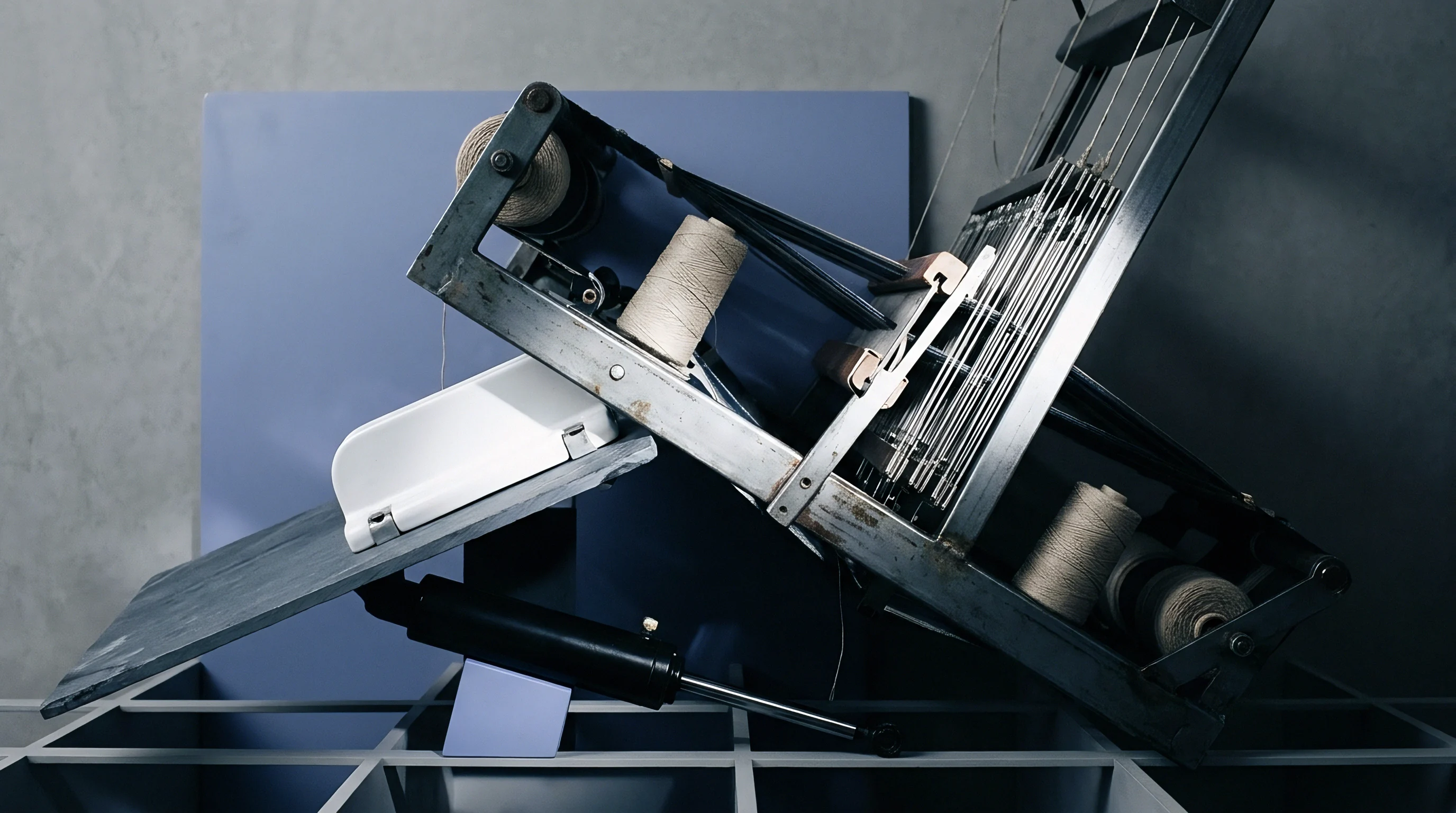
A damaged reed dent distorts the local weave at every stage of cloth formation. Take a standard 100 percent linen plain weave with 14 ends per centimeter in the warp, 14 picks per centimeter in the weft, and a yarn count of 26 Nm (38.5 tex). For a 2-end-per-dent draft, the nominal dent pitch is 1.43 millimeters.
If a single stainless steel reed wire twists by just 0.10 millimeters, the gap between adjacent wires narrows from 1.03 millimeters to 0.93 millimeters on one side and widens to 1.13 millimeters on the other. This shift squeezes two warp yarns into a tight channel while opening the adjacent space by about ten percent.
A reed wire misalignment exceeding 0.08 millimeters creates a visible longitudinal band in 100 percent linen plain weaves at 180 grams per square meter.
Reeds wear down over long production runs. High-abrasion flax yarns, carrying residual micro-shives and rough surface fibers, cut continuous grooves into stainless steel wire edges over millions of beat-up strokes. As these grooves deepen, individual warp ends get caught in the micro-notches.
Trapped yarns can no longer shift laterally during shed closure, which alters warp crimp distribution and creates permanent structural streaks that survive wet finishing. While inspection tables catch this mechanical wear early, mills often blame raw flax variations for longitudinal streaks instead of replacing worn reed sections.

Beat
Mechanical forces during beat-up push the inserted pick into the fabric fell at the front limit of reed travel. Driven by eccentric cranks or conjugate cams, the sley assembly accelerates the reed past 400 strokes per minute on modern rapier machines. When the reed face hits the new weft yarn, it overcomes friction against the interlocked warp sheet to drive the yarn home.
Beat-up resistance depends on warp tension, shed clearance timing, yarn friction coefficients, and fabric density. In heavy flax weaves, peak beat-up forces push the fabric fell forward several millimeters at maximum stroke before elastic tension pulls it back into place.
When the loom stops, this dynamic equilibrium collapses. Static warp tension ~ typically set between 25 and 35 cN per end for pure linen ~ causes progressive stress relaxation in the flax fibers. Under constant load, flax undergoes viscoelastic creep.
During a twenty-minute stop, the warp sheet stretches permanently by a fraction of a millimeter while cloth wrapped around the sand roller slowly loses tension, allowing the fell to drift back toward the reed face. If the electronic let-off and take-up systems fail to apply active compensation to reposition the fell upon restart, the reed strikes at the wrong coordinate, leaving a severe density flaw.
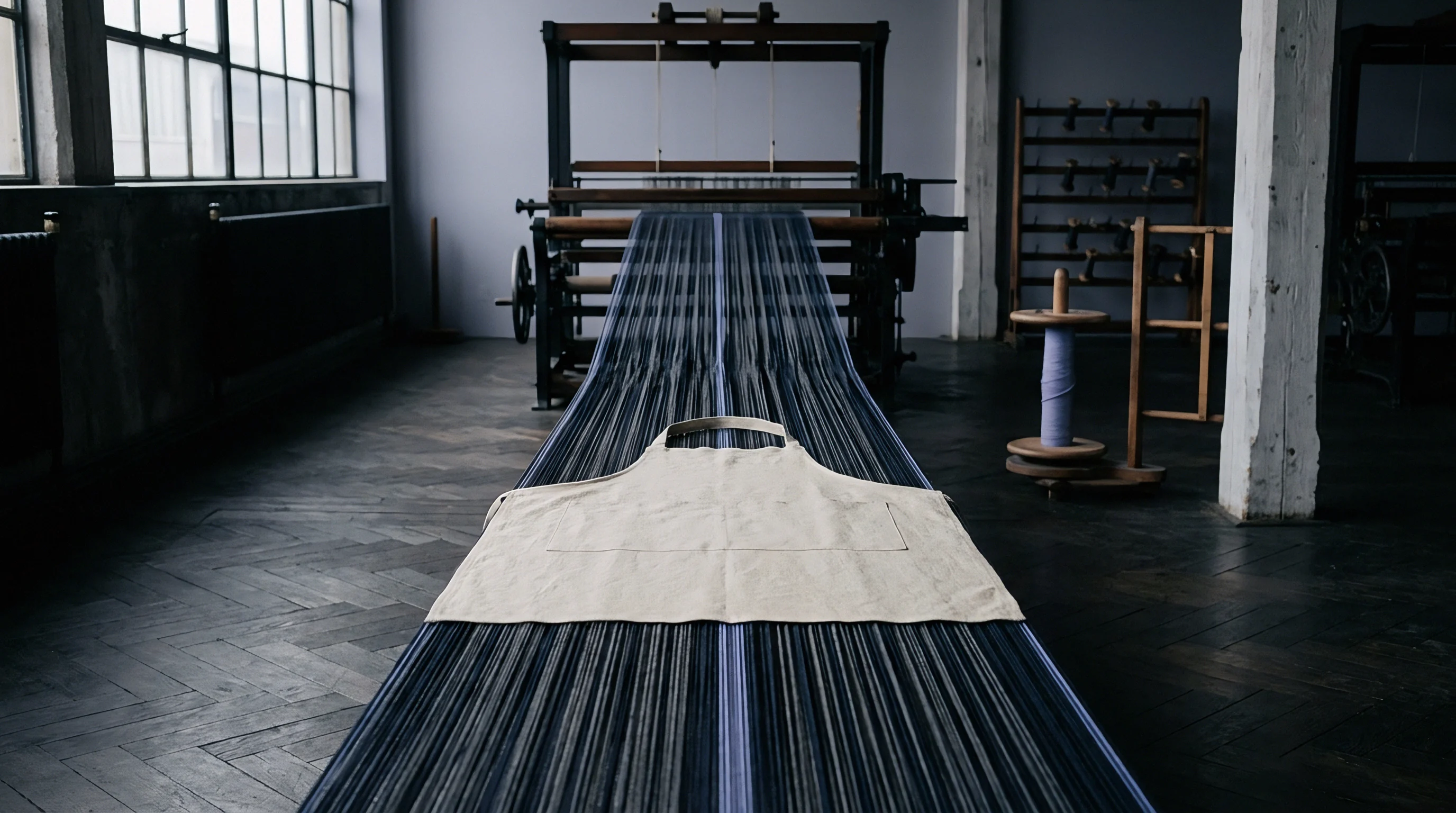
Kinematics of Beat up and Fell Displacement
Mapping fell movement under both running and static conditions shows how displacement develops. At 450 picks per minute, the fell moves through a regular spatial amplitude known as fell drift. Each time the reed hits the weft, the fell advances by a distance delta-x; as the reed recedes, warp tension pulls the fell back by that same delta-x.
The size of this displacement depends directly on the warp cover factor and weft packing density.
The baseline beat-up resistance force accounts for warp tension, weave geometry, and yarn friction:
F_beat = 2 T_warp sin(theta) + mu F_normal
Here, T_warp is the dynamic tension per warp end, theta is the warp shed deflection angle at reed contact, mu is the yarn-to-yarn kinetic friction coefficient, and F_normal is the clamping force exerted by crossing warp ends on the inserted pick. For a 100 percent linen 2/1 twill with 22 ends per centimeter and 18 picks per centimeter woven from 36 Nm (27.8 tex) wet-spun flax yarn, dynamic T_warp averages about 30 cN per end, producing an aggregate beat-up resistance force over 450 Newtons per meter of weaving width.
| Reed Dent Count (dents/cm) | Wire Thickness (mm) | Dent Pitch (mm) | Warp Ends per Dent | Warp Cover Factor (%) | Visual Mark Threshold (mm) |
|---|---|---|---|---|---|
| 8.0 | 0.45 | 1.250 | 2 | 52.4 | 0.12 |
| 10.0 | 0.38 | 1.000 | 2 | 58.1 | 0.09 |
| 12.0 | 0.32 | 0.833 | 2 | 64.7 | 0.07 |
| 14.0 | 0.28 | 0.714 | 2 | 71.2 | 0.05 |
| 16.0 | 0.24 | 0.625 | 3 | 78.9 | 0.04 |
| Data measured on 190 cm weaving width rapier looms running 100% wet-spun flax at 380 picks per minute under standard conditions of 65% relative humidity and 20 degrees Celsius. Visual mark threshold defines the minimum lateral wire displacement producing a grade 3 streak under ASTM D5430 evaluation. | |||||

Viscoelastic Relaxation in Linen Warps
Linen fibers consist of rigid, highly oriented cellulose microfibrils embedded in a matrix of hemicellulose and lignin. This structure makes flax yarn sensitive to stress relaxation over time under constant strain. When the loom halts from an automatic warp break, yarn stretched between the back rest roller and the fabric fell stays locked under static strain.
Internal hydrogen bonds within the amorphous hemicellulose regions slip, causing tension to decay without any physical movement from the warp beam.
A fifteen-minute stoppage on a 100 percent flax warp produces a measured fell shift of 0.42 millimeters, altering where the reed strikes the weft on the initial restart cycle. Tension decay in flax warps follows a logarithmic relationship:
T(t) = T_0 (1 – k ln(1 + t / t_ref))
In this equation, T(t) is the remaining warp tension at time t (in minutes), T_0 is the dynamic running tension (30 cN/end), k is the stress relaxation coefficient for wet-spun flax (typically 0.085 to 0.112), and t_ref is the reference time constant (0.05 minutes). After a fifteen-minute stoppage (t = 15), warp tension on a 30 cN/end sheet drops to roughly 21.2 cN/end ~ a 29.3 percent loss in restoring force.
With warp tension down by nearly thirty percent, the reduced restoring force lets the fabric fell drift 0.42 millimeters back toward the harnesses. On the first restart stroke, the reed travels to its fixed front dead center position. Because the fell has drifted, the distance the reed travels before hitting the fell increases by 0.42 millimeters, driving the newly inserted pick too deep into the existing cloth.
This forms a high-density thick bar carrying up to 22 picks per centimeter against the nominal target of 14.
Static tension causes flax warp ends to stretch and creep during prolonged loom stoppages.
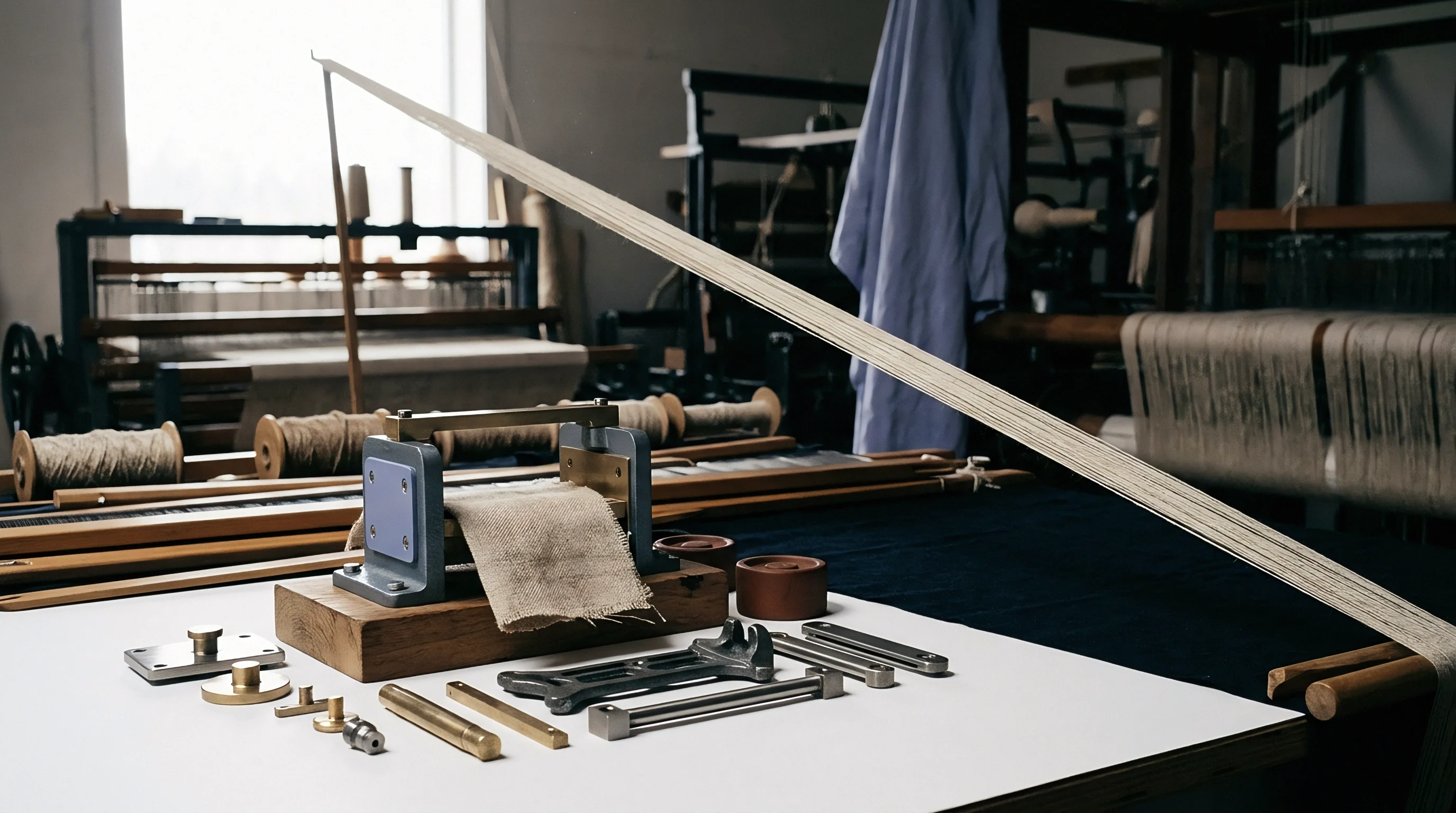
Pick Density Deviations at Loom Restart
Modern rapier and air-jet looms use servomotor-driven Electronic Let-Off (ELO) and Electronic Take-Up (ETU) systems to prevent stoppage marks. During the pick-finding sequence, these drives make forward or reverse movements to reposition the fell before the main motor accelerates. Setting these parameter curves requires calibration based on fabric weight, fiber type, and stop duration.
Calibrating electronic stoppage compensation parameters follows a clear sequence:
- Record baseline warp tension and dynamic fell position using a high-speed optical sensor while running production fabric at full speed.
- Introduce controlled stops of 30 seconds, 3 minutes, 10 minutes, and 30 minutes with harness frames held level.
- Measure static fell drift using an optical micrometer focused on the reed-to-fell boundary at each interval.
- Input the measured displacement coordinates into the loom control interface under the Electronic Take-Up correction matrix.
- Set the Electronic Let-Off reverse pulse count to restore target warp tension before the main motor engages on the first pick cycle.
- Program the motor acceleration ramp to reach full operating speed within two shaft revolutions, ensuring full beat-up force on the first pick.
- Weave test sections after each stoppage interval and check pick density variations using an automated counter across the first 50 millimeters of fabric.
These counter readings confirm motor synchronization. Operating parameters must account for both structural fabric relaxation and mechanical backlash in the take-up gear train, while proper motor brake tension keeps the fell from drifting during extended idling.
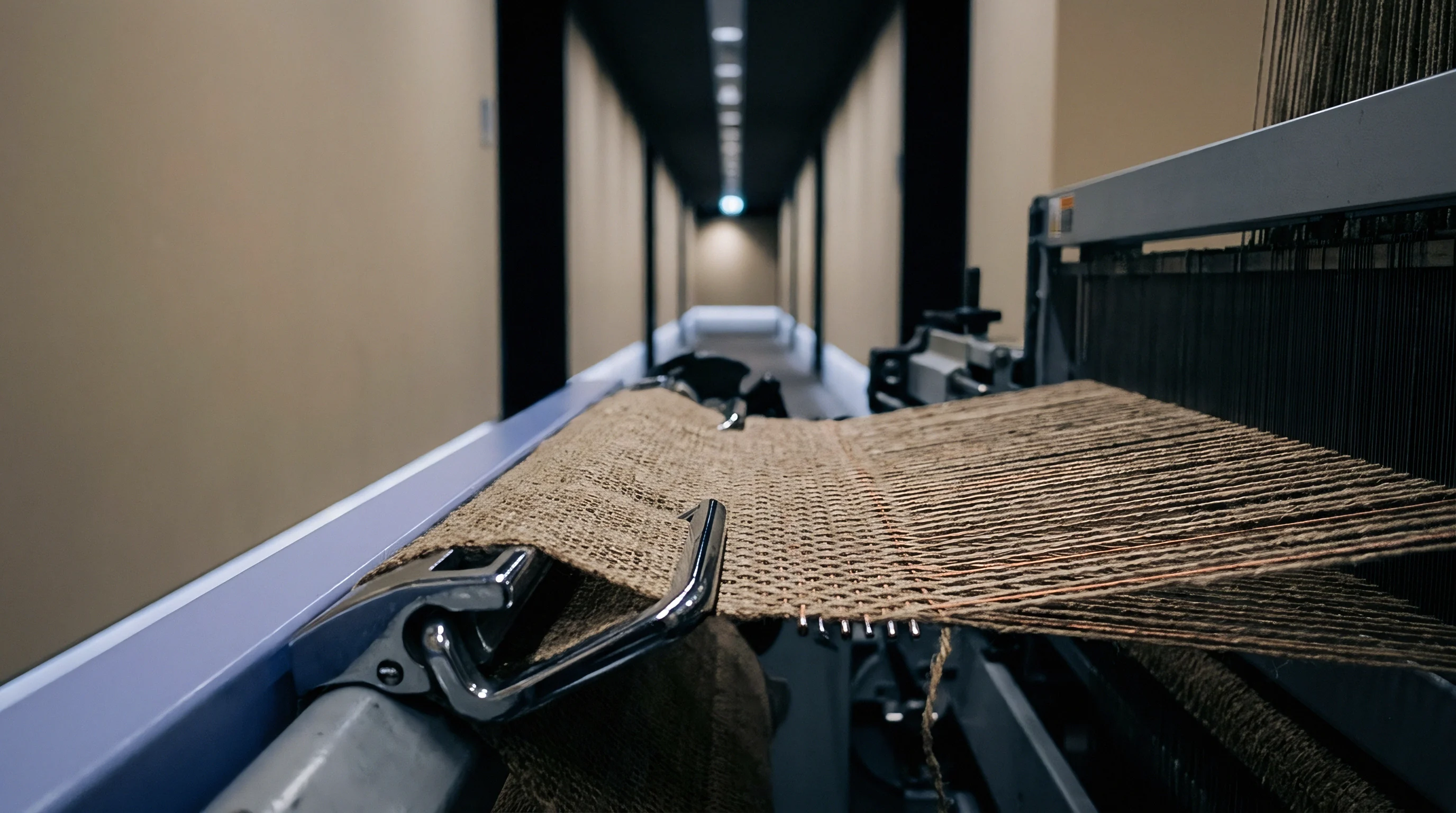

Audit
Verifying greige fabric quality relies on visual and physical inspection on standard unrolling frames. These frames require controlled lighting to highlight both longitudinal reed spacing issues and transverse density shifts. Inspectors check rolls under dual light setups, using top reflection to inspect surface irregularities and bottom transmission to reveal local density changes in the weave.
Lighting angle dictates defect visibility. Positioning top light tubes at a 30-degree oblique angle to the fabric plane casts distinct shadows behind distorted warp ends or bunched picks. Backlighting panels under diffuse frosted glass plates highlight gaps between adjacent threads.
On fine to medium linen fabrics, backlighting should deliver between 1,500 and 2,000 lux across the full width of the inspection plate.
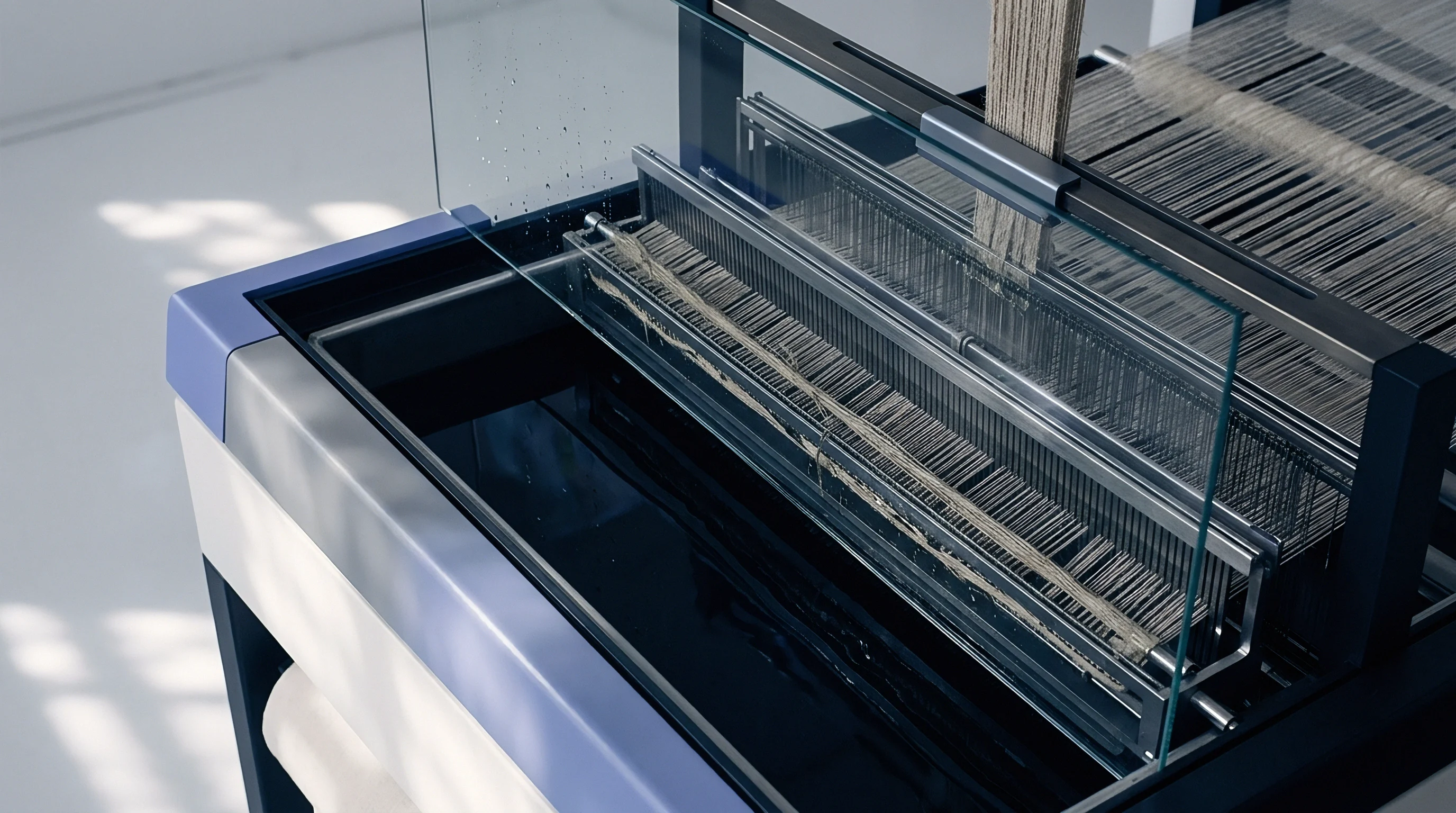
Inspection Frame Backlighting and Angles
Setting inspection light banks at a thirty-degree angle exposes reed spacing anomalies immediately. For premium linen, inspection speed should stay between 8 and 12 meters per minute so inspectors catch subtle density shifts. Running tables faster than 25 meters per minute leads to missed defect signatures, letting structural starting marks slip through to finishing.
Automated inspection systems using high-resolution line-scan CCD cameras provide continuous digital checking across the full width of the fabric. These arrays capture images down to 50 micrometers per pixel. Real-time fast Fourier transform (FFT) algorithms process the image matrix to calculate two-dimensional spatial frequency profiles of the thread grid.
A local drop in spatial frequency along the horizontal axis marks a drop in weft density (a thin mark), while a spike indicates a compacted pick zone (a thick mark). Continuous drops along the vertical axis track longitudinal reed marks running down the roll.
ASTM D5430 four-point inspection assigns maximum penalty points to any continuous reed mark extending beyond one linear meter.
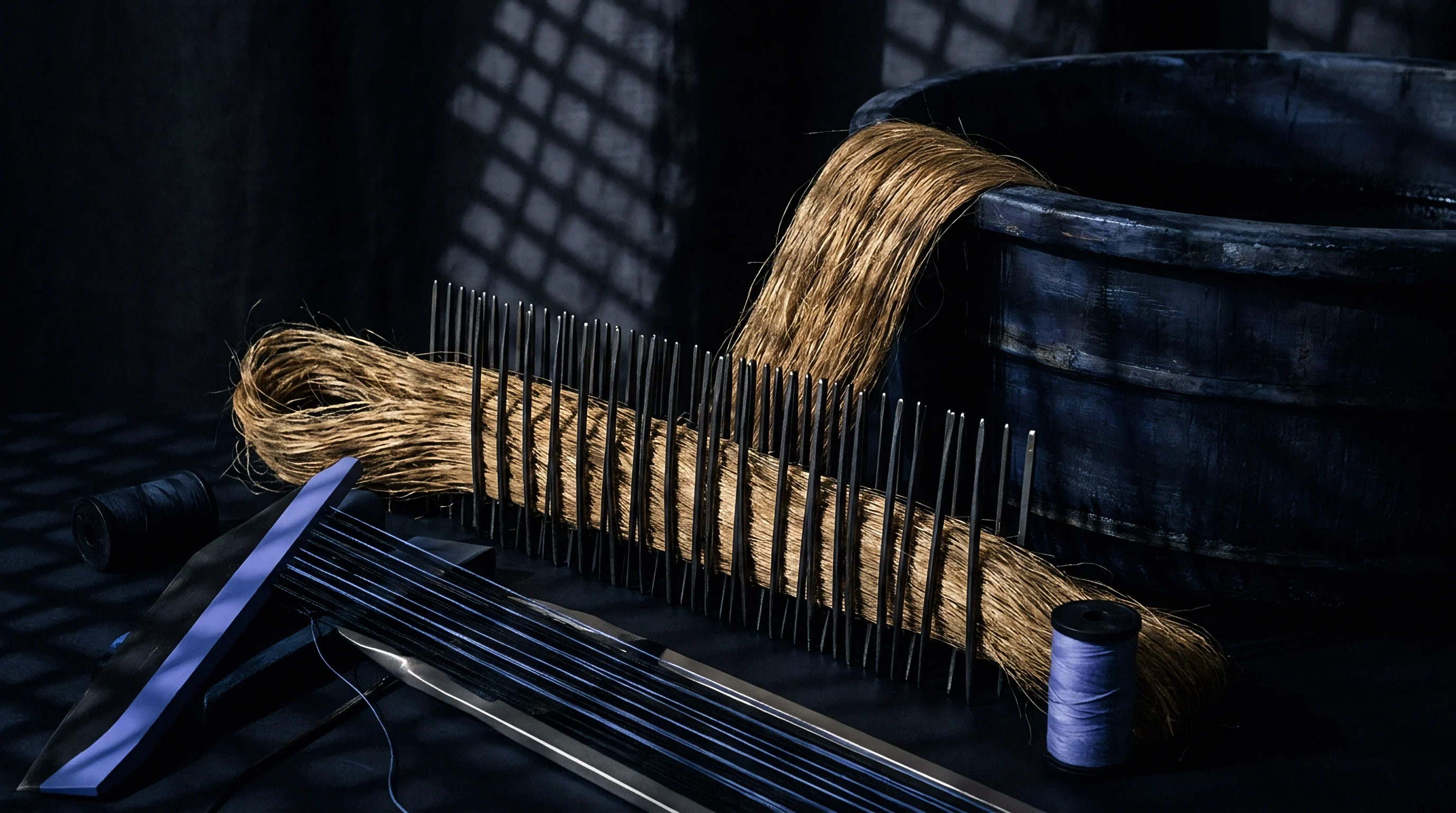
Where Does the Loom Record Mechanical Wear?
Modern loom microcontrollers log every operational stop, recording timestamps, cause codes, shaft angles at stop, and pick counter coordinates. Cross-referencing these logs against physical roll defect positions gives clear evidence for root-cause diagnosis. When an inspector flags a severe starting mark at meter 245, they can convert that distance directly back to the pick count based on nominal weft sett.
| Fault Type | Visual Pattern under Light | Root Mechanical Cause | Loom Component Source | Diagnostic Standard Method |
|---|---|---|---|---|
| Continuous Reed Mark | Sharp longitudinal light and dark lines extending continuously through bolt | Permanently bent or worn reed wire altering dent pitch gap | Sley reed assembly grid wires | ISO 7211-2 optical dent pitch gauge |
| Intermittent Reed Mark | Periodic longitudinal shadow lines appearing every few meters | Sizing buildup or fiber lint accumulation within reed dent gap | Reed wire surface cleanliness | ASTM D5430 visual lighting inspection |
| Loom Stop Thin Mark | Transverse light band across full width carrying low pick density | Take-up back-slip or delayed let-off motor engagement at start | Electronic Take-Up motor sync drive | ISO 7211-5 pick density counter matrix |
| Loom Stop Thick Mark | Transverse dark band across full width carrying high pick density | Fell drift toward harnesses caused by warp stress relaxation | Electronic Let-Off compensation parameters | High-magnification pick counting camera |
| Pick Finder Misalignment | Double pick or broken pattern bar extending across full width | Incorrect pick finding sequence timing during manual weft repair | Automated pick finding control logic | Physical pattern repeat inspection panel |
Because loom logs record every automatic stop, physical inspection can verify machine telemetry directly. Standard contract addendums requiring pick-finding verification force mills to calibrate restart parameters before mounting production beams.
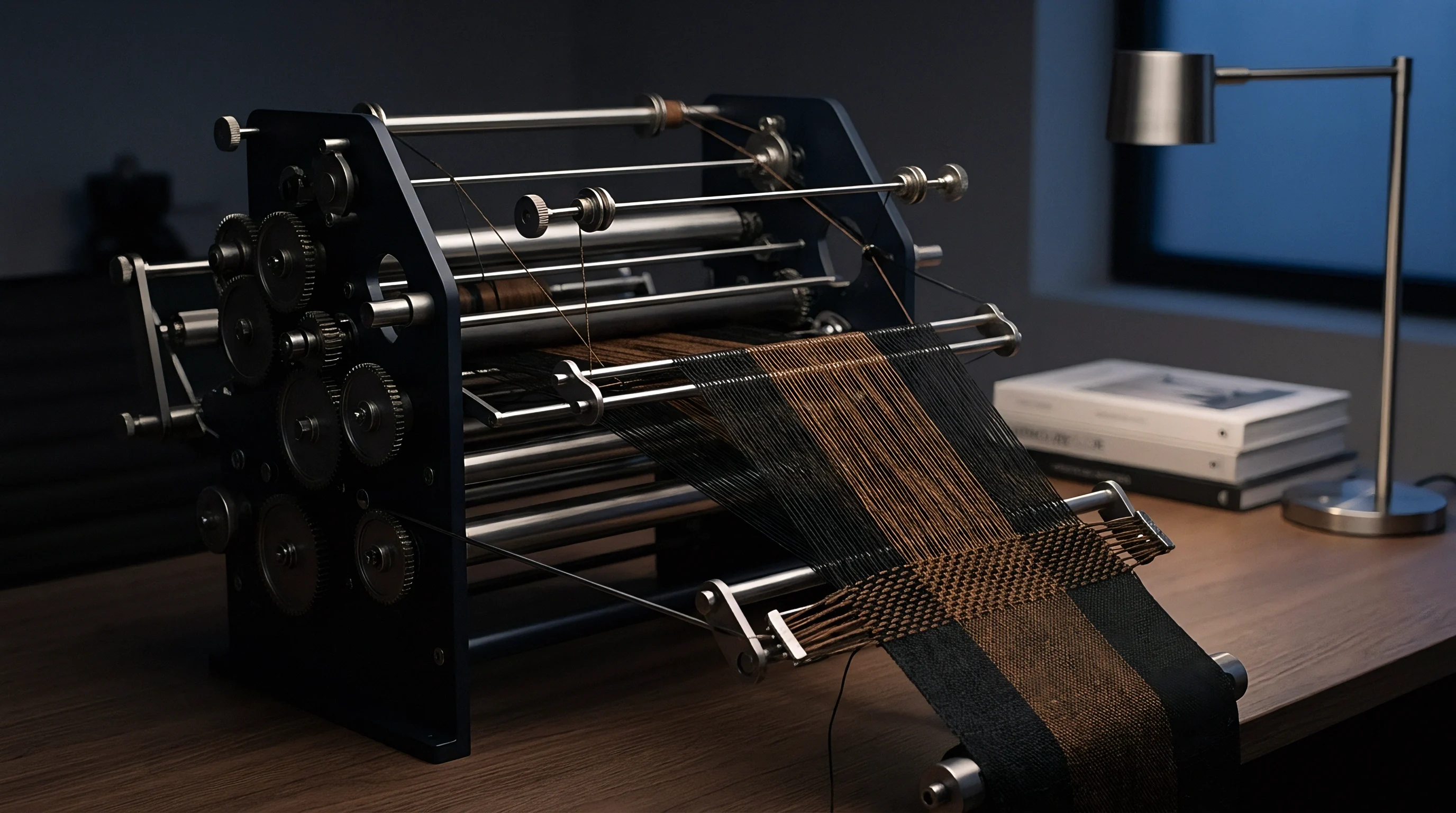
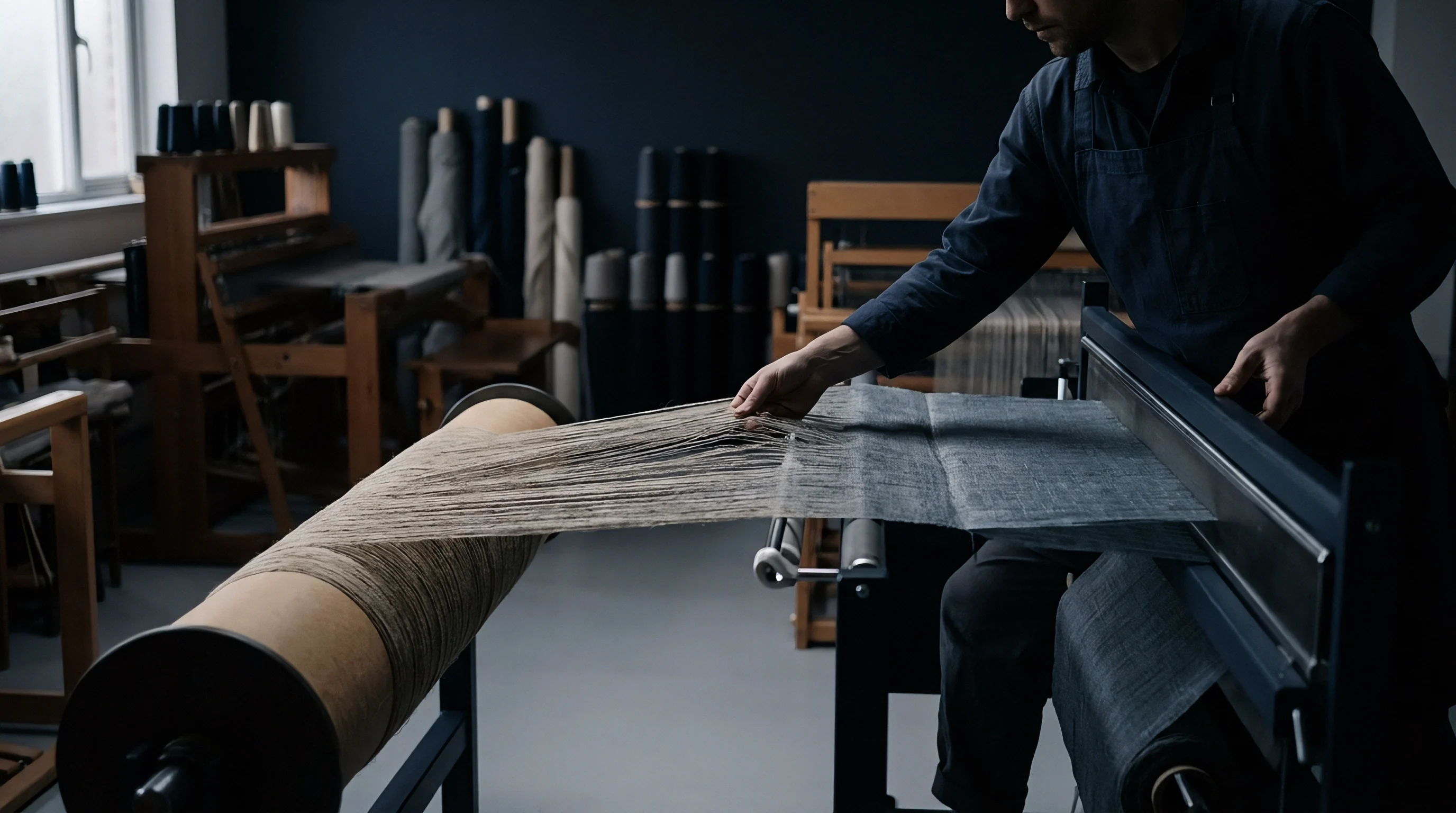
Bound
Setting clear technical quality thresholds keeps sub-standard greige cloth out of wet processing, where heat and chemicals worsen physical defects. Warp streaks and starting marks alter finished fabric performance, reducing tensile strength, tear resistance, and seam slippage resistance along the affected zones. Defining exact numerical tolerances in purchase contracts gives a clear legal ground for batch rejection or price adjustments.
Tensile strength drops sharply inside density fault zones. Standard ISO 13934-1 strip testing (50 mm specimens) shows that thin places in severe starting marks fail under loads well below specification. When a mark carrying only 9 picks per centimeter instead of 14 is placed under tension, stress concentrates entirely on the unsupported warp ends, causing early yarn rupture.

Tensile and Tear Resistance Reductions
Physical testing demonstrates clear performance losses in fabric containing structural defects:
Trouser tear testing under ISO 13937-2 highlights extreme sensitivity to reed marks. Because a reed mark creates a continuous line of reduced thread interlock where warp ends sit wider apart, tearing forces running along or across it require up to 35 percent less force to advance compared to uniform fabric. The lower yarn packing density prevents thread bundling, which would normally spread tearing forces across neighboring yarns.
Seam slippage testing under ISO 13936-1 measures warp end movement away from weft picks under a 100 Newton load. Along longitudinal reed marks, open dent gaps lower friction between warp and weft threads. As a result, seam opening displacement increases from a nominal 1.8 millimeters up to 4.2 millimeters along severe lines, exceeding the 3.0 millimeter limit set for apparel and upholstery.

Dye Absorbency and Optical Streak Thresholds
Finishing operations rarely hide density bars. Bleaching, mercerizing, and piece dyeing actually magnify mechanical variations through uneven dye liquor absorption. Flax fibers absorb dye via capillary action governed by fiber alignment and thread packing density.
In dense starting marks (thick bars), tightly packed threads restrict dye flow, leaving a lighter surface shade. In open thin marks, rapid liquor penetration produces darker local shading after drying.
Measuring color variation across starting marks relies on spectrophotometer analysis per ISO 105-J03. The CIELAB color difference formula yields a delta-E value comparing the fault bar against baseline fabric:
Delta E_ab = sqrt((L_1 – L_2)^2 + (a_1 – a_2)^2 + (b_1 – b_2)^2)
A delta-E exceeding 0.8 creates a visible color line under standard D65 daylight viewing. Severe starting marks on dyed linen often register delta-E values between 2.2 and 4.5, making the finished fabric unusable for color-critical garments.
Technical acceptance criteria require explicit limits during incoming greige qualification:
- Maximum Permissible Reed Marks cannot exceed two minor grade-1 lines per 100 linear meters, with zero tolerance for continuous grade-3 or grade-4 longitudinal streaks.
- Maximum Permissible Starting Marks must remain below three minor grade-1 events per 100 linear meters, with full rejection for any mark creating a post-dye shade shift above 1.2 delta-E.
- Minimum Strip Tensile Retained across any transverse stoppage bar must equal or exceed 90 percent of average batch tensile strength under ISO 13934-1.
- Maximum Seam Opening Displacement along longitudinal reed lines must not exceed 2.5 millimeters under a 100 Newton load per ISO 13936-1.
- Pick Density Variation Limit across any 10-millimeter section containing a restart line must stay within plus or minus 5 percent of nominal pick specification.
Direct measurement exposes structural flaws and gives tolerances legal force. Whether real-time camera inspection at the fell can dynamically adjust electronic let-off parameters during high-speed restarts remains a subject for ongoing mill trials.

Debit
Financial reconciliation converts physical inspection scores into monetary claims, price deductions, or mill chargebacks. Raw materials are the single largest cost in textile manufacturing, with high-quality wet-spun flax greige running between $4.50 and $9.80 per linear meter depending on construction, width, and weight. Sourcing teams must enforce strict penalty structures tied to standard inspection systems like ASTM D5430 to protect margins.
Inspection under the ASTM D5430 four-point system assigns penalty points based on defect length during unrolling. Flaws up to 3 inches (75 mm) receive 1 point; those between 3 and 6 inches (75 to 150 mm) get 2 points; between 6 and 9 inches (150 to 230 mm) receive 3 points; and defects over 9 inches (230 mm) get 4 points. Continuous longitudinal reed marks extending over multiple meters accumulate 4 points per linear yard or meter inspected.
Financial Impact of Defect Density
Tallying total penalty points per 100 square meters establishes the roll’s commercial grade. The standard formula computes points per 100 square meters:
Points per 100 sq m = (Total Penalty Points Assigned 10000) / (Inspected Roll Length in meters Fabric Width in centimeters)
A roll scoring under 20 points per 100 square meters rates as First Quality, qualifying for full invoice payment. Scores between 20 and 28 points classify the roll as Second Quality, triggering price allowances. Rolls scoring over 28 points face outright rejection, requiring full replacement by the mill plus reimbursement for freight and customs duties.
| Defect Dimension | Penalty Points Assigned | Greige Price Allowance (%) | Loom-Hour Chargeback Rate ($/hr) | Commercial Action |
|---|---|---|---|---|
| Length under 75 mm (Minor Stop Mark) | 1 Point | 0.0% | $0.00 | Accept at full price |
| 75 mm to 150 mm (Medium Stop Mark) | 2 Points | 2.5% | $12.00 | Deduct yardage allowance |
| 150 mm to 230 mm (Major Stop Mark) | 3 Points | 5.0% | $24.00 | Apply roll price discount |
| Over 230 mm or full-width bar | 4 Points | 10.0% | $48.00 | Credit note or reject roll |
| Continuous Reed Mark (per meter) | 4 Points (Cumulative) | 100.0% (Affected yardage) | $48.00 | Reject roll or full credit |

Calculating Loom Hour Loss and Allowances
Financial losses from loom stop defects extend beyond fabric replacement costs. When severe starting marks force roll rejection on a high-density linen order, the buyer loses booked loom capacity. Operating high-speed rapier looms runs $48.00 to $65.00 per loom-hour, covering depreciation, energy, direct labor, overhead, and shed humidity control.
Take a purchase contract for 5,000 linear meters of 220 g/m² 100 percent linen plain weave at $6.20 per meter, woven at 14 picks per centimeter on 190 cm looms running at 380 picks per minute. Total weaving output calculates as:
Production Speed = (380 picks/min 60 min/hr) / (14 picks/cm 100 cm/m) = 16.285 meters per loom-hour
Weaving this 5,000-meter batch takes 307 loom-hours. If uncorrected starting marks appear every 12 meters due to miscalibrated electronic let-off settings, the batch accumulates 416 major defect lines. Scoring each 4-point mark generates 1,664 penalty points across the lot.
Calculating points per 100 square meters for the 1.90-meter width yields:
Points per 100 sq m = (1664 10000) / (5000 190) = 17.51 points per 100 sq m
Commercial disputes over starting marks resolve quickly when loom event logs match greige inspection roll timestamps.
Defect scoring determines the final allowance. Although the overall score places the batch just under the 20-point rejection threshold, the frequent starting marks ruin cutting yield for garment production. Under standard sourcing terms, each 4-point starting mark deducts a 1.5-meter yardage allowance.
Across 416 marks, this allowance totals 624 meters ~ a credit value of $3,868.80 against the gross invoice of $31,000.00.
Clear stoppage compensation rules belong in every greige purchase contract. On high-density linen upholstery runs, accepting uncompensated starting mark clusters leads directly to a six percent scrap rate during post-dye cutting.