Modeling Viscoelastic Attenuation and Hydrodynamic Drag Kinetics in Ultra-Fine Flax Wet Drafting Troughs
Heating wet drafting bath fluid to 68°C balances pectin relaxation with hydrodynamic drag, stabilizing Nm 80 flax drafting tension below 0.12 N.
Trough
Wet spinning of long-staple flax relies on submerged thermal softening to attenuate dense fibre bundles into fine yarn counts. Unretted and dew-retted bast fibres arrive bound by a complex intercellular matrix consisting primarily of high-molecular-weight pectins, hemicelluloses, and residual lignin. In dry drafting, these inter-fibre bonds resist sliding, causing bundle fracture and high mass irregularity across the sliver.
Submerging the roving in a heated aqueous bath alters this dynamic by inducing a glass transition within the amorphous pectin matrix. Water molecules penetrate the middle lamella, breaking hydrogen bonds and lowering the activation energy required for inter-filament displacement.

Thermal Softening and Matrix Viscoelasticity
High-density pectin networks bonding individual elementary fibres undergo structural relaxation when exposed to hot liquid channels. Pectin relaxation governs bundle drafting. At temperatures below 50°C, the middle lamella remains rigid, causing high peak tension during roller drafting.
As liquid temperature increases toward 65°C to 70°C, the storage modulus of the pectin gel drops exponentially, shifting the material from an elastic solid to a viscoelastic fluid state. Viscous drag opposes fibre movement. This shift allows technical bundles to split into finer elementary filaments under longitudinal tension without breaking individual ultimate fibres.
The time-temperature superposition principle applies directly to this softening regime. Short residence times at high bath temperatures achieve the same matrix yield as extended dwell times at lower temperatures. Ultra-fine flax spinning frames operating at delivery speeds exceeding twenty metres per minute restrict roving bath residence time to under two seconds.
Warm water softens native pectin. Under these kinetic conditions, bath temperature must maintain strict thermal stability within a narrow tolerance band to ensure consistent attenuation before the roving enters the drafting nip.
Laminar fluid flow at 68°C reduces pectin relaxation time in long-staple flax roving to under 1.2 seconds during wet drafting.
Boundary Layer Fluid Dynamics
Immersion of running roving strands creates localized velocity gradients within the liquid bath. As the porous fibre bundle moves through stationary water, it drags a thin boundary layer of fluid along its surface. Fluid drag creates trailing tension.
The boundary layer thickness grows along the submerged length, increasing total hydrodynamic drag and altering the tension distribution within the unattenuated strand.
Fluid motion surrounding the moving bundle transitions from laminar to turbulent depending on line velocity, bundle surface hairiness, and fluid viscosity. In ultra-fine wet spinning, bundle diameters range from 0.3 mm to 0.8 mm. At these dimensions, boundary layer shear forces create a transverse pressure gradient that squeezes liquid out of the internal void spaces of the roving.
This internal fluid expulsion generates localized capillary forces that hold elementary fibres together, opposing the mechanical drafting force exerted by the front rollers. Trough heater vendors routinely claim that increasing bath agitation compensates for short residence times during high-speed drafting.
Drag
Movement of roving bundles through liquid bath zones generates resistant hydrodynamic shear forces along the strand perimeter. Hydrodynamic drag operates as both a stabilizing force and an attenuation barrier in wet drafting. Drag force supplies the necessary back-tension that holds the roving taut between the submerged guide pins and the drafting rollers.
Excess hydrodynamic drag overstresses the softened pectin matrix, causing premature strand thinning and uncontrolled end breakages.
Shear Stress and Boundary Resistance Calculations
Viscous forces acting on moving yarn strands scale directly with fluid viscosity and line speed. Navier-Stokes equations adapted for axial movement of cylindrical fibre bundles show that hydrodynamic drag per unit length scales with fluid density, strand velocity squared, and the skin friction coefficient. Shear stress scales with velocity.
For a smooth cylinder in parallel flow, the drag force density depends on the Reynolds number calculated from bundle diameter and fluid kinematic viscosity.
Fluid viscosity changes non-linearly with bath temperature and dissolved pectin concentration. As processing continues, dissolved pectins and added wetting agents alter the fluid from a Newtonian liquid into a weakly shear-thinning fluid. This shift reduces interfacial shear stress at elevated drafting speeds, modifying the expected pull force exerted on the unattenuated roving strand entering the drafting nip.
Attenuating Mechanics under Hydrodynamic Load
Tensile forces required to draw softened pectin bundles depend heavily on fluid drag friction. Attenuation occurs when the front drafting roller pair rotates faster than the back feed roller pair, establishing a draft ratio typically between 10 and 20 for wet-spun line flax. The total drafting force equals the sum of the mechanical sliding friction between elementary fibres and the hydrodynamic drag of the fluid entrained inside and around the bundle.
Strand tension spikes cause breaks. When hydrodynamic drag exceeds the internal cohesive strength of the softened pectin matrix, drafting becomes uncontrolled. The strand elongates viscoelastically before reaching the main drafting zone, creating local thin spots that pass into the final yarn as periodic count variations.
Worked Shear Stress and Tension Model
Processing an Nm 80 line flax roving at twenty metres per minute delivery speed provides a concrete case for fluid friction evaluation. Take an Nm 80 yarn spun at a draft ratio of 12 from an Nm 6.7 roving strand. The entry speed at the back roller equals 1.67 metres per minute, while the exit speed at the front roller reaches 20 metres per minute.
Assuming an immersion path length of 0.25 metres in a water bath held at 68°C with dynamic viscosity of 0.41 millipascal-seconds, fluid skin friction generates a cumulative drag force along the submerged length.
Using empirical drag calculations for submerged textile filaments, the total hydrodynamic drag force acting on the roving strand enters the draft zone at approximately 0.045 Newtons. Mechanical pull resistance from internal fibre cohesion contributes an additional 0.065 Newtons at 68°C. Fine yarns demand strict control. The combined tension reaches 0.110 Newtons.
If bath temperature drops to 50°C, fluid viscosity increases to 0.55 millipascal-seconds and pectin yield stress doubles, raising total strand tension to 0.185 Newtons. This tension excess exceeds the wet breaking strength of an Nm 6.7 softened roving strand, causing high end breakage rates.
| Yarn Target Count | Roving Linear Density | Delivery Speed | Hydrodynamic Drag | Cohesive Pull Force | Total Draft Tension |
|---|---|---|---|---|---|
| Nm 60 (16.6 tex) | Nm 5.0 (200 tex) | 18 m/min | 0.038 N | 0.082 N | 0.120 N |
| Nm 80 (12.5 tex) | Nm 6.7 (149 tex) | 20 m/min | 0.045 N | 0.065 N | 0.110 N |
| Nm 100 (10.0 tex) | Nm 8.3 (120 tex) | 22 m/min | 0.052 N | 0.048 N | 0.100 N |
Operating a wet drafting zone without hydrodynamic balance increases end breakage rates past ten per thousand spindle hours and ruins yarn tenacity across fine counts.

Slip
Inter-fibre displacement inside the drafting zone determines yarn mass uniformity and end breakage frequency. During wet drafting, elementary flax fibres, measuring 15 to 25 millimetres in length and 12 to 20 micrometres in diameter, must slide past each other smoothly. The softened pectin layer acts as a boundary lubricant.
Slippage occurs when the applied mechanical drafting force overcomes static friction between adjacent filaments within the technical bundle.
Inter-Fibre Displacement and Tensile Attenuation
Individual bast filaments separate from technical bundle clusters as the drafting rollers exert longitudinal pull. Cohesion losses increase sliver variance. In ultra-fine line flax processing, the goal is splitting large technical bundles down to isolated elementary fibres.
If the friction between filaments remains too high, bundles draft as single thick units, resulting in coarse, uneven yarn. If inter-fibre friction falls too low, the strand loses structural integrity and pulls apart under minimal line tension.
Shorter immersion limits thermal transfer. Slippage kinetics follow a non-linear velocity dependence. At low drafting speeds, stick-slip friction dominates, leading to periodic force oscillations.
At higher drafting speeds, hydrodynamic lubrication takes over, creating a continuous fluid film between sliding fibres that reduces force spikes and stabilizes strand attenuation.
Defect Modes Driven by Pectin Softening Deficits
Incomplete thermal breakdown of the middle lamella causes uncontrolled bundle surges during drafting. Uneven heat transfer across the roving cross-section leaves core fibres rigid while outer fibres soften. The drafting rollers pull the softened outer layers away from the stiff inner core, causing distinct physical defect modes on the spinning frame.
- Drafting waves ~ Irregular bundle sliding creates periodic thick and thin places across short lengths of attenuated strand when fluid temperature fluctuates beyond set limits.
- Stick-slip surges ~ Insufficient pectin softening causes sudden bundle acceleration and local strand snapping when static friction collapse releases stored elastic energy.
- Lequette accumulation ~ Excess liquid drag strips short fibres from the main core, forming wet slubs that lodge in the roller nip and cause yarn breaks.
- Splice pull-out ~ Weak wet cohesion allows pneumatic or manual roving splices to separate under hydrodynamic tension before entering the front drafting roll.
A ten-degree drop in trough temperature increases inter-fibre static friction by forty percent, triggering severe drafting waves in Nm 80 line flax.
Warmer immersion fluid always yields smoother attenuation than tight nip pressure on delicate line roving.

Flow
Fluid circulation geometry inside the bath directly impacts local temperature stability and drag uniformity. Troughs must supply continuous, non-turbulent liquid exchange along the entire length of the spinning frame. Stagnant fluid zones develop temperature gradients exceeding 5°C, creating variation in pectin softening between adjacent spindles.
Liquid flow profiles must sweep away dissolved pectins and short fibre fly without inducing surface waves that disturb running strands.
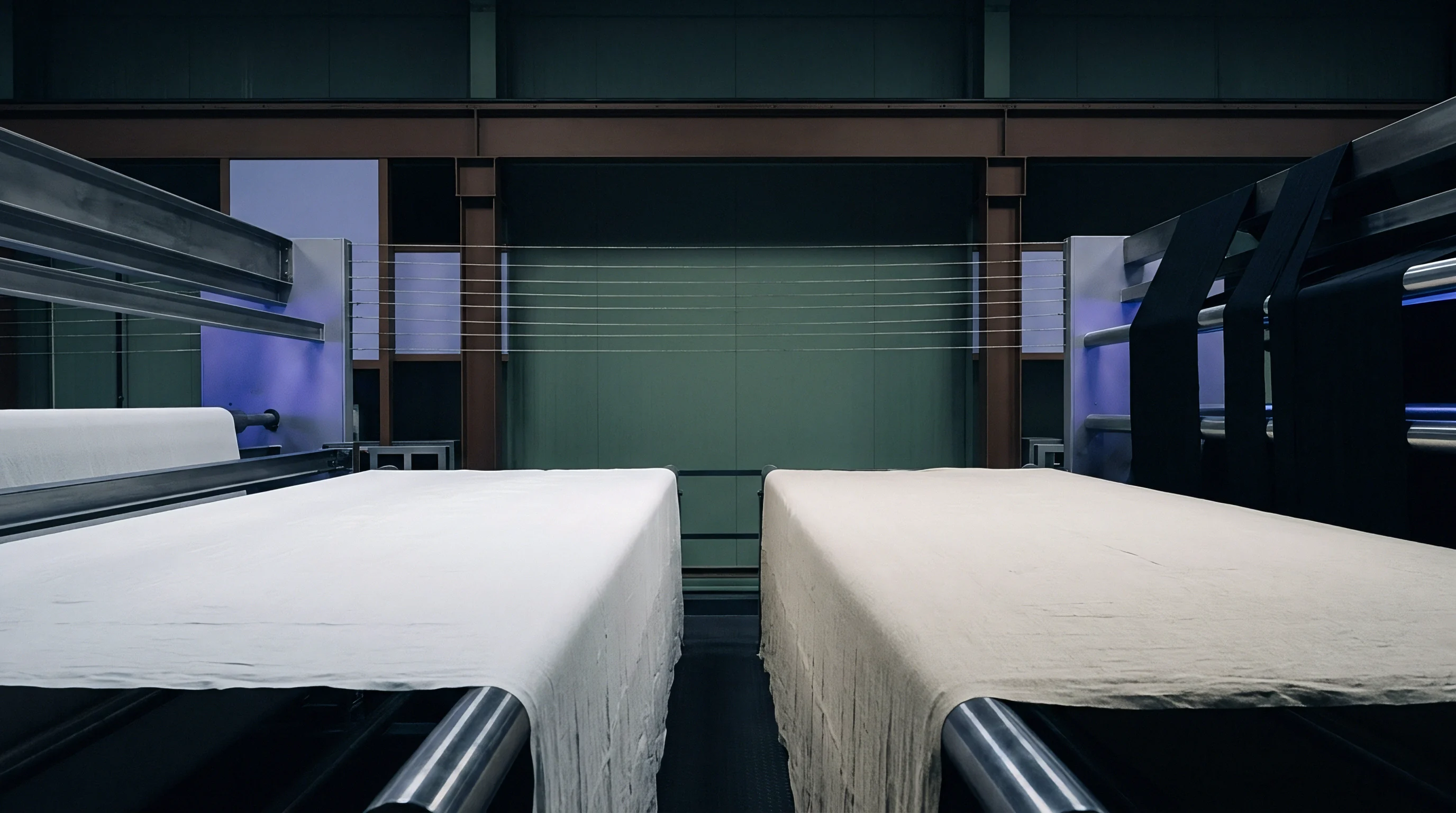
Submerged Guidance Geometry and Fluid Turnover
Stainless steel guide pins route the running strand through prescribed liquid depths before reaching the nip. Wet drafting sets final count. Pin orientation and immersion depth govern the exact contact length between fluid and fibre.
Submerged rollers reduce static friction compared to stationary ceramic pins, lowering entry tension into the drafting zone.
Laminar flow prevents bundle flutter. Recirculation pumps introduce fresh, heated water at the trough bottom, creating an upward displacement flow toward overflow dams at the rear. This continuous renewal prevents accumulation of dissolved pectin, which increases fluid viscosity and alters hydrodynamic drag over long production runs.
What Temperature Control Prevents Thermal Attenuation Drift?
Maintaining liquid bath temperatures between sixty-five and seventy degrees Celsius keeps middle lamella pectins sufficiently pliable for stable drafting. Temperature control systems use closed-loop heat exchangers equipped with proportional-integral-derivative controllers. Direct steam injection causes local thermal spikes and turbulence that disrupt strand geometry.
Indirect heat exchange through stainless steel trough jackets provides uniform heat delivery without introducing turbulent steam bubbles into the drafting path.
| Parameter | Target Range | Control Tolerance | Impact on Attenuation |
|---|---|---|---|
| Fluid Temperature | 68 °C | ± 1.0 °C | Governs pectin relaxation rate and matrix viscosity |
| Fluid Viscosity | 0.41 mPa·s | ± 0.03 mPa·s | Dictates hydrodynamic boundary layer drag force |
| Surfactant Concentration | 1.5 g/L | ± 0.2 g/L | Controls fluid penetration rate into dry roving bundle |
| Bath pH Level | 6.5 pH | ± 0.5 pH | Prevents premature chemical degradation of flax cellulose |
| Total Dissolved Solids | < 300 ppm | Max 500 ppm | Prevents mineral scale accumulation on guide rollers |

Standardized Operational Sequence for Trough Calibration
Line technicians follow five critical steps when verifying liquid bath mechanics prior to spinning high-count flax.
- Measure incoming bath fluid temperature at three submerged points using calibrated resistance thermometers.
- Adjust the submerged roller immersion depth to set the target path length through the liquid column.
- Verify pump displacement rates to maintain laminar circulation without surface turbulence.
- Sample attenuated sliver after five minutes of steady operation to audit linear mass uniformity.
- Log fluid electrical conductivity to detect accumulation of dissolved pectin and processing surfactants.
Process engineering audits require strict compliance with chemical dosage and fluid maintenance parameters to safeguard thread line integrity.
- Surfactant dosage ~ Non-ionic wetting agents reduce surface tension below thirty-two millinewtons per metre, accelerating fluid penetration into dense roving cores.
- Immersion depth ~ Guide roller position governs residence duration inside the heated liquid column, directly setting the degree of pectin matrix relaxation.
- Circulation velocity ~ Cross-flow pumping rates must stay under laminar threshold values to avoid strand vibration and mass periodicities.
Standard delivery terms under ISO 6741 specify a commercial moisture regain of twelve percent, altering the net billed weight when fluid residue remains unwashed during drying.
Yield
Final yarn linear density accuracy governs commercial value and mill margin during ultra-fine flax production. In fine counts such as Nm 80 to Nm 100, small variations in drafting force alter the final count by several percent, shifting yarn out of specified commercial tolerances. Pectin extraction alters liquid density.
Maintaining precise control over viscoelastic attenuation and hydrodynamic drag kinetics directly protects material yield and reduces costly spinning waste.

Linear Density Variation and Yarn Count Economics
Deviations in attenuated roving mass convert directly into costly off-spec yarn packages. ISO 2060 defines methods for determining yarn linear density from skeins under conditioned moisture equilibrium. Wet-spun flax yarns tested under ISO 2060 show direct correlation between trough temperature variance and yarn count coefficient of variation.
Fine line spinning generates waste. When trough temperature drops by 3°C, count CV percentage increases from 2.1% to 3.8% due to localized attenuation resistance. Off-spec yarn failing target count tolerances must be downgraded or sold at steep discounts, destroying profit margins on high-grade long-staple flax fibre.

Metre Cost Impacts of Drafting Breakage and Waste
Spinning frame end breaks consume expensive long-staple roving while generating non-recoverable hard waste. Each end break requires manual piecing, introducing local slubs or knot defects that reduce yarn quality under ISO 2062 tensile testing standards. High end-breakage frequencies lower overall frame efficiency, driving up energy, labor, and overhead costs per kilogram of finished yarn.
Uncontrolled hydrodynamic drag increases wet spinning end breaks by six per thousand spindle hours, adding three percent to net yarn manufacturing cost.
| Spun Yarn Count | Roving Input Cost | Frame Efficiency | Pneumafil Waste | Yarn Yield per Tonne | Net Metre Cost |
|---|---|---|---|---|---|
| Nm 60 (16.6 tex) | $12.50 / kg | 93.5 % | 2.8 % | 890 kg | $0.028 / m |
| Nm 80 (12.5 tex) | $16.80 / kg | 91.2 % | 4.1 % | 860 kg | $0.038 / m |
| Nm 100 (10.0 tex) | $22.00 / kg | 87.8 % | 6.2 % | 815 kg | $0.054 / m |
| Figures reflect long-staple dew-retted hackled flax line processed at 68°C trough temperature under standard operating conditions. | |||||
Whether real-time acoustic emission sensors can reliably detect micro-slippage before strand tension triggers a full end break remains an open industrial question.