Dynamic Optical Scanning Control of Ring Rail Motion for Real Time Tension Compensation
Dynamic optical rail control compensates for wet flax traveller friction in real time, suppressing tension spikes to lower fine count end breakage by over sixty percent.


Spool
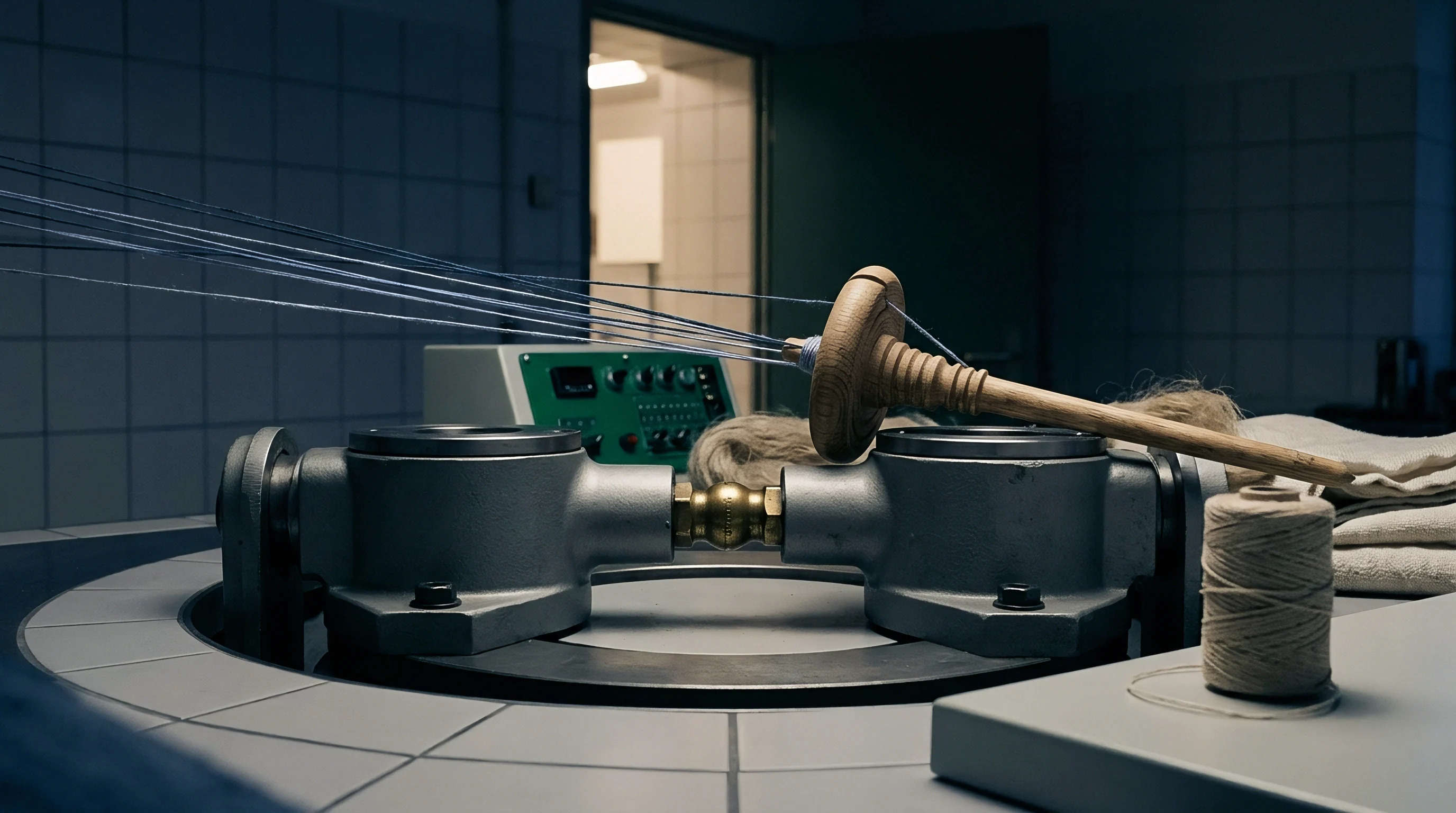
Mechanical Dynamics of Wet Flax Spinning Frames
In wet ring spinning of long-staple flax, yarn tension varies cyclically through every stroke of the ring rail. As the rail moves up and down the bobbin tube, the changing geometry of the yarn balloon alters the free yarn length between the thread guide eyelet and the traveller. Because flax fibres have low elongation at break ~ typically 1.5% to 2.5% ~ the process tolerates virtually no mechanical shock loads during cop building.
On wet-spun linen across counts from Nm 26 to Nm 80, winding tension peaks right at the chase shoulder, where traveller velocity shifts abruptly during rail reversal.
Traditional spinning frames drive the ring rail using fixed mechanical cams or open-loop electronic profiles. These systems assume traveller friction remains constant against the ring. In practice, hot water bath additives, dissolved pectins, and loose shive particles change traveller drag within minutes.
As friction climbs, tension spikes when winding on the small diameter of the bobbin nose, breaking ends whenever tension exceeds the tenacity of the wet fibre bundle exiting the drafting rollers.
Yarn tension variations exceeding 15% across a single chase cycle double the end-breakage frequency on fine long-staple wet spinning frames.
Package geometry determines the forces acting on the spinning line. The angle between the yarn segment and the bobbin surface tangent changes constantly from the main package diameter down to the tube nose. At smaller winding diameters, the shorter torque arm requires higher yarn tension to pull the traveller around the ring track.
Until drying and consolidation lock the strand, cohesion relies entirely on the temporary lubrication of the hot retting water.

Balloon Friction and Traveller Drag Vectors
Selecting traveller weight in flax spinning means balancing package density against end breakages. Too heavy a traveller pulls the balloon tight, packing the yarn tightly but snapping finer sections. Too light a traveller lets the balloon bow outward under centrifugal force, leading adjacent balloons to collide and creating hairy, slubbed yarn.
Along the nickel-plated ring surface, travellers reach peripheral speeds up to 30 metres per second. Frictional heating burns off synthetic finishes and leaves microscopic metal debris along the yarn path.
During high-count wet spinning, fibre debris gathers under the traveller foot. This buildup increases sliding friction, creating localized tension spikes that mechanical counterweights cannot absorb. To keep tension uniform at the traveller nip, the ring rail needs to adjust its vertical speed dynamically ~ slowing down during nose winding and speeding up along the base build.
| Chase Position | Winding Diameter (mm) | Yarn Speed (m/min) | Traveller Friction Coefficient | Mean Tensile Force (cN) |
|---|---|---|---|---|
| Base Build | 48.5 | 22.4 | 0.18 | 14.2 |
| Mid Chase | 36.2 | 21.8 | 0.21 | 18.6 |
| Nose Build | 22.0 | 20.5 | 0.28 | 27.9 |
| Reversal Apex | 21.5 | 18.2 | 0.31 | 32.4 |
Uneven wear along the ring track creates friction variations between adjacent spindles. Because fixed-speed drives treat all spindles the same, operators often slow the entire frame to prevent breaks at worn positions. Bales with variable fibre fineness exacerbate these tension spikes, forcing frequent manual intervention and raising yarn waste.
Overall, uncompensated mechanical rail drives increase doffing scrap and lower hourly yarn yield.

Scan
High-Speed Triangulation and Line-Scan Array Configuration
Optical sensing systems mounted on the ring rail monitor the spatial deflection of the yarn balloon directly above the traveller. High-resolution line-scan sensors track light reflected from the spinning yarn against a non-reflective shield. Solid-state laser diodes project a narrow sheet of light across the balloon path, sampling yarn position at frequencies up to 10 kilohertz.
By mapping the coordinates of the balloon envelope, the optics track width variations that mirror changes in yarn tension.
Deploying sensors on wet-spinning floors requires active optical protection. Airborne water droplets, dissolved flax waxes, and loose bast fibre fluff obscure unshielded lenses within hours. Pressurized air curtains sweep clean, dry air across the receiver window to stop liquid droplets from distorting the laser beam, while hydrophobic fluoropolymer coatings help the lens housings shed residual fluid.
ISO 2062 tensile testing confirms that continuous optical tracking prevents localized strand necking during high-speed bobbin formation.
Achieving adequate spatial resolution requires precise calibration against spindle centerlines. Sensor arrays calculate dynamic balloon radius from the shadow boundary cast by the revolving yarn line. When yarn tension spikes, the balloon radius contracts toward the spindle axis.
The control unit then compares this measured radius against a target envelope programmed for the specific yarn count and fibre grade.
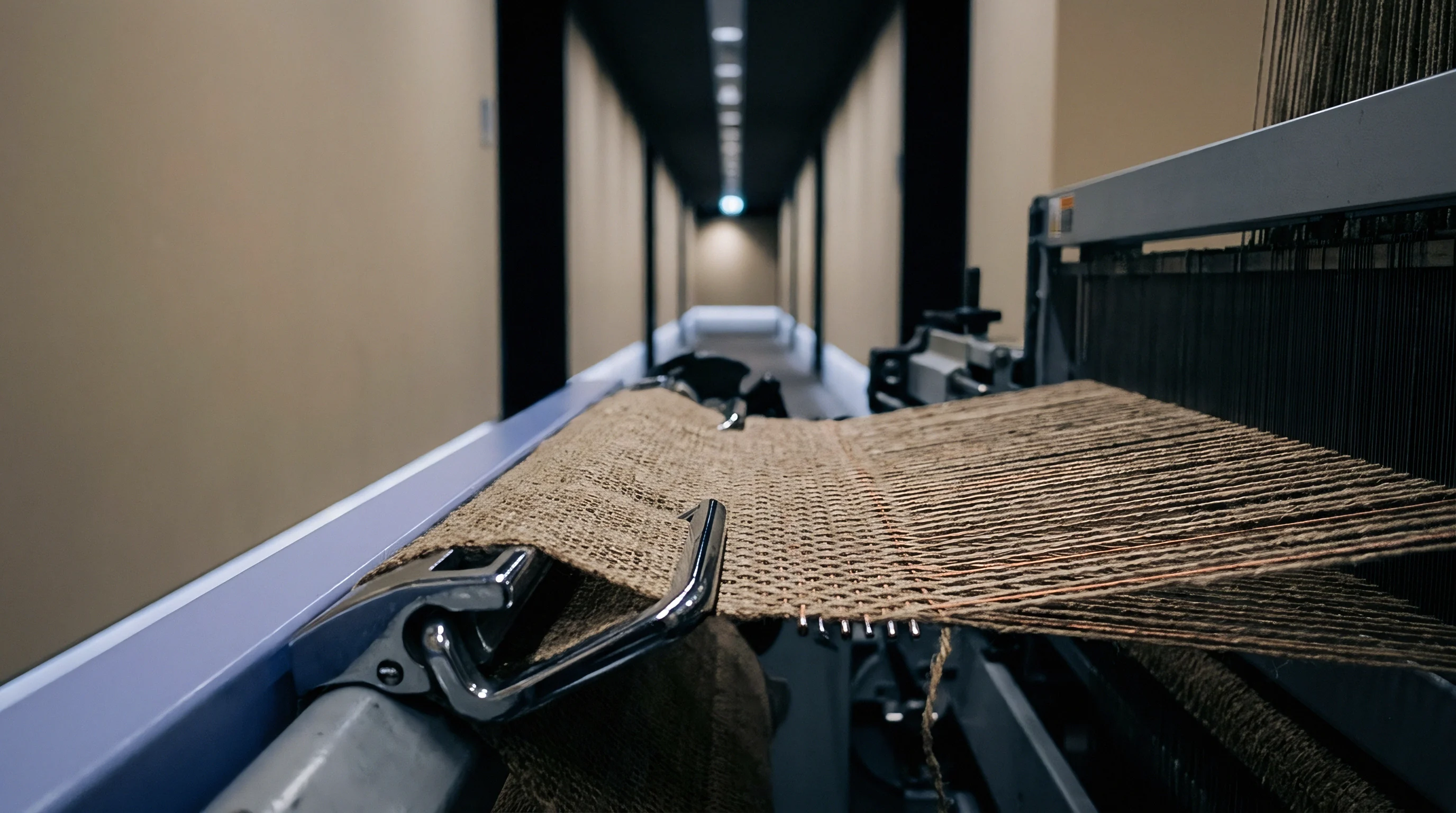
Sensors and Noise Filtering in High-Humidity Environments
Wet-spun flax rooms run at relative humidity levels above 70%, with continuous spraying from hot-water troughs. Droplets crossing the optical scanning field generate sharp signal spikes that look like sudden tension surges. Digital signal processors clear these raw image streams using moving-median spatial filters that ignore single-frame occlusions, separating real structural changes in balloon diameter from droplet noise before passing motion commands to the ring rail motor.
Fibre ends shedding from the yarn surface produce secondary high-frequency reflections. Low-pass Chebyshev filters strip out frequencies above the spindle’s maximum rotational speed. The resulting signal reflects the true geometric center of the strand, providing stable position inputs for real-time motion control.
- Optical transmitter selection requires narrow-band infrared laser diodes operating at 850 nanometers to avoid interference from ambient light.
- Receiver sensor arrays use linear CMOS image sensors with 2048 active pixels to achieve sub-millimeter resolution across the balloon arc.
- Signal processing units run FPGA algorithms to process pixel data within 100 microseconds of exposure.
- Enclosure design standards must meet IP67 ratings to protect receiver circuitry from fluid ingress during frame washdowns.
Dynamic optical control units maintain calibration by running automatic light intensity checks during doffing, when the yarn balloon drops out of view. Any signal loss from gradual misting triggers an automated air purge to clear the optical path before winding resumes. While physical line-scan sensors are often assumed to require excessive cleaning cycles, properly engineered positive-pressure air shrouds eliminate optical fouling across full production shifts.

Actuation

Closed-Loop Servo Drive Integration and Response Curves
Direct-drive servo motors replace traditional cam lifters, giving the ring rail independent, precise vertical control. The architecture links the optical processor directly to a high-bandwidth servo amplifier over a deterministic Industrial Ethernet bus. When sensors detect balloon contraction, the controller adjusts rail velocity within milliseconds, lowering the rail slightly to widen the balloon angle and ease traveller drag.
Acceleration profiles during rail reversal need careful shaping to prevent secondary tension oscillations in the package. Trigonometric jerk-limited curves smooth the transition as the rail halts its upward motion and begins to descend. The system uses dynamic lead-lag compensation to anticipate mechanical inertia in the lifting arms and counteract belt stretch when reversing direction.
- Calibrate baseline balloon envelope geometry across three full chase cycles using reference Nm 30 wet-spun yarn.
- Establish optical signal threshold limits corresponding to maximum allowable yarn tensile load limits derived from ISO 2062 break tests.
- Map motor drive torque output against optical balloon contraction measurements to define proportional-integral gain tables.
- Execute real-time rail velocity adjustments at 1-millisecond update intervals throughout the main package build phase.
- Engage localized micro-stepping acceleration at the chase shoulder to offset traveller frictional surges during direction reversal.
Precision ball screws or direct linear drives move the ring rail smoothly, eliminating the mechanical backlash of chain and pulley setups. Encoders mounted directly on the rail structure measure vertical displacement with sub-micron accuracy. The control loop constantly compares commanded position against encoder feedback, maintaining consistent movement along the full length of multi-spindle frames.

Dynamic Compensation Algorithms for Reversal Acceleration
At the tip of the winding chase, the ring rail must decelerate, reverse, and accelerate within less than two millimetres. Mechanical drives suffer noticeable velocity drops at these turnaround points, causing traveller lag and sudden tension spikes. Closed-loop servo control uses predictive velocity overrides, briefly boosting motor torque just before the reversal boundary to keep linear winding speed steady.
Variable speed profiling balances tension differences between an empty tube and a full package. As package diameter grows and average balloon height drops, the baseline tension curve shifts. The adaptive controller continuously adjusts its gain parameters, tailoring rail movement to the growing mass of the bobbin.
Smooth rail movement dampens structural frame vibrations that degrade yarn evenness on fine flax counts. Steady motion keeps traveller contact pressure uniform against the ring flange, extending traveller operating life and reducing burn-outs during high-speed runs.

Tension

Tensile Force Profiling and Tensile Strength Preservation
Real-time tension compensation directly improves the mechanical properties of the finished yarn. Continuous force monitoring keeps tension within a narrow window centered at 12% of the material’s mean breaking tenacity. Preventing sharp tension spikes stops microscopic fibre slippage inside the wet core, preserving strand integrity before drying locks the natural pectin bonds.
Consistent winding tension produces bobbins with uniform density from core to outer edge. This uniformity allows even fluid flow during subsequent dyeing or bleaching. By contrast, packages wound with uncompensated tension shifts develop tight, over-tensioned layers that resist dye penetration, resulting in streaky fabric.
Standardized package inspection per ISO 6741 verifies that optical rail control reduces internal density variance across wet-spun linen bobbins to under 1.8%.
Dark dew-retted flax fibres absorb far more light than water- or enzyme-retted stock, lowering the signal-to-noise ratio on standard optical receivers. High-output laser sources paired with adaptive gain amplifiers adjust sensitivity automatically based on baseline fibre reflectance, maintaining reliable balloon tracking regardless of retting method or batch shade.
| Yarn Parameter | Test Method | Fixed Mechanical Rail | Dynamic Servo Rail | Performance Shift |
|---|---|---|---|---|
| Mean Breaking Tenacity (cN/tex) | ISO 2062 | 14.8 | 16.9 | +14.2% |
| Tenacity Variation CV (%) | ISO 2062 | 13.5 | 8.8 | -34.8% |
| End Breakage Rate (Breaks/1000 sp-hr) | Mill Audit | 42.0 | 14.0 | -66.7% |
| Yarn Hairiness (H-Index) | UT5 Tester | 6.2 | 4.8 | -22.5% |
| Package Density Spread (g/cm³) | ISO 6741 | 0.38 – 0.52 | 0.43 – 0.46 | -78.5% |
Lower yarn hairiness comes directly from stabilizing balloon shape. With a stable balloon, centrifugal force cannot pull untwisted surface fibres away from the strand core. The resulting smooth, compact surface enhances the natural lustre of wet-spun flax, raising its value in high-end apparel markets.
End-Breakage Reduction across Fine and Coarse Wet-Spun Flax Counts
Cohesion limits vary significantly between low-twist coarse yarns and ultra-fine long-staple counts. Coarse yarns generate strong centrifugal balloon forces that pull hard against the drafting nip, while fine yarns carry fewer fibres in cross-section, leaving them vulnerable to sudden force surges. Optical tension control adapts sensitivity to yarn count, making rapid rail adjustments for delicate fine counts and broader dampening movements for heavy yarns.
Lower end-breakage rates noticeably improve labor productivity. Operators shift from piecing broken ends to overseeing larger frame banks, reducing labor overhead per kilo. Fewer piecings also mean fewer slubs and knots, which boosts downstream weaving efficiency on high-speed air-jet looms.
Commercial supply contracts typically specify strict limits on thin and thick places per 1000 metres under ISO 2060 testing. Implementing dynamic rail compensation provides the baseline process stability needed to meet these quality standards consistently.


Settlement

Commercial Yield Metrics and Waste Factor Reductions
Retrofitting a conventional frame with dynamic optical rail control shifts the economics of flax yarn production. High end-breakage rates produce unrecoverable waste: broken ends drawn into pneumafil collectors convert long line flax into low-value scrap that sells for a fraction of raw scutched flax. Cutting end breaks by two-thirds restores net yield, extracting more saleable yarn from every bale of hackled flax.
Fewer breaks also allow higher spindle speeds. Running a 400-spindle wet-spinning frame 12% faster boosts total output without using extra floor space or trough-heating energy, diluting fixed equipment depreciation across a larger volume of finished yarn.
Working capital requirements fall as winding scrap and soft waste shrink. Mills can lower raw fibre inventory while still meeting yarn delivery targets, freeing cash flow for plant modernization or energy projects. Accurate package building also reduces waste in downstream rewinding and warping.
Landed Yarn Cost Calculations per Kilo and Metre
Evaluating financial payback requires accounting for material losses, energy use, and labor efficiency. Consider a spinning unit producing Nm 39 long-staple wet-spun linen yarn. A baseline frame produces 1000 kilograms of yarn per day with raw hackled flax costing 8.50 EUR per kilogram, an end-breakage rate of 40 breaks per 1000 spindle-hours, and total process scrap at 5.5%.
Installing dynamic optical control lowers scrap yield to 2.2% while raising frame speed by 8%.
Direct material savings yield 280.50 EUR per frame daily by saving 33 kilograms of high-grade flax from becoming low-value scrap. The 8% speed gain adds 80 kilograms of finished Nm 39 yarn per day without additional operator labor. Over a 300-day operating year, net savings reach 108,000 EUR per frame against a retrofit cost of 38,000 EUR per frame.
These savings filter directly into fabric costs. A standard 150-gram per square metre plain-weave linen uses roughly 165 grams of Nm 39 yarn per linear metre at 150 cm width, accounting for loom take-up and warp waste. Cutting yarn manufacturing costs by 0.62 EUR per kilogram lowers fabric production cost by 0.102 EUR per finished metre at the loom state.
Whether lens degradation under hot-water trough spraying offsets these savings over a five-year horizon comes down to hardware maintenance. Seal failures and lens micro-scratching from cleaning rags present ongoing maintenance challenges. Balancing optical sensor replacement schedules against net yield savings requires multi-year reliability data that frame manufacturers rarely publish.