Establishing Elastic Strain Limits for Hydrolyzed Polyvinyl Alcohol Films on Fine Linen Warps
Polyvinyl alcohol sizing on fine linen warps must maintain elastic strain capacity above dynamic shedding peak strain to prevent brittle coating breakdown.

Shield
Flax fibers possess an unusually high initial Young’s modulus paired with an ultimate elongation at break rarely exceeding 2.0 to 2.5 percent. Sizing fine linen warps demands a protective polymer barrier capable of matching this inextensible substrate while accommodating cyclic tension spikes during high-speed shedding. Polyvinyl alcohol and related saturated synthetic polymers offer strong film formation, but their mechanical response depends heavily on the degree of macromolecular hydrolysis.
Hydrolysis Degrees and Film Crystallinity
Fully hydrolyzed grades with more than 98 mole percent vinyl alcohol units form dense, crystalline networks linked by extensive hydrogen bonding. When dry, these films provide high tensile yield strength but narrow failure strain. By contrast, partially hydrolyzed grades at 87 to 89 mole percent retain residual acetate side groups that disrupt chain packing, producing a more compliant matrix with greater elongation at lower tension.
During beat-up on high-modulus linen, the outer polymer film takes the brunt of abrasive contact against the reed wire. If the film yields plastically under running warp tension, micro-fissures develop across the yarn surface. Under dry room conditions, fully hydrolyzed films preserve their elastic integrity up to roughly 3.0 percent elongation, which covers the physical stretch envelope of fine flax singles without premature yield.
Fully hydrolyzed PVA at a 98 percent hydrolysis level exhibits a 3.2 percent elastic strain limit when measured at 65 percent relative humidity and 20°C.
Applying this formulation to fine linen requires strict mechanical control through the sizing line to coat the yarn evenly without damaging the core structure.
- Aqueous dissolution requires maintaining a thermal bath at 95°C for a minimum of 45 minutes under continuous high-shear agitation to fully hydrate crystalline regions.
- Viscosity adjustment controls size pickup by maintaining the sizing liquor temperature at 85°C, targeting an operational viscosity between 12 and 18 mPa·s.
- Immersion squeezing passes the fine linen warp through a dual-nip size box set to a uniform pneumatic pressure of 18 kN to drive polymer liquor past the outer fiber bundle boundaries.
- Cylinder drying modulates temperature profiles across successive drying cans from 110°C down to 70°C to manage film shrinkage without generating internal thermal stresses.
- Lease splitting separates cooked individual warp ends using smooth lease rods while the sizing film remains slightly pliable, preventing mechanical rupture of the outer polymer shell.
Moisture Sorption Mechanics in Flax Structures
Polyvinyl alcohol absorbs moisture directly from the weave-room air. Water acts as an internal plasticizer in the polymer network, swelling the matrix and lowering its glass transition temperature. When ambient relative humidity rises from 50 percent to 75 percent, the elastic modulus of a fully hydrolyzed film drops by more than half, accompanied by a substantial rise in ultimate strain capacity.
When ambient humidity drifts beyond operating windows on warps sized with an unsuitable hydrolysis ratio, the yarn either sheds excessive size deposit or breaks outright, resulting in severe loom downtime across the weaving floor.
Grip
Sized yarn performance rests on the physical bond formed between the synthetic film and the flax fiber surface. Flax fibers are irregular, marked by cross-nodes as well as residual surface waxes and pectins, so the size liquor must penetrate and mechanically lock into these surface crevices to maintain structural continuity.
Interfacial Anchorage on Linen Nodes
Liquid wetting sets the initial contact area before drying. Fully hydrolyzed polyvinyl alcohol has high surface energy, requiring tight temperature regulation in the size box to lower surface tension and encourage penetration into yarn capillary channels. Without adequate interfacial grip, the polymer sleeve shears off the core yarn under the impact of the reed, leaving raw flax fibers exposed to metal abrasion.
| PVA Hydrolysis Grade (mole %) | Plasticizer Ratio (Glycerol %) | Tensile Yield Strength (MPa) | Elastic Strain Limit (%) | Interfacial Shear Stress (MPa) |
|---|---|---|---|---|
| 99.0 (Fully Hydrolyzed) | 0.0 | 68.5 | 2.8 | 14.2 |
| 99.0 (Fully Hydrolyzed) | 5.0 | 52.1 | 3.9 | 11.8 |
| 88.0 (Partially Hydrolyzed) | 0.0 | 41.3 | 5.4 | 8.6 |
| 88.0 (Partially Hydrolyzed) | 5.0 | 30.7 | 8.2 | 6.1 |
Plasticizer Plasticity and Fiber Adhesion
Polyols like glycerol or diethylene glycol modify inter-chain hydrogen bonds in the size mix. Dosing glycerol at 3 to 8 percent on dry PVA weight relieves internal shrinkage stress as water evaporates, preventing the drying film from pulling away from fiber nodes during winding and beaming.
Contractual specifications under ISO 13934 establish baseline breaking force standards that mandate isolated testing of sized yarn elastic recovery before loom mounting.
Dynamic weaving subjects this bond to multiple mechanical stresses that degrade the interface if size parameters drift out of specification.
- Shear delamination occurs when the axial elongation of the linen core exceeds the elastic limit of the outer sizing coating, causing clean detachment along smooth fiber surfaces.
- Adhesive skinning arises when residual surface pectins prevent complete chemical wetting, allowing the sizing sheath to roll back into dense pills behind the reed.
- Transverse splitting develops under high harness lift angles where radial squeezing forces crack brittle, fully hydrolyzed films lacking sufficient internal plasticization.
- Brittle flaking manifests in low-humidity environments when unplasticized PVA film loses bound moisture and fractures into microscopic debris during shedding cycles.
How far can plasticizer modification increase film strain capacity before interfacial shear strength drops below the minimum threshold needed to prevent shedding abrasion?


Stretch
High-speed rapier weaving subjects sizing films to severe cyclic strain. The warp maintains a steady baseline tension punctuated by sharp peak extensions each time the harness frames separate to form the shed for weft insertion.
Dynamic Load Distribution in Shedding
Rapier looms running at 500 picks per minute produce strain cycles that last only milliseconds. At these rates, the viscoelastic size film responds much more stiffly than it does during standard static tensile tests. This dynamic stiffening depresses the practical elastic strain limit, narrowing the usable window for warp tension settings.
Sizing film elasticity must equal or exceed the peak geometric strain imposed by shed opening to prevent permanent structural deformation of the protective matrix.
What Strain Threshold Precipitates Irreversible Sizing Film Micro-Fracturing?
Micro-fracturing in fully hydrolyzed polyvinyl alcohol begins at the yield point where elastic deformation gives way to plastic flow. For an unplasticized 99 percent hydrolyzed film at 65 percent relative humidity, that transition occurs at roughly 3.0 percent axial strain. Stretching past this threshold creates permanent crazing in the polymer network and compromises its protection against reed abrasion.
Safe tension limits must account for both yarn properties and loom mechanics before a batch is cleared for the floor.
- Target water absorption rate balances polymer film flexibility against atmospheric moisture sensitivity across seasonal shedding temperature swings.
- Maximum geometric shed lift defines the absolute peak strain percentage imposed on the top and bottom warp sheds during shedding frame movement.
- Minimum film yield stress dictates the necessary load resistance required to prevent permanent plastic necking of the sizing under peak beat-up force.
- Permissible add-on weight range establishes the physical coating thickness boundaries needed to guarantee encapsulation without over-stiffening the warp yarn structure.
Keeping the film’s elastic reserve slightly above the maximum geometric shed strain ensures unbroken warp protection throughout the weaving run.

Scale
Measuring elastic limits requires testing both unsupported cast films and sized single ends. Standard protocols use precise cyclic load-unload routines on tensile testers to separate true elastic recovery from viscoelastic creep.
Bench Verification of Film Strain
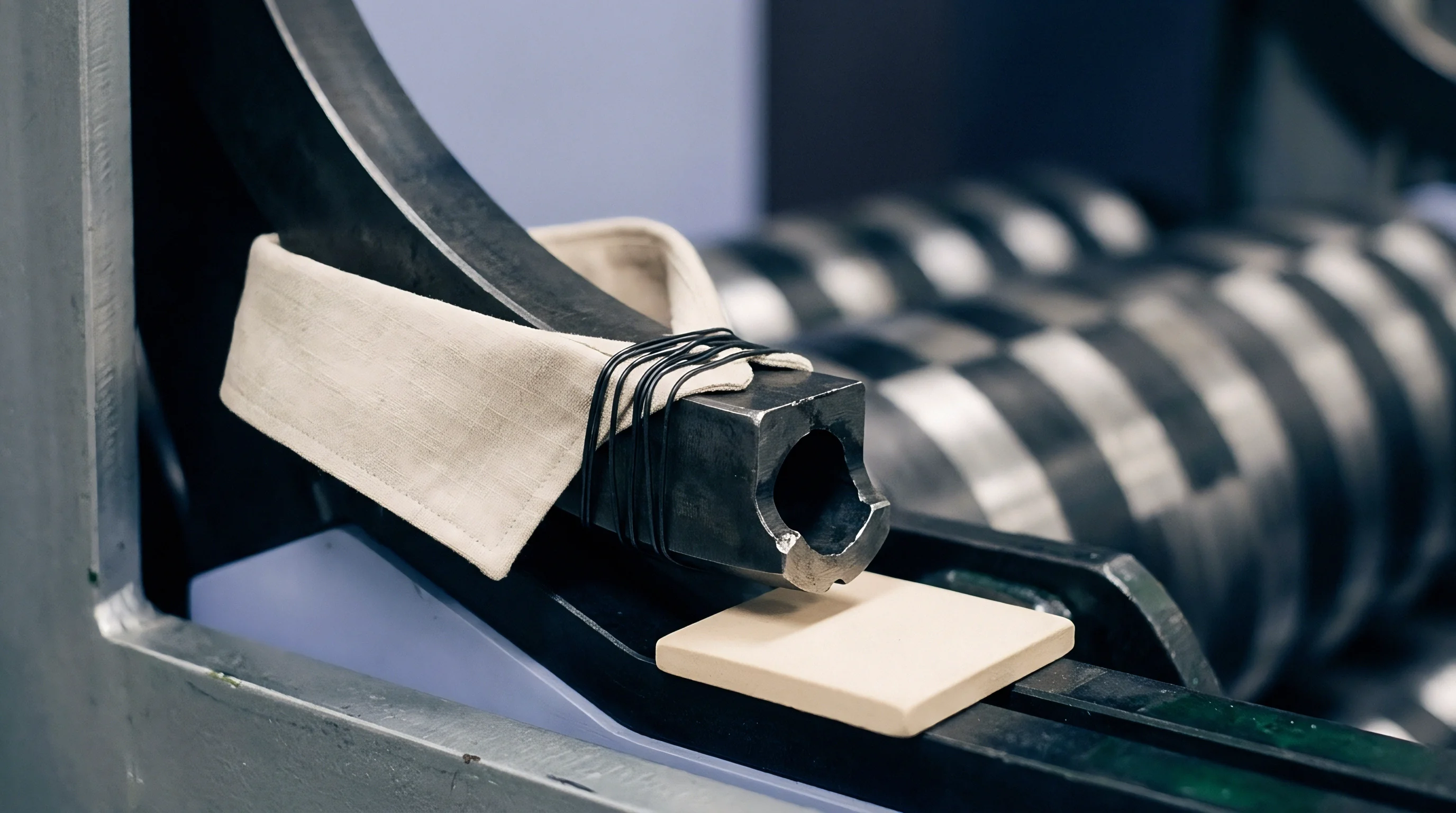
Cast films between 0.05 mm and 0.10 mm thick are tested under ASTM D882 at a 100 mm gauge length, using crosshead speeds scaled to match loom strain rates. The elastic limit is identified where the stress-strain trace departs from linearity, verified through progressive cyclic loading until residual strain appears on release.
| Add-On Weight (%) | Film Modulus (GPa) | Elastic Recovery at 2% Strain (%) | Warp End Breaks per 100k Picks | Loom Efficiency (%) |
|---|---|---|---|---|
| 6.0 | 1.85 | 94.5 | 12.4 | 88.2 |
| 8.5 | 2.10 | 91.2 | 4.1 | 95.6 |
| 11.0 | 2.35 | 86.7 | 3.8 | 96.1 |
| 13.5 | 2.60 | 79.4 | 9.6 | 91.4 |

Standardized Tensile Protocol Executions
Single-yarn tensile tests under ISO 13934-1 require a 24-hour conditioning period at 20°C and 65 percent relative humidity. Sizing increases the initial tensile modulus of fine linen while reducing elongation at break relative to greige yarn. When add-on exceeds 11 percent by weight, the yarn turns overly rigid, lowering the composite elastic limit and triggering clean breaks at harness lift.
Bench verification relies on cross-referencing measured yield strain against the construction guidelines in ISO 7211, where warp delivery limits correspond to certified tensile stress boundaries.
Margin
Mill margins on fine linen depend on keeping warp stops low to protect loom efficiency and reduce operator interventions. Size formulation directly drives the stop-rate assumptions behind loom-hour costing.
Loom Efficiency and Stop Rate Economics
A single warp break on a modern rapier or air-jet loom consumes one to three minutes of downtime. On fine linen running at 500 picks per minute, exceeding 5 stops per 100,000 picks pulls efficiency below profitable levels. Size films that remain within their elastic strain envelope resist progressive fatigue and keep stop rates stable across long beams.
Balancing add-on chemistry against loom efficiency requires systematic floor trials.
- Sample three greige warp bobbins per lot to establish baseline yarn tensile limits, elongation at break, and moisture regain.
- Formulate trial PVA bath recipes varying hydrolysis levels between 88 percent and 99 percent to map exact viscosity behavior.
- Process trial warps through the sizing machine, continuously logging size box temperature, squeeze roll pressure, and dry can heat profiles.
- Measure real sizing add-on percentages using desizing wash-off protocols per ISO 2060 standards to verify coating density.
- Mount sized beams onto rapier looms equipped with continuous stop-motion data logging to track end-break frequencies over 50,000 pick increments.
- Select the final sizing formulation that yields the lowest end-break rate while remaining within calculated elastic strain safety margins.
Add-On Cost and Capacity Allocation
Polyvinyl alcohol is a primary cost driver in warp preparation, with fully hydrolyzed grades priced higher than partially hydrolyzed types or modified starches. Applying excessive add-on to offset inadequate film elasticity wastes chemical and increases water and energy loads during subsequent desizing operations.
Matching the film’s elastic limit to peak shedding strain allows mills to maintain target running speeds, lower stop frequencies, and preserve fabric construction standards without over-consuming sizing chemicals.