Linen Warp Preparation Fundamentals for Textile Mill Operations
Linen warp preparation demands high-precision tension control, customized starch-PVA sizing, and late loom shedding to overcome flax brittleness and stops.
Spindle
Warp Package Density and Payoff Behavior
Loom stops in linen processing trace straight back to package build geometry on the winding frame. Wet-spun flax yarn has an irregular cross-section, low yield strain between 1.5% and 2.5%, and no elastic recovery whatsoever. Cross-wound packages running on automatic winders require a steady winding tension between 30 cN and 45 cN for an NeL 24 count (69 tex; Nm 40).
A package built with a soft flank will slough off multiple wraps during rapid creel acceleration, lodging thick coils behind the cone adapter. Hard wind profiles, on the other hand, crush the inner paper cones and cause erratic unwinding tension that shows up as tight warp ends in the finished cloth.
Flax running on modern winders requires grooved-drum or individual electronic traverse guides set to a winding angle between 12 degrees and 15 degrees. This steep angle eliminates pattern ribbons and diamond distortion on the package face. Splicing linen requires pneumatic cycles with water injection.
Mechanical knots create tension spikes as they pass through heddle eyes and reed splits, snapping adjacent ends through friction. Under a burst of demineralized water at 0.5 MPa to 0.6 MPa, compressed splice strength in wet-spun linen reaches 75% to 85% of parent yarn tenacity. Dry splicing leaves less than 45% retained strength, leading to sudden warp failures at the lease rods during slashing.
Tensile retention in spliced wet-spun flax falls below half of parent yarn strength when pneumatic splicing chambers operate without metered liquid injection.
The moisture content of packages entering the warping creel controls the modulus of the running ends. Wet-spun linen yarn stored below 60% relative humidity loses its natural flexibility, driving up unwinding tension variations by up to 40%. Conditioning rooms are maintained at 65% to 70% relative humidity and 20 degrees Celsius for at least a 48-hour dwell window.
This equilibrium period stabilizes package weight and stops uneven balloon collapse during fast creel payoff. Mill managers check package core temperatures and moisture regain using electrical resistance probes before moving trolleys to the warping floor.
| Count (NeL / tex / Nm) | Winding Speed (m/min) | Winding Tension (cN) | Traverse Angle (deg) | Package Density (g/cm³) | Splice Air Pressure (bar) |
|---|---|---|---|---|---|
| NeL 14 / 118 tex / Nm 24 | 650 to 800 | 50 to 65 | 14 to 16 | 0.38 to 0.42 | 6.5 |
| NeL 24 / 69 tex / Nm 40 | 750 to 950 | 35 to 45 | 13 to 15 | 0.35 to 0.39 | 6.0 |
| NeL 36 / 46 tex / Nm 60 | 800 to 1100 | 22 to 30 | 12 to 14 | 0.32 to 0.36 | 5.5 |
| NeL 50 / 33 tex / Nm 85 | 700 to 900 | 15 to 20 | 12 to 13 | 0.30 to 0.34 | 5.0 |
Flax packages wound on conical bobbins need nose accelerators to tame the whip tension created as yarn clears the package head. In dry-spun yarns, long fiber bundles uncurl and create heavy fly contamination, leading modern preparation departments to isolate winding bays behind high-velocity air-wash filtration booths. If lint builds up inside creel tension discs, the resulting pinch pressure spikes and snaps fine warp ends before they reach the collecting v-reed.

Creel

Section Warping Geometry and Cone Density
Direct beam warping works for heavy flax canvas, but high-density dress linens and shirting damasks require section warping to manage pattern layouts and short dye lots. Flax has no stretch. Section warping tables therefore need rigid drums and micro-step traverse drives that can track winding build within 0.01 mm.
Selecting the cone angle comes down to the yarn packing coefficient; standard angles of 9 degrees to 11 degrees prevent section collapse during side-traverse movement. If the incline is too shallow, each layer slips down the slope and creates pinched ends that break during final beam winding.
Traverse rate calculations determine thread alignment along the cone face. The lateral shift per drum revolution must match yarn count, sett, and compaction density. Carriage feed per revolution follows yarn diameter calculations adjusted for packing density:
Carriage Feed = (1 / (Ends per cm Layer Density Factor)) tan(Cone Angle)
For NeL 24 yarn with an apparent diameter of 0.28 mm running at 28 ends per centimeter, the layer density factor falls between 0.88 and 0.92 under 25 cN of end tension. Any variation in drum speed alters centrifugal tension, flattening the cone face and creating longitudinal tension bands across the woven web. Section warping speeds for pure linen top out between 400 m/min and 600 m/min ~ much slower than speeds used for continuous filament or combed cotton.
A drum-traverse variance exceeding two hundredths of a millimeter per band revolution produces barre lines across the entire finished fabric face.
Creel braking relies on collective pneumatic control tied directly to the drum stop-motion. When an end breaks at the section v-reed, the drum must stop within 1.5 to 2.0 meters of yarn travel to keep the loose end on the outer circumference. If the drum overruns, the broken end winds under adjacent bands, forcing manual searches that disrupt beam tension.
Individual stop motions use infrared optical sensors or drop-wire switches calibrated to a 3 cN trip force to catch breaks right away.
Beaming-off transfers the wound bands onto a single production warp beam, an operation that demands steady radial torque control. As the beam diameter grows from a 200 mm core up to an 800 mm or 1000 mm flange, winding tension must hold steady or taper down by 5% to 8%. A flat radial build prevents inner layers from crushing.
Excessive winding pressure during beaming-off compresses underlying wraps, altering yarn crimp and leaving tight streaks through weaving.
Unequal band tensions create width-wise tightness gradients that show up only after the fabric exits the loom take-up roll.

Liquor
Sizing Formulations and Chemical Pick-Up
Sizing linen warps serves two purposes: binding loose surface fibers into the yarn core and increasing breaking tenacity through mechanical cohesion. Cotton relies on a porous, convoluted lumen to absorb size, but wet-spun linen has a smooth, highly crystalline cellulose surface held together by residual pectins. Standard unmodified corn or potato starches cannot grip this dense surface.
Mill formulations instead use low-viscosity oxidized or hydroxyethylated potato starches combined with synthetic adhesion promoters ~ mainly polyvinyl alcohol (PVA) at medium hydrolysis rates (88% to 92%) or water-soluble carboxymethyl cellulose (CMC).
Liquor solids concentration runs between 8% and 12% by weight, set according to target dry size add-on. Lightweight linen shirting (NeL 36 to NeL 50) runs with 7% to 9% dry add-on, while heavier apparel or upholstery fabrics (NeL 14 to NeL 24) work best between 5% and 7%. Too much size turns brittle linen yarn into a stiff rod that fractures as it passes over the loom whip roll.
Too little leaves surface pectins exposed, allowing fibers to peel into clumps that clog drop wires and heddle eyes.
| Component Role | Chemical Compound | Concentration (g/L) | Size Box Temp (°C) | Viscosity (mPa·s / 85°C) |
|---|---|---|---|---|
| Primary Binder | Oxidized Potato Starch | 60 to 80 | 85 to 90 | 35 to 55 |
| Adhesion Booster | Partially Hydrolyzed PVA | 20 to 35 | 85 to 90 | 45 to 70 |
| Film Modifier | Carboxymethyl Cellulose | 10 to 15 | 80 to 85 | 25 to 40 |
| Softener/Lubricant | Sulfated Tallow Fatty Acid | 4 to 7 | 85 to 90 | N/A |
| Penetrant | Ethoxylated Alcohol Derivative | 1 to 2 | 85 to 90 | N/A |
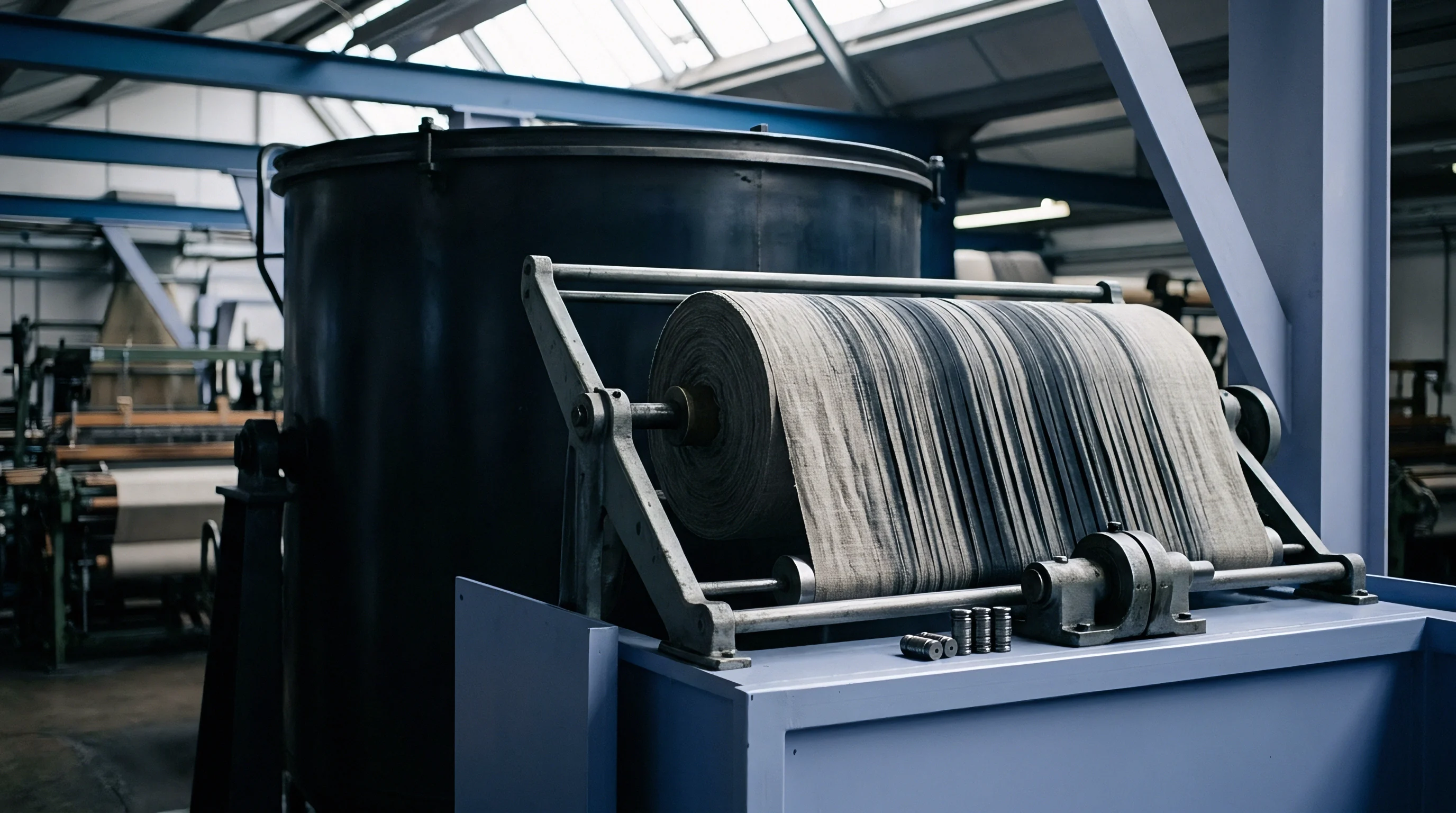
Squeeze roll setup controls how evenly liquor is absorbed across the warp width. Dual-box arrangements prevent crowding when warp density exceeds 3500 ends. Squeeze pressures are held between 15 kN and 25 kN using synthetic rubber covers rated at 65 to 70 Shore A hardness.
Rollers that are too hard crush the thick nodes along the flax stem, creating micro-cracks that lead to localized splits. Overly soft rollers give uneven penetration, leaving the center of the warp wet and over-saturated.
Viscosity control requires inline rotational viscometers alongside automatic dilution and temperature loops. If the size box temperature drops below 80 degrees Celsius, retrogradation sets in, forming thick gel skins that cling to the yarn as irregular lumps. When dry, these lumps turn into hard beads that shear warp threads at the reed during insertion.
Trough

Moisture Targets and Cylinder Drying Dynamics
Drying linen warps requires careful thermal control so the natural pectin network does not break down. Under tension, flax cellulose crystallizes and loses plastic elongation if heated past critical limits. Slasher dryers generally use a stack of eight to twelve Teflon-coated cylinders with steam pressures stepped down along the path: initial wet cylinders operate at 0.15 MPa to 0.20 MPa, mid-zone cans run at 0.25 MPa, and cooling cylinders at the exit run below 0.10 MPa.
Target residual moisture on linen warp beams sits between 7.0% and 8.5%. Drying below 6.0% makes fibers brittle, quadrupling warp breaks on the loom as flexural resilience drops. Exiting the dryer above 9.5% moisture causes mildew in stored warp beams and leads to cold adhesion between neighboring ends.
Sensors mounted across the delivery head ~ microwave or high-frequency ~ link directly to slasher drive speed to regulate drying.
Slasher operating speed ranges from 25 m/min to 45 m/min depending on warp density and available drying surface. Wet-zone tension between the size box squeeze rolls and the first cylinder must stay under 1.5% elongation. Because linen cannot recover from stretch under draft, over-stretching wet yarn permanently robs the fiber of its remaining weaving elasticity.
Splitting threads at the lease rods is a critical point on the slasher head. As size dries, it forms starch bridges between adjacent yarns, and separating them across split rods subjects the fibers to heavy flexural stress. Rod diameters should step down gradually, from 60 mm ~ 80 mm down to 25 mm ~ 35 mm.
Polished, low-friction chrome rods minimize surface peeling during break-out.
Ignoring the natural moisture equilibrium of bast fibers inevitably leads to constant end breaks across the harness.
Harness
Denting, Drop Wire Selection, and Loom Geometry
Harness preparation sets up the sized beam for actual shed formation. Because wet-spun flax is stiff, drop wires, heddles, and reed dents need specific profiles to reduce friction as the shed opens and closes. Drop wires for automatic warp stop motions must be weighted to match yarn count: 0.7 grams to 1.1 grams for NeL 36 to NeL 50, and 1.4 grams to 2.1 grams for NeL 14 to NeL 24.
An overly heavy drop wire drags the yarn line down, rubbing against adjacent ends. A wire that is too light will not drop cleanly through fuzzy size clusters when an end breaks.
Heddle selection favors flat steel with nickel-chrome finishes or duplex designs with wide, rounded eyes. Eye length needs to be three to four times the yarn diameter to prevent pinching during harness lifts. Twisted-wire heddles should never be used on linen warps; their rough solder joints strip size film and shear off linen slubs.
- Mechanical inspection ensures heddles slide freely across support frames, checking eye alignment and confirming guide surfaces are completely burr-free.
- Drawing-in sequence runs via automated optical threading heads or precision manual frames, matching draft patterns to harness distribution so yarn friction remains equal across frames.
- Drop wire pinning places four to six contact bars across the depth of the rear loom frame, staggering wires across separate banks to prevent them from catching on each other.
- Reed denting plan spaces ends through stainless steel air-jet or rapier reeds, avoiding tight denting patterns that cause severe friction during beat-up.
- Drop-box alignment verifies warp sheet clearance through lease bars and back-rest rollers, preventing scuffing before ends reach the harness eyes.
Reed denting density should keep yarn occupation below 45% to 50% of the space between dents. For an 18-ends-per-centimeter fabric in NeL 24 linen, a 90/10/2 denting plan (9 dents per centimeter, 2 ends per dent) leaves a 48% metal-to-space ratio with a 0.55 mm wire thickness. Crowding three or four linen ends into one dent causes heavy friction where threads cross, generating broken filaments that build up behind the reed during beat-up.
A reed air-space ratio below forty percent cuts flax warp fibers at the fell through repetitive lateral pinches during beat-up.
Shedding requires asymmetric timing on linen looms. Early shed timing, where the harness crosses before beat-up, distributes tension unevenly and strains the raised harness sheet. Linen requires late shed timing, crossing between 340 degrees and 355 degrees of the loom cycle.
This protects warp elongation, lowers peak beat-up forces, and allows clean pick insertion without catching loose bast fibers in the shed.
Yield

Loom Stops, Weft Insertion, and Capacity Audits
Loom performance on linen directly reflects the quality of warp preparation. Rapier weaving machines are standard for pure linen warps, operating at 350 rpm to 550 rpm depending on width and yarn uniformity. Projectile looms handle wide bed sheetings over 330 cm, while air-jet insertion is limited to uniform, combed, long-staple yarns because loose fibers quickly clog jet nozzles.
High-efficiency mills keep warp stops below 1.5 per 100,000 picks. Poorly sized or unprepared warps can push stops past 8.0 per 100,000 picks, cutting loom efficiency in half and driving up labor demands.
Loom uptime dictates weaving costs. Take a standard plain weave linen apparel fabric: 150 cm cut width, 18 ends/cm, 16 picks/cm, using NeL 24 (69 tex) for both warp and weft. Running at 450 picks per minute, theoretical 100% production yields 16.875 meters per hour.
At an 88% efficiency target, output reaches 14.85 meters per loom hour. If warp stops rise from 1.2 to 5.0 per 100,000 picks, efficiency drops to 68%, cutting production to 11.47 meters per hour.
At a shed overhead rate of $18.50 per running loom hour, that efficiency loss increases weaving conversion cost from $1.25 to $1.61 per meter. This $0.36 per meter penalty wipes out operating margins regardless of raw flax prices.
| Prep Quality Level | Warp Stops / 100k Picks | Operating Efficiency (%) | Output (Meters/Loom Hour) | Conversion Cost ($/Meter) | Monthly Yield Deficit (Meters) |
|---|---|---|---|---|---|
| Optimized Size / Dynamic Draft | 0.8 to 1.4 | 89 to 92 | 15.0 to 15.5 | $1.19 to $1.23 | Baseline |
| Standard Commercial Starch | 2.0 to 3.2 | 80 to 84 | 13.5 to 14.1 | $1.31 to $1.37 | 64,800 |
| Sub-Optimal Formulation / High Tension | 4.5 to 6.5 | 68 to 74 | 11.4 to 12.4 | $1.49 to $1.62 | 140,400 |
| Unsized / Direct Beamed Wet-Spun | 10.0 to 16.0 | 45 to 55 | 7.6 to 9.2 | $2.01 to $2.43 | 291,600 |
Greige fabric grading under ASTM D5430 assigns penalty points for warp defects. Typical flax warp flaws include start marks, missing ends, slack ends, and fuzz balls from broken threads. Poor lease separation on the slasher leaves loose fiber ends that clump during beat-up, creating warp floats that ruin first-quality fabric.
When first-quality pack-out drops below 94%, inventory write-downs add up quickly.
Tension variations across the warp show up on inspection tables as uneven bands across the fabric width. Because flax swells unevenly during finishing, a tight warp thread stays under higher tension through wet processing and dyes to a lighter shade due to compressed fibers and altered light reflection. These shade bands cannot be corrected in dyeing; they start back in the creel and on the slasher beam.
Uncalibrated sizers often try to offset low elongation by overloading softeners, sacrificing film strength for temporary flexibility.

Intake

Quality Verification and Lot Acceptance
Yarn audits establish quality control before packages ever reach the creel. Receiving checks should test every yarn lot, sampling at least ten packages per pallet for tensile strength, twist factor, and moisture content under ISO 2060 and ISO 2062 atmospheres. Wet-spun linen shows a high coefficient of variation (CV%) in linear density, often running between 12% and 18%.
That spread requires systematic count checks; an NeL 24 lot that actually measures NeL 21 will overload the size box, resulting in under-drying and stuck warp threads.
Tensile testing is the clearest indicator of how yarn will run. Single-end tenacity for premium wet-spun warp yarn should exceed 22 cN/tex, with elongation at break between 1.8% and 2.4%. Dry-spun yarns, which show tenacities below 14 cN/tex, cannot handle high-speed warping without specialized sizing polymers and reduced loom speeds.
Twist levels must also match fiber length; a twist factor (alpha metric) of 45 to 55 delivers stability without causing kinking during payoff.
- Tenacity distribution metrics highlight weak tails in the sample population, catching weak packages before they cause repeated warp breaks.
- Twist angle verification tracks turns per meter on individual bobbins, preventing snarling and liveliness at the creel pins.
- Moisture regain analysis flags dry-shipped yarn lots that need extra time in the conditioning room.
- Residual pectin quantification tracks raw fiber purity, spotting lots likely to shed inside size boxes.
- Package hardness testing catches soft-wound bobbins that slough off or collapse during fast beaming off.
Yarn clearance limits belong directly in purchase specifications. Contracts should state exact count tolerances, maximum knot or splice counts per kilogram, and verified hairiness values measured on Zweigle or Uster instruments. Skipping incoming yarn inspection ensures that raw material flaws turn into lost loom hours and downgraded greige fabric downstream.
Purchase contracts should state that yarn lots with a single-end tenacity coefficient of variation over 16% will be rejected before creeling.