Quantifying Pectin Lamella Shear Resistance during Fine Line Hackling Preparation
Quantifying pectin lamella shear resistance establishes the mechanical limit between inter-fibre bundle splitting and cell wall fracture during fine line hackling.

Adhesion
A bundle of scutched flax drawn from the center of a dew-retted bale resists transversal division until mechanical shear exceeds the cohesion of the inter-cellular middle lamella. That cohesive boundary consists of a complex polysaccharide gel dominated by homogalacturonan and rhamnogalacturonan-I networks cross-linked by divalent calcium ions. In technical bast fibre extraction, the force required to slide elementary fibres past one another without rupturing the primary cellulose cell walls defines hackling split efficiency.
When the shear resistance of this pectinaceous layer exceeds 3.8 megapascals under standard laboratory conditioning at 20 degrees Celsius and 65 percent relative humidity, mechanical hackling pins shear the crystalline cellulose bodies instead of dividing the technical bundle. The resulting sliver contains blunt, broken fibre fragments alongside unseparated coarse bundles, reducing the achievable wet-spun yarn count from an intended metric number of 60 down to an uneven 36.
Classers judge this cohesive resistance by manually bending and splitting a strick over the thumb, observing how it resists lateral separation. This resistance correlates directly with the degree of methyl esterification within the pectin polymer chains and the residual non-cellulosic gum remaining after field retting. Homogalacturonan domains with a low degree of esterification form crystalline calcium-pectate egg-box structures that elevate transverse shear strength.
Over-retted straw permits rapid bundle separation with minimal pin resistance, yet cellulolytic microorganisms degrade the secondary cell wall, dropping single-fibre tenacity below 45 centinewtons per tex. Under-retted flax maintains cellular wall strength above 60 centinewtons per tex while presenting excessive pectin shear resistance, shifting mechanical separation from interfacial slip to violent transverse fracture.
Cohesive middle lamella zones divide smoothly under pin acceleration when bacterial enzymes consume the branched rhamnogalacturonan bridges.
Chemical analysis of commercial flax lots demonstrates that pectin constitutes between 1.8 percent and 4.2 percent of the dry scutched fibre weight. The spatial distribution of this fraction dictates mechanical response during the aggressive initial striking actions of the hackling machine. Where calcium bridge concentrations between adjacent chains remain high because of hard-water dew retting conditions or early crop desiccation, the shear yield stress spikes.
Pin fields encounter a rigid composite structure that behaves like a solid beam rather than a separable cluster of fibrils. The classer separates line from tow based on this behaviour, because excessive bundle cohesion converts potentially fine line fibre into valueless extraction waste under the combs.

Pectin Lamella Degradation across Retting Variants
Microbial communities during dew retting systematically alter the non-cellulosic matrix over three to six weeks of field exposure. Fungal species including Cladosporium herbarum and Epicoccum nigrum secrete polygalacturonases that cleave alpha-1,4-D-galacturonan linkages, dropping the molecular mass of the middle lamella pectin fraction from approximately 150 kilodaltons to fragments below 25 kilodaltons. Water retting achieves a more uniform enzymatic removal of arabinogalactans and galactans, producing bundle interfaces with predictable shear thresholds.
Enzyme retting with commercial pectinase formulations isolates this reaction by targeting specific ester linkages, leaving secondary cellulose walls intact while reducing lamella shear resistance to predictable operational targets.
| Retting Method | Residual Pectin Weight Percent | Degree of Methyl Esterification | Interfacial Shear Yield (MPa) | Hackling Split Ratio (Nm Equivalent) |
|---|---|---|---|---|
| Green Unretted | 5.4 | 72 | 6.2 | 18 |
| Under-Retted Dew | 3.9 | 58 | 4.5 | 28 |
| Balanced Dew Retting | 2.4 | 34 | 2.6 | 56 |
| Industrial Water Retting | 1.9 | 28 | 2.1 | 68 |
| Controlled Pectinase Bath | 1.5 | 22 | 1.7 | 78 |
The relationship between residual gum content and splitting ease shows that a lot containing more than 3.0 percent residual pectin produces an excessive proportion of coarse technical bundles during primary combing. Fibre separation ceases before reaching the target fineness needed for wet-spinning fine apparel yarns. Mill operators observe this as persistent stiffness in the strick, leading to harsh comb chatter as the hackle needles strike the root ends.


Pin
Penetration of hackle needles into a clamped flax strick introduces a multiaxial stress state dominated by localized transverse shear and axial drag. The tool array on a modern hackling machine moves through progressive gradations, beginning with coarse round pins spaced at 3 pins per centimeter and finishing with fine flat pins spaced at 28 pins per centimeter. As each needle enters the bundle cluster, the tapered point creates a lateral displacement that forces adjacent technical fibres apart.
When the inter-fibre pectin lamella possesses a low shear yield point, the bundle splits cleanly along the natural anatomical boundaries of the parenchymatous tissue. If the lamella shear modulus matches or exceeds the transverse tensile strength of the individual bast cells, the pin fractures the cellulose wall, ejecting short fragments into the tow box.
Kinematic analysis shows that pin impact speeds range from 1.2 to 2.8 meters per second depending on comb drum rotation. High contact speeds induce dynamic shear stiffening within viscoelastic pectin networks. Pectin rich in neutral sugar side chains exhibits marked shear-rate sensitivity, producing elevated resistance under rapid comb impacts.
The classer identifies this defect when an otherwise fine-looking lot produces an unexpectedly high percentage of machine tow during high-speed processing while testing acceptably on a slow laboratory comb. Hackling machine configurations balance comb speed against needle density to maintain the applied shear force within the window of lamella failure without surpassing the ultimate tensile strength of the elementary fibres.

Mechanical Failure Mechanisms under Pin Action
Needle interaction with bast bundles produces three distinct mechanical failure paths depending on the localized pectin shear resistance:
- Interfacial Lamella Slip occurs when needle shear forces overcome the calcium pectate bond without damaging elementary cell structures, generating long line fibres with metric fineness above 50.
- Transverse Cell Fracture takes place when high middle lamella shear resistance diverts pin stresses across the crystalline cellulose microfibrils, snapping the technical bundle and generating high volumes of short tow.
- Decortication Surface Spalling arises where residual epidermal and woody shive fragments remain glued to the fibre bundles by unretted pectin, ripping the bundle flanks away during needle extraction.
Mechanical splitting depends on needle geometry. Conical needles exert radial compressive forces that increase frictional contact between adjacent filaments before inducing shear. Flat needles with sharpened cutting edges reduce radial compression, applying a concentrated linear shear stress along the middle lamella plane.
Rounded or burred needle tips generate irregular stress concentrations, increasing the likelihood of cellular wall rupture regardless of retting quality. Maintaining precision pin profiles ensures that applied mechanical work expends itself in shearing inter-fibre adhesives rather than crushing cellulose walls.
While short pins increase lateral deflection, stiff pins maintain a perpendicular orientation through the dense strick, enforcing precise mechanical shear paths through the bundle thickness.

Microtensile
Direct quantification of middle lamella shear strength requires specialized micro-mechanical bench protocols designed to isolate interfacial sliding from axial fibre elongation. Bast fibres do not present uniform planar lap joints; they exist as overlapping polygonal elementary cells measuring 10 to 35 micrometers in diameter and 20 to 50 millimeters in length, grouped into technical bundles. Standard tensile testing according to ISO 5079 measures total axial breaking force without resolving matrix properties.
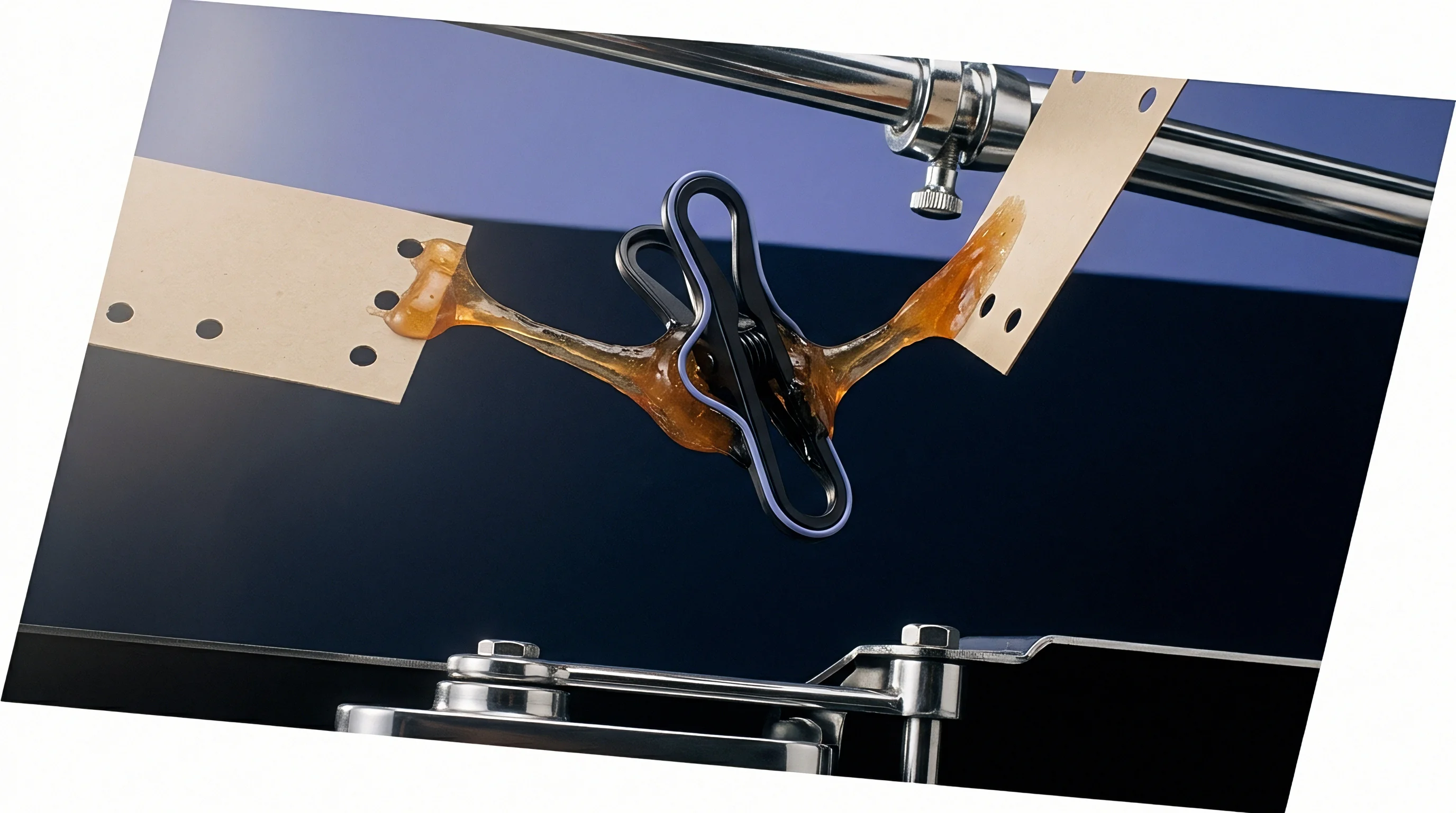
To measure pectin shear resistance specifically, the laboratory isolates a pair of overlapping elementary fibres using micromanipulators under a stereomicroscope, bonding each free end to a segmented micro-tensile load cell fixture with two-part cyanoacrylate adhesive.
The isolated specimen undergoes tensile displacement at an extension rate of 50 micrometers per minute, monitoring force accumulation until interfacial shear slip occurs. The active shear zone represents the calibrated overlap length multiplied by the shared contact perimeter determined through confocal laser scanning microscopy. Shear strength calculates as the peak rupture force divided by this shared interfacial area.
Replicating this procedure across repeated specimens provides a statistically sound distribution of interfacial shear resistance for a commercial lot.
Under controlled microtensile pull at 50 micrometers per minute, undegraded middle lamella zones record a mean interfacial shear rupture stress of 4.1 megapascals.
Engineering methods in bast fibre testing also adapt the pull-out test configuration, where a single elementary cell is drawn axially from a micro-matrix of surrounding cells embedded in a droplet of cold-curing resin. The recorded peak force represents the mechanical shear resistance of the residual pectin and hemicellulose boundary. High testing speeds elevate measured shear values due to matrix visco-elasticity, while temperatures above 40 degrees Celsius soften the branched polysaccharide domains, reducing apparent resistance.
Establishing uniform conditioning parameters at 20 degrees Celsius and 65 percent relative humidity provides repeatability across different test batches.
Can Micro-Mechanical Shear Testing Predict Hackling Loss?
Tensile stress-strain profiles generated from these micro-mechanical tests display a distinct linear elastic zone followed by a plateau corresponding to progressive pectin yield. In under-retted flax lots, the curve lacks a yield plateau, exhibiting a sudden brittle drop that marks simultaneous fibre fracture and matrix rupture. Over-retted samples display prolonged viscous slip at stress levels below 1.5 megapascals, accompanied by extensive fibrillar peeling.
Connecting these micro-scale parameters to mill-scale performance creates a predictive grading baseline for incoming fibre evaluation.
The standard laboratory workflow for evaluating interfacial shear properties follows an exact sequence of mechanical and optical operations:
- Mount individual technical bast bundles across a slotted metal testing tab with a calibrated five-millimeter gauge span under a high-magnification binocular microscope.
- Secure the elementary fibre extremities to the tab grips using low-viscosity adhesive, verifying that no glue wicks into the central overlap zone.
- Cut the supporting metal tab side rails using heated micro-shears to transfer the mechanical load entirely to the fibre specimen without introducing vibration.
- Apply tensile displacement at a steady crosshead rate of 0.05 millimeters per minute until interfacial separation completes.
- Measure the failed overlap area using environmental scanning electron microscopy to calculate ultimate shear strength per unit area.
Data scatter in bast fibre microtensile measurements remains wide because of natural agronomic variability. Diameters change along the length of each cell, and local voids in the middle lamella alter the effective load-bearing area. A lot showing an average shear strength of 2.5 megapascals often exhibits individual test values ranging from 1.2 to 4.8 megapascals.
A commercial buyer must evaluate the standard deviation alongside the mean; wide dispersion indicates uneven field retting, which manifests as patchy, irregular splitting during industrial hackling. The test leaves open whether low-molecular-weight galacturonan fragments retain sufficient ionic cross-linking in dry states to mimic the mechanical resistance of intact polymers.

Cleavage
Industrial hackling lines convert scutched flax stricks into aligned slivers through progressive mechanical cleavage. The process relies on differential tension and comb impact to divide coarse technical fibres into finer spinning subunits. Scutched flax entering the machine has an average linear density ranging from 15 to 30 tex, representing clusters of twenty to forty elementary cells glued together.
The objective of fine line preparation is reducing this linear density below 4 tex without dropping the mean fibre length below 450 millimeters. The success of this transition depends on whether the applied transverse cleavage stresses exceed the middle lamella shear resistance before exceeding the longitudinal tensile strength of the cells.
The splitting process displays mechanical similarities to peel fracture in bonded composite joints. As hackle pins enter the strick, they act as wedges driving longitudinal cracks along the pectin-rich inter-fibre boundary. Structural peel mechanics in synthetic adhesives describe a steady-state fracture energy required to propagate a delamination crack.
In bast fibres, this energy release rate depends directly on the cohesion of the pectin gel. When high calcium concentrations lock the homogalacturonan chains into dense configurations, the fracture energy spikes, diverting the crack path across the primary cell wall and shearing through the cellulose microfibrils.
| Mean Shear Strength (MPa) | Initial Tex | Finished Sliver Tex | Long Line Yield (Percent) | Machine Tow Loss (Percent) | Comb Pin Breakage Rate (Per Tonne) |
|---|---|---|---|---|---|
| 1.5 to 2.0 | 22.4 | 3.2 | 58.5 | 36.5 | 0.8 |
| 2.1 to 2.8 | 24.1 | 3.8 | 54.2 | 41.0 | 1.2 |
| 2.9 to 3.5 | 23.8 | 4.6 | 48.1 | 46.8 | 2.4 |
| 3.6 to 4.2 | 25.2 | 6.2 | 41.3 | 52.7 | 4.1 |
| 4.3 to 5.5 | 26.0 | 8.5 | 32.0 | 61.5 | 7.6 |
The data demonstrates that long line yield drops sharply as interfacial shear strength crosses 3.5 megapascals. Machine tow loss expands to consume over half the incoming fibre weight. Tow fibre sells at approximately 25 to 35 percent of the price of hackled line fibre, turning excess lamella cohesion into an immediate commercial penalty.
The finished sliver linear density doubles when shear resistance exceeds 4.3 megapascals, indicating that the comb pins fail to divide the bundles down to the fineness required for high-count yarn drafting.

Cleavage Sorting Parameters for Scutched Flax Stocks
Incoming lots undergo qualification to ensure they match the mechanical capabilities of the hackling line:
- Interfacial Rupture Stress below 2.8 megapascals designates lots suitable for fine line hackling intended for wet-spun apparel yarns above Nm 50.
- Linear Density Variance along the technical bundle span must show a coefficient of variation under 22 percent to prevent erratic drafting resistance.
- Shive Adhesion Index measuring the mechanical force required to strip woody core remnants from the bast boundary must remain below 0.15 newtons per centimeter.
- Moisture Equilibrium Content held at 12.5 percent ensures the pectin lamella remains sufficiently pliable to permit ductile shear deformation during combing.
Operating a hackling line with fibre that exceeds cohesive shear tolerances leads to excessive comb pin wear, widespread pin breakage, elevated machine tow generation, and downstream spinning stoppages caused by coarse unyielding drafting clusters.

Trough
The wet-spinning trough represents the final chemical and thermal station where residual pectin lamella shear resistance is neutralized before drafting. In traditional wet spinning of long line flax, the roving passes through a hot water bath maintained between 60 and 70 degrees Celsius prior to reaching the drafting rollers. Heat and moisture soften the remaining middle lamella adhesives, reducing their shear resistance to a fraction of their dry value.
If the fibre arrives at the spinning frame with excessive pectin content caused by inadequate retting and defective hackling preparation, the short transit time through the trough proves insufficient to achieve the necessary softening. The drafting rollers encounter rigid bundles, producing drafting slips, thick-and-thin defects, and repeated end breaks.
Assume a commercial spinning lot of 20 metric tonnes of hackled line flax purchased at 6.80 euros per kilogram landed at the mill. The contract specifies fibre capable of spinning to a yarn count of Nm 50. If under-retting elevates the dry lamella shear resistance to 3.8 megapascals, the hackling line yield drops from an expected 55 percent down to 43 percent.
The remaining 57 percent of the fibre enters the tow stream, which recovers only 1.80 euros per kilogram on the commodity market. The raw material cost of the resulting line sliver rises from an anticipated 10.90 euros per kilogram to 13.45 euros per kilogram when factoring in the downgraded tow fraction.
| Lot Classification | Mean Shear Strength (MPa) | Hackled Line Yield (kg) | Machine Tow Yield (kg) | Sliver Cost (EUR/kg) | Spun Metres at Nm 50 (m/kg) |
|---|---|---|---|---|---|
| Grade A: Low Shear | 2.1 | 11,400 | 7,800 | 10.72 | 48,500 |
| Grade B: Moderate Shear | 2.9 | 10,200 | 8,900 | 11.75 | 44,200 |
| Grade C: High Shear | 3.8 | 8,600 | 10,400 | 13.45 | 35,100 |
| Grade D: Severely Cohesive | 4.7 | 6,800 | 12,100 | 16.20 | 22,400 |
The cost disparity carries directly into the finished fabric. At Nm 50, a standard plain weave linen fabric weighing 140 grams per square meter requires approximately 1.45 kilograms of hackled line sliver per meter of finished goods after accounting for spinning, winding, and weaving waste. A lot suffering from elevated pectin shear resistance increases the fibre input cost from 15.54 euros per meter to 19.50 euros per meter.
The mill absorbs this difference or fails the fabric inspection when end breaks introduce excessive knots and yarn unevenness. When the downstream spinning frame cannot soften the bundles in the trough, drafting tension rises, causing structural yarn imperfections that lower the commercial grade of the bolt.
Under commercial arbitration rules governed by the Confederation Europeenne du Lin et du Chanvre, fibre lots exhibiting unretted characteristics that reduce hackled line yield by more than five percent below the certified grade baseline trigger automatic commercial price adjustments on the raw invoice.
Buyers protect processing margins by writing technical shear thresholds directly into purchase contracts. The contract requires that representative bale samples undergo lab-scale hackling yield verification and pectin esterification assays prior to bill-of-lading endorsement. Where moisture testing according to ISO 6741 reveals imbalances, or where residual gum percentages exceed 2.5 percent by weight, the buyer applies a direct price penalty per kilogram.
This commercial discipline shifts the financial burden of uneven field retting back to the scutching mill, preventing costly operational failures on the hackling and wet-spinning floors.