Flax Fibre Bundle Separation and Staple Length Retention Fundamentals
Selective pectin degradation paired with tuned hackling pin density maximizes fibre bundle separation while retaining staple length for fine wet spinning.

Stem

Anatomical Architecture of Bast Bundles
Within the outer stalk layer of Linum usitatissimum, phloem tissues contain elongated structural units arranged in concentric rings. Polysaccharide chains bind individual ultimate cells together into technical strands that run the length of the stalk. Individual ultimate fibers measure 20 to 40 millimetres long and 15 to 25 micrometres across.
Overlapping end-to-end and side-by-side, these single cells form composite technical bundles that extend 300 to 900 millimetres along the stem. This structure relies on an intercellular middle lamella composed mainly of calcium polygalacturonates, highly branched rhamnogalacturonans, and hemicellulosic polymers. In the secondary cell wall, cellulose microfibrils align at a narrow spiral angle of roughly 10 degrees relative to the fibre axis, giving the structure high axial tensile stiffness but low transverse shear resistance, with pectin acting as the inter-microfibrillar cement.
Technical bundle tenacity depends on preserving middle lamella integrity while stripping cortical parenchyma.
Preserving technical bundle integrity during processing determines whether raw stock yields long line flax or short tow. Excessive mechanical impact ruptures individual cell walls, causing transverse fracturing along kink bands. Controlled chemical or biological softening degrades non-cellulosic inter-cellular matrices without depolymerizing structural cellulose chains.
When pectin breakdown proceeds too far, ultimate cells detach entirely, destroying bundle cohesion and generating unspinnable short fibre.
Whether non-destructive enzymatic targeting can selectively cleave rhamnogalacturonan-I blocks without weakening adjacent xyloglucan linkages in the primary cell wall remains unresolved in commercial processing.


Reagent
Biochemical Separation Mechanisms
Releasing technical bundles from surrounding epidermal and woody stalk tissue requires targeted removal of the pectinous matrix. During field exposure, ambient microflora break down galacturonans through aerobic and anaerobic pathways; dew retting relies largely on fungal species such as Cladosporium herbarum to secrete polygalacturonases and pectate lyases. Tank-based water retting instead utilizes anaerobic bacteria like Clostridium felsineum kept at 30 to 35 degrees Celsius to dissolve calcium pectate complexes, though cooler water slows this enzymatic breakdown.
As pectin depolymerizes, bundle cross-sections narrow, driving linear density down from 5.0 tex to between 1.5 and 2.2 tex. Alternatively, chelating agents like ethylenediaminetetraacetic acid or sodium tripolyphosphate sequester calcium cations to solubilize pectate complexes without biological incubation.
Contracts referencing ISO 2370 fibre linear density limits penalize lots exceeding 2.2 tex with a three percent price deduction per tex step.

Selection Criteria for Chemical Pretreatment
Industrial processing trials require systematic parameters to balance pectin removal against cellulose depolymerization.
- Dew retting duration tracks cumulative thermal units and rainfall to avoid over-retting structural cellulose.
- Water retting temperature maintains optimal bacterial metabolism between 32 and 34 degrees Celsius for uniform digestion.
- Enzyme bath potential sets pectinase activity concentrations to achieve targeted bundle fineness within six hours.
- Chelating agent dosage adjusts cation sequestering levels based on dry stalk calcium concentrations.
Seasonal weather variations during field retting cause up to a fifteen percent spread in bundle fineness across bales from a single harvest lot.
Pin
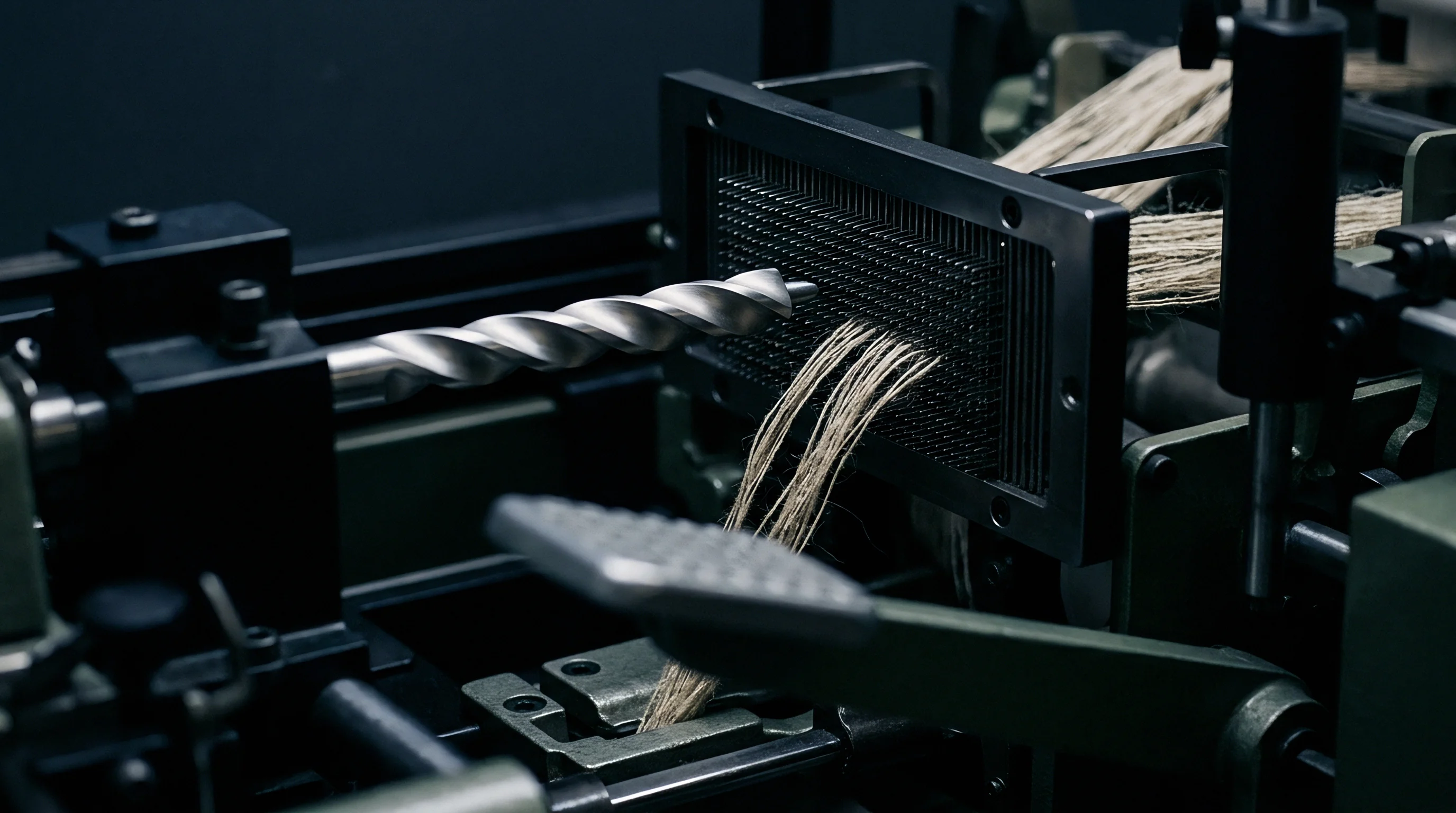
Hackling Dynamics and Penetration Mechanics
Combing machines subdivide parallel flax stricks by drawing steel needles through bundle aggregates under controlled tension. This progressive mechanical working splits coarse technical units into finer parallel strands while stripping away shive fragments. Hackling frames carry stricks across rotating aprons fitted with progressively denser needle bars ~ starting with coarse fields at 1 to 2 needles per centimetre (1.5 millimetre wire diameter) and ending at finishing fields with 18 to 24 needles per centimetre (0.35 millimetre wire diameter).
While the pins shear away primary bark layers, keeping ambient relative humidity at 65 to 70 percent maintains fiber flexibility and prevents brittle breakage under impact.
| Hackling Field | Needle Density (bars/cm) | Wire Diameter (mm) | Target Bundle Fineness (tex) | Mean Retained Length (mm) |
|---|---|---|---|---|
| Coarse Entry | 1.2 | 1.50 | 4.8 | 680 |
| Intermediate Combing | 6.5 | 0.80 | 3.1 | 640 |
| Fine Subdividing | 14.0 | 0.50 | 2.2 | 610 |
| Ultra-Fine Finishing | 22.0 | 0.35 | 1.6 | 580 |
A hackling pin density of eighteen pins per centimetre yields a mean staple length of 620 millimetres when relative humidity is held at 68 percent.
Atmospheric and Machine Setup Parameters
Mechanical adjustment protocols demand precise mechanical alignment to minimize tow generation during strick processing.
- Step 1: Inspect incoming scutched stricks for moisture regain using capacitive probe testing across five sample points per bundle.
- Step 2: Adjust strick holder clamping force to 0.45 MPa to prevent slippage during initial coarse combing passes.
- Step 3: Set drawing roller ratch spacing to 110 percent of the upper quartile staple length determined from comb sorter diagrams.
- Step 4: Regulate comb aprons speed differential to maintain a 1.15 draft ratio between successive hackling fields.

Should Pin Density Shift for Under-Retted Tow?
Processing insufficiently retted stalk material requires reducing comb density in early hackling fields to prevent catastrophic transverse fracturing. When pectin removal is incomplete, high needle density acts as an abrasive cutter rather than a divider. Lowering initial needle density allows gradual splitting without exceeding ultimate tensile strength.
Excessive pin density on under-retted stricks snaps technical bundles into tow-length fragments, reducing long-line yield by twenty percent and increasing short-fibre fly in the spinning hall.
Sorter

Staple Length Distribution Analysis
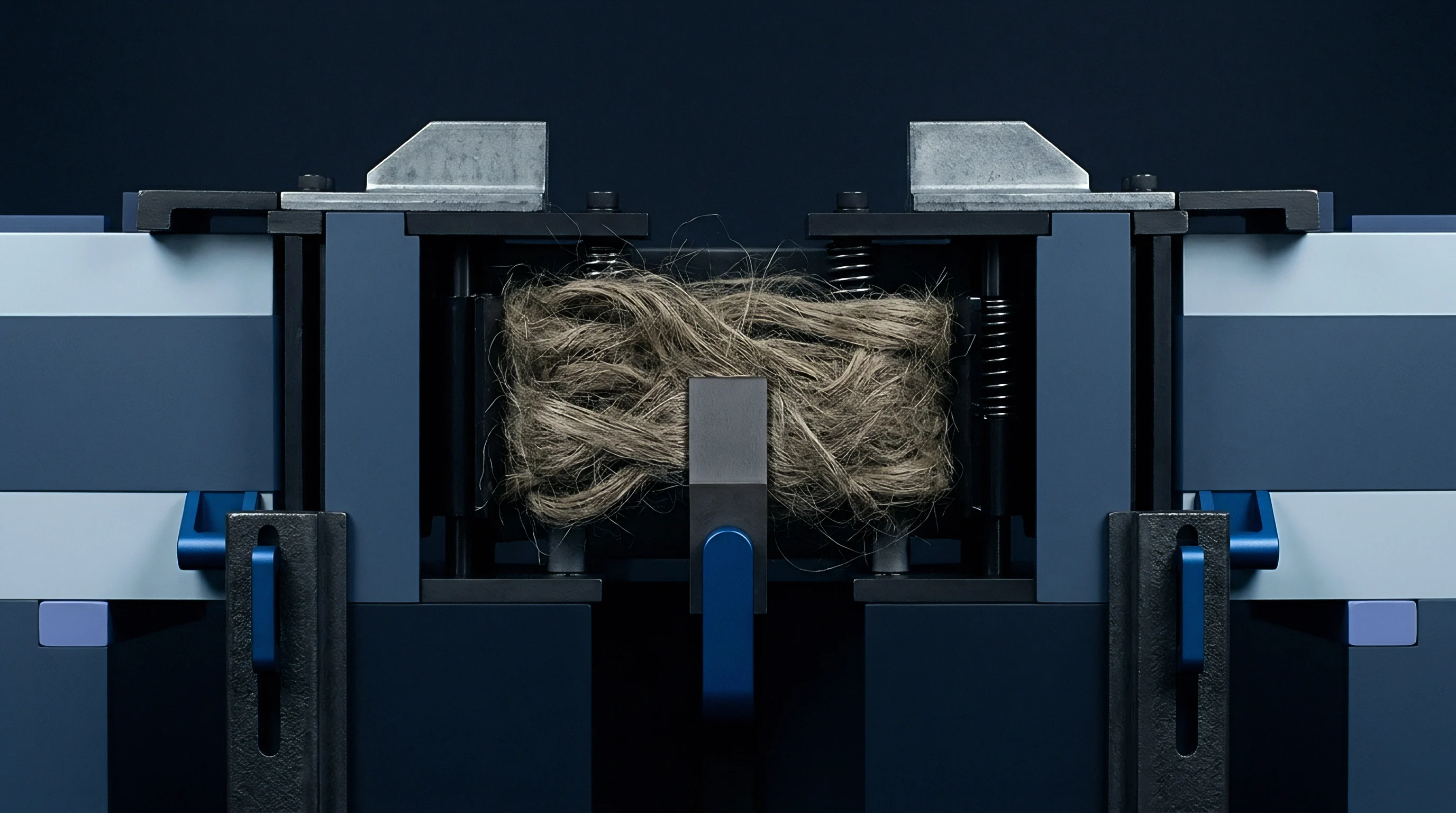
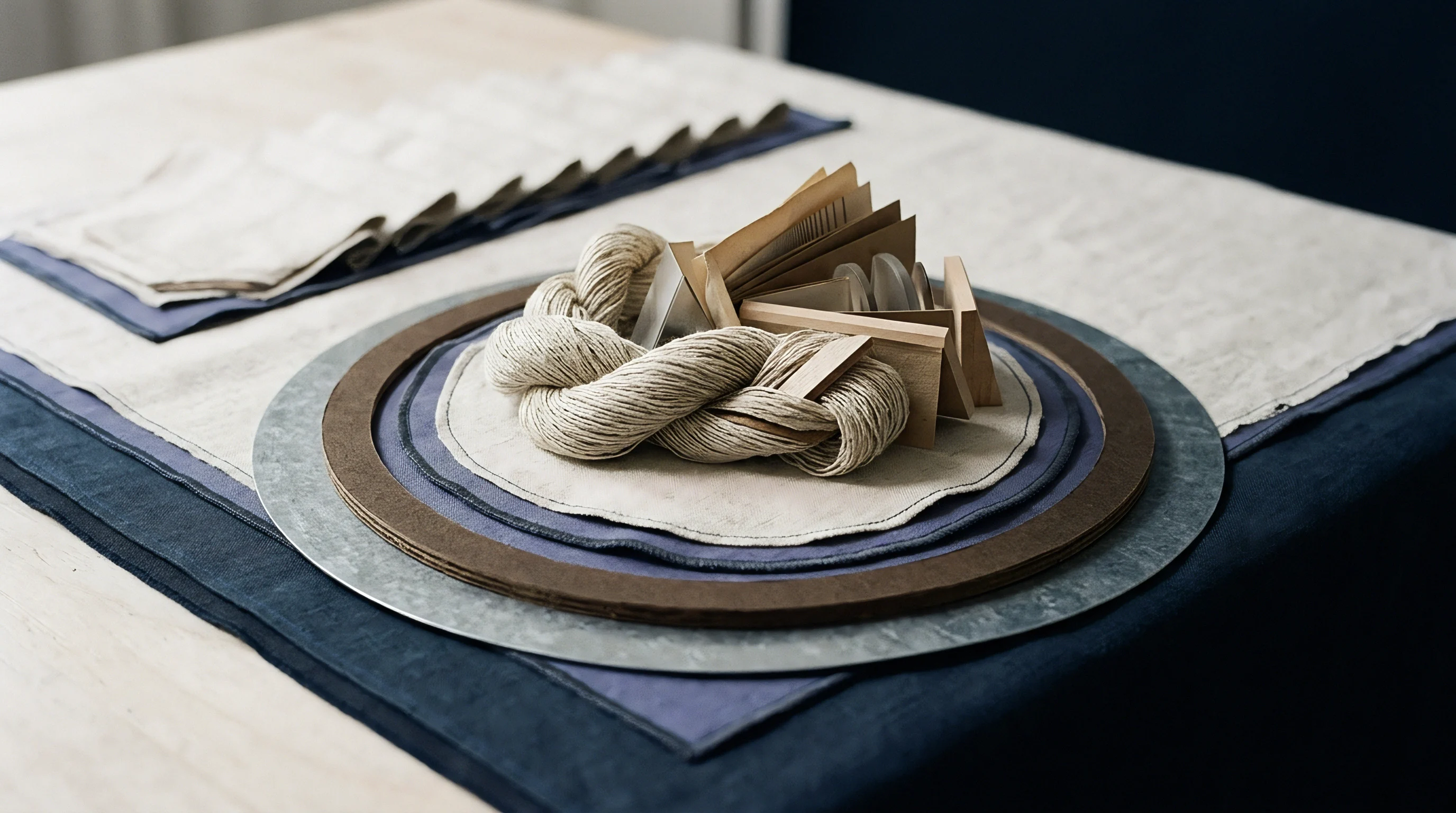
Evaluating length distribution and fineness requires standardized comb sorters to build array diagrams. Duplex comb sorters line up bundle bases against a zero baseline to isolate individual length classes. A standard test combs a 10-gram sample, transfers the fibers onto velvet boards, and weighs each sorted fraction.
Upper quartile length marks the threshold above which 25 percent of the fibre mass lies, mean length represents total sample mass divided by total strand count, and short fibre content measures the mass fraction under 50 millimetres. High proportions of these short fibers degrade drafting stability, while over-retting sharply reduces overall bundle tenacity.
| Standard | Measurement Parameter | Sample Size | Conditioning Requirement | Commercial Acceptance Tolerance |
|---|---|---|---|---|
| ISO 2370 | Air Permeability Linear Density | 5.0 g bundle | 20°C, 65% RH for 24h | ±0.15 tex |
| ISO 6741 | Commercial Mass and Regain | 500 g lot sample | Oven dry at 105°C | 12.0% standard regain |
| ISO 2062 | Single Bundle Tenacity | 100 mm gauge strand | 20°C, 65% RH for 24h | Minimum 35 cN/tex |
| Methods testing requires prior conditioning in standard atmospheres per ISO 139 protocols. | ||||
Flax bundle strength correlates directly with the structural order of crystalline cellulose within primary cell walls.
Fineness Measurement Protocols
Determining linear density via air permeability instruments yields a metric fibre number that dictates spinnable yarn count. Structural degradation during scutching or hackling alters length distributions, introducing distinct failure profiles under load.
- Transverse shear fracture occurs when excessive drafting tension snaps technical bundles across kink bands.
- Kink band formation develops during mechanical scutching when stalks experience severe bending strain.
- Unseparated coarse bundles survive processing when retting fails to digest middle lamella pectins evenly.
- Short fibre accumulation increases draft variance on spinning frames, generating thick-and-thin yarn defects.
Consider a 10.0-gram test specimen analyzed on a comb sorter. Sorting yields 6.2 grams of long line strands above 500 millimetres, 2.6 grams of intermediate strands between 150 and 500 millimetres, and 1.2 grams of short strands below 150 millimetres. The short fibre content equals 12.0 percent by mass.
Metric fibre number determination on the long line fraction yields 450 metric fibre number (2.22 tex). Spinning limits for wet-spun yarn depend directly on this fineness rating; 450 metric fibre number permits drafting up to Nm 60 yarn counts before end breakage rates surge.
Standard purchasing contracts referencing ISO 6741 require raw fibre weight adjustments based on an official commercial regain allowance of 12.0 percent, converting invoice weights directly to standardized dry mass.
Valuation
Spinnable Count Limits and Hackling Yield
Translating raw fiber prices into finished fabric costs depends on hackling yield, spinning waste, and maximum count potential. Retained staple length and fine-bundle linear density dictate the finest yarn count a wet-spinning frame can produce: long line flax maintaining a 600 millimetre staple length at 1.8 tex spins into Nm 60 to Nm 80 fine yarns, whereas coarse tow strands measuring 150 millimetres at 4.0 tex are limited to dry-spun counts between Nm 10 and Nm 24. While finer lines demand greater staple length, residual shive increases yarn hairiness, and proper moisture regain is essential to restore bundle pliability before severe pectin degradation compromises cohesion.
| Fibre Grade Category | Raw Fibre Price (USD/kg) | Hackling Line Yield (%) | Target Yarn Count (Nm) | Net Spinning Cost (USD/kg) | Fabric Cost (USD/m at 150g/m²) |
|---|---|---|---|---|---|
| Water-Retted Long Line | 5.20 | 68 | Nm 60 | 6.80 | 3.45 |
| Dew-Retted Long Line | 4.20 | 62 | Nm 39 | 4.50 | 2.38 |
| Scutched Combing Tow | 2.10 | N/A | Nm 18 | 2.80 | 1.42 |
| Cottonised Short Flax | 1.85 | N/A | Nm 24 (Blend) | 2.20 | 1.18 |

Landed Cost Calculations per Linear Metre
Translating raw bundle prices into landed fabric estimates requires tracing mass loss across each conversion stage. Take a 1,000 kilogram lot of dew-retted long line flax purchased at $4.20 per kilogram ($4,200 raw investment). Processing through hackling yields 620 kilograms of dressed long line fibre, 260 kilograms of hackling tow ($1.80 per kilogram recovery credit = $468), and 120 kilograms of unrecoverable dust and shive waste.
Net dressed line mass cost equals ($4,200 – $468) / 620 kg = $6.02 per kilogram. Wet spinning into Nm 39 yarn adds $4.50 per kilogram in conversion cost, raising total yarn cost to $10.52 per kilogram. Weaving at 150 grams per square metre with a 1.5 metre fabric width requires 225 grams of yarn per linear metre.
Adding 5 percent weaving waste, yarn consumption per metre equals 0.236 kilograms, yielding a direct yarn fabric cost of $2.48 per linear metre.
Higher long-line yield during hackling consistently lowers raw material waste and secures finer spinnable yarn limits on wet-spinning frames.