Hydrothermal Strain Limits in Sized Wet Spun Linen Weaving Warps
Hydrothermal strain in sized wet spun linen warps breaks down sizing films above 75 percent relative humidity, driving warp stops and mill yield loss.
Film
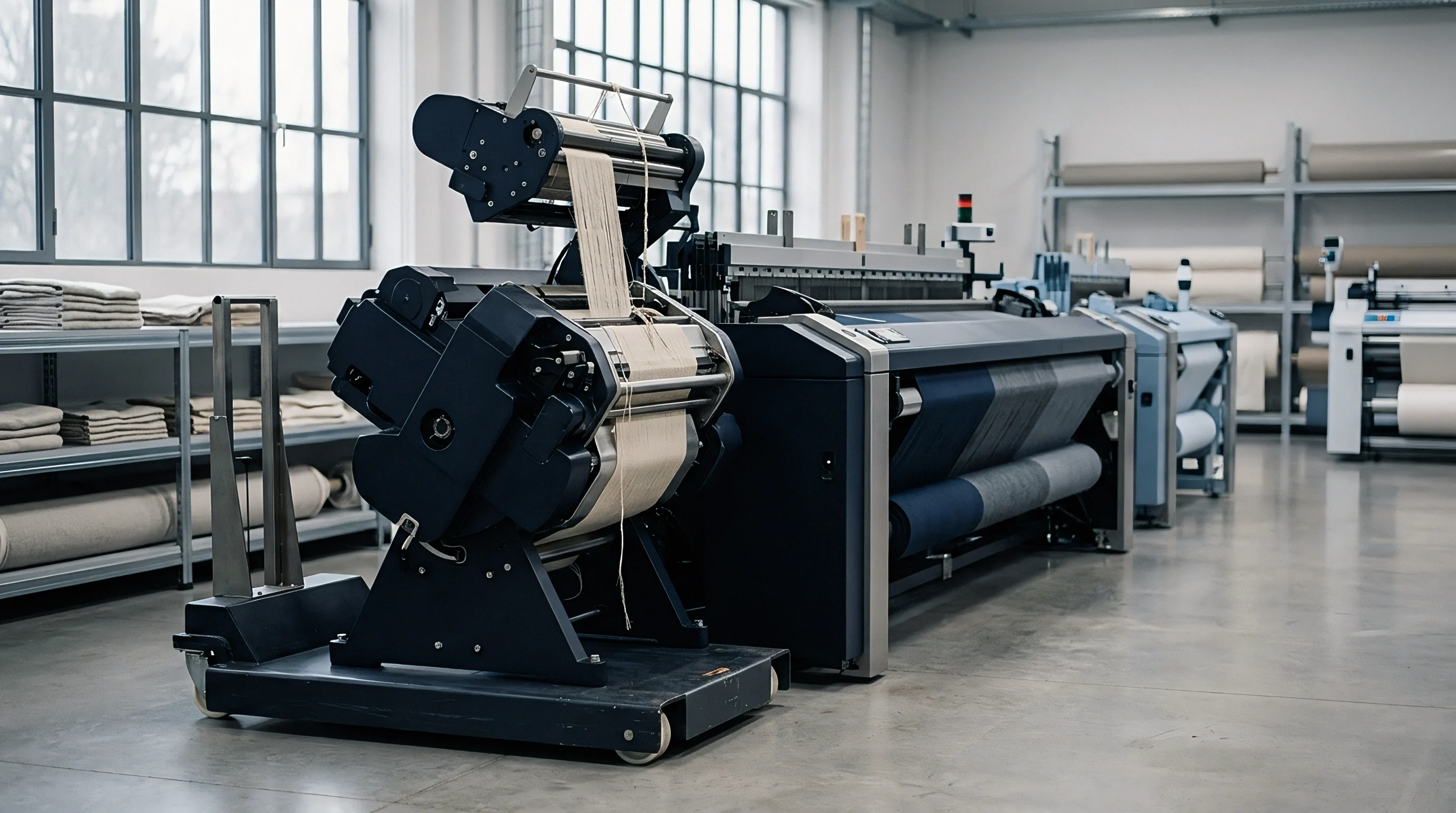
Polymer coatings applied during warp sizing protect wet-spun linen yarns from mechanical friction and cyclic tension inside the weaving shed. While wet-spun flax yarn has a smoother surface than dry-spun yarn, its internal structure contains large intra-bundle voids filled with natural pectins and hemicellulose. These native non-cellulosic polymers react quickly to atmospheric moisture, so sizing formulations must anchor into the outer fiber bundles while maintaining a continuous exterior shield.
Modified starches form the main matrix, supplemented by polyvinyl alcohol for elasticity under dry stress and carboxymethyl cellulose to adjust liquor viscosity and control encapsulation depth.
The protective layer degrades when exposed to the high humidity typical of linen weaving sheds. Keeping relative humidity between 70 percent and 85 percent prevents flax yarns from turning brittle, but atmospheric moisture plasticizes synthetic and natural sizing polymers alike. Water molecules penetrate the matrix, breaking intermolecular hydrogen bonds and lowering the glass transition temperature of the blend.
Below this transition point, the protective film acts as a rigid, abrasion-resistant shell; once moisture and friction heat push the film past it, the sizing softens, loses tensile modulus, and shifts from elastic deformation into viscous flow.
A sizing film that softens under loom temperature converts mechanical protection into sticky surface drag.
Liquor composition directly governs how well a sized warp tolerates moisture. Pure starch films offer high dry modulus but soften rapidly when ambient humidity exceeds 75 percent relative humidity at 28 degrees Celsius. Incorporating fully hydrolyzed polyvinyl alcohol elevates the moisture threshold before film yield occurs, while synthetic acrylic co-polymers add wet-state cohesion to prevent size from scrubbing off on yarn guides, drop wires, and heddle eyes.
When sizing penetration exceeds 30 percent of yarn cross-sectional area, the yarn grows overly rigid, driving shedding strain into micro-structural fractures within the ultimate flax fibers.
- Native Starch Formulations provide high tensile strength in dry air, but plasticize rapidly and lose film integrity once weaving shed humidity passes 72 percent.
- Polyvinyl Alcohol Blends hold structural ductility through shifting humidity zones, retaining toughness up to 80 percent relative humidity before viscoelastic yield sets in.
- Carboxymethyl Cellulose Additives control liquor viscosity during immersion, preventing deep core penetration while ensuring uniform coverage over surface flax fibrils.
- Acrylic Co-Polymer Modifiers improve wet-state adhesion between the size envelope and the smooth outer cortical cells of wet-spun linen threads.
Size shedding on the loom often stems from improper warp drying temperatures during slasher operation rather than structural plasticizer overload in the sizing recipe.

Hydration
Water absorption in wet-spun linen yarns occurs through two concurrent mechanisms: swelling of amorphous cellulose regions and plasticization of the inter-fibrillar pectin matrix. Flax ultimate fibers consist of highly crystalline microfibrils embedded in an amorphous hemicellulose and pectin binder. As ambient moisture rises, water molecules bind to hydroxyl groups within this amorphous matrix, forcing microfibrils apart.
Radial swelling in wet-spun linen yarn can reach 15 percent, while axial extension stays below 1.5 percent because of the steep helical winding angle of the fibrillar structure.
Hydrothermal strain limits mark the point where swelling and elevated shed temperature weaken the warp’s load-bearing capacity. When shed conditions reach 30 degrees Celsius at 80 percent relative humidity, thermal and hygral softening of the pectin binder allows internal microfibrils to slip past each other under reduced axial load. As hydrogen bonds break, the yarn’s initial modulus drops sharply, shifting the work-to-break energy curve toward higher elongation at lower peak tensile forces.
| Formulation Base | Sizing Pick-Up (%) | Test Humidity (% RH) | Test Temp (°C) | Yield Strain (%) | Max Hydrothermal Strain (%) |
|---|---|---|---|---|---|
| Modified Potato Starch | 12.5 | 65 | 20 | 2.1 | 1.8 |
| Modified Potato Starch | 12.5 | 80 | 32 | 4.6 | 2.2 |
| Starch / PVA (70:30) | 11.0 | 65 | 20 | 2.8 | 2.4 |
| Starch / PVA (70:30) | 11.0 | 80 | 32 | 5.2 | 3.1 |
| Starch / Acrylic (80:20) | 10.5 | 80 | 32 | 4.9 | 2.9 |
Evaluating warp strain limits under shed conditions involves tracking yarn behavior across four operational phases, starting before the warp beam enters the weaving shed and finishing when woven fabric winds onto the cloth roller.
- Slashing dry-off conditioning establishes initial moisture equilibrium at 7 percent regain.
- Shed acclimatization exposes sized warps to ambient weaving conditions for 24 hours before knotting.
- Cyclic shedding extension imposes mechanical strain pulses between 1.2 percent and 2.5 percent stretch.
- Beat-up impact forces apply localized hydrothermal strain spikes at the fell of the cloth.
Standard purchasing specifications require sized linen warps to retain at least 65 percent of their dry tensile modulus when tested at 78 percent relative humidity.
Keeping shed relative humidity below the glass transition point of the wet-size matrix prevents structural warp lengthening during prolonged loom stoppages.

Tension
Mechanical loads on warp ends during rapier and air-jet weaving alternate rapidly between baseline static tension and peak dynamic extension. Shed geometry creates cyclic stretch, while the reed beating against the cloth fell adds high-frequency impact energy, driving tension to its peak at beat-up. In dense constructions like heavy plain weaves or four-end twills, beat-up resistance spikes the warp load considerably.
If yarn stays within its linear elastic strain region, it recovers fully upon shed closure; if hydrothermal conditions force it past its yield point, plastic strain accumulates with every loom revolution.
What Triggers Hydrothermal Creep Failure during Weaving?
Hydrothermal creep failure occurs when continuous cyclic tension causes wet-spun flax fibers to undergo permanent displacement under elevated heat and humidity. As the sizing shell softens, it stops restricting internal fibrillar movement. The structural binder yields, allowing micro-slippage between technical fibers inside the yarn bundle.
This accumulated creep leads to permanent warp elongation and loss of working tension, causing loose ends, poor shed openings, mispicks, and eventual breakages when the reed hits a slack thread.
| Yarn Count (Tex) | Sett (Ends/cm) | Peak Shed Strain (%) | Beat-up Peak Strain (%) | Plastic Creep Rate (%/hr) | Time to Fail (Hours) |
|---|---|---|---|---|---|
| 42 | 24 | 1.4 | 2.2 | 0.08 | 18.5 |
| 42 | 28 | 1.8 | 2.9 | 0.24 | 4.2 |
| 84 | 16 | 1.1 | 1.8 | 0.03 | 42.0 |
| 84 | 20 | 1.6 | 2.5 | 0.15 | 9.8 |
Dynamic friction aggravates hydrothermal strain damage as heddle eyes and reed wires rub against the softened size film hundreds of times per minute. This constant rubbing strips protective coating from the yarn surface, forming small size balls that collect behind the drop wires. Once stripped of size, raw flax fibers sit directly exposed to metal contact and moisture, accelerating yarn degradation and split ends.
Accumulated plastic strain in wet warp ends alters reed alignment and destroys cloth cover uniformity.
- Fibrillar Micro-Slippage develops when hydrothermally plasticized pectins allow ultimate flax fibers to slide internally without structural recovery.
- Size Film Abrasion Shearing takes place when wet, softened sizing sheds under high-frequency contact with heddle eyes and reed blades.
- Beat-Up Fell Displacement occurs as slackened, over-stretched warp ends bounce at the cloth fell, generating uneven pick spacing and horizontal bar marks.
- Dropper-Induced Friction Fractures form when excessive yarn elongation allows drop wires to drag against neighboring warp threads, cutting outer fibers.
Operating a weaving shed above the hydrothermal strain limit of the sized warp causes systemic warp breaks, high fabric fault scores, and forced loom speed reductions.

Metrics
Evaluating warp survival under shed conditions demands lab testing that measures mechanical response under controlled temperature and humidity. Conventional dry tensile tests under standard ISO 139 conditions fail to predict loom performance, as measuring yarn breaking force at 20 degrees Celsius and 65 percent relative humidity misses the viscoelastic softening that occurs in a humid shed. Reliability requires environmental chambers mounted directly onto constant-rate-of-extension tensile testing machines.
Modified testing standards require conditioning sized yarn samples inside an environmental chamber between 25 and 35 degrees Celsius and 70 to 85 percent relative humidity for at least four hours before testing. Gauge length is set to 500 millimeters to match the active mechanical zone of the loom shed, while crosshead speed mimics shedding strain rates. Displacement sensors track initial modulus, yield point strain, strain at peak force, and total work-to-break, marking the exact strain level where elastic recovery gives way to permanent plastic deformation.
| Condition State | Test Temp (°C) | Relative Humidity (%) | Tenacity (cP/tex) | Elongation at Break (%) | Elastic Modulus (cP/tex) |
|---|---|---|---|---|---|
| Standard ISO 139 | 20 | 65 | 28.5 | 2.4 | 850 |
| Shed Warm / Dry | 30 | 65 | 26.2 | 2.7 | 780 |
| Shed Warm / Humid | 30 | 80 | 21.8 | 4.8 | 420 |
| Extreme Hydrothermal | 35 | 85 | 17.4 | 6.2 | 290 |
Hygral expansion coefficients supplement tensile strain data. Measuring axial and radial dimensional shifts across a stepped humidity spectrum reveals where size encapsulation fails to hold back fiber swelling. An optical dilatometer records diameter changes while tension transducers track longitudinal forces on yarns clamped at fixed length.
Rapid drops in force indicate moisture-induced stress relaxation within the size film, signalling that the yarn has passed its threshold for stable weaving.
Does dynamic strain hysteresis testing at high frequency correlate closely enough with real shed warp break rates to replace full-scale trial warps?
Outlay
Exceeding warp strain limits inflicts direct financial penalties on mill efficiency and landed cloth costs. High-speed rapier looms running at 400 picks per minute require continuous warp delivery without interruption. Every breakage forces a stop, generating a starting mark in the cloth, consuming operator time, and driving down overall shed efficiency.
A mill operating at 82 percent efficiency due to persistent warp stops consumes significantly more loom hours per thousand metres produced than a facility running at 94 percent efficiency.
| Warp Stop Rate (Stops/10^5 Picks) | Shed Efficiency (%) | Production Speed (Metres/Loom Hour) | Total Loom Hours Booked | Added Cost per Metre ($) |
|---|---|---|---|---|
| 1.2 | 94.5 | 18.2 | 549 | 0.00 |
| 2.8 | 89.0 | 17.1 | 584 | 0.48 |
| 5.5 | 81.5 | 15.7 | 636 | 1.18 |
| 9.2 | 72.0 | 13.8 | 724 | 2.35 |
Loom hours are billed as fixed overhead blocks covering capital amortization, climate control energy, labor, and facility costs. Excess warp stops caused by hydrothermal breakdown of the size film directly inflate the cost per finished metre. Because raw materials for sizing represent a small fraction of manufacturing expenses, proper sizing formulation is cheap insurance against loom downtime.
High-grade synthetic co-polymers and precise climate control yield immediate returns by preserving warp strain limits and stabilizing weaving speeds.
At a warp stop rate of 5.5 breaks per 100,000 picks, mill efficiency losses add 1.18 dollars per finished metre to production outlay.
Sourcing contracts for wet-spun linen fabrics should explicitly define technical warp sizing parameters alongside standard physical fabric specifications, shielding buyers from paying for mill inefficiencies.
- Certified Hydrothermal Strain Limits must be documented via wet-chamber tensile testing before mounting warps on high-speed looms.
- Maximum Warp Stop Thresholds set the contractual allowance for mill stops, placing financial liability for excessive downtime on the weaver.
- Sizing Formulation Dossiers specify chemical ingredients, pick-up percentage targets, and desizing requirements for downstream finishing qualification.
- Climate Control Logging Sheets record hourly relative humidity and temperature levels inside the weaving shed throughout the production run.
Standard master purchasing agreements stipulate that if loom stops exceed 3.5 stops per 100,000 picks due to sizing failure, the weaver absorbs all additional loom-hour costs without adjusting the unit price per metre.