Optimizing Sizing Formulations for High Speed Rapier Weaving of Flax Warps
Engineered sizing formulations balancing modified starch, PVA, and acrylic binders restrict penetration while preventing high-speed rapier yarn breakage.
Film
Flax tow and line yarns present irregular cross-sections, low intrinsic elasticity, and stiff surface fibrils that snag during high-speed shedding. Wet spinning leaches out natural pectins, leaving porous cellulosic bundles with high initial liquor absorption rates. Unsized flax breaks during shed clearing.
Applying a protective surface encasement binds these protruding fibrils to the yarn core while preserving enough bundle suppleness to clear rapier cycles at five hundred picks per minute.
Dry pick-up levels between seven and nine percent by weight provide protection without packing inter-fiber voids completely. Over-penetrated starch locks the internal fibrils into a solid rod, provoking brittle shear fractures as the rapier gripper accelerates across the shed center. The target distribution confines the polymer shell to the outer third of the yarn perimeter, anchoring loose fiber ends while leaving the core free to flex under shedding strokes.

Adhesion Dynamics on Lignocellulosic Fiber Bundles
Hydroxyl groups along cellulose chains offer abundant hydrogen bonding sites for polar sizing agents. Low-viscosity potato starch derivatives and carboxymethyl cellulose adhere readily to clean bast surfaces, though residual hemicelluloses and waxes modify local surface tension. Pre-wetting warp sheets at sixty degrees Celsius flushes loose surface debris, evens out yarn moisture, and tempers capillary suction, preventing premature liquor depletion at the squeeze nip.
Flax warp yarn spun wet at 39 tex maintains tensile elongation above two percent only when size penetration stays restricted to the outer forty percent of the bundle annulus.
Synthetic co-binders balance the stiffness of native starches. Polyvinyl alcohol with an eighty-eight percent hydrolysis rating forms a pliable skin capable of withstanding cyclic flex fatigue. Acrylic copolymers introduce specific chemical adhesion on semi-bleached and boiled flax bundles, curbing the flaking common to pure modified starch coatings under dry shed conditions.
| Yarn Count (tex / Nm) | Modified Starch Ether (g/L) | PVA Partially Hydrolyzed (g/L) | Acrylic Dispersion (g/L) | Synthetic Wax Softener (g/L) | Target Viscosity (mPa·s at 85°C) | Target Dry Pick-up (%) |
|---|---|---|---|---|---|---|
| 77 tex / 13 Nm | 65 | 25 | 10 | 4.5 | 38 | 6.5 |
| 39 tex / 26 Nm | 55 | 35 | 15 | 5.0 | 32 | 8.0 |
| 26 tex / 38 Nm | 45 | 45 | 20 | 6.0 | 26 | 9.5 |
| 18 tex / 55 Nm | 35 | 55 | 25 | 6.5 | 22 | 11.0 |

Polymer Selection and Recipe Architecture
Formulation stability at ninety degrees Celsius ensures uniform transfer from the immersion roll to the moving yarn sheet. Viscosity drift alters liquor uptake and shifts coating depth unpredictably across thousand-meter production lengths. Modern size preparation integrates automated cooking cells that hold shear rates steady throughout batch life.
- Etherified potato starch delivers moderate paste viscosity alongside high retrogradation resistance during continuous hot circulating cycles.
- Partially hydrolyzed polyvinyl alcohol builds elastic elongation into the dry surface mantle, preventing premature shattering under rapid beat-up impact.
- Sulfonated polyester resin enhances interfacial bonding on high-wax flax lots without raising overall liquor viscosity.
- Self-emulsifying tallow lubricants migrate toward the exterior face on the drying cylinders to cut yarn-to-metal friction against droppers and drop wires.
Batch viscosity swings trace to boiler steam condensation rather than unstable starch ester decomposition.

Trough
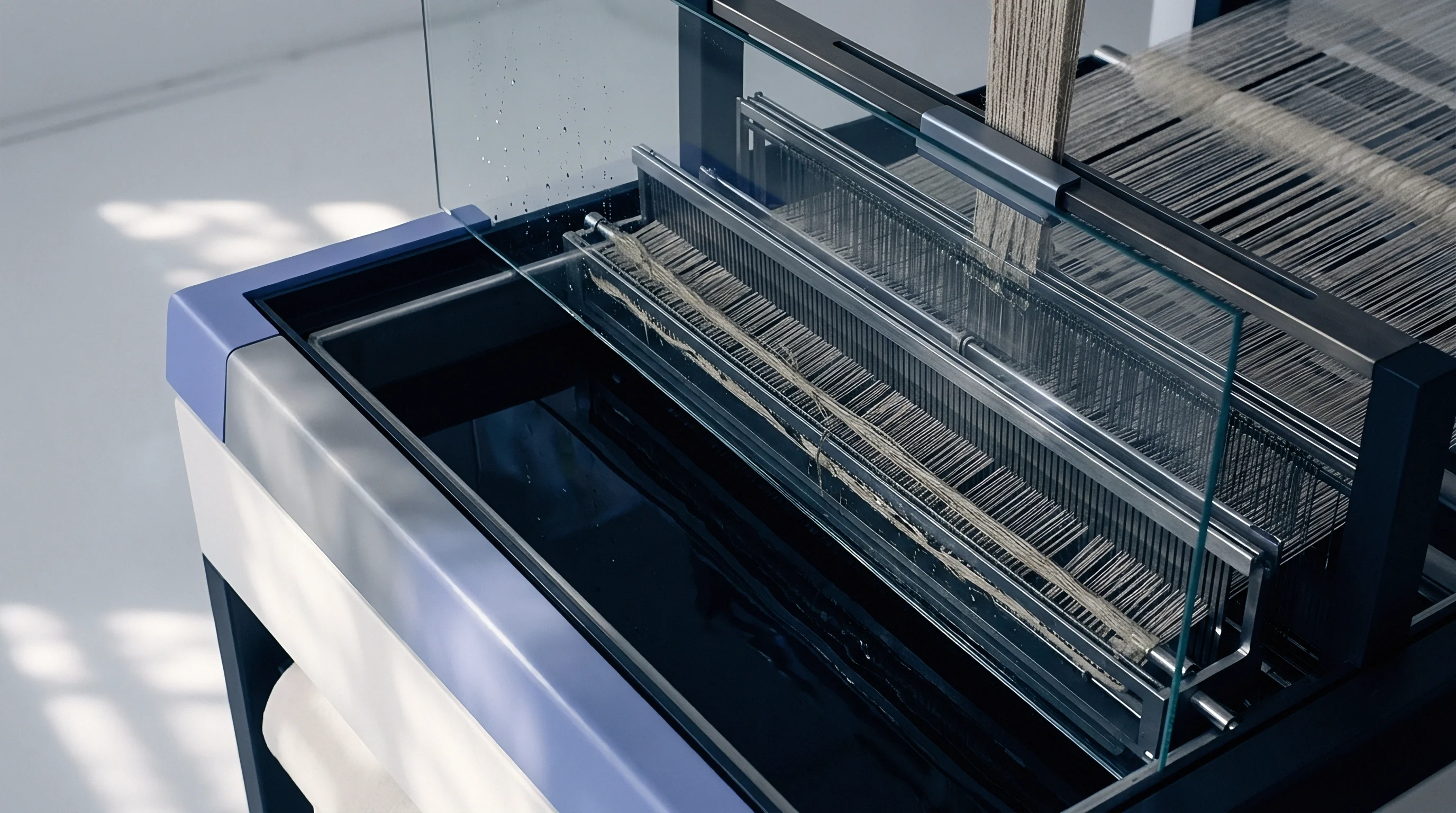
Immersion depth inside the size box dictates contact time between the running flax yarn and the liquid polymer. High-speed slashers operating above seventy meters per minute drag substantial air boundaries into the bath. Submerged entry guide rollers displace this boundary layer, forcing liquid into contact with the dense bast bundle structure before the yarn enters the primary nip.
Double-squeeze configurations isolate liquid displacement from pickup regulation. The first roller pair drives the sizing liquor through the outer yarn periphery at lower pressure, displacing entrained air packets across rolls of uniform shore hardness. The second pair, loaded by calibrated pneumatic cylinders to pressures between twenty and thirty-five kilonewtons per meter of width, shears off surplus surface paste and meters the final wet pickup.
Purchasing specifications citing ISO 7211-3 penalize suppliers when desized warp crimp variation across the loom width exceeds zero point six percentage points.

Squeeze Roll Loading and Wet Pickup
Linear nip pressure distributions often reveal irregularities across wider beam formats. Synthetic rubber coverings calibrated at sixty-five to seventy Shore A hardness deform evenly, creating an extended contact footprint that limits crushing damage on delicate wet-spun flax yarn cores while slasher speed governs squeeze duration.
- Immersion box saturation immerses the warp sheet under zero draft, where inadequate dwell time leaves unglued fibrils that later foul loom drop wires.
- Primary nip consolidation displaces entrapped gas bubbles, risking core flattening when roll pressures exceed forty kilonewtons per meter.
- Secondary nip metering establishes final wet pick-up percentages, where uneven roll wear generates edge-to-middle pick-up deltas exceeding two percent.
- Wet-splitting zone dividing separates adjacent sized ends before drying, preventing tear fractures that ruin individual yarn profiles.
Warp sheets emerge from the final squeeze box carrying seventy to eighty-five percent wet liquor calculated against bone-dry flax weight. Excess water burden wastes steam capacity on subsequent drying sections, while insufficient wet pickup leaves bundle exteriors naked against reed abrasion.

Cylinder Temperature Regimes and Moisture Targets
Contact drying across multi-cylinder configurations demands progressive temperature gradients. Subjecting wet flax warps to immediate one-hundred-and-thirty-degree surface heat boils internal moisture violently, causing steam expansion that blisters the curing polymer skin until it flakes away during weaving.
Entering cylinders stay set between seventy-five and eighty-five degrees Celsius to initiate film gelatinization smoothly. Middle cylinder banks ramp to one hundred and twenty degrees to drive off bulk moisture, while exit drums drop back to ninety degrees to temper yarn temperatures, since overdrying turns potato starch brittle. Finishing the drying pass with eight to nine percent residual moisture preserves the natural core elasticity of the flax cellulose.
Imparting excessive slasher stretch across wet zones strips the fiber bundles of their limited natural give, causing widespread end breaks within the first thousand picks on the production floor.


Stress
Rapier insertion cycles on modern machinery generate dynamic tension peaks that double baseline warp sheet tension. Machines running at six hundred picks per minute impose cyclic loads exceeding zero point eight centinewtons per tex within fifty-millisecond shedding intervals. Because flax fibers lack natural elongation, the sized yarn assembly must absorb these rapid strain oscillations purely through the tensile properties of the composite polymer shell and the inter-fiber frictional lock created by sizing.
Asymmetrical shed profiles concentrate mechanical distress onto the lower warp sheet during rapier entry and exit, where the rapier tape slides directly along the bottom yarn layer. When sizing films crack under bending cycles, outer bast fibrils peel backwards into slubs that jam adjacent warp ends and trigger loom stops.
| Loom Speed (ppm) | Shed Opening Angle (degrees) | Warp Tension per End (cN) | Target Relative Humidity (%) | Stop Rate (per 100k picks) | Loom Operating Efficiency (%) |
|---|---|---|---|---|---|
| 420 | 26 | 45 | 68 | 1.2 | 92.4 |
| 480 | 24 | 52 | 70 | 1.8 | 89.6 |
| 540 | 23 | 58 | 72 | 2.9 | 85.1 |
| 600 | 21 | 68 | 74 | 4.6 | 79.8 |
| Data measured on 39 tex wet-spun flax warps using profiled steel reeds, double flexible rapier drives, and plain interlacing patterns under air-conditioned shed environments. | |||||

Rapier Insertion Forces at Elevated Velocities
Yarn passage across the drop wires, heddle eyes, and reed dents exerts severe rubbing actions that demand effective boundary lubrication. Formulations containing modified microcrystalline waxes decrease metal-to-yarn dynamic friction values from zero point thirty-eight down to zero point eighteen, cutting thermal buildup at the reed dent face.
Excessive sizing viscosity blinds the shed. When the coating glues neighboring yarn bundles together, the wet-split operation at the slasher leaves harsh microscopic torn fringes along each end that entangle during shed crosses. Rapier heads traveling at twenty meters per second snag these tangled fibers, cutting whole yarn clusters cleanly away from the harness.

Shed Geometry and Friction Mitigation
Loom tuners minimize shed opening angles to limit peak strain cycles on the flax warps. A shed angle drop from twenty-six degrees to twenty-one degrees cuts warp extension by nearly eighteen percent during peak harness lift. However, narrower sheds restrict clearance for the rapier heads, demanding clean sizing films that keep fiber fuzz from obstructing the weft insertion line.
- Heddle eye abrasive shaving strips brittle starch layers lacking acrylic plasticizer, accumulating white powder across harness frames.
- Reed dent chafing exposes raw lignocellulosic bundles at the fabric selvedges, leading to broken ends along extreme lateral drop wires.
- Rapier guide tooth friction wears through thin size coatings, yielding micro-slubs that block shed crossings.
- Drop wire cyclic pecking fractures dry size coatings when weaving shed atmospheric relative humidity slips below sixty-five percent.
Shed humidity governs size performance through every shift. A wet-spun linen warp sized with starch and synthetic softeners weaves smoothly when ambient air supplies sufficient relative moisture to prevent film crystallization.


Scour
Finishing mills treat sizing materials as transient production coatings that add direct chemical cost and must wash away before dyeing and bleaching operations. If starch coatings resist standard desizing chemistry, residual polymer blocks dyestuff penetration, triggering cloudy dye streaks across the finished linen bolt.
Modified starches degrade rapidly under alpha-amylase enzymatic baths at seventy degrees Celsius, breaking into water-soluble maltose fragments. Polyvinyl alcohol segments dissolve directly in neutral water at ninety degrees, while acrylic components yield cleanly to mild sodium carbonate scours. Formulations relying entirely on water-soluble synthetic polymers accelerate desizing line speeds without generating harsh biological oxygen demands in municipal effluent treatment streams.
Size film flexibility preserves loom output far better than raw size film hardness on bast fiber bundles.
Desizing Kinetics and Washing Efficiency
Enzyme baths require controlled dwell periods to saturate dense flax bundles thoroughly. Because cold wash liquor solidifies tallow lubricants, saponifying waxes with hot alkaline rinses prevents fatty acid deposits from re-attaching to the scoured fabric web.
Uneven size pickup translates directly into greige defects, showing up as warp streakiness, varying dye receptivity, and inconsistent handfeel across the finished piece. Analytical checks using potassium iodide spot testing confirm whether residual starch concentrations remain below zero point one percent of fabric weight before goods enter the dye jigger.
Capacity Economics and Loom Downtime
Loom stop rates dictate true manufacturing costs. Running a rapier machine at five hundred and forty picks per minute delivers little financial advantage when sized flax breakage drops shed efficiency down to seventy-nine percent. Each stop consumes two to four minutes of weaver attention, generating visible starting marks and degraded greige inspection scores under ASTM D5430 criteria.
High-performance polymer size formulations elevate initial chemical batch expenditures by up to forty percent compared to basic native starch mixes. This upfront chemical expenditure amortizes across recovered production capacity: reducing end breaks from four per hundred thousand picks down to one point five adds three loom hours of productive capacity per machine week. The unresolved trade-off centers on whether effluent biological oxygen demand surcharges imposed by regional water authorities erode the operating margins gained from synthetic sizing agents running at maximum insertion speeds.